
Judge, 1917-08-11 · page 13 of 28
Judge — August 11, 1917 — page 13: what you’re looking at
What you’re looking at
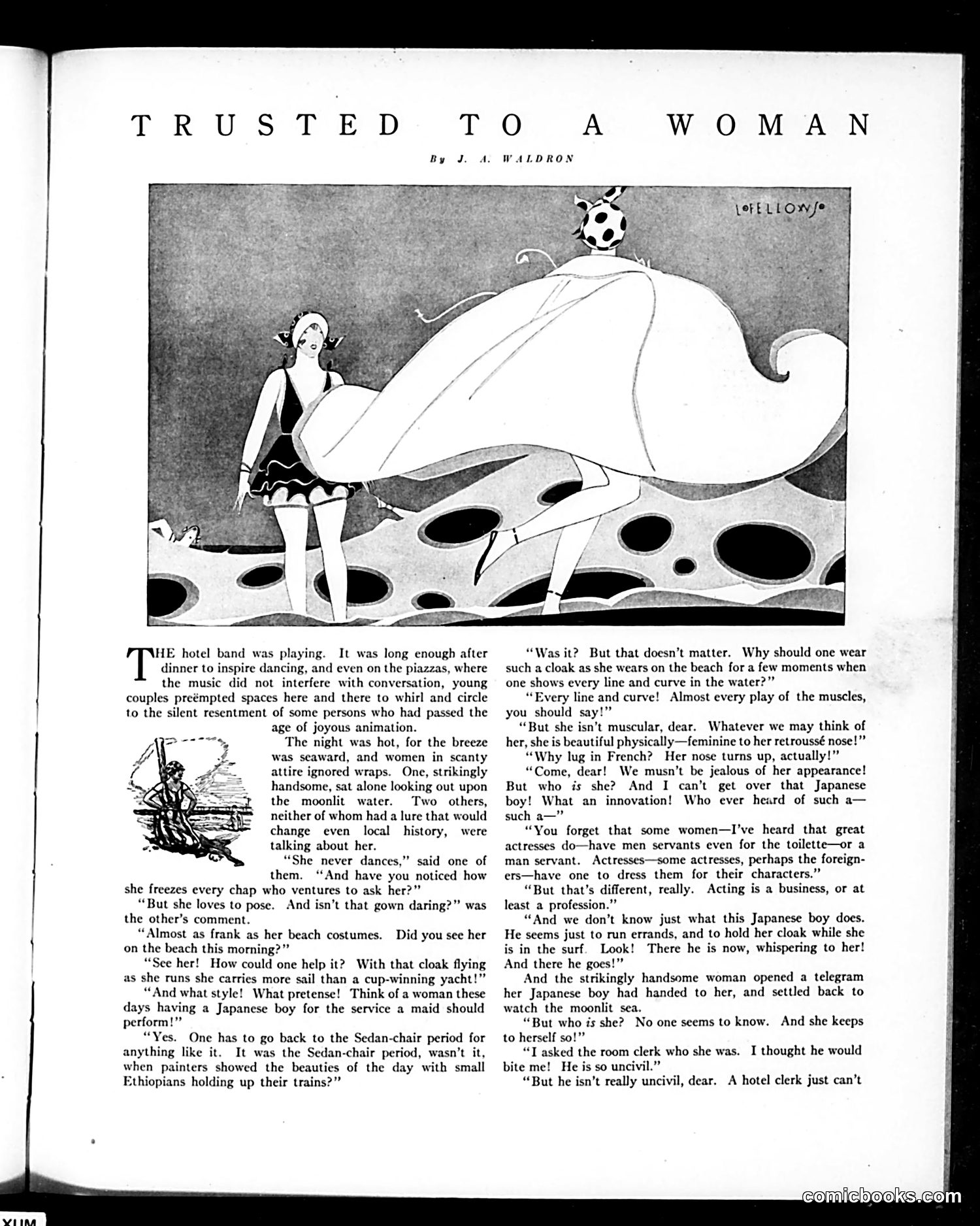
This satirical story critiques female vanity and social hypocrisy among the leisure class. A striking, mysterious woman at a seaside hotel scandalized guests by wearing revealing bathing attire and employing a Japanese boy as her personal attendant—an unconventional arrangement suggesting either wealth, eccentricity, or moral looseness. Two gossiping women mock her: she refuses to dance, poses dramatically in an daring cape, displays her physique, yet claims femininity. The satire targets their jealous moralizing—they're outraged she shows "every line and curve" in the water while exposing herself on the beach. The comparison to Sedan-chair era portraits (where aristocratic women were painted with Black servants) implies she's mimicking outdated pretension. The woman's mysterious telegram and self-contained demeanor suggest she's indifferent to their judgment, making the gossips' obsession with her appearance and unconventional choices the real target of ridicule.
📄 Transcribed text from this page (OCR, searchable)
Machine-transcribed from the original scan — historical spelling and the odd misread are preserved.
TRUSTED HE hotel band was playing. It was long enough after T dinner to inspire dancing, and even on the piazzas, where the music did not interfere with conversation, young couples preémpted spaces here and there to whirl and circle to the silent resentment of some persons who had passed the age of joyous animation. The night was hot, for the breeze was seaward, and women in scanty attire ignored wraps. One, strikingly handsome, sat alone looking out upon the moonlit water. Two others, neither of whom had a lure that would change even local history, were talking about her. “She never dances,” said one of them. ‘And have you noticed how she freezes every chap who ventures to ask her?” “But she loves to pose. And isn’t that gown daring?” was the other’s comment. “Almost as frank as her beach costumes. Did you see her on the beach this morning?” “See her! How could one help it? With that cloak flying as she runs she carries more sail than a cup-winning yacht!” “And what style! What pretense! Think of a woman these days having a Japanese boy for the service a maid should perform “Yes. One has to go back to the Sedan-chair period for anything like it. It was the Sedan-chair period, wasn’t it, when painters showed the beauties of the day with small Ethiopians holding up their trains?” T O A WALDRON “Was it? But that doesn’t matter. Why should one wear such a cloak as she wears on the beach for a few moments when one shows every line and curve in the water?” “Every line and curve! Almost every play of the muscles, you should say!” “But she isn’t muscular, dear. Whatever we may think of her, she is beautiful physically—feminine to her retroussé nose!” “Why lug in French? Her nose turns up, actually!” “Come, dear! We musn’t be jealous of her appearance! But who is she? And I can’t get over that Japanese boy! What an innovation! Who ever heard of such a— such a—” “You forget that some women—I’ve heard that great actresses do—have men servants even for the toilette—or a man servant. Actresses—some actresses, perhaps the foreign- ers—have one to dress them for their characters.” “But that’s different, really. Acting is a business, or at least a profession.” “And we don’t know just what this Japanese boy docs. He seems just to run errands, and to hold her cloak while she is in the surf. Look! There he is now, whispering to her! And there he goes!” And the strikingly handsome woman opened a telegram her Japanese boy had handed to her, and settled back to watch the moonlit sea. “But who is she? No one seems to know. And she keeps to herself so!” “T asked the room clerk who she was. I thought he would bite me! He is so uncivil.” “But he isn’t really uncivil, dear. A hotel clerk just can’t