
A complete issue · 28 pages · 1917
Judge — July 21, 1917
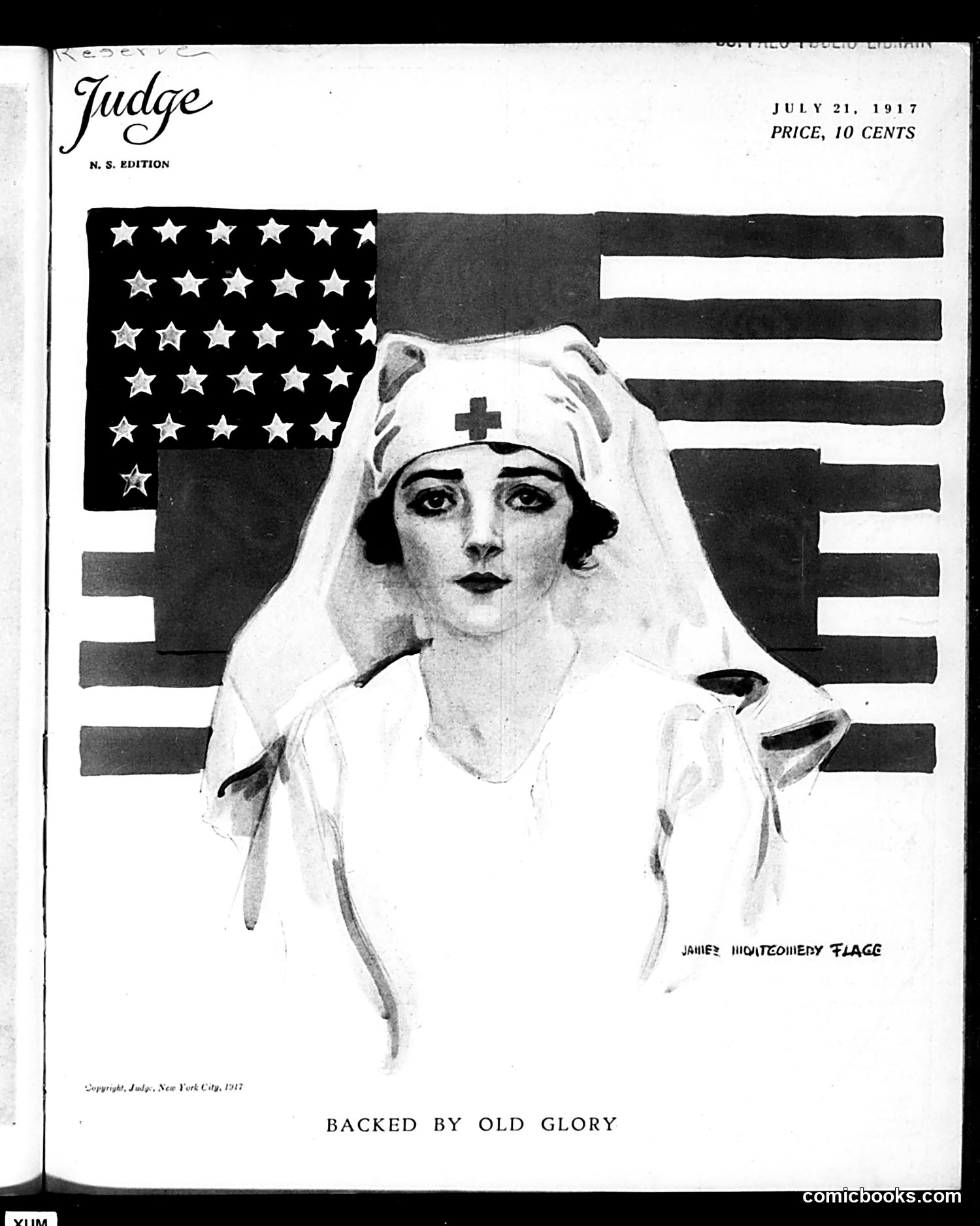
This July 1917 Judge cover depicts a nurse wearing a Red Cross headpiece and veil, positioned before the American flag. The artwork is credited to James Montgomery Flagg, the era's most prominent patriotic illustrator. The caption "Backed by Old Glory" celebrates American nurses, likely referencing those serving in World War I (America entered in April 1917). The image conflates nursing with patriotic duty—the nurse becomes a symbol of American moral strength and humanitarian values supporting the war effort. The composition deliberately frames the nurse as protected by and aligned with national authority. This represents typical 1917 propaganda messaging: presenting war participation as morally righteous and American institutions (medical care, feminine virtue, national pride) as unified in the cause. The satire magazine here appears to be earnestly promoting patriotic sentiment rather than critiquing it.
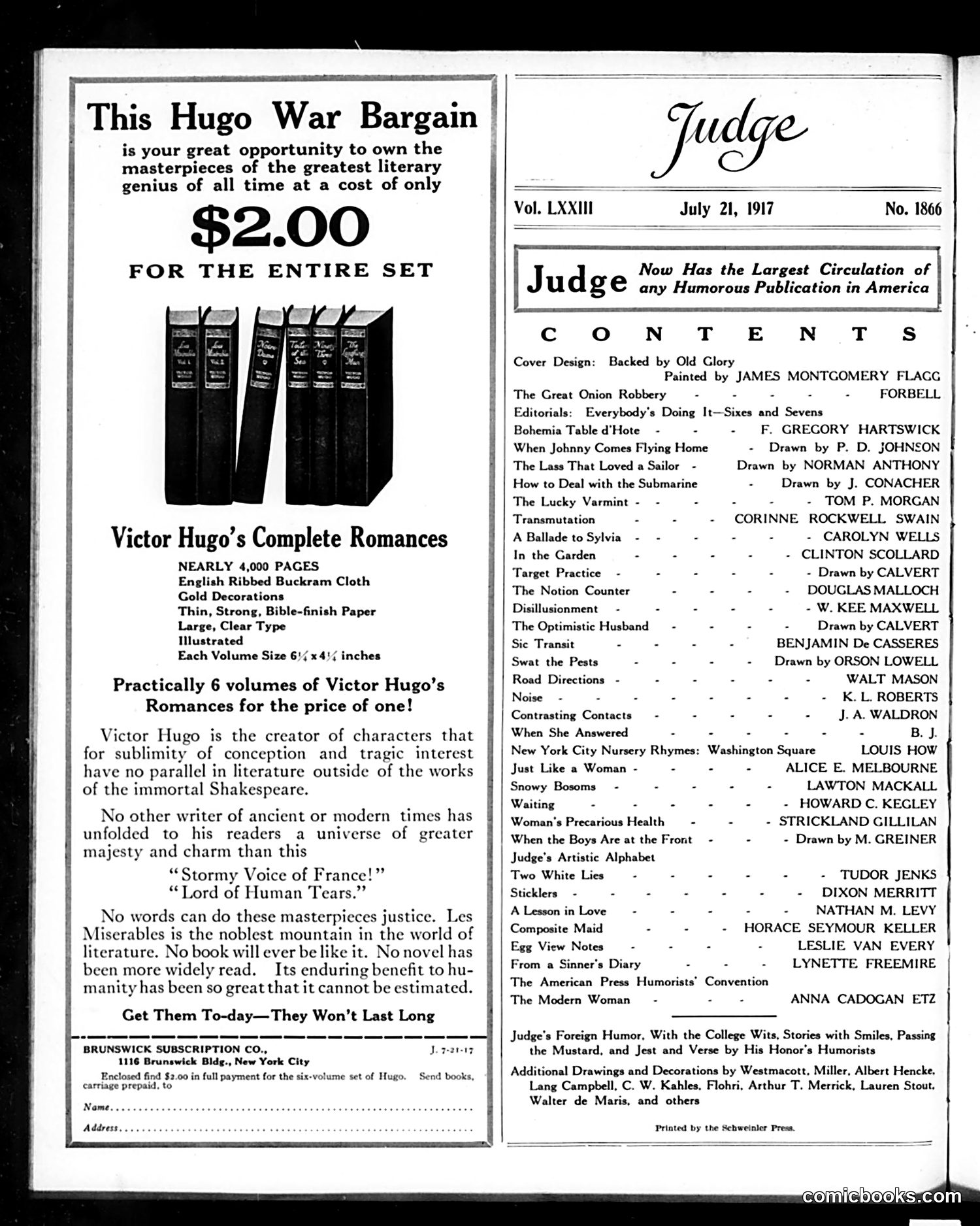
This page is primarily **advertising** rather than satirical content. The left side features a full-page ad for Victor Hugo's Complete Romances (6 volumes for $2.00), using Victorian-era marketing language praising Hugo as a literary genius. The right side is a table of contents listing the magazine's articles and illustrations, though the actual cartoons themselves are not visible on this page. The content appears humor-focused, with titles like "The Great Onion Robbery," "The Lucky Varmint," and "Target Practice." The publication date (July 1917) falls during World War I, suggesting some articles may reference contemporary wartime topics, though specific political references cannot be determined from this contents page alone.
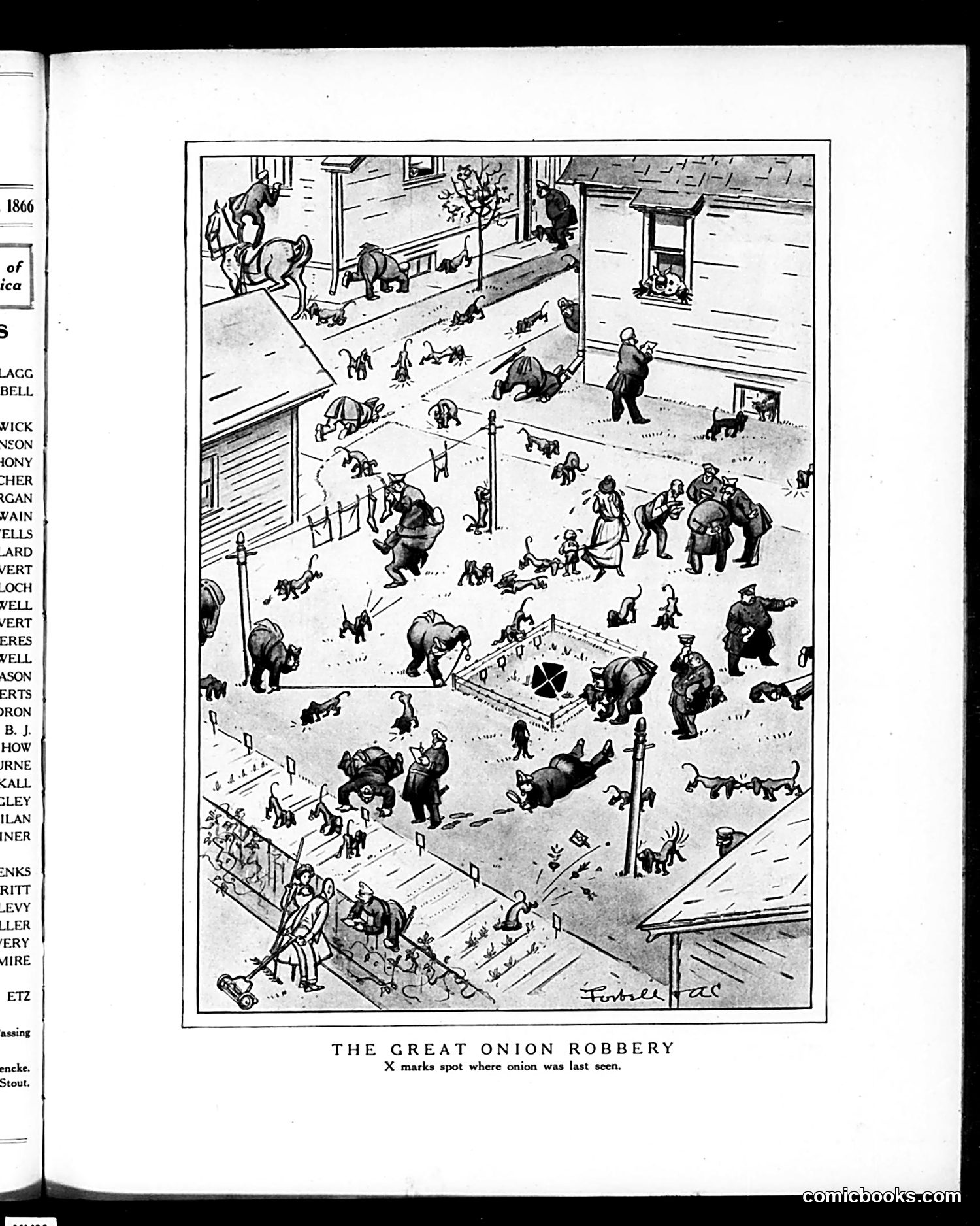
This is a humorous cartoon satirizing street life in a crowded urban neighborhood, likely New York City. The illustration depicts a chaotic scene where an onion has gone missing—marked with an "X" to show where it was last seen—and the entire neighborhood has mobilized in search of it as if it were a major crime. The satire mocks both the sensationalism of contemporary crime reporting and the petty concerns of working-class urban life. By treating a lost onion with the gravity of a serious robbery, the cartoon ridicules how the press and public could become obsessed with trivial matters. The densely packed street scene captures the bustle and comic chaos of tenement life in the Gilded Age.
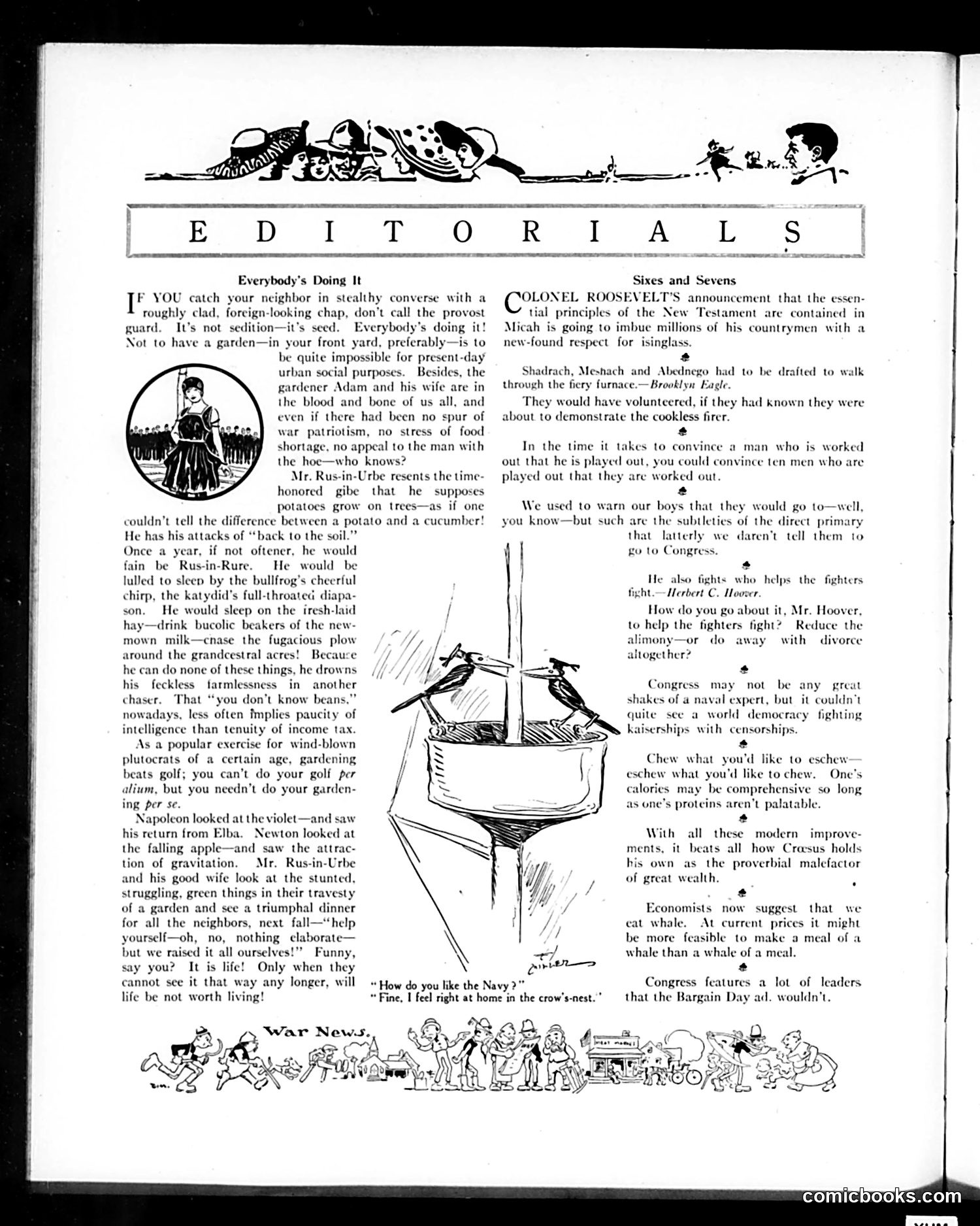
This Judge magazine editorial page contains two distinct sections: **"Everybody's Doing It"** (left): A satirical piece mocking the trend of urban Americans creating home gardens during what appears to be WWI rationing. The author humorously argues that gardening is impractical for city dwellers, comparing it to absurd notions like potatoes growing on trees. The piece criticizes the romanticization of gardening as patriotic duty. **"Sixes and Sevens"** (right): Commentary on Colonel Roosevelt's religious statements and mentions of drafting men like Shadrach, Meshach, and Abednego (biblical figures). The editorial discusses war volunteerism and contains quotes from Herbert C. Hoover about fighting, suggesting WWI-era debate about military mobilization and civilian support. The central illustration depicts a cooking pot, likely relating to food rationing discussions in the editorials.
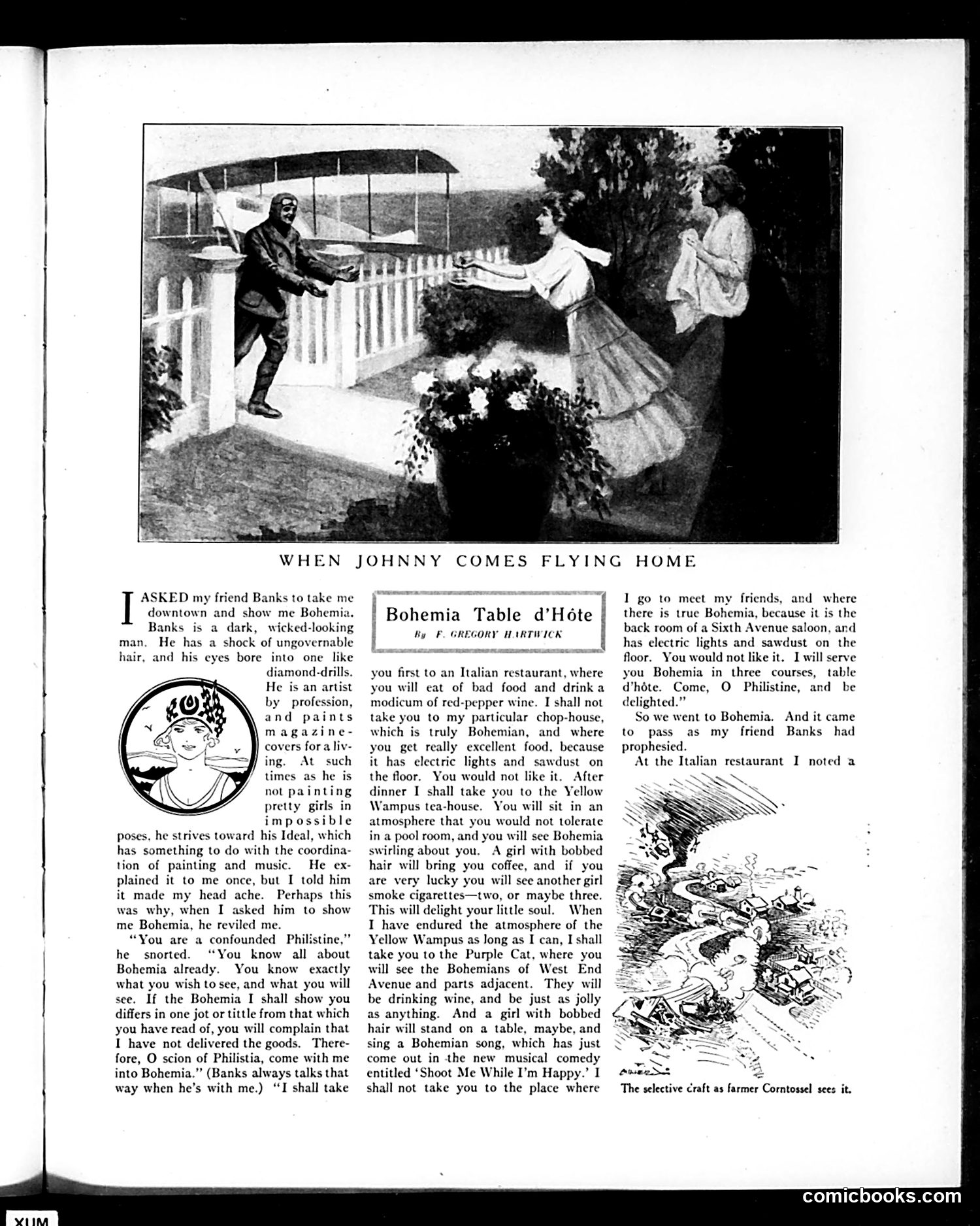
This Judge magazine page satirizes "Bohemia"—the artistic, unconventional lifestyle associated with Greenwich Village and similar communities. The top illustration shows a pilot returning home to two women, evoking the popular WWI song "When Johnny Comes Marching Home." The "Bohemia Table d'Hôte" article by F. Gregory Hartwick mocks Bohemian culture through Banks, a character who promises to show the narrator "true Bohemia." The satire targets the affectation of artistic pretense: Banks boasts of taking him to fashionable establishments (Italian restaurants, tea houses, cabarets) that merely *affect* Bohemian authenticity through electric lights, "sawdust on the floor," and girls with bobbed hair singing trendy songs. The joke: what Banks presents as genuine Bohemian experience is actually commercialized, mass-produced leisure—a commodified performance of nonconformity.
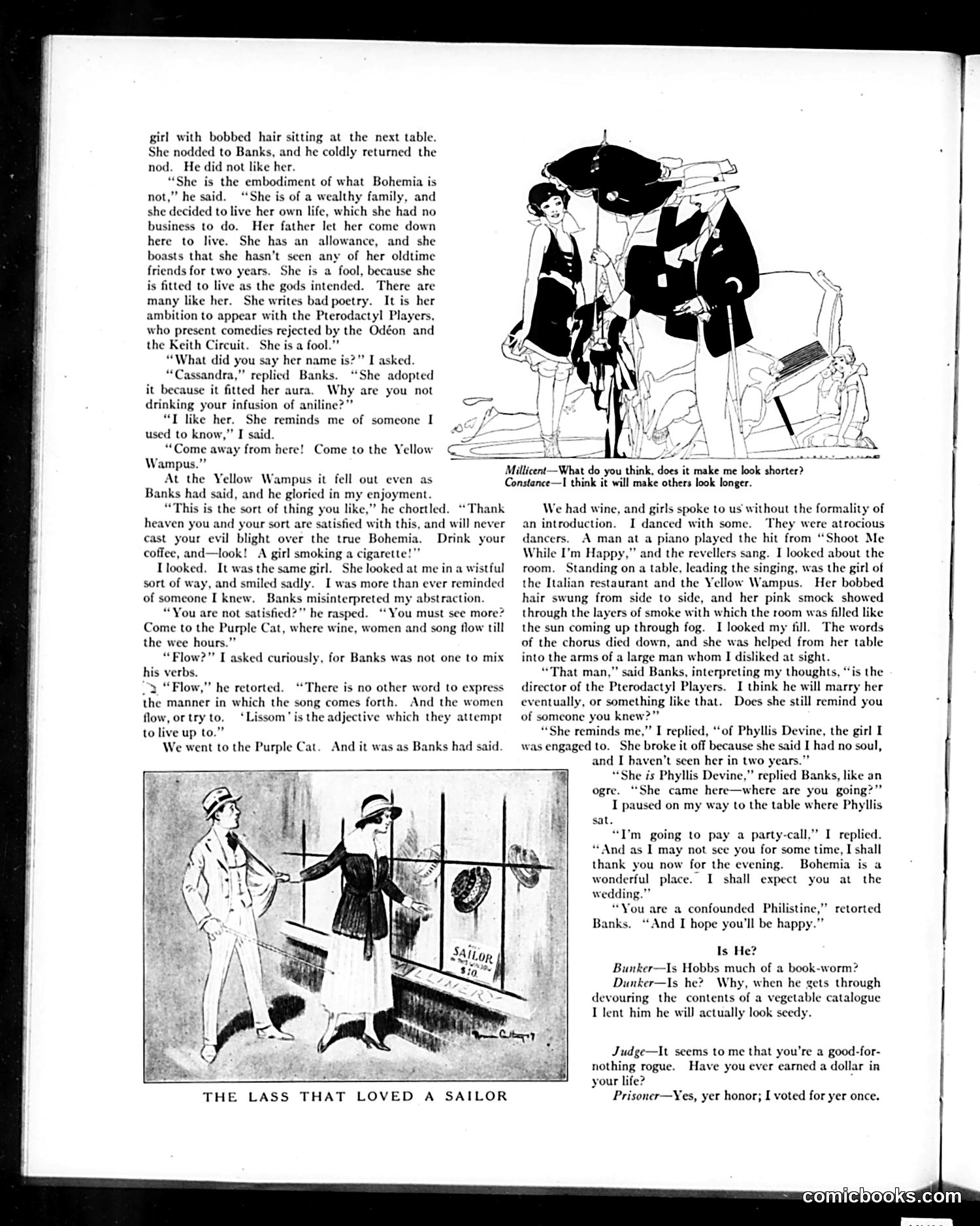
This page contains two distinct sections: **Upper Content**: A narrative story about "Bohemia" and social commentary on a girl named Cassandra who frequents artistic circles like the Pterodactyl Players. The text satirizes pretentious bohemian culture and bohemians' affectations. **Lower Cartoon** ("The Lass That Loved a Sailor"): A simple illustrated joke showing a woman at what appears to be a shop window displaying sailor uniforms. The humor likely plays on a double entendre about women's attraction to sailors—a common early 20th-century comedic trope. **Bottom Section**: A humor exchange labeled "Is He?" featuring witty insults between characters named Banker, Dunker, Judge, and Prisoner—typical of Judge magazine's brief joke format. The page reflects 1920s social satire targeting bohemian pretension and contains period-typical humor about gender and class.
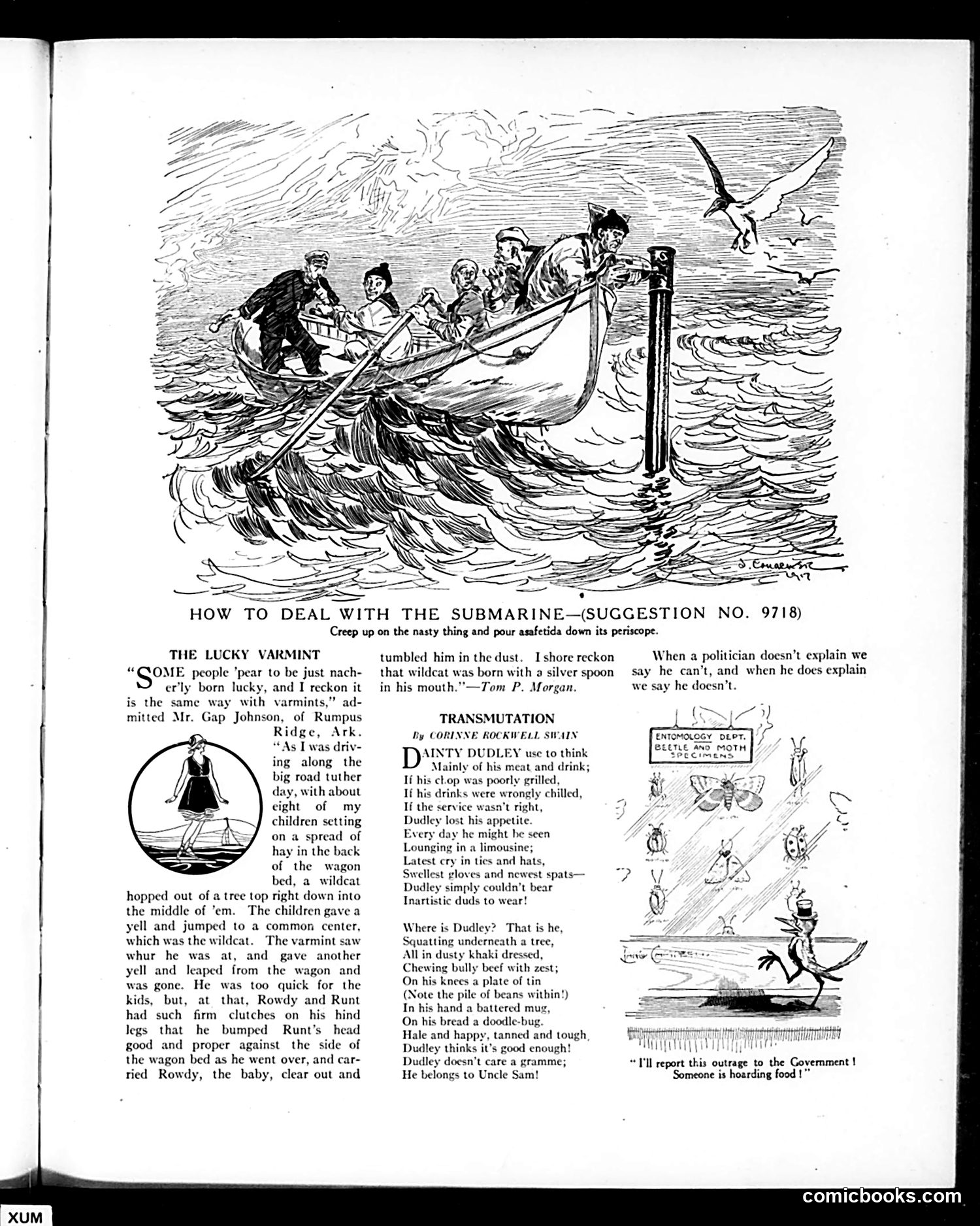
**Top Cartoon - "How to Deal with the Submarine":** A WWI-era joke suggesting absurd methods to combat German submarines—pouring asafetida (a foul-smelling substance) down a periscope. This ridicules both the submarine threat and armchair strategists offering impractical war solutions. **"The Lucky Varmint":** A rural anecdote by Tom P. Morgan about a wildcat that escaped a wagon full of children through sheer speed and luck. It's humorous folk wisdom with no apparent political meaning. **"Transmutation" (Poem by Corinne Rockwell Swain):** Contrasts "Dainty Dudley," a wealthy peacenik obsessed with fine dining and fashion, with his present self: a soldier in WWI serving under Uncle Sam. He's now content eating army rations and wearing khaki. The satire celebrates patriotic sacrifice and military service, implicitly mocking civilian complaints about wartime restrictions and food hoarding (referenced in the cartoon caption below).
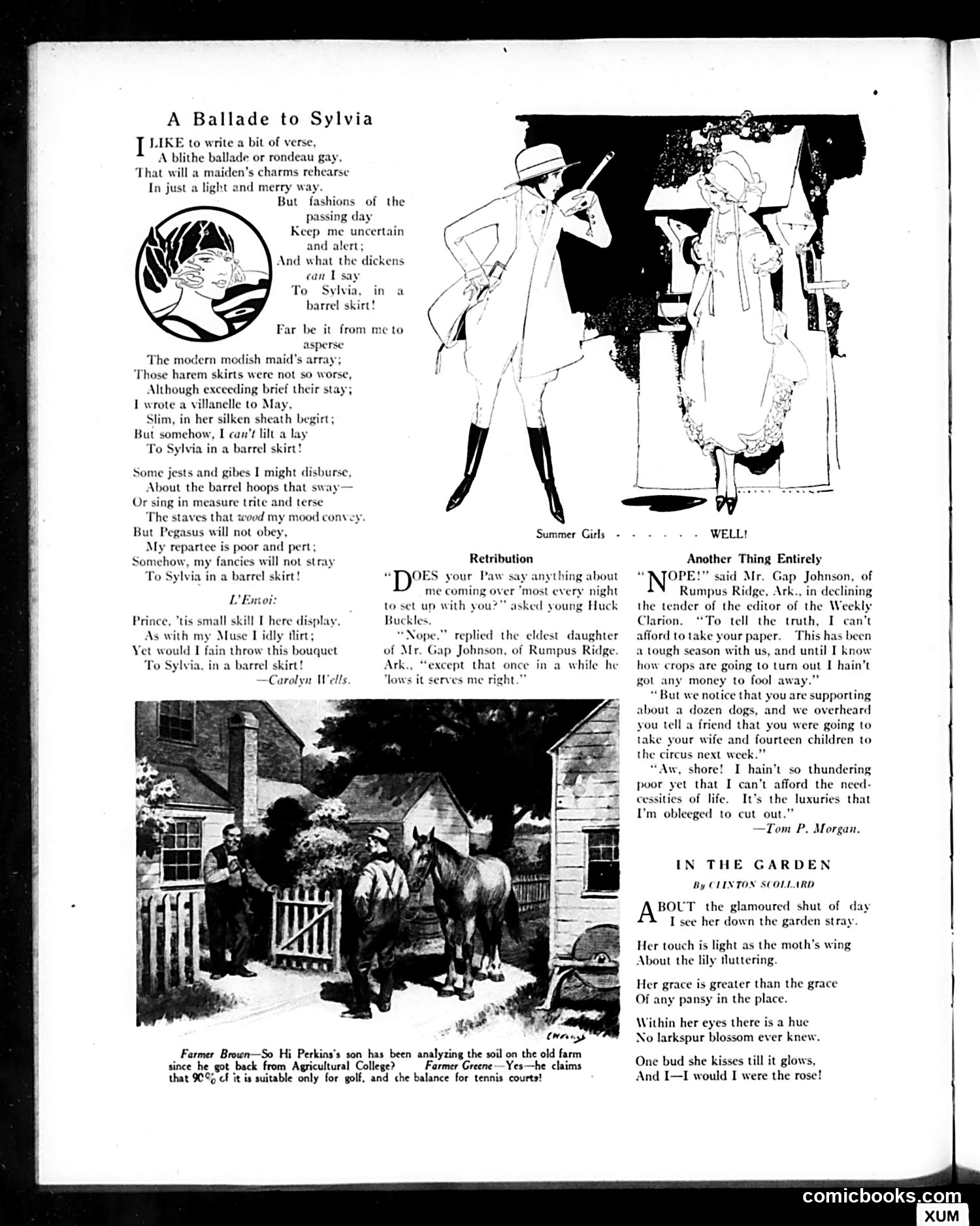
This page satirizes early 1900s women's fashion and rural attitudes toward luxury and necessity. **"A Ballade to Sylvia"** mocks the "barrel skirt"—a tubular, unflattering silhouette that was fashionable at the time. The poet laments he cannot write romantic verse about a woman wearing such an ungainly garment, finding it aesthetically uninspiring compared to previous fashions. The two comic strips below satirize rural economic priorities: In "Retribution," a farmer's daughter refuses a suitor who visits nightly. In "Another Thing Entirely," Mr. Gap Johnson declines a newspaper subscription as an unaffordable luxury during hard times—yet supports a dozen dogs and plans circus trips for his fourteen children. The editor's sarcasm highlights the contradiction between claiming poverty while indulging in actual luxuries. "In the Garden" is romantic poetry unrelated to satire. The humor targets both changing women's fashion and rural hypocrisy about financial hardship.
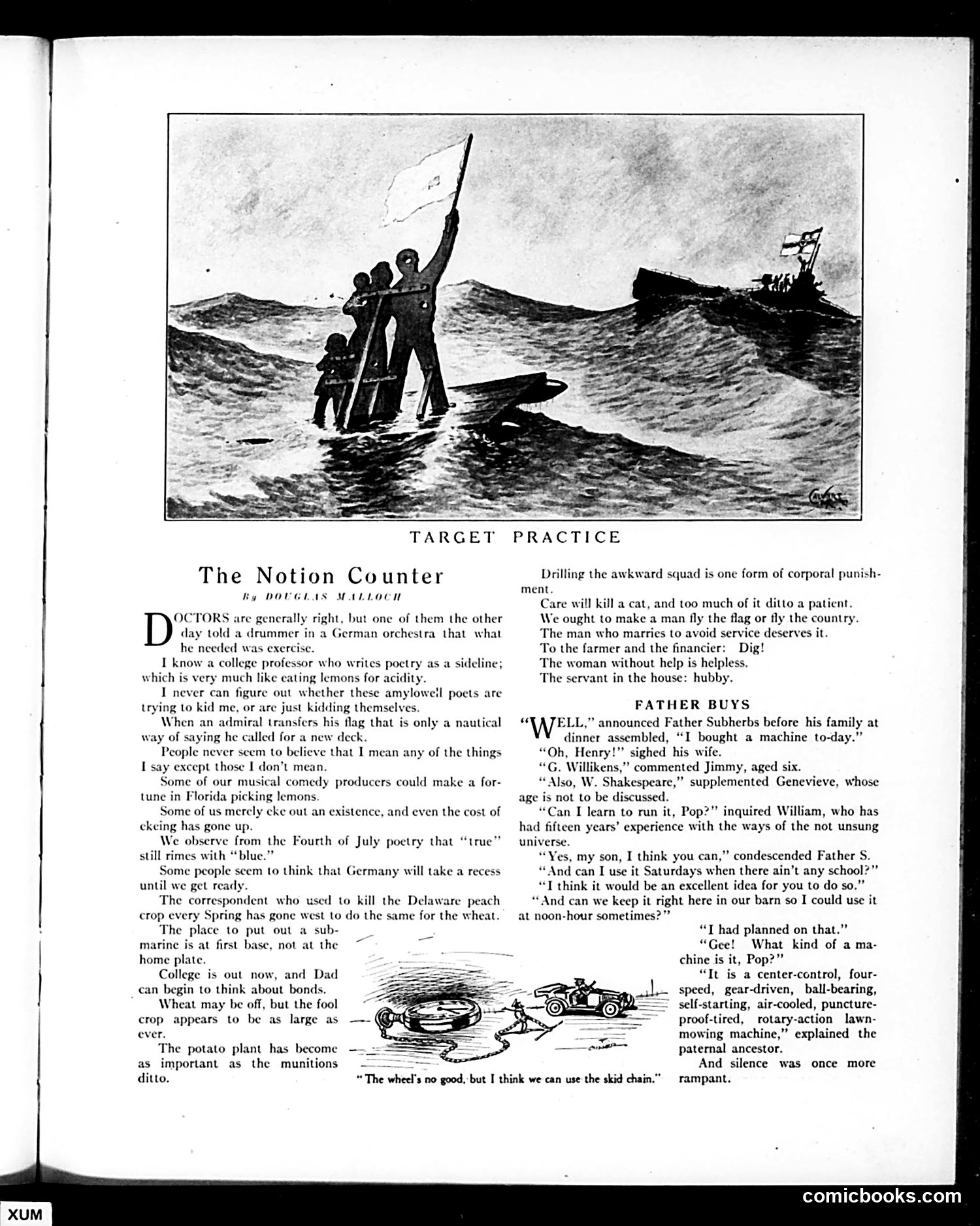
This page contains two satirical pieces from *Judge* magazine: **"The Notion Counter"** (top): Douglas Malloch's column of short, cynical observations about American life—mocking poets, military bureaucracy, Florida lemon farmers, and wartime submarine placement. The humor relies on absurdist non-sequiturs and social commentary typical of WWI-era satirical columns. **"Father Buys"** (bottom): A domestic comedy sketch mocking the "modern father" who purchases a newfangled **lawn mower**. The satire lies in how each family member immediately sees practical personal benefit—the children want to use it for their own purposes, asking permission with calculated innocence. The punchline ("silence was once more rampant") suggests Father's elaborate mechanical explanation has bored everyone into submission. The accompanying illustration shows two children examining a broken-down machine with the caption "The wheel's no good, but I think we can use the skid chain"—capturing the children's pragmatic indifference to Father's technological pride. The humor targets early-20th-century consumer culture and domestic gender dynamics.
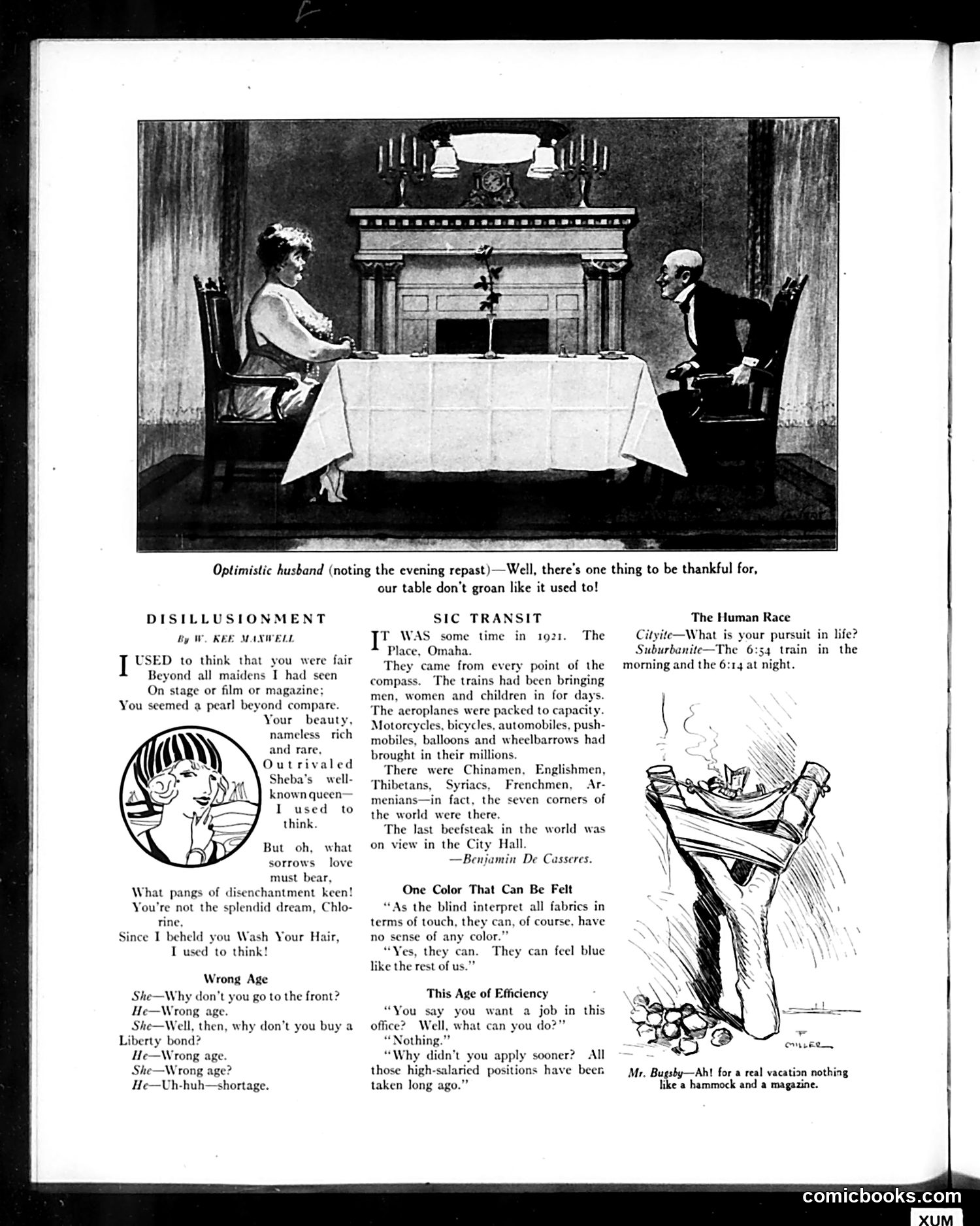
This page contains multiple short satirical pieces reflecting post-WWI American anxieties: **"Disillusionment"** mocks romantic disappointment—a man idealizes a woman until seeing her with wet hair, suggesting superficiality in courtship. **"Wrong Age"** jokes about draft dodging and war bonds during WWI, with a man claiming he's the "wrong age" for both military service and financial contribution, then admitting the real issue is "shortage"—likely referencing labor shortages or economic constraints. **The dinner cartoon** satirizes wartime food rationing, with a husband grateful their table "doesn't groan" anymore—meaning it's less full than pre-war abundance. **"Sic Transit"** describes witnessing the last beefsteak on Earth in 1921 Omaha, reflecting genuine post-war anxieties about scarcity and a world transformed by conflict. **Other pieces** include wordplay about blindness and color, and office inefficiency humor typical of 1920s satire. The overall tone captures 1920s American disillusionment: romantic, economic, and social disappointment following World War I.
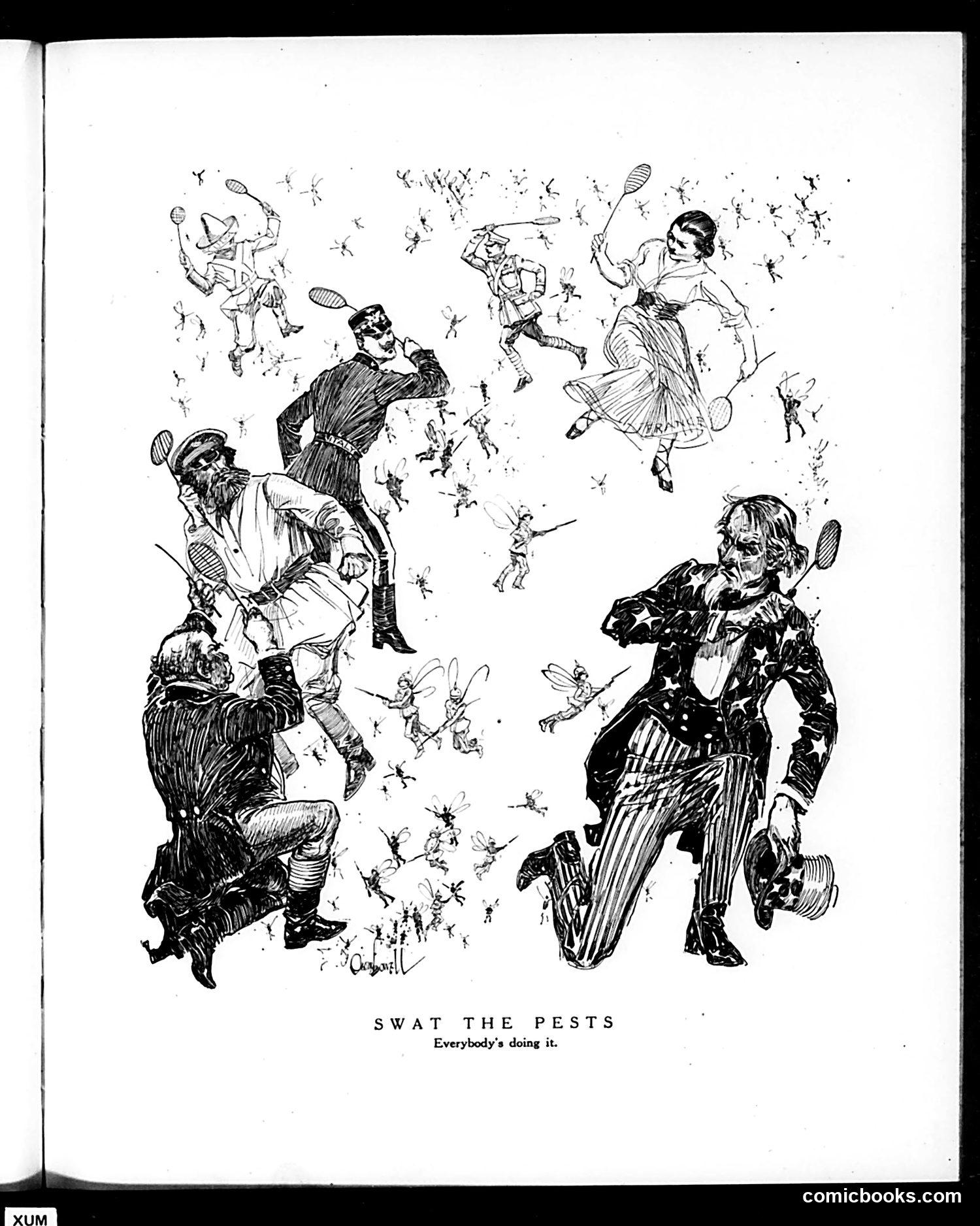
This satirical cartoon depicts various figures—apparently politicians and public figures of the Judge magazine era—energetically swatting at flies with tennis rackets and similar implements. The subtitle "Everybody's doing it" suggests this was a timely reference to a popular cultural trend or phrase. The "pests" being swatted likely refer to social or political problems the cartoonist wanted ridiculed. The figures' varied costumes (including what appears to be military dress and formal attire) suggest different sectors of society or government supposedly addressing these issues. The cartoon's humor lies in depicting pest control as a widespread, fashionable activity—mocking either the ineffectiveness of efforts to solve certain problems or the superficial nature of public concern about them. Without knowing the specific publication date, precise identifications remain unclear.
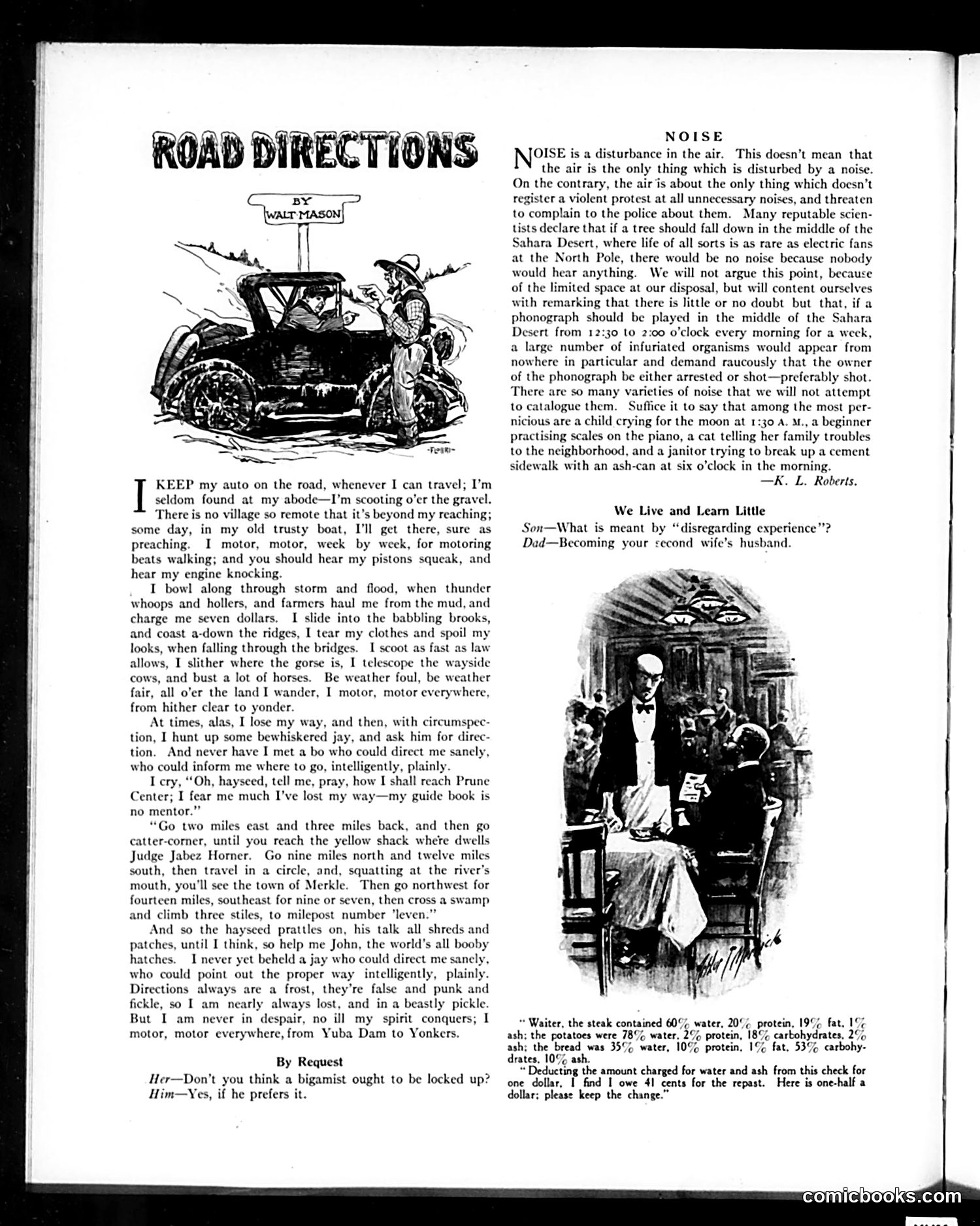
This humorous poem mocks the early 20th-century automobile craze and the chaos it creates. The speaker obsessively "motors" everywhere despite constant mishaps—getting stuck in mud, falling through bridges, destroying property—yet remains undeterred. The satire targets both the reckless new motorists and rural locals asked for directions. When the speaker asks a "bewhiskered" farmer for help reaching "Prune Center," the farmer gives absurdly convoluted, nonsensical directions (going in circles, crossing swamps, counting mileposts), suggesting rural people's inability to comprehend the new automobile age. The joke: early motorists were simultaneously obsessed with their vehicles and hopelessly incompetent, while the automobile itself represented a bewildering disruption to traditional rural life. The final couplet joke about bigamists appears unrelated—likely filler content typical of Judge magazine's miscellaneous humor format.
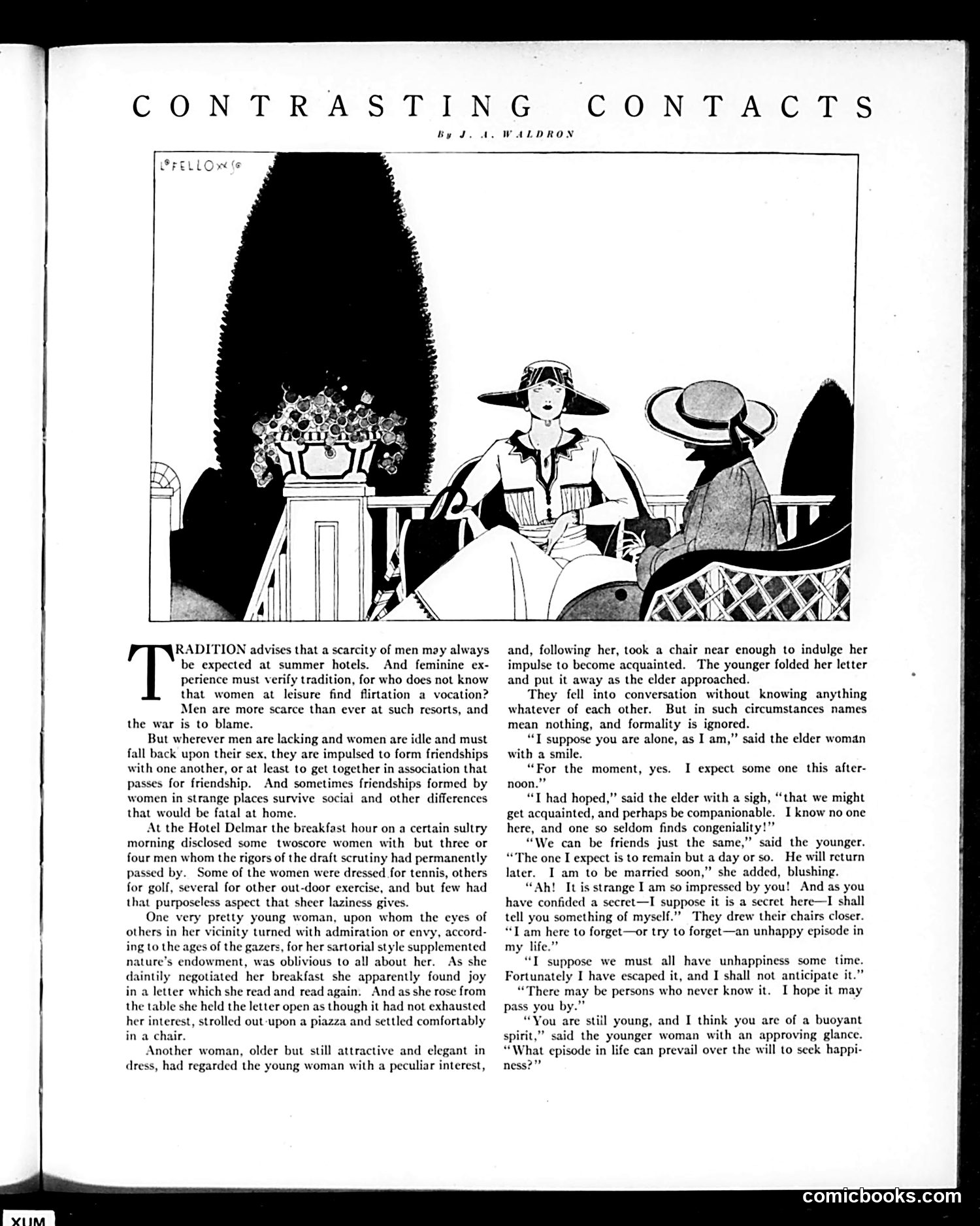
This illustration and story depict two women at a summer hotel forming an unexpected friendship. The cartoon satirizes the social dynamics of wartime leisure spaces—specifically, how the absence of men (due to WWI draft requirements) forced wealthy women to seek companionship with each other. The satire's point: during peacetime, class differences and social hierarchies would prevent such friendships ("fatal at home"), but wartime scarcity creates temporary social leveling. A young, attractive, engaged woman and an older woman nursing an undisclosed romantic disappointment bridge their differences through shared circumstance. The humor lies in the implicit social commentary—that women's friendships are merely pragmatic substitutes for male attention, a survival mechanism rather than genuine connection. The story presents this arrangement as charming rather than critically, reflecting period attitudes about female sociability and wartime's social disruptions.
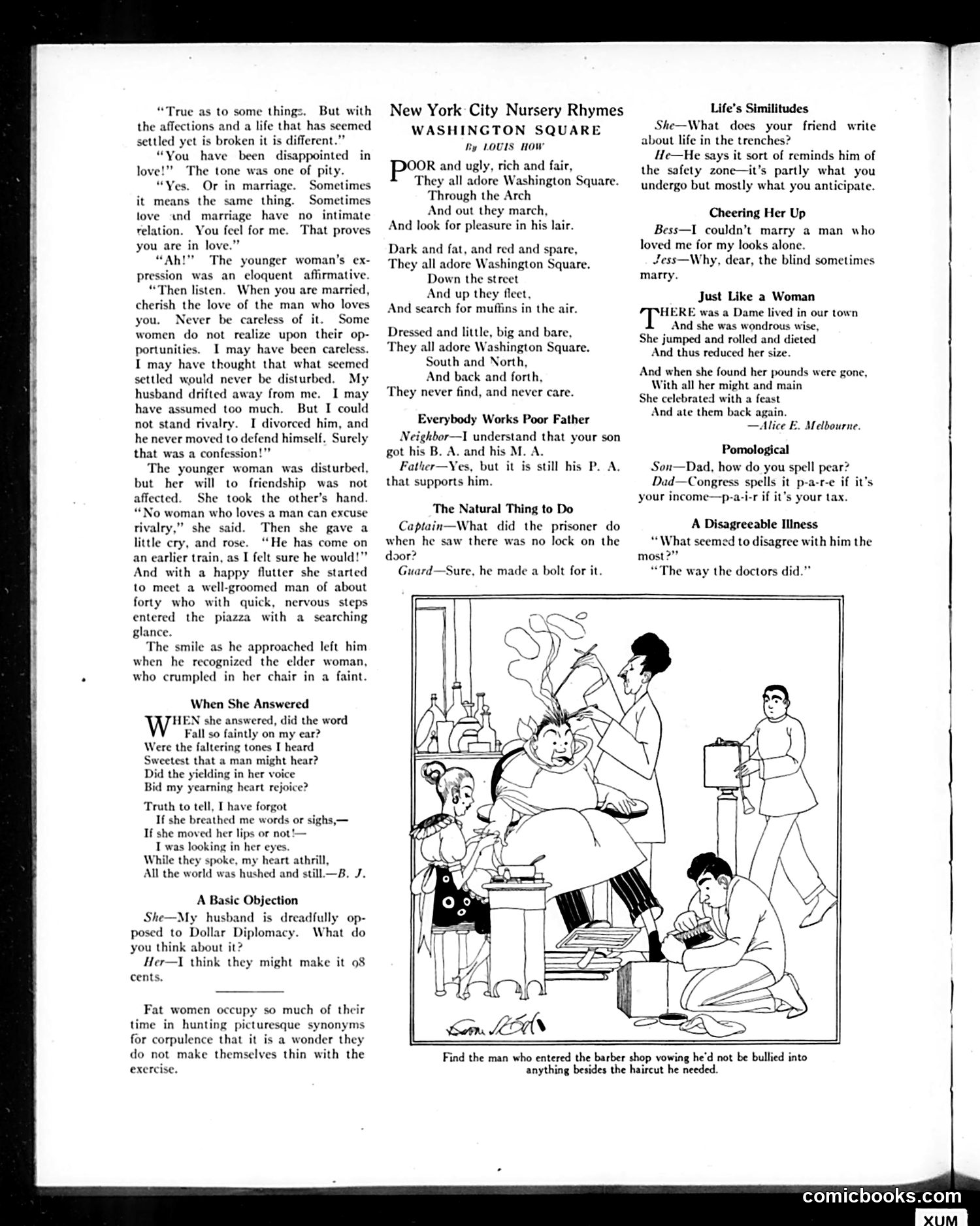
This page from *Judge* magazine contains several pieces of satirical humor typical of early 20th-century American wit: **Main Cartoon/Story**: A serialized domestic drama about infidelity and marriage disappointment. An older woman warns a younger one about neglecting a husband's affection; when the younger woman's husband arrives unexpectedly, he recognizes the older woman and is shocked—implying a past romantic connection. The satire critiques marital complacency and infidelity. **Short Jokes**: Social commentary including: - "Dollar Diplomacy" joke: mocking U.S. foreign policy by reducing its value to pennies - Fat women satire: poking fun at women's obsession with euphemisms for obesity rather than actual weight loss - A pun about a prisoner making "a bolt" for an unlocked door **Lighter Verse**: Nursery rhymes about Washington Square's various inhabitants; romantic poetry; wordplay on "pear/pare" (congressional spending cuts). The overall tone is urbane, cynical about relationships and gender, and topical regarding contemporary politics.
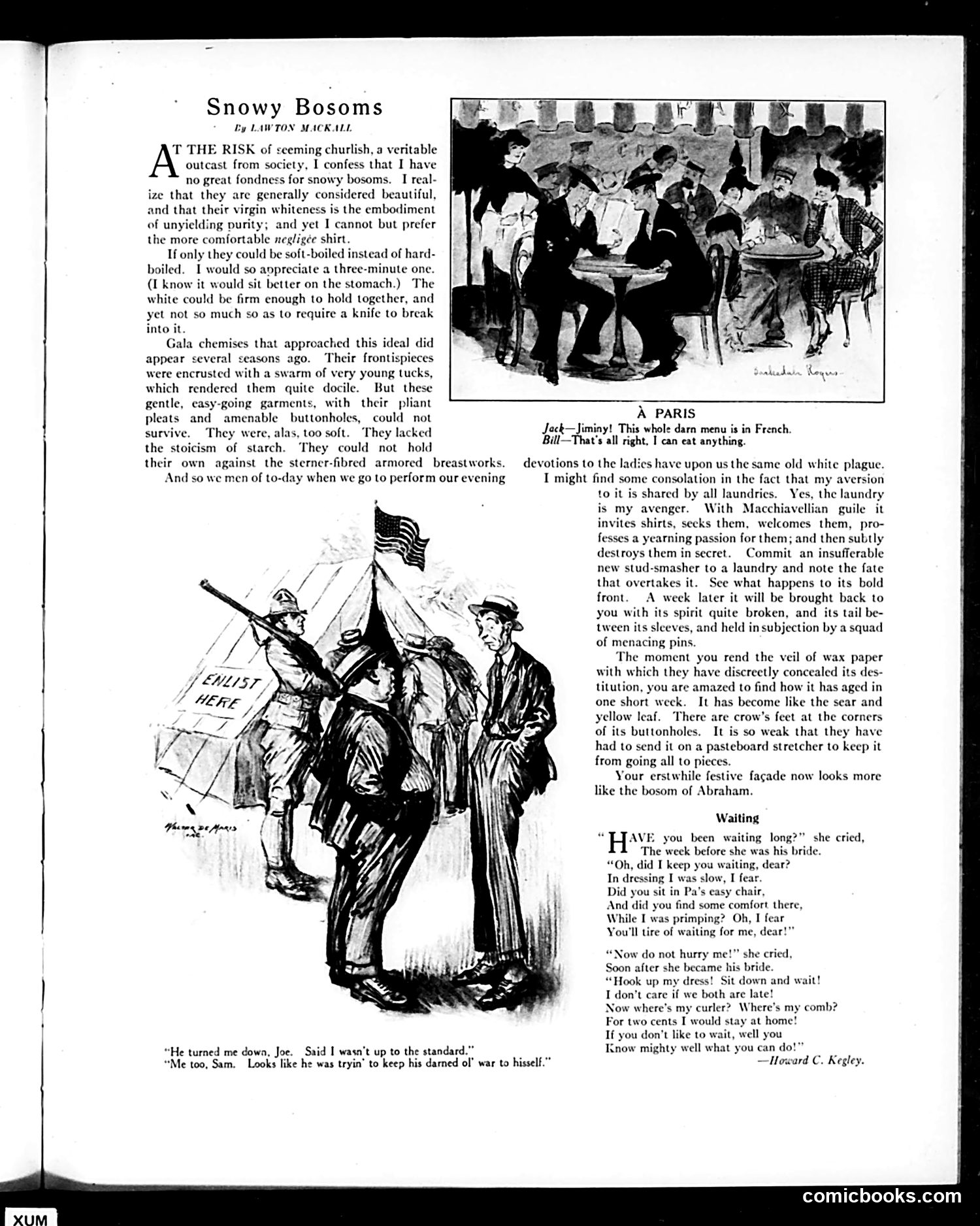
This *Judge* magazine page contains two satirical pieces: **"Snowy Bosoms"** (main article): Humorously complains about formal white dress shirts—their starch-stiffened, uncomfortable nature. The author laments that gentler, softer shirt styles from years past couldn't survive laundry's destructive "Macchiavellian guile," which intentionally ruins garments. This is social satire about fashion rigidity and the frustration of men's formal wear standards. **Cartoon (lower left)**: Shows soldiers with an "Enlist Here" recruitment poster during what appears to be World War I, with dialogue suggesting reluctance about military service. **"Waiting" poem (right)**: Contrasts a bride's initial politeness before marriage with her demanding, impatient behavior after. Classic early-20th-century misogynistic humor about wives becoming shrewish post-wedding. The bottom cartoon depicts soldiers resisting recruitment, with one saying his superior "tried to keep his damned ol' war to himself"—likely satirizing military authority or reluctant conscription attitudes.
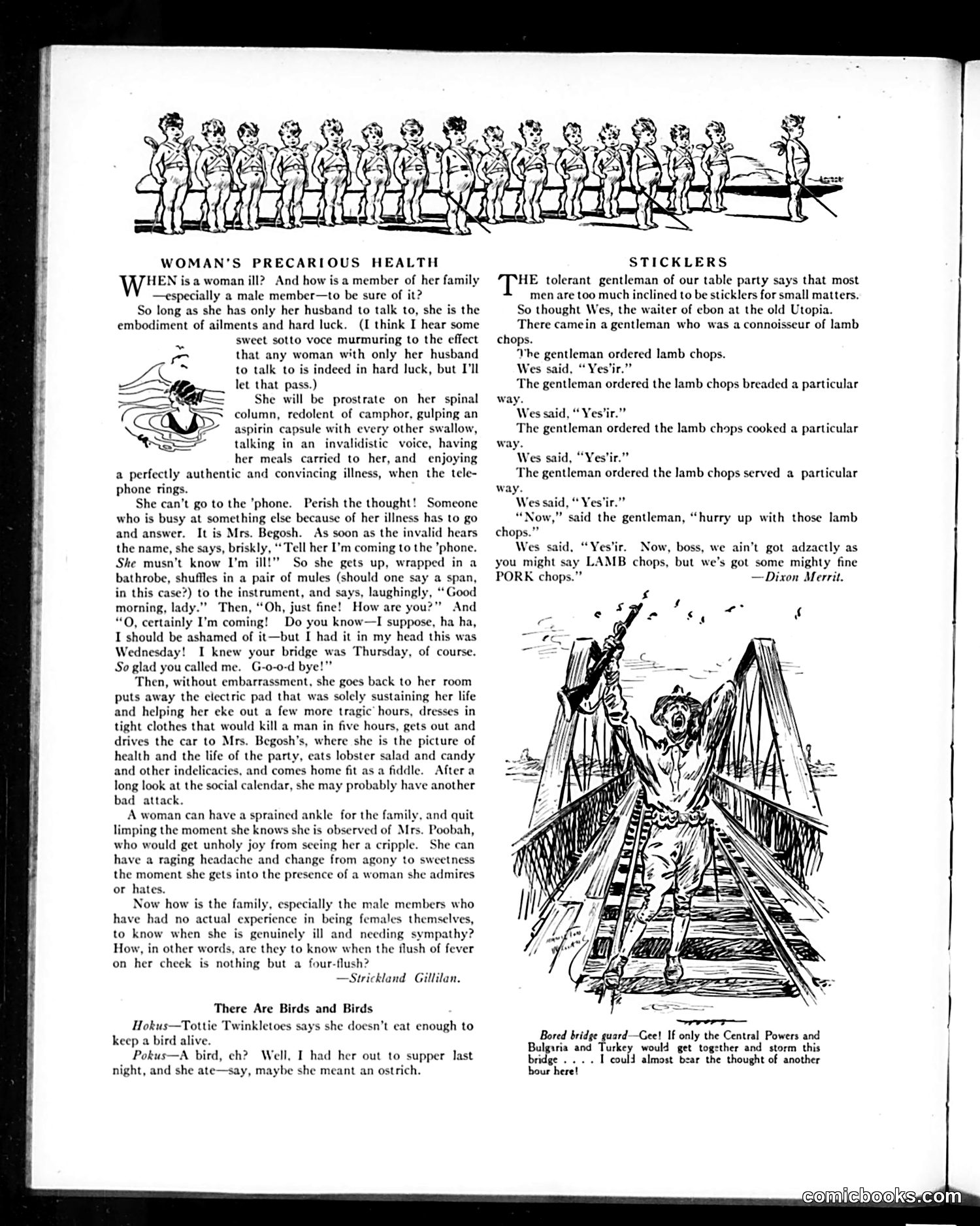
This page contains three separate satirical pieces mocking social pretense: **"Woman's Precarious Health"** (left): Satirizes women who dramatically perform illness when alone but instantly recover when needing to appear well for social obligations. The piece, by Strickland Gillilan, highlights the performative nature of female invalidism—a woman bedridden with "ailments" suddenly springs up, dresses in restricting clothing, and becomes the "life of the party" at a friend's gathering. The satire targets both women's theatrical hypochondria and men's difficulty distinguishing genuine illness from social theater. **"Sticklers"** (right): A brief joke about an overly particular diner who obsessively specifies lamb chop preparation (breading, cooking method, serving style) before demanding speed. The Black waiter's deadpan response—that they lack "lamb chops" but have "mighty fine PORK chops"—suggests the customer's fussiness is absurd and undeserved. **"There Are Birds and Birds"** (bottom): A quick pun where a woman claiming she eats too little "for a bird" is humorously reinterpreted as eating like an ostrich after a large supper. All three pieces mock social pretension and exaggeration.
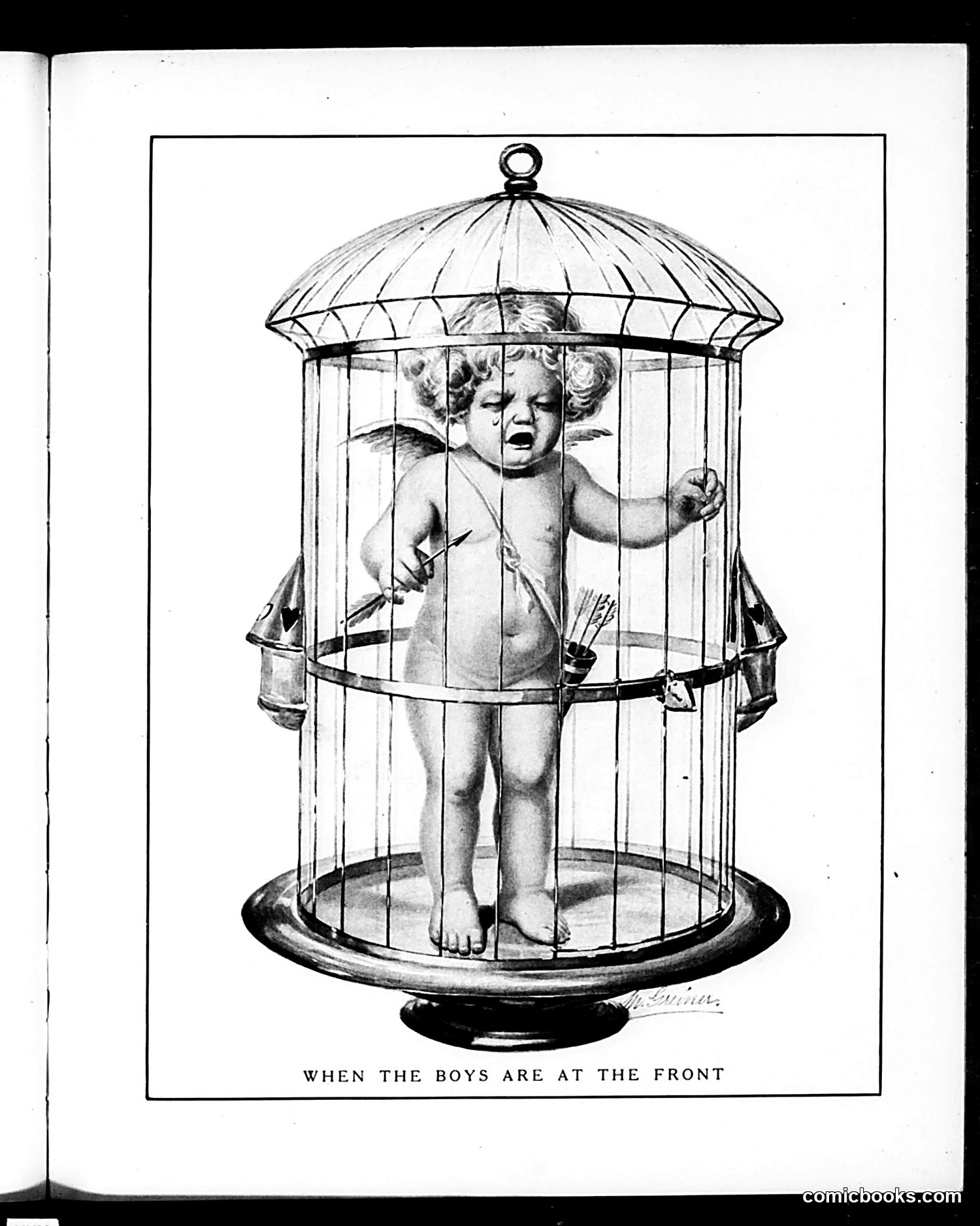
This illustration from *Judge* magazine satirizes parental behavior and childhood management. The image depicts a winged cherub or cupid figure enclosed in a decorative birdcage with a domed top, labeled "WHEN THE BOYS ARE AT THE FRONT." The satire likely comments on how parents (particularly mothers) confine or protect their children—here represented by the cherub—when sons are away at war or in military service. The cage suggests overprotectiveness or emotional restriction despite the boys' absence. The winged figure trying to escape the ornate cage implies the tension between parental control and children's desire for freedom. The joke critiques how anxiety about absent sons paradoxically leads to controlling behavior toward those remaining at home, or perhaps mocks empty-nest overcompensation.
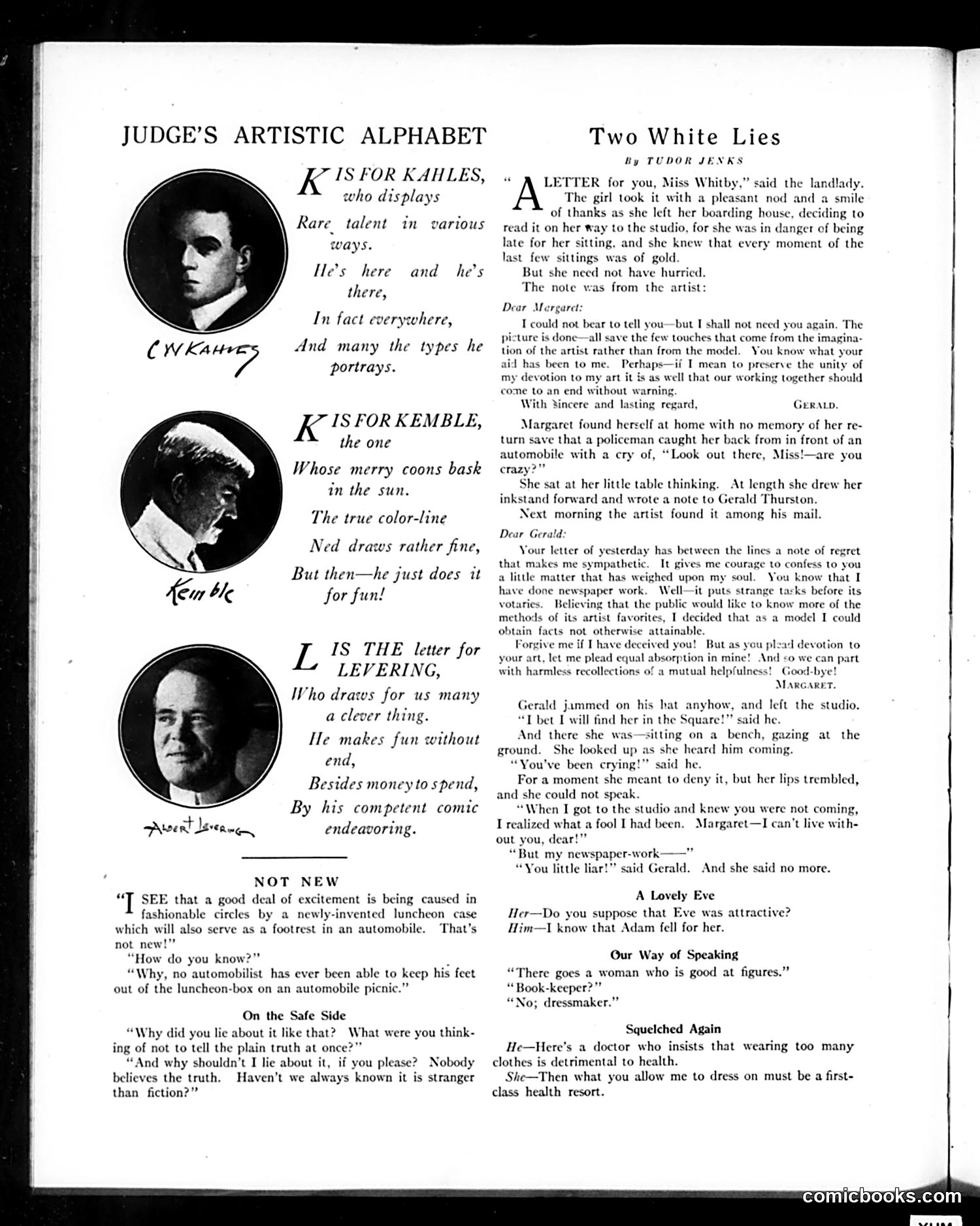
This page from *Judge* (a satirical magazine) contains three distinct sections: **"Judge's Artistic Alphabet"** features caricatured portraits of three cartoonists: Kahles, Kemble, and Levering. The verses humorously describe their drawing styles and prolific output—Kahles draws "everywhere," Kemble specializes in racial caricature ("coons"), and Levering produces clever comics while earning good money. This is insider satire praising contemporary cartoonists. **"Two White Lies"** (by Tudor Jenks) is a short story about an artist dismissing his model Margaret with a letter, claiming artistic reasons. She responds with her own letter, revealing she'd secretly done newspaper work. Both parties lied from devotion to their craft—a play on the "white lies" concept (socially acceptable untruths). **Small humor snippets** mock automobile etiquette and gender stereotypes ("dressmaker" as "figures"). The page targets early-20th-century bohemian art culture, celebrating artistic integrity while gently mocking pretension and the lives of artists and their models.
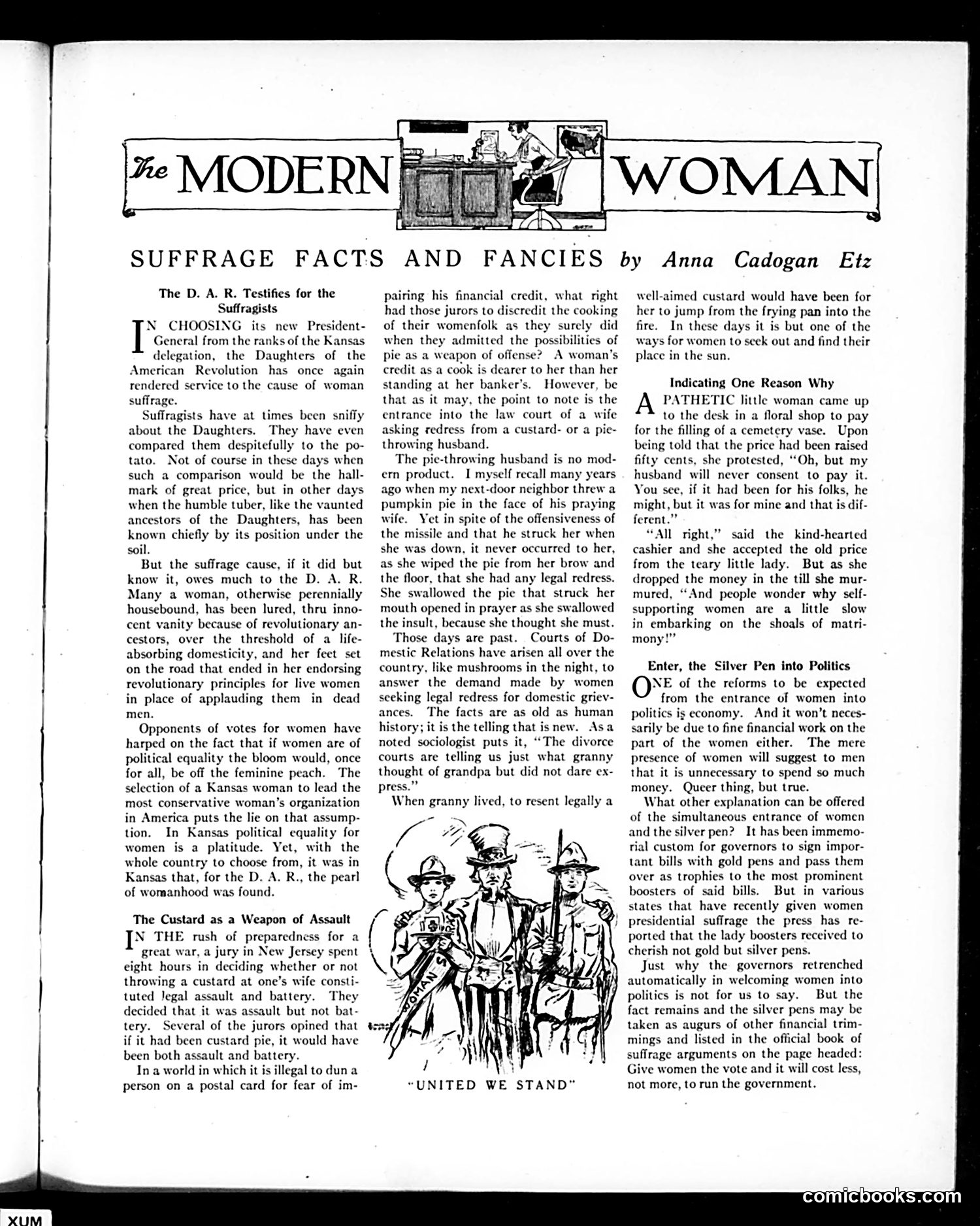
This page from Judge magazine satirizes opposition to women's suffrage through three interconnected arguments: **The D.A.R. Endorsement**: Etz notes that the Daughters of the American Revolution—a conservative, ancestry-focused organization—selected a Kansas woman as president. Since Kansas had already granted women voting rights, this proves female suffrage doesn't destroy femininity or "the bloom of the feminine peach," as opponents claimed. **The Custard Assault Case**: A New Jersey court recently ruled that throwing custard (though not custard pie) at one's wife constituted assault. Etz uses this absurdist example to highlight how women historically had *no legal recourse* for domestic violence—they simply endured it. Modern Courts of Domestic Relations now allow women legal redress, symbolizing their emerging political equality. **The Silver Pen Cartoon**: The illustration shows three figures labeled "UNITED WE STAND"—likely representing suffrage, women's rights, and political/economic power entering governance together. The satire's core: women gaining votes doesn't damage society; rather, it finally allows them basic legal protections previously denied.
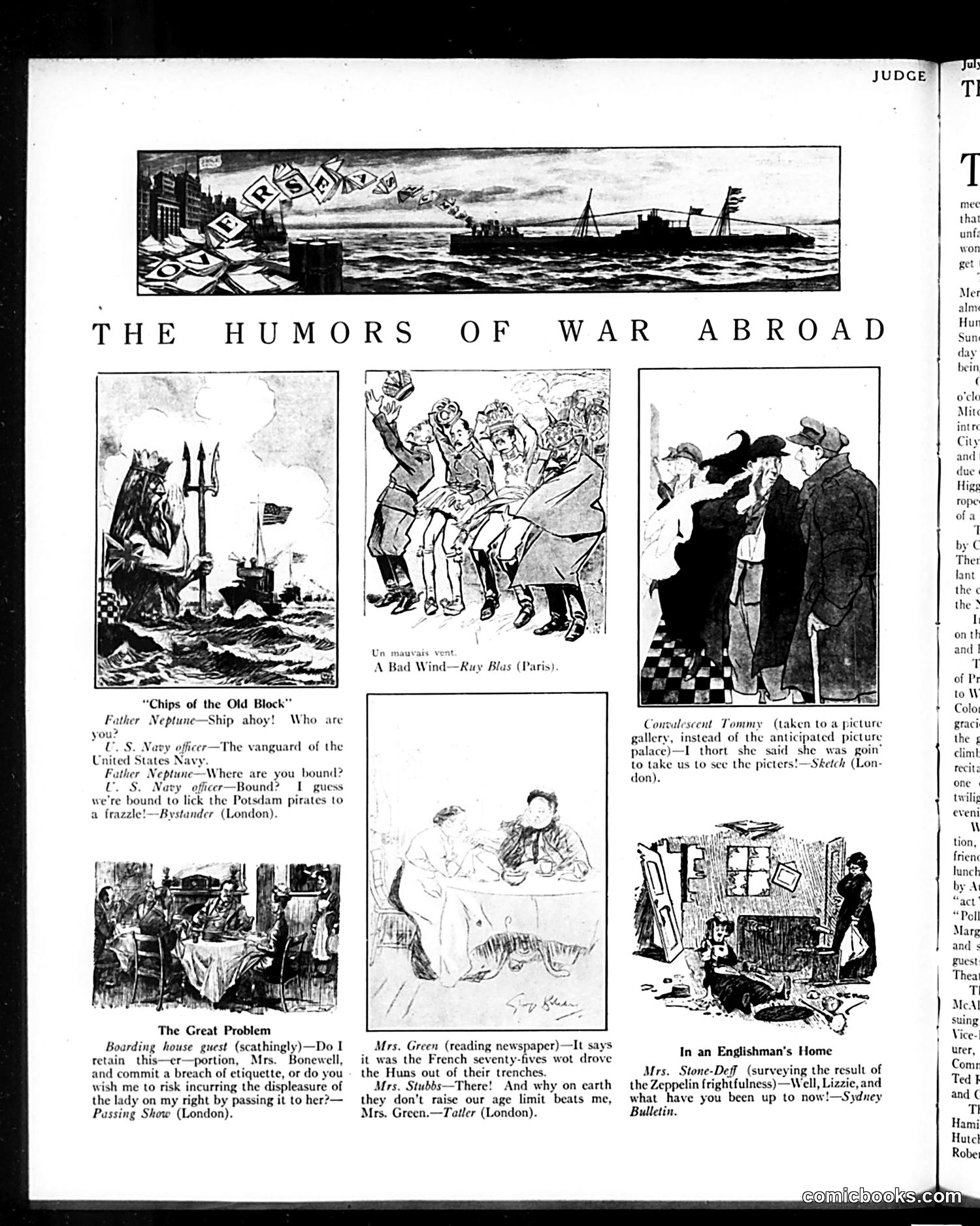
This Judge magazine page collects wartime satirical cartoons from Allied publications (London, Paris), mocking the Central Powers during World War I. **"Chips of the Old Block"** jokes that American naval officers eagerly anticipate fighting Germany ("the Potsdam pirates"), inheriting martial spirit from their nation's naval heritage. **"The Great Problem"** is unrelated WWI humor: a boarding-house guest absurdly overthinks etiquette when offered food. **"A Bad Wind"** (French source) appears to satirize German military setbacks. **"Convalescent Tommy"** mocks a British soldier's misunderstanding—expecting a "picture palace" (cinema) but receiving art gallery instead; plays on working-class speech. **"In an Englishman's Home"** shows civilians surveying Zeppelin bomb damage, with dark humor about air raids' terrifying "frightfulness." The page reflects Allied satirical unity against Germany, targeting both military and civilian morale through humor about combat eagerness, domestic disruption, and enemy barbarity.
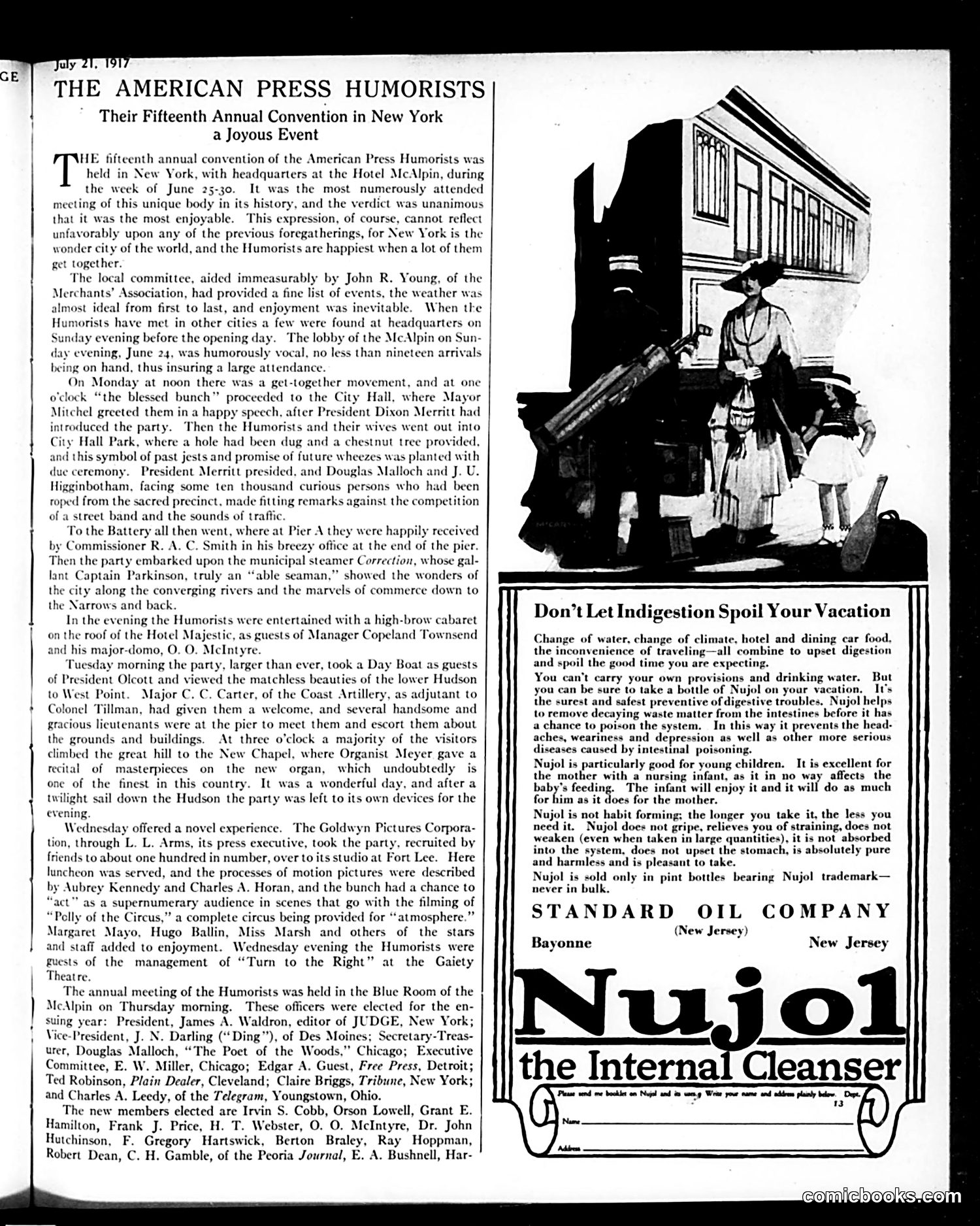
This is primarily a news article, not a political cartoon. It reports on the 15th annual convention of the American Press Humorists held in New York, June 25-30, 1917. The text describes social events: a tree-planting ceremony at City Hall (with Mayor Mitchel and President Dixon Merritt), a harbor cruise on the municipal steamer *Correction*, entertainment at hotels, a West Point visit, and a film studio tour at Fort Lee where attendees watched the production of "Polly of the Circus." The illustration shows a woman in 1910s dress boarding or disembarking from what appears to be a ship or vessel—likely commemorating the harbor excursion mentioned in the text. The page is primarily informational coverage of a professional organization's gathering, with the small illustration serving as documentary accompaniment.
This page is primarily a **house advertisement** for the Periodical Publishers' Association and Judge magazine itself, rather than containing a political cartoon. The central text, "The Great Interpreter," argues that magazines serve American democracy by interpreting events for busy citizens, promoting health and product innovation, and advancing "national life." It's essentially self-promotional propaganda defending magazines' cultural importance and advertising value. The accompanying list shows major publications of the era (Harper's, Collier's, National Geographic, etc.), positioning them as respectable institutions worthy of advertiser investment. Below is an event recap describing a gathering of "Humorists" (likely humor magazine editors/contributors) entertained by the Rotary Club in New York, with lunches and dinners at various establishments. No significant political satire is evident on this page—it's advertising copy promoting magazines as vehicles for commercialism and social progress during what appears to be the early 20th century.
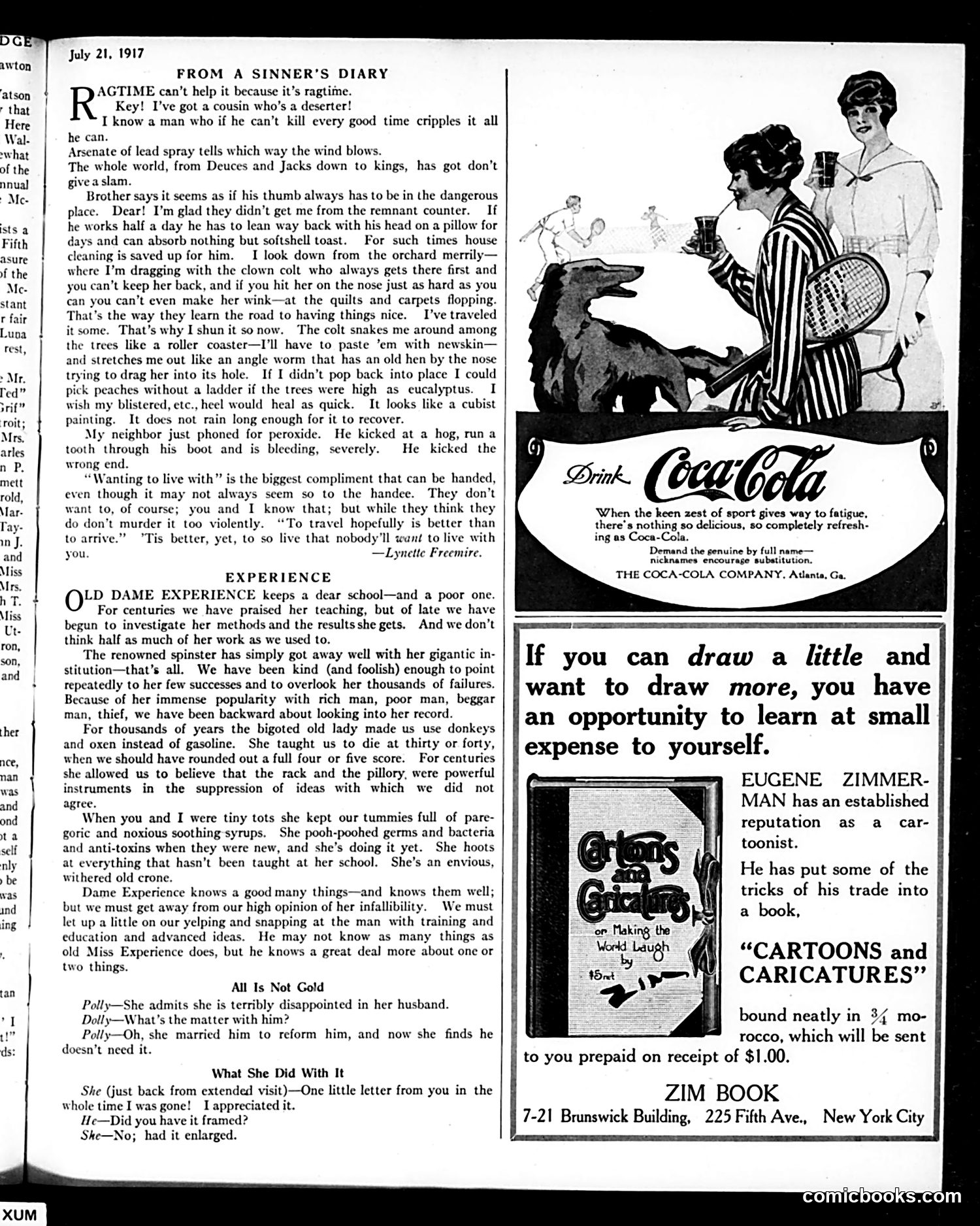
This page mixes personal essay with advertising. The main content is "From a Sinner's Diary," a rambling first-person reflection by Lynette Freemire on wartime life (note the reference to a cousin who "deserted"), rural scenes, and domestic mishaps. The tone is satirical and darkly humorous—mocking sentimentality about "learning through hardship" while describing physical pain and foolish neighbors. Below this is an essay questioning "Old Dame Experience"—personified as an outdated teacher who resisted progress (gasoline over donkeys, germ theory, modern medicine). This appears to critique blind respect for tradition during wartime modernization. The Coca-Cola advertisement shows fashionable women relaxing—typical 1917 advertising targeting leisure and refinement. The lower advertisement promotes Eugene Zimmerman's cartooning instruction book. The satire targets complacency, rural ignorance, and uncritical reverence for tradition during America's WWI involvement.
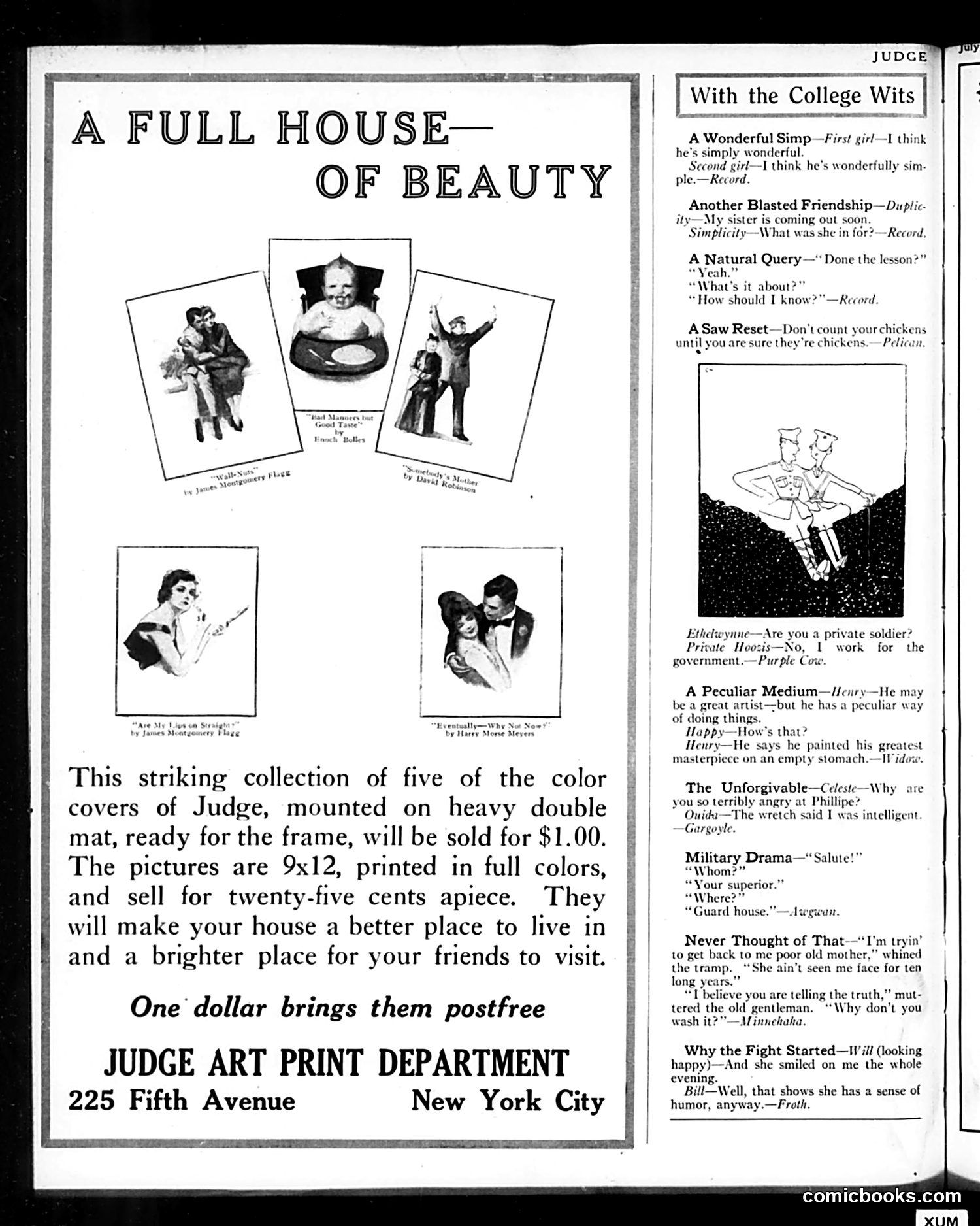
This page is primarily an advertisement for Judge magazine's art print department, not a political cartoon. The left side promotes a collection of five color cover illustrations available for $1.00, featuring artwork by James Montgomery Flagg, Frank Bolin, and Harry Morse Meyers. These 9x12 prints are marketed as home decoration. The right side contains "With the College Wits"—a humor section featuring brief jokes and witty exchanges from college publications like *Record*, *Pelican*, and *Froth*. These jokes address typical early 20th-century college life and romantic situations: admirers who are simple-minded, departing friendships, romantic misunderstandings, and military service. The humor is light, topical, and directed at a college-educated audience, reflecting period social conventions and dating customs.
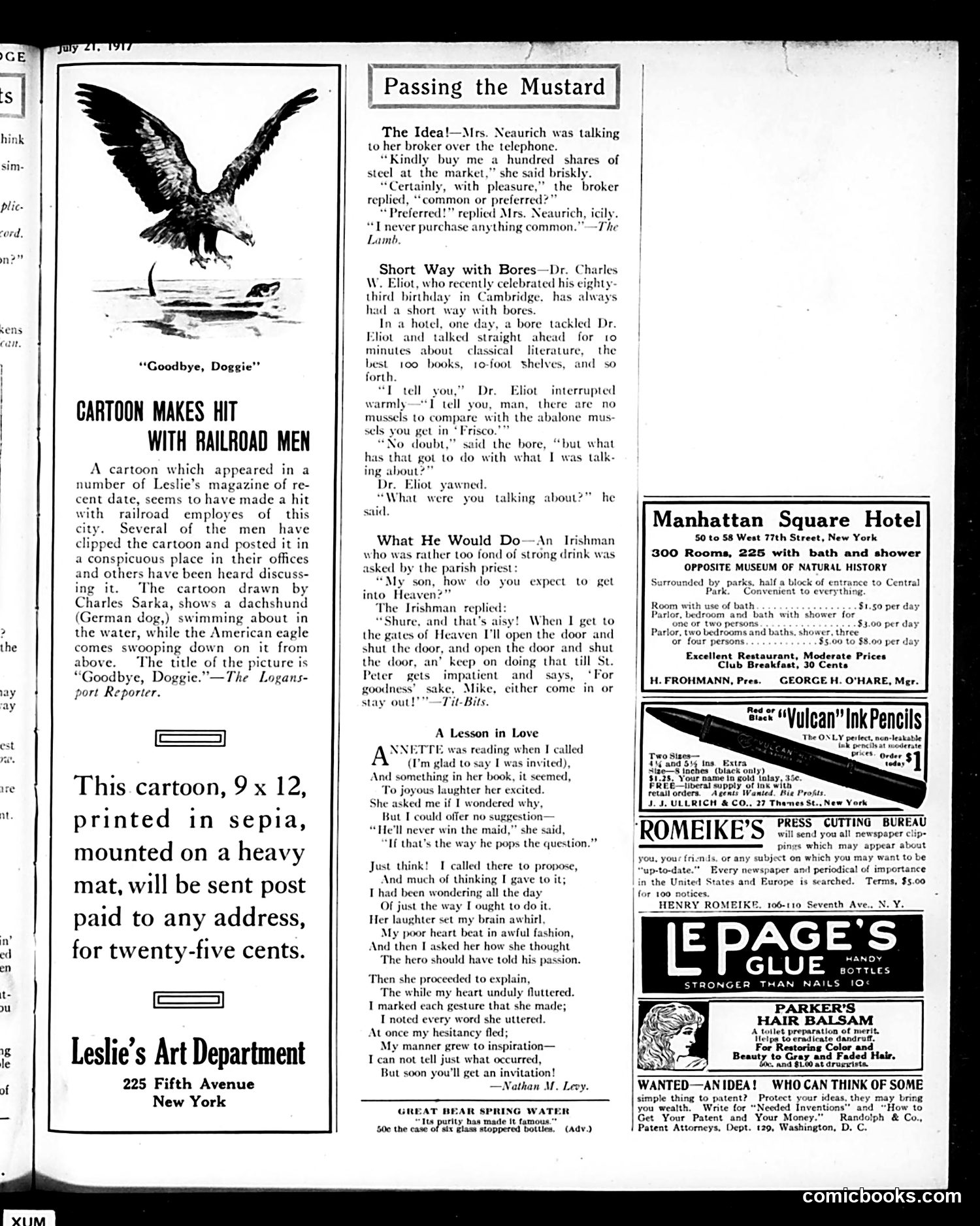
**The Main Cartoon ("Goodbye, Doggie"):** A dachshund (German dog) swims in water while an American eagle dives at it from above. The cartoon satirizes German-Americans during World War I, equating the German breed with enemy Germany. The image implies the need to eliminate German influence from America—a common wartime xenophobic sentiment. Railroad workers apparently found it resonant enough to post in offices. **Context:** America entered WWI in April 1917, making this July cartoon timely propaganda. Anti-German sentiment was intense; dachshunds became objects of suspicion as "enemy" symbols. **Other Content:** The page includes three humorous anecdotes about wealthy socialites, a famous Harvard president dismissing bores, and an Irishman's joke about Heaven—typical light satirical fare for Judge. Ads for hotels, ink pencils, and glue round out the commercial space.
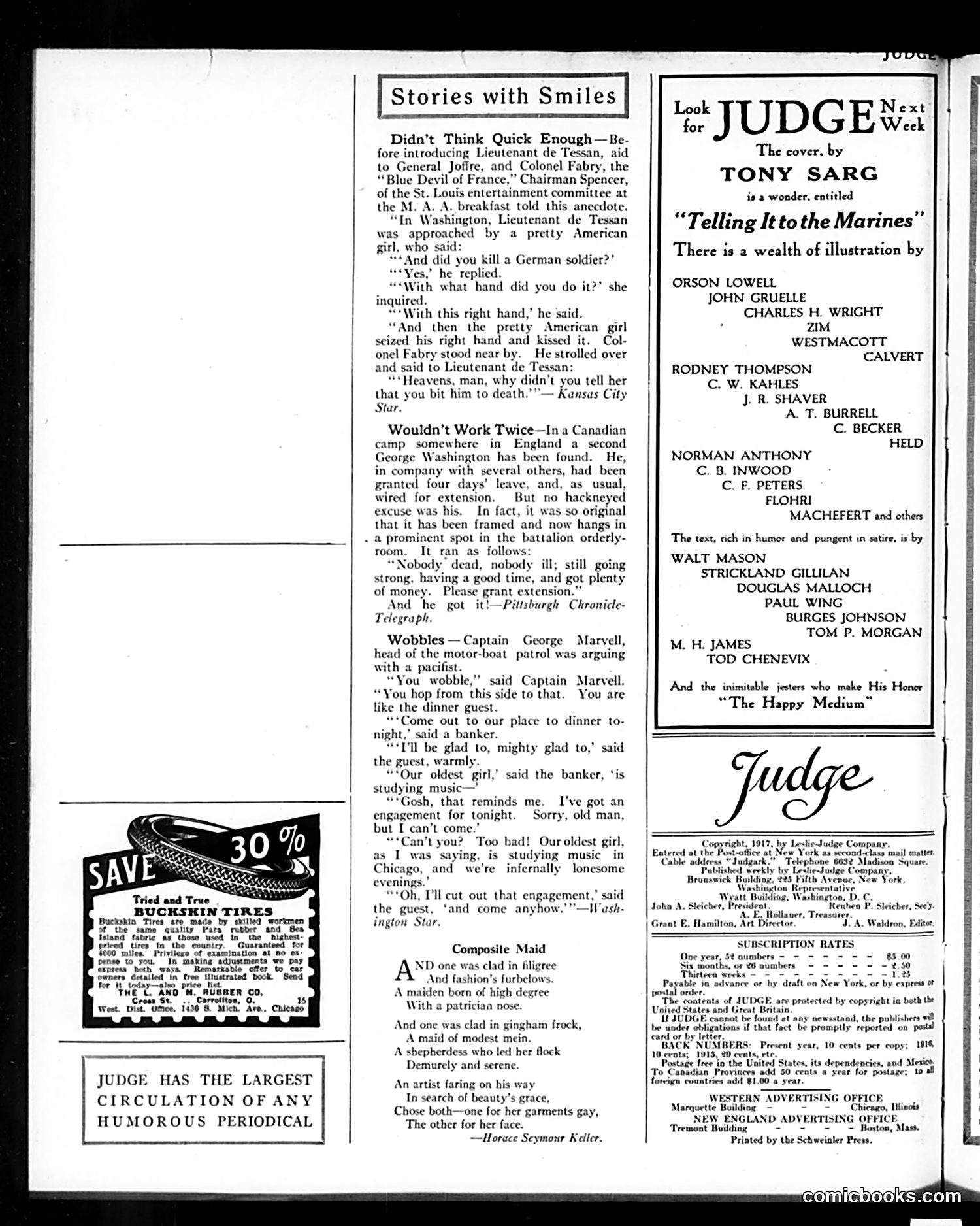
This is primarily a **title/contents page** from Judge magazine (1917), not a political cartoon page. The content consists of: **"Stories with Smiles"** section: Three humorous anecdotes featuring World War I themes. One anecdote involves French military officers (Lieutenant de Tessan and Colonel Fabry, real WWI figures) and an American girl; another features a Canadian soldier's creative leave extension request; a third satirizes a wishy-washy dinner guest ("wobbles"). **"Composite Maid"** poem: A lighthearted verse about an artist choosing a woman for both her fashionable clothing and her natural beauty. **Advertisement**: Buckskin Tires promotion claiming quality comparable to expensive competitors. The page's humor reflects American attitudes circa 1917—celebrating French/Canadian allies, mocking pacifists and indecisiveness, and displaying genteel romantic sentiment. There are no identifiable political cartoons or caricatures visible.
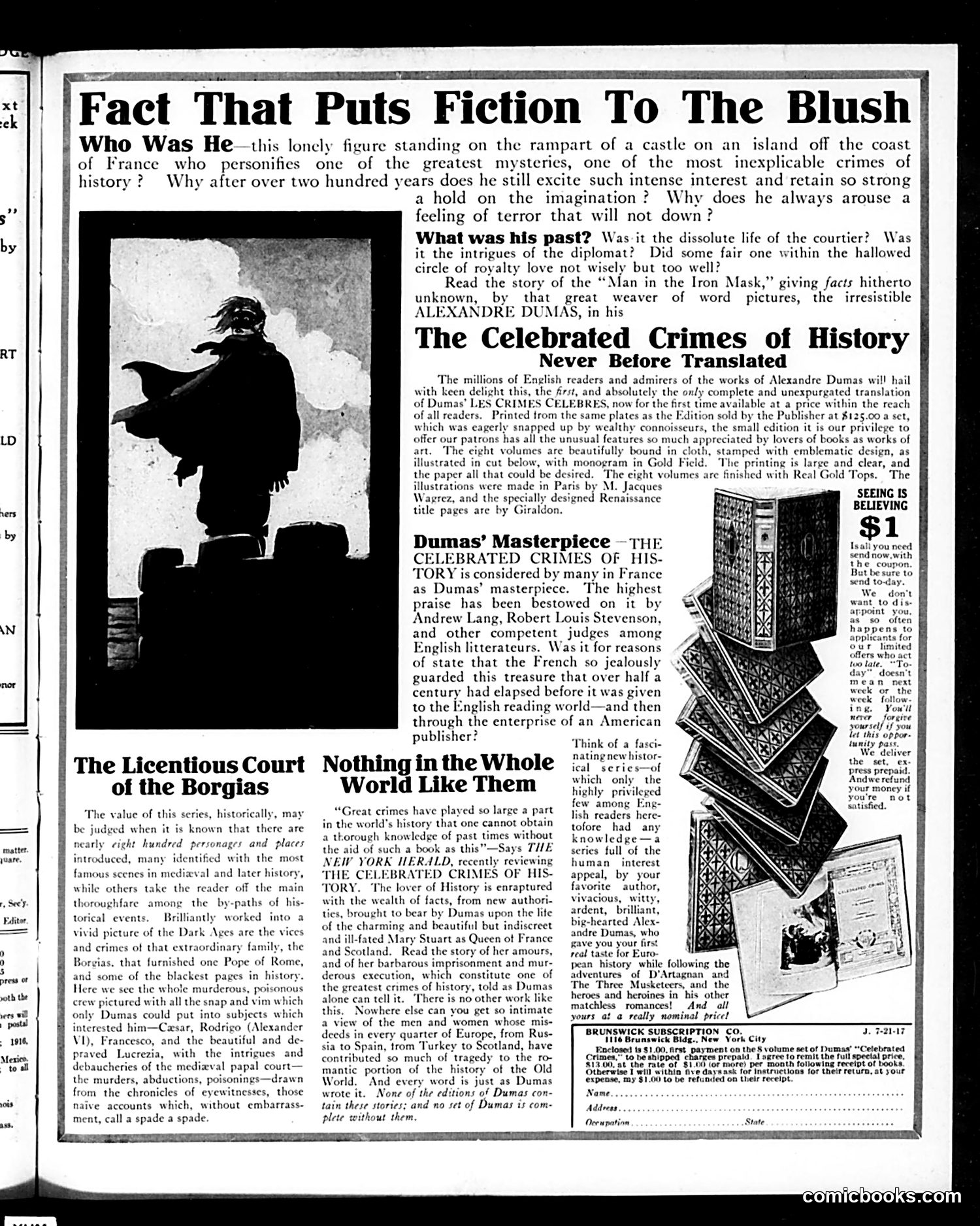
This is primarily **advertising copy**, not satire. The page promotes Alexandre Dumas's *Celebrated Crimes of History*, a newly translated eight-volume set, emphasizing its exclusivity and literary prestige. The silhouette image depicts **the Man in the Iron Mask**—Dumas's famous historical mystery about an unnamed prisoner in a French castle, a figure who captivated 19th-century imagination. The text poses rhetorical questions about this mysterious figure's identity and past to hook readers' interest. The advertisement leverages **intellectual snobbery**: it notes the original edition sold for $125 (expensive then), boasts endorsements from literary luminaries (Andrew Lang, Robert Louis Stevenson), and emphasizes this is the "only complete and unexpurgated translation." The publisher positions the set as both an **artistic object** (gold-embossed binding, Renaissance title pages) and serious literature. References to "The Licentious Court of the Borgias" and Mary Stuart suggest the volumes contain sensational historical scandals—marketing "crime" as sophisticated entertainment for educated readers.

I can see this is a mostly blank page from Judge magazine with minimal visible content. The page appears to be either largely empty, a verso (blank back side of a printed page), or an advertising page with very faint text that doesn't render clearly in this image. There are some faint marks along the right margin and what might be page numbers or printing marks, but no cartoon, satirical illustration, or legible text content is discernible enough for me to accurately identify figures, political references, or explain any intended satire or humor to a modern reader. Without clearer visual content, I cannot responsibly interpret this page's meaning.