
Judge, 1917-07-21 · page 12 of 28
Judge — July 21, 1917 — page 12: what you’re looking at
What you’re looking at
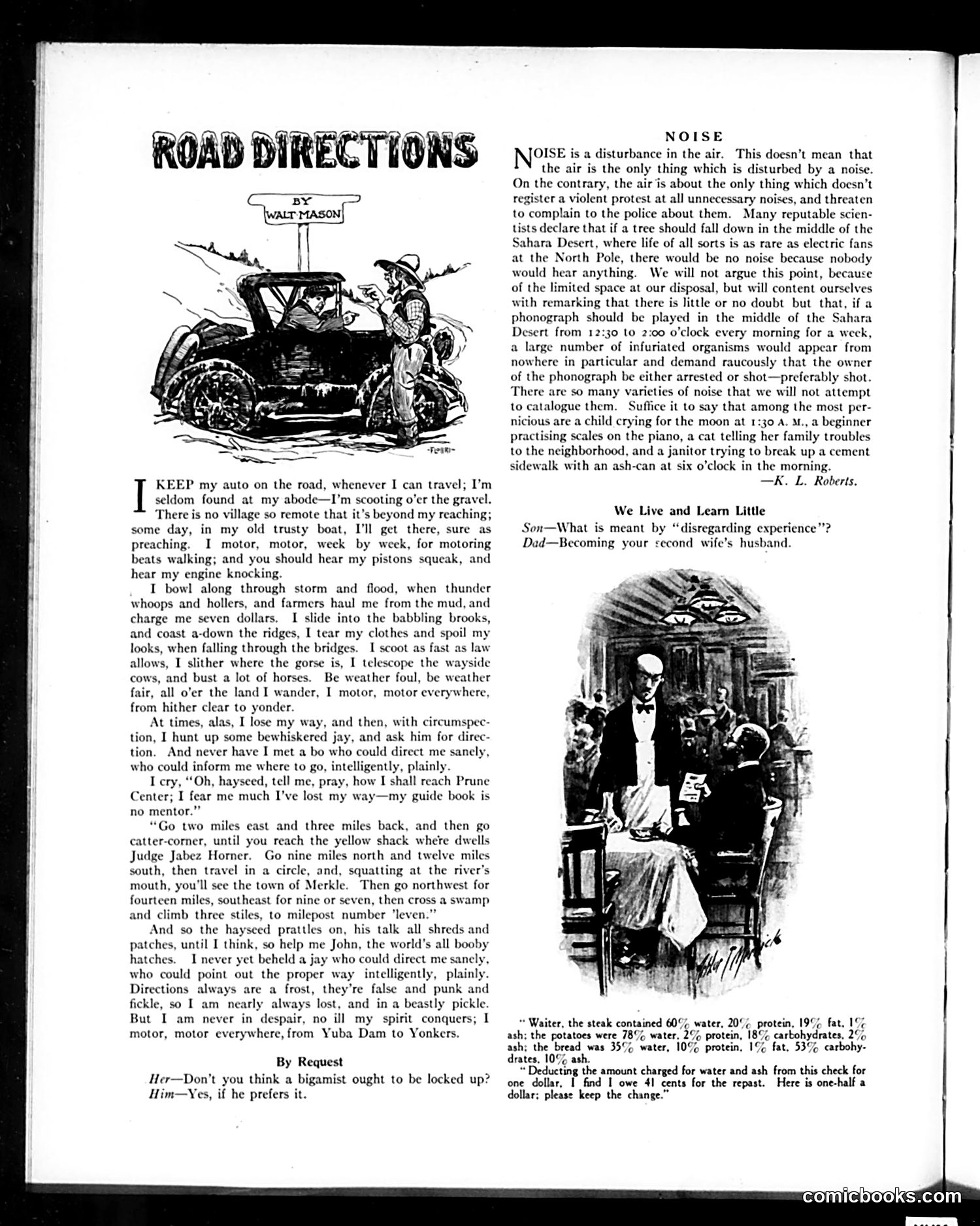
This humorous poem mocks the early 20th-century automobile craze and the chaos it creates. The speaker obsessively "motors" everywhere despite constant mishaps—getting stuck in mud, falling through bridges, destroying property—yet remains undeterred. The satire targets both the reckless new motorists and rural locals asked for directions. When the speaker asks a "bewhiskered" farmer for help reaching "Prune Center," the farmer gives absurdly convoluted, nonsensical directions (going in circles, crossing swamps, counting mileposts), suggesting rural people's inability to comprehend the new automobile age. The joke: early motorists were simultaneously obsessed with their vehicles and hopelessly incompetent, while the automobile itself represented a bewildering disruption to traditional rural life. The final couplet joke about bigamists appears unrelated—likely filler content typical of Judge magazine's miscellaneous humor format.
📄 Transcribed text from this page (OCR, searchable)
Machine-transcribed from the original scan — historical spelling and the odd misread are preserved.
ROAD DIRECTIONS wastes KEEP my auto on the road, whenever I can travel; I’m Idom found at my abode—I’m scooting o’er the gravel. here is no village so remote that it’s beyond my reaching; some day, in my old trusty boat, I'll get there, sure as preaching. I motor, motor, week by week, for motoring beats walking; and you should hear my pistons squeak, and hear my engine knocking. I bowl along through storm and flood, when thunder whoops and hollers, and farmers haul me from the mud, and charge me seven dollars. I slide into the babbling brooks, and coast a-down the ridges, I tear my clothes and spoil my looks, when falling through the bridges. I scoot as fast a allows, I slither where the gorse is, I telescope the wa‘ cows, and bust a lot of horses. Be weather foul, be we: fair, all o'er the land I wander, I motor, motor everywhere, from hither clear to yonder. At times, alas, I lose my way, and then, with circumspec- tion, I hunt up some bewhiskered jay, and ask him for direc- tion. And never have I met a bo who could direct me sanely who could inform me where to go, intelligently, plainly. I cry, ‘Oh, hayseed, tell me, pray, how I shall reach Prune Center; I fear me much I’ve lost my way—my guide book is no mentor.” o two miles east and three miles back, and then go catter-cormer, until you reach the yellow shack where dwells Judge Jabez Horner. Go nine miles north and twelve miles south, then travel in a circle, and, squatting at the river's mouth, you'll see the town of Merkle. Then go northwest for fourteen miles, southeast for nine or seven, then cross a swamp and climb three stiles, to milepost number ‘leven.” And so the hayseed prattles on, his talk all shreds and patches, until I think, so help me John, the world’s all booby hatches. I never yet beheld a jay who could direct me sanely, who could point out the proper way intelligently, plainly. Directions always are a frost, they’re false and punk and fickle, so I am nearly always lost, and in a beastly pickle. But I am never in despair, no iJl my spirit conquers; I motor, motor everywhere, from Yuba Dam to Yonkers. By Request Her—Don’t you think a bigamist ought to be locked up? Him—Yes, if he prefers it. NOISE OISE is a disturbance in the air. This doesn’t mean that the air is the only thing which is disturbed by a noise. On the contrary, the air is about the only thing which doesn’t register a violent protest at all unnecessary noises, and threaten to complain to the police about them. Many reputable scien- tists declare that if a tree should fall down in the middle of the Sahara Desert, where life of all sorts is as rare as electric fans at the North Pole, there would be no noise because nobody would hear anything. We will not argue this point, because of the limited space at our disposal, but will content ourselves with remarking that there is little or no doubt but that, if a phonograph should be played in the middle of the Saha Desert from 12:30 to 2:00 o'clock every morning for a weck, a large number of infuriated organisms would appear from nowhere in particular and demand raucously that the owner of the phonograph be either arrested or shot—preferably shot. There are so many varieties of noise that we will not attempt logue them. Suffice it to say that among the most per- sare a child crying for the moon at 1:30 A. M., a beginner practising scales on the piano, a cat telling her family troubles to the neighborhood, and a janitor trying to break up a cement sidewalk with an ash-can at six o’clock in the morning. —K. L. Roberts. We Live and Learn Little Son—What is meant by “disregarding experience”? Dad—Becoming your second wife’s husband. * Waiter, the steak contained 609% water, 20°( protein, 199% fat, 1% ash; the potatoes were 78% water, 2% pro! 18% carbohydrates, 2% ash; the bread was 35°% water, 10% protein, 1% fat, 53% carbohy- drates, 10% ash. “ Deducting the amount charged for water and ash from this check for one dollar, I find | owe 41 cents for the repast. Here is one-half a dollar; please keep the change.”