
Judge, 1917-07-21 · page 18 of 28
Judge — July 21, 1917 — page 18: what you’re looking at
What you’re looking at
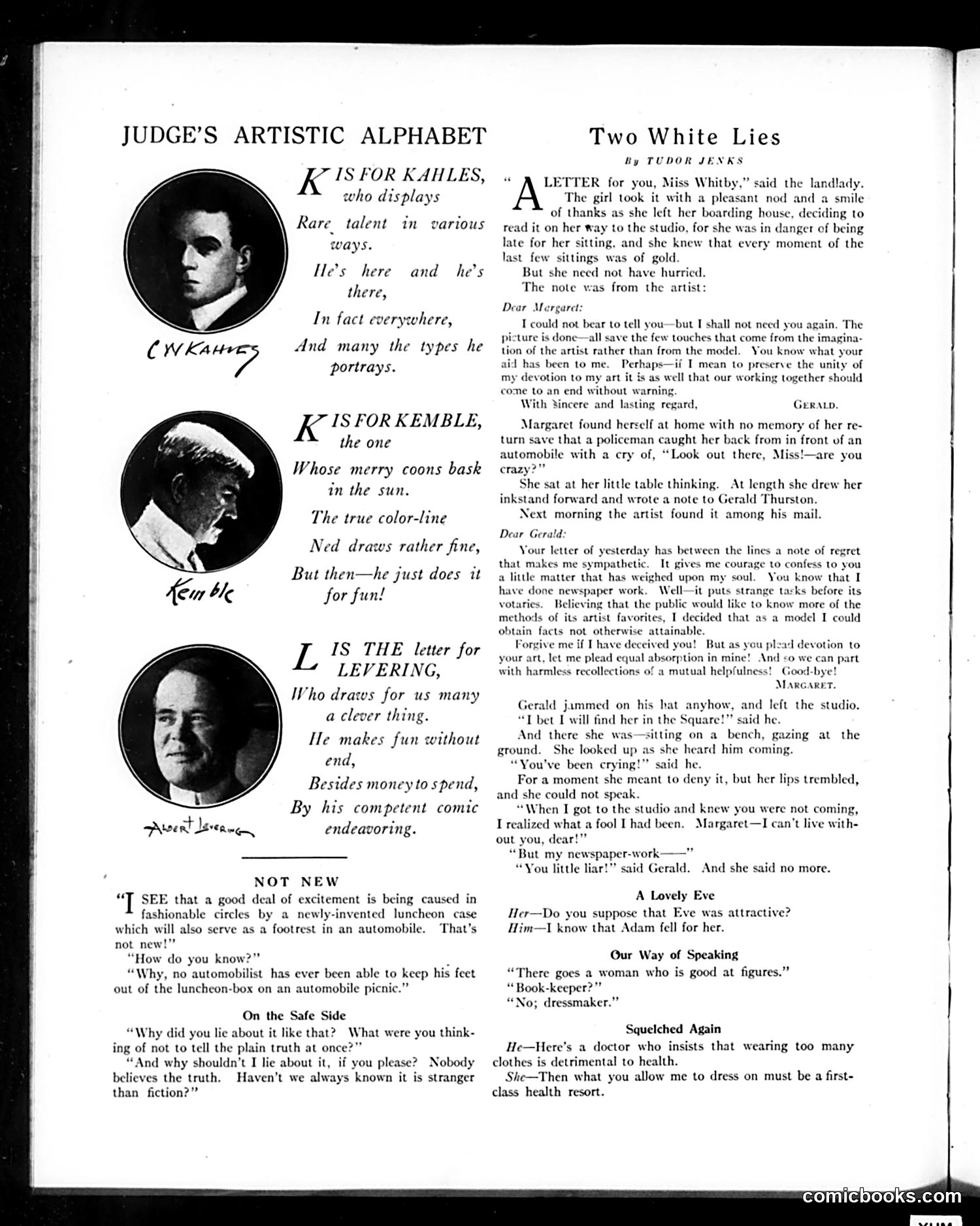
This page from *Judge* (a satirical magazine) contains three distinct sections: **"Judge's Artistic Alphabet"** features caricatured portraits of three cartoonists: Kahles, Kemble, and Levering. The verses humorously describe their drawing styles and prolific output—Kahles draws "everywhere," Kemble specializes in racial caricature ("coons"), and Levering produces clever comics while earning good money. This is insider satire praising contemporary cartoonists. **"Two White Lies"** (by Tudor Jenks) is a short story about an artist dismissing his model Margaret with a letter, claiming artistic reasons. She responds with her own letter, revealing she'd secretly done newspaper work. Both parties lied from devotion to their craft—a play on the "white lies" concept (socially acceptable untruths). **Small humor snippets** mock automobile etiquette and gender stereotypes ("dressmaker" as "figures"). The page targets early-20th-century bohemian art culture, celebrating artistic integrity while gently mocking pretension and the lives of artists and their models.
📄 Transcribed text from this page (OCR, searchable)
Machine-transcribed from the original scan — historical spelling and the odd misread are preserved.
JUDGE’S ARTISTIC ALPHABET IS FOR KAHLES, who displays Rare talent in various ways. He's here there, and he’s In fact everywhere, And many the types he portrays. IS FORKEMBLE, the one Whose merry coons bask tn the sun. The true color-line Ned draws rather fine, But then—he just does it for fun! IS THE letter for LEVERING, Who draws for us many a clever thing. He makes fun without end, Besides money to spend, By his competent comic endeavoring. vent ASrtamen, NOT NEW “T SEE that a good deal of excitement is being caused in fashionable circles by a newly-invented luncheon case which will also serve as a footrest in an automobile. That’s not new!"" “How do you knov . “Why, no automobilist. has ever been able to keep his feet out of the luncheon-box on an automobile picnic.” On the Safe Side “Why did you lie about it like that? What were you think- ing of not to tell the plain truth at once?” “And why shouldn’t I lie about it, if you please? Nobody believes the truth. Haven’t we always known it is stranger than fiction?” Two White Lies By TUDOR JENKS “ LETTER for you, Miss Whitby,” said the landlady. A The girl took it with a pleasant nod and a smile of thanks as she left her boarding house, deciding to read it on her way to the studio, for she was in danger of being late for her sitting, and she knew that every moment of the last few sittings was of gold But she need not have hurried. The note was from the artist: Dear Mergaret: T could not bear to tell you—but I shall not need you again. picture is done—all save the few touches that come from the imagina- tion of the artist rather than from the model. You know what y aid has been to me. Perhaps—ii T mean to preserve the unity of my devotion to my art it is as well that our working together should come to an end without warnin; With Rincere and lasting regard, Gerarp. Margarct found herself at home with no memory of her re- turn save that a policeman caught her back from in front of an automobile with a cry of, “Look out there, Miss!—are you crazy?” She sat at her little table thinking. At length she drew her inkstand forward and wrote a note to Gerald Thurston. Next morning the artist found it among his mail. ar Gerald: y has between the lines a note of regret that makes me sympathet! It gives me courage to confess to you a little matter that has weighed upon my soul. You know that I have done newspaper work. Well—it puts strange tasks before its Believing that the public would like to know more of the I decided that as a model I could inable. Your letter of yesterd votaries. methods of its artist favorites cts not otherwise ve me if I have deceived you! But as you plzad devotion to your art, let me plead equal absorption in mine! And so we with harmless recollections of a mutual helpfulness! G Marcaret. Gerald jammed on his anyhow, and left the studio. “T bet I will find her in the Square!” said he. And there she was—sitting on a bench, gazing at ground. She looked up as she heard him coming. “You've been crying!” said he. For a moment she meant to deny it, but her lips trembled, and she could not s i. “When I got to the studio and knew you were not coming, I realized what a fool I had been, Margaret—I can’t live with- the paper-work—" said Gerald. And she said no more. A Lovely Eve -r-—Do you suppose that Eve was attractive? Him—I know that Adam fell for her. i Our Way of Speaking “There goes a woman who is good at figures.” “Book-keeper?” “No; dressmaker.” Squelched Again He—Here’s a doctor who insists that wearing too many clothes is detrimental to health. She—Then what you allow me to dress on must be a first- class health resort.