
Judge, 1917-07-21 · page 10 of 28
Judge — July 21, 1917 — page 10: what you’re looking at
What you’re looking at
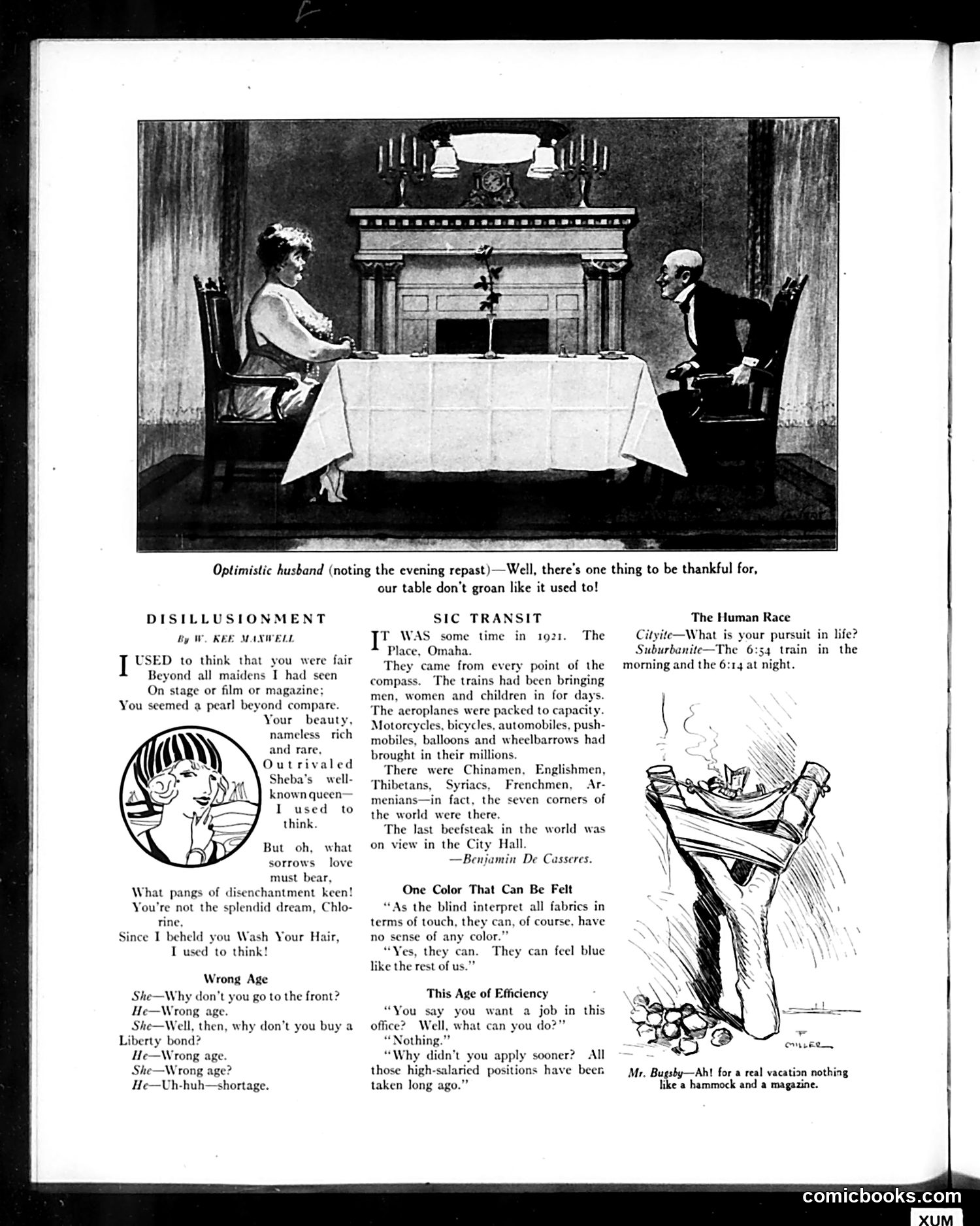
This page contains multiple short satirical pieces reflecting post-WWI American anxieties: **"Disillusionment"** mocks romantic disappointment—a man idealizes a woman until seeing her with wet hair, suggesting superficiality in courtship. **"Wrong Age"** jokes about draft dodging and war bonds during WWI, with a man claiming he's the "wrong age" for both military service and financial contribution, then admitting the real issue is "shortage"—likely referencing labor shortages or economic constraints. **The dinner cartoon** satirizes wartime food rationing, with a husband grateful their table "doesn't groan" anymore—meaning it's less full than pre-war abundance. **"Sic Transit"** describes witnessing the last beefsteak on Earth in 1921 Omaha, reflecting genuine post-war anxieties about scarcity and a world transformed by conflict. **Other pieces** include wordplay about blindness and color, and office inefficiency humor typical of 1920s satire. The overall tone captures 1920s American disillusionment: romantic, economic, and social disappointment following World War I.
📄 Transcribed text from this page (OCR, searchable)
Machine-transcribed from the original scan — historical spelling and the odd misread are preserved.
DISILLUSIONMENT By W. KEE MAXWELL USED to think that you were fair Beyond all maidens I had seen On stage or film or magazine: You seemed a pearl beyond compare. Your beauty, nameless rich and rar Outrivaled Sheba’s well- known queen I used to think. But oh, what sorrows love must bear, What pangs of disenchantment keen! You're not the splendid dream, Chlo- rine, Since I beheld you Wash Your Hair, I used to think! Wrong Age She—Why don’t you go to the front? He—Wrong age. She—Well, then, why don’t you buy a Liberty bond? He—Wrong age. She—Wrong age? He—Uh-huh—shortage. Optimistic husband (noting the evening repast)—Well, there’s one thing to be thankful for, our table don’t groan like it used to! SIC TRA IT I WAS some time in 10921. The Place, Omaha. They came from every point of the compass. The trains had been bringing men, women and children in for days. The aeroplanes were packed to capacity Motorcycles, bicycles, automobiles, push- mobiles, balloons and wheelbarrows had brought in their millions. There were Chinamen, Englishmen, Thibetans, Syriacs, Frenchmen, Ar- menians—in fact, the seven corners of the world were there. The last beefsteak in the world was on view in the City Hall. —Benjamin De Casseres. One Color That Can Be Felt s the blind interpret all fabrics in terms of touch, they can, of course, have no sense of any color.” “Yes, they can. They can feel blue like the rest of us.” This Age of Efficiency “You say you want a job in this office? Well, what can you do?” Nothing. “Why didn’t you apply sooner? All those high-salaried positions have been taken long ago.” The Human Race Cityite—What is your pursuit in life? Suburbanite—The 6:54 train in the morning and the 6:14 at night. MOY & ome, Mr. Bugsby—Ab! for a real vacation nothing like a hammock and a magazine. comicbooks.com