
Judge, 1917-07-21 · page 13 of 28
Judge — July 21, 1917 — page 13: what you’re looking at
What you’re looking at
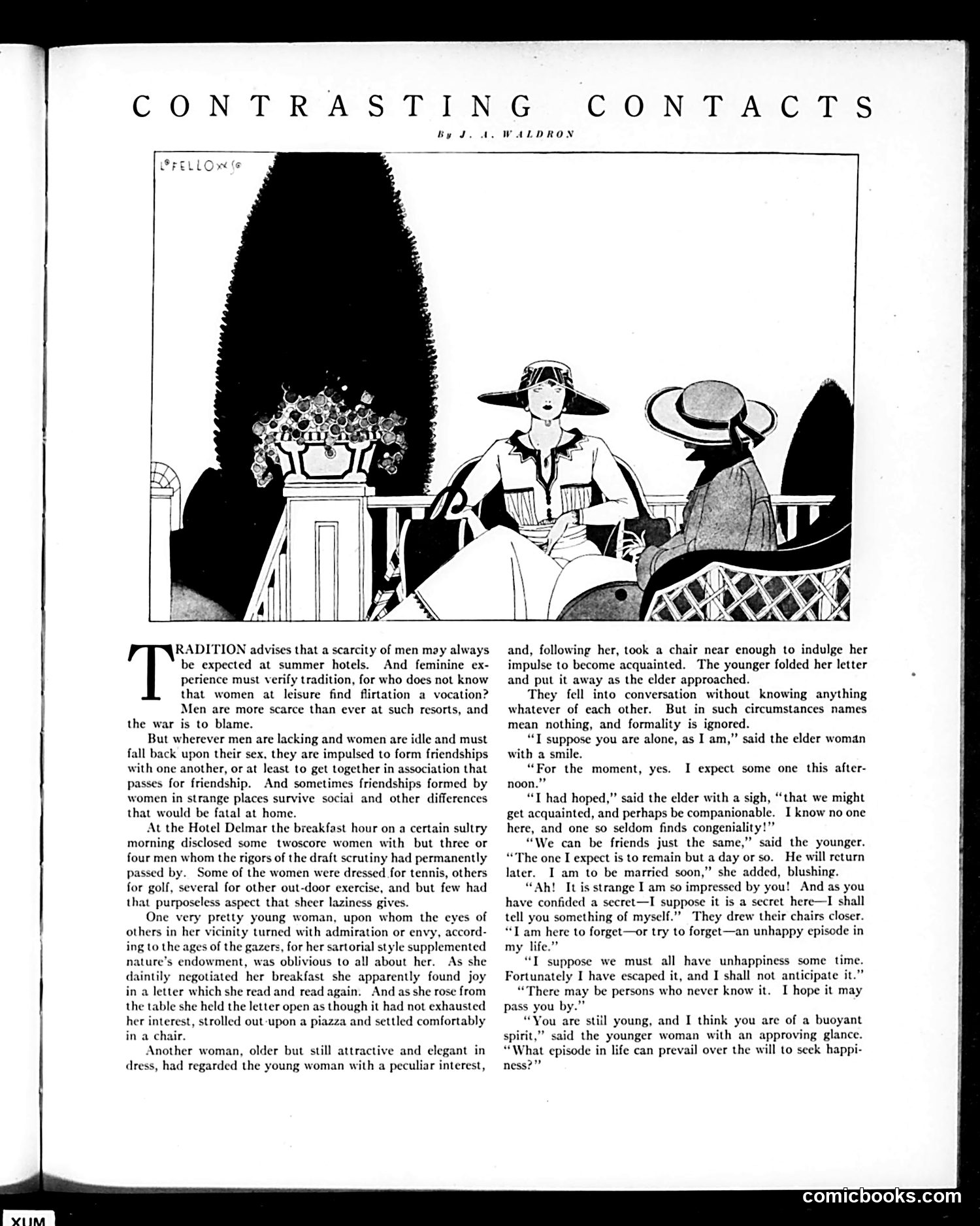
This illustration and story depict two women at a summer hotel forming an unexpected friendship. The cartoon satirizes the social dynamics of wartime leisure spaces—specifically, how the absence of men (due to WWI draft requirements) forced wealthy women to seek companionship with each other. The satire's point: during peacetime, class differences and social hierarchies would prevent such friendships ("fatal at home"), but wartime scarcity creates temporary social leveling. A young, attractive, engaged woman and an older woman nursing an undisclosed romantic disappointment bridge their differences through shared circumstance. The humor lies in the implicit social commentary—that women's friendships are merely pragmatic substitutes for male attention, a survival mechanism rather than genuine connection. The story presents this arrangement as charming rather than critically, reflecting period attitudes about female sociability and wartime's social disruptions.
📄 Transcribed text from this page (OCR, searchable)
Machine-transcribed from the original scan — historical spelling and the odd misread are preserved.
WLIMA CONTRASTING WALDRON By J. AL CONTACTS a || RADITION advises that a scarcity of men may always be expected at summer hotels. And feminine ex- perience must verify tradition, for who does not know that women at leisure find flirtation a vocation? Men are more scarce than ever at such resorts, and the war is to blame. But wherever men are lacking and women are idle and must fall back upon their sex, they are impulsed to form friendships with one another, or at least to get together in association that passes for friendship. And sometimes friendships formed by women in strange places survive sociai and other differences that would be fatal at home. At the Hotel Delmar the breakfast hour on a certain sultry morning disclosed some twoscore women with but three or four men whom the rigors of the draft scrutiny had permanently passed by. Some of the women were dressed for tennis, others for golf, several for other out-door exercise, and but few had that purposeless aspect that sheer laziness gives. One very pretty young woman, upon whom the eyes of others in her vicinity turned with admiration or envy, accord- ing to the ages of the gazers, for her sartorial style supplemented nature’s endowment, was oblivious to all about her. As she daintily negotiated her breakfast she apparently found joy in a letter which she read and read again. And as she rose from the table she held the letter open as though it had not exhausted her interest, strolled out-upon a piazza and settled comfortably in a chair. Another woman, older but still attractive and elegant in dress, had regarded the young woman with a peculiar interest, and, following her, took a chair near enough to indulge her impulse to become acquainted. The younger folded her letter and put it away as the elder approached. They fell into conversation without knowing anything whatever of each other. But in such circumstances names mean nothing, and formality is ignored. “T suppose you are alone, as I am,” said the elder woman with a smile. “For the moment, yes. I expect some one this after- noon.” “T had hoped,” said the elder with a sigh, “that we might get acquainted, and perhaps be companionable. I know no one here, and one so seldom finds congeniality!” “We can be friends just the same,” said the younger. “The one I expect is to remain but a day or so. He will return later. I am to be married soon,” she added, blushing. “Ah! Itis strange I am so impressed by you! And as you have confided a secret—I suppose it is a secret here—I shall tell you something of myself.””. They drew their chairs clo: “Lam here to forget—or try to forget—an unhappy episod: my life.” “TI suppose we must all have unhappiness some time. Fortunately I have escaped it, and I shall not anticipate it.” “There be persons who never know it. I hope it may you by. You are still young, and I think you are of a buoyant spirit,” said the younger woman with an approving glance. “What episode in life can prevail over the will to seek happi- ness?” in P comicbooks.com