
A complete issue · 28 pages · 1917
Judge — June 9, 1917
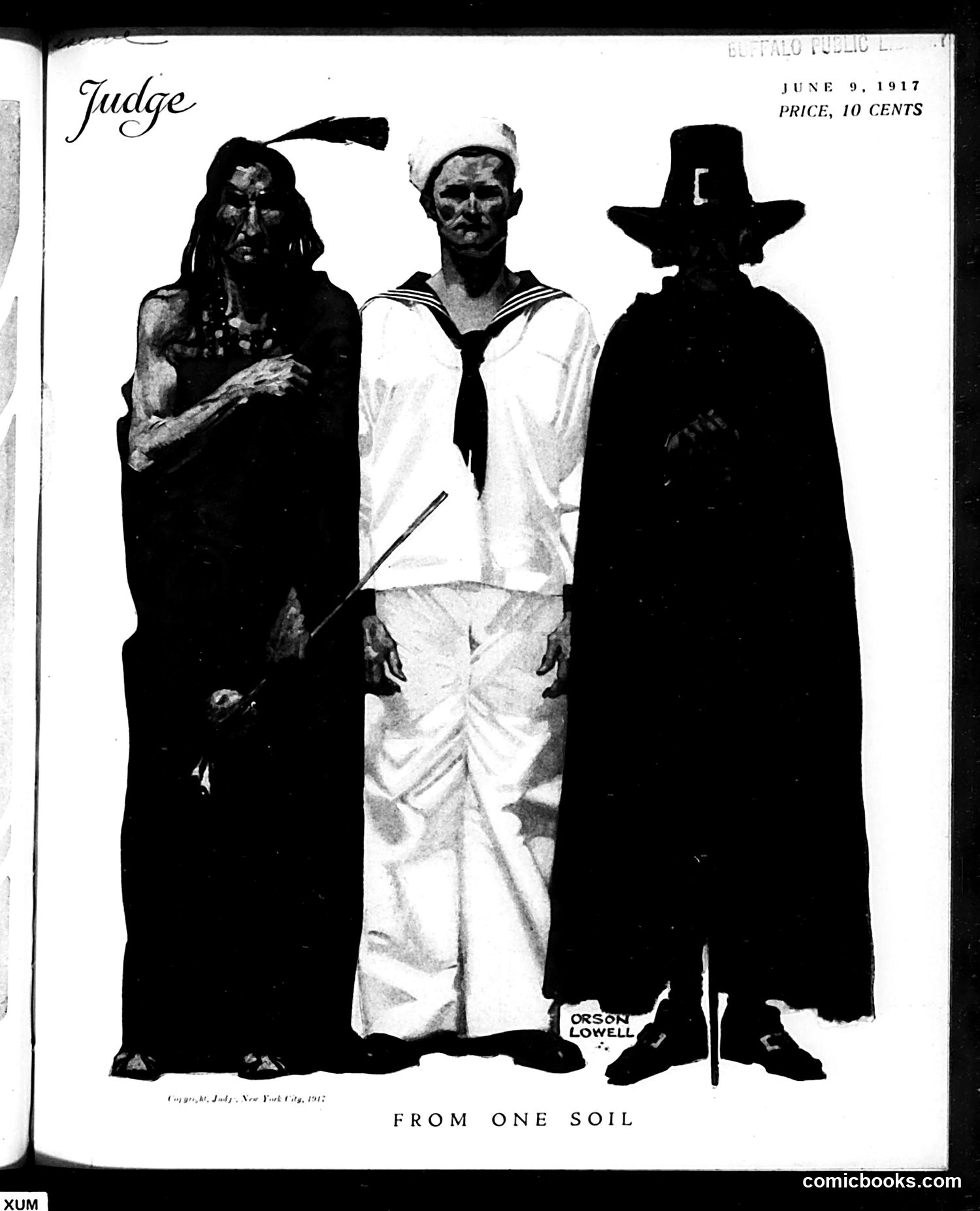
This cartoon depicts three figures representing different American populations: a Native American (left), a U.S. sailor (center), and what appears to be an immigrant or working-class figure (right). The title "From One Soil" suggests unity despite differences. Published during America's entry into World War I (April 1917), this satirical image likely comments on national unity and shared citizenship during wartime. The diverse representation—Native American, military, and civilian—emphasizes that all Americans, regardless of origin or background, belonged to one nation and shared responsibility for the war effort. The message appears patriotic rather than critical, promoting social cohesion during the national mobilization for war.
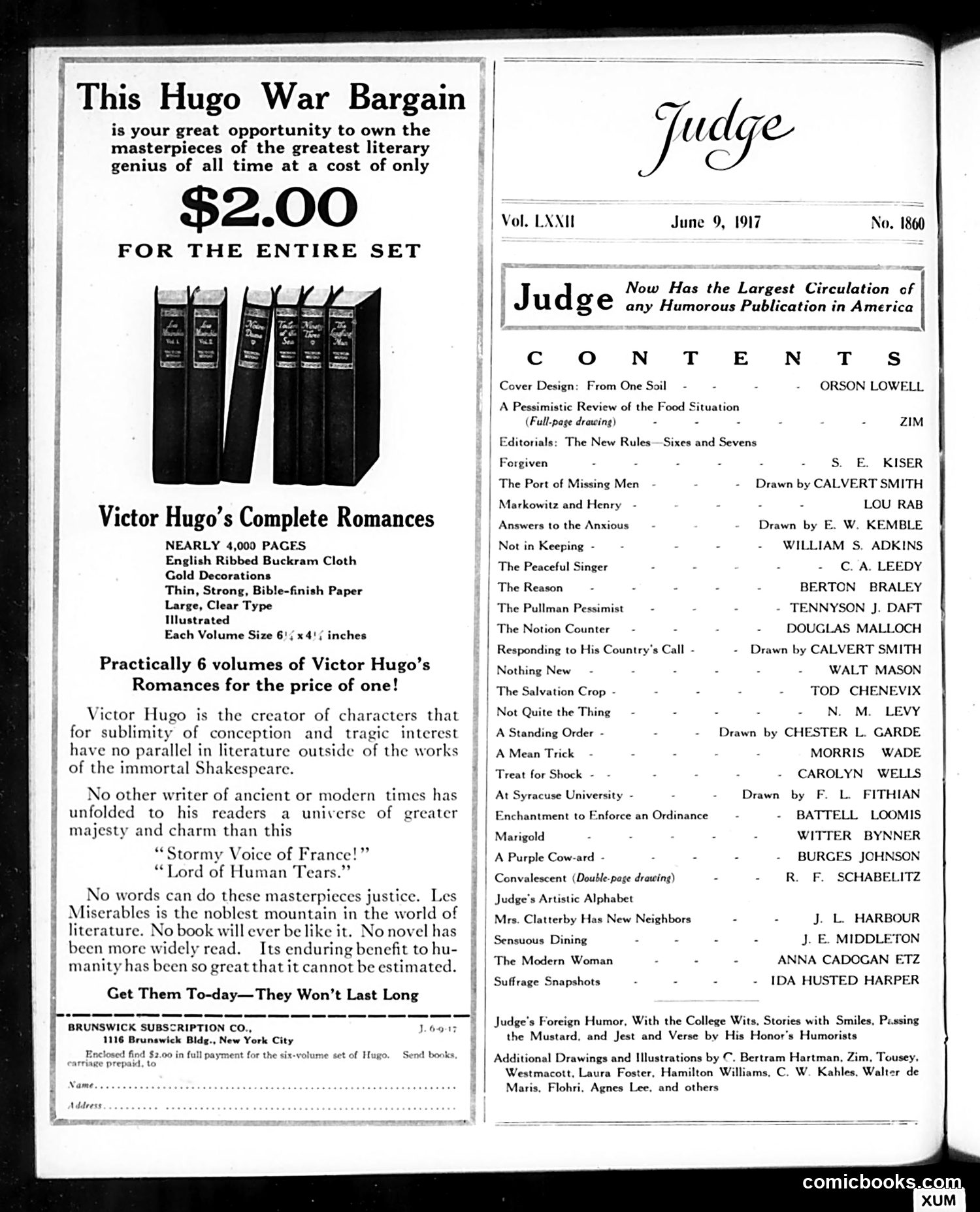
This page is primarily **advertising and table of contents** rather than political satire. The left side features a book advertisement for Victor Hugo's complete romances—"nearly 4,000 pages" for $2.00—emphasizing the bargain during wartime ("Hugo War Bargain"). The right side shows the contents page for Judge magazine's June 9, 1917 issue, listing numerous humorous articles and drawings by various contributors. The single visible cartoon appears to be titled "From One Soil" by Orson Lowell (the cover design), but the image is too small and unclear to discern its satirical meaning or subjects. Without seeing the actual cartoons referenced in the contents, we cannot determine the specific social or political commentary intended.
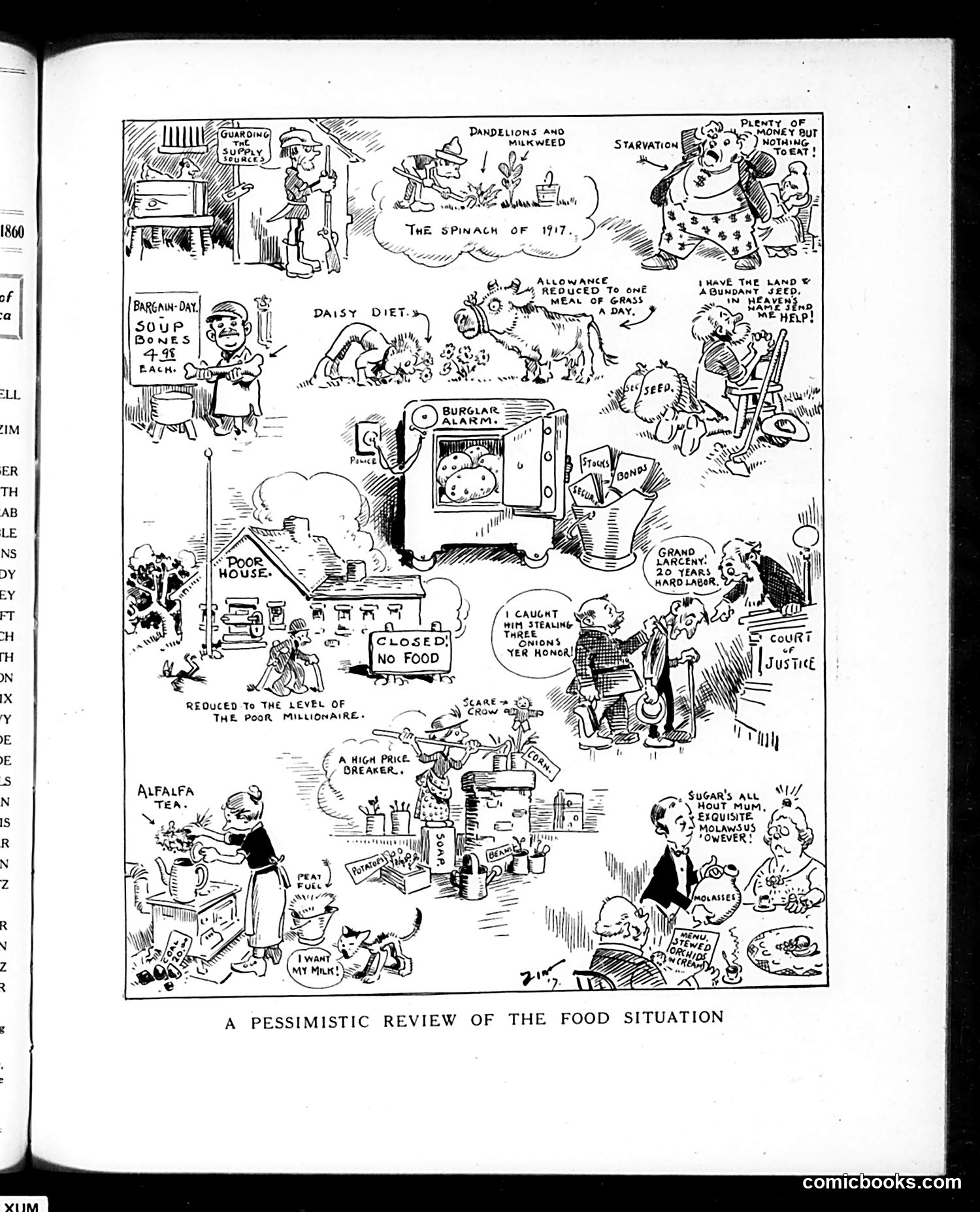
This 1917 cartoon satirizes widespread food shortages during World War I. The various panels depict the era's rationing and scarcity: - "The Spinach of 1917" mocks inadequate vegetable substitutes for meat - "Daisy Diet" shows minimal bone rations - "Bargain-Day Bones" depicts people purchasing meager scraps - A "Burglar Alarm" on a food house suggests desperation over theft - "Closed: No Food" reflects shuttered businesses - References to "Poor Millionaire" and "High Price Breaker" illustrate economic inequality despite shortages The cartoon criticizes both the food crisis itself and its unequal impact—wealthy people struggling while poor people suffer worse deprivation. The "Court of Justice" panel suggests authorities' inadequate response. Overall, it's a bitter commentary on wartime hardship and governmental failure to manage the emergency equitably.
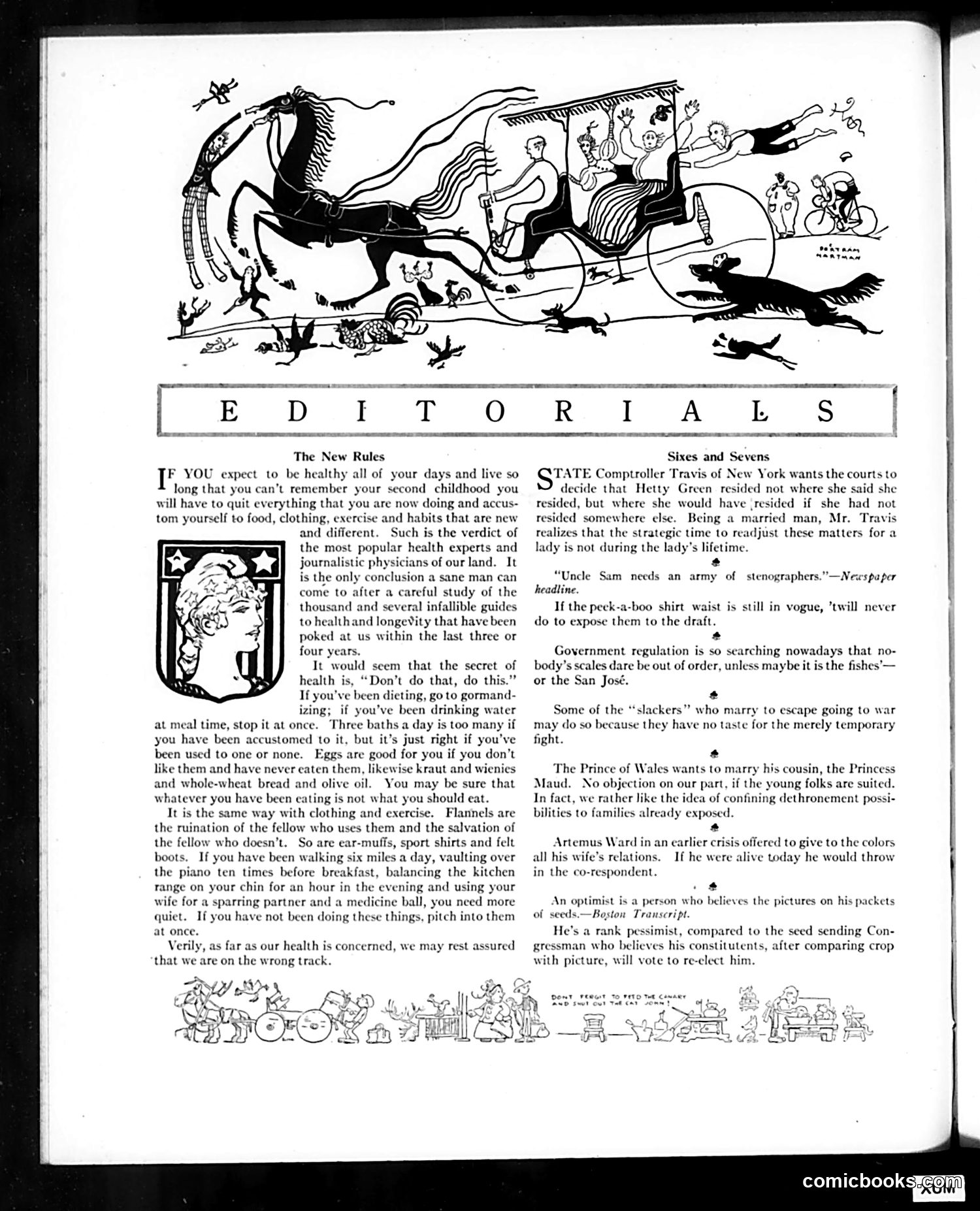
This appears to be an editorial page from Judge magazine featuring health advice and political commentary. The top illustration depicts a chaotic carriage scene, likely satirizing disorderly conduct or mismanagement. The left column ("The New Rules") offers tongue-in-cheek health guidance, ironically reversing popular wellness advice—telling readers to ignore doctors' recommendations, drink water sparingly, and avoid exercise. This satirizes contemporary health crazes and fad diets prevalent in the era. The right column ("Sixes and Sevens") contains brief political jabs. References include State Comptroller Travis, an "Uncle Sam needs stenographers" quip about military recruitment, and commentary on wartime profiteering and marriage evasion. The Prince of Wales marriage reference and Artemus Ward anecdote suggest commentary on social hypocrisy and political opportunism during what appears to be a wartime period.
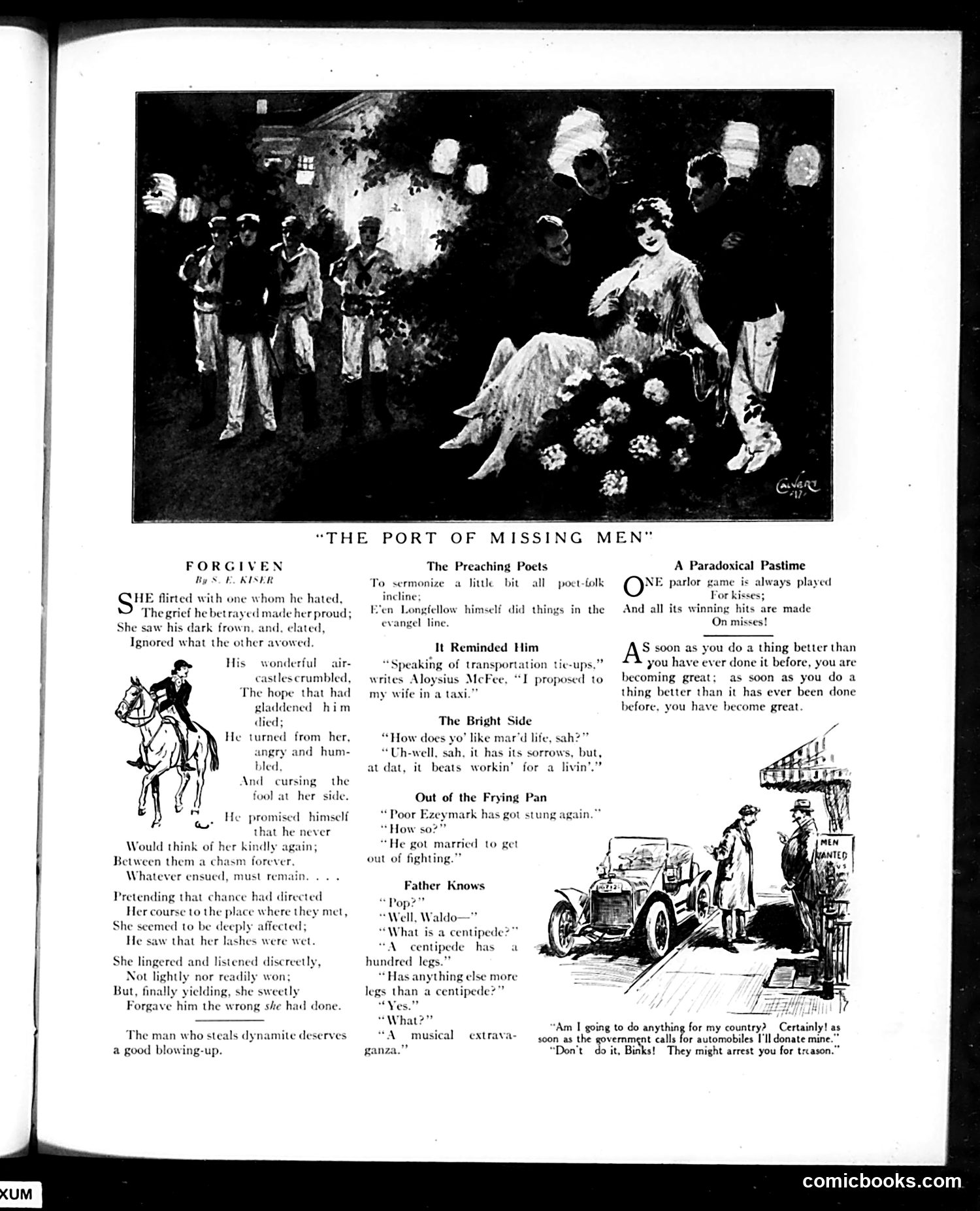
This Judge magazine page presents satirical poetry and cartoons mocking early 20th-century social pretensions and domestic life. **Top illustration**: "The Port of Missing Men" appears to depict a theatrical or supernatural scene with elegantly dressed figures and an angelic/cherub character, likely satirizing romantic escapism or marital infidelity fantasies. **Poetry sections** mock various social types: a woman scorned by an unfaithful husband, pretentious couples, and self-deluding individuals. The satire targets hypocrisy and vanity. **Right-side cartoon**: Shows an automobile scene where a man promises to donate his car to the government "for my country," while his companion warns "They might arrest you for treason"—mocking both patriotic posturing and automotive pride during an era when automobiles were expensive status symbols. The page's overall theme ridicules social pretension and false virtue.
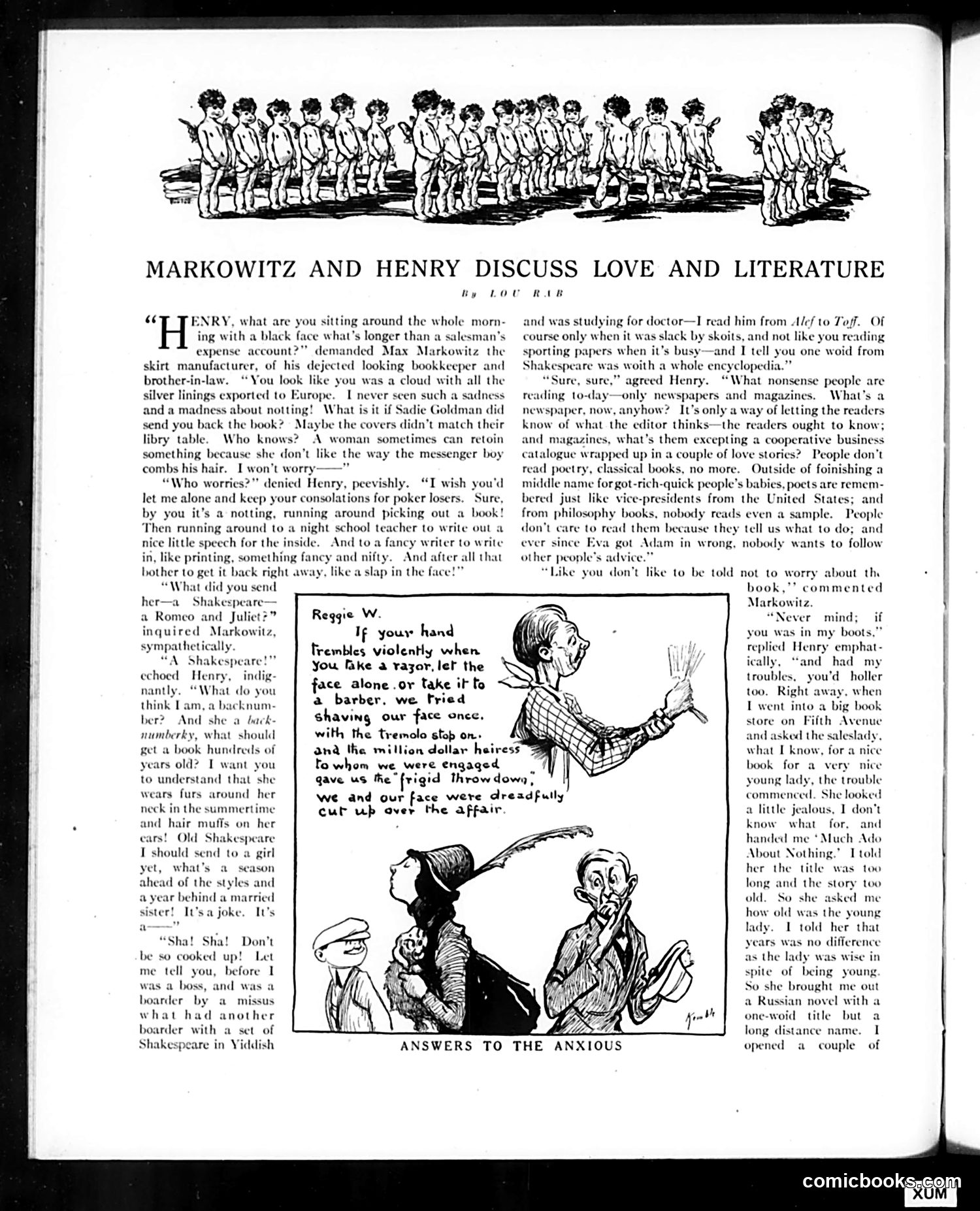
This page satirizes literary pretension and romantic self-deception among the educated classes. Two characters—Markowitz (identified by his name) and Henry—debate whether reading Shakespeare and classics constitutes genuine intellectual engagement. Henry defends popular literature (newspapers, magazines, love stories), while Markowitz mocks this as beneath serious readers. The irony emerges when Henry reveals his own romantic troubles: he sought a book for "a very nice young lady" but was sold *Much Ado About Nothing*—a title the saleswoman apparently found literally descriptive of their relationship. The cartoon mocks both characters: Markowitz's snobbery about "real" literature versus Henry's naive romanticism and the saleswoman's crude judgment. The humor targets pretentiousness on all sides.
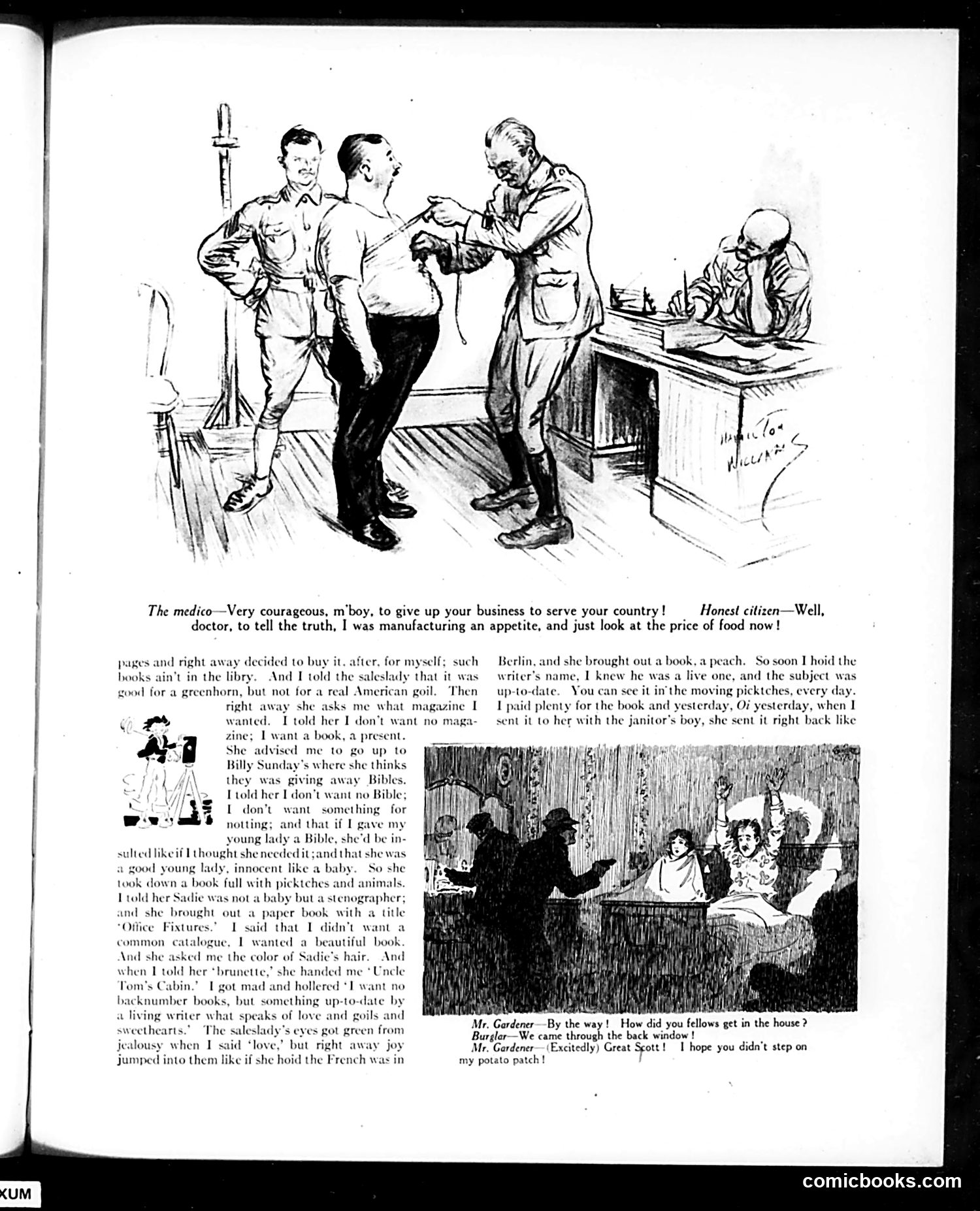
This page contains three satirical pieces reflecting early 20th-century American concerns: **Top Cartoon:** A medico (doctor) praises a businessman for patriotic military service, but the "honest citizen" reveals he actually manufactured artificial appetite—profiting from inflated wartime food prices. The satire criticizes profiteers who exploit national crises rather than genuinely serving. **Middle Text:** A humorous monologue about a man shopping for a book to give his stenographer girlfriend named Sadie. He rejects various suggestions (Bible, animal pictures, office catalogs, outdated classics) until finding something "up-to-date by a living writer" about love. The satire mocks both commercialized gift-giving and changing literary tastes. **Bottom Cartoon:** A homeowner discovers burglars entered through his back window; his only concern is the potato patch—satirizing misplaced priorities during wartime when food production was nationally important. All three pieces reflect WWI-era anxieties about profiteering, changing social values, and civilian responsibilities.
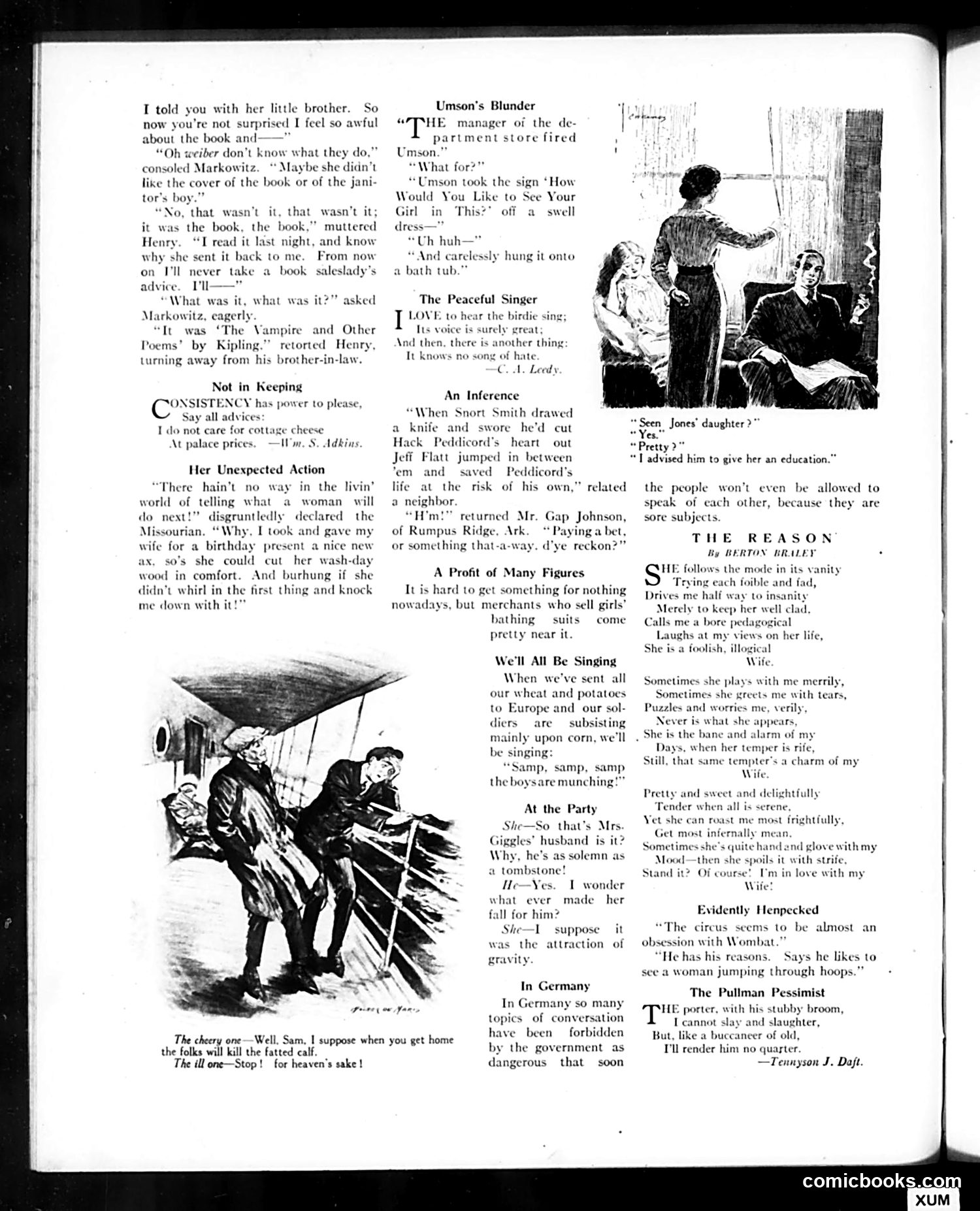
This page contains multiple brief humorous pieces typical of early 20th-century American satirical magazines: **"Umson's Blunder"**: A department store manager fires an employee for moving a suggestive dress advertisement sign ("How Would You Like to See Your Girl in This?") onto a bathtub, creating unintended absurdist humor. **"Her Unexpected Action"**: A Missouri man complains that his wife unexpectedly used an axe he gave her as a birthday gift as a weapon against him—satirizing the unpredictability of women's behavior, a common stereotype of the era. **"In Germany"**: Mockery of German wartime censorship, suggesting the government has banned so many conversation topics that citizens will soon have nothing to discuss except "sore subjects." **Other pieces** include light verses and anecdotes about marriage, rural life, and social observation. The overall tone reflects early-1900s attitudes toward gender relations, rural life, and international affairs, using gentle ridicule rather than sharp political commentary.
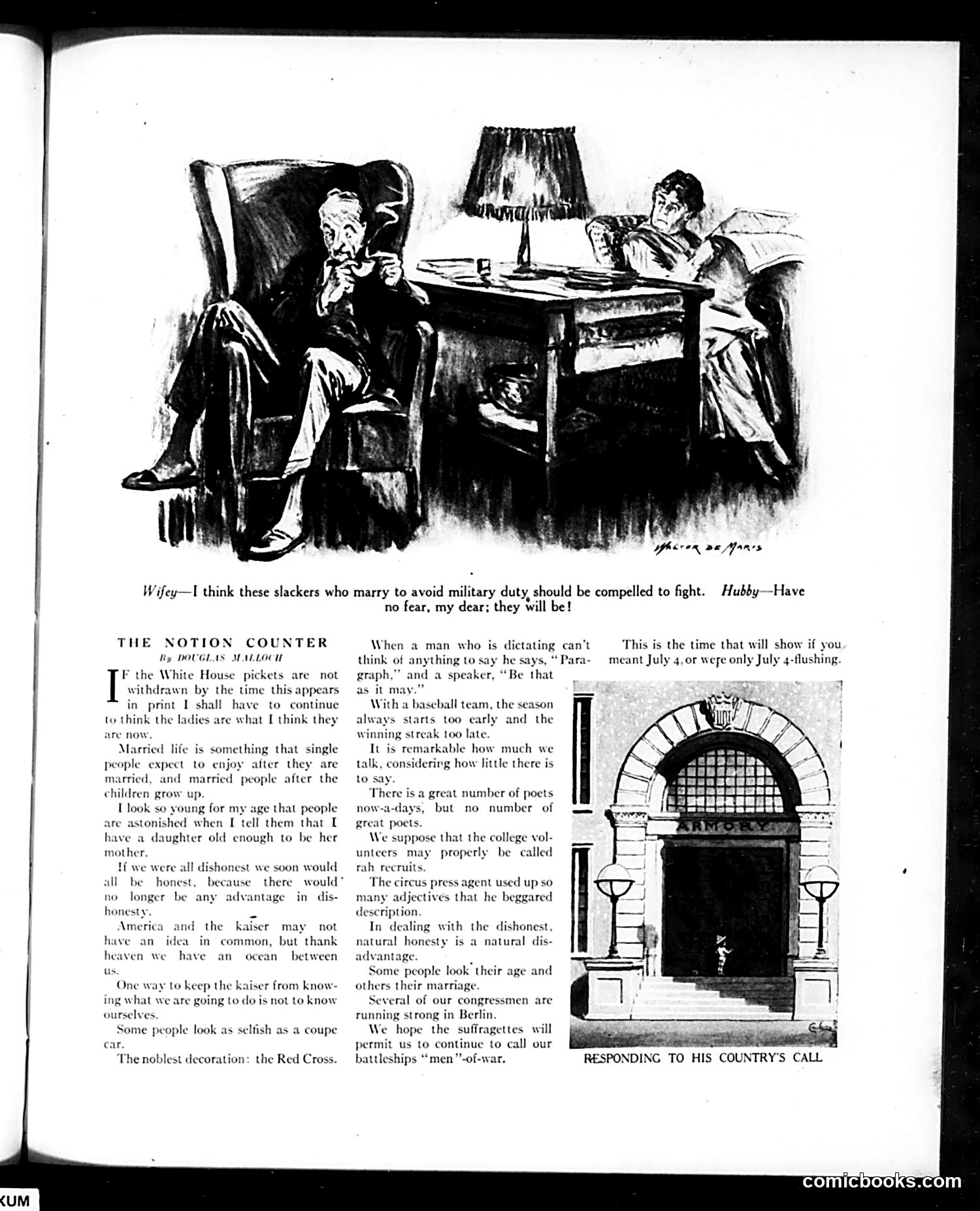
**The Top Cartoon** depicts a domestic debate about military conscription during WWI. The wife argues that men avoiding the draft ("slackers") should be forced to fight; the husband reassures her they will be. The satire targets both the draft controversy and gender dynamics—the wife's hawkish patriotism contrasts with the husband's confident acceptance, mocking how the home front debates military policy. **"The Notion Counter"** column by Douglas Malloch contains brief satirical observations on American life and the war effort. Key points include: criticism of congressmen "running strong in Berlin" (appearing unpatriotic); a joke about suffragettes and battleship nomenclature (women's rights activism); and reflections on honesty, poets, and marriage. The bottom image labeled "Responding to His Country's Call" (showing an architectural entrance) likely illustrates enlistment or patriotic duty, though its exact reference is unclear. The overall theme reflects WWI-era American anxieties about patriotism, draft dodging, and changing social roles.
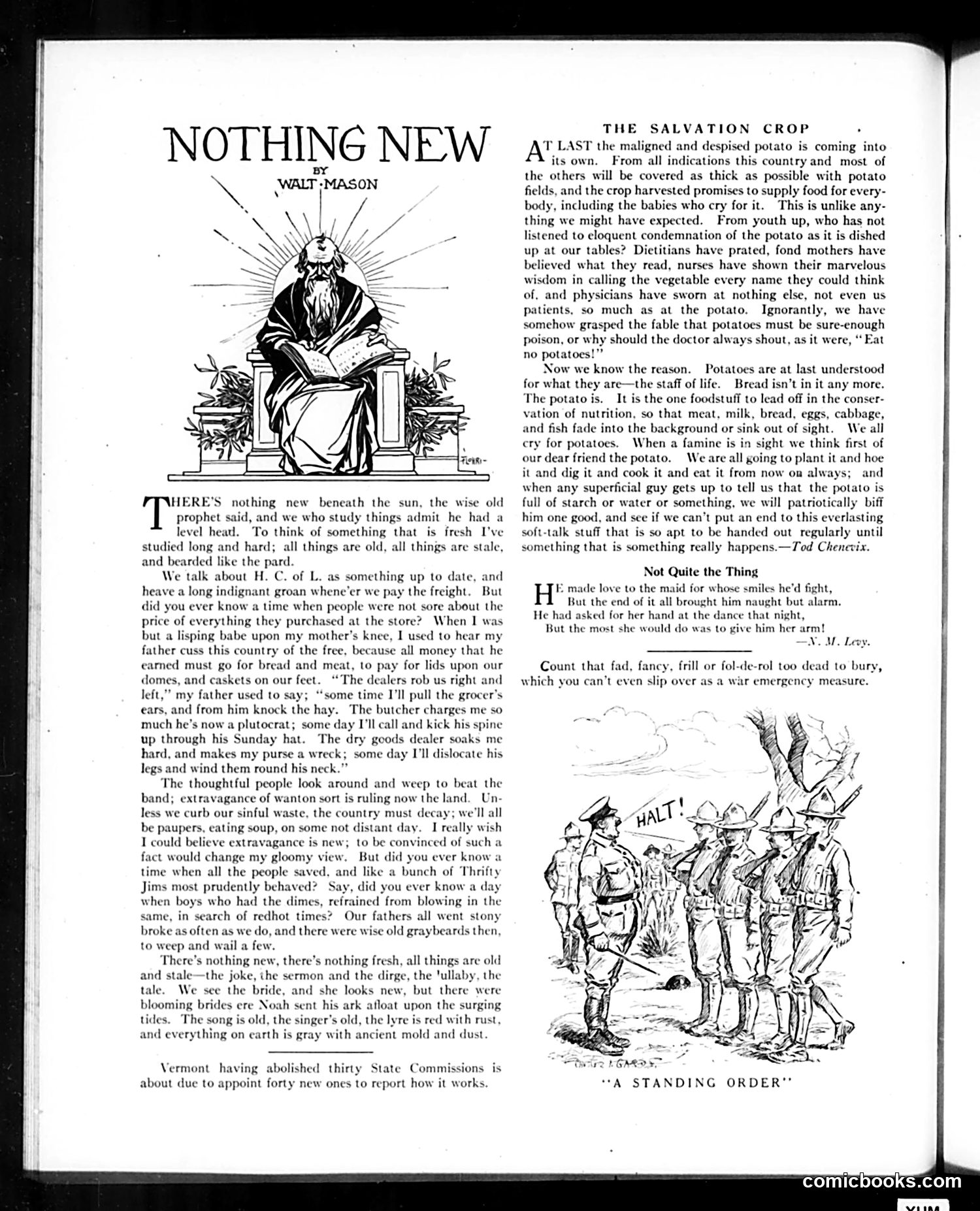
**"Nothing New" (left column):** Walt Mason's philosophical essay argues that complaints about high cost-of-living (H.C. of L.) are timeless, not modern. Mason uses nostalgic examples—his father cursing inflated prices for bread, meat, and services—to claim every generation believes *their* era uniquely suffers economic hardship. The piece satirizes contemporary anxiety by insisting human nature and economic greed are unchanging. A closing jab at Vermont's bureaucratic habit adds topical humor. **"The Salvation Crop" (right column):** This celebrates the potato as a wartime food solution. The article ironically notes that doctors and nutritionists previously condemned potatoes, but now recognize them as essential sustenance ("staff of life"). The timing suggests this is WWI-era, when food conservation became patriotic duty. The shift from dismissing potatoes to exalting them reflects wartime propaganda reframing humble foods as patriotic necessities. **"A Standing Order" (illustration):** Depicts soldiers halting, likely illustrating military discipline or wartime civilian compliance with food rationing directives.
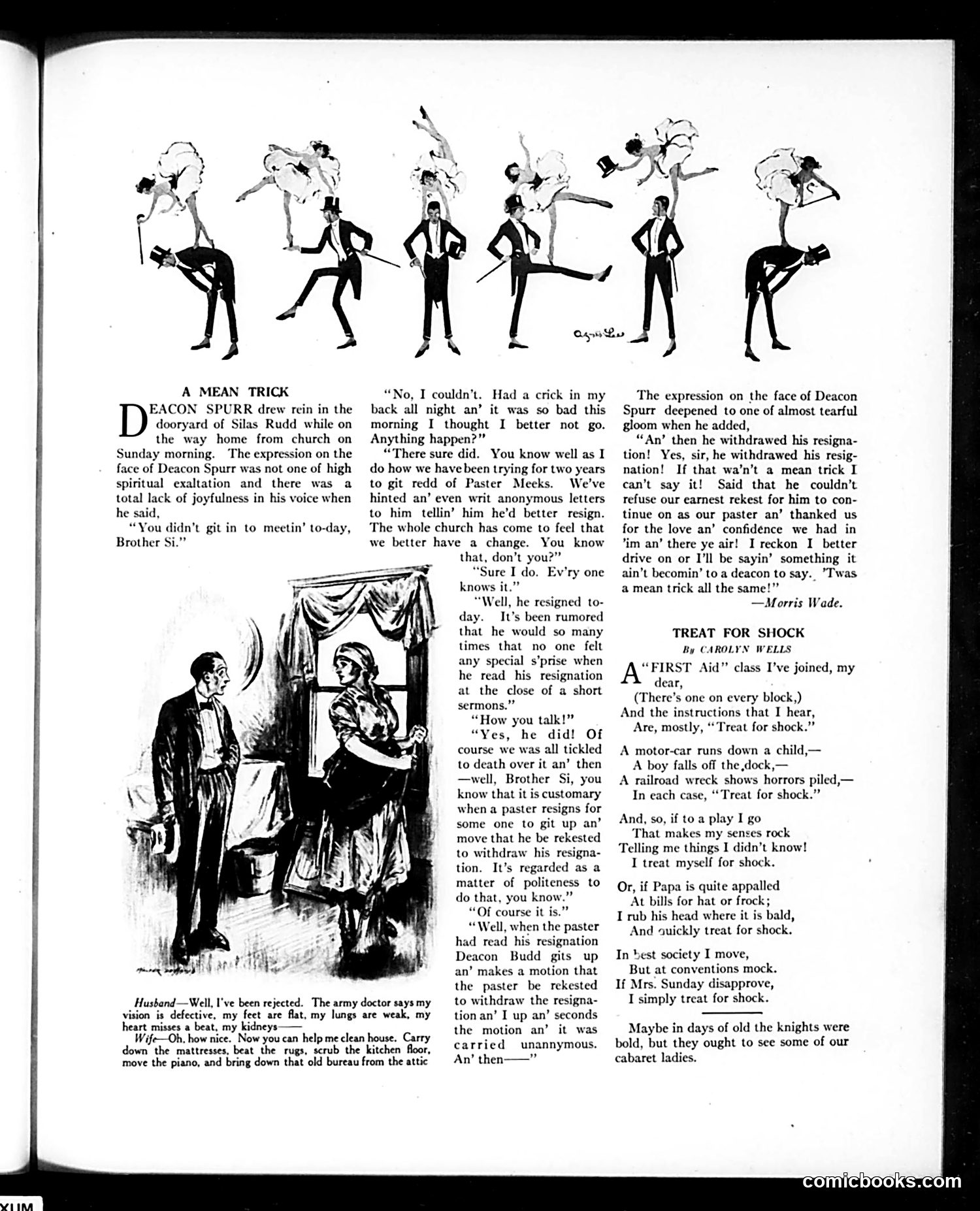
**"A Mean Trick"** satirizes small-town church politics and hypocrisy. Deacon Spurr complains that the congregation spent two years trying to remove Pastor Meeks through hints and anonymous letters. When Meeks finally resigned, the deacons made a formal motion requesting he stay—a polite church custom. Meeks accepted, withdrawing his resignation. Spurr feels "tricked" because their subtle campaign failed when put to the test. The humor lies in the gap between the deacons' genuine desire for change and their inability to be direct, their underhanded tactics backfiring when forced into honest procedure. The accompanying illustration shows a husband rejected from military service due to physical defects, now facing domestic labor while his wife exploits his "incapacity"—ironic commentary on wartime priorities. **"Treat for Shock"** is a light poem by Carolyn Wells joking that "treating for shock" has become a panacea for every modern problem.
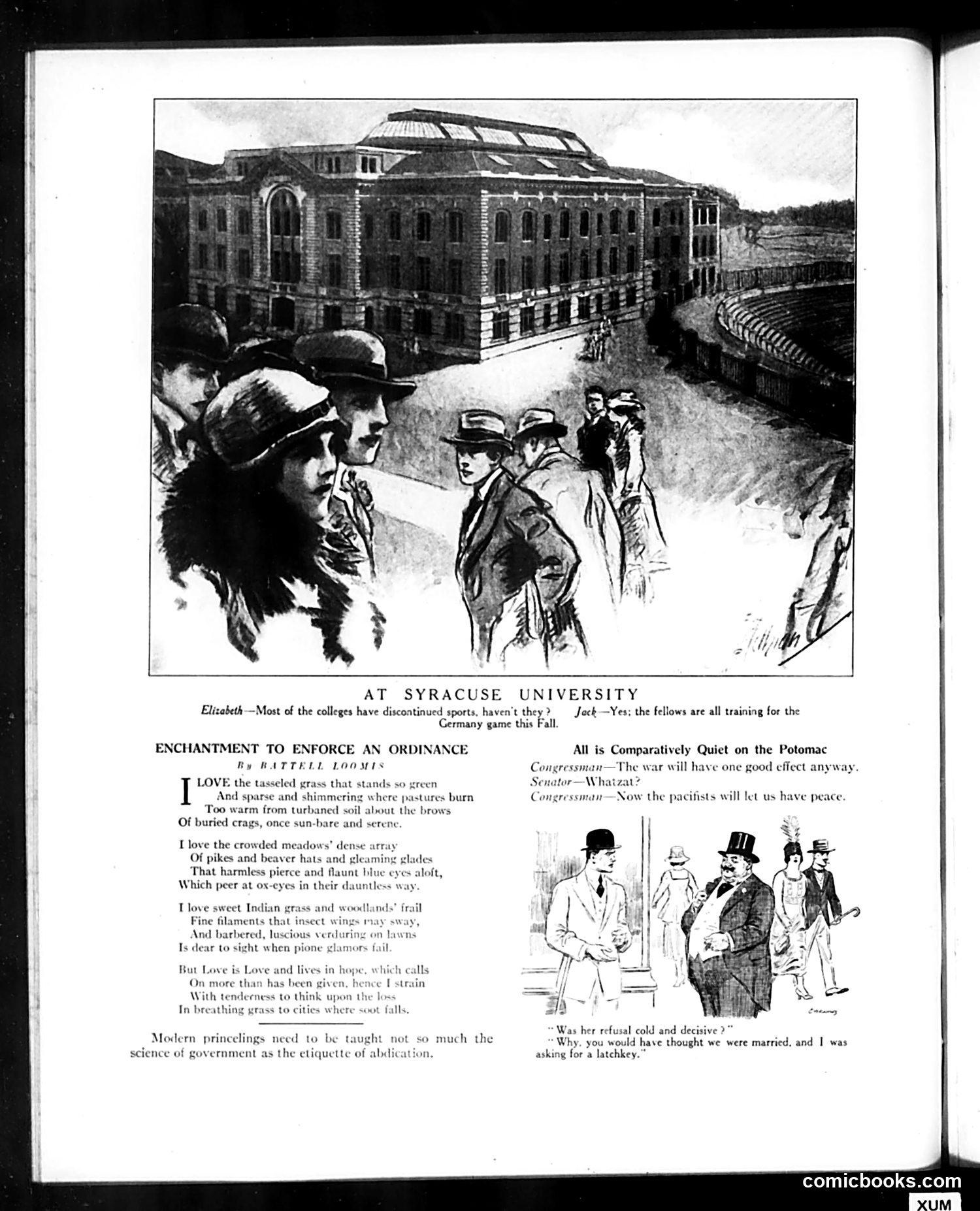
This page contains two separate satirical pieces from Judge, likely from WWI era (based on references to "Germany game" and pacifists). **Top cartoon**: "At Syracuse University" depicts college students discussing how athletics have been suspended because young men are "training for the Germany game this Fall"—a dark joke about military preparation and young men being conscripted or enlisting for potential combat with Germany. **Middle section**: "Enchantment to Enforce an Ordinance" is a sentimental poem by Brattell Loomis celebrating pastoral nature, appearing unrelated to the satirical content. **Bottom cartoon**: "All is Comparatively Quiet on the Potomac" shows a congressman and senator discussing how the war will finally silence pacifists—satirizing how wartime is used to suppress anti-war voices and domestic dissent. **Right cartoon**: A domestic joke about a husband asking for a latchkey (house key), with the wife misinterpreting this as marriage proposal language—unrelated political satire. The page satirizes both militarism and political suppression during wartime.
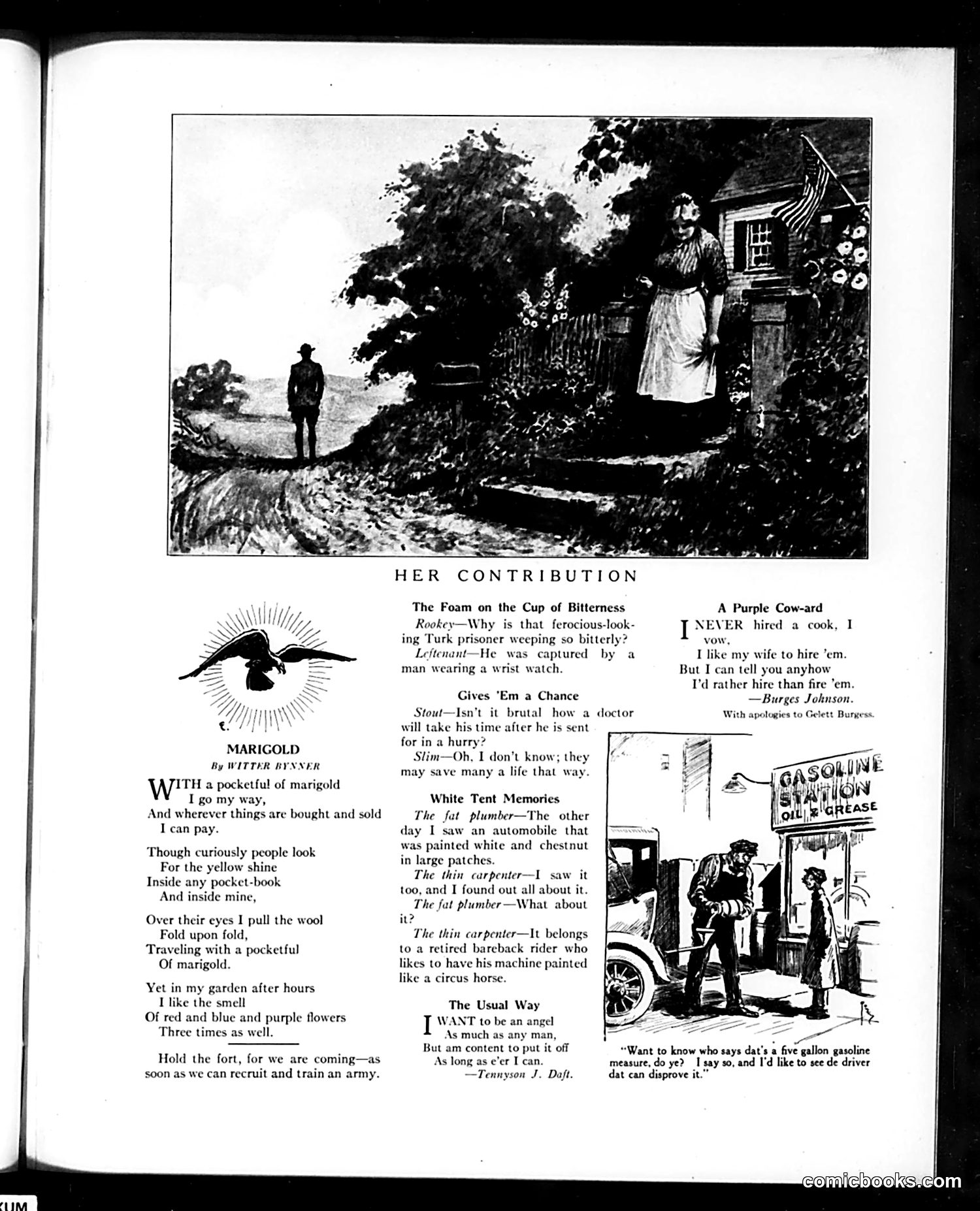
This page from *Judge* magazine contains several short humorous pieces reflecting early 20th-century American life and concerns: **"Marigold"** (poem by Witter Bynner) uses flowers as metaphor for wealth—carrying marigolds as currency while preferring the authentic beauty of real garden flowers. It suggests tension between commercial life and genuine values. **"Her Contribution"** features wartime-related jokes (references to Turkish prisoners and military recruitment suggest WWI context). The humor is crude: capturing a Turk via wristwatch implies racial/cultural stereotyping common to the era. **"White Tent Memories"** jokes about wartime automotive camouflage painted on civilian cars. **"A Purple Cow-ard"** parodies Gelett Burgess's famous nonsense poem "Purple Cow," applying it to domestic hiring practices. **The gasoline cartoon** satirizes dishonest gas-station attendants inflating measurements—reflecting post-war consumer fraud concerns. Overall: light satirical commentary on wartime life, commercial dishonesty, and social pretension typical of *Judge's* middle-class readership.
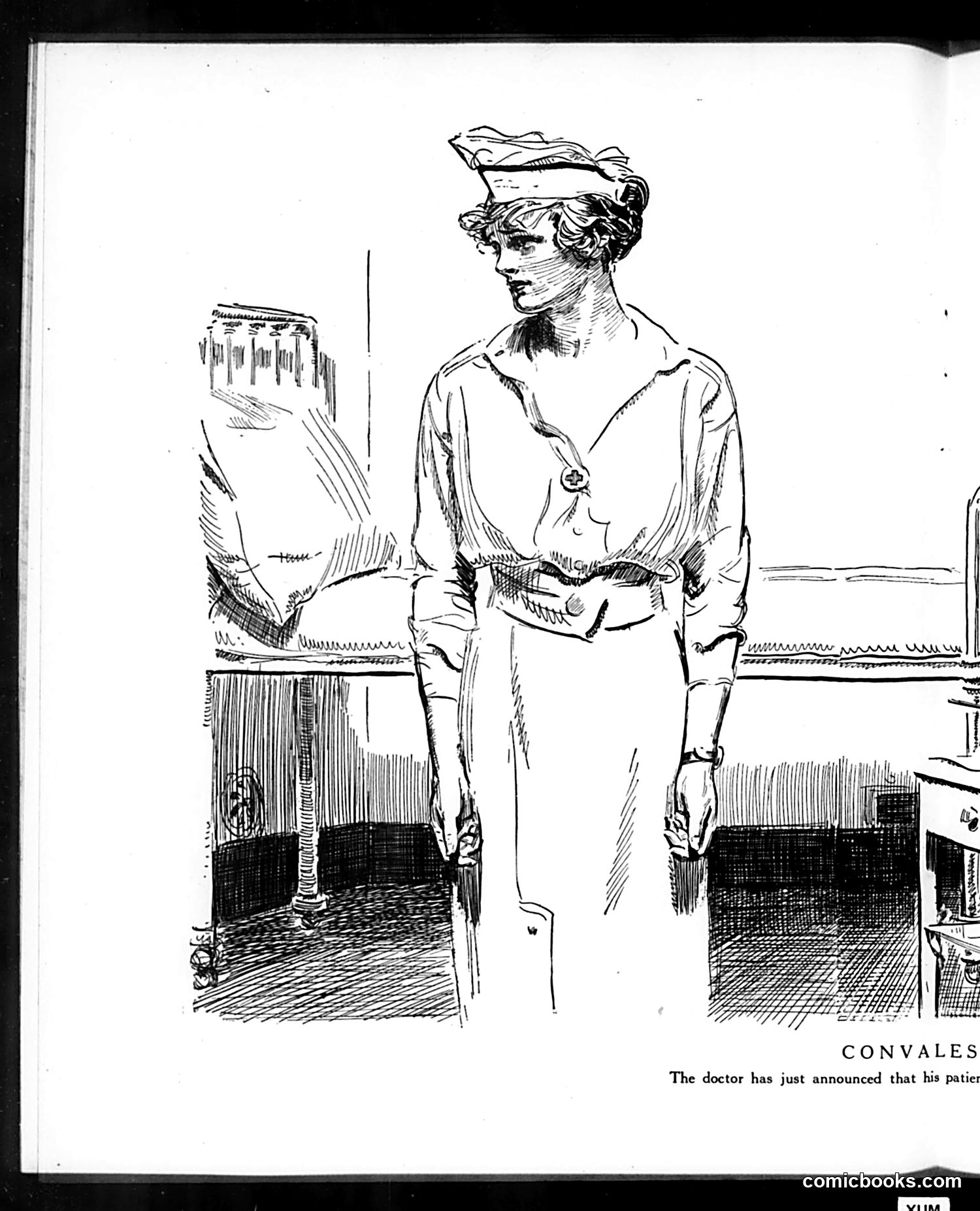
This appears to be a medical/hospital scene showing a nurse or healthcare worker standing beside a patient's bed. The OCR text is incomplete, cutting off mid-sentence ("The doctor has just announced that his patier[nt]..."), so the specific joke or satirical point cannot be fully determined from what's visible. The cartoon likely plays on convalescence (recovery from illness) — the incomplete caption suggests the doctor has made some announcement about the patient's condition or recovery prospects. Without the full text, the specific satire or humor being targeted remains unclear. The scene depicts early 20th-century hospital settings and gender roles around medical care, but the actual punchline or social commentary is lost due to the truncated caption.
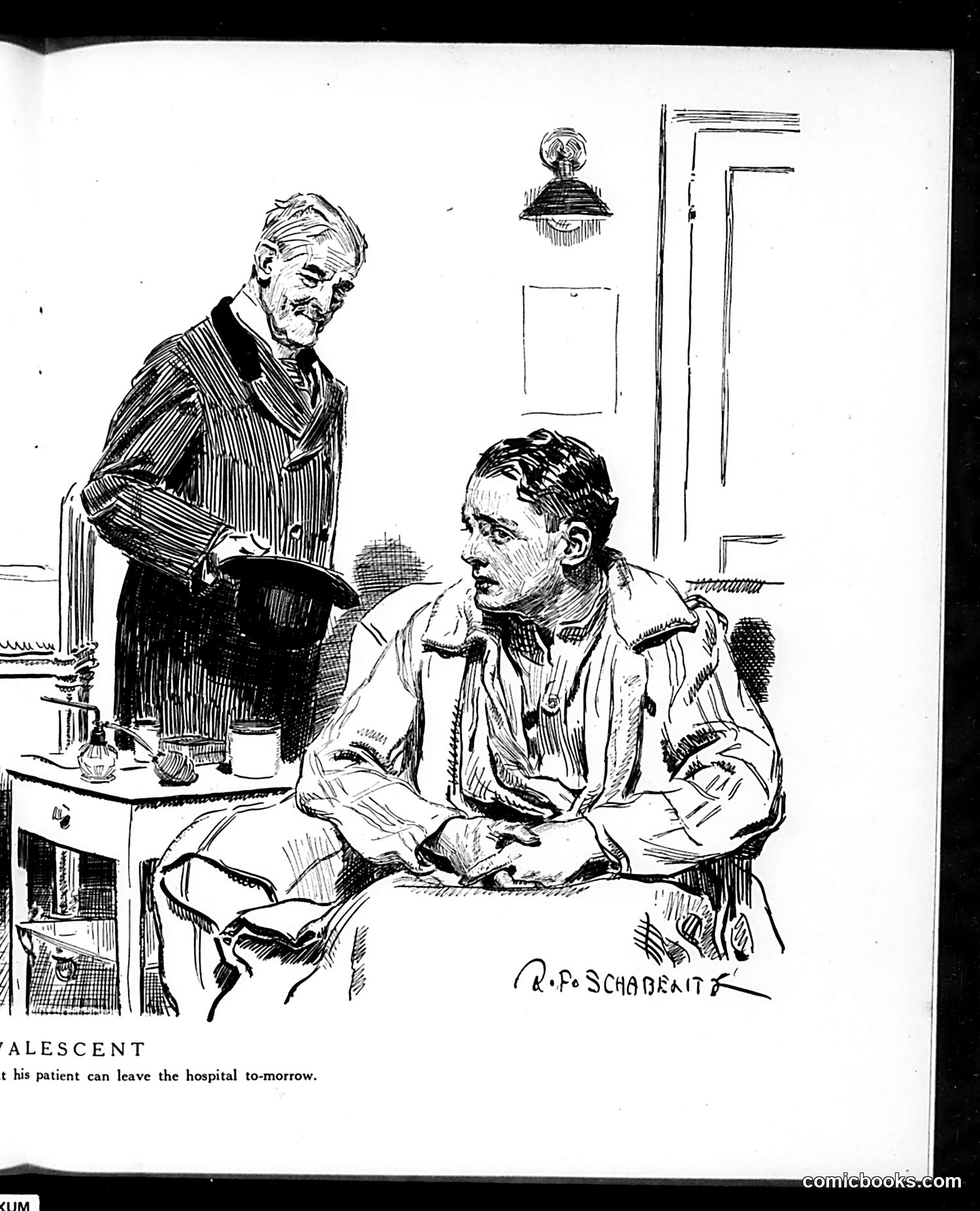
This sketch by R. P. Schobaert depicts a medical scene: a doctor (standing) informs a seated patient that he can leave the hospital tomorrow. The cartoon's satire likely centers on the patient's apparent skepticism or concern about his discharge—his facial expression suggests worry rather than relief. The humor appears to target either: (1) overly hasty hospital discharges, (2) questionable medical competence, or (3) the patient's dubious health status despite the doctor's optimism. The title fragment "TALESCENT" is unclear in context, possibly truncated OCR text. Without the full caption and surrounding page context, the specific political or social reference remains uncertain, though the piece critiques medical practice standards typical of Judge's satirical approach.
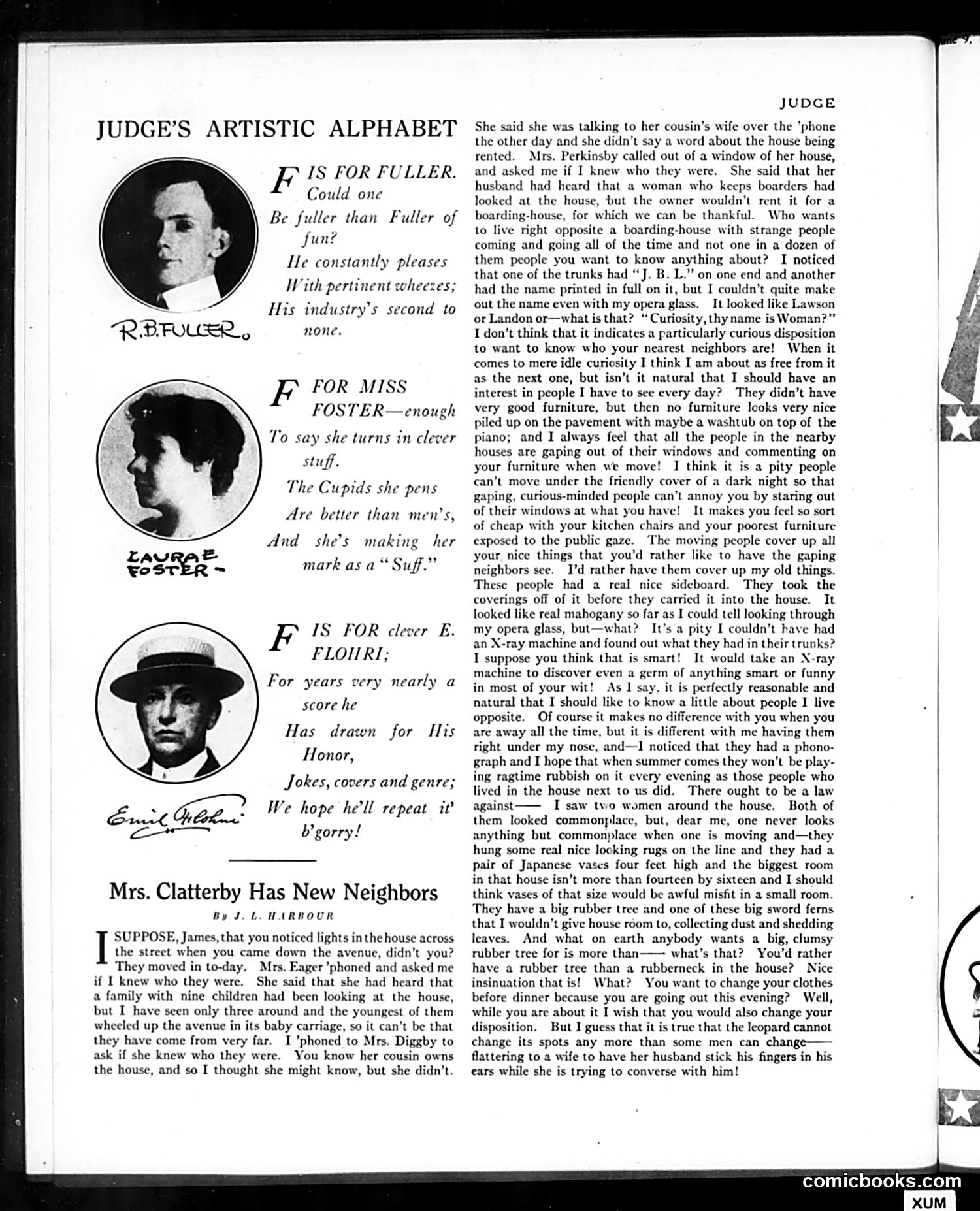
This page from *Judge* contains two sections: **"Judge's Artistic Alphabet"** features brief, complimentary profiles of cartoonists/contributors: - R.B. Fuller (humor/wheezers) - Miss Foster (draws Cupids, noted as "Suff"—likely suffragist) - E. Florri (longtime staff artist) **"Mrs. Clatterby Has New Neighbors"** by J.L. Harbour satirizes suburban nosiness. A gossipy woman obsesses over new neighbors' identities and possessions, rationalizing her curiosity as natural rather than intrusive. She admits wanting an X-ray to peek in their trunks, yet insists this isn't truly nosy—just reasonable interest in people living "opposite." The satire targets feminine busybodies and their self-deluding justifications for invasive neighborhood surveillance, a common *Judge* theme mocking middle-class social pretensions and hypocrisy.
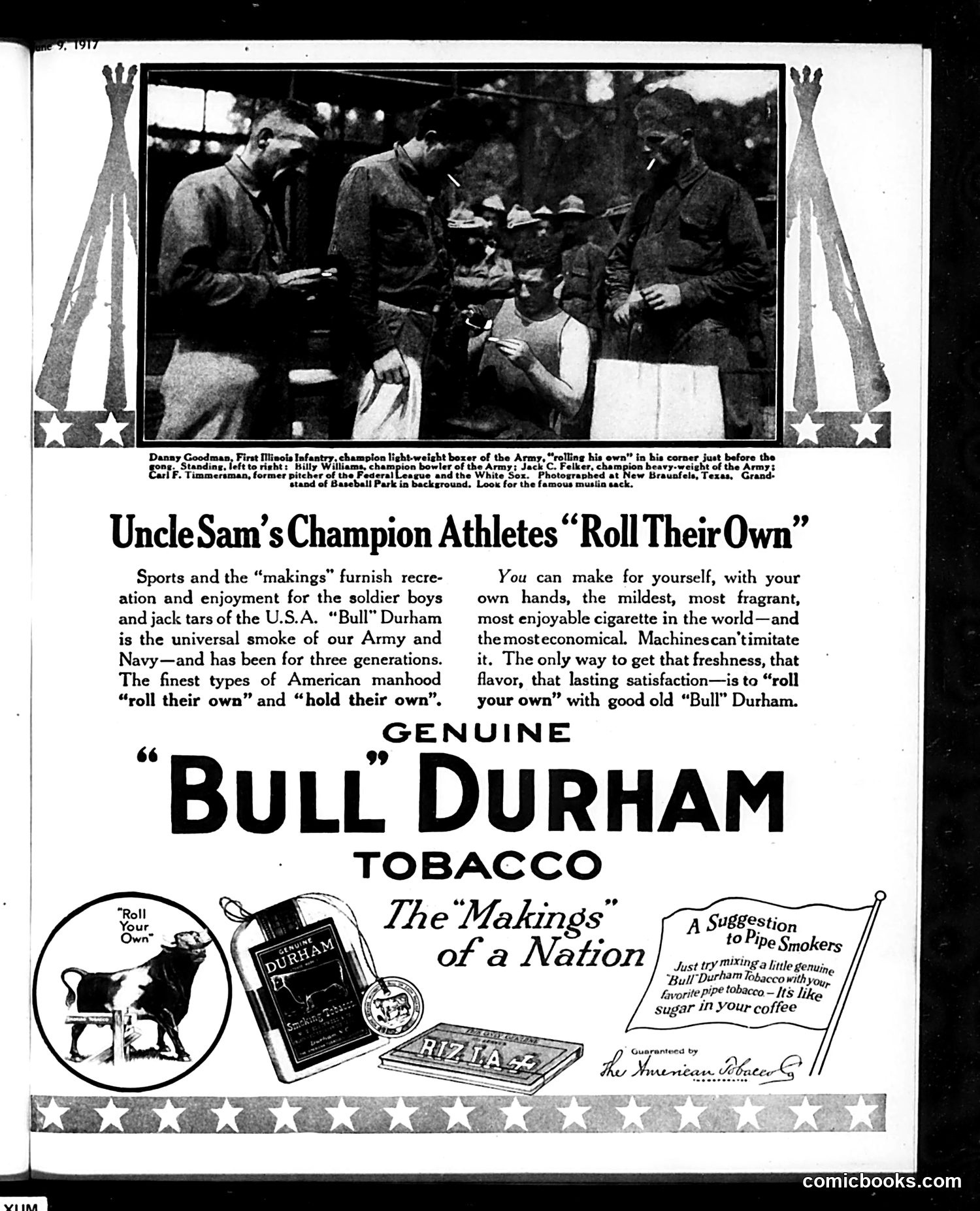
This is a **Bull Durham tobacco advertisement**, not political satire. It uses patriotic and military imagery to market cigarette rolling tobacco during World War I (the page is dated 1917). The photograph shows three Army champion athletes (boxer Danny Goodman, bowler Billy Williams, and heavyweight Jack C. Felker) demonstrating hand-rolling cigarettes. The ad's pun—"roll their own"—plays on both the literal act of rolling tobacco and the American idiom meaning to be self-sufficient. The advertisement explicitly connects the product to patriotism: Bull Durham has been smoked by "our Army and Navy...for three generations." By featuring champion soldiers, the ad implies that strong American manhood chooses this brand. The phrase "The Makings of a Nation" doubles as product branding (referring to rolling papers) and nationalistic messaging, positioning the tobacco as fundamentally American during wartime. This is commercial propaganda using military prestige and athletic achievement to sell cigarettes.
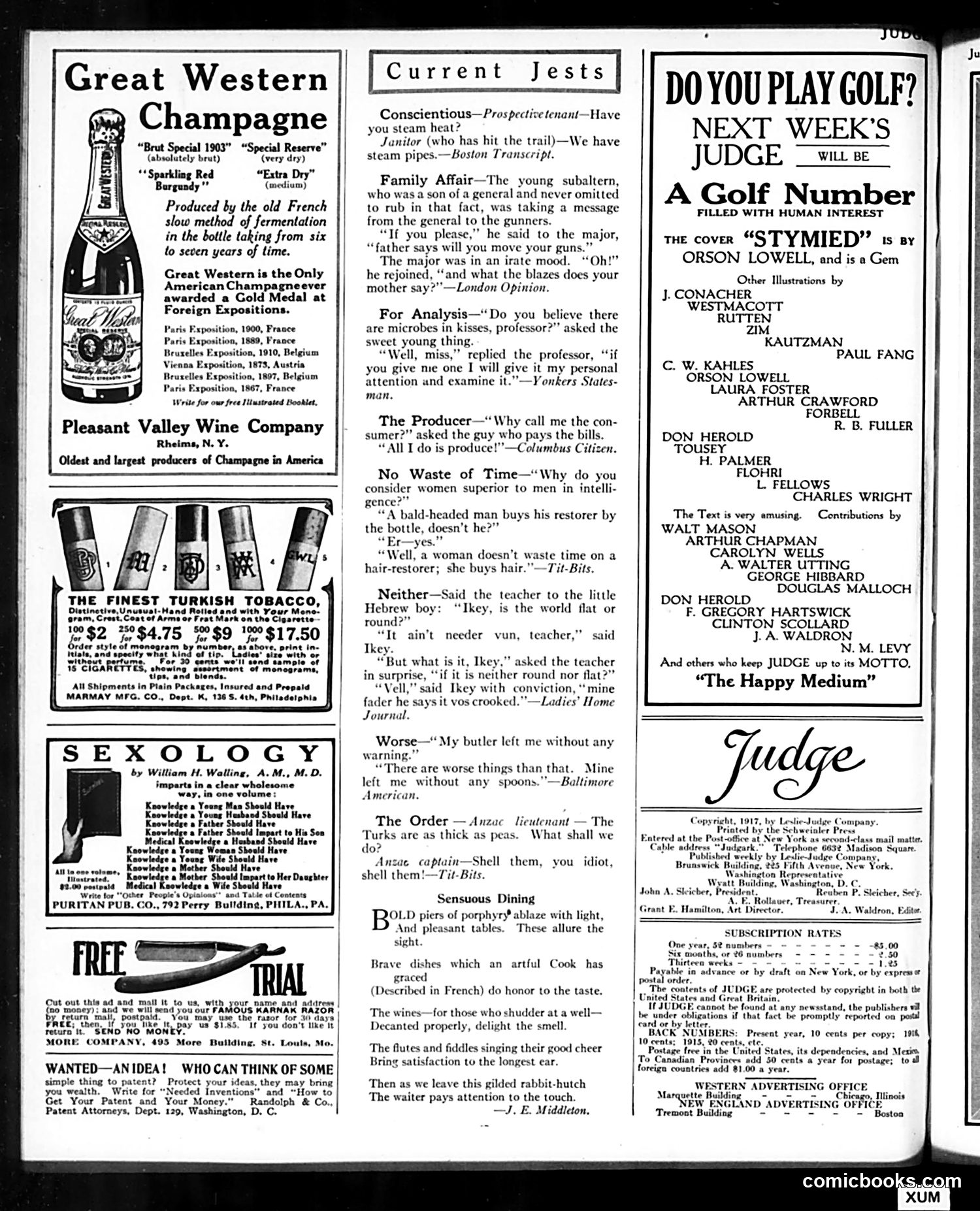
This page is primarily **advertisements and editorial matter** rather than satirical cartoons. The content includes: **Advertisements:** Great Western Champagne, Turkish tobacco cigarettes, a "Sexology" book, and a razor company occupy the left side—typical luxury goods targeting Judge's upper-class readership. **"Current Jests" section:** A collection of brief, light humor pieces typical of the era, featuring: - Wordplay about tenants, military officers, and scientific professors - Ethnic humor (a "Hebrew boy" named Ikey with stereotypical dialect) reflecting period attitudes - Gender jokes about women's vanity regarding hair - An Australian/Turkish military joke (likely WWI-era, given the 1917 copyright) **Right page:** Announces next week's golf-themed issue with cover art by Orson Lowell titled "Stymied," plus contributor credits. The overall tone is genteel, apolitical humor for an affluent audience—jokes about servants, professors, and social etiquette. There are no clear political cartoons or caricatures visible on this particular page.
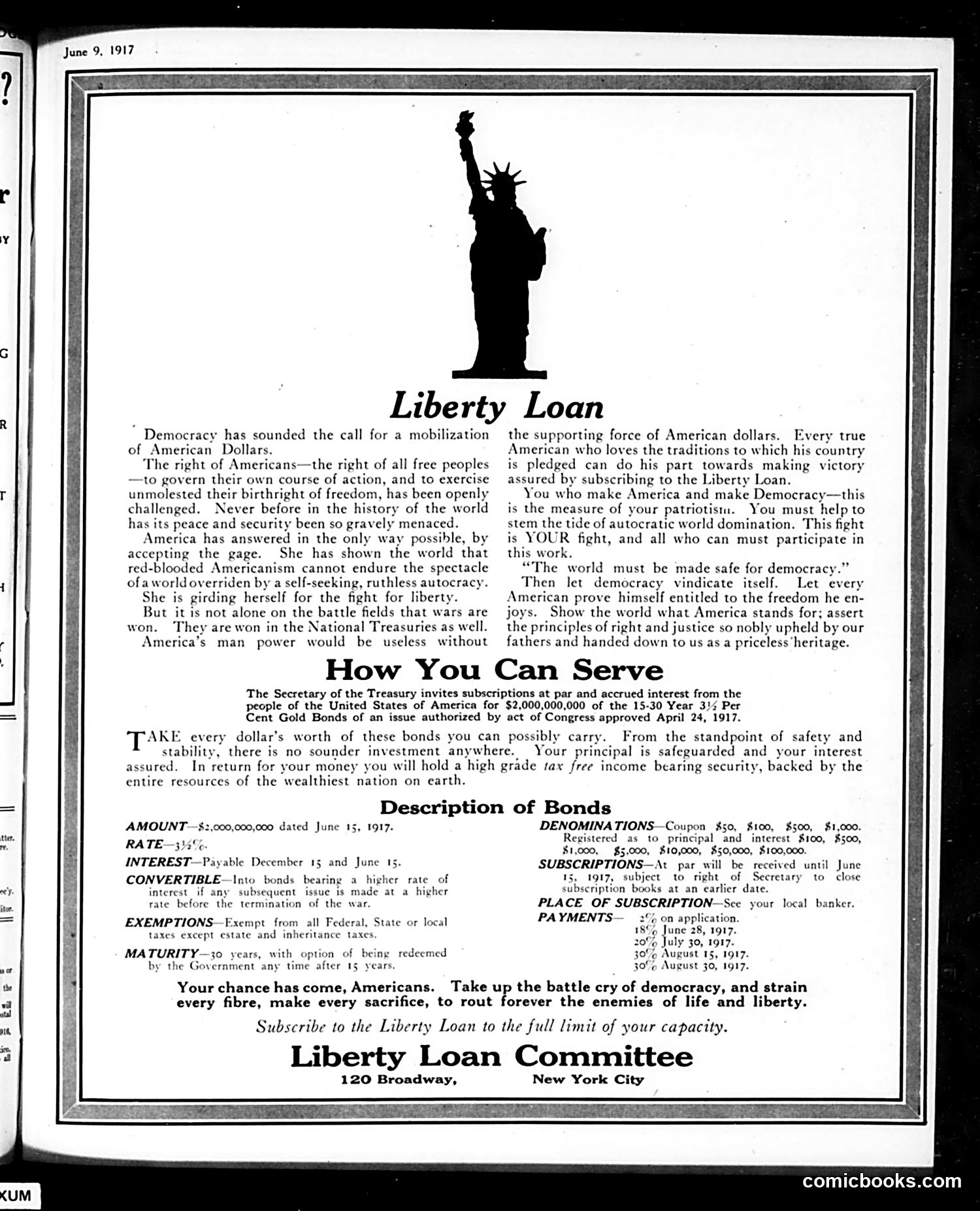
This is primarily a **government bond advertisement**, not satire. Published during America's first year in World War I, it promotes the Liberty Loan—a massive Treasury Department fundraising effort to finance the war effort. The Statue of Liberty silhouette symbolizes American democracy under threat. The text frames bond purchases as patriotic duty, arguing that financial contribution equals military sacrifice. Phrases like "the world must be made safe for democracy" (Wilson's actual war justification) and warnings against "autocratic world domination" (Germany) appeal to patriotic obligation. The ad presents bonds as safe investments while *conflating* financial participation with defending freedom itself. For modern readers, this exemplifies WWI-era propaganda: converting economic obligation into moral imperative, suggesting that buying bonds—not combat—represents the citizen's proper wartime role. The page is essentially selling both bonds and patriotism simultaneously.
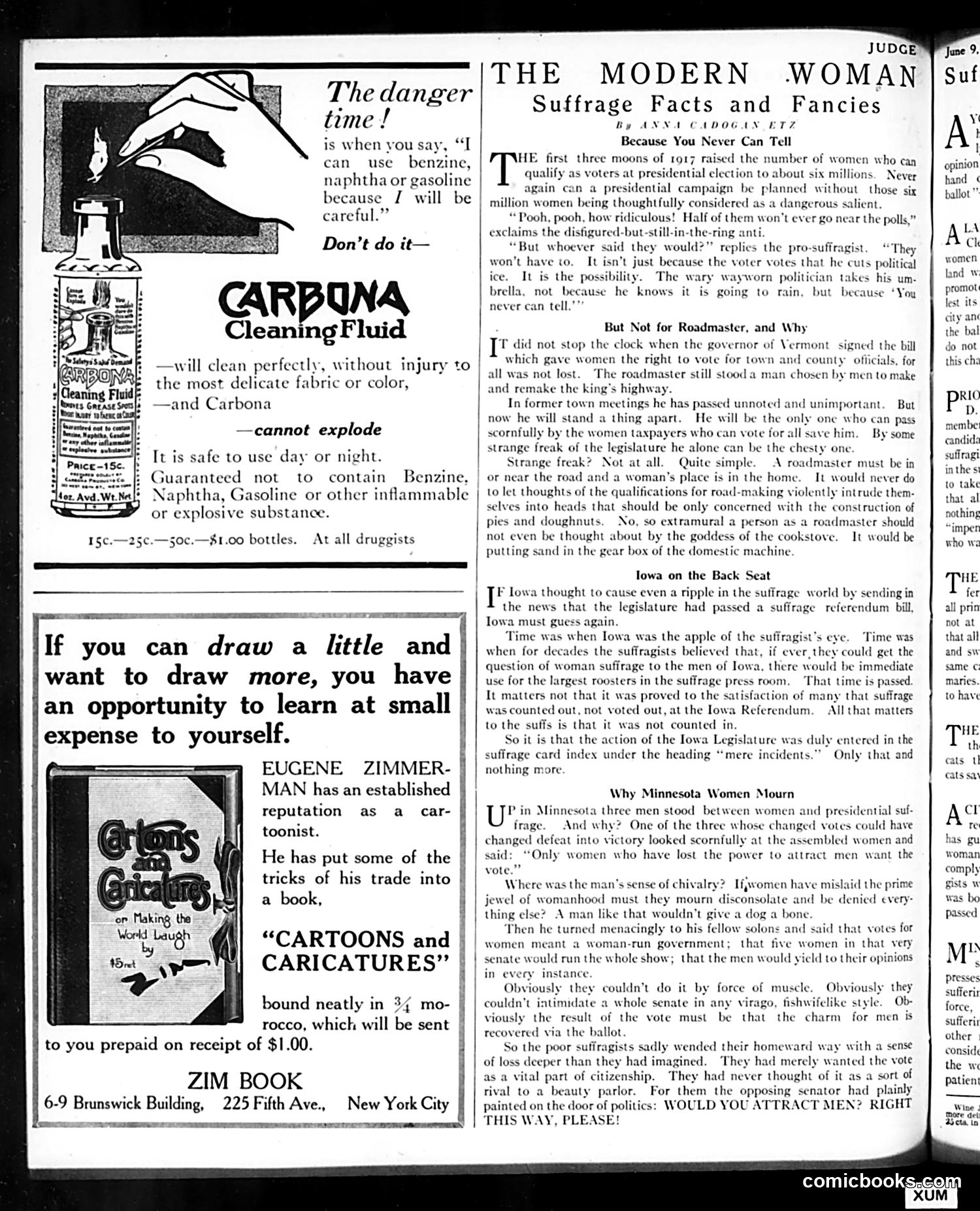
This page contains satirical commentary on women's suffrage circa 1917, when the 19th Amendment was being debated. **Main Content:** The article "The Modern Woman: Suffrage Facts and Fancies" by Anna Cadogan Etz mocks anti-suffrage arguments through three anecdotes: 1. **"Because You Never Can Tell"** — Ridicules the fear that six million newly eligible female voters pose "dangerous" political challenges, comparing politicians' caution to carrying umbrellas "just in case." 2. **"But Not for Roadmaster"** — Satirizes the gendered exception allowing only male roadmasters to retain power in Vermont, despite women gaining town voting rights. The author highlights the absurdity: women can vote for officials but not road-maintenance workers, because a woman's "place is in the home." 3. **"Iowa on the Back Seat"** — Dismisses Iowa's suffrage referendum as merely a footnote ("mere incidents"), suggesting the state's support matters little to the broader movement. **Advertisements** for Carbona cleaning fluid and a cartooning instruction book occupy the remaining space. The satire targets anti-suffrage logic and inconsistent partial suffrage measures.
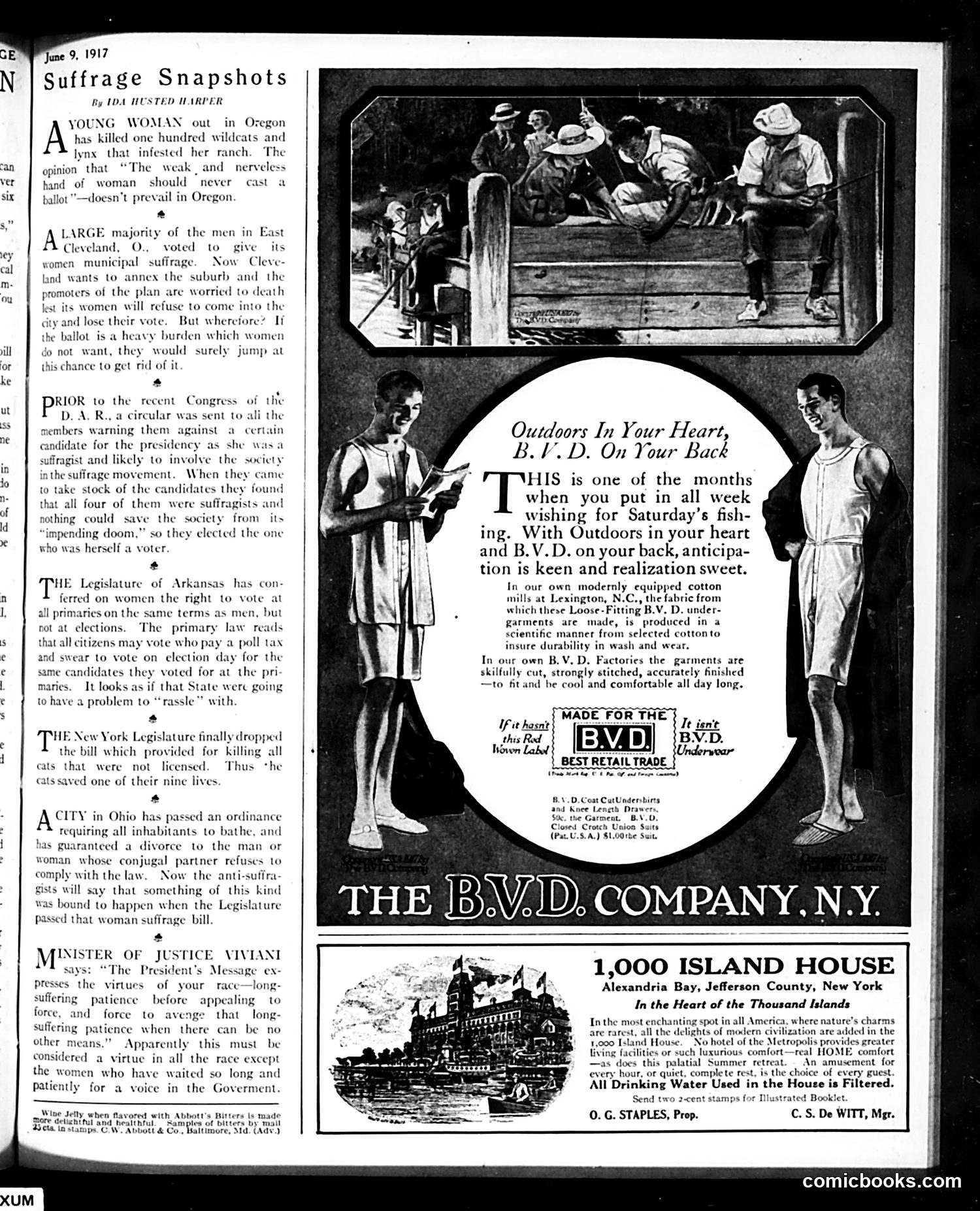
This page presents satirical arguments *supporting* women's suffrage, contrary to anti-suffrage claims. Author Ida Husted Harper counters opposition rhetoric through anecdotes: **The Oregon woman** killed wildcats—refuting claims women are "weak and nerveless" for voting. **Cleveland's annexation problem** exposes anti-suffragists' hypocrisy: if voting is truly a "heavy burden," why do women resist losing it? **The D.A.R. dilemma** shows suffrage cannot be avoided—all four presidential candidates supported it anyway. **Arkansas's primary voting** highlights legal absurdities when women gain partial voting rights. **Ohio's bathing ordinance** sarcastically suggests anti-suffragists will blame women's suffrage for any new laws (implying their reasoning is circular and irrational). **Viviani's quote** ironically notes women's "patient suffering" has gone unrewarded in government despite waiting longer than other groups. The page mixes these arguments with advertisements (B.V.D. undergarments, Island House resort), typical of Judge's format.
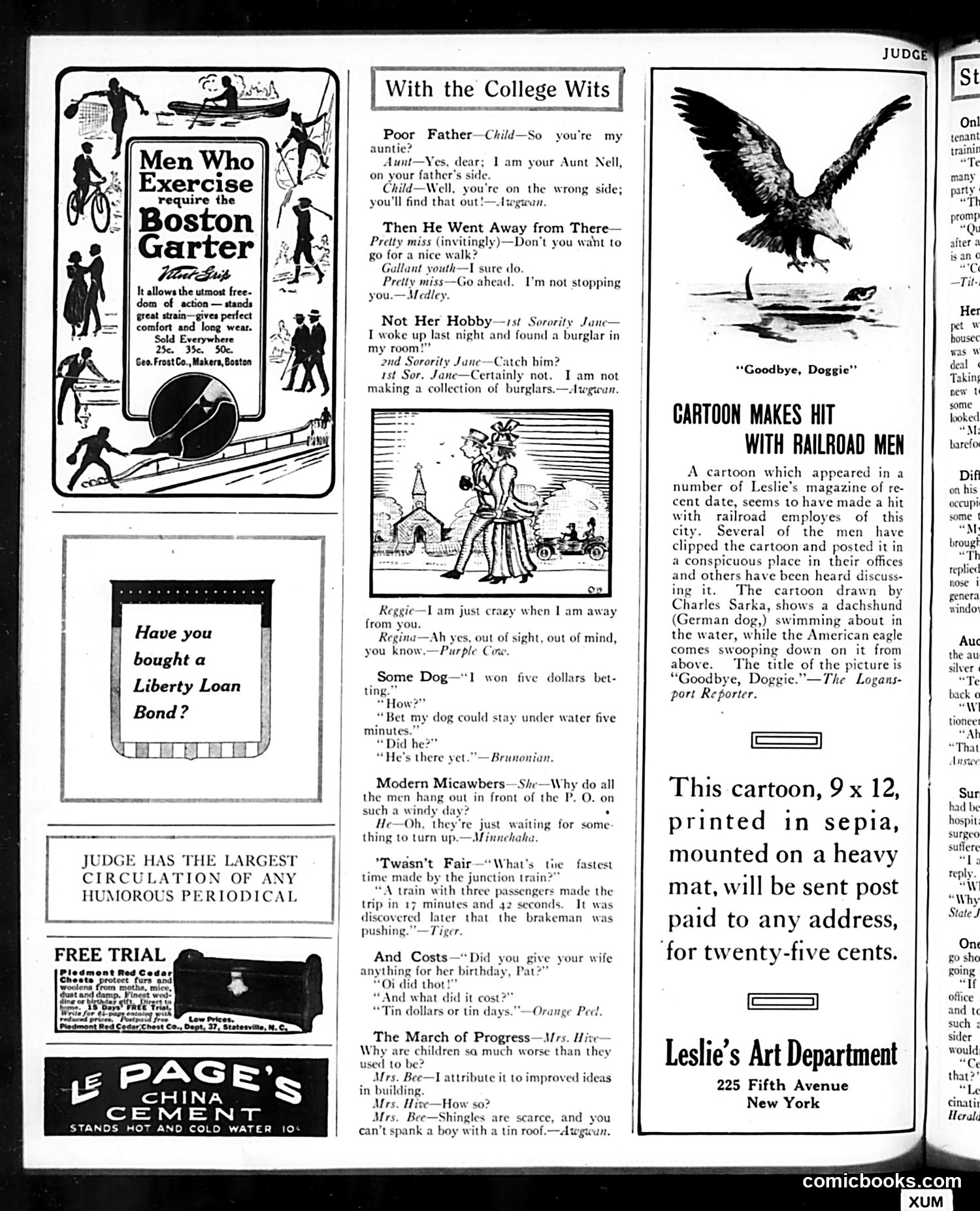
This page from *Judge* contains mostly **humor columns and advertisements** rather than political cartoons. The "With the College Wits" section offers **brief comedic exchanges** typical of early 20th-century humor magazines—jokes about family relationships, courtship, and absurd situations. These reflect period attitudes: a child's sass to an aunt, flirtation between young people, casual references to burglars, and commentary on social behavior. The main noteworthy content is **"Cartoon Makes Hit with Railroad Men,"** which reports that a cartoon by Charles Sarka titled "Goodbye, Doggie" (depicting a dachshund in water while an American eagle swoops down) has become popular with railroad employees. This is **wartime anti-German sentiment**: the dachshund represents Germany, while the eagle represents America. Railroad workers posting this satirical image in their offices reflects contemporary patriotic fervor, likely during or shortly after World War I. The page also includes advertisements for corsets, cedar chests, and art prints for sale.
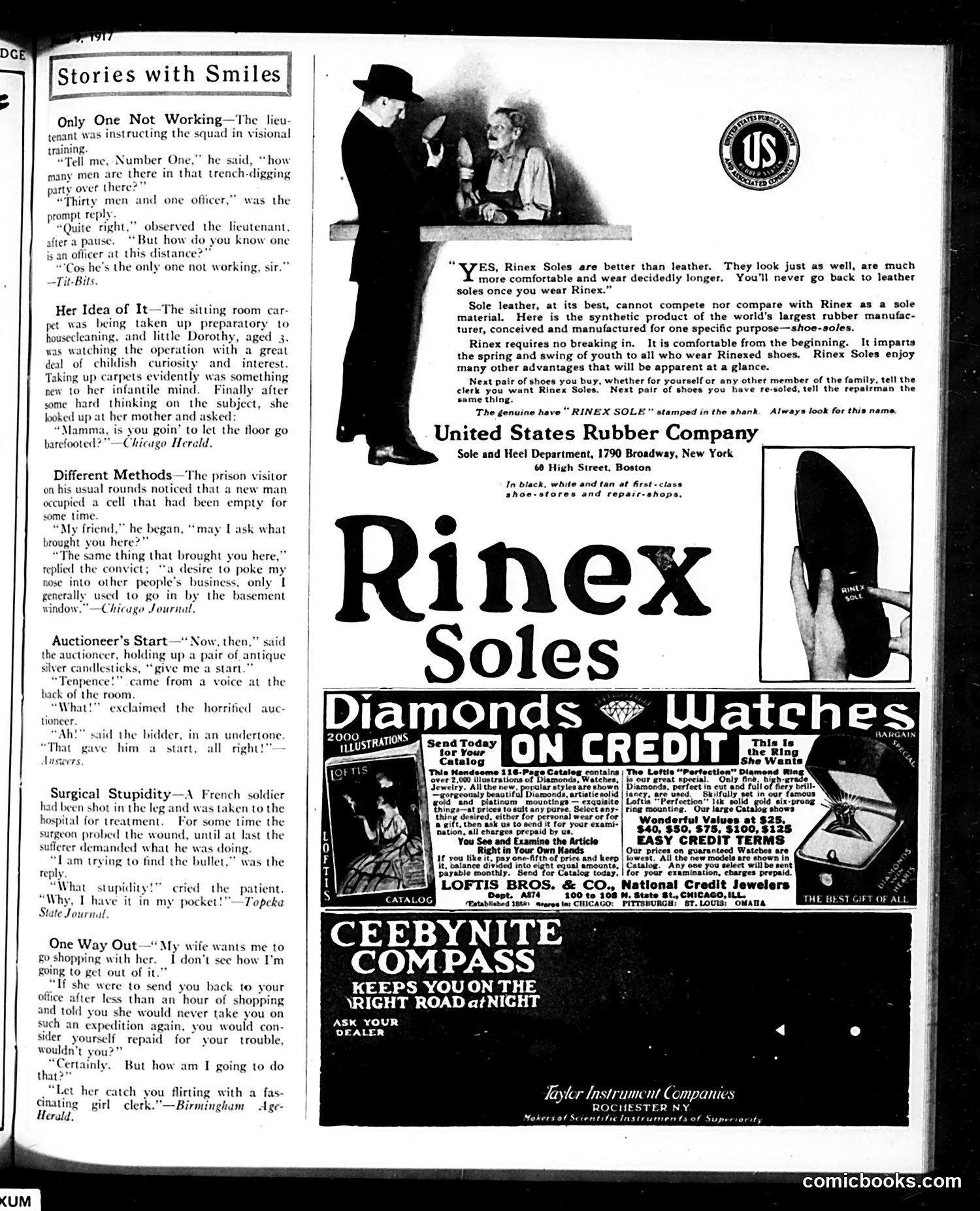
This page primarily consists of **humorous anecdotes** ("Stories with Smiles") aimed at early 20th-century readers, plus advertisements—not political cartoons. The jokes reflect period attitudes and military/social hierarchies: - **"Only One Not Working"** satirizes officers as lazy compared to enlisted men—a common class-based joke about military hierarchy - **"Her Idea of It"** depicts innocent childhood misunderstanding (a common humor format) - **"Different Methods"** compares a burglar's basement entry to a prison visitor's snooping—dark humor about invasiveness - **"Surgical Stupidity"** mocks a soldier's absent-mindedness and incompetent doctoring - **"One Way Out"** presents domestic humor about marriage/shopping, suggesting wives as burdens The advertisements (Rinex Soles, Diamonds, Ceebynite Compass) are standard period product pitches. The page reflects early 1900s sensibilities: military culture, class distinctions, and gender stereotypes presented as lighthearted entertainment.
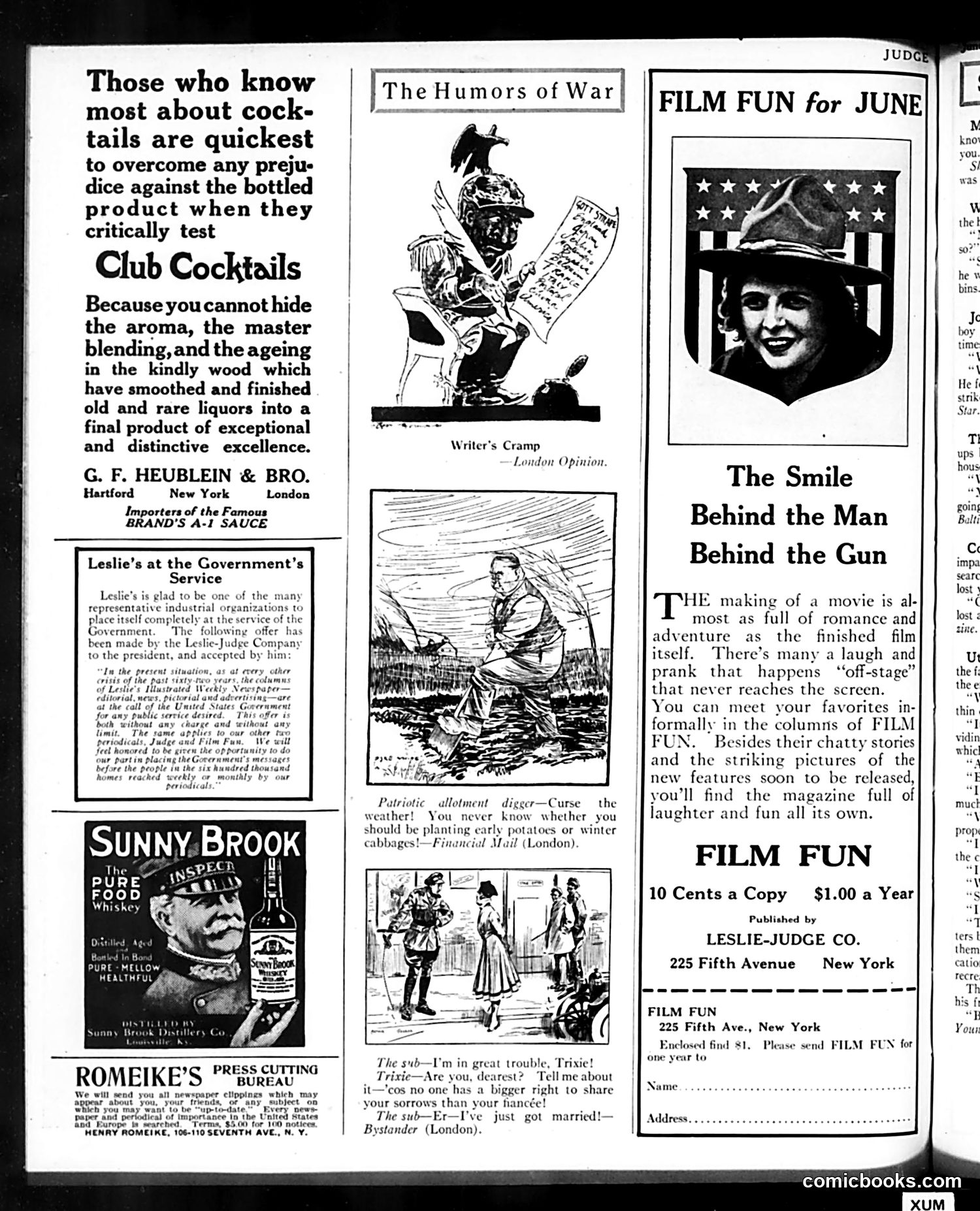
This page is primarily **advertising and promotional material** rather than satirical editorial content. **"The Humors of War" section** contains three brief comic panels with captions sourced from British publications (London Opinion, Financial Mail, Bystander). These are wartime-era jokes: one depicts a gardener frustrated by unpredictable weather for his vegetable allotment; another shows a soldier's marital troubles. The humor relies on domestic inconveniences and mild wordplay rather than sharp political satire. **Main advertisements** promote Club Cocktails (emphasizing quality blending), Sunny Brook whiskey, Leslie's Magazine (celebrating government service), and Romeike's press-clipping bureau. **"Film Fun" magazine** is advertised as entertainment featuring movie stars and behind-the-scenes stories—positioned as wholesome fan magazine content. The page reflects wartime America's blend of commercial marketing with light humor drawn from allied British sources, lacking the sharper satirical edge one might expect from Judge's reputation.
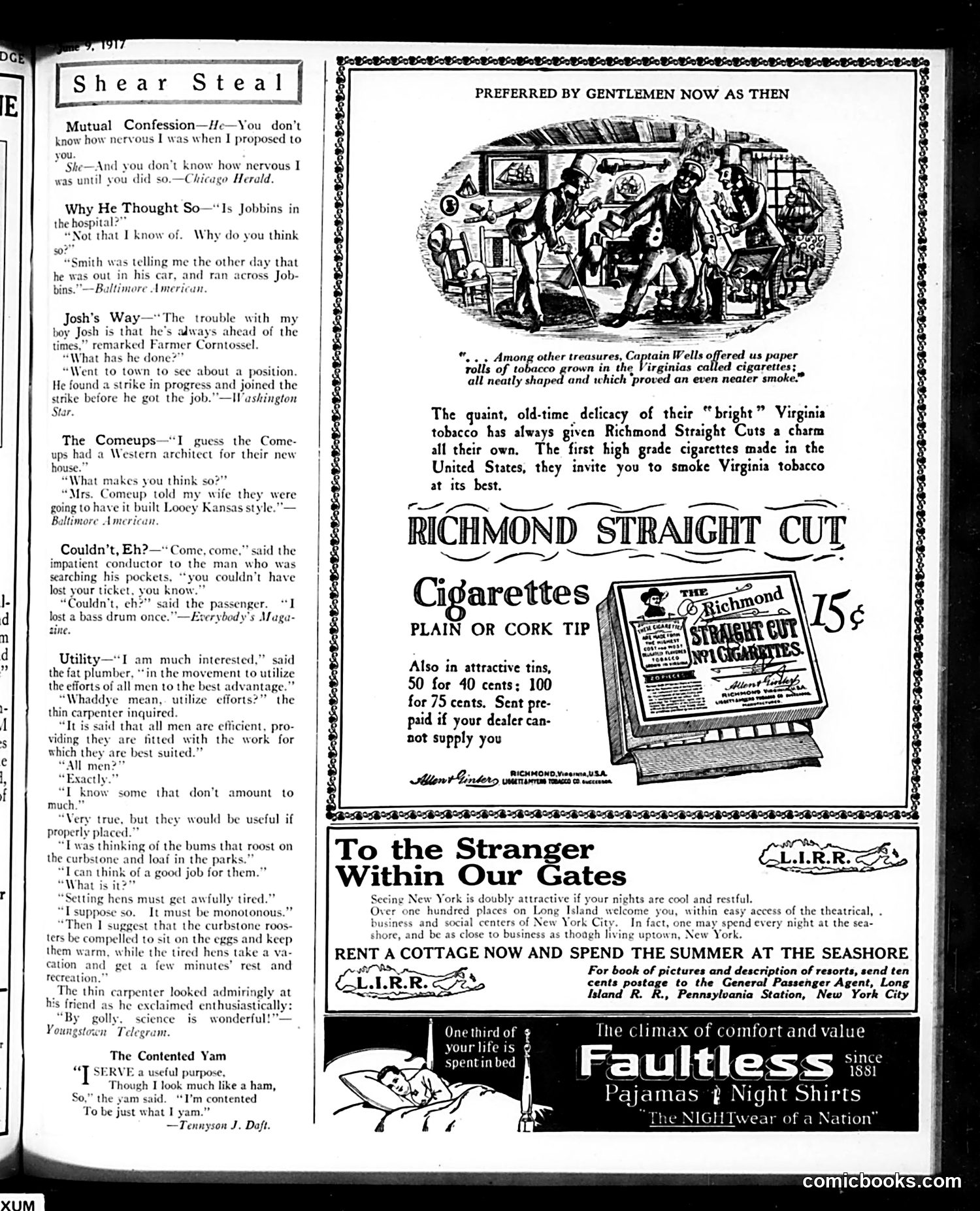
This page from Judge (dated 1917) contains primarily **humorous short jokes** rather than political cartoons. The left column features six brief comic anecdotes playing on wordplay and situational irony—a common Judge format. Notable examples include "Josh's Way," where a farmer's son joins a labor strike before getting hired, satirizing workers' eagerness to strike; and "Utility," a dialogue mocking overly optimistic social engineering about employing unemployed "bums" from park benches. The right side is dominated by **advertising**: Richmond Straight Cut cigarettes prominently featuring historical tobacco imagery ("Preferred by Gentlemen"), a Long Island Railroad seashore cottage rental ad, and Faultless Pajamas. The cartoon illustration at top shows gentlemen in period dress, supporting the cigarette ad's nostalgic appeal to historical "delicacy." The page reflects 1917 consumer culture and pre-regulation cigarette marketing directly targeting men with heritage and class associations.
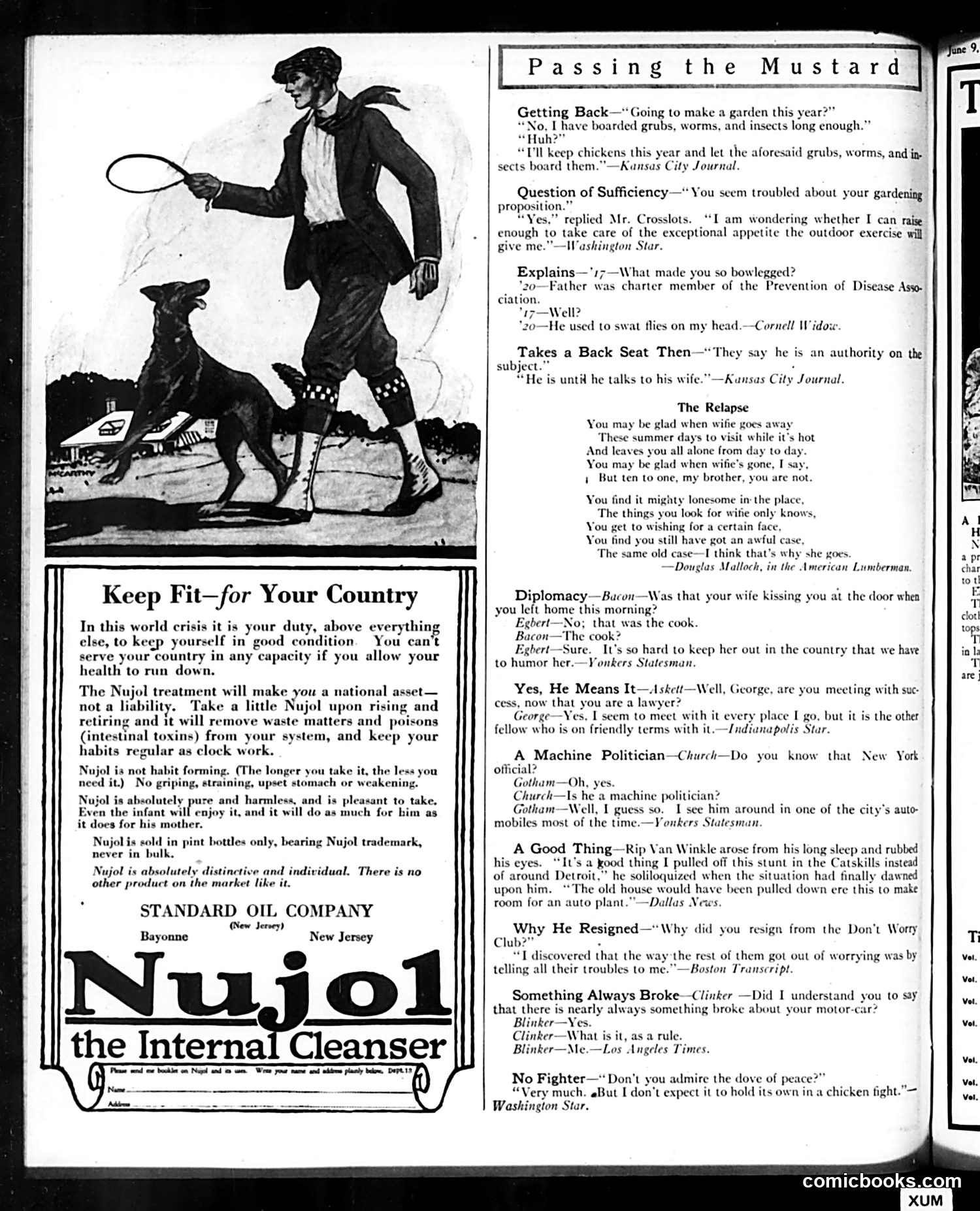
This page from *Judge* magazine features two main elements: **Left side:** A Nujol laxative advertisement disguised as patriotic duty. During WWI ("world crisis"), the ad claims bowel regularity is a national service—a humorous exaggeration of wartime propaganda about personal health as civic responsibility. **Right side:** "Passing the Mustard"—a humor column of short jokes and quips. Topics include: - Gardening and chickens (post-WWI food production) - A poem about missing one's wife during summer trips - Marital dynamics (husbands' authority undermined by wives) - Small-town politics and urban "machine politicians" (those connected to corrupt city political machines via automobiles) The humor relies on domestic situations, marital tension, and mild social commentary—typical of 1910s-20s American satirical magazine fare. The Rip Van Winkle reference jokes that even sleeping through industrialization is preferable to Detroit's auto-plant expansion.
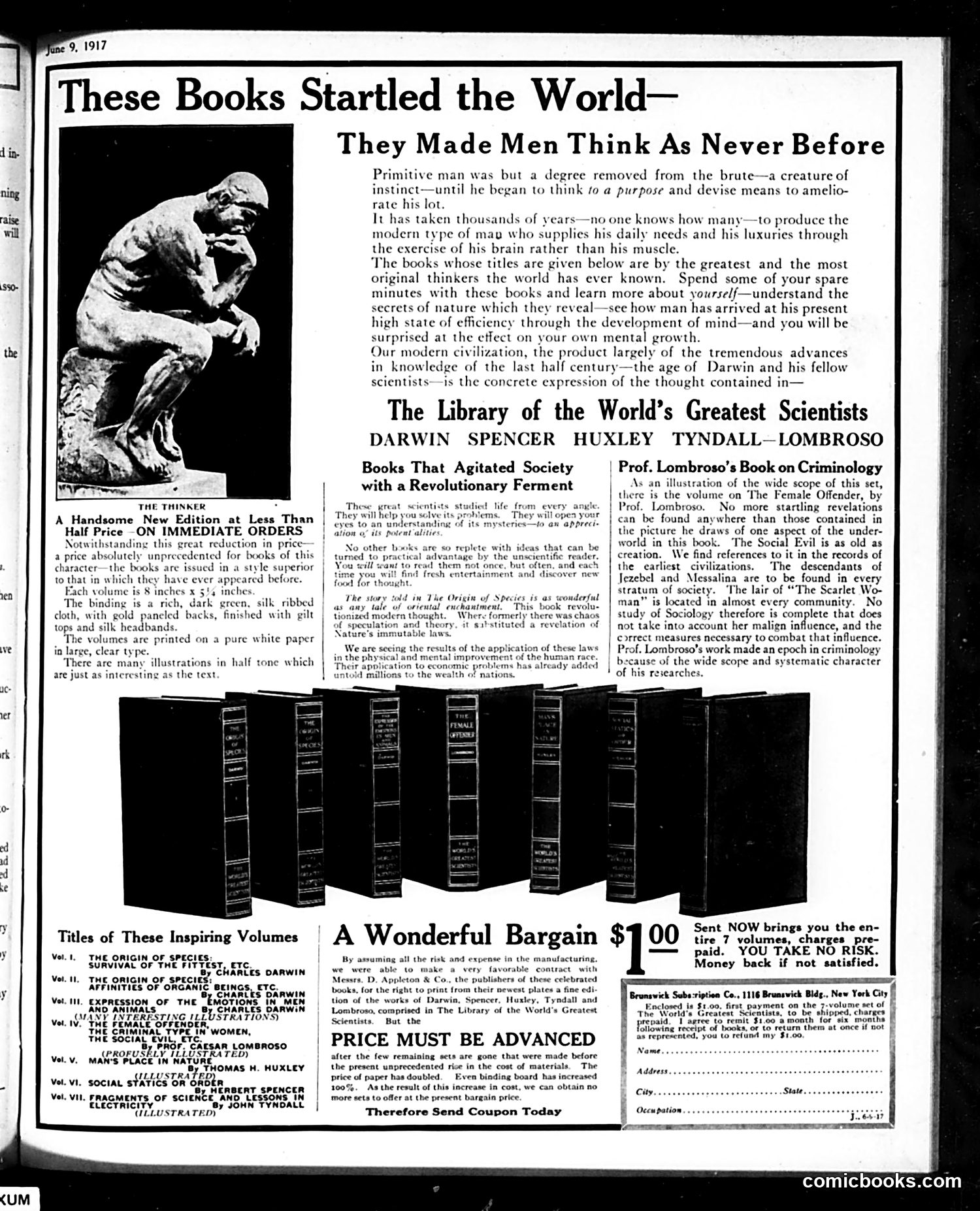
This is primarily a **book advertisement**, not political satire. It's selling a seven-volume set of scientific works by Darwin, Spencer, Huxley, Tyndall, and Lombroso as "The Library of the World's Greatest Scientists." The iconic image—Rodin's "The Thinker" sculpture—symbolizes intellectual progress and contemplation. The ad's framing argues these books represent civilization's advancement: primitive humans used muscle; modern humans use brains. The sales pitch emphasizes how reading these works will improve your "mental growth." Notable is the inclusion of Lombroso's "The Female Offender"—pseudoscientific criminology that claimed women criminals were biological oddities—reflecting early-20th-century pseudo-scientific racism and sexism presented as legitimate science. The "revolutionary ferment" claim suggests these books challenged established thinking, though today we'd recognize some content (particularly Lombroso's work) as discredited pseudoscience. The urgent pricing claim—"price must be advanced"—is standard marketing pressure, not actual editorial commentary.
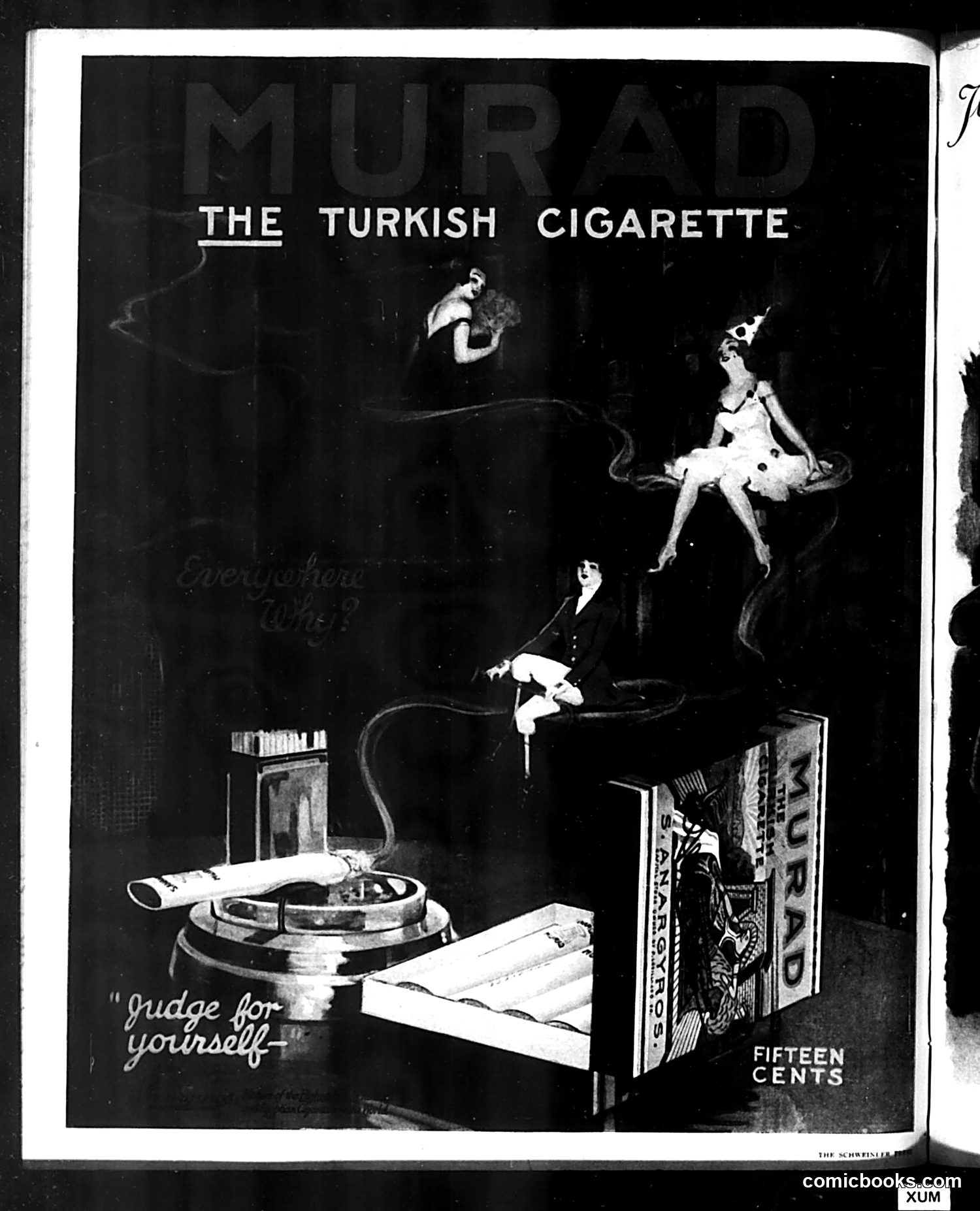
This is a cigarette advertisement disguised as entertainment content. The page depicts a surreal, dreamlike scene where a man lounges smoking, attended by dancing figures and fantastical imagery—likely representing the exotic allure marketing campaigns used to sell Turkish cigarettes in early 20th-century America. The tagline "Judge for yourself" and fifteen-cent price point suggest this was a common advertorial format in *Judge* magazine. The exotic dancers and orientalist aesthetic reflect period marketing that linked foreign cigarettes to sophistication and worldliness. The dreamlike quality implies smoking produces euphoric fantasies. This represents an era when tobacco companies advertised directly in humor magazines without modern restrictions, and "Turkish" branded products traded on orientalist exoticism to appeal to American consumers.