
Judge, 1917-06-09 · page 10 of 28
Judge — June 9, 1917 — page 10: what you’re looking at
What you’re looking at
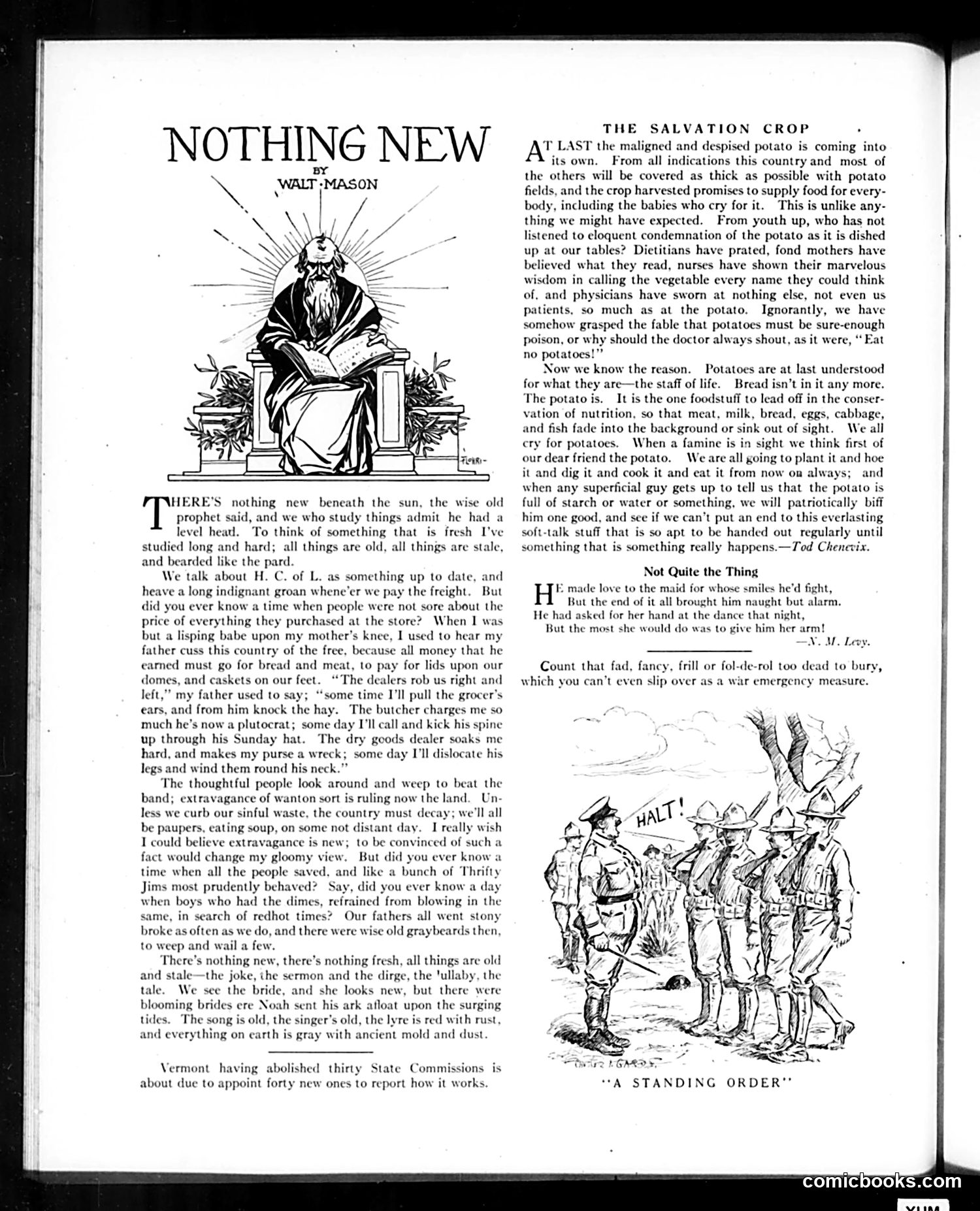
**"Nothing New" (left column):** Walt Mason's philosophical essay argues that complaints about high cost-of-living (H.C. of L.) are timeless, not modern. Mason uses nostalgic examples—his father cursing inflated prices for bread, meat, and services—to claim every generation believes *their* era uniquely suffers economic hardship. The piece satirizes contemporary anxiety by insisting human nature and economic greed are unchanging. A closing jab at Vermont's bureaucratic habit adds topical humor. **"The Salvation Crop" (right column):** This celebrates the potato as a wartime food solution. The article ironically notes that doctors and nutritionists previously condemned potatoes, but now recognize them as essential sustenance ("staff of life"). The timing suggests this is WWI-era, when food conservation became patriotic duty. The shift from dismissing potatoes to exalting them reflects wartime propaganda reframing humble foods as patriotic necessities. **"A Standing Order" (illustration):** Depicts soldiers halting, likely illustrating military discipline or wartime civilian compliance with food rationing directives.
📄 Transcribed text from this page (OCR, searchable)
Machine-transcribed from the original scan — historical spelling and the odd misread are preserved.
E. nothing new beneath the sun, the wise old T prophet said, and we who study things admit he had a evel To think of something that is fresh I've studied long and hard; all things are old, all things are stale, and bearded like the pard. We talk about H. C. of L. as something up to date, and heave a long indignant groan whene’er we pay the freight. But did you ever know a time when people were not sore about the price of everything they purchased at the store? When I was but a lisping babe upon my mother’s knee, I used to hear my father cuss this country of the free, because all money that he eared must go for bread and meat, to pay for lids upon our domes, and caskets on our feet. “The dealers rob us right and left,” my father used to say; “some time I'll pull the grocer’s ears, and from him knock the hay. The butcher charges me so much he’s now a plutoc: ay I'll call and kick his spine up through his Sunday The dry goods dealer soaks me hard, and makes my purse a wreck; some day I'll dislocate his legs and wind them round his neck.” The thoughtful people look around and weep to beat the band; extravagance of wanton sort is ruling now the land. Un- less we curb our sinful waste, the country must decay; we'll all be paupers, eating soup, on some not distant day. I really wish I could believe extravagance is new; to be convinced of such a fact would change my gloomy view. But did you ever know a time when all the people saved, and like a bunch of Thrifty Jims most prudently behaved? Say, did you ever know a day when boys who had the dimes, refrained from blowing in the same, in search of redhot times? Our fathers all went stony broke as often as we do, and there were wise old graybeards then, to weep and wail a few. There’s nothing new, there’s nothing fresh, all things are old and stale—the joke, the sermon and the dirge, the 'ullaby, the tale. We see the brid d she looks new, but there were blooming brides ere Noah sent his ark afloat upon the surging tides. The song is old, the singer’s old, the lyre is red with rust, and everything on earth is gray with ancient mold and dust. Vermont having abolished thirty State Commissions is about due to appoint forty new ones to report how it works. THE SALVATION CROP . T LAST the maligned and despised potato is coming into its own. From all indications this country and most of the others will be covered as thick as possible with potato fields, and the crop harvested promises to supply food for every- body, including the babies who cry for it. This is unlike any- thing we might have expected. From youth up, who has not listened to eloquent condemnation of the potato as it is dished up at our tables? Dietitians have prated, fond mothers have believed what they read, nurses have shown their marvelous wisdom in calling the vegetable every name they could think of, and physicians have sworn at nothing else, not even us patients, so much as at the potato. Ignorantly, we have somehow grasped the fable that potatoes must be sure-enough poison, or why should the doctor always shout, as it were, “ Eat no potatoes Now we know the reason. Potatoes are at last understood for what they are—the staff of life. Bread isn’t in it any more. The potato is. It is the one foodstuff to lead off in the conser- vation of nutrition, so that meat, milk, bread, eggs, cabbage, and fish fade into the background or sink out of sight. We all cry for potatoes. When a famine is in sight we think first of our dear friend the potato. We are all going to plant it and hoe it and dig it and cook it and eat it from now on always; and when any superficial guy gets up to tell us that the potato is full of starch or water or something, we will patriotically biff him one good, and see if we can’t put an end to this everlasting soft-talk stuff that is so apt to be handed out regularly until something that is something really happens.—Tod Chenevix. Not Quite the Thing E made love to the maid for whose smiles he'd fight, But the end of it all brought him naught but alarm, He had asked for her hand at the dance that night, But the most she would do was to give him her arm! —VMLL Count that fad, fancy, frill or fol-de-rol too dead to bury, which you can’t even slip over as a war emergency measure. 2 ECMAS “A STANDING ORDER" comicbooks.com