
Judge, 1917-06-09 · page 6 of 28
Judge — June 9, 1917 — page 6: what you’re looking at
What you’re looking at
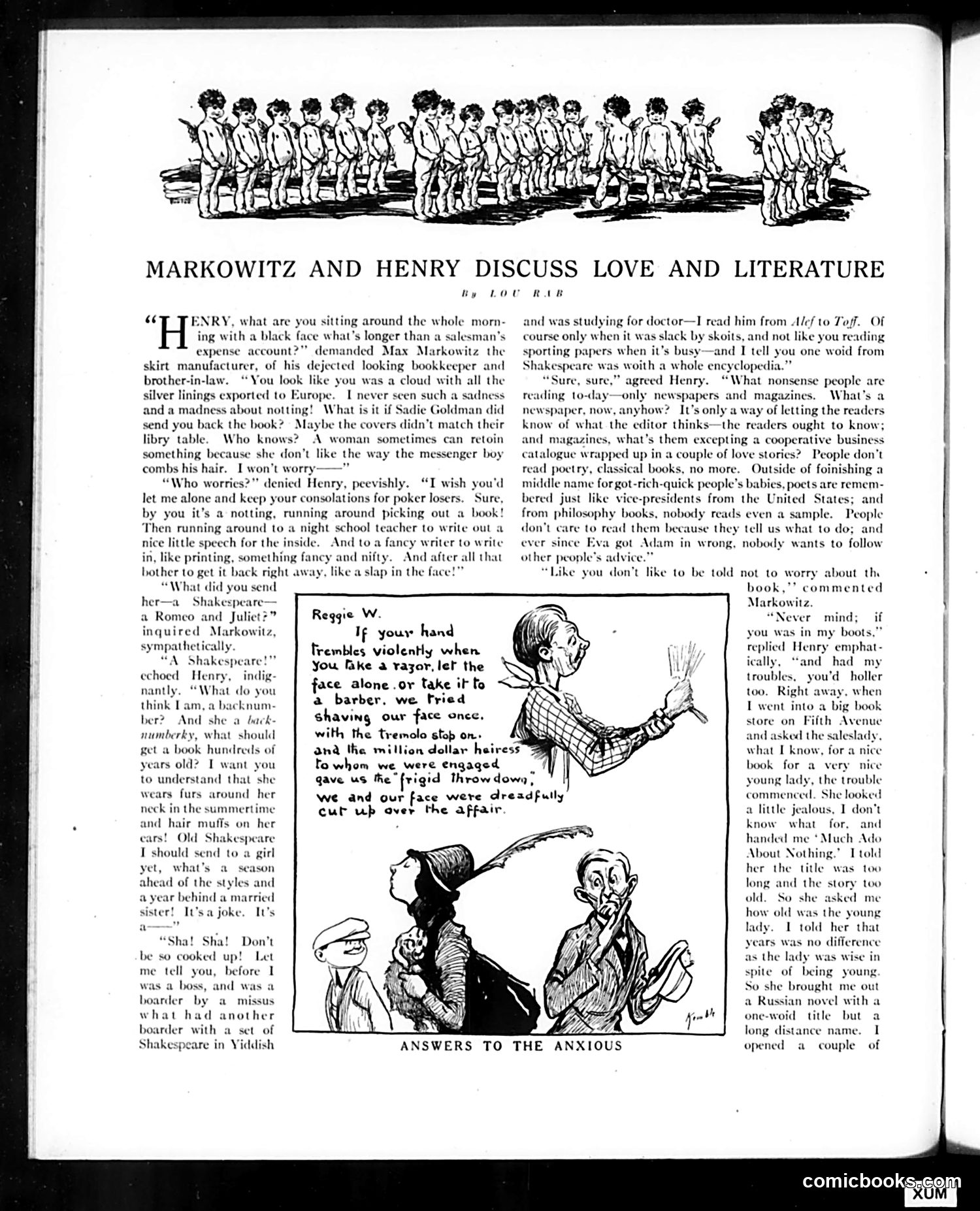
This page satirizes literary pretension and romantic self-deception among the educated classes. Two characters—Markowitz (identified by his name) and Henry—debate whether reading Shakespeare and classics constitutes genuine intellectual engagement. Henry defends popular literature (newspapers, magazines, love stories), while Markowitz mocks this as beneath serious readers. The irony emerges when Henry reveals his own romantic troubles: he sought a book for "a very nice young lady" but was sold *Much Ado About Nothing*—a title the saleswoman apparently found literally descriptive of their relationship. The cartoon mocks both characters: Markowitz's snobbery about "real" literature versus Henry's naive romanticism and the saleswoman's crude judgment. The humor targets pretentiousness on all sides.
📄 Transcribed text from this page (OCR, searchable)
Machine-transcribed from the original scan — historical spelling and the odd misread are preserved.
Ny =NRY, what are you sitting around the whole morn- ing with a black face what's longer than a salesman’s expense account?” demanded Max Markowitz the skirt manufacturer, of his dejected looking bookkeeper and brother-in-law. “You look like you was a cloud with all the silver linings exported to Europe. I never scen such a sadness and a madness about notting! What is it if Sadie Goldman did send you back the book? Maybe the covers didn’t match their libry table. Who knows? A woman sometimes can retoin something because she don’t like the way the messenger boy combs his hair. I won't worry-—" “Who worries?” denied Henry, peevishly. “I wish you'd let me alone and keep your consolations for poker losers. ‘Sure, by you it’s a notting, running around picking out a book! Then running around to a night school teacher to write out a nice little speech for the inside. And to a fancy writer to write in, like printing, something fancy and nifty. And after all that bother to get it back right away, like a slap in the face!” What did you send her—a_ Shakespeare— ” a Romeo and Juliet?” Reggie W. inquired Markowitz, Tg your hand sympathetically trembles violently when A Shakespeare You [ake a razor, lel the echoed Henry, indig- : nantly. “What do you face alone .or take it to think Lam, a backnum- a barber, we frie shaving our face once, ber? And she a back- numberky, what should with the tremolo stop ons get a book hundreds of years old? T want you to understand that she wears furs around her neck in the summertime and hair mufis on her cars! Old Shakespe I should send to a yet, what's ahead of the styles and ayear behind a married sister! It’sa joke. I's a towhom we were engaged cur up over the affair & season “Sha! Sha! Don’t be so cooked up! Let me tell you, before I was a boss, and was a boarder by a missus what had another boarder with a set of Shakespeare in Yiddish MARKOWITZ AND HENRY DISCUSS LOVE AND LITERATURE Lov ana the million dollar heiress gave us Te" frigid Throw down; we and our face were dreadfully RAB and was studying for doctor—I read him from Alef to Toff. Of course only when it was slack by skoits, and not like you reading sporting papers when it’s busy—and I tell you one woid from Shakespeare was woith a whole encyclopedia.” ure, sure,” agreed Henry. “What nonsense people reading to-day—only newspapers and magazines. W newspaper, now, anyhow? It’s only a way of letting the re know of what the editor thinks—the readers ought to know; and magazines, what's them excepting a cooperative business catalogue wrapped up in a couple of love stories? People don’t read poetry, classical books, no more. Outside of foinishing a middle name forgot-rich-quick people's babies, poets are remem- bered just like vice-presidents from the United States; and from philosophy books, nobody reads even a sample. People don’t care to read them because they tell us what to do; and ever since Eva got Adam in wrong, nobody wants to follow other people's advice.” “Like you don’t like to be told not to worry about th. book,”’ commented Markowitz. “Never mind; if you was in my boots,” replied Henry emphat- ically, “and had my troubles, you'd holler too. Right away, when I went into a big book store on Fifth Avenue and asked the saleslady, what I know, for a nice book for a very nice young lady, the trouble commenced. She looked a little jealous, I don’t know what for, and handed me ‘Much Ado \bout Nothing.” I told her the title was too long and the story too old. So she asked me how old was the young lady. 1 told her that years was no difference as the lady was wise in spite of being young So she brought me out a Russian novel with a one-woid title but a long distance name. 1 opened a couple of | | |