
Judge, 1917-06-09 · page 26 of 28
Judge — June 9, 1917 — page 26: what you’re looking at
What you’re looking at
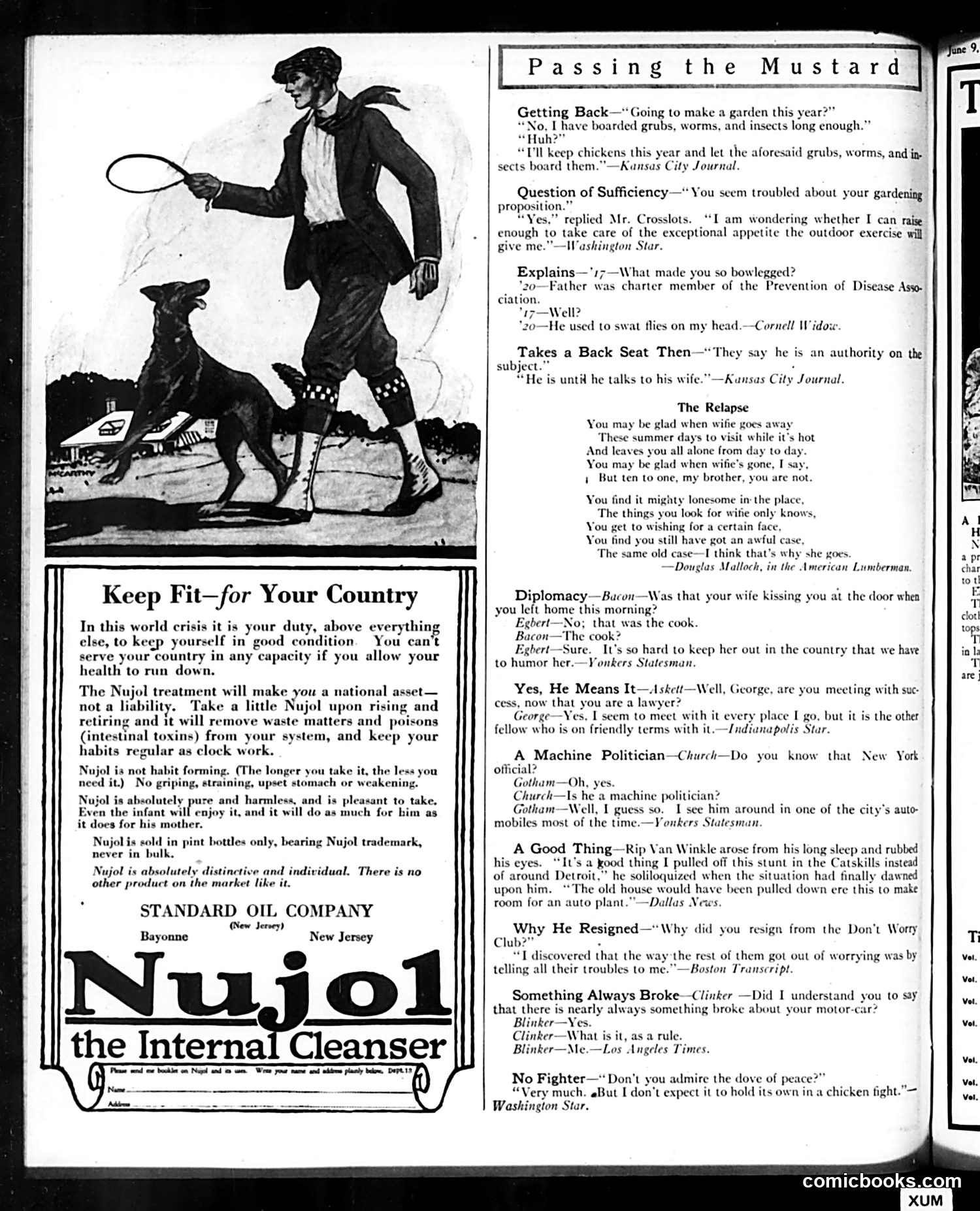
This page from *Judge* magazine features two main elements: **Left side:** A Nujol laxative advertisement disguised as patriotic duty. During WWI ("world crisis"), the ad claims bowel regularity is a national service—a humorous exaggeration of wartime propaganda about personal health as civic responsibility. **Right side:** "Passing the Mustard"—a humor column of short jokes and quips. Topics include: - Gardening and chickens (post-WWI food production) - A poem about missing one's wife during summer trips - Marital dynamics (husbands' authority undermined by wives) - Small-town politics and urban "machine politicians" (those connected to corrupt city political machines via automobiles) The humor relies on domestic situations, marital tension, and mild social commentary—typical of 1910s-20s American satirical magazine fare. The Rip Van Winkle reference jokes that even sleeping through industrialization is preferable to Detroit's auto-plant expansion.
📄 Transcribed text from this page (OCR, searchable)
Machine-transcribed from the original scan — historical spelling and the odd misread are preserved.
Keep Fit—for Your Country In this world crisis it is your duty, above everythin; else, to keep yourself in good condition. You can’t serve your country in any capacity if you allow your health to run down, The Nujol treatment will make you a national asset— not a liability. Take a little Nujol upon rising and retiring and it will remove waste matters and poisons (intestinal toxins) from your system, and keep your habits regular as clock work. Nujol is not habit forming. (The longer take it, the less you need it.) No griping, straining, upset stomach or weakening. N is absolutely pure and harmless, and is pleasant to take. Sven the infant will enjoy it, and it will do as much for bim as it does for his mother. Nujol is sold in pint bottles only, bearing Nujol trademark, never in bulk. Nujol is absolutely distinctive and individual. There is no other product on the market like it. STANDARD OIL COMPANY @ew Jersey) Passing the Mustard Getting Back—* Going to make a garden this year?” “No, L have boarded grubs, worms, and insects long enough.” Huh?” “Tl keep chickens this year and let the aforesaid grubs, worms, and in sects board them.”’—Kansas City Journal. Question of Sufficiency—* You seem troubled about your gardening proposition.” “Yes,” replied Mr. Crosslots. “I am wondering whether I can raise enough to t care of the exceptional appetite the outdoor exercise will give me.” —Washington Star. Explains—'s7—What made you so bowlegged? *20—Father was charter member of the Prevention of Disease Asso- ciation "17—Well? *20—He used to swat flies on my head.—Cornell Widow. Takes a Back Seat Then—*They say he is an authority on the subject . “He is untit he talks to his wife.”"—Aunsas City Journal. The Relapse You may be glad when wifie goes away These summer days to visit while it’s hot And leaves you all alone from day to day. You may be glad when wifie’s gone, I say, + But ten to one, my brother, you are not. You find it mighty lonesome in: the place, the things you look for witie only: knows, You get to wishing for a certain face, You find you still have got an awful case, The same old case—I think that’s why she goes. —Douglas Malloch, in the American Lumberman. Diplomacy—Bucon—Was that your wife kissing you at the door when you left home this morning? Exgbert—No; that was the cook. Bacon—The cook? Egbert—Sure. It's so hard to keep her out in the country that we have to humor her.—Yonkers Statesman. Yes, He Means It—A skett—Well, George, are you meeting with suc you are a lawyer? George—Yes, I seem to meet with it every place I go, but it is the other fellow who is on friendly terms with it.—/ndianapolis Star. A Machine Politician—Church—Do you know that New York official? Gotham—Oh, yes. Church—Is he a machine politician? Gotham—Well, I guess so. I see him around in one of the city’s auto- mobiles most of the time.—Vonkers Statesman A Good Thing—Rip Van Winkle arose from his long sleep and rubbed his eyes. “It’s a kod thing I pulled off this stunt in the Catskills instead of around Detroit,” he soliloquized when the situation had finally dawned upon him. “The old house would have been pulled down ere this to make room for an auto plant.” —Dallas News. Why He Resigned—*Why did you resign from the Don’t Worry Club: . I discovered that the way the rest of them got out of worrying was by telling all their troubles to me.” —Boston Transcript. Something Always Broke—Clinker —Did I understand you to sy that there is nearly always something broke about your motor-car? Blinker—Yes. Clinker—What is it, as a rule. Blinker—Me. s Angeles Times. No Fighter—* Don't you admire the dove of peac 4 “Very much. eBut I don’t expect it to hold its own in a chicken fight."— Washington Star. comicbooks.com XUM