
A complete issue · 30 pages · 1917
Judge — May 5, 1917
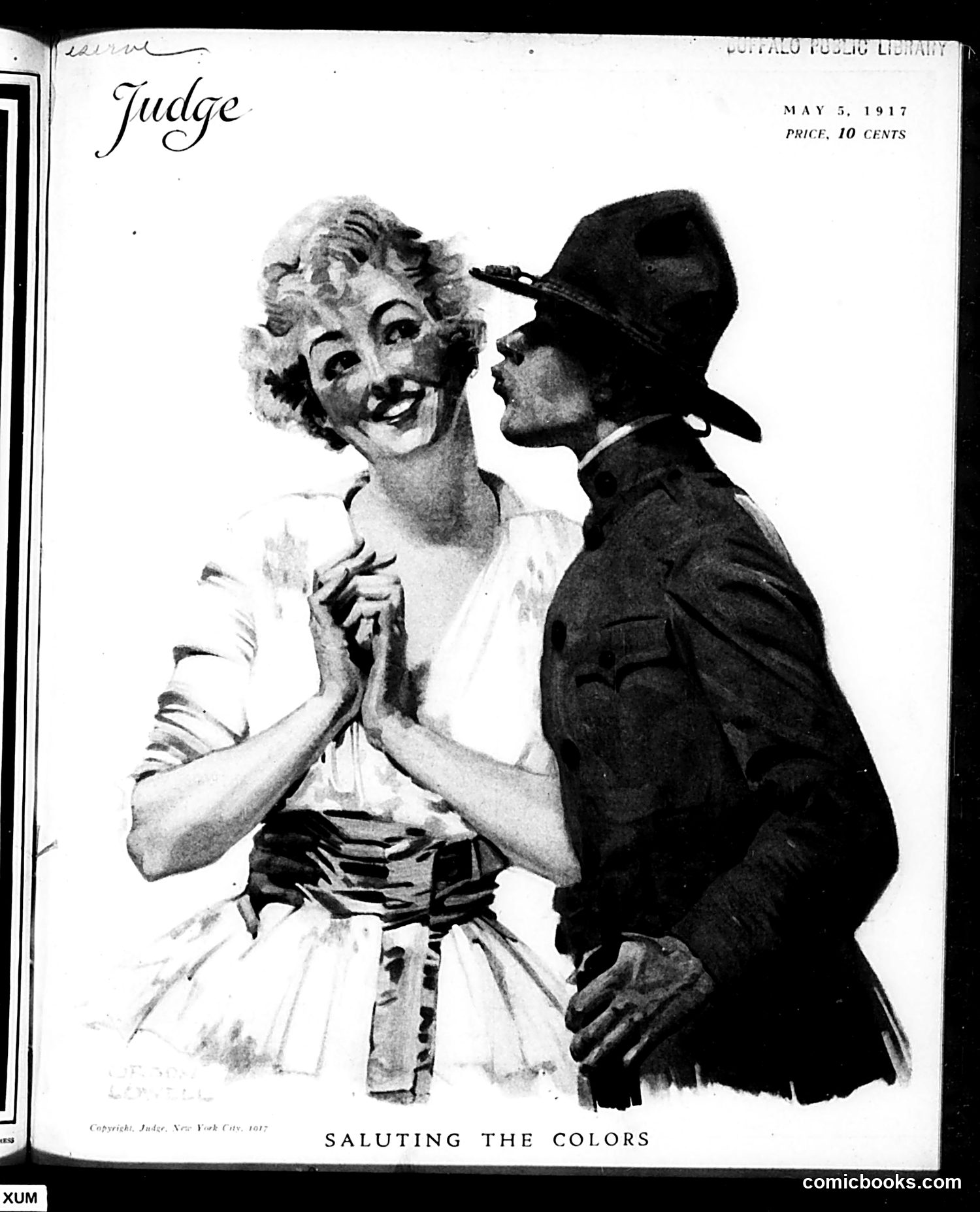
This illustration appears to depict a romantic encounter between a woman and a uniformed soldier, likely referencing America's recent entry into World War I (April 1917). The caption "Saluting the Colors" is a double entendre: it plays on military protocol while suggesting the woman is greeting the soldier with romantic enthusiasm. The satire likely mocks the sentimental patriotism and romantic fervor surrounding the war effort—particularly how women were encouraged to support soldiers. The woman's exaggerated expression and theatrical pose suggest Judge is gently ridiculing the overwrought emotional displays of the era, or perhaps the way wartime patriotism was being packaged and sentimentalized for public consumption.
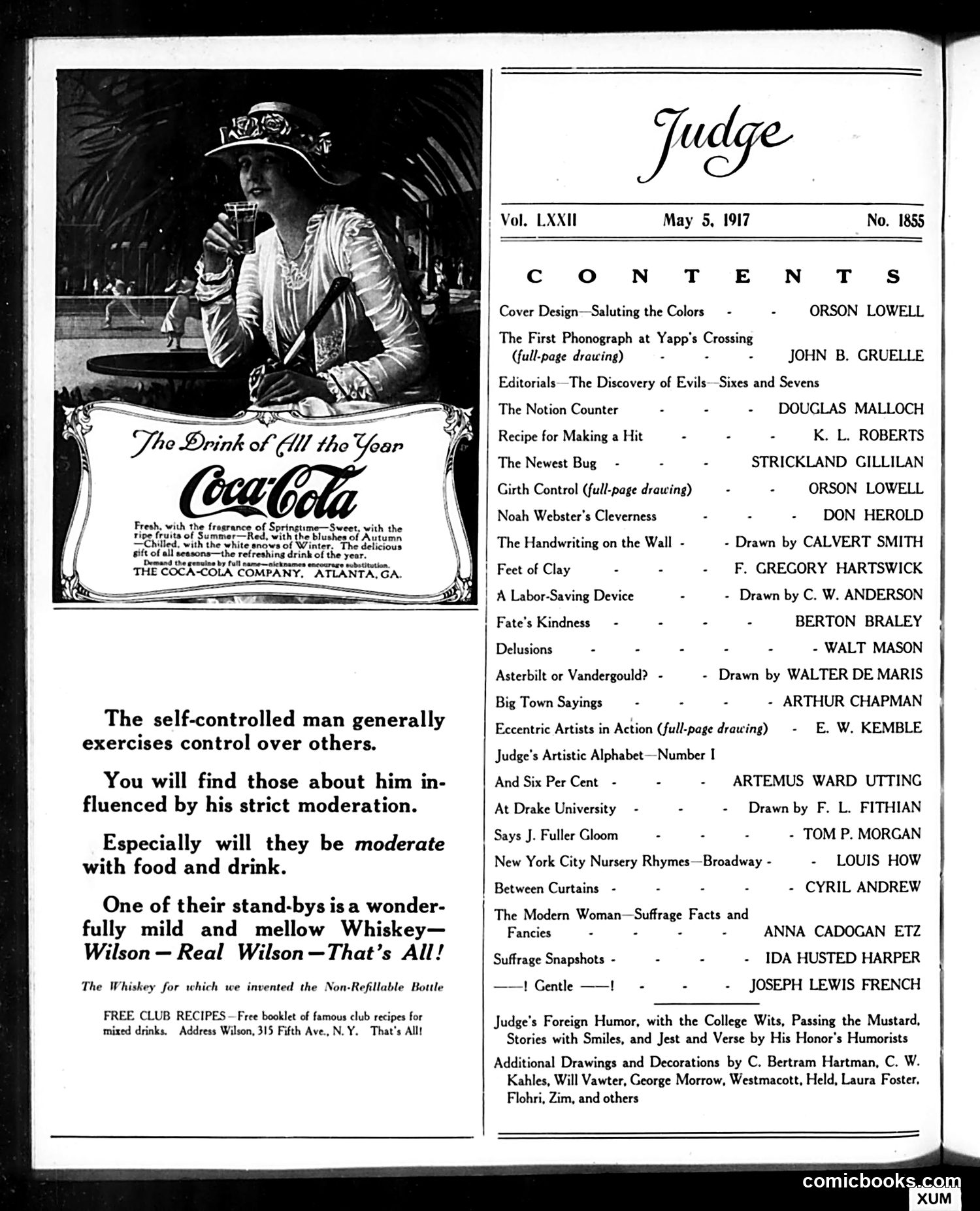
This is a contents page featuring a Coca-Cola advertisement as the dominant visual element. The ad shows an elegantly dressed woman in an ornate hat drinking from a glass, with marketing copy emphasizing Coca-Cola as "the drink of all the year." Below the ad is an unrelated Wilson Whiskey advertisement promoting their product as a "stand-by" for the self-controlled man, emphasizing moderation. The right column lists the magazine's contents—articles, drawings, and humor pieces by various contributors. Notable topics include suffrage-related content ("The Modern Woman—Suffrage Facts and Fancies") and general satirical pieces. The date (May 5, 1917) places this during America's entry into World War I, though this particular page focuses primarily on advertising and contents rather than political satire.
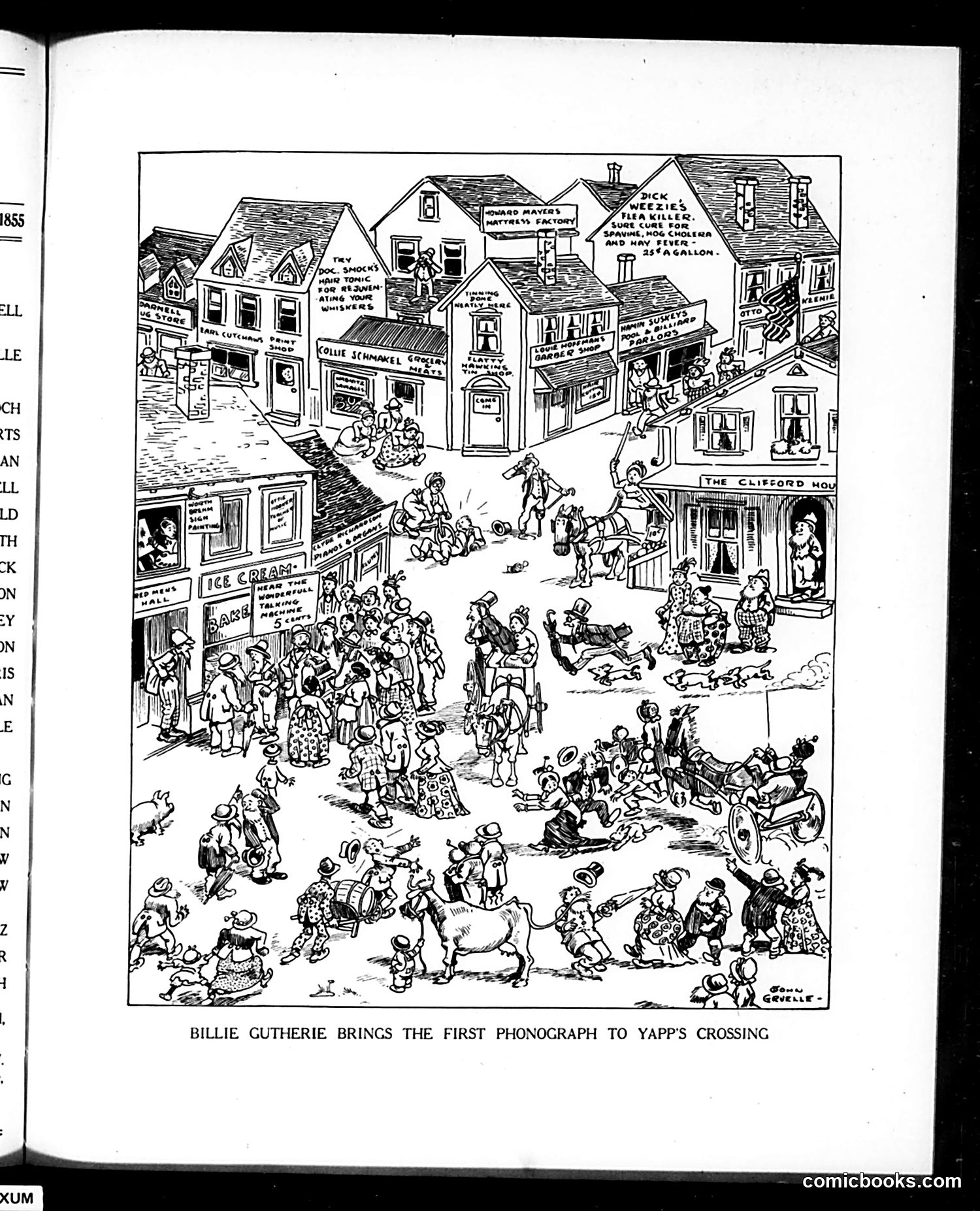
This satirical cartoon depicts a lively village scene where someone named Billie Cutherie introduces a phonograph (an early sound-recording device) to a rural community called "Yapp's Crossing." The humor derives from the contrast between cutting-edge urban technology and rustic village life. The townspeople react with evident curiosity and excitement—children play, people gather, and the scene captures the disruption caused by this novelty in an isolated setting. The satire likely mocks both rural communities' unfamiliarity with modern conveniences and the optimistic marketing of new technology. Shop signs are visible (ice cream, various businesses), suggesting this is a commercial village hub, yet the introduction of recorded sound remains a dramatic event worthy of the entire community's attention.
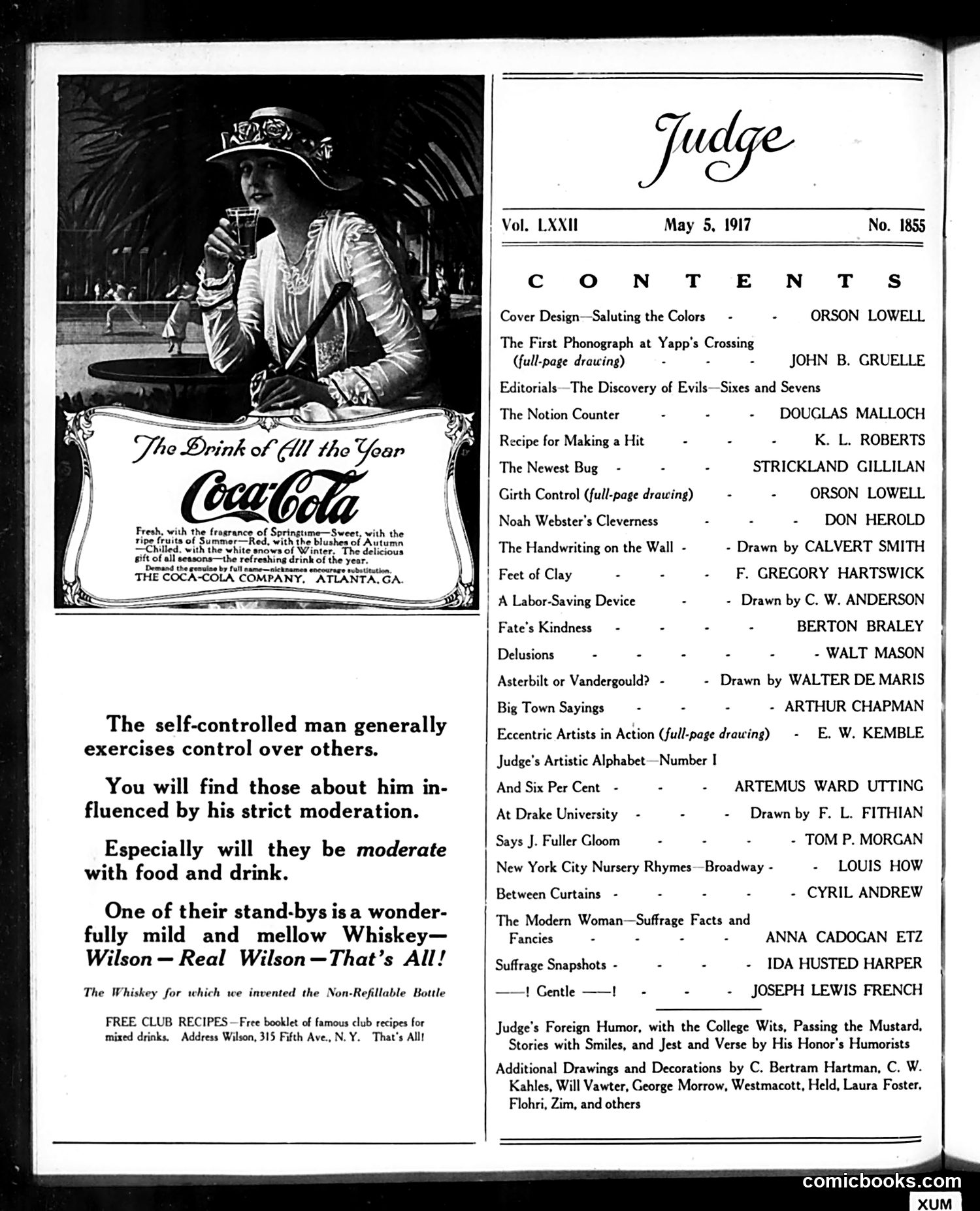
This page is primarily **advertising and table of contents** rather than political satire. The left side features a Coca-Cola advertisement showing an elaborately dressed woman in a decorative hat, promoting Coca-Cola as "The Drink of All the Year." Below it runs a Wilson Whiskey ad emphasizing moderation and self-control in drinking—ironic given Prohibition was imminent (this is May 1917, months before the 18th Amendment passed). The ad's message about "moderate" consumption with food and drink appears tongue-in-cheek. The right side is a standard contents page listing the magazine's articles and illustrations by various contributors. Without seeing the actual cartoons referenced, we cannot assess their satirical content or political messaging.
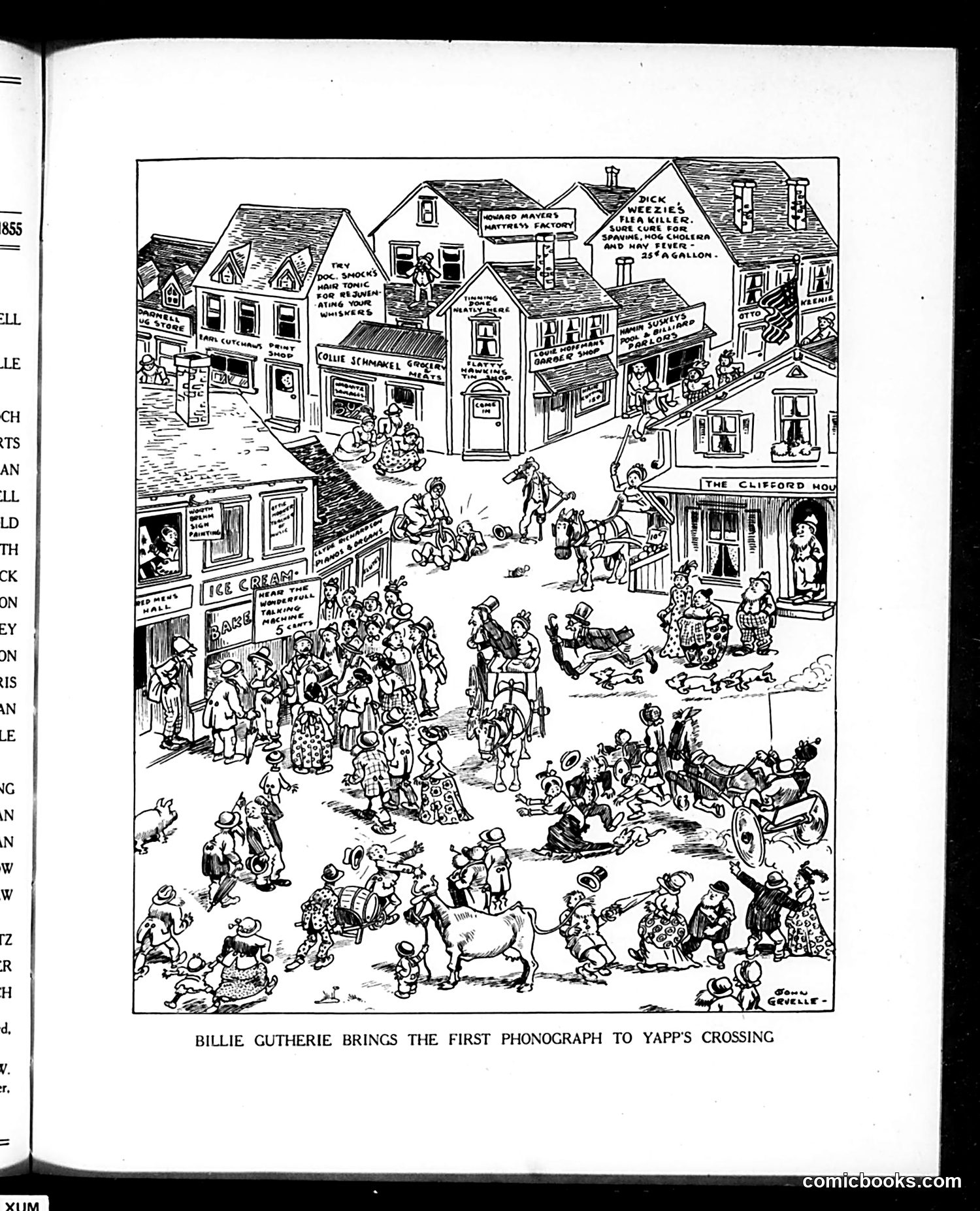
This illustration depicts a bustling village street scene titled "BILLIE GUTHERIE BRINGS THE FIRST PHONOGRAPH TO YAPP'S CROSSING." The cartoon shows a crowd of villagers—men, women, and children—gathered in excited chaos around what appears to be an early phonograph device, likely a gramophone or similar recording/playback equipment. The satire mocks rural communities' fascination with new technology and their provincial isolation. The villagers' enthusiastic, almost frenzied reaction to this modern invention humorously exaggerates how "backwards" or unsophisticated small towns were perceived by urban audiences. Various shops line the street, emphasizing the village setting. The cartoon's humor relies on contrasting technological progress with rural simplicity—a common Judge magazine theme mocking Americana and regional stereotypes.
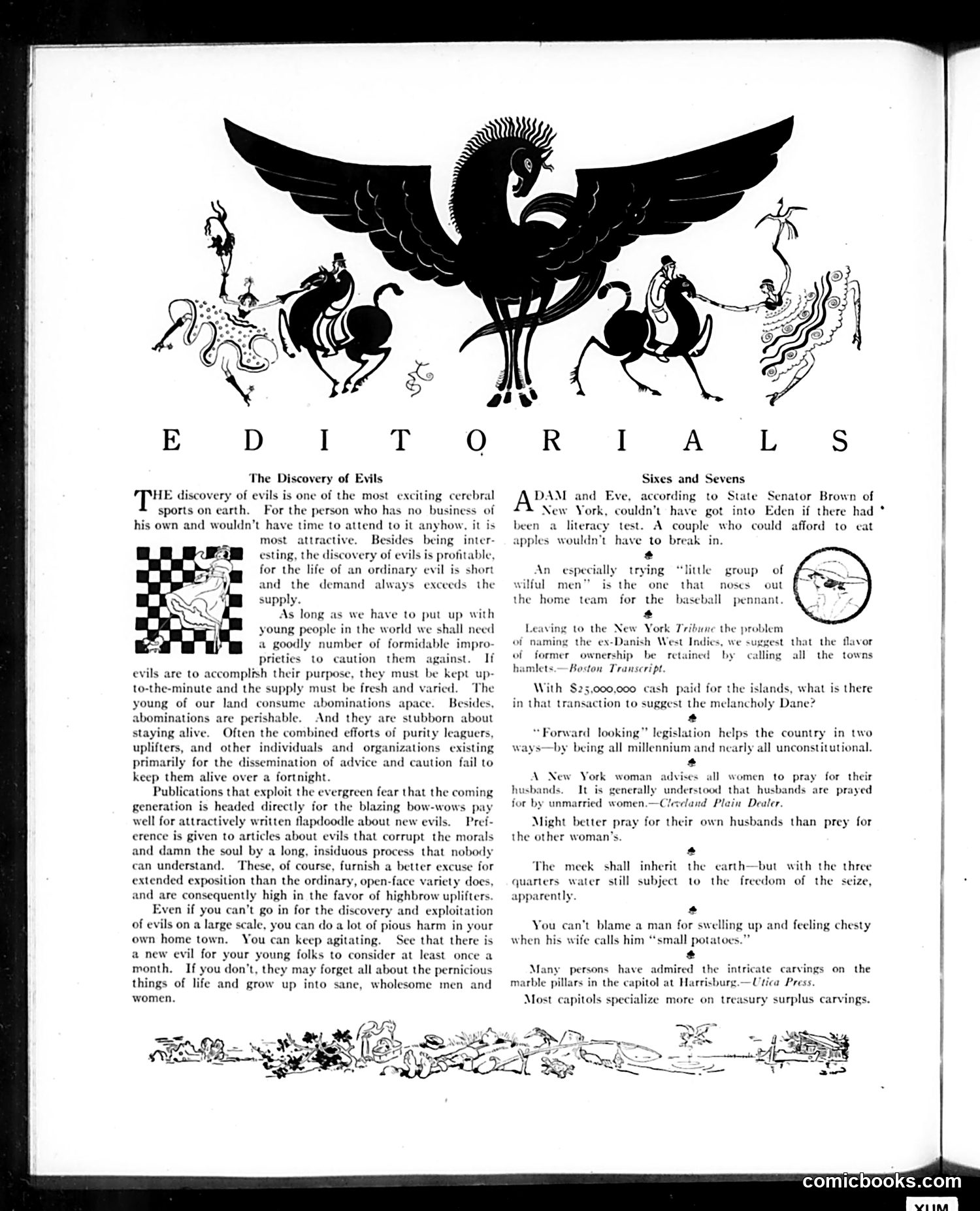
This page from *Judge* magazine presents satirical commentary on morality and social issues. The header illustration depicts a peacock-like bird surrounded by smaller figures, likely representing "evils" spreading through society. The main editorial "The Discovery of Evils" argues that publicizing vice—while seemingly attractive—serves a moral purpose: it keeps society vigilant against corruption. The piece criticizes sensationalized accounts of wrongdoing while defending their necessity. The "Sixes and Sevens" section contains brief social commentary, including jokes about literacy tests, New York politics, and marital dynamics. One item references State Senator Brown of New York and property ownership on islands, suggesting local political satire now obscure to modern readers. The overall tone is moralistic Victorian-era commentary wrapped in humor.
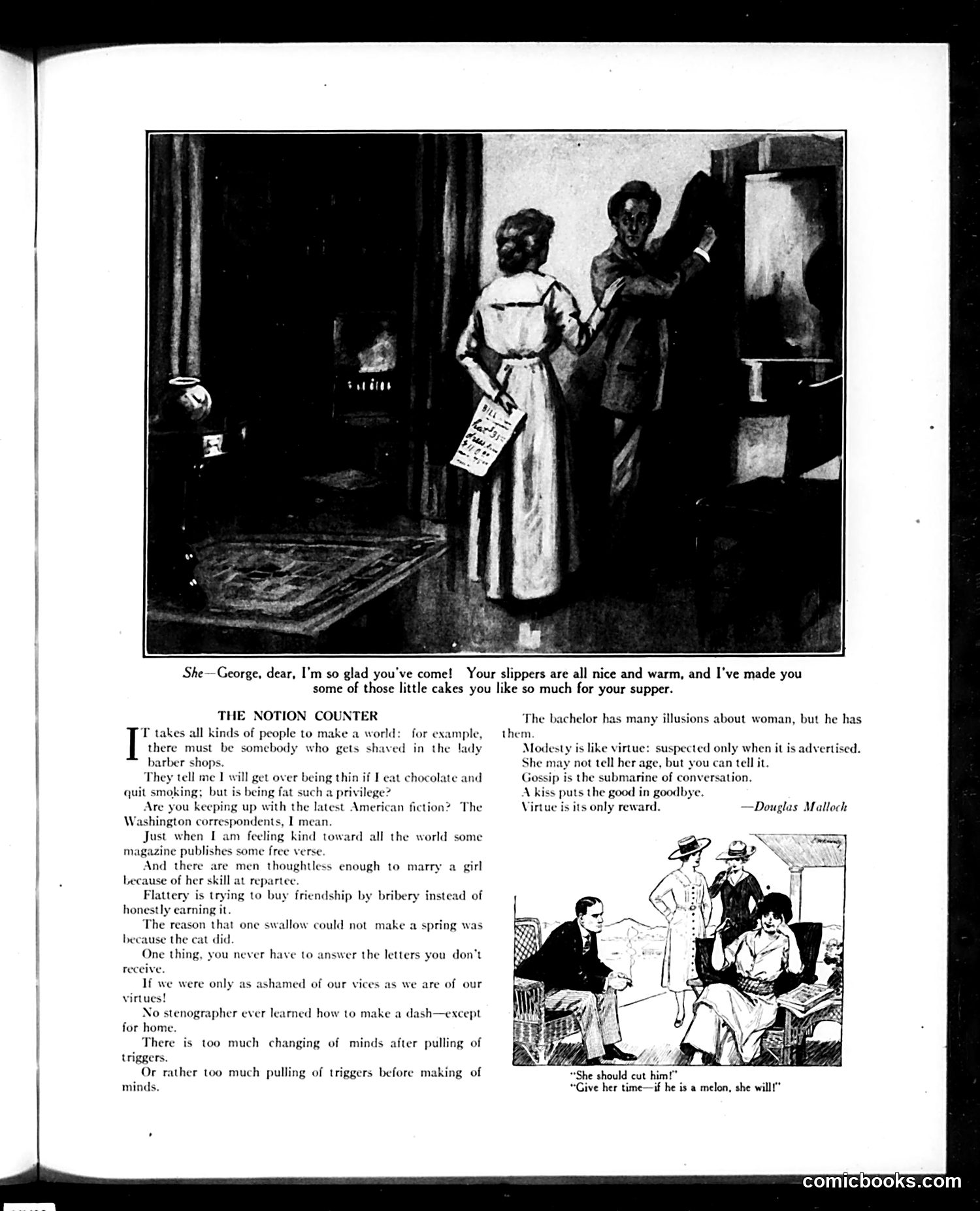
The page contains two separate satirical pieces: **Top Image:** A domestic scene showing a wife welcoming her husband home with slippers and homemade cakes. The caption emphasizes traditional wifely devotion. This appears to satirize idealized notions of domestic bliss and gender roles—likely mocking either the sentimentality of such domestic ideals or, conversely, husbands' unrealistic expectations of wives. **"The Notion Counter":** A column of witty observations about human nature and social behaviors. It critiques various absurdities: men marrying for superficial reasons, the fashion for free verse poetry, people's hypocrisy about vices versus virtues, and the illogic of everyday sayings ("one swallow could not make a spring"). **Bottom Cartoon:** Shows a woman advising another to "give him time—if he is a melon, she will!" This mocks romantic decision-making, suggesting women shouldn't rush into relationships and should assess men's worth over time. Overall, the page satirizes social conventions, romantic expectations, and human contradictions typical of early 20th-century American life.
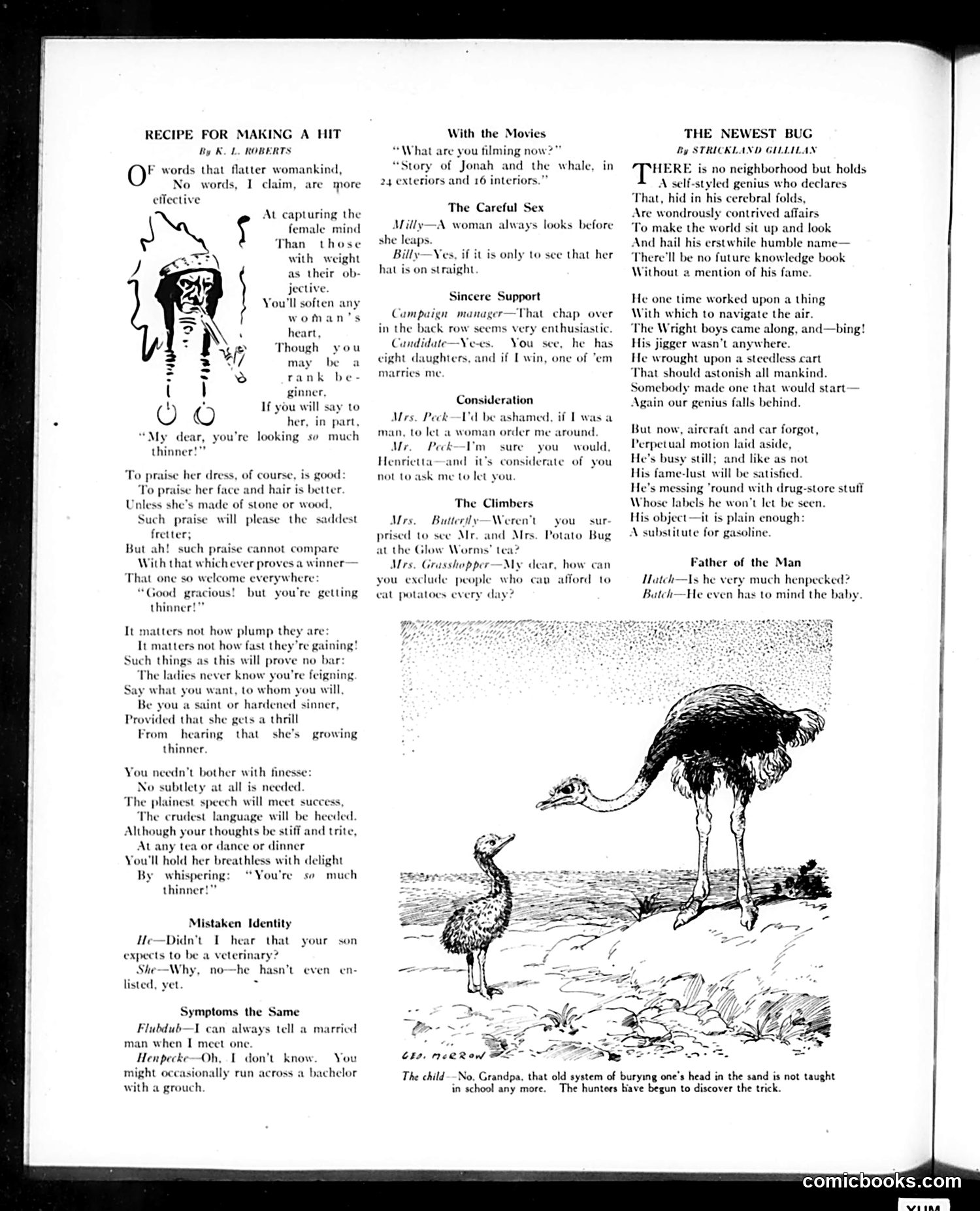
This Judge magazine page contains several brief satirical pieces mocking common social dynamics of the era. **"Recipe for Making a Hit"** advises men that the most effective compliment to women is telling them they look thinner—regardless of truth. The satire targets both male insincerity and women's presumed vanity about weight. **The shorter jokes** mock predictable relationship patterns: wives who order husbands around ("Consideration"), candidates with daughters to marry off ("Sincere Support"), and the assumption that married men are obviously henpecked. **"The Newest Bug"** (right column) satirizes an inventor obsessed with solving humanity's problems—aviation, automobiles, perpetual motion—but repeatedly fails as others succeed. Now he's chasing "a substitute for gasoline," suggesting he'll fail again. The accompanying ostrich illustration reinforces the "head-in-sand" metaphor about ignoring reality. The tone is light domestic humor typical of Judge's era, focused on gender relations, marriage dynamics, and cultural pretension rather than political commentary.
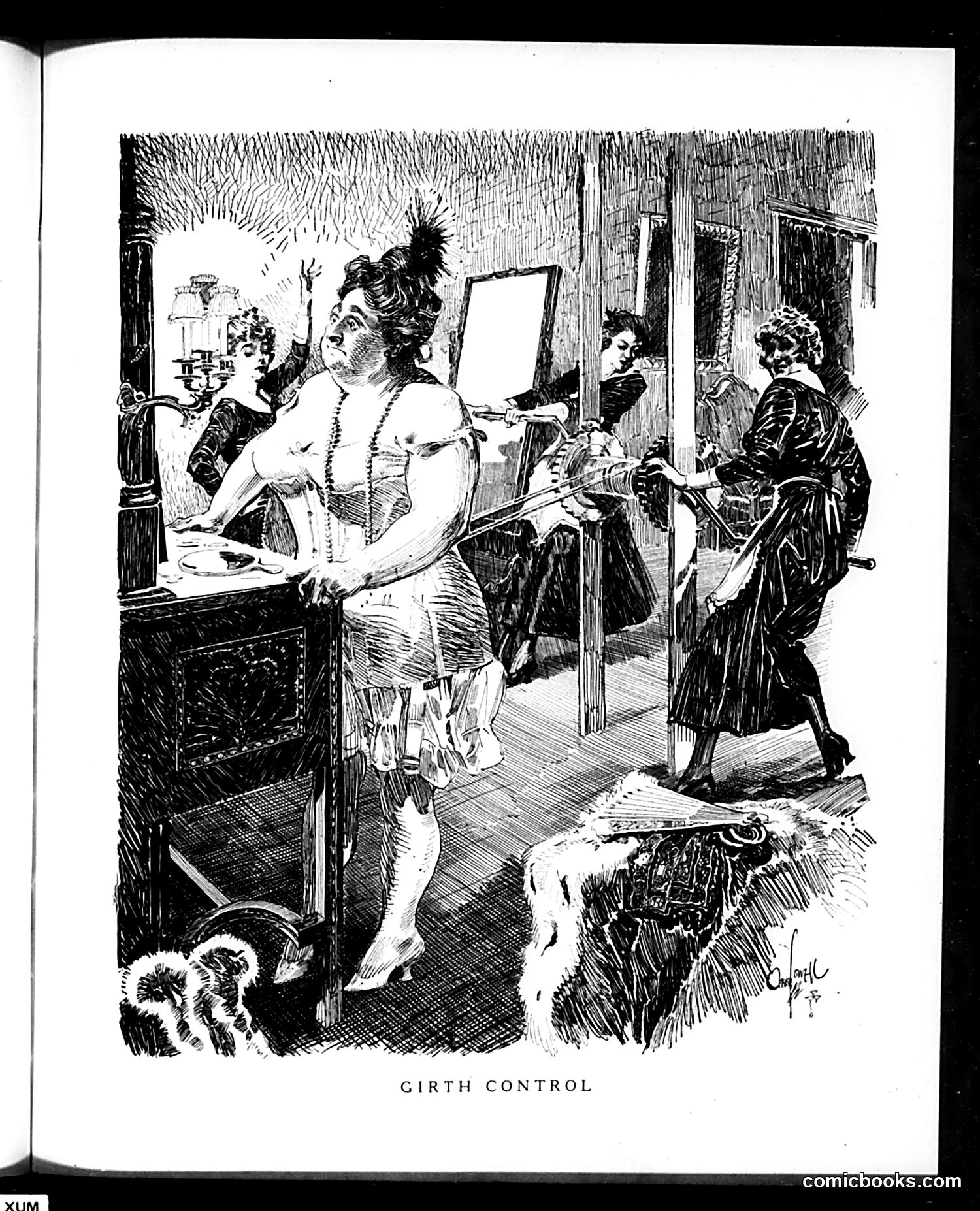
This satirical cartoon depicts a woman at her mirror being fitted into a corset by attendants, with small dogs nearby. The title "Girth Control" is a pun on "birth control"—a highly controversial topic in early 20th-century America. The satire equates women's obsession with maintaining a fashionably slim silhouette (achieved through restrictive corsetry) with birth control efforts. Both were considered scandalous subjects involving female bodily autonomy. The cartoon mocks upper-class women's vanity and the extreme measures they'd undergo for appearance, while simultaneously playing on anxieties about women's reproductive independence. The artist appears to be commenting on what was considered a more socially acceptable female preoccupation—appearance control—versus the morally fraught topic of actual birth control.
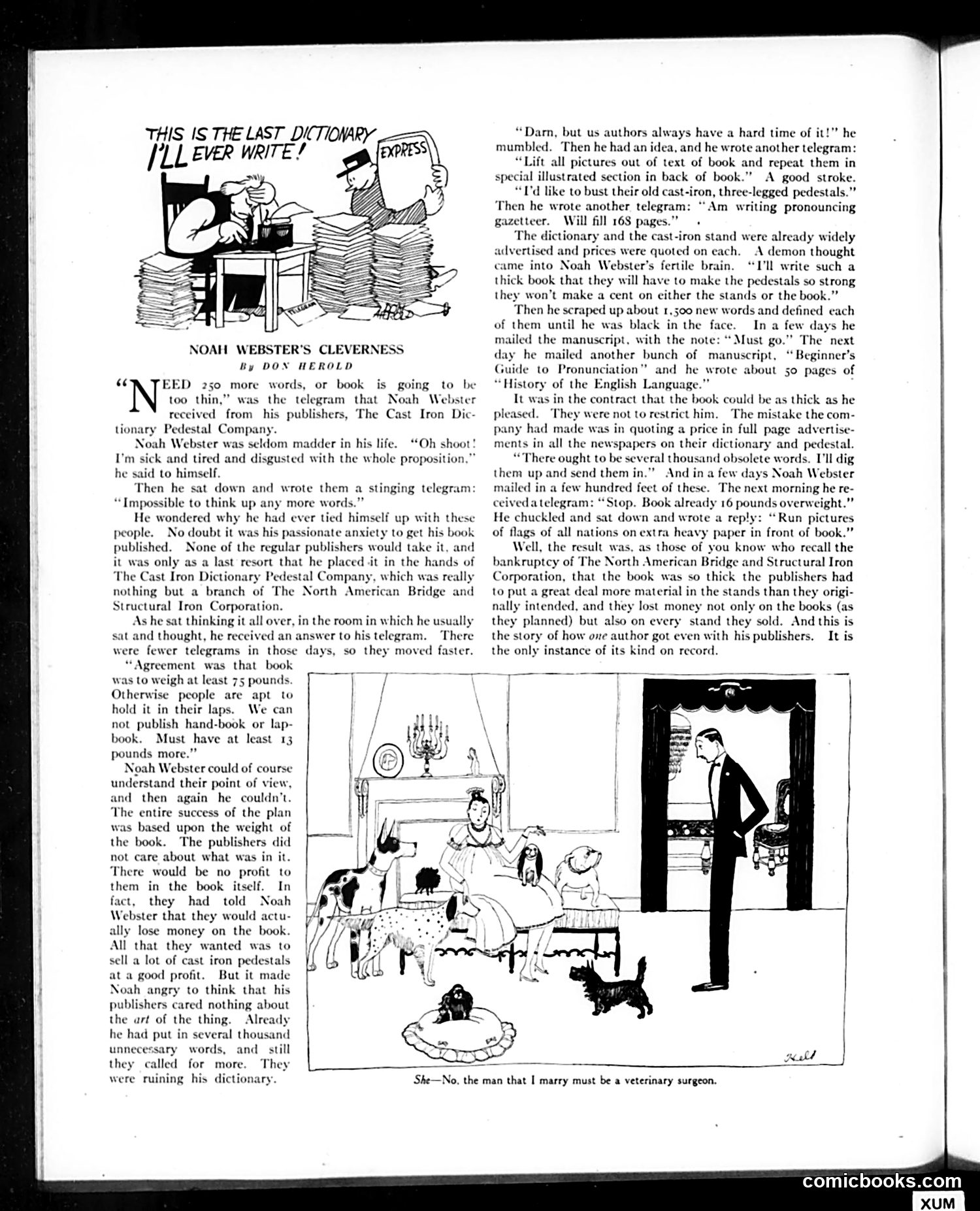
This Don Herold story satirizes the mutual antagonism between authors and publishers. Noah Webster, contracted to write a dictionary for the Cast Iron Dictionary Pedestal Company (a front for a bridge-building corporation), receives demands to add 250 words to make the book "weigh at least 75 pounds"—thick enough to justify selling expensive cast-iron stands. Webster retaliates by deliberately bloating the manuscript with unnecessary content: obsolete words, a pronouncing gazetteer, historical essays, and decorative flag illustrations on heavy paper. The book becomes so massive (16 pounds overweight) that the publishers must reinforce the pedestals with extra material, ultimately losing money on both the books and stands. The satire mocks the absurdity of contractual disputes and opposing incentives: publishers want profitable bulk; Webster wants revenge. The joke's bitter edge reflects real author-publisher tensions of the era, where control over content and production frequently caused conflict.
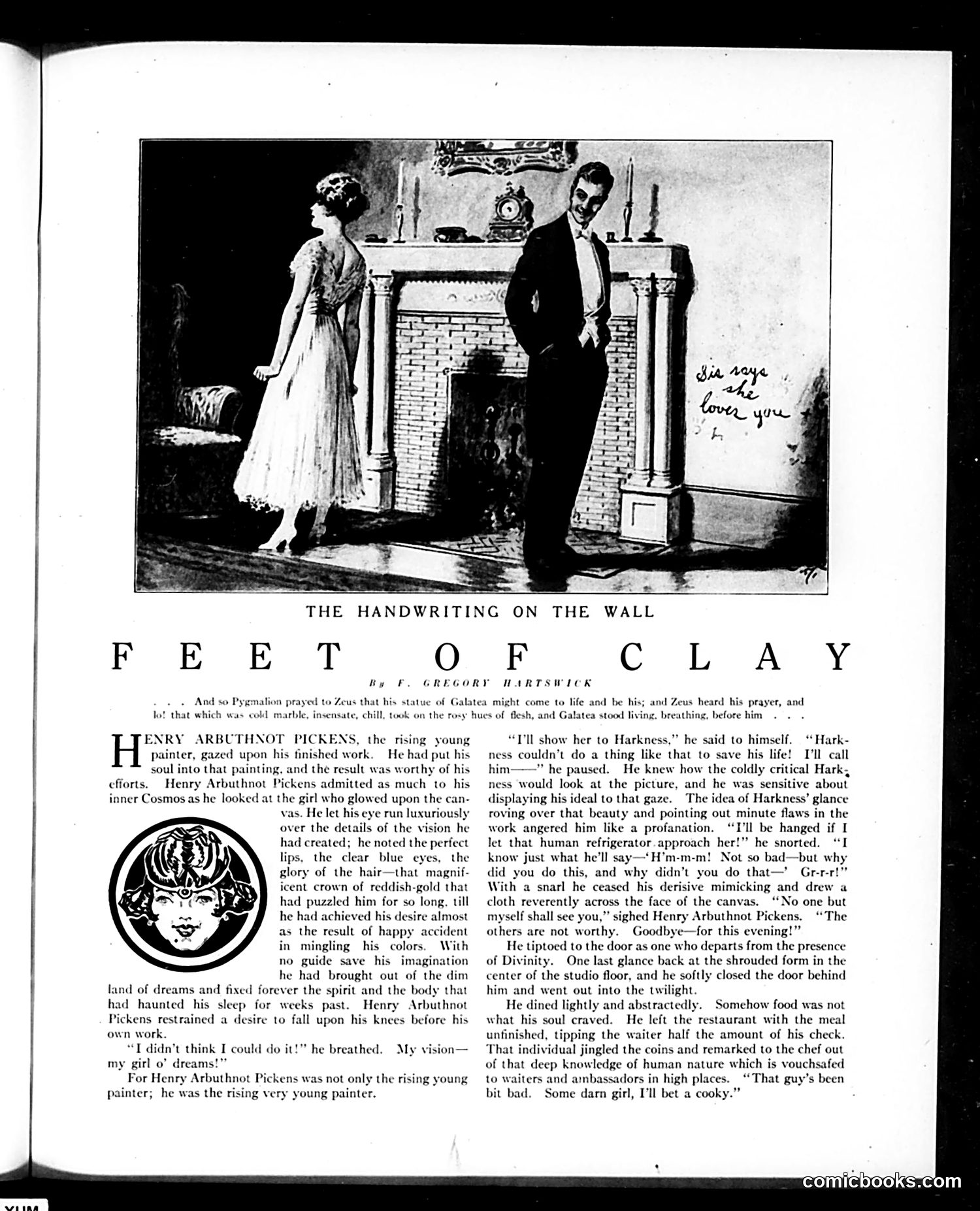
This story satirizes artistic vanity and self-delusion. Henry Arbuthnot Pickens, a young painter, completes a portrait of an idealized woman that he considers his masterwork. He becomes so protective of it—refusing to show it to the critical Harkness—that he treats it with quasi-religious reverence, tiptoing away "as one who departs from the presence of Divinity." The title alludes to the biblical phrase "feet of clay," meaning hidden weakness beneath an impressive exterior. The satire targets Pickens's inflated ego and his need to shield his work from any scrutiny or criticism. His obsessive behavior—leaving the painting shrouded, dining distractedly afterward—suggests he's more in love with his own idealized vision than with reality. The waiter's final comment hints that Pickens's emotional turmoil stems from romantic disappointment ("some dam girl"), suggesting his artistic "creation" is really just wish-fulfillment—a projection of his own desires rather than genuine artistic achievement.
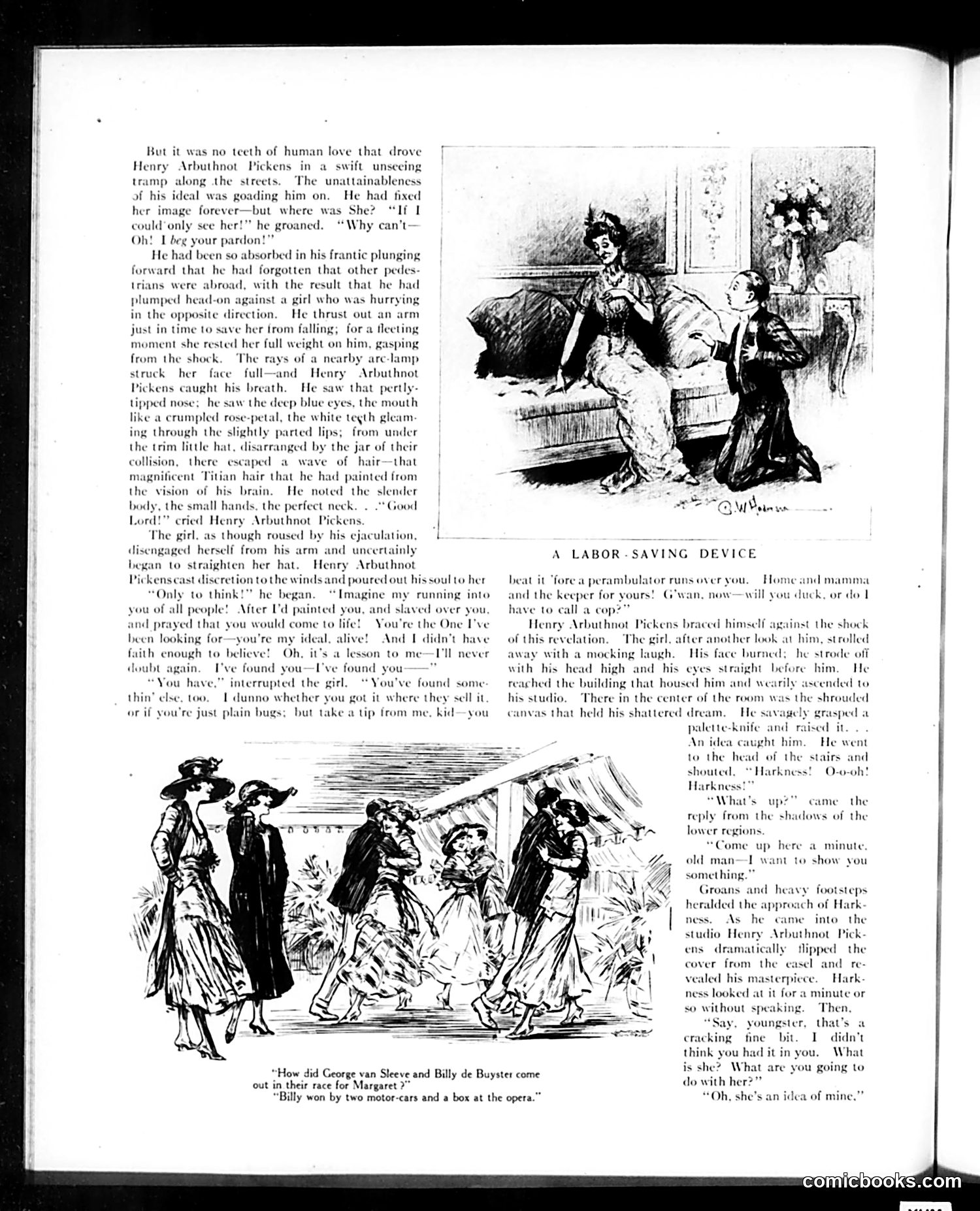
This page illustrates a romantic comedy about Henry Arbuthnot Pickens, an idealistic artist who paints his fantasy woman from imagination. He literally collides with a girl on the street who matches his painting perfectly—she is, impossibly, his ideal made flesh. The joke's twist: the girl is unimpressed and dismisses him as a lunatic ("plain bugs"), telling him to "beat it." She leaves mocking him. Pickens initially devastated, then has an epiphany: he decides to exhibit the portrait itself as "an idea of mine," abandoning the pursuit of the real woman in favor of his artistic creation. The satire targets romantic idealism and artistic pretension—the irony that the artist values his imagined vision more than actual human connection. The lower cartoon's caption about winning a race for Margaret through "motor-cars and a box at the opera" reinforces that material displays matter more than genuine feeling.
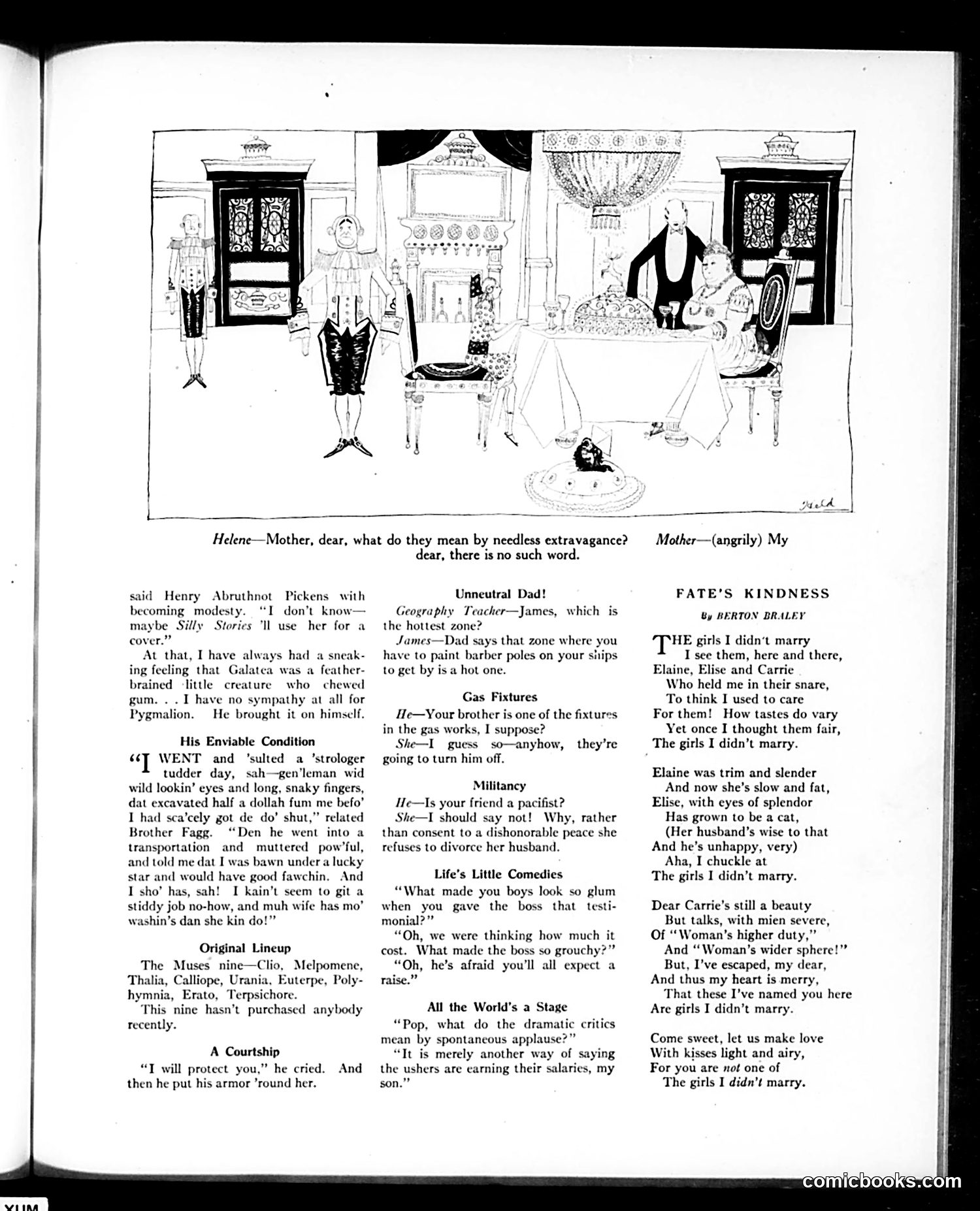
This page contains multiple short humorous pieces typical of Judge's satirical style, rather than a single political cartoon. The illustrations show an elegant interior scene with figures in formal dress, likely accompanying one of the verbal jokes below. The humor relies on wordplay and social commentary: a character mocking "needless extravagance" while being vain; an astrologer's prediction proving ironically accurate (a "lucky star" resulting in joblessness); a barber pole joke about naval war zones; a gas works employee who will be "turned off"; and a woman so militant she refuses divorce "rather than consent to a dishonorable peace"—mocking female suffragists' uncompromising positions. The poem "Fate's Kindness" reflects common early-20th-century bachelor humor: the speaker congratulates himself on *not* marrying women who aged poorly or became insufferable (one promoting "Woman's higher duty"). The overall tone satirizes modern life, gender relations, and social pretension typical of Judge's readership.
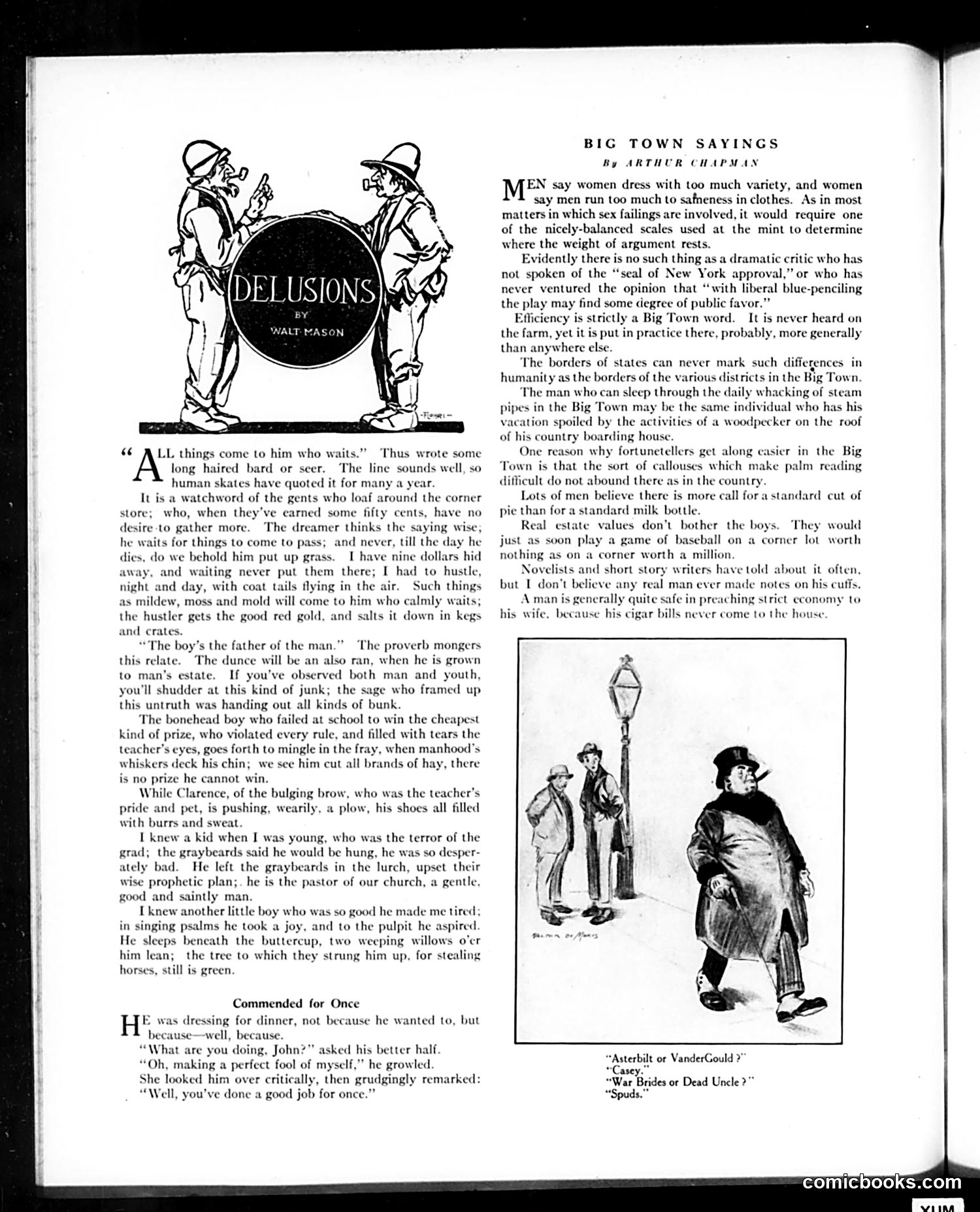
This page combines two distinct pieces of early 20th-century American satire. **"Delusions" by Walt Mason** (left): A poem debunking popular proverbs. Mason challenges the saying "all things come to him who waits," arguing hustlers—not passive dreamers—achieve success. He similarly critiques "the boy's the father of the man," using contrasting examples: a "bonehead" school failure who becomes successful versus a teacher's pet who struggles. The satire mocks folk wisdom as "bunk," reflecting Progressive-era skepticism of traditional sayings. **"Big Town Sayings" by Arthur Chapman** (right): Short social observations contrasting urban and rural life. Chapman notes Big Town peculiarities (dramatic critics, "efficiency," palm readers thriving where calluses don't exist) versus country simplicity. **"Commended for Once"** (bottom): A domestic humor sketch where a husband dressing for dinner calls himself a "fool," and his wife agrees—but adds it's the one time he's done something right, suggesting habitual incompetence. The illustration depicts three men in period dress, likely representing types discussed in the text, though specific identities are unclear.
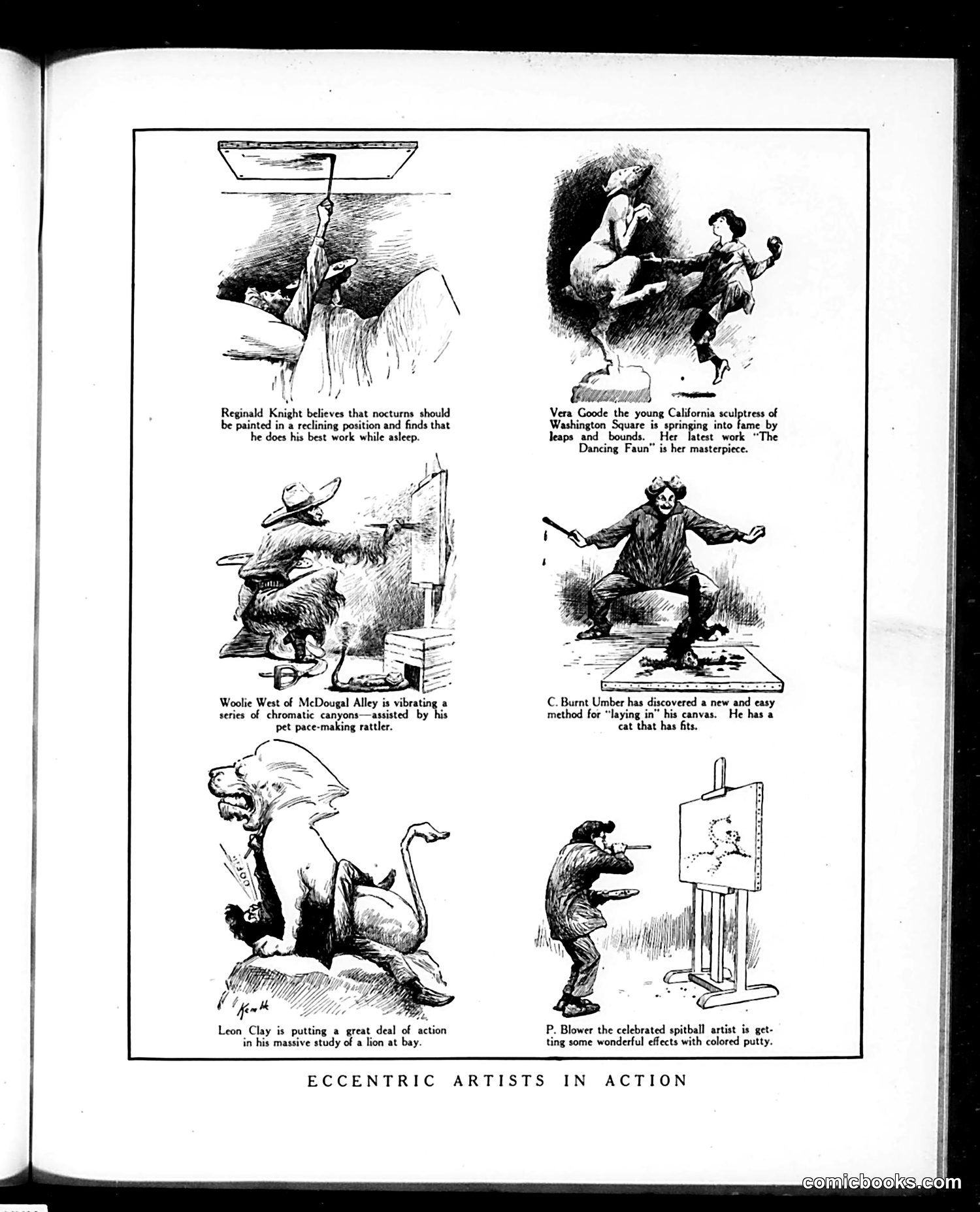
This page satirizes bohemian artists of Greenwich Village/Washington Square area through mock-serious "profiles" paired with absurd illustrations. Each caption presents a ridiculous artistic method presented as legitimate technique: - **Reginald Knight** paints while sleeping (sleeping artist suspended from ceiling) - **Woolie West** uses a rattlesnake as creative "assistant" - **Vera Goode** creates sculpture through uncontrolled jumping/dancing - **C. Burnt Umber** uses a cat having seizures to apply paint - **P. Blower** throws spitballs for artistic effect - **Leon Clay** studies lions in an exaggerated, contorted pose The satire mocks the pretentiousness of avant-garde artists and their dubious creative methods. By presenting these absurdities with deadpan captions, Judge ridicules the Greenwich Village art scene as eccentric fraudsters using nonsensical techniques while claiming serious artistic purpose. The humor relies on readers recognizing these as parodies of actual contemporary bohemian affectations.
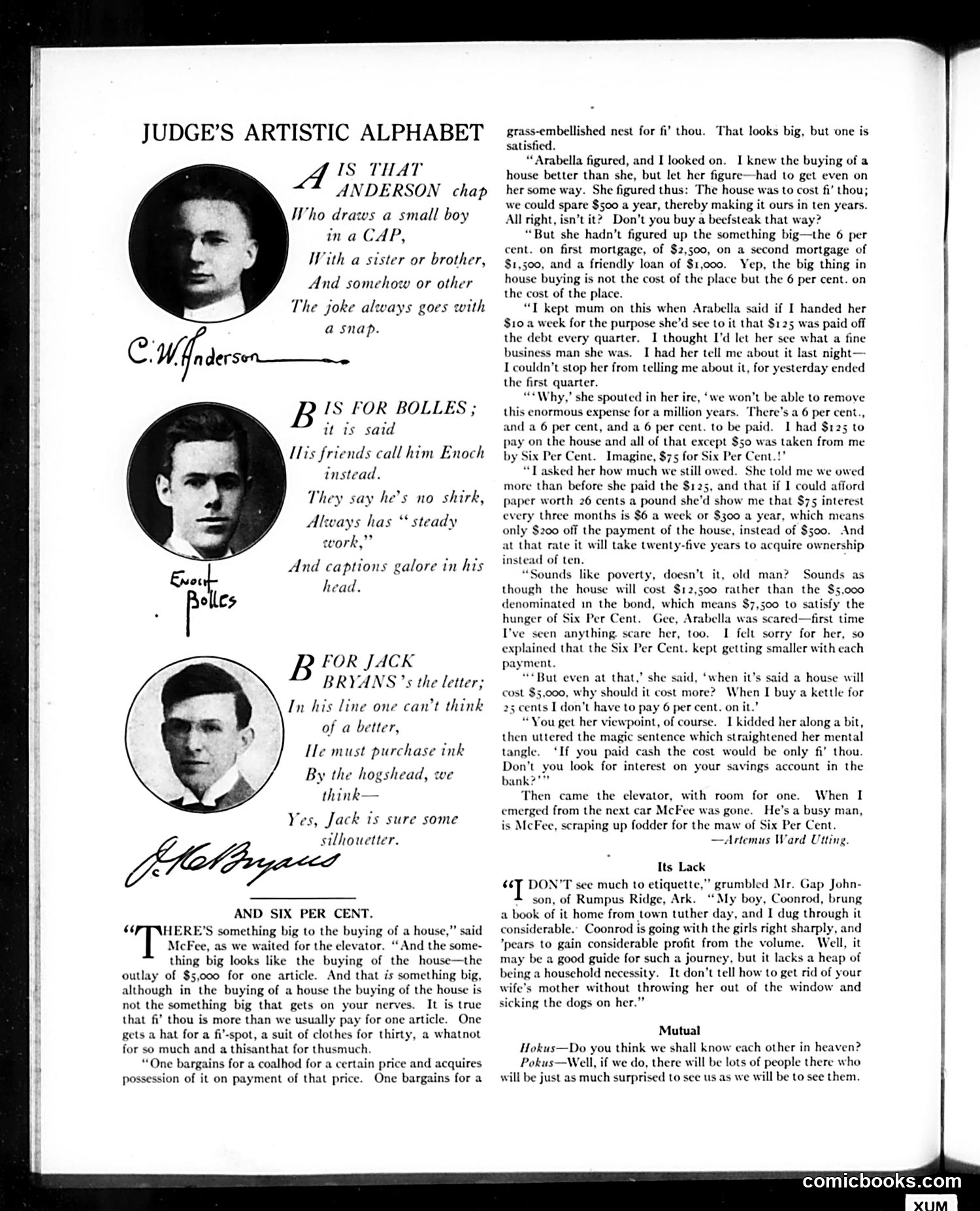
This page showcases three cartoonists working for *Judge* magazine through brief biographical sketches paired with their portraits: **C.M. Anderson** — Known for drawing small boys in caps with siblings, his humor relies on visual "snap" (punchy timing). **Enoch Bolles** — Friends call him this instead of his real name. The text notes he works steadily and produces abundant captions for his illustrations. **Jack Bryans** — A silhouettist (artist specializing in black outline portraits) who uses so much ink the magazine jokes he must purchase it "by the hogshead." The second article, "And Six Per Cent," satirizes the hidden costs of home-buying through a husband-wife conversation. The joke: a $5,000 house actually costs $12,500 once interest on mortgages and loans accumulates—the "six per cent" repeatedly stacking up. The wife initially calculates naively; the husband's final revelation about paying cash versus financed purchase illustrates how interest transforms the true cost.
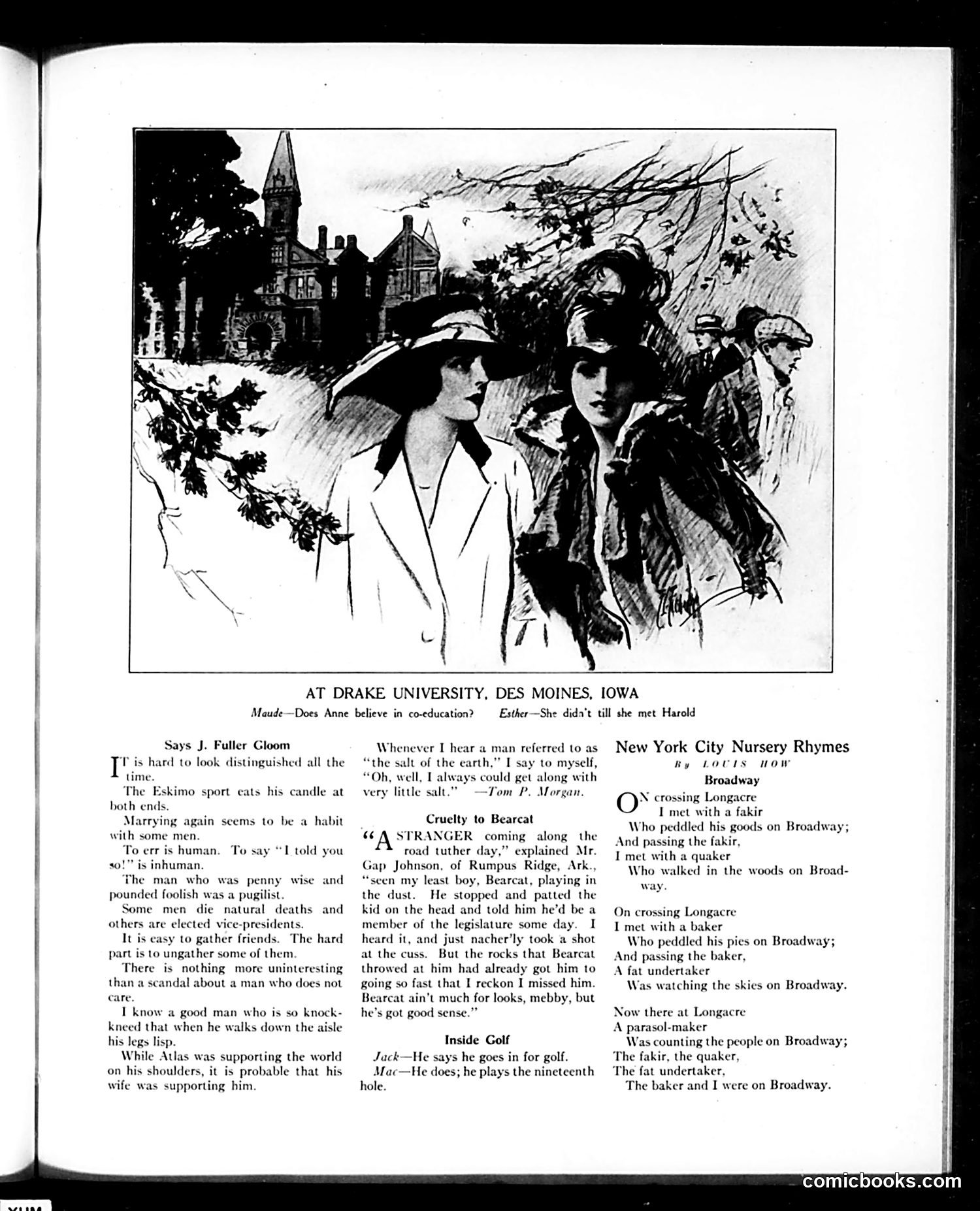
This page from Judge contains several satirical humor pieces typical of early 20th-century American comedy magazines. **Main cartoon** (top): Shows fashionable women at Drake University, Des Moines. The caption questions whether a character named Anne believes in co-education—a contemporary social debate about whether men and women should study together. The satire likely mocks either progressive attitudes toward co-education or resistance to it. **Text sections** include: - **"Says J. Fuller Gloom"**: Short, cynical quips about human nature (marriage habits, hypocrisy, vice-presidents elected through scandal). Standard satirical social commentary. - **"Cruelty to Bearcat"**: Rural dialect humor about a backwoods father defending his dim-witted son, praising "good sense" while describing violent, senseless behavior—the irony being the satire itself. - **"Inside Golf"**: A two-liner joke: "nineteenth hole" refers to the bar after golfing, implying the man drinks rather than actually plays golf. - **"New York City Nursery Rhymes"**: Parodies traditional nursery rhymes using Manhattan street types (fakirs, quakers, bakers, undertakers), mocking urban commerce and diversity.
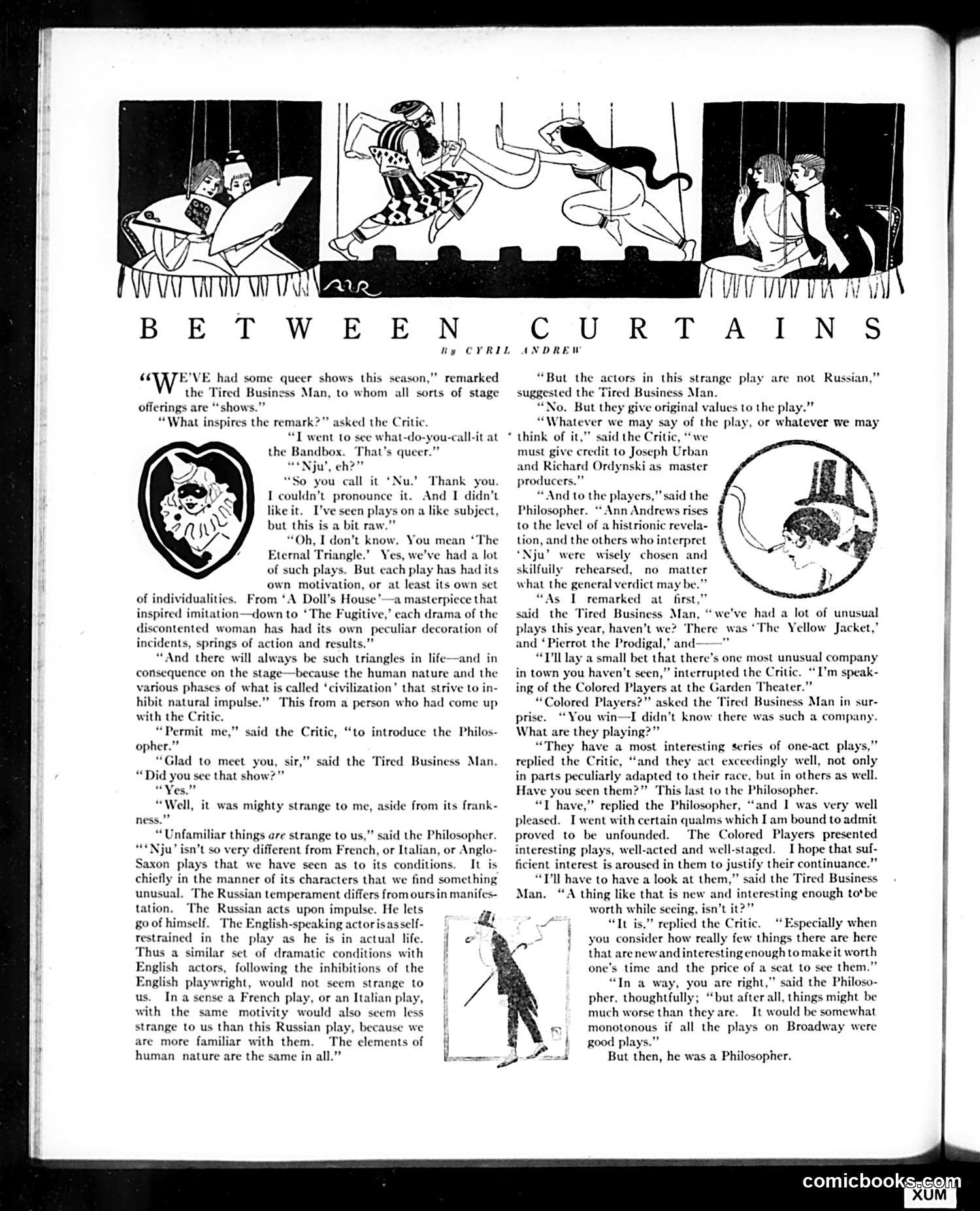
This page features a conversation between three recurring Judge characters: the Tired Business Man, the Critic, and the Philosopher, discussing contemporary theater. The main point involves defending an avant-garde Russian play called "Nju" (appearing to be a translation of a Chekhov-era work about infidelity—"the eternal triangle"). The Tired Business Man finds it strange and "raw," but the Critic and Philosopher explain that Russian drama's power lies in its emotional authenticity, contrasting with the restrained English theatrical tradition. The discussion extends to praising several contemporary productions, including "The Yellow Jacket" and notably "Pierrot the Prodigal." The text concludes by highlighting the Colored Players theater company at the Garden Theater, praising their skilled performances across diverse roles, with the Philosopher noting his initial prejudices proved unfounded. The satire gently mocks middlebrow American theatergoers' resistance to experimental foreign drama while celebrating artistic merit regardless of performers' race.
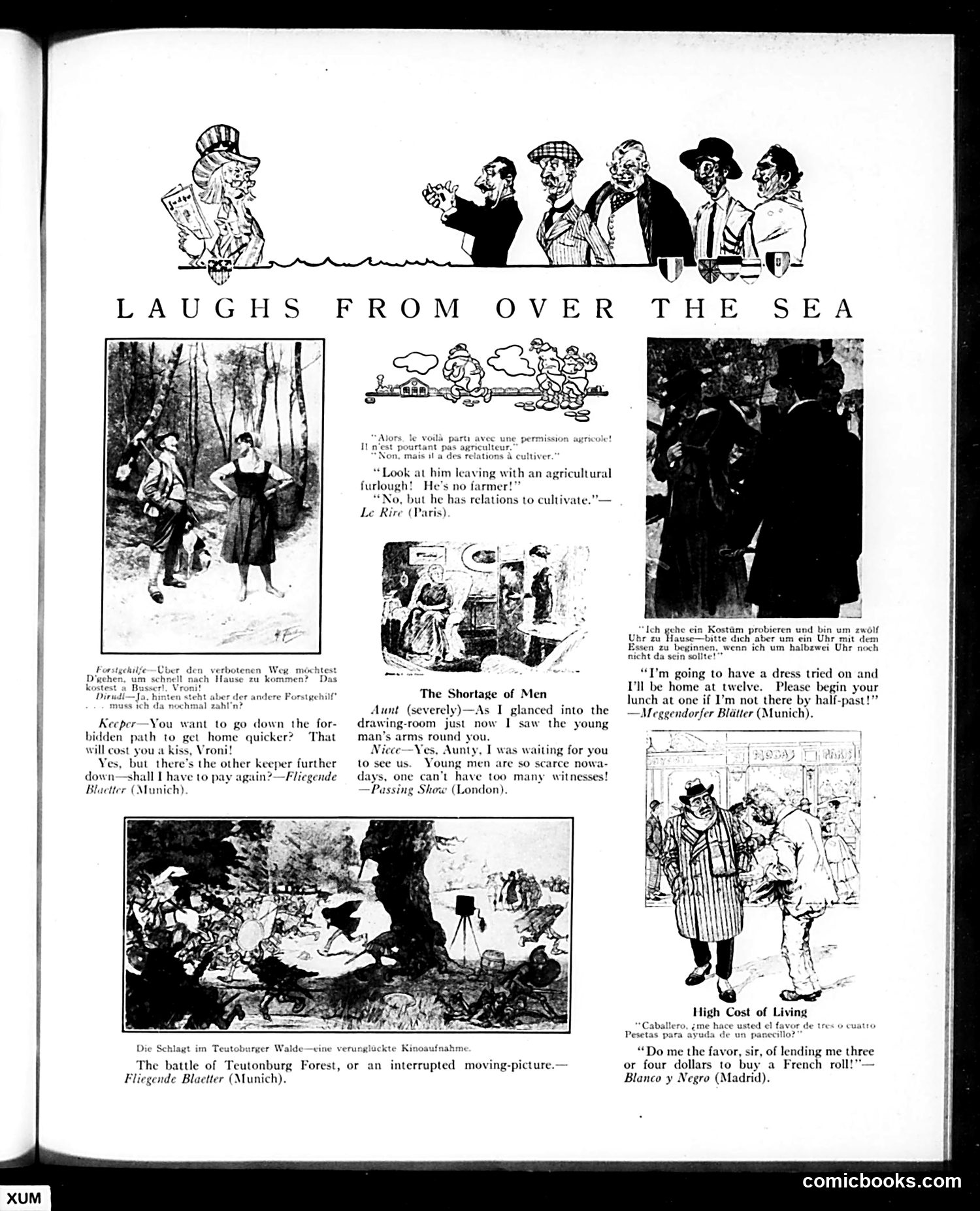
This page collects satirical cartoons from European magazines, translated for American readers. The humor reflects post-WWI anxieties: **"The Shortage of Men"** jokes about young men being scarce (likely due to war casualties), so a niece brazenly displays her suitor's affection to have "witnesses" to their courtship—implying competition for eligible bachelors. **"High Cost of Living"** depicts economic hardship: a man asks for a loan to buy bread, suggesting inflation and poverty. **Other sketches** include German humor about keepers demanding payment (kisses) for using forbidden paths, and a joke about agricultural furloughs concealing affairs rather than farm business. The cartoons collectively satirize post-war social disruption—absent men, economic struggle, and shifting social norms—through light humor intended for an American audience familiar with European perspectives.
This page is primarily **theatre advertising and reviews** rather than political satire. It showcases New York theatrical productions from what appears to be the early 1920s, including "Lilac Time," "The Willow Tree," and "The 13th Chair." The only substantive editorial content is a piece titled **"The Only Way,"** which discusses practical military training—specifically how soldiers should learn to manage blankets efficiently in the field. This appears to reference **post-WWI military preparedness**, though the text cuts off mid-sentence. The cartoon illustration (showing a figure in an oval frame) appears decorative rather than satirical and doesn't clearly caricature any identifiable political figure. **For modern readers:** This page reflects a period when Judge mixed commercial theatre advertisements with brief practical commentary on contemporary concerns like military readiness, rather than the sharp political cartooning the magazine was known for.
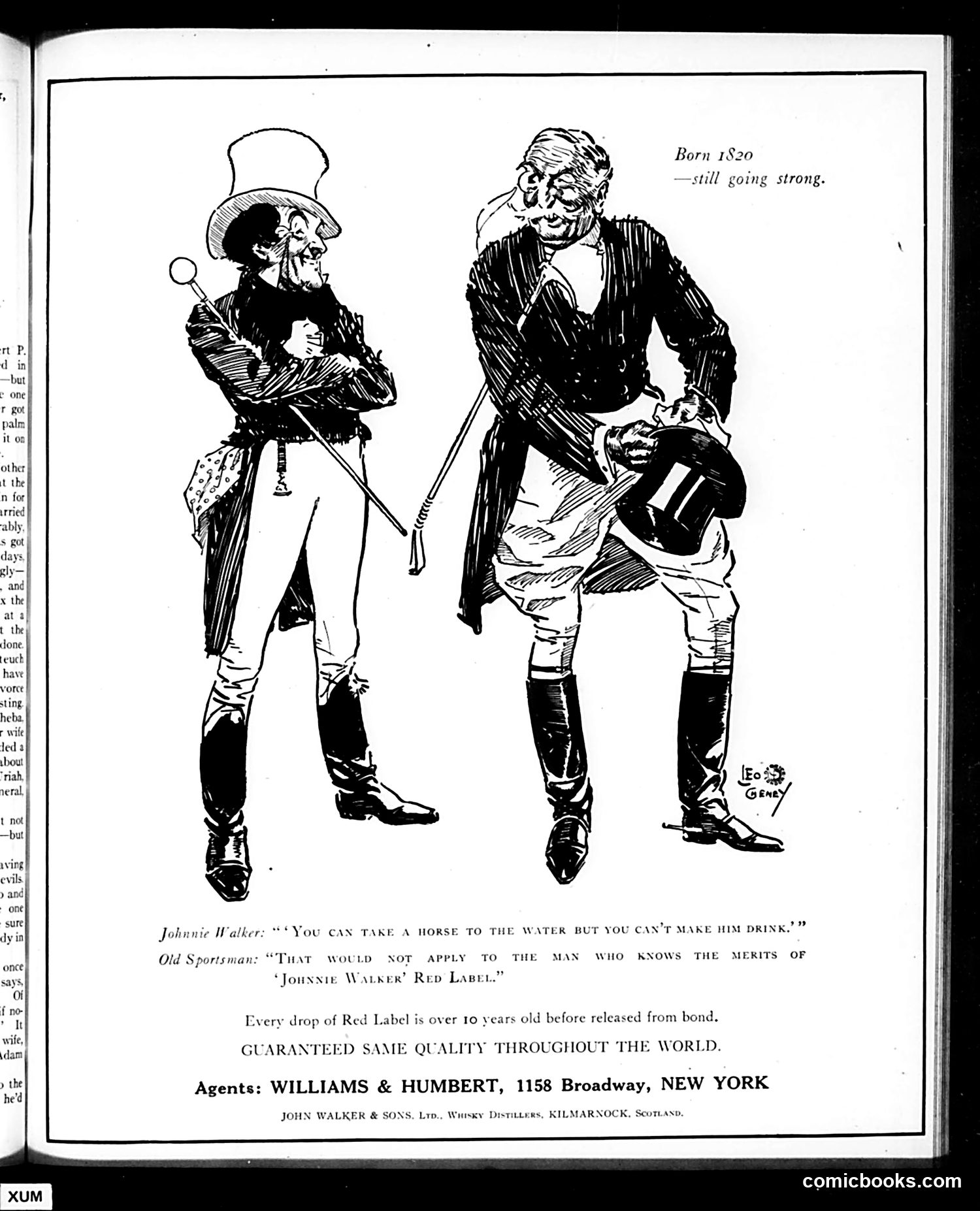
This is a Johnnie Walker whisky advertisement disguised as editorial cartoon humor. Two figures—"Johnnie Walker" (left, in top hat) and an "Old Sportsman" (right)—discuss the proverb about leading a horse to water. The sportsman counters that this saying doesn't apply to men who know the quality of Johnnie Walker Red Label whisky: they'll drink it willingly. The cartoon plays on the brand's iconic "Johnnie Walker" mascot character (the walking man in formal dress, born 1820, "still going strong"). The joke suggests the whisky's reputation is so established that no persuasion is needed—quality sells itself. The ad emphasizes the product's age (over 10 years) and consistency, positioning it as a premium, internationally recognized brand available through New York agents.
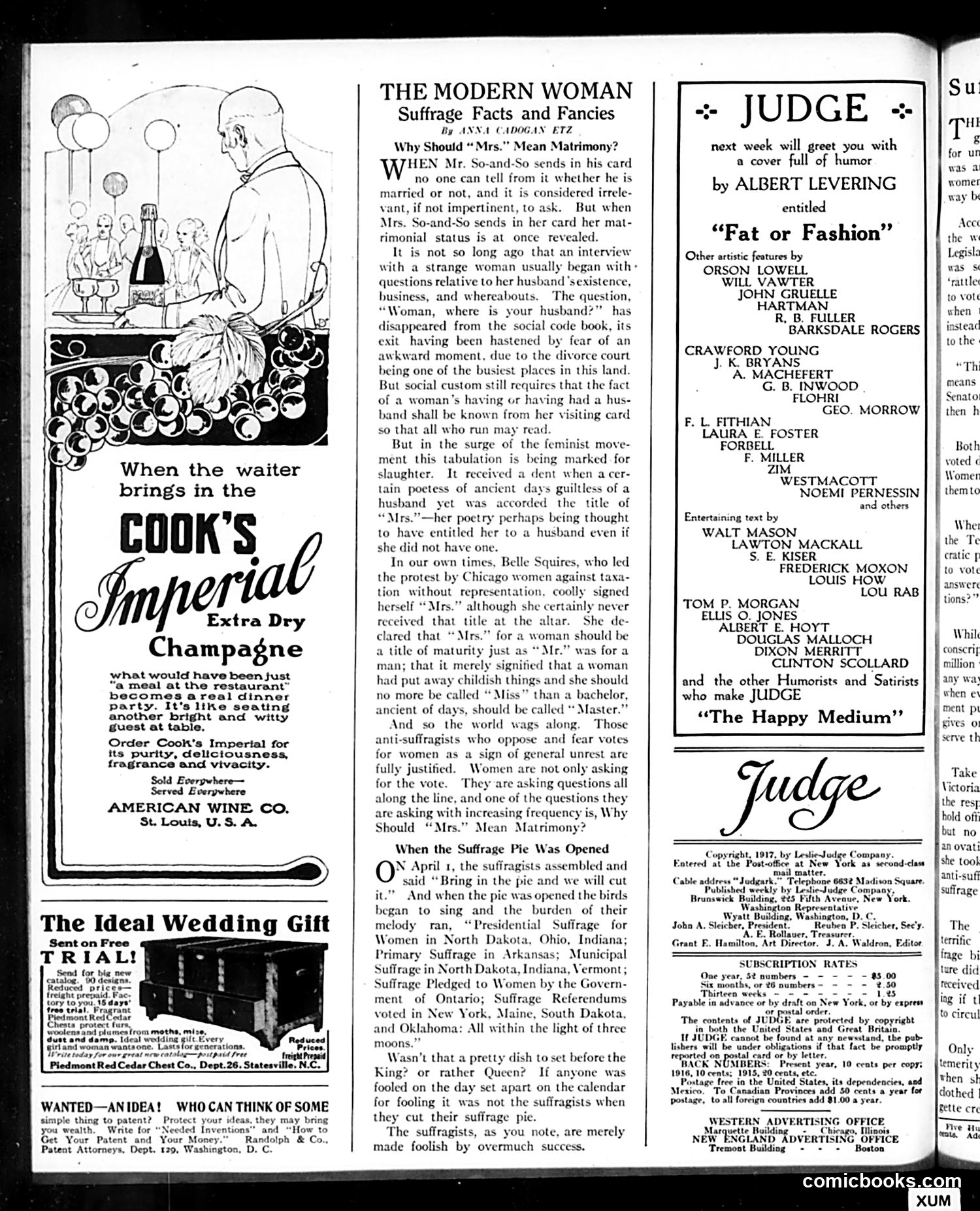
This page features satirical commentary on women's suffrage and social conventions from an early 20th-century American perspective. **Main Article: "The Modern Woman - Suffrage Facts and Fancies"** The piece critiques the title "Mrs." as inherently tied to marital status, contrasting it with how men's titles ("Mr.") reveal nothing about marriage. It references **Belle Squires**, who led Chicago women's anti-taxation protest, as an example of women challenging gendered social conventions. The article argues that the feminist movement is questioning outdated rules requiring women's marital status to be publicly declared on calling cards—a significant social convention of the era. **"When the Suffrage Pie Was Opened"** This section celebrates recent suffrage victories (April 1917), listing gains in North Dakota, Ohio, Indiana, Arkansas, and referendums in New York, Maine, South Dakota, and Oklahoma. The "pie" metaphor humorously describes women obtaining voting rights. **Left Cartoon** The illustration shows a formal dinner party centered on champagne—satirizing how luxury goods and social status mattered more to society than substantive issues like women's rights.
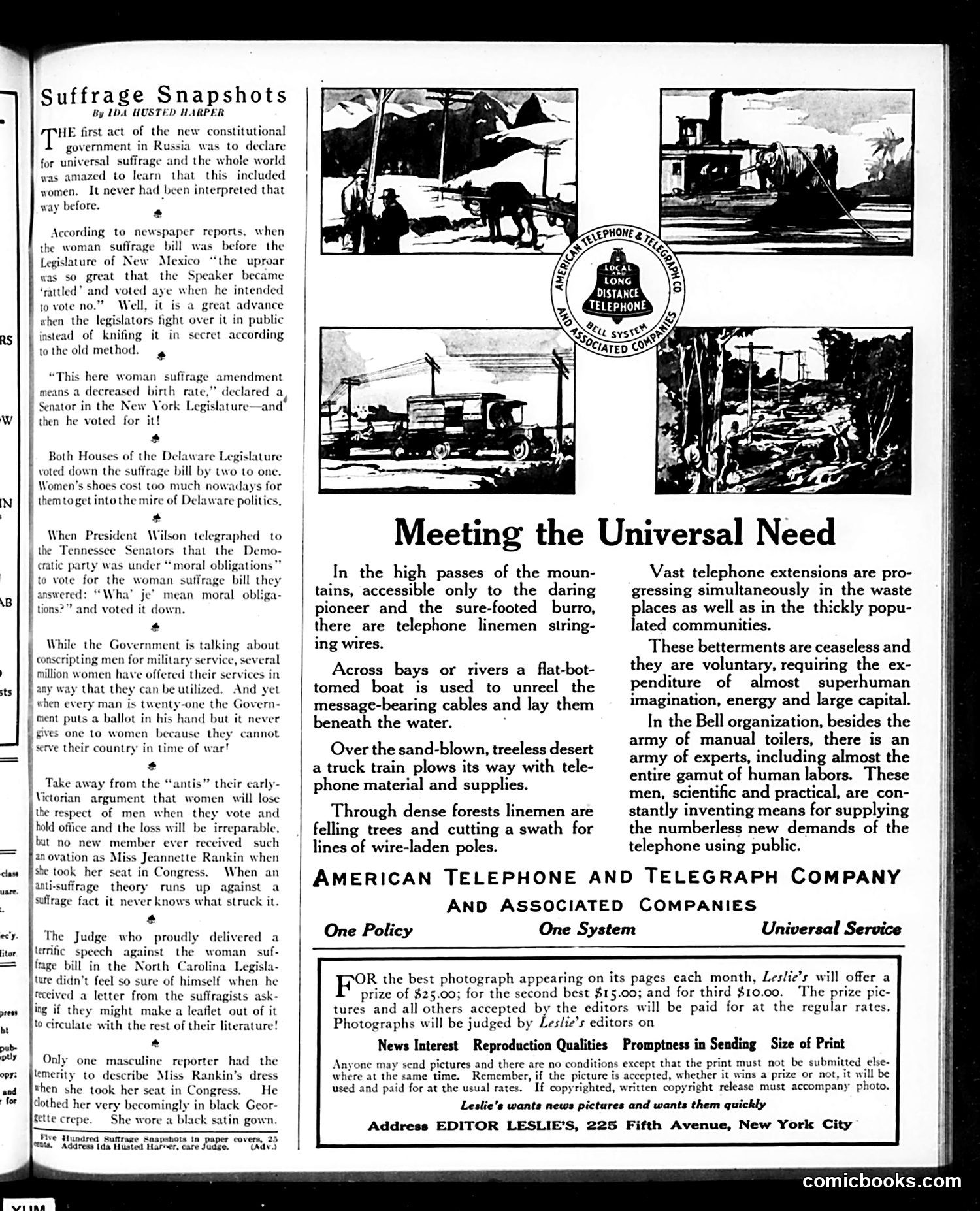
This *Judge* article by Ida Husted Harper uses anecdotes to mock anti-suffrage arguments. Harper highlights the hypocrisy and absurdity of male legislators opposing women's voting rights. **Key satirical points:** - A New Mexico Speaker accidentally votes *for* suffrage while intending to vote against it—suggesting the cause's inevitability - A New York Senator claims suffrage reduces birth rates, then votes for it anyway—exposing hollow reasoning - Delaware rejects suffrage because "women's shoes cost too much" for politics—mocking trivializing arguments - Male officials invoke "moral obligations" while voting no—showing bad faith - Men demand women serve in war but deny them ballots—highlighting logical contradiction - Jeannette Rankin's Congressional arrival receives standing ovations, contradicting claims women lose male respect by voting The satire argues that anti-suffrage rhetoric crumbles against reality. This was written during active 1910s-1920s suffrage debates, before the 19th Amendment (1920).
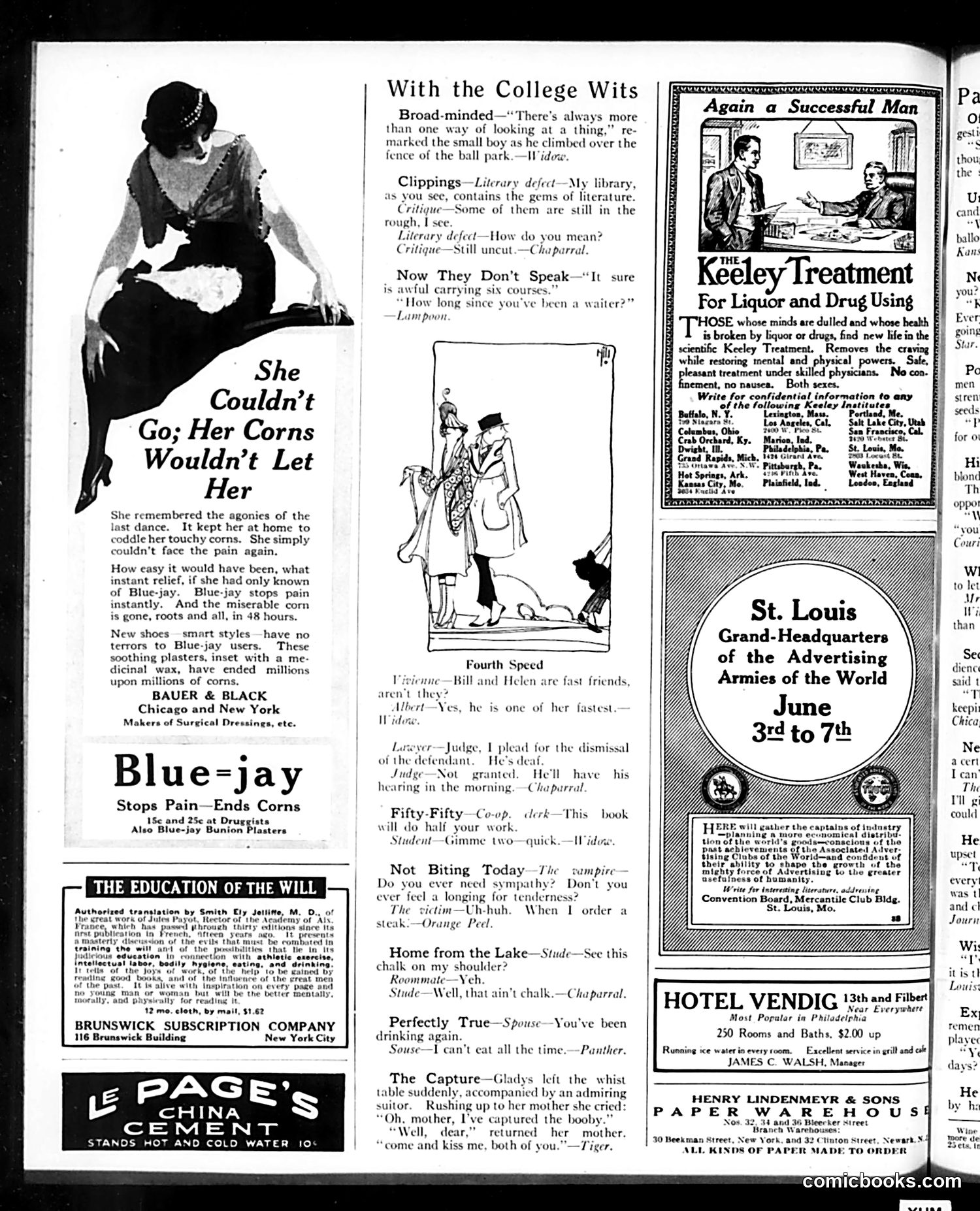
This page is primarily **advertising** with a small humor section ("With the College Wits"). The main content consists of vintage ads for corn treatments (Blue-jay), subscription books, cement, the Keeley Treatment for alcoholism and drug addiction, hotels, and paper supplies—typical commercial messages from this era. The "College Wits" section features brief, generic jokes about university life: students complaining about course loads, wordplay about waiters and fast friends, and romantic mishaps. These represent light satirical commentary on student culture rather than political satire. The single substantive cartoon shows a woman unable to attend a dance because of painful corns—used as a setup to advertise the Blue-jay pain treatment product. **Overall**: This is a commercial page with incidental humor, not political or social satire. The content reflects early 20th-century concerns (foot pain, substance abuse treatment) and college campus stereotypes, but contains no identifiable political figures or sharp satirical commentary.
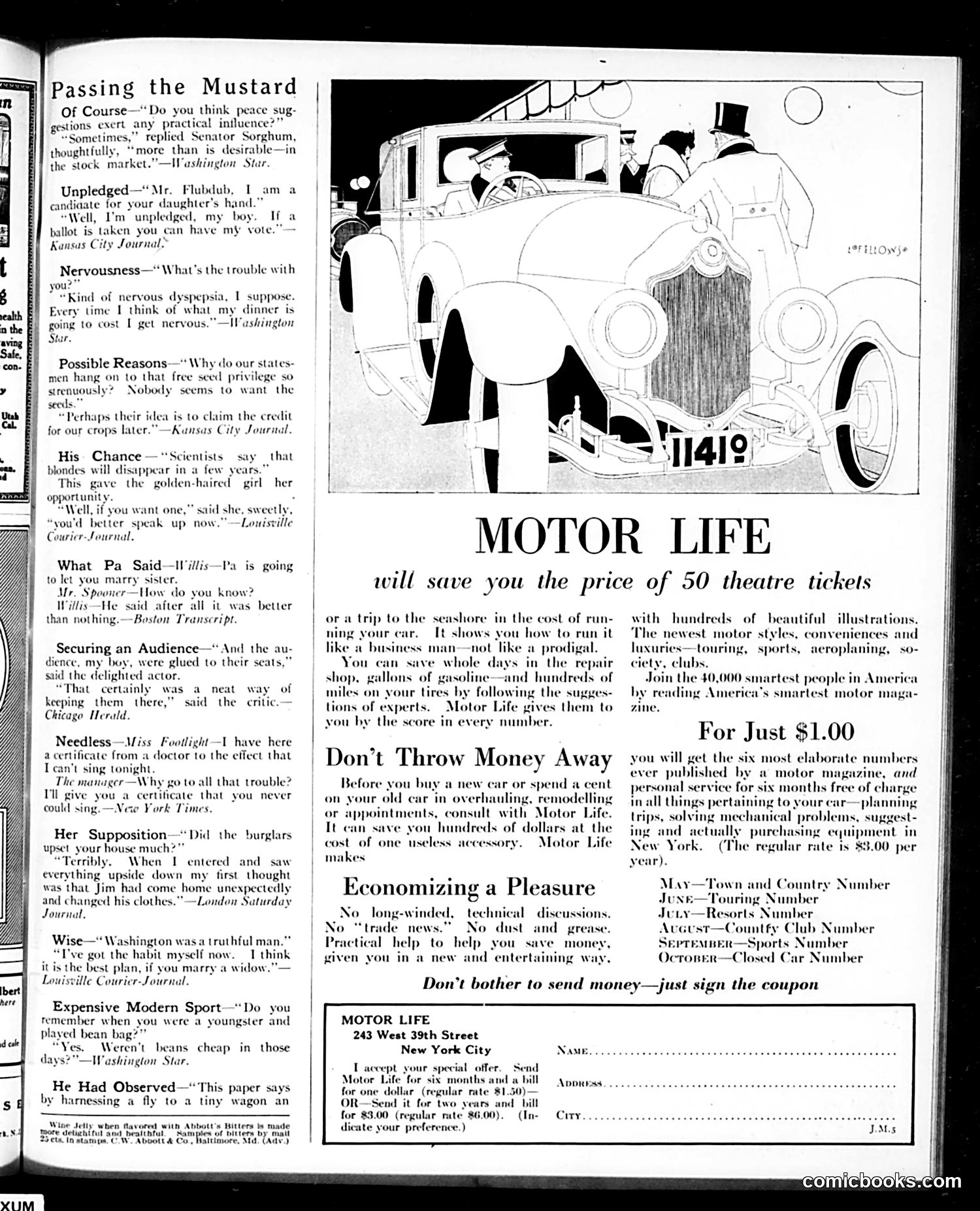
This page contains two distinct elements: **humorous anecdotes** (left column) and a **Motor Life magazine advertisement** (right side). The anecdotes are brief satirical jokes typical of Judge's style, mocking contemporary figures and behaviors: - **"Passing the Mustard"**: Senator Sorghum admits his suggestions influence stock markets—satire of politicians' undue market influence - **"Unpledged"**: A candidate's joke about votes, likely referencing voting pledges in elections - **"Nervousness"** and **"Possible Reasons"**: Generic social satire about anxieties and politicians hoarding seed privileges The **Motor Life advertisement** pitches a motor magazine subscription for $1.00, promising six issues annually covering cars, racing, and aeroplanes. It targets "the 40,000 smartest people in America" interested in automobiles—reflecting the early 1900s automobile boom and emerging car culture. The cartoon shows men in top hats examining a stylish automobile, representing the era's fascination with new automotive technology as a status symbol and leisure activity.
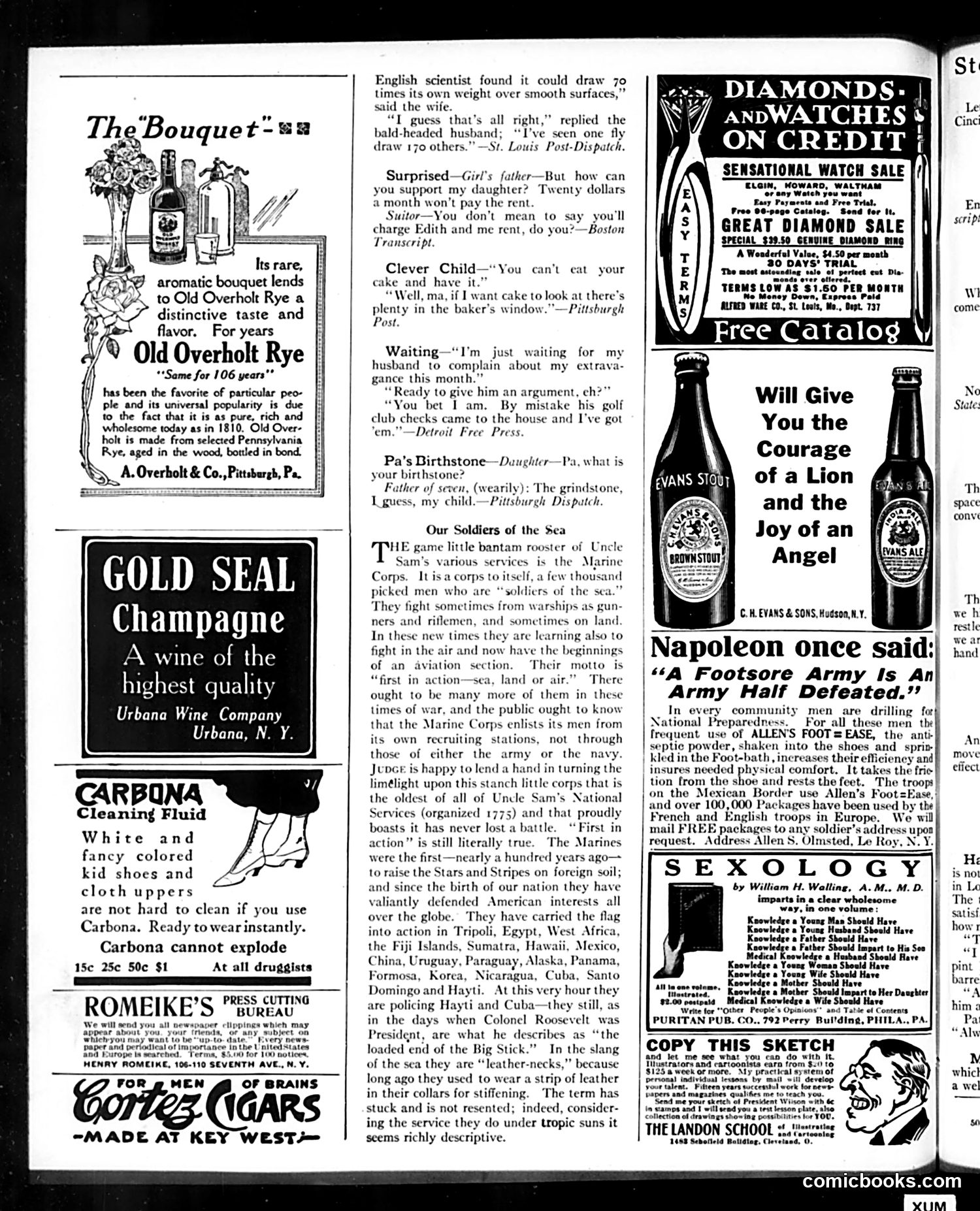
This page is primarily **advertising with light satirical humor** rather than political cartoons. The visible content includes: **Humorous anecdotes** in the upper section ("Surprised," "Clever Child," "Waiting," "Pa's Birthstone") present brief domestic jokes—typically showcasing wife-husband tensions, parental exasperation, or children's logic. These reflect early 20th-century middle-class social dynamics and gender roles. **The substantial article "Our Soldiers of the Sea"** celebrates the Marine Corps, emphasizing their independence from Army/Navy recruitment and their long service history (since 1775). This appears patriotic rather than satirical, likely reflecting WWI-era support for military preparedness. **Advertisements dominate**: Old Overholt Rye whiskey, Gold Seal Champagne, Carbona cleaning fluid, and Allen's Foot-Ease powder. The Napoleon quotation about footsore armies serves as marketing copy connecting the product to military readiness. There are **no identifiable political figures or clear satirical targets** visible on this page. It represents Judge's mixed format of light humor and commercial content typical of American magazines from this period.
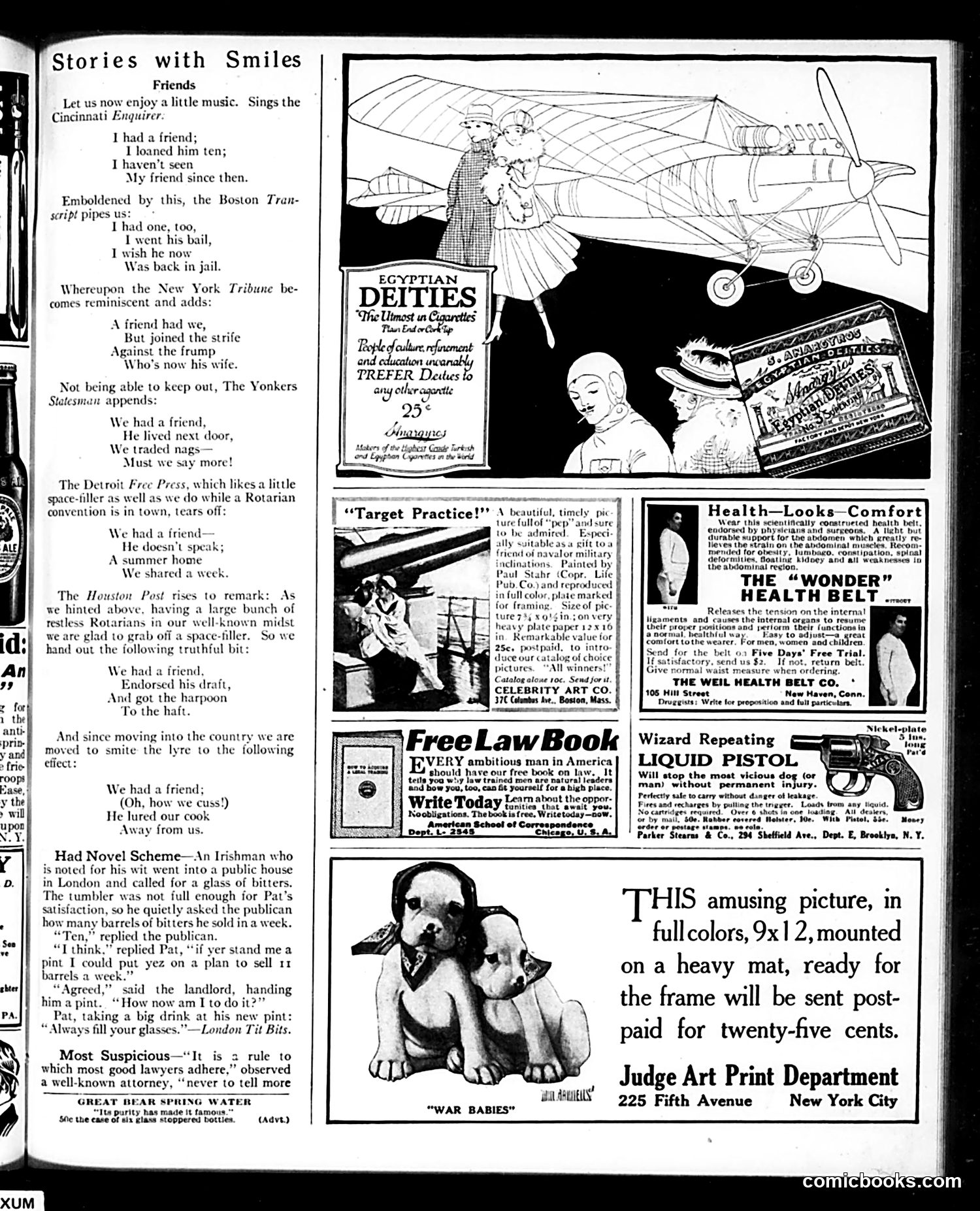
This page is primarily **humorous verse and advertising**, not political cartoons. The main content consists of interconnected jokes about friendship's disappointments, reprinted from various American newspapers (Cincinnati Enquirer, Boston Transcript, New York Tribune, etc.). **The humor**: Each newspaper contributes a short rhyming verse describing a "friend" who caused financial or personal loss—loaning money without repayment, bailing someone out, etc. The running gag illustrates how friendships often end badly, with the final contribution (about a cook being lured away) prompting the editor's rueful admission: "Oh, how we cuss!" **Context**: This reflects early-20th-century skepticism about friendship's reliability—a common satirical theme. The inclusion of multiple newspapers suggests editors shared this cynical sensibility. The page also contains period advertisements (health belts, law books, Egyptian cigarettes) and an unrelated Irish pub anecdote, typical of Judge's miscellaneous filler content.
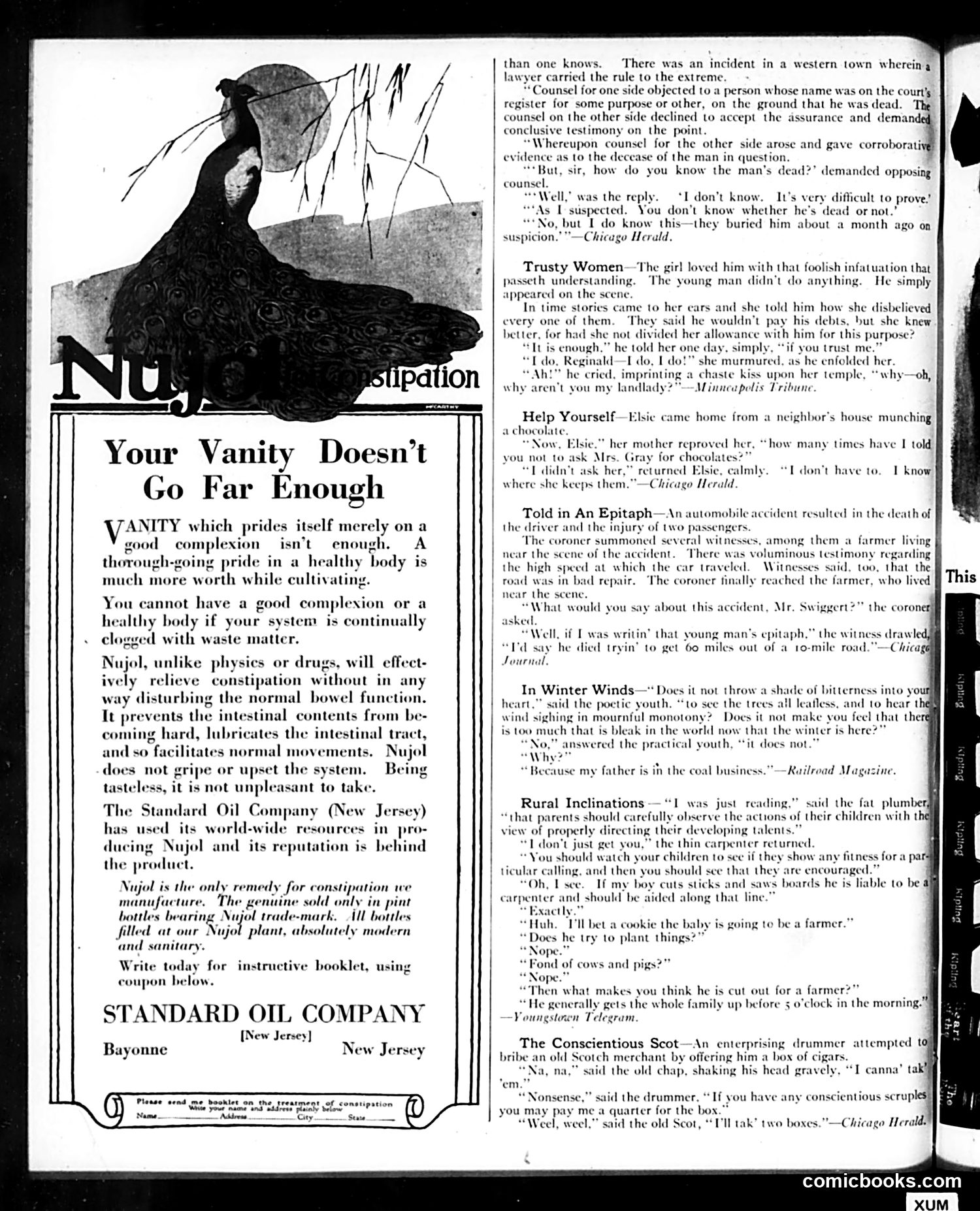
This page combines a **Nujol laxative advertisement** with several humorous **short anecdotes** typical of Judge's satirical format. The main advertisement uses a stylized illustration of a woman to pitch Nujol as a constipation remedy, emphasizing that "vanity" (good looks) means nothing without internal health. Standard Oil Company (New Jersey) manufactured Nujol, leveraging their industrial reputation to market a medicinal product. The accompanying joke sections mock various social behaviors: a lawyer demanding "conclusive testimony" that someone is dead; a young man exploiting a trusting woman's devotion while avoiding financial responsibility; a child stealing chocolates from a neighbor; and a farmer's blunt assessment that a reckless driver died trying to exceed his vehicle's limits. The humor reflects early-20th-century middle-class anxieties about trust, propriety, and the consequences of modern life (automobiles, debt). These brief, moralistic jokes were standard Judge fare—satirizing human folly through exaggeration and wordplay.
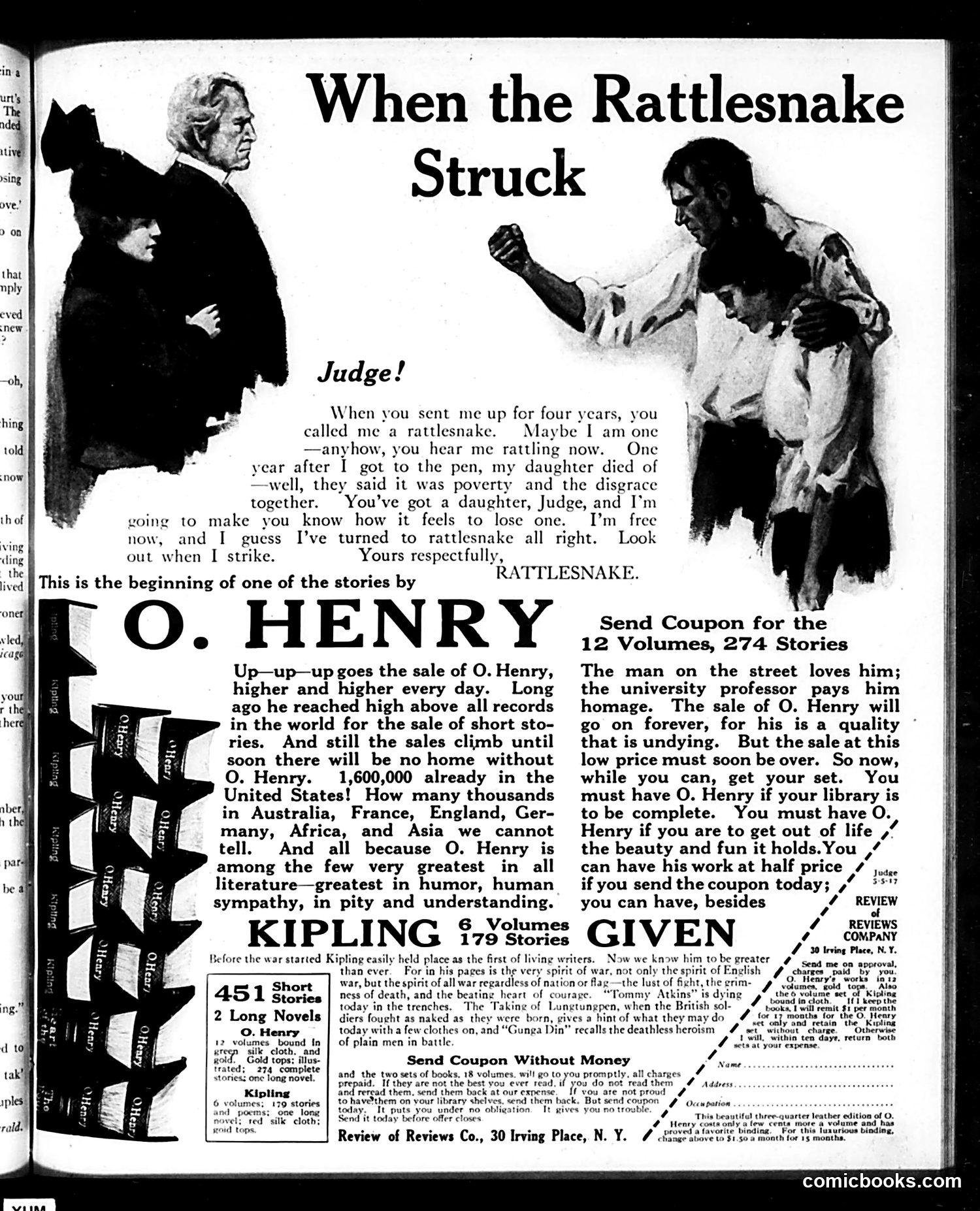
This page is primarily **advertising for O. Henry and Kipling book collections**, but frames them around a satirical story premise. The cartoon depicts a convict addressing a judge, claiming he was imprisoned for four years and called a "rattlesnake." His daughter died from poverty and shame while he was incarcerated. Now freed, he's threatening revenge against the judge—specifically warning him to experience the loss of his own daughter. **The satire's point**: The story ironically uses melodramatic social commentary about injustice and poverty to *advertise* O. Henry's works, which the ad claims excel in "human sympathy, in pity and understanding." By opening with this dark tale of a vengeful criminal, Judge magazine cleverly ties the narrative to O. Henry's reputation for depicting common people's struggles with dignity and pathos. The ad emphasizes O. Henry's massive sales (1.6 million copies in the US) and universal appeal—he's beloved "on the street" and by university professors alike. The competing Kipling collection is also promoted below. This is essentially clickbait-era advertising disguised as satirical storytelling.
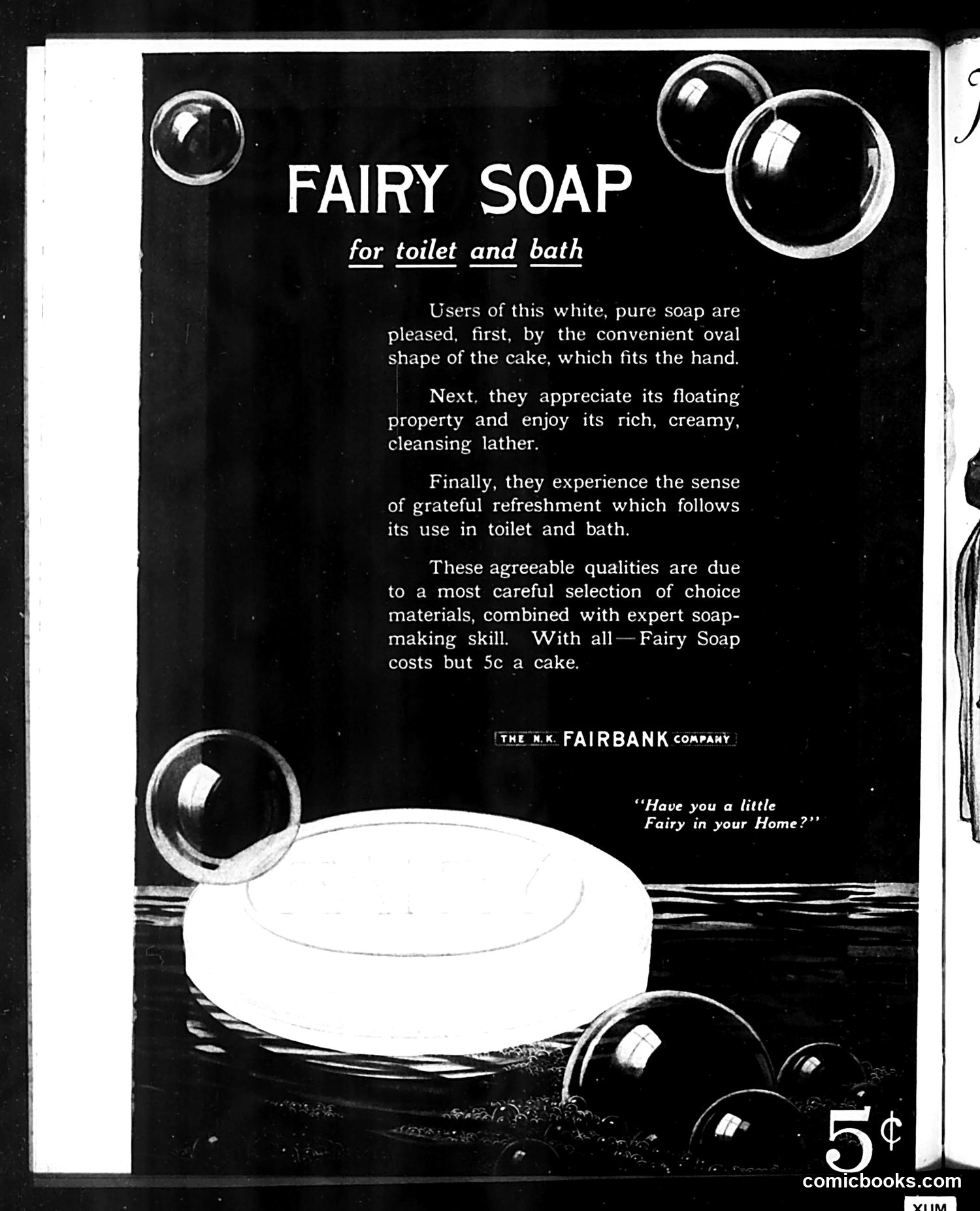
This is a straightforward **product advertisement**, not political satire. It promotes Fairy Soap by the N.K. Fairbank Company, priced at 5 cents per cake. The page uses visual appeals typical of early 20th-century advertising: soap bubbles surrounding a floating oval cake to demonstrate the product's claimed "floating property." The text employs marketing language emphasizing convenience, purity, and value. The slogan "Have you a little Fairy in your Home?" uses the product name as a household appeal—common advertising rhetoric of the era. The description of benefits (shape fitting the hand, rich lather, refreshment) represents standard soap-marketing claims. This appears in **Judge magazine** but functions purely as commercial advertising rather than editorial content or satire. It reflects period advertising conventions targeting domestic consumers.