
Judge, 1917-05-05 · page 16 of 30
Judge — May 5, 1917 — page 16: what you’re looking at
What you’re looking at
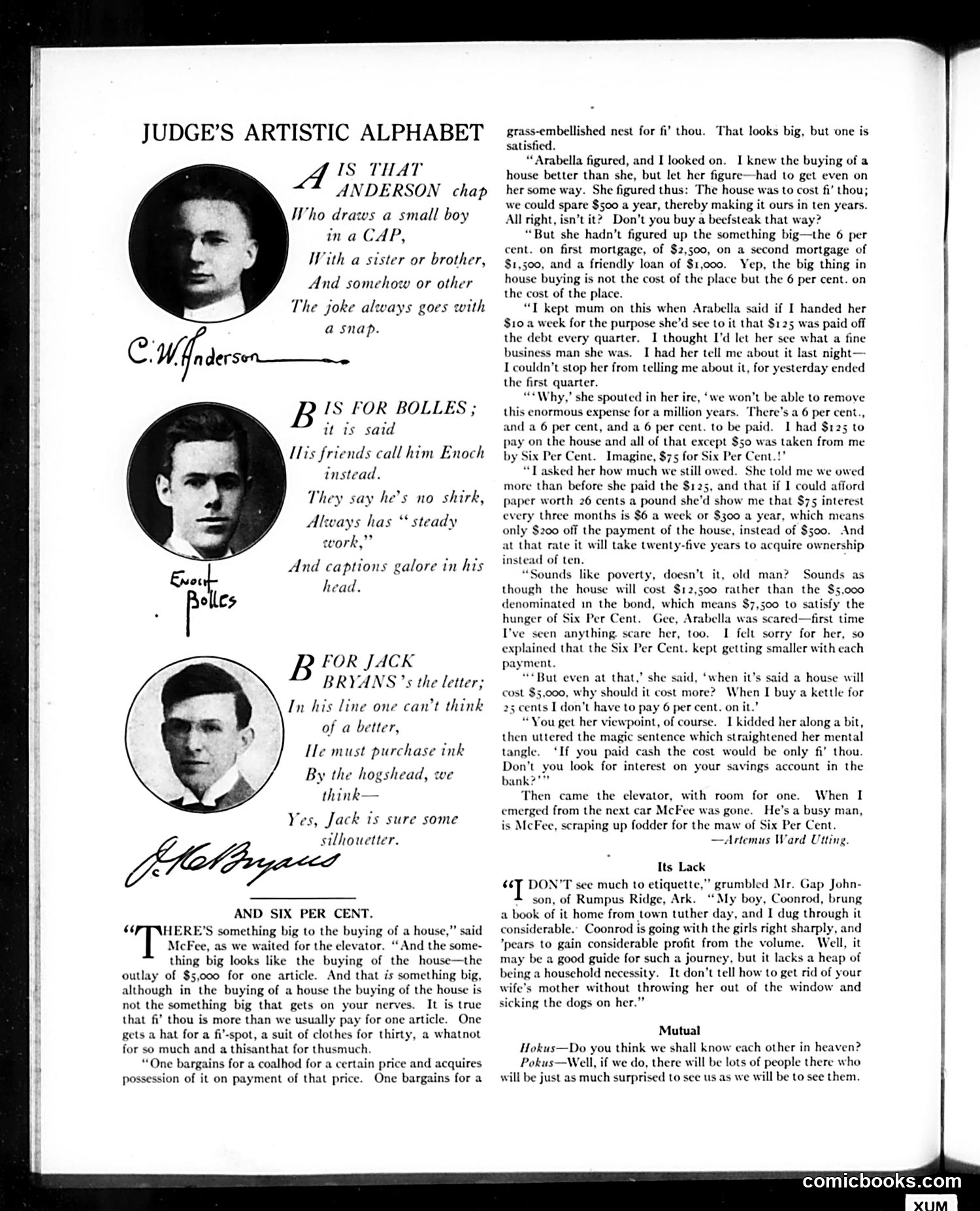
This page showcases three cartoonists working for *Judge* magazine through brief biographical sketches paired with their portraits: **C.M. Anderson** — Known for drawing small boys in caps with siblings, his humor relies on visual "snap" (punchy timing). **Enoch Bolles** — Friends call him this instead of his real name. The text notes he works steadily and produces abundant captions for his illustrations. **Jack Bryans** — A silhouettist (artist specializing in black outline portraits) who uses so much ink the magazine jokes he must purchase it "by the hogshead." The second article, "And Six Per Cent," satirizes the hidden costs of home-buying through a husband-wife conversation. The joke: a $5,000 house actually costs $12,500 once interest on mortgages and loans accumulates—the "six per cent" repeatedly stacking up. The wife initially calculates naively; the husband's final revelation about paying cash versus financed purchase illustrates how interest transforms the true cost.
📄 Transcribed text from this page (OCR, searchable)
Machine-transcribed from the original scan — historical spelling and the odd misread are preserved.
JUDGE’S ARTISTIC ALPHABET IS THAT ANDERSON chap Who draws a small boy in a CAP, With a sister or brother, And somehow or other The joke always goes with a snap. C. Wf derson____.. 1S FOR BOLLES ; it ts said His friends call him Enoch instead. They say he’s no shirk, Akvays has “steady cvork,”” And captions galore in his | Ener head. f cs B FOR JACK BRYANS’s the letter; In his line one can’t think of a better, He must purchase ink By the hogshead, we think— Yes, Jack is sure some silhouetter. AND SIX PER CENT. i ie something big to the buying of a house,” said McFee, as we waited for the elevator. “And the som thing big looks like the buying of the house—the outlay of $5,000 for one article. And that is something bij ' although in the buying of a house the buying of the house is not the something big that gets on your nerves. It is true that fi’ thou is more than we usually pay for one article. One gets a hat for a fi’-spot, a suit of clothes for thirty, a whatnot for so much and a thisanthat for thusmuch. “One bargains for a coalhod for a certain price and acquires possession of it on payment of that price. One bargains for a grass-embellished nest for fi’ thou. That looks big, but one is satisfied. “ Arabella figured, and I looked on. I knew the buying of a house better than she, but let her figure—had to get even on her some way. She figured thus: The house was to cost fi’ thou; we could spare $500 a year, thereby making it ours in ten years. All right, isn’t it? Don’t you buy a beefsteak that way? “But she hadn’t figured up the something big—the 6 per cent. on first mortgage, of $2,500, on a second mortgage of $1,500, and a friendly loan of $1,000. Yep, the big thing in house buying is not the cost of the place but the 6 per cent. on the cost of the place. “T kept mum on this when Arabella said if I handed her $10 a week for the purpose she’d see to it that $125 was paid off the debt every quarter. I thought I'd let her see what a fine business man she was. I had her tell me about it last night— I couldn't stop her from telling me about it, for yesterday ended the first quarter. “*Why,’ she spouted in her ire, ‘we won't be able to remove this enormous expense for a million years. ‘There's a 6 per cent., and a 6 per cent, and a 6 per cent. to be paid. I had $125 to ay on the house and all of that except $50 was taken from me x Per Cent. Imagine, $75 for Six Per Cent.!" I asked her how much we still owed. She told me we owed more than before she paid the $125, and that if I could afford paper worth 26 cents a pound she’d show me that $75 interest every three months is $6 a week or $300 a year, which means only $200 off the payment of the house, instead of $500. And at that rate it will take twenty-five years to acquire ownership instead of ten. “Sounds like poverty, doesn’t it, old man? Sounds as though the house will cost $12,5 rather than the $5,000 denominated in the bond, which means $7,500 to satisfy the hunger of Six Per Cent. Gee, Arabella was scared—first time ‘are her, too. I felt sorry for her, so ix Per Cent. kept getting smaller with each I've seen explained that the payment. “*But even at that,’ she said, ‘when it’s said a house will cost $5,000, why should it cost more? When I buy a kettle for nts I don’t have to pay 6 per cent. on it.’ wpoint, of course. I kidded her along a bit, then uttered the magic sentence which straightened her mental tangle. ‘If you paid cash the cost would be only fi’ thou. Don’t you look for interest on your savings account in the bank?'” Then came the elevator, with room for one. When I emerged from the next car McFee was gone. He’s a busy man, is McFee, scraping up fodder for the maw of Six Per Cent. —Artemus Ward Utting. Its Lack 66] DON’T see much to etiquette,” grumbled Mr. Gap John- son, of Rumpus Ridge, Ark. “ My boy, Coonrod, brung a book of it home from town tuther day, and I dug through it considerable.- Coonrod is going with the girls right sharply, and ’pears to gain considerable profit from the volume. Well, it may be a good guide for such a journey, but it lacks a heap of being a household necessity. It don’t tell how to get rid of your fe’s mother without throwing her out of the window and sicking the dogs on her.” Mutual Hokus—Do you think we shall know each other in heaven? Pokus—Well, if we do, there will be lots of people there who will be just as much surprised to see us as we will be to see them. comicbooks.com