
Judge, 1917-05-05 · page 10 of 30
Judge — May 5, 1917 — page 10: what you’re looking at
What you’re looking at
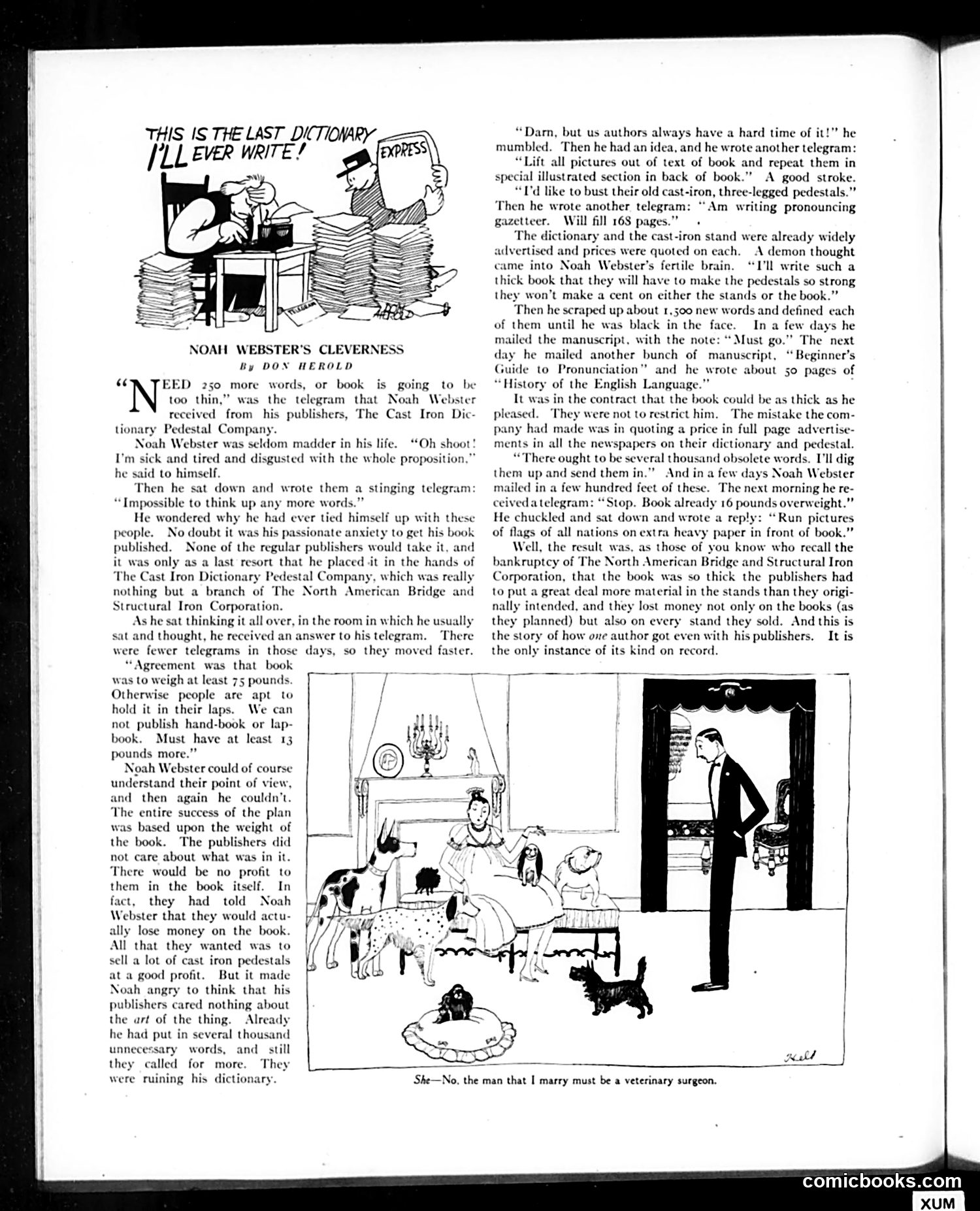
This Don Herold story satirizes the mutual antagonism between authors and publishers. Noah Webster, contracted to write a dictionary for the Cast Iron Dictionary Pedestal Company (a front for a bridge-building corporation), receives demands to add 250 words to make the book "weigh at least 75 pounds"—thick enough to justify selling expensive cast-iron stands. Webster retaliates by deliberately bloating the manuscript with unnecessary content: obsolete words, a pronouncing gazetteer, historical essays, and decorative flag illustrations on heavy paper. The book becomes so massive (16 pounds overweight) that the publishers must reinforce the pedestals with extra material, ultimately losing money on both the books and stands. The satire mocks the absurdity of contractual disputes and opposing incentives: publishers want profitable bulk; Webster wants revenge. The joke's bitter edge reflects real author-publisher tensions of the era, where control over content and production frequently caused conflict.
📄 Transcribed text from this page (OCR, searchable)
Machine-transcribed from the original scan — historical spelling and the odd misread are preserved.
THIS IS THE LAST DICTIONARY. [LL EVER WrITE? NOAH WEBSTER’S CLEVERNESS By DON HEROLD D 250 more words, or book is going to be too thin,” was the telegram that Noah Webster received from his publishers, The Cast Iron Dic- tionary Pedestal Company. Noah Webster was seldom madder in his life. ‘*Oh shoot! I'm sick and tired and disgusted with the whole proposition,” he said to himself. Then he sat down and wrote them a stinging telegram “Impossible to think up any more words. He wondered why he had ever tied himself up with these people. No doubt it was his passionate anxiety to get his book published. None of the regular publishers would take it, and it was only as a last resort that he placed it in the hands of The Cast Iron Di ry Pedestal Company, which was really nothing but a branch of The North American Bridge and Structural Iron Corporation. As he sat thinking it all over, in the room in which he usually sat and thought, he received an answer to his telegram. There were fewer telegrams in those days, so they moved faster. “Agreement was that book “Darn, but us authors always have a hard time of it!” he mumbled. Then he had an idea, and he wrote another telegram: Lift all pictures out of text of book and repeat them in special illustrated section in back of book.” A good stroke. “I'd like to bust their old cast-iron, three-legged pedestal Then he wrote another telegram: “Am writing pronouncing gazetteer. Will fill 168 pages.” « The dictionary and the cast-iron stand were already widely advertised and prices were quoted on each. A demon thought came into Noah Webster's fertile brain. “I'll write such a thick book that they will have to make the pedestals so strong they won’t make a cent on either the stands or the book.” Then he scraped up about 1,500 new words and defined each of them until he was black in the fa In a few days he mailed the manuscript, with the note: “Must go.”” The next day he mailed another bunch of manuscript, “Beginner's Guide to Pronunciation” and he wrote about 50 pages of “History of the English Language.” It was in the contract that the book could be as thick as he pleased. They were not to restrict him. The mistake the com- pany had made was in quoting a price in full page advertise- ments in all the newspapers on their dictionary and pedestal. “There ought to be several thousand obsolete words. I'll dig them up and send them in.” And ina few ys Noah Webster mailed in a few hundred feet of these. The next morning he re- cei telegram: “Stop. Book already 16 pounds overweight He chuckled and sat down and wrote a reply: “Run pictures. of flags of all nations on extra heavy paper in front of book.” Well, the result was, as those of you know who recall the bankruptcy of The North American Bridge and Structural Iron Corporation, that the book was so thick the publishers had to put a great deal more material in the stands than they origi- nally intended, and they lost money not only on the books (as planned) but also on every stand they sold. And this is the story of how one author got even with his publishers. It is the only instance of its kind on record. was to weigh at least 75 pounds. Otherwise people are apt to hold it in their laps. We can not publish hand-book or lap- book. Must have at least 13 pounds more. Noah Webster could of course understand their point of view, and then again he couldn't. The entire success of the plan was based upon the weight of the book. The publishers did not care about what was in it. There would be no profit to them in the book itself. In fact, they had told Noah Webster that they would actu- ally lose money on the book. All that they wanted was to sell a lot of cast iron pedest ata good profit. But it made Noah angry to think that his publishers cared nothing about the urt of the thing. Already he had put in several thousand unnecessary words, and_ still they called for more. They were ruining his dictionary comicbooks.com