
Judge, 1917-05-05 · page 18 of 30
Judge — May 5, 1917 — page 18: what you’re looking at
What you’re looking at
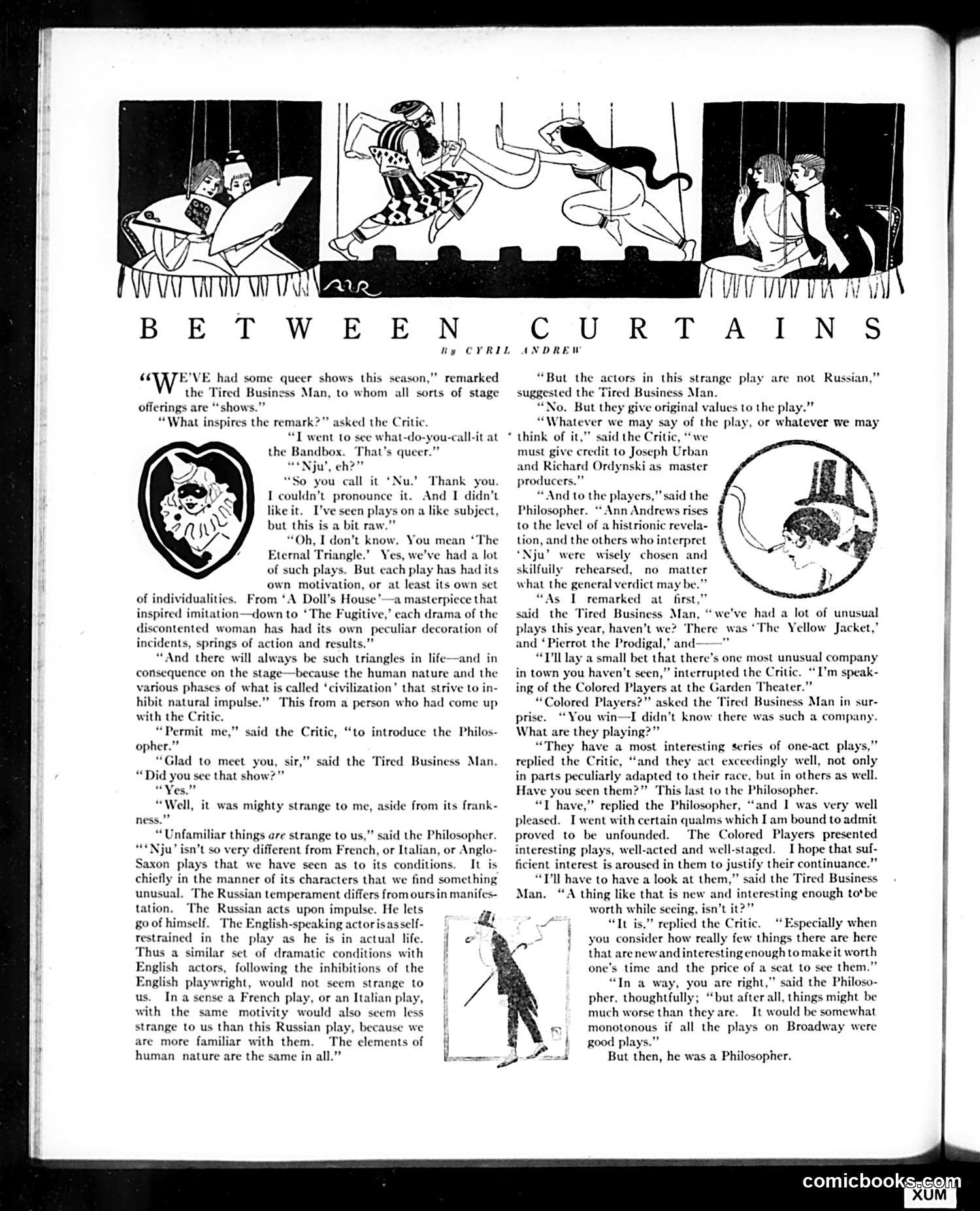
This page features a conversation between three recurring Judge characters: the Tired Business Man, the Critic, and the Philosopher, discussing contemporary theater. The main point involves defending an avant-garde Russian play called "Nju" (appearing to be a translation of a Chekhov-era work about infidelity—"the eternal triangle"). The Tired Business Man finds it strange and "raw," but the Critic and Philosopher explain that Russian drama's power lies in its emotional authenticity, contrasting with the restrained English theatrical tradition. The discussion extends to praising several contemporary productions, including "The Yellow Jacket" and notably "Pierrot the Prodigal." The text concludes by highlighting the Colored Players theater company at the Garden Theater, praising their skilled performances across diverse roles, with the Philosopher noting his initial prejudices proved unfounded. The satire gently mocks middlebrow American theatergoers' resistance to experimental foreign drama while celebrating artistic merit regardless of performers' race.
📄 Transcribed text from this page (OCR, searchable)
Machine-transcribed from the original scan — historical spelling and the odd misread are preserved.
BETWEEN By CYRIL “ E’VE had some queer shows this season,” remarked the Tired Business Man, to whom all sorts of stage offerings are “shows.” “What inspires the remark?” asked the Critic “T went to see what-do-you-call-it at the Bandbox. That's queer.” = eh?” So you call it ‘Nu.’ Thank you. I couldn't pronounce it. And I didn’t like it. I’ve seen plays on a like subject, but this is a bit raw.” “Oh, I don’t know. You mean ‘The Eternal Triangle.’ Yes, we’ve had a lot of such plays. But each play has had its own motivation, or at least its own set of individualities. From ‘A Doll’s House’—a masterpiece that inspired imitation—down to ‘The Fugitive, h drama of the discontented woman has had its own peculiar decoration of incidents, springs of action and results.” “And there will always be such triangles in lif consequence on the st the human various phases of wha ilization’ tha hibit natural impulse.” This from a person who had come up with the Critic. “Permit me, opher.” “Glad to meet you. “Did you see that show?” “Yes” “Well, it was mighty strange to me, aside from its frank- ness.” id the Critic, “to introduce the Philos- said the Tired Business Man. Unfamiliar things are strange to us,” said the Philosopher. ju’ isn’t so very different from French, or Italian, or Anglo Saxon plays that we have seen as to its conditions. It is chiefly in the manner of its characters that we find something unusual, The Russian temperament differs from oursin manifes- tation. The Russian acts upon impulse. He lets go of himself. The English-speaking actor isasself- restrained in the play as he is in actual life. Thus a similar set of dramatic conditions with English actors, following the inhibitions of the English playwright, would not seem strange to In a sense a French play, or an Italian play, with the same motivity would also seem less strange to us than this Russian play, because we are more familiar with them. The elements of human nature are the same in all.” C UR TAINS INDREW “But the actors in this strange play are not Russian,” suggested the Tired Business Man. “No. But they give original values to the play.” “Whatever we may say of the play, or whatever we may think of it,” said the Critic, “we must give credit to Joseph Urban and Richard Ordynski as master producers.” “ And to the players,” said the Philosopher. ‘Ann Andrews rises to the level of a histrionic reve tion, and the others who interpret ‘Nju’ were wisely chosen and skilfully rehearsed, no matter what the general verdict may be.” “As T remarked at first,” said the Tired Business Man, “we've had a lot of unusu plays this year, haven't we? There was ‘The Yellow Jacket, and ‘Pierrot the Prodigal,’ and——” “Tl lay a small bet that there’s one most unusual company in town you haven't seen,” interrupted the Critic. “I’m speak- ing of the Colored Players at the Garden Theater.” “Colored Players?” asked the Tired Business Man in sur- prise. “You win—I didn’t know there was such a company. What are they playing?” “They have a most interesting series of one-act play replied the Critic, “and they act exceedingly well, not only in parts peculiarly adapted to their race, but in others as well. Have you seen them?” This last to the Philosopher. “T have,” replied the Philosopher, “and I was very well pleased. I went with certain qualms which I am bound to admit proved to be unfounded. The Colored Players presented interesting plays, well-acted and well-staged. I hope that suf- ficient interest is aroused in them to justify their continuance.” “Tl have to have a look at them,” said the Tired Business Man. “A thing like that is new and interesting enough totbe worth while secing, isn’t it?” s,”’ replied the Critic. specially when you consider how really few things there are here that arenew and interesting enough to make it worth one’s time and the price of a seat to see them.”” “In a way, you are right,” said the Philoso- pher, thoughtfully; “but after all, things might be much worse than they are. It would be somewhat monotonous if all the plays on Broadway were good plays.” But then, he was a Philosopher.