
Judge, 1917-05-05 · page 14 of 30
Judge — May 5, 1917 — page 14: what you’re looking at
What you’re looking at
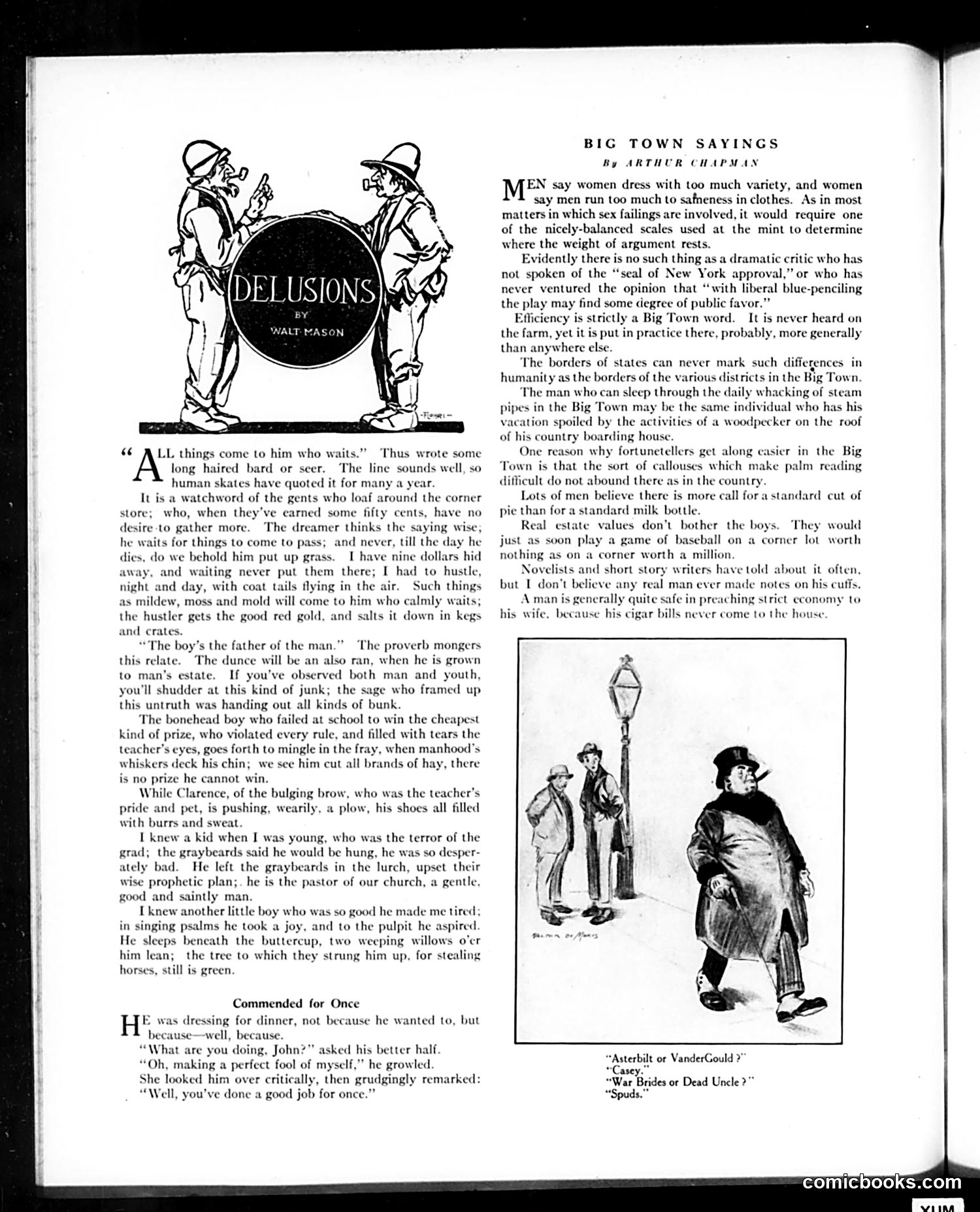
This page combines two distinct pieces of early 20th-century American satire. **"Delusions" by Walt Mason** (left): A poem debunking popular proverbs. Mason challenges the saying "all things come to him who waits," arguing hustlers—not passive dreamers—achieve success. He similarly critiques "the boy's the father of the man," using contrasting examples: a "bonehead" school failure who becomes successful versus a teacher's pet who struggles. The satire mocks folk wisdom as "bunk," reflecting Progressive-era skepticism of traditional sayings. **"Big Town Sayings" by Arthur Chapman** (right): Short social observations contrasting urban and rural life. Chapman notes Big Town peculiarities (dramatic critics, "efficiency," palm readers thriving where calluses don't exist) versus country simplicity. **"Commended for Once"** (bottom): A domestic humor sketch where a husband dressing for dinner calls himself a "fool," and his wife agrees—but adds it's the one time he's done something right, suggesting habitual incompetence. The illustration depicts three men in period dress, likely representing types discussed in the text, though specific identities are unclear.
📄 Transcribed text from this page (OCR, searchable)
Machine-transcribed from the original scan — historical spelling and the odd misread are preserved.
. things come to him who waits.” Thus w: long haired bard or seer. The line sounds well, so human skates have quoted it for many a year. It is a watchword of the gents who loaf around the corner store; who, when they’ve earned some fifty cents, have no desire to gather more. The dreamer thinks the saying wise; he waits for things to come to pass; and never, till the day he dies, do we behold him put up grass. I have nine dollars hid away, and waiting never put them there; I had to hustle, night and day, with coat tails flying in the air. Such things as mildew, moss and mold will come to him who calmly waits; the hustler gets the good red gold, and salts it down in kegs and crates. “The boy’s the father of the man.” The proverb mongers this relate. The dunce will be an also ran, when he is grown to man’s estate. If you’ve observed both man and youth, you'll shudder at this kind of junk; the sage who framed up this untruth was handing out all kinds of bunk. The bonehead boy who failed at school to win the cheapest kind of prize, who violated every rule, and filled with tears the teacher’s eyes, goes forth to mingle in the fray, when manhood’s whiskers deck his chin; we see him cut all brands of hay, there is no prize he cannot win. While Clarence, of the bulging brow, who was the teacher's pride and pet, is pushing, wearily, a plow, his shoes all filled with burrs and sweat. I knew a kid when I was young, who was the terror of the grad; the graybeards said he would be hung, he was so desper- ately bad. He left the graybeards in the lurch, upset their wise prophetic plan;. he is the pastor of our church, a gentle, good and saintly man. I knew another little boy who was so good he made me tired; in singing psalms he took a joy, and to the pulpit he aspired He sleeps beneath the buttercup, two weeping willows o'er him lean; the tree to which they strung him up, for stealing horses, still is green. Commended for Once HE 85 dressing for dinner, not because he wanted to, but because—well, because. “What are you doing, John?” asked his better half “Oh, making a perfect fool of myself,” he growled. She looked him over critically, then grudgingly remarked: “Well, you've done a good job for once.” BIG TOWN SAYINGS By ARTHUR CHAPMAN MX say women dress with too much variety, and women say men run too much to safneness in clothes. As in most matters in which sex failings are involved, it would require one of the nicely-balanced scales used at the mint to determine where the weight of argument rests. Evidently there is no such thing as a dramatic critic who has not spoken of the “seal of New York approval,” or who has never ventured the opinion that “with liberal blue-penciling the play may find some degree of public favor.” Efficiency is strictly a Big Town word. It is never heard on the farm, yet it is put in practice there, probably, more generally than anywhere else. The borders of states can never mark such differences in humanity as the borders of the various districts in the Big Town. The man who can sleep through the daily whacking of steam pipes in the Big Town may be the same individual who has his vacation spoiled by the activities of a woodpecker on the roof of his country boarding house. One reason why fortunetellers get along casier in the Big Town is that the sort of callouses which make palm reading difficult do not abound there as in the country. Lots of men believe there is more call for a standard cut of pie than for a standard milk bottle. Real estate values don’t bother the boys. They would just as soon play a game of baseball on a corner lot worth nothing as on a corner worth a million. Novelists and short story writers have told about it often, but I don’t believe any real man ever made notes on his cutis. \ man is generally quite safe in preaching strict economy to his wife, because his cigar bills never come to the house. —— sss ):2::2°0.8.880° “= “Asterbilt or VanderGould » “Casey.” “War Brides or Dead Uncle ?™ “Spuds.” comicbooks.com