
A complete issue · 28 pages · 1917
Judge — January 20, 1917
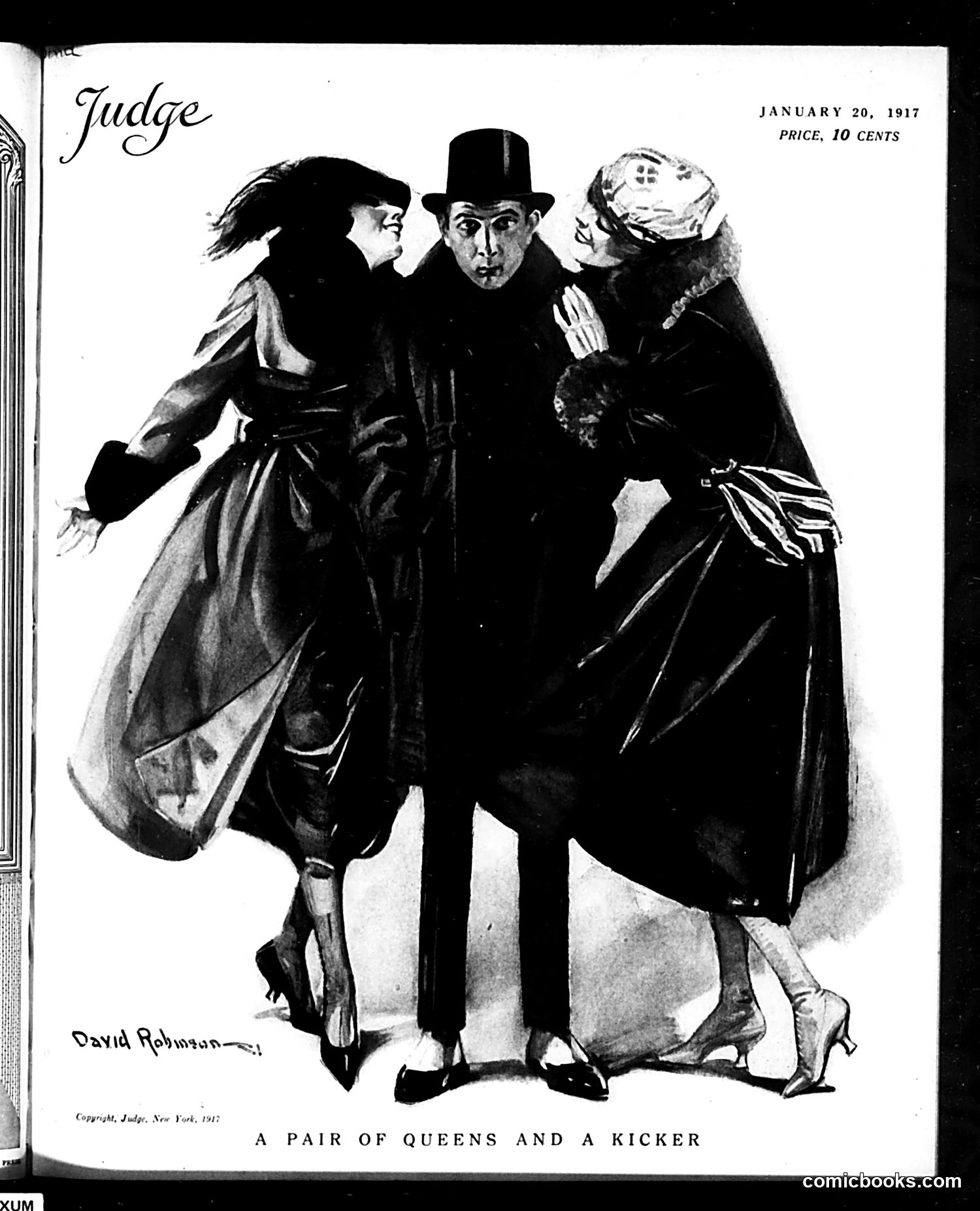
This January 20, 1917 cartoon by David Robinson satirizes what appears to be a political or social scandal involving three figures—two women ("queens") flanking a man in the center. The title's wordplay suggests deception: in card games, a "kicker" is a hidden card used to cheat. The elaborate winter coats and formal dress indicate wealthy subjects, likely prominent public figures of the era. The composition—with the women seeming to manipulate or control the central figure—suggests he's being duped or compromised by them. Without additional context about early 1917 politics, the specific identities remain unclear, but the satire targets corruption, moral hypocrisy, or financial impropriety among the upper classes during the WWI period.
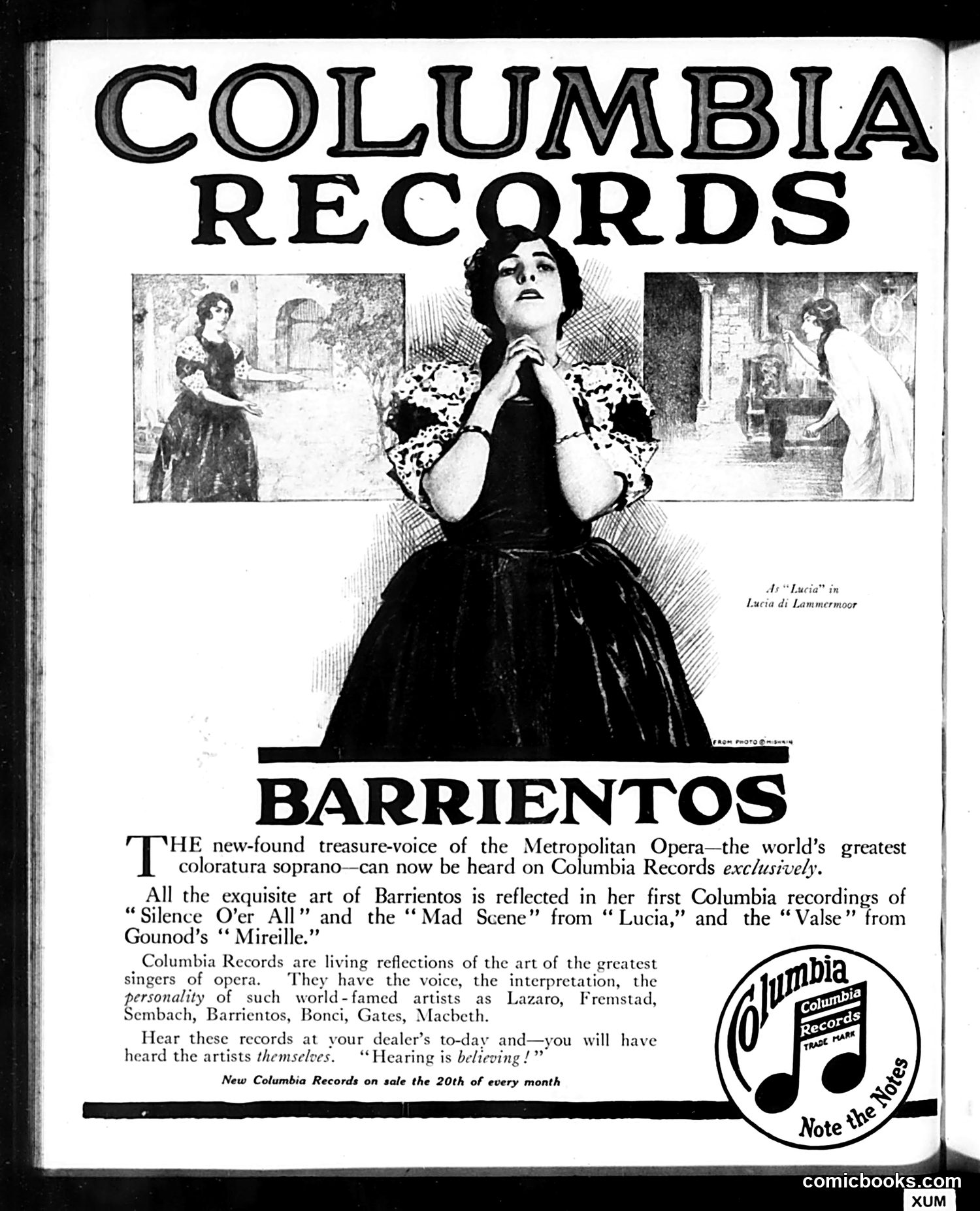
This is primarily **a Columbia Records advertisement**, not political satire. It promotes recordings by Amelita Galli-Curci (a famous coloratura soprano), featuring her performing operatic arias including selections from Gounod's "Miracles" and Donizetti's "Lucia di Lammermoor." The page advertises Columbia Records' exclusive arrangement with the Metropolitan Opera's "greatest coloratura soprano." The central image shows a woman in operatic costume (the "Lucia" reference), with smaller scene photographs above. The advertisement emphasizes Columbia Records' prestige by listing other famous opera singers they've recorded (Lazaro, Fremstad, Sembach, Bonci, Gates, Macbeth), positioning the records as "living reflections of the art of the greatest singers of opera." No political cartoon or satire is present on this page.
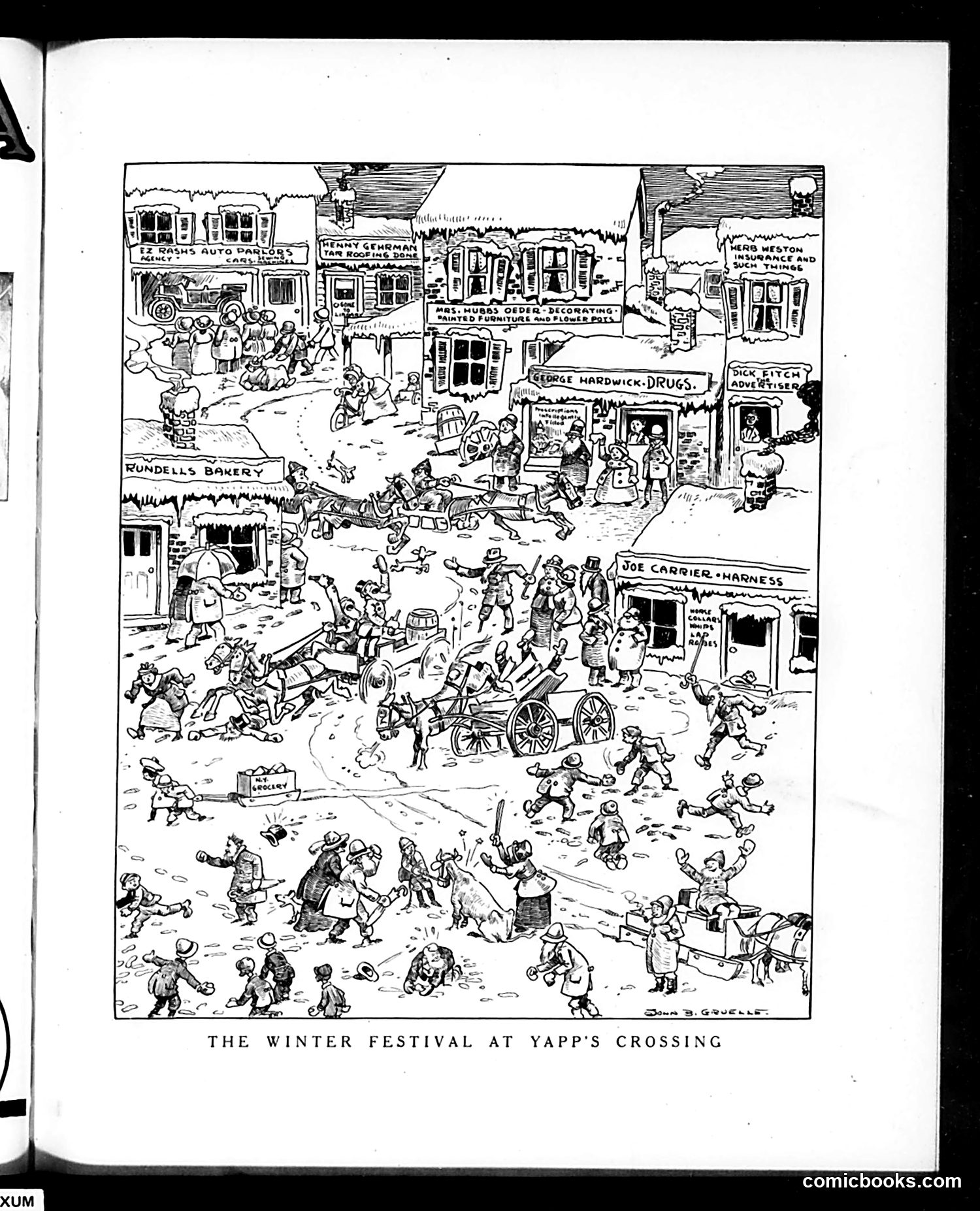
This illustration depicts a bustling small-town winter scene with numerous storefronts and businesses labeled, including Rundell's Bakery, George Hardwick Drugs, Dick Fitch Auctioneer, and Joe Carrier Harness. The drawing shows dozens of townspeople engaged in winter activities and socializing in the street. The cartoon appears to be a humorous, detailed slice-of-life illustration of American small-town commerce and community rather than political satire. It showcases various local businesses and captures the busy, chaotic energy of a winter gathering or market day at what appears to be a rural crossroads community. The artist's signature reads "Owen B. Gould" or similar. Without additional context, the specific satirical point remains unclear.
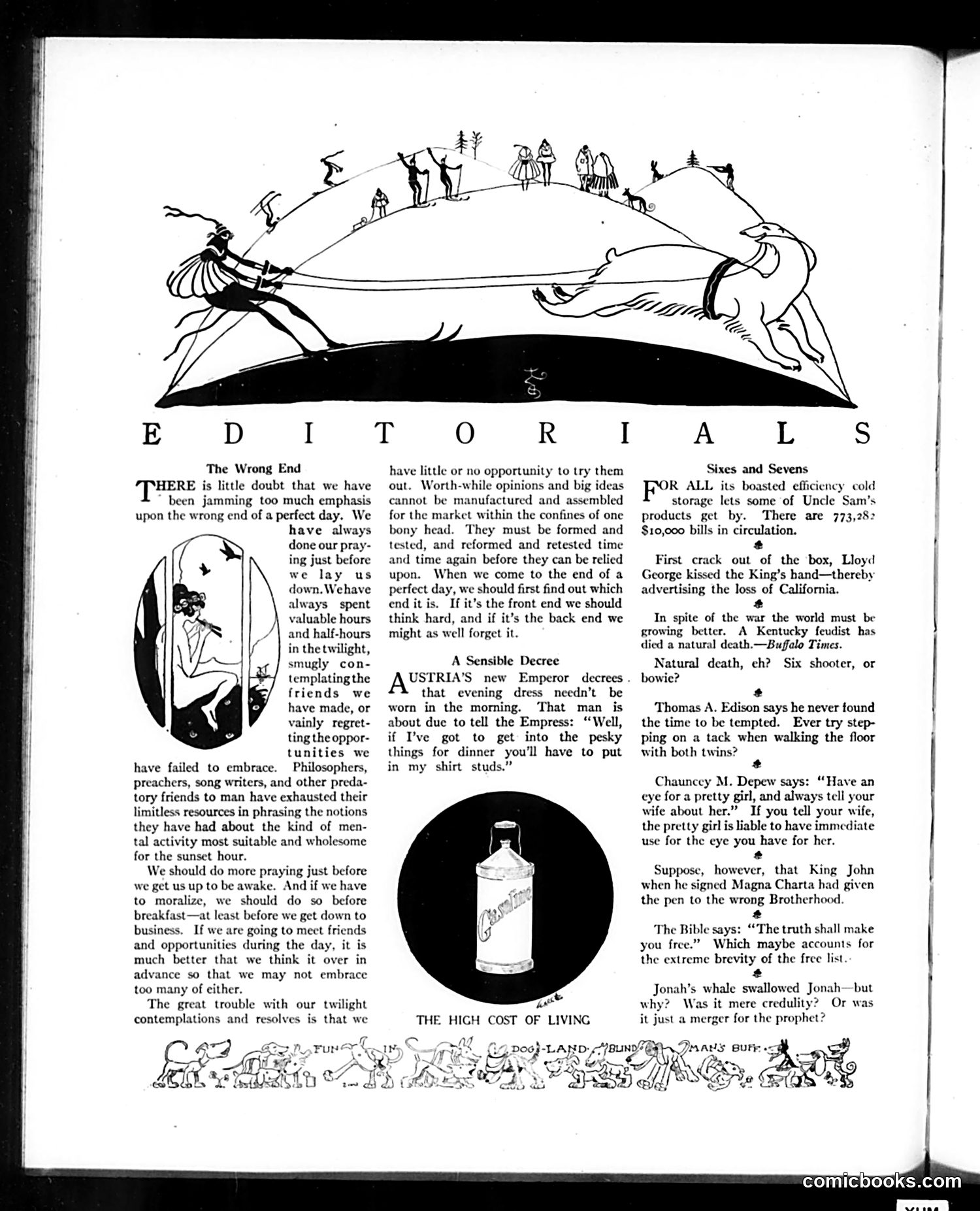
**Main Cartoon ("The Wrong End")**: This appears to be social commentary about misplaced priorities. The illustration shows a figure in formal dress contemplating which end of a situation to address—likely critiquing how people focus on wrong problems or solutions. **"The High Cost of Living"**: The central image of a bottle suggests satire about inflation or economic hardship. The text mentions "THE HIGH COST OF LIVING," a major concern during the early 20th century, particularly around WWI era. **"Editorials" Section**: Brief humorous observations on contemporary topics—including references to Austria's emperor's evening dress decree (likely WWI-era), Uncle Sam's efficiency, and natural death commentary. These are light satirical jabs at government and social customs of the period. The page blends visual satire with commentary on economics and wartime society.
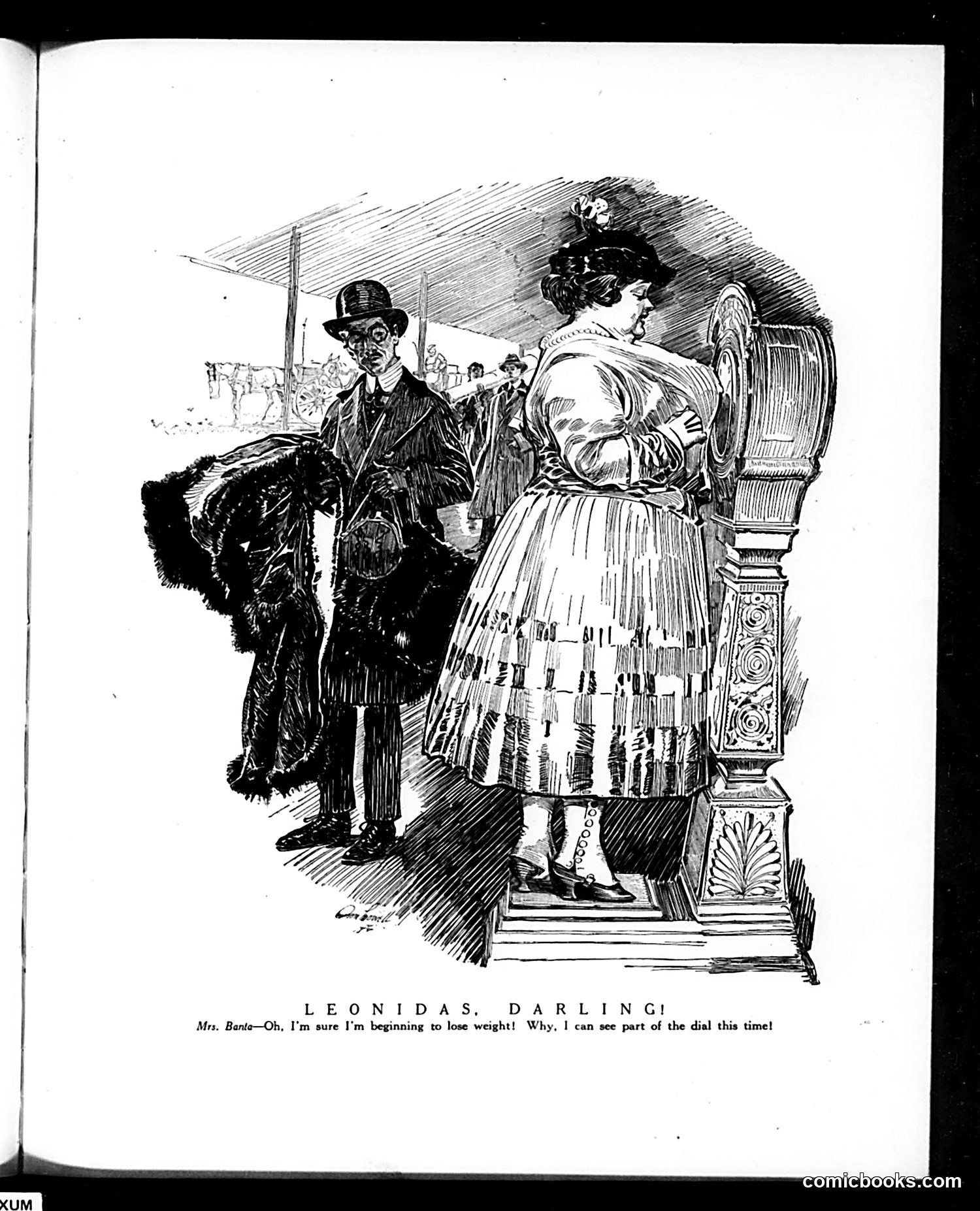
This cartoon depicts a woman (labeled "Leonidas") speaking to a man holding a fur coat. The caption reads: "Oh, I'm sure I'm beginning to lose weight! Why, I can see part of the dial this time!" The satire targets a wealthy woman obsessed with her weight and appearance. "Leonidas" is her self-aggrandizing nickname, invoking the ancient Spartan warrior—ironically comparing herself to a legendary military figure. The joke: she's so heavyset that a weighing scale's dial was previously hidden beneath her body; now she can barely glimpse it, which she mistakes for weight loss. This mocks the vanity and self-delusion of affluent women concerned with fashion and figure, while implying she remains significantly overweight. The fur coat signals her wealth and status, key elements of Gilded Age satirical humor about excess and superficiality.
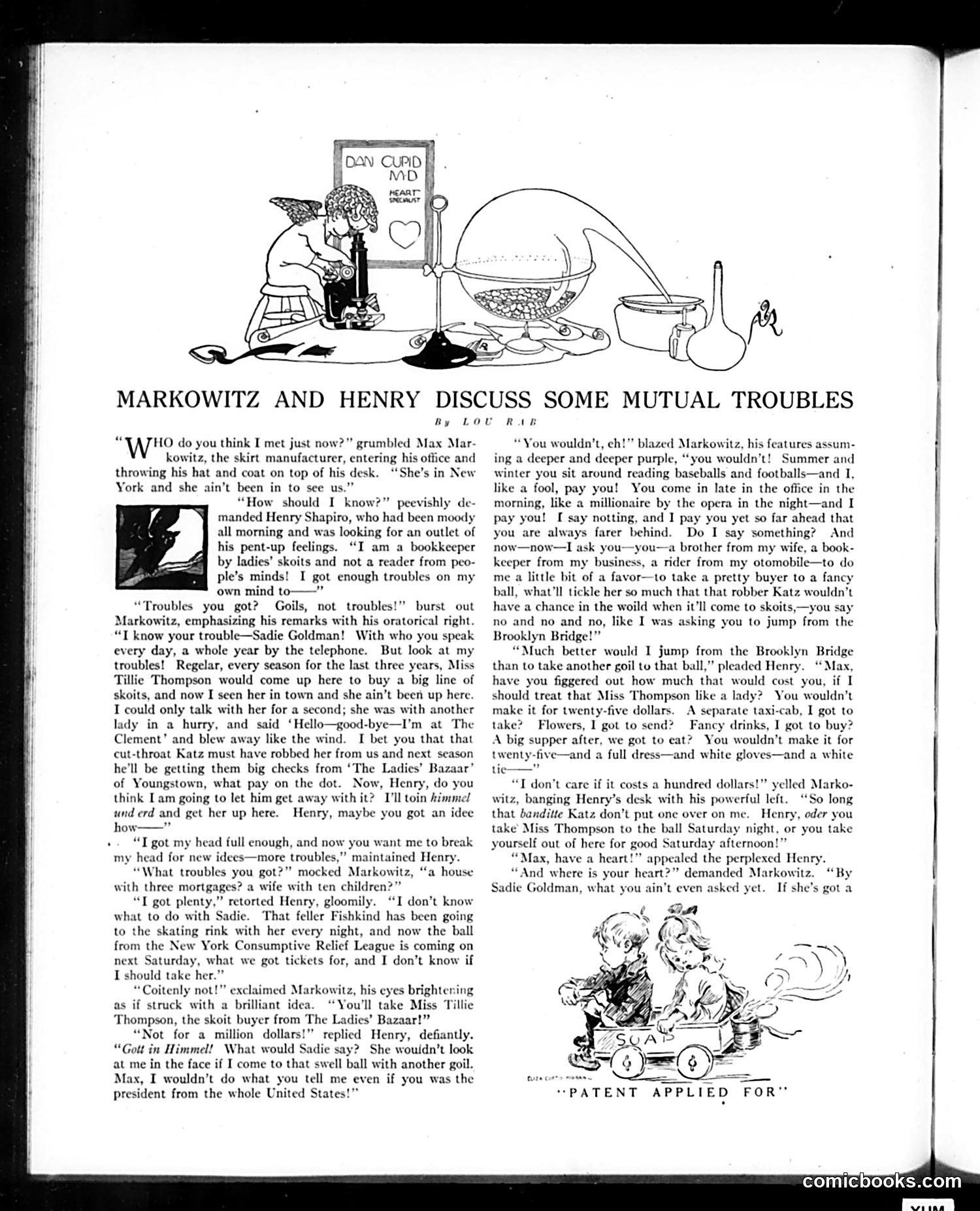
This is a humorous story about two Jewish businessmen in the garment industry (skirt manufacturers). Max Markowitz complains that a major client, Miss Tillie Thompson, has disappeared—likely stolen by a competitor named Katz. He pressures his employee Henry Shapiro to take Thompson to an upcoming charity ball to win back her business. Henry refuses, explaining he's already committed to taking his girlfriend Sadie. Markowitz grows furious, reminding Henry of all he provides (employment, a car, opera tickets) and demands this "small favor." Henry resists, calculating the expense would be ruinous. The satire targets early 20th-century immigrant business culture—the mix of Yiddish and English dialect, the personal/professional entanglement, the manipulative boss-employee dynamic, and romantic complications all converge. The humor lies in both men's desperation and the absurdity of their situation.
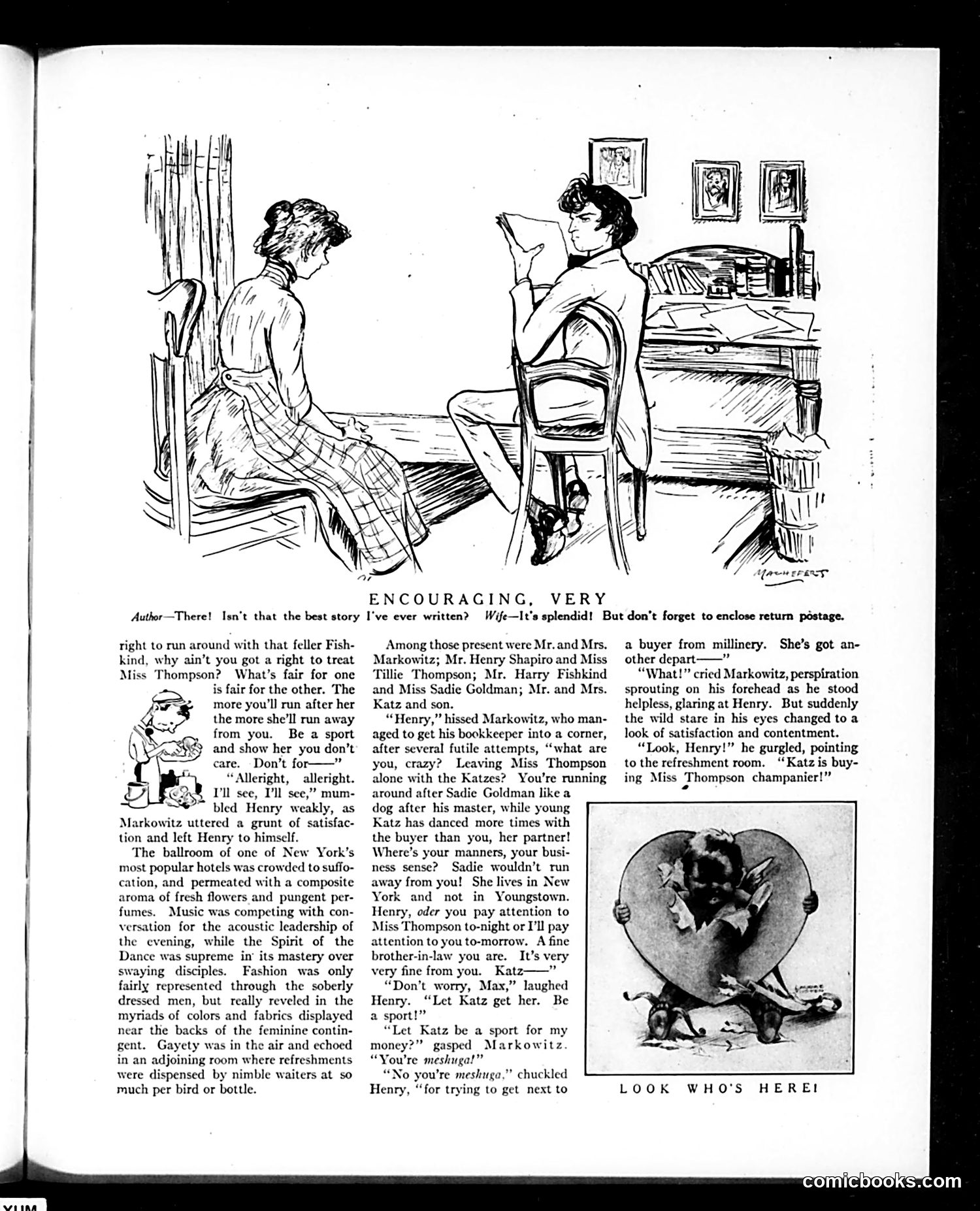
This page satirizes Jewish immigrant social dynamics in early 20th-century New York. The main cartoon depicts a domestic scene where a wife compliments her husband's writing but reminds him about return postage—a joke about authors' practical concerns. The longer story below mocks courtship etiquette among young Jewish New Yorkers at a hotel dance. Markowitz frantically advises his brother-in-law Henry to stop pursuing Sadie Goldman and instead court Miss Thompson, warning that ignoring a woman makes her lose interest. Henry dismisses this, claiming to be a "sport" (indifferent). The satire's point: Markowitz's anxiety proves justified when young Katz begins buying Miss Thompson champagne, suggesting Henry's strategy backfired. The Yiddish phrases ("meshuga"—crazy) and names ground this in ethnic-specific humor about Old World courtship wisdom versus American dating casualness.
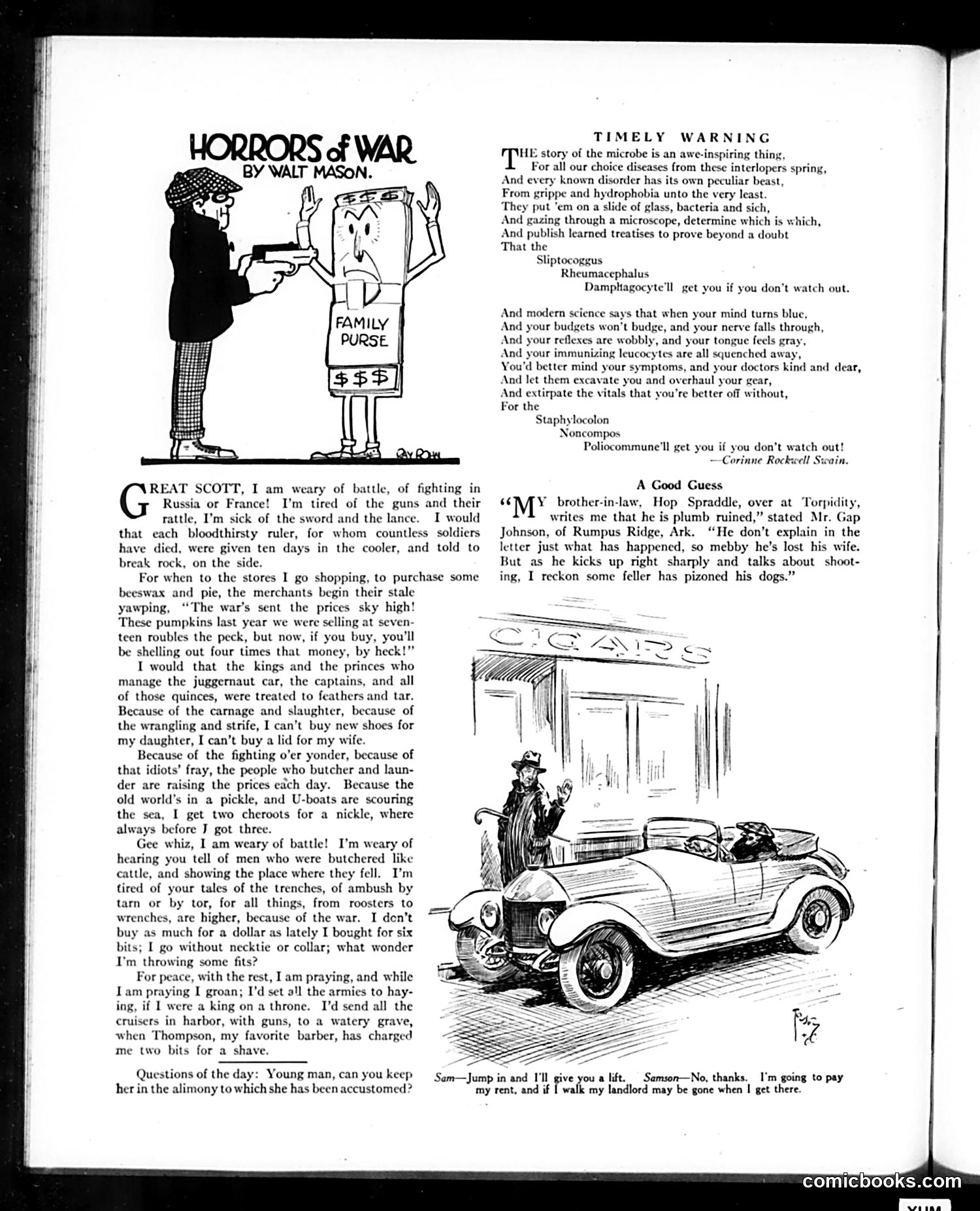
This page contains anti-war satire by Walt Mason responding to World War I's economic and social disruption. **"Horrors of War" (main article):** A common man complains that military conflict has caused inflation across all consumer goods—pumpkins, shoes, tobacco, barber services—making daily life unaffordable. He wishes military leaders faced punishment ("feathers and tar") instead of ordinary people bearing the financial burden. The satire targets how war profiteering and supply disruption create hardship for civilians while generals remain insulated. **"Timely Warning" (right column):** Mock-scientific verse satirizes both medical pseudoscience and wartime anxiety. It invents absurd bacterial names (Sliptocoggus, Staphylocolon) suggesting doctors exploit fear and uncertainty to sell unnecessary treatments—a commentary on how war hysteria fuels both medical quackery and public paranoia. **"A Good Guess" (bottom):** Brief anecdote where a man avoids a ride because his landlord might leave, implying economic desperation during wartime. The page collectively mocks how WWI disrupted civilian life through inflation and fear while enriching military/commercial interests.
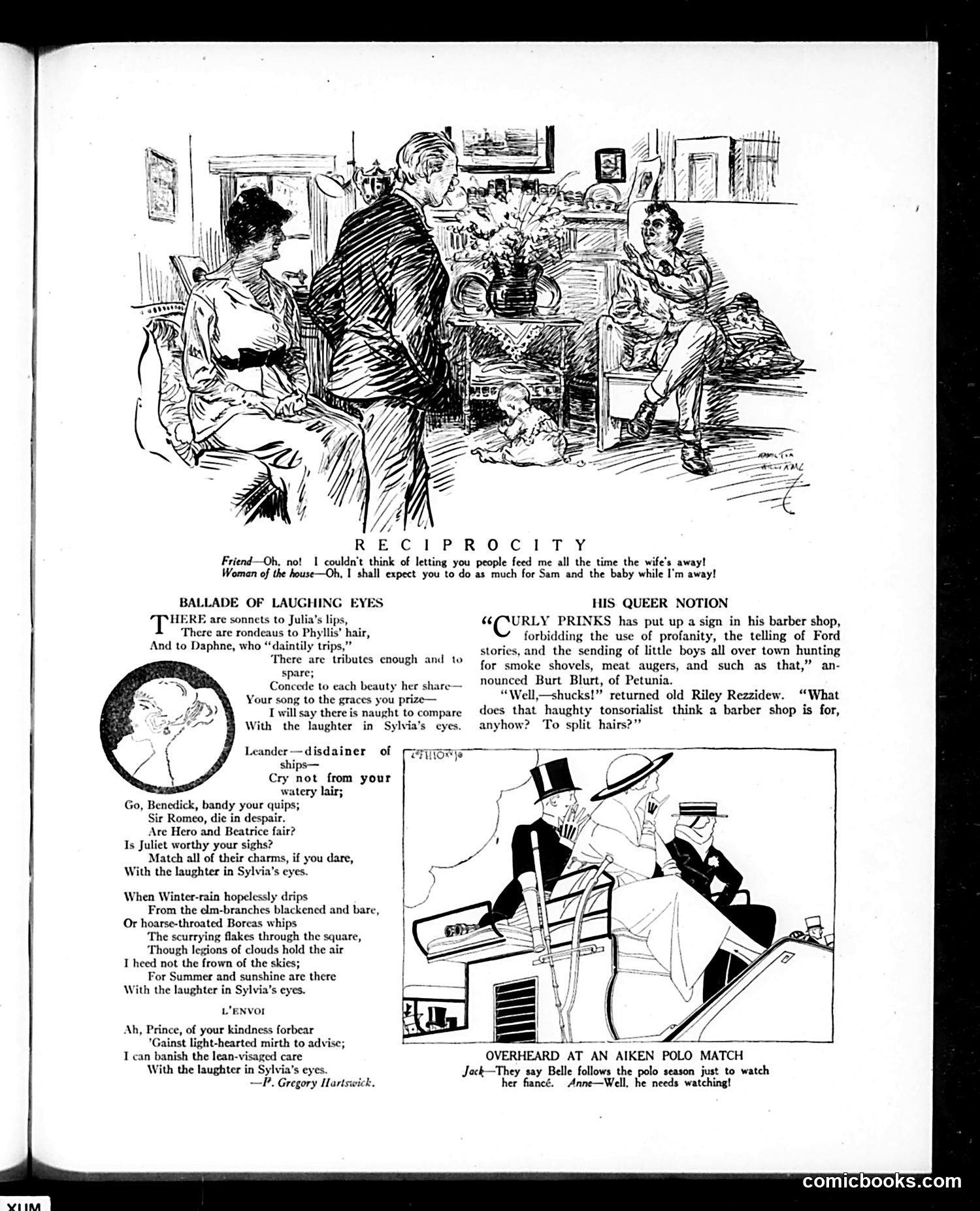
This page contains three separate satirical pieces typical of early 20th-century Judge magazine humor. **"Reciprocity"** (top): A domestic cartoon mocking the principle of reciprocal obligation. A man tells his wife he won't accept her hospitality while she's away, but she immediately counters that he must then reciprocate fully by caring for their child and her friend "Sam" during her absence—turning his gallant refusal into his own burden. **"Ballade of Laughing Eyes"** (left): A sentimental poem praising a woman's laughter over other beauties, written in classical poetic form. This parodies flowery romantic verse popular in the era. **"His Queer Notion"** (right): A humorous anecdote about a barber named Curly Prinks who posts rules forbidding profanity and "Ford stories" (likely crude jokes about Ford automobiles, then novel). A customer sarcastically questions whether a barber shop exists for anything *but* such talk. **"Overheard at an Aiken Polo Match"** (bottom): A brief joke about a woman attending polo matches to watch her fiancé—implying he needs supervision, likely suggesting infidelity concerns.
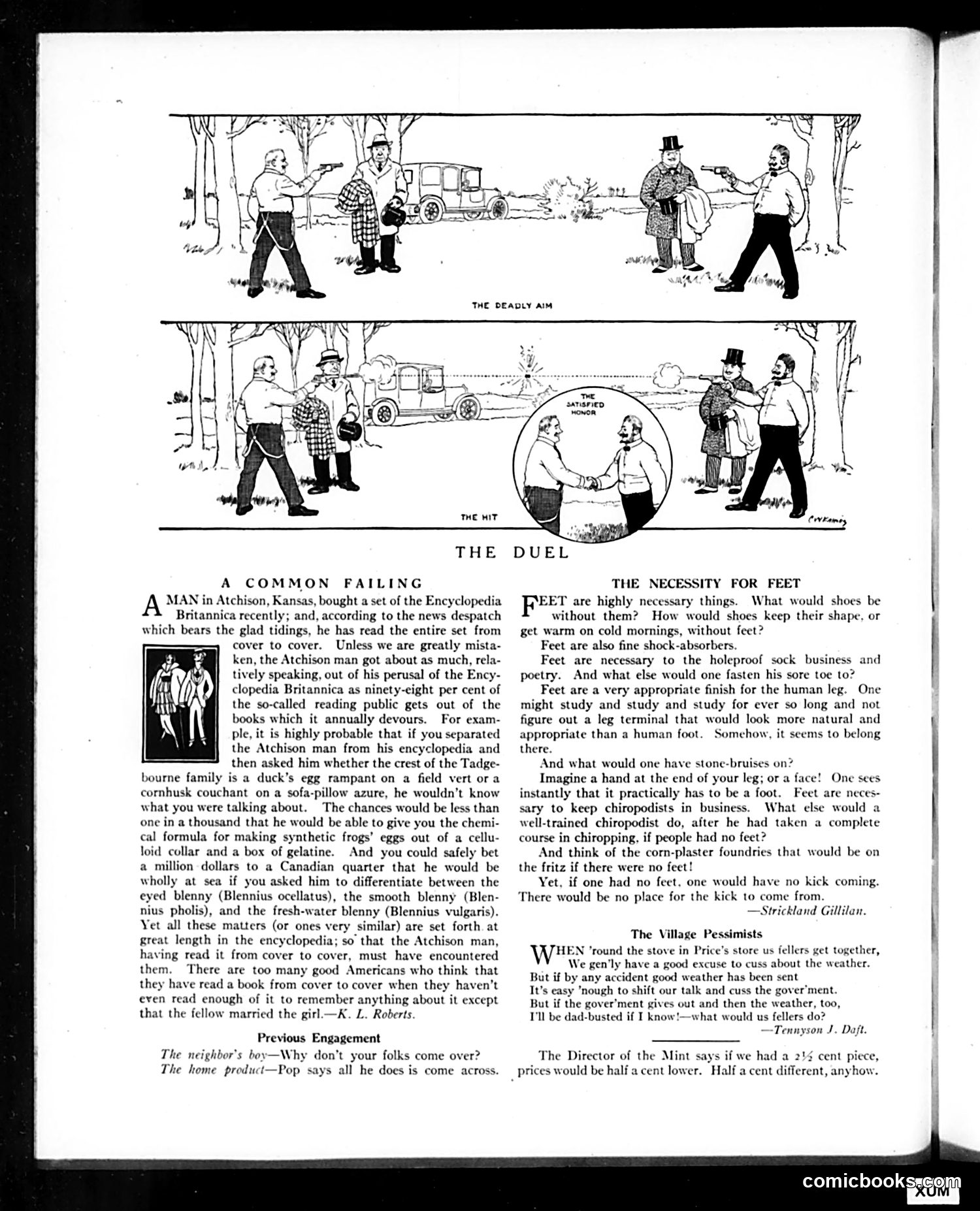
This page contains three humorous pieces from *Judge* magazine (a satirical publication): **"The Duel" (top cartoon):** A visual joke showing two men attempting to shoot each other but repeatedly missing. The caption labels the panels "The Deadly Aim" and "The Hit," with the final panel showing them shaking hands—suggesting that despite their poor marksmanship, they somehow managed to hit their target (or reconcile). It's absurdist humor about incompetence. **"A Common Failing" (left article):** Satirizes reading without retention. An Atchison, Kansas man claims to have read the entire Encyclopedia Britannica, but the author doubts he absorbed anything meaningful—he'd likely forget obscure details about fish species or heraldry within days. The piece mocks people who claim intellectual accomplishment through mere page-turning without actual learning. **Right-side poems:** Light verse about feet, optimism, and currency—filler content typical of *Judge*'s miscellaneous humor sections. These are gentle social observations rather than sharp satire. The page reflects early 20th-century American magazine style: illustrated jokes mixed with short humorous essays and poetry.
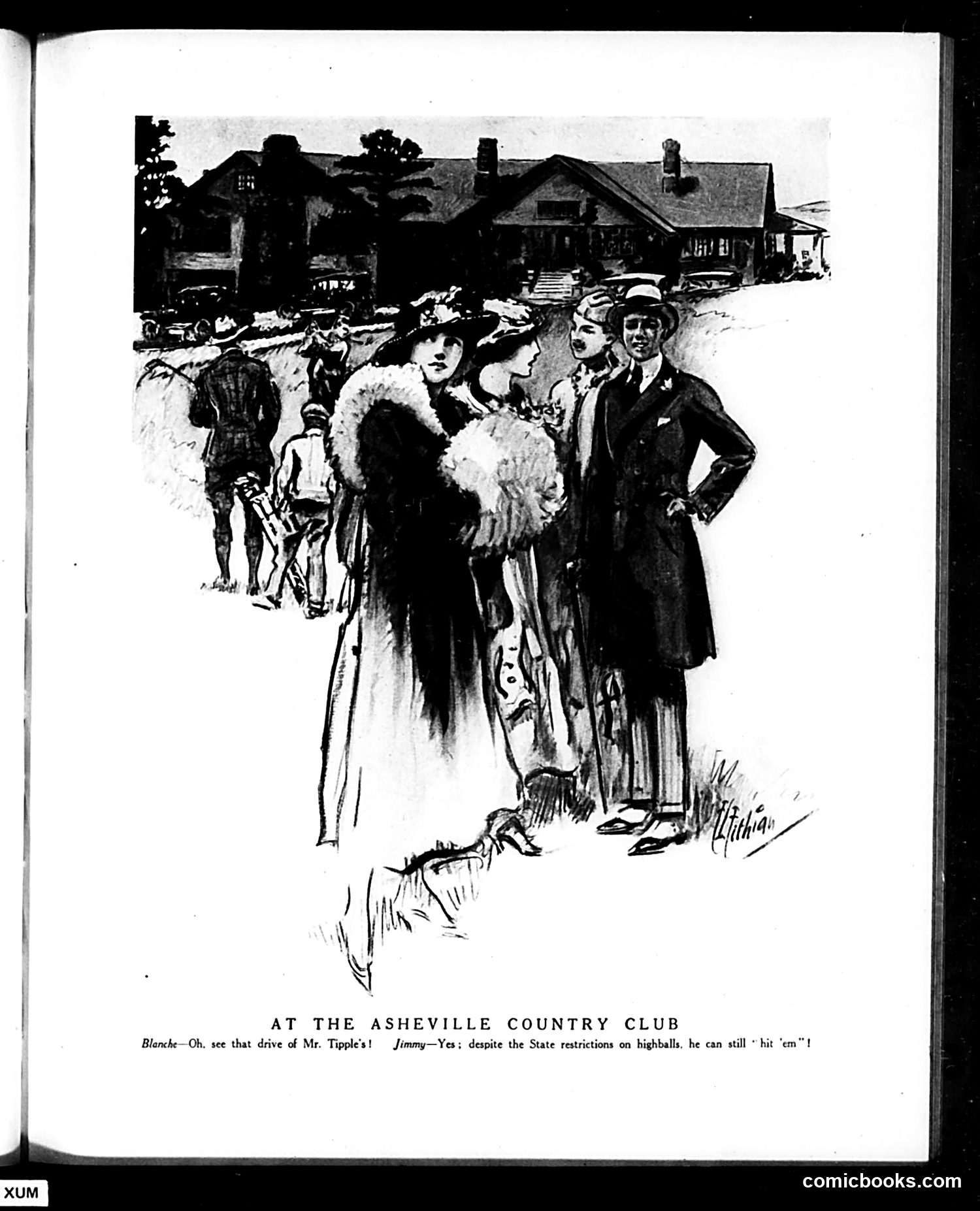
This cartoon satirizes Prohibition-era hypocrisy at an upscale country club in Asheville, North Carolina. The joke plays on a double meaning: "hit 'em" refers both to Mr. Tipple's golf drive and to his ability to consume highballs (cocktails) despite state alcohol restrictions. The cartoon suggests that wealthy club members could circumvent Prohibition laws that applied to ordinary citizens. "Mr. Tipple" (a name implying habitual drinking) apparently continues consuming alcohol openly at the exclusive venue, mocking the enforcement of Prohibition restrictions. The well-dressed figures and country club setting emphasize class privilege—the affluent could maintain their drinking habits while legal restrictions supposedly applied universally. This critiques both the ineffectiveness of Prohibition and the special treatment afforded to the wealthy.
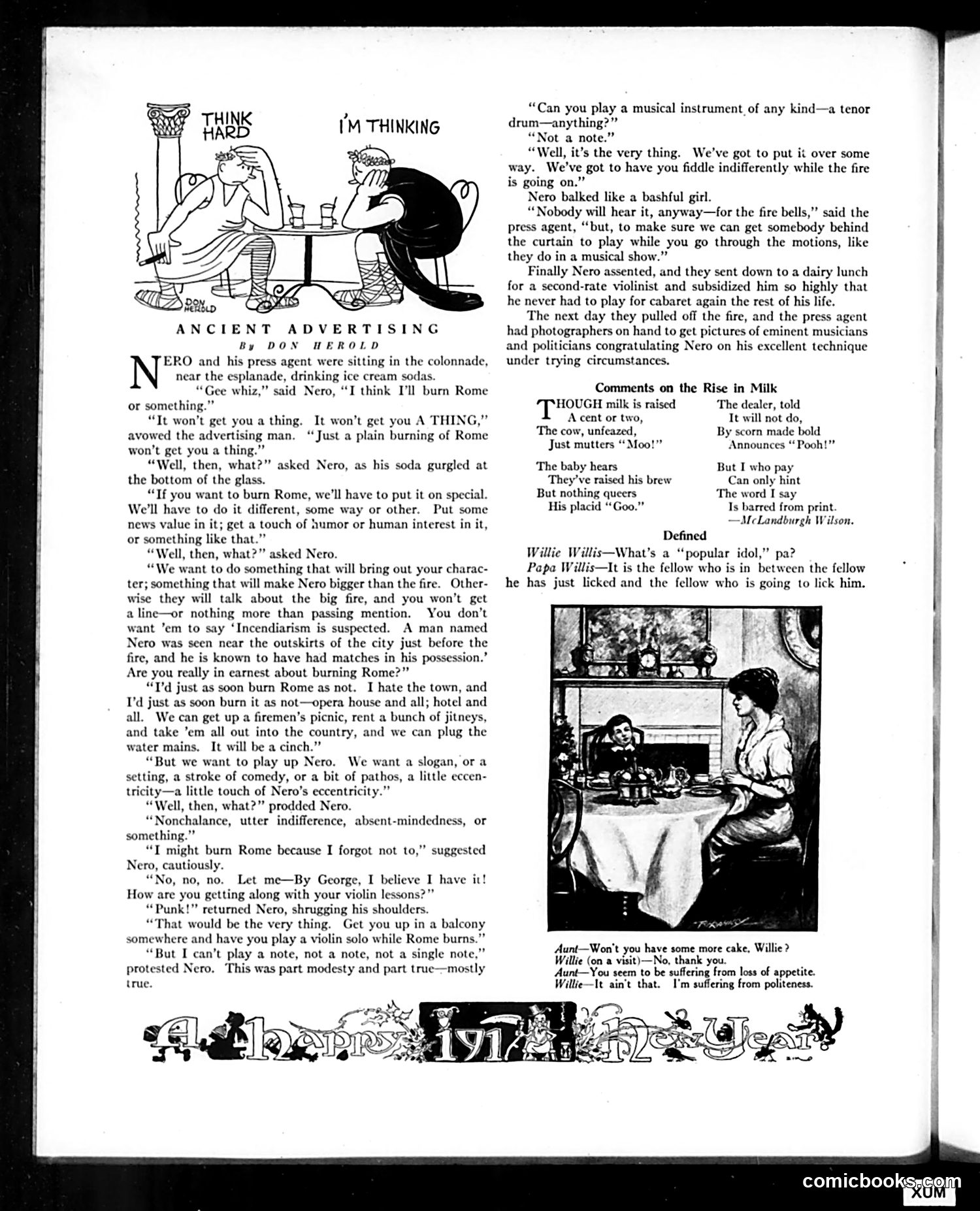
This satirical piece mocks modern advertising practices by reimagining the historical figure Nero (Roman emperor infamous for allegedly fiddling while Rome burned) as a modern celebrity managed by a PR agent. The joke: The press agent insists that simply burning Rome won't generate publicity—it needs a *narrative angle*. He coaches Nero to play violin while the city burns, creating the iconic image that will dominate coverage. Crucially, Nero can't actually play; the agent hires a stand-in to perform off-stage while Nero fakes it for photographers. The satire targets 1920s advertising culture: the obsession with manufactured image over substance, staged authenticity, and the understanding that reality matters less than the narrative presented to the public. By applying modern PR tactics to an ancient historical event, Herold highlights how advertising creates false impressions through careful staging and media manipulation. The page also includes unrelated content: poems about milk prices and a joke about "popular idols."
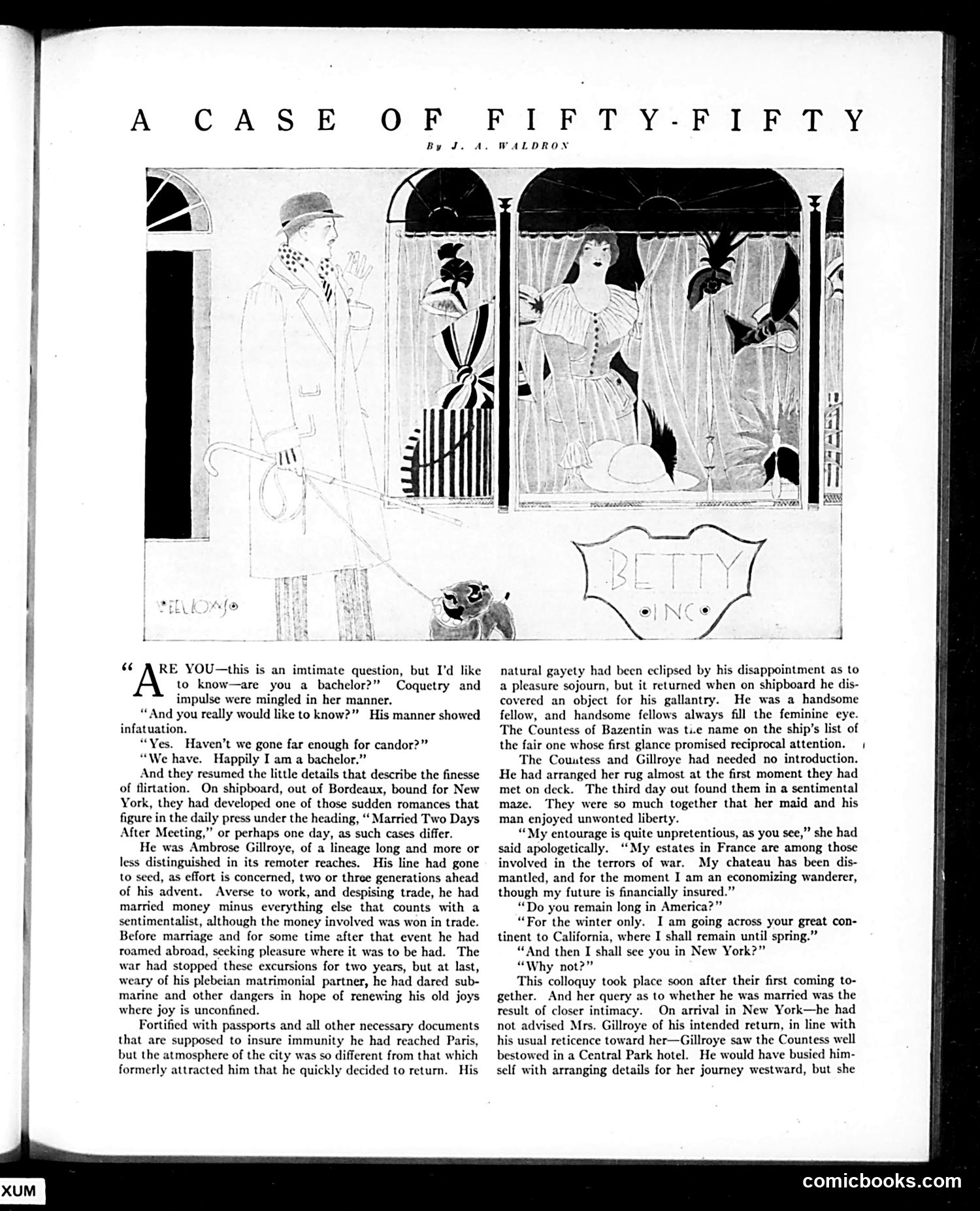
This satirical story depicts a married man, Ambrose Gillroye, who abandons his wife to pursue a shipboard romance with a woman claiming to be a French countess. The narrative mocks his shallow gallantry and class pretensions—he's from a distinguished but declining family who married for money yet despises "trade." The joke centers on infidelity and gender dynamics of the era. The woman asks pointedly whether he's a bachelor, then orchestrates their affair in New York while he keeps his wife uninformed. The "fifty-fifty" title likely refers to the equal deception both parties engage in—she may not be genuinely titled, and he's clearly not the faithful husband his wife believes. The satire critiques wealthy idlers who pursue pleasure abroad, post-WWI social upheaval, and the performative nature of romantic encounters between strangers of uncertain backgrounds.
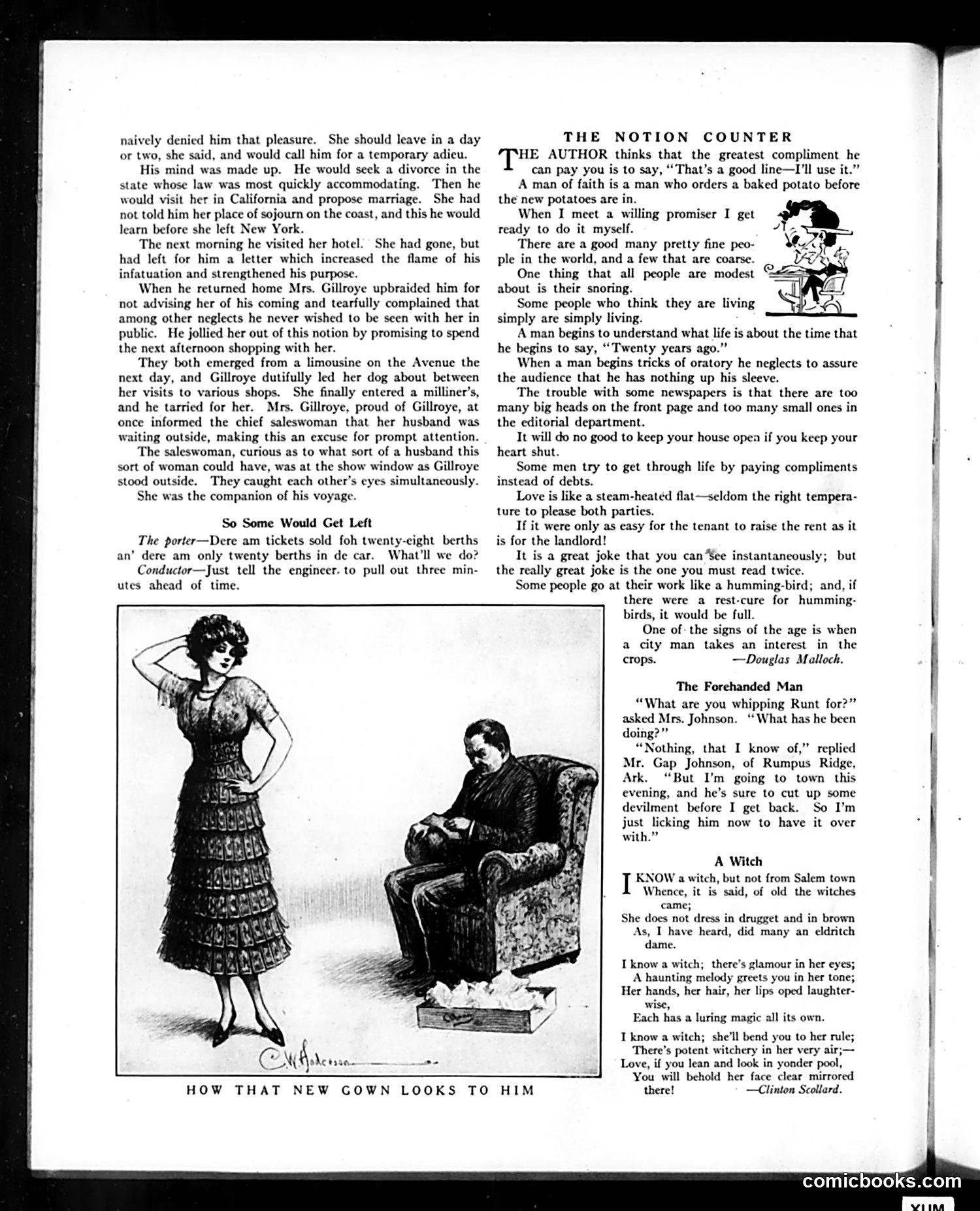
The main cartoon, captioned "How That New Gown Looks to Him," depicts a husband slouched disinterestedly in a chair while his wife displays her new dress. The satire targets the disconnect between spouses' priorities: she's excited about fashion; he's indifferent or bored. This reflects early-20th-century gender expectations and marital dynamics. The page's narrative sections mock various social types and behaviors through brief, cynical observations. "The Notion Counter" column offers aphorisms about human nature—complaining that newspapers have "too many big heads on the front page" (likely referring to sensationalism), mocking men who flatter instead of pay debts, and critiquing pretentious city dwellers. "The Forehanded Man" satirizes a rural father's preventative discipline: he whips his son *before* misbehaving, assuming the boy will cause trouble. This mocks both rural parenting and backwards logic. These pieces exemplify Judge's satirical approach: exposing hypocrisy, gender tensions, class pretensions, and absurd human behavior through humor.
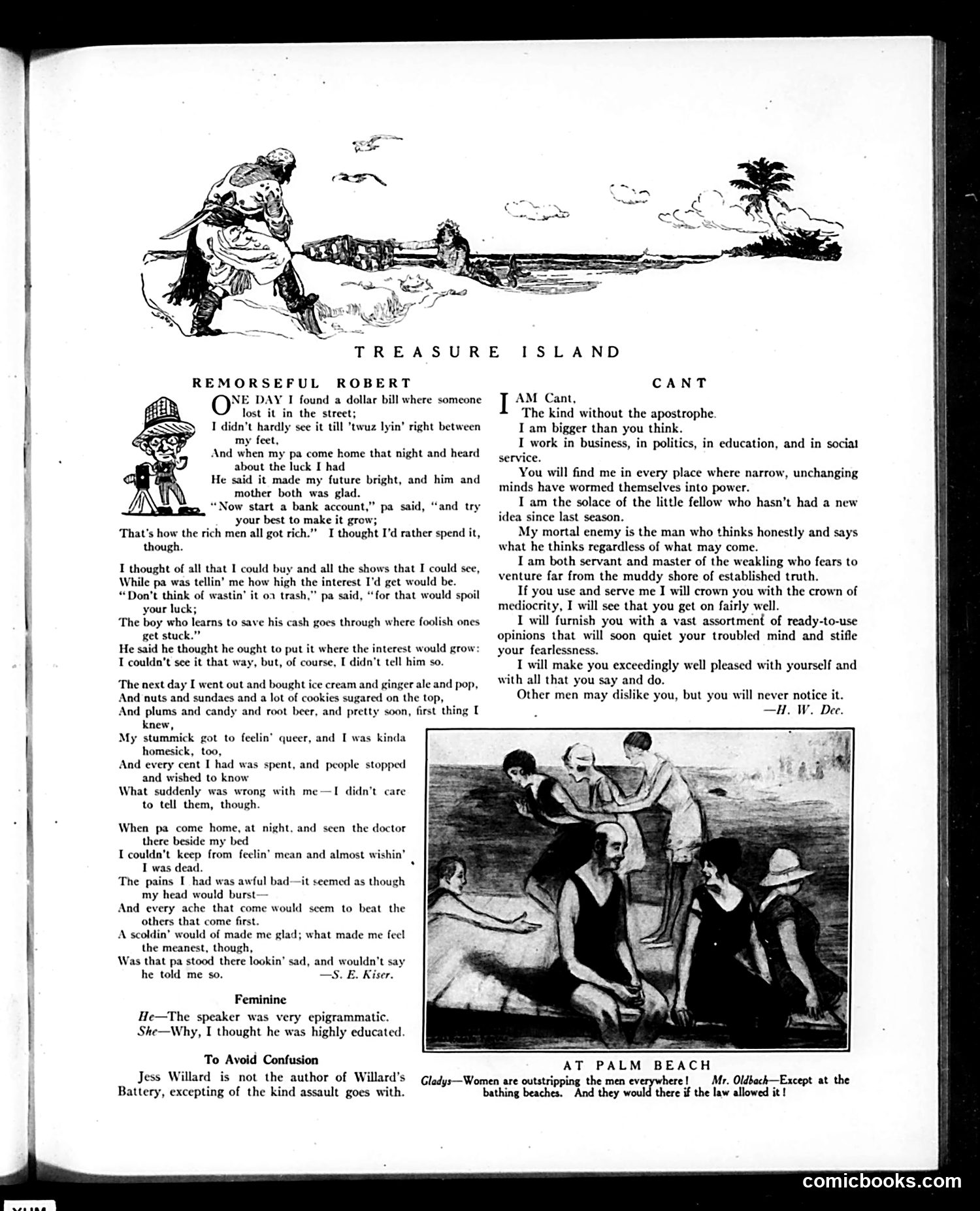
This page contains two satirical pieces: **"Remorseful Robert"** is a cautionary verse about a boy who finds a dollar and ignores his father's advice to save it. Instead, he spends it on sweets and junk food, gets sick, and suffers stomach pain. The moral lesson: the father's restraint would have been better than the boy's indulgence. The satire targets youthful impulsiveness and lack of financial discipline. **"Cant"** is a personified definition-poem mocking hypocrisy and empty rhetoric. "Cant" (insincere talk) claims to work everywhere—business, politics, education—enabling mediocrity and stifling honest thought. It's the enemy of truth-telling and serves those afraid of real progress. The piece critiques how shallow platitudes and conventional thinking maintain the status quo. The bottom cartoon shows women outnumbering men at Palm Beach beaches, with a man joking women would do this everywhere "if the law allowed it"—likely satirizing gender anxieties of the era about women's increasing public presence.
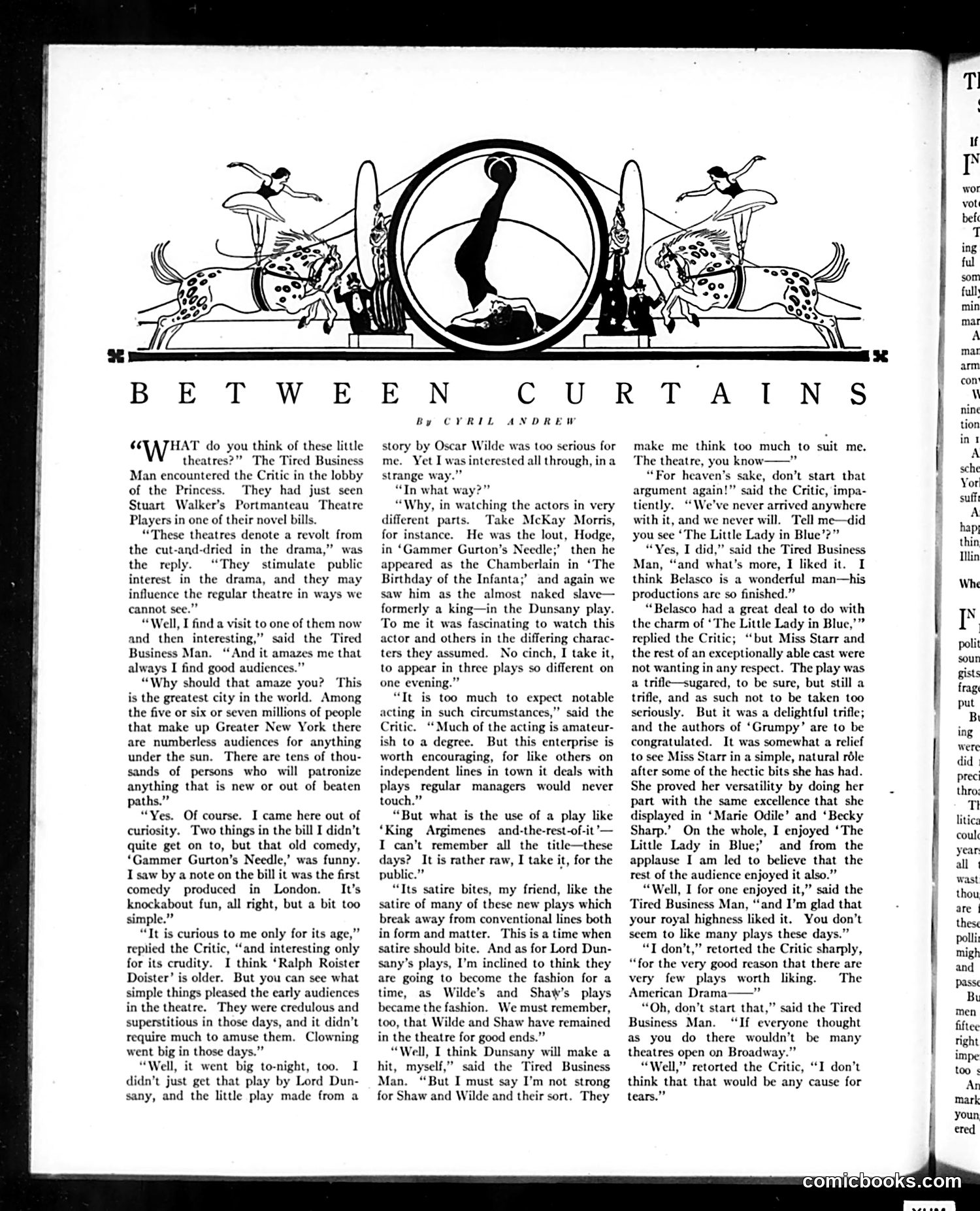
This is a dialogue between a "Tired Business Man" and a "Critic" discussing the experimental "little theatres" movement—small, avant-garde venues like Stuart Walker's Portmanteau Theatre Players that were challenging Broadway's commercial conventions in the early 20th century. The satire critiques both positions: the Businessman represents the general public's preference for simple, accessible entertainment (he enjoyed the knockabout farce *Gammer Gurton's Needle* but found Lord Dunsany's symbolist plays confusing). The Critic defends artistic innovation and intellectual challenge in drama. The cartoon above illustrates this tension visually—acrobatic figures and theatrical masks suggest both the playfulness and the serious artistic ambitions of these experimental productions. The satire suggests that both perspectives have merit: the public wants entertainment, while serious artists want to advance the medium beyond commercial formulas.
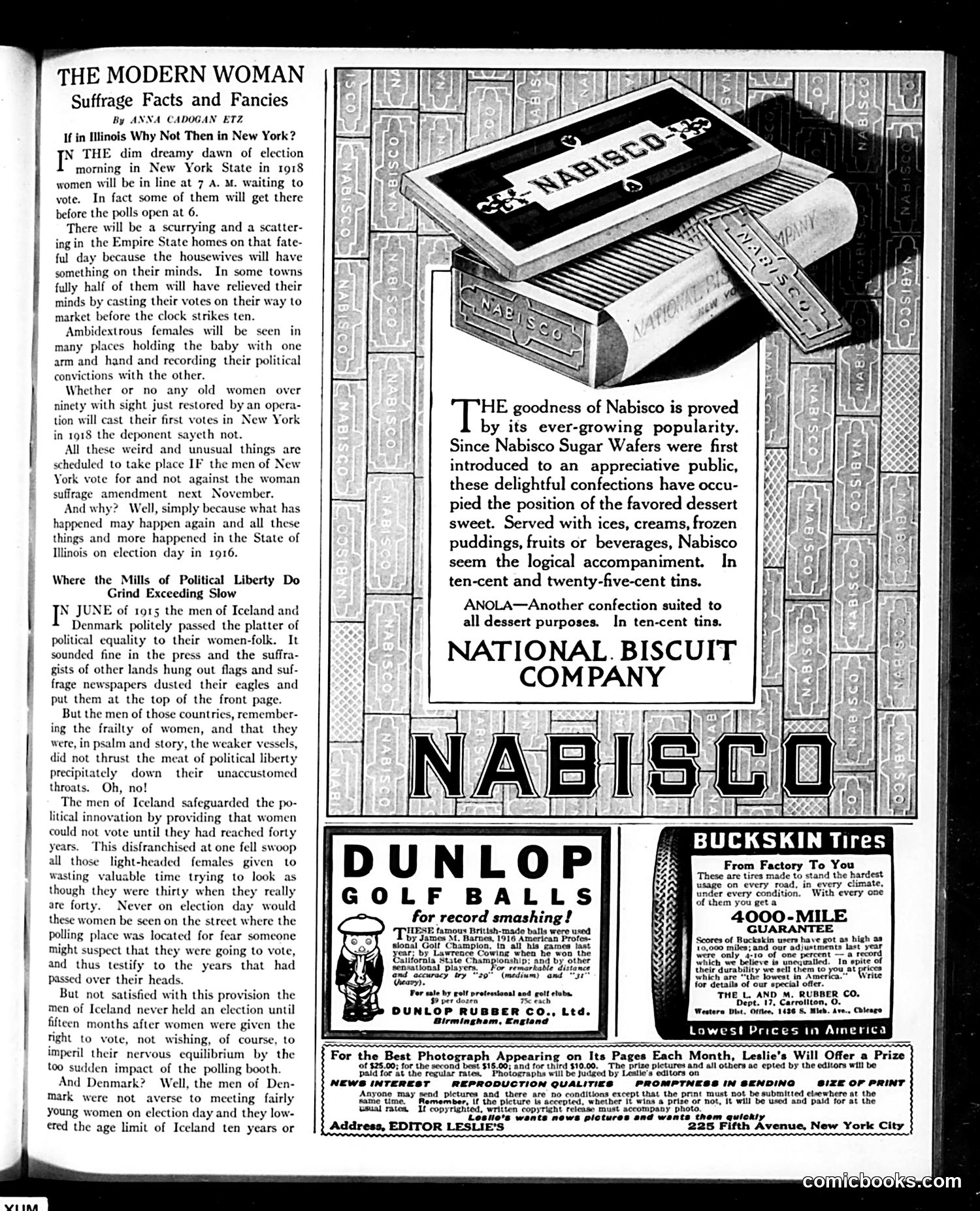
This page combines a suffrage opinion piece with period advertisements. The main text by Anna Cadogan Etz discusses women's voting, using satirical comparisons to Iceland and Denmark to mock male concerns about female voters. **The Satire:** Etz describes how Iceland and Denmark granted women suffrage but imposed restrictions—Iceland required women be 40 years old to vote and delayed the first election 15 months afterward, fearing women might reveal their actual age or suffer nervous collapse from voting. Denmark lowered the age requirement slightly but similarly hedged the innovation. Etz implies these measures are absurdly paternalistic, suggesting similar patronizing attitudes exist in New York as it debates its own suffrage amendment. The piece anticipates chaotic election day scenes (women voting with babies, rushing between voting and shopping), sarcastically suggesting this proves women unfit—when actually it demonstrates their genuine civic engagement. **Context:** This appears to be from *Judge* magazine circa 1918, during New York's suffrage campaign, using historical examples to highlight the illogical, condescending reasoning behind restricting women's political participation.
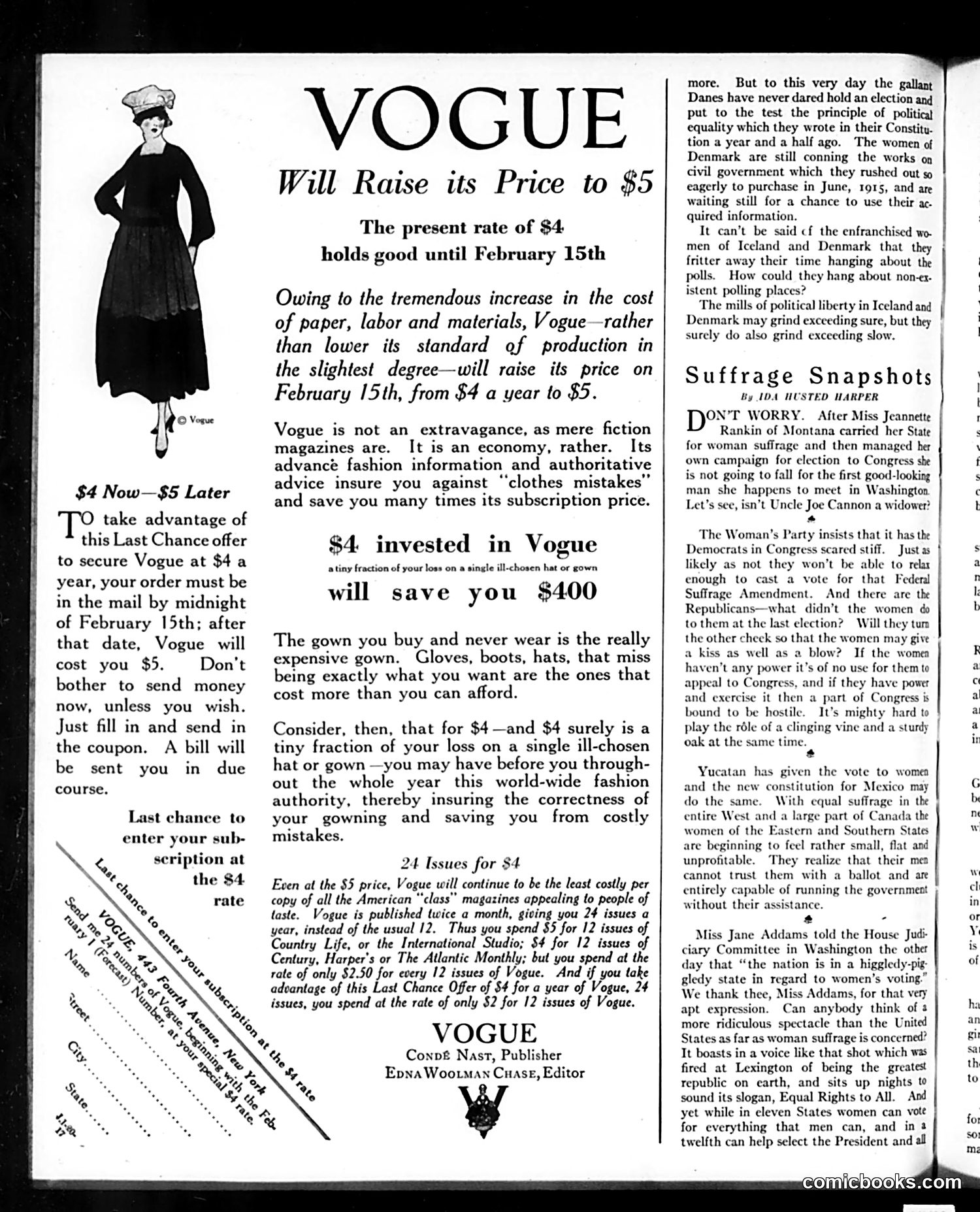
This page is primarily a **Vogue magazine advertisement** announcing a price increase from $4 to $5 annually, effective February 15th. The ad argues that Vogue is an economy, not luxury, because its fashion guidance saves readers from costly clothing mistakes—claiming a $4 subscription saves $400 in poor purchases. The right column contains **"Suffrage Snapshots"** by Ida Husted Harper, a political commentary on women's voting rights. It mocks Iceland and Denmark for granting women suffrage but never actually holding elections to test it ("istent polling places"). The piece also references **Jeannette Rankin**, the first woman elected to Congress from Montana, and sarcastically comments on the Woman's Party's attempts to leverage political power. The tone suggests frustration that despite winning the franchise, women lack practical opportunities to exercise it. Both sections reflect the magazine's 1916 context—women's suffrage remains incomplete and contentious.
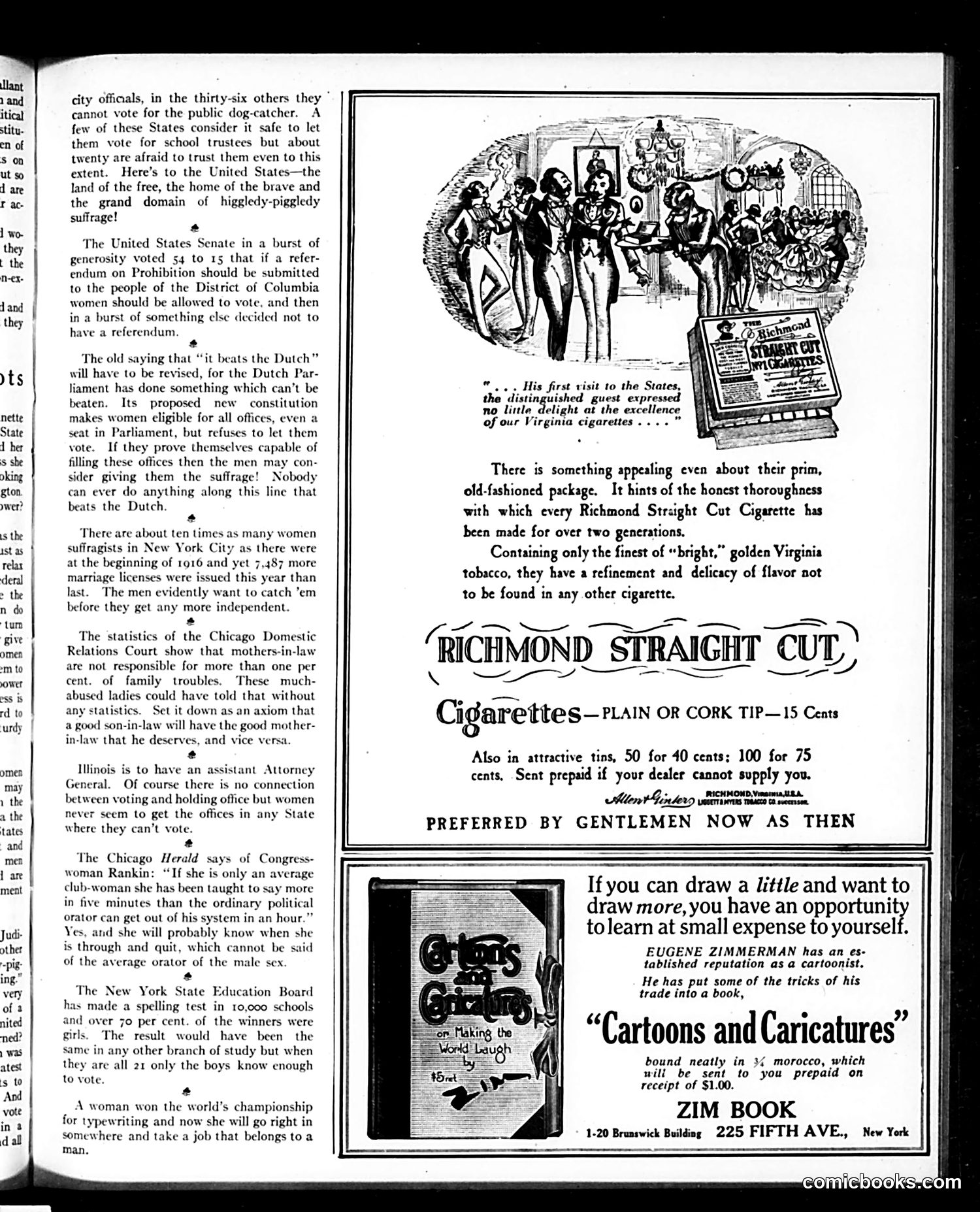
This page contains **primarily text commentary on women's suffrage** alongside period advertisements—not a single unified political cartoon. The left column satirizes inconsistent American suffrage laws. Judge ridicules that U.S. states restrict women's voting rights while the Dutch Parliament (unexpectedly) proposed allowing women to hold office but not vote. The text also notes the contradiction that more women are joining suffragist movements in New York City even as marriage licenses increase—suggesting men rush to marry women before they gain independence. Additional jabs target women's demonstrable competence: spelling test winners are mostly girls, yet only boys "know enough to vote"; a congresswoman speaks more effectively than male orators; a woman won a typewriting championship but will lose the job to a man. The advertisements—for Richmond Straight Cut cigarettes and a cartooning instruction book—are period commercial content unrelated to the political commentary.
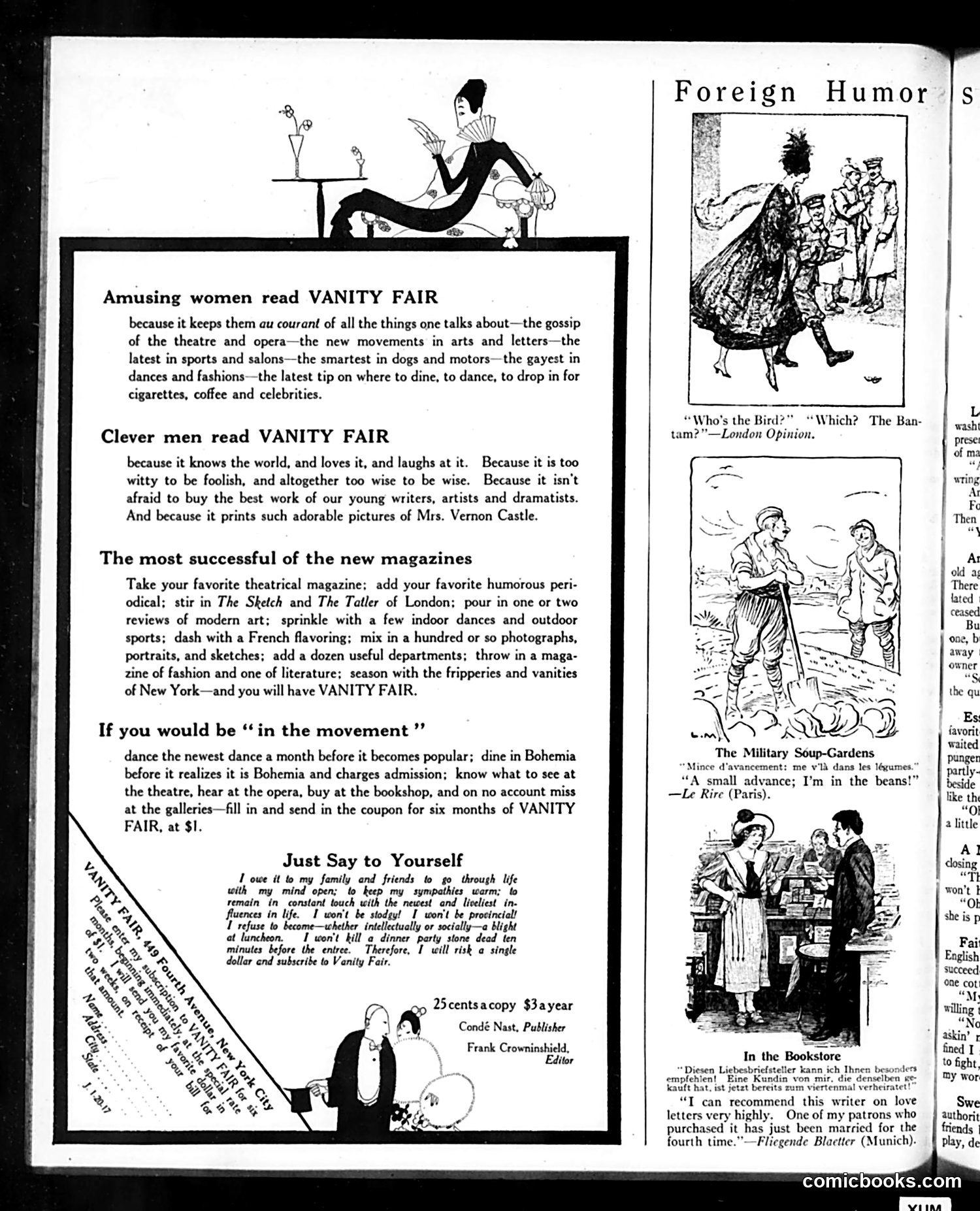
This is primarily a **Vanity Fair magazine advertisement** (left page) with international humor cartoons (right page). ## The Ad's Satire The Vanity Fair promotion satirizes social aspiration and intellectual vanity. It flatters readers into subscribing by claiming the magazine prevents them from being "stodgy" or "provincial"—social fears of the era's upper-middle class. The pitch targets both women (via fashion/theatre gossip) and men (via wit and sophistication), suggesting that reading Vanity Fair signals cultural refinement and "being in the movement." ## The Foreign Humor Cartoons The right page collects jokes from European publications (London Opinion, Le Rire, Fliegende Blaetter). These depict class-based humor: a woman with soldiers about "advancement through vegetables" (likely WWI-era), and a bookshop clerk recommending a love-letter writer who's enabled four marriages—mocking both romantic incompetence and commercial exploitation. The overall message: sophisticated readers belong to an international cultural circle, making the advertisement itself part of Vanity Fair's pitch about cosmopolitan awareness.
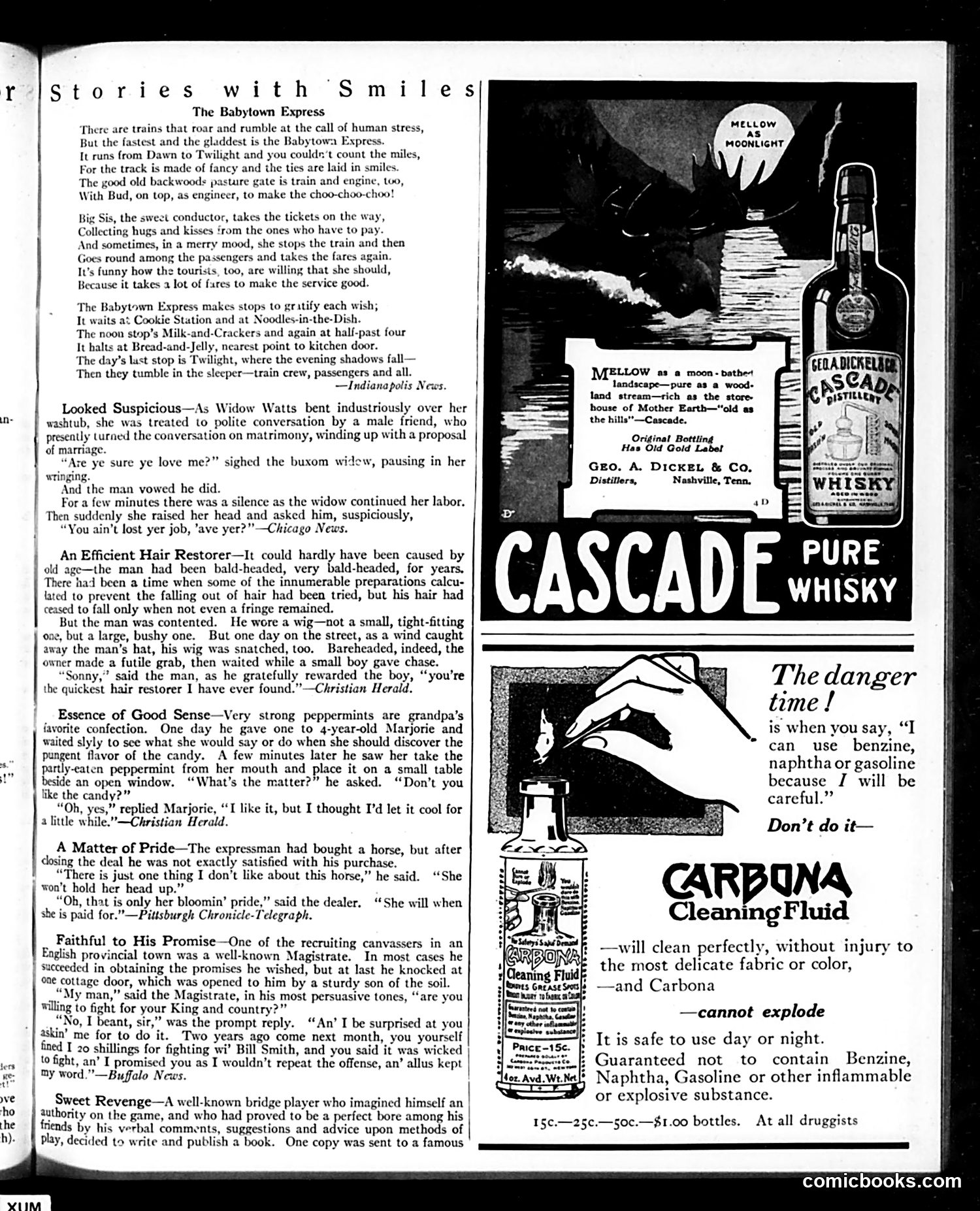
This page consists primarily of **short humorous anecdotes** rather than political cartoons. The stories reflect early 20th-century American sensibilities: **"The Babytown Express"** uses whimsical personification—a child's imaginary train journey through daily routines (meals, bedtime) with family members as conductor and engineer. **Other brief jokes** play on period-specific concerns: a widow's practical worry about marriage ("You ain't lost yer job?"), a bald man's wig blown away by wind, a child cooling a peppermint candy by a window, and a horse's pride. The page also features **two period advertisements**: Cascade Pure Whisky (with romantic moonlit imagery) and Carbona Cleaning Fluid (emphasizing it won't explode like competitors—a genuine safety selling point when naphtha-based cleaners were common household hazards). There is **no overt political satire** here; instead, the humor targets universal human foibles and domestic situations recognizable to contemporary readers.
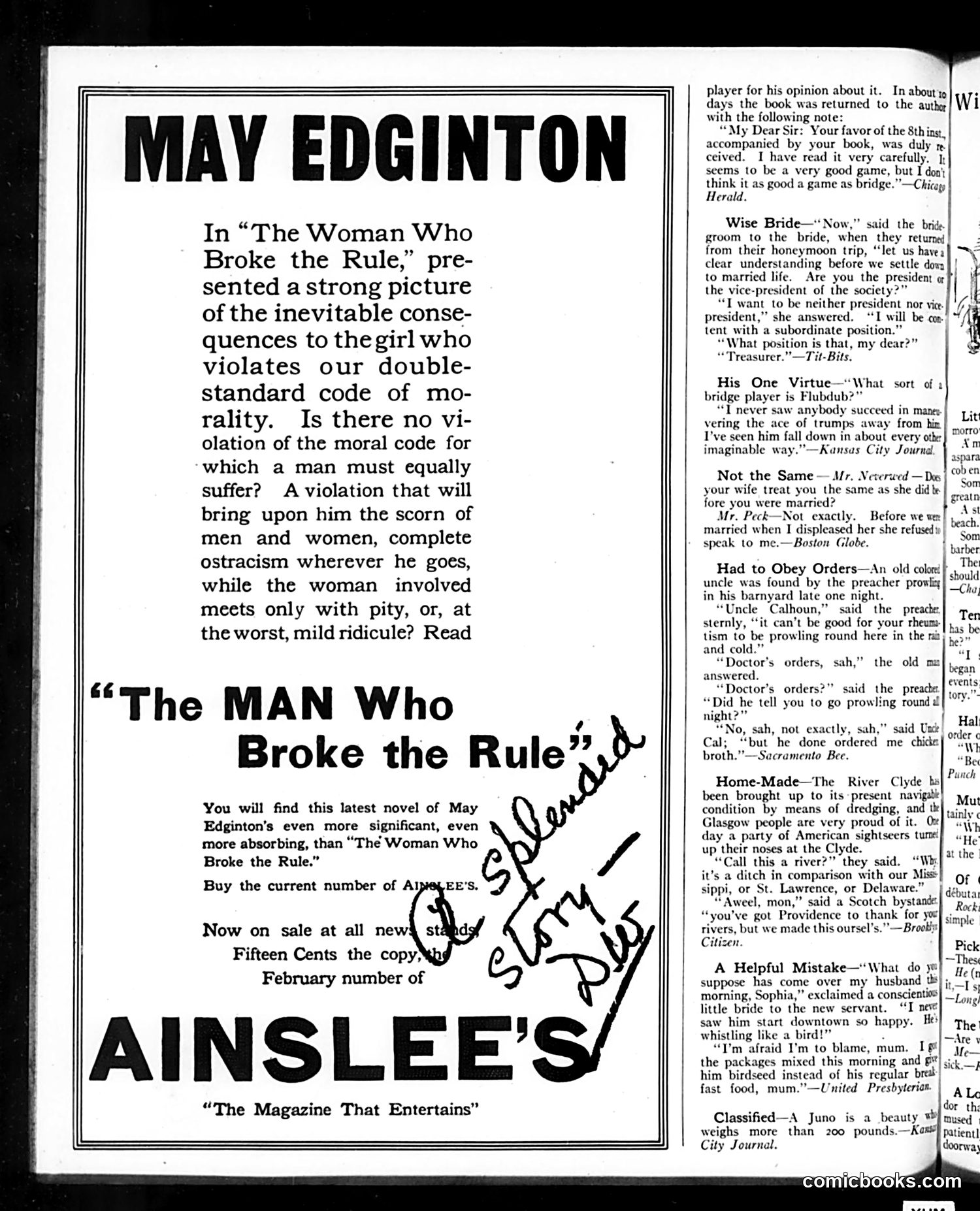
This page is primarily an **advertisement for Ainslee's Magazine**, disguised as editorial content. It promotes May Edginton's novel "The Man Who Broke the Rule" by contrasting it with her earlier work "The Woman Who Broke the Rule." The ad's satire targets the **sexual double standard** of the era: women who violated sexual morality faced social ruin and ridicule, while men faced no equivalent consequences. The advertisement sarcastically questions this hypocrisy—"Is there no violation of the moral code for which a man must equally suffer?"—then pitches Edginton's new novel as addressing this imbalance. The right column contains typical **humor filler** common to magazines: brief jokes about marriage, bridge, servants, and regional pride (Scottish vs. American rivers). These are disconnected from the main ad and serve as space-filling content. The handwritten signatures appear to be **autographs**, likely added to this particular copy as promotional material.
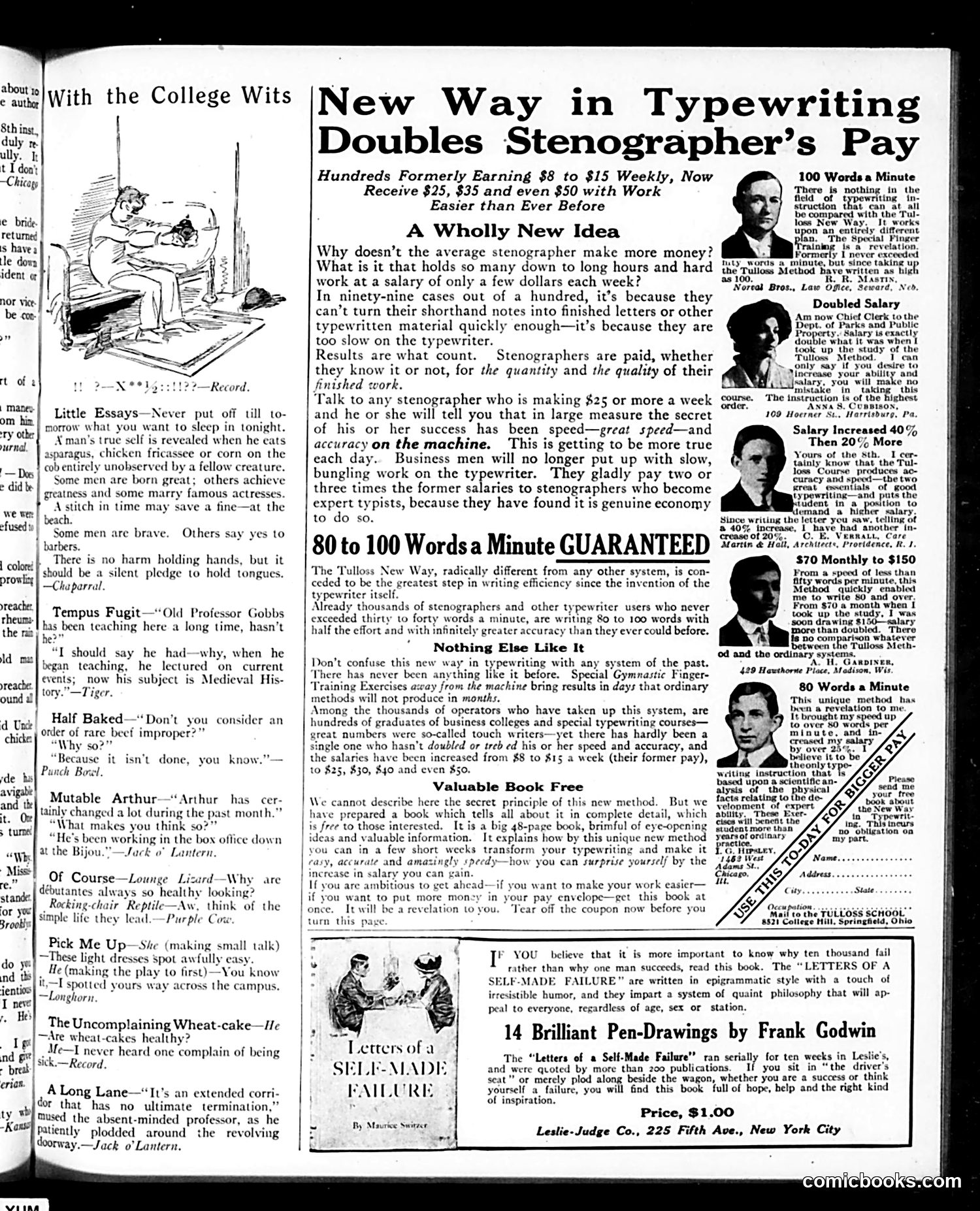
This page primarily showcases **advertising for the Tullos Stenography Method**, presented as a revolutionary typewriting system. The ads feature testimonials from stenographers claiming salary increases from $8-$15 weekly to $25+ weekly, with promises of typing 80-100 words per minute. The satire lies in **Judge's skepticism about business education claims**. The left column contains the magazine's traditional "College Wits" humor section—short, cynical jokes mocking academic life and human nature. These undercut the earnest advertising claims on the right: while the ads promise rapid self-improvement and wealth through the Tullos Method, the humor section satirizes the gap between aspiration and reality in American life. The implicit critique: readers should be as skeptical of stenography-school promises as they are of the absurd contradictions in daily life. The juxtaposition suggests these "get-rich-quick" typing schemes may be exaggerated, reflecting broader Judge skepticism toward modern educational and business schemes targeting vulnerable workers.
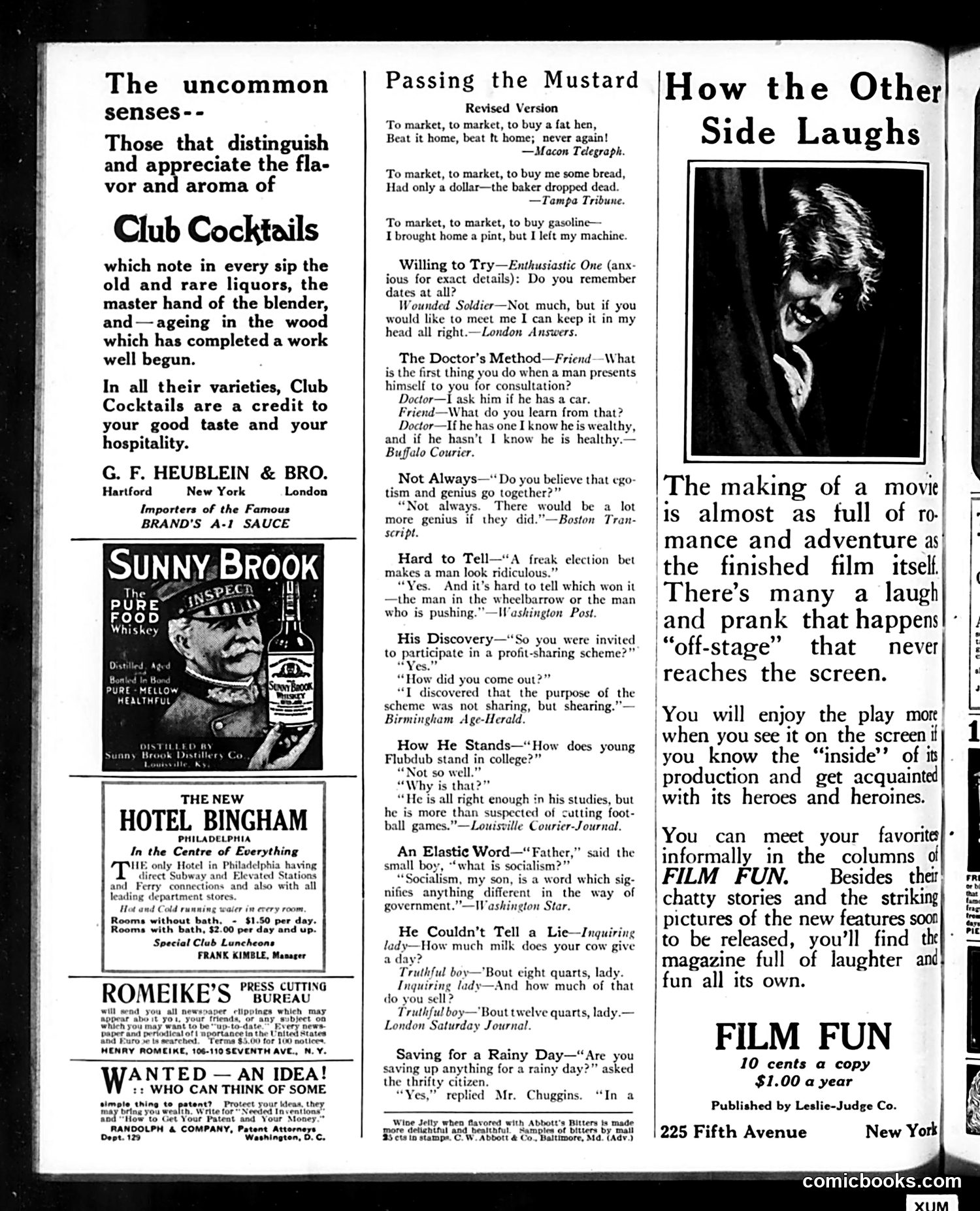
This page is primarily **advertisements and humor columns**, not political cartoons. The left side contains ads for liquor (Club Cocktails, Sunny Brook whiskey), a hotel, and patent services. The center section, "Passing the Mustard," presents **humorous revised versions of nursery rhymes** reflecting post-WWI American life—jokes about rising food prices (bread costing more than a dollar), gasoline shortages, and inflation. Other jokes mock doctors who diagnose wealth by car ownership, and soldiers' memory loss from combat. The right side advertises **"Film Fun" magazine**, explaining that movie-making contains behind-the-scenes humor audiences never see on screen. This section appeals to readers' interest in film industry gossip and "inside" knowledge of Hollywood production. The humor throughout reflects **early 1920s concerns**: economic hardship, the recent war's effects, and fascination with emerging film industry culture. There are no identifiable political figures or sustained satirical campaigns—just lightweight topical gags typical of Judge's lighter content.
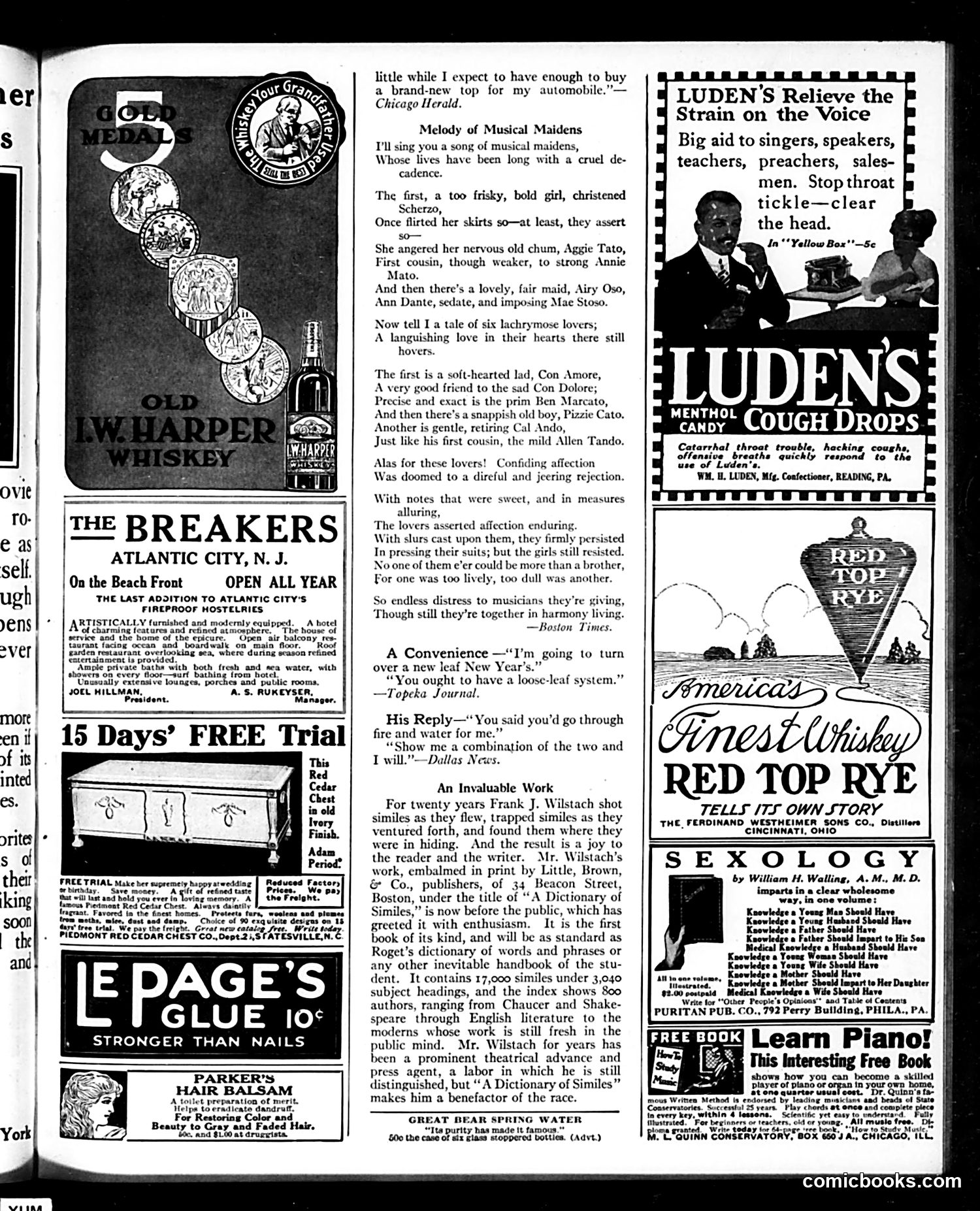
This page is primarily **advertising with light editorial content**, typical of early 20th-century magazines. The main satirical content is "Melody of Musical Maidens"—a clever wordplay poem disguised as romantic verse. Each character's name is actually a **musical term**: Scherzo, Aggie Tato (Agitato), Airy Oso (Arioso), Mae Stoso (Maestoso), Con Amore, Con Dolore, Ben Marcato (Marcato), Pizzie Cato (Pizzicato), Cal Ando (Calando), and Allen Tando (Allentando). The joke exploits how these musical directions, when slightly altered, sound like ordinary names—a clever play on specialized vocabulary that would amuse educated readers familiar with music. The remaining content consists of **period advertisements** for luxury hotels, whiskey, cough drops, furniture, and educational books—standard commerce for Judge's affluent readership. No political satire is evident on this particular page.
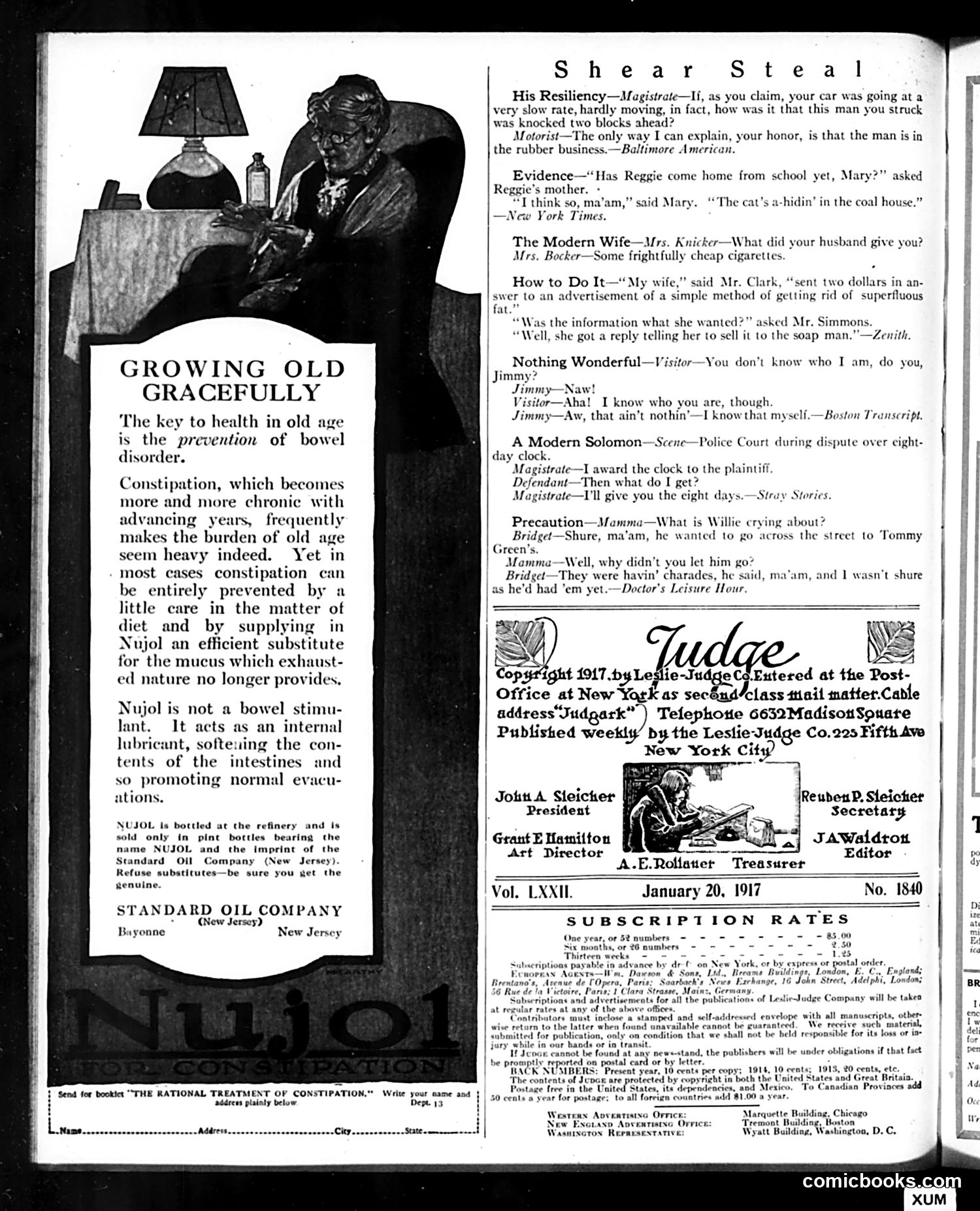
This page combines satirical humor pieces with advertising. The main content consists of six brief jokes mocking various social situations: **"Shear Steal"** jokes target a motorist claiming a slow-moving car somehow knocked someone two blocks (he "must be in the rubber business"), and a wife selling superfluous fat to a soap manufacturer—both playing on absurd explanations. **Other pieces** mock domestic life: a neglectful nanny, a wife receiving cheap cigarettes, Irish maids' speech patterns, and a magistrate's illogical judgment awarding a clock to one party and "eight days" to another. The large advertisement for **Nujol** (a Standard Oil laxative product) dominates the left side, promoting constipation relief as essential for "Growing Old Gracefully"—reflecting early 20th-century obsession with digestive wellness as a health cure-all. The humor targets working-class characters, domestic servants, and urban confusion—typical Judge magazine fare satirizing contemporary American life and consumer culture.
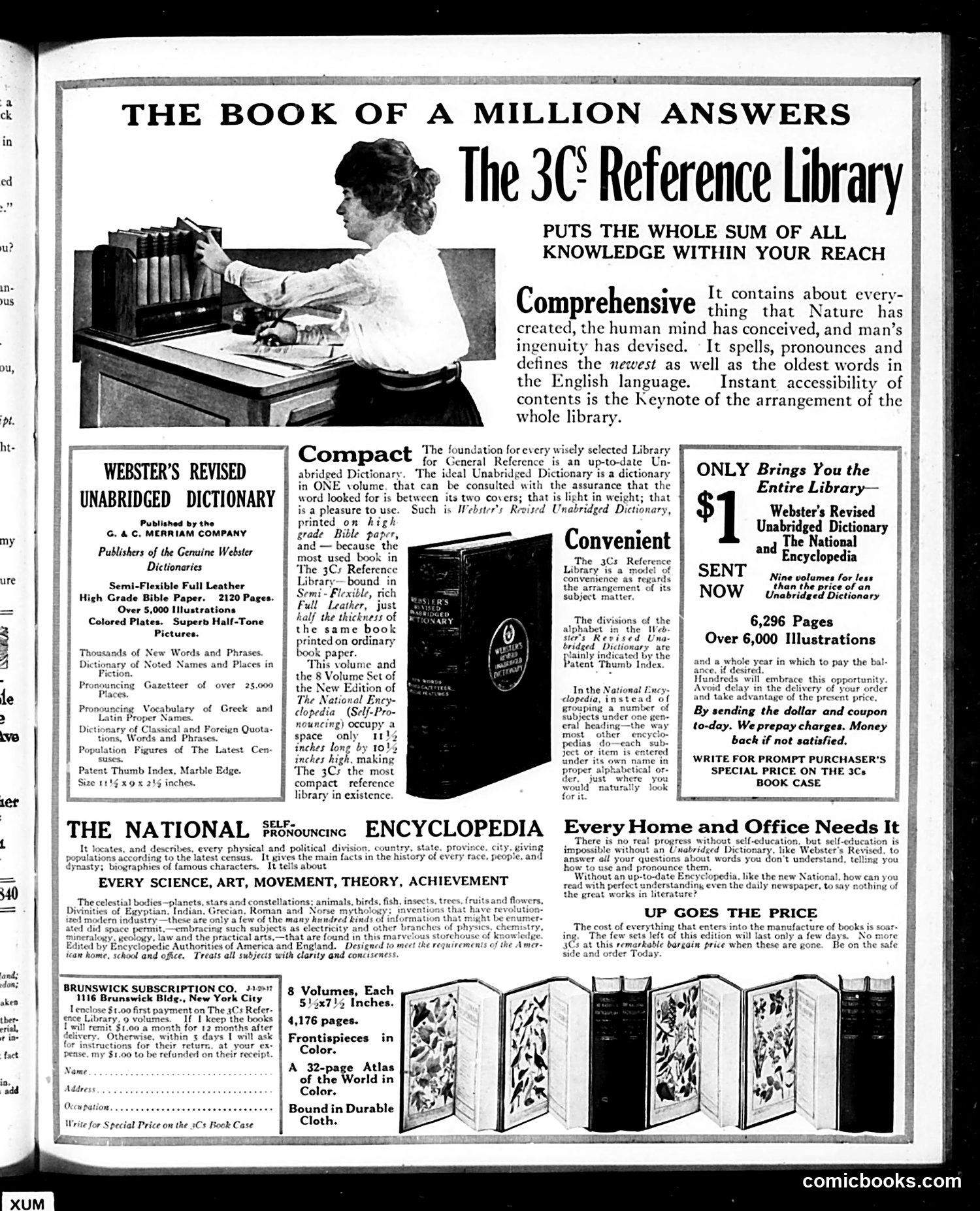
This page is almost entirely **advertising**, not satire or editorial content. It promotes reference materials—Webster's Dictionary, the "3Cs Reference Library," and the National Encyclopedia—marketed as comprehensive knowledge sources for home and office use. The key sales pitch emphasizes affordability ($1 for the complete set) and accessibility: "puts the whole sum of all knowledge within your reach." The imagery of a woman consulting the books reinforces this as a product for educated households. For modern readers: this reflects early-20th-century attitudes about self-education and "self-culture"—the belief that home reference libraries were essential for social advancement and respectability. The repeated emphasis on "convenience" and instant access mirrors contemporary marketing of smartphones and Google, suggesting perennial human desire for quick information access. There is no political cartoon or satire visible on this page.
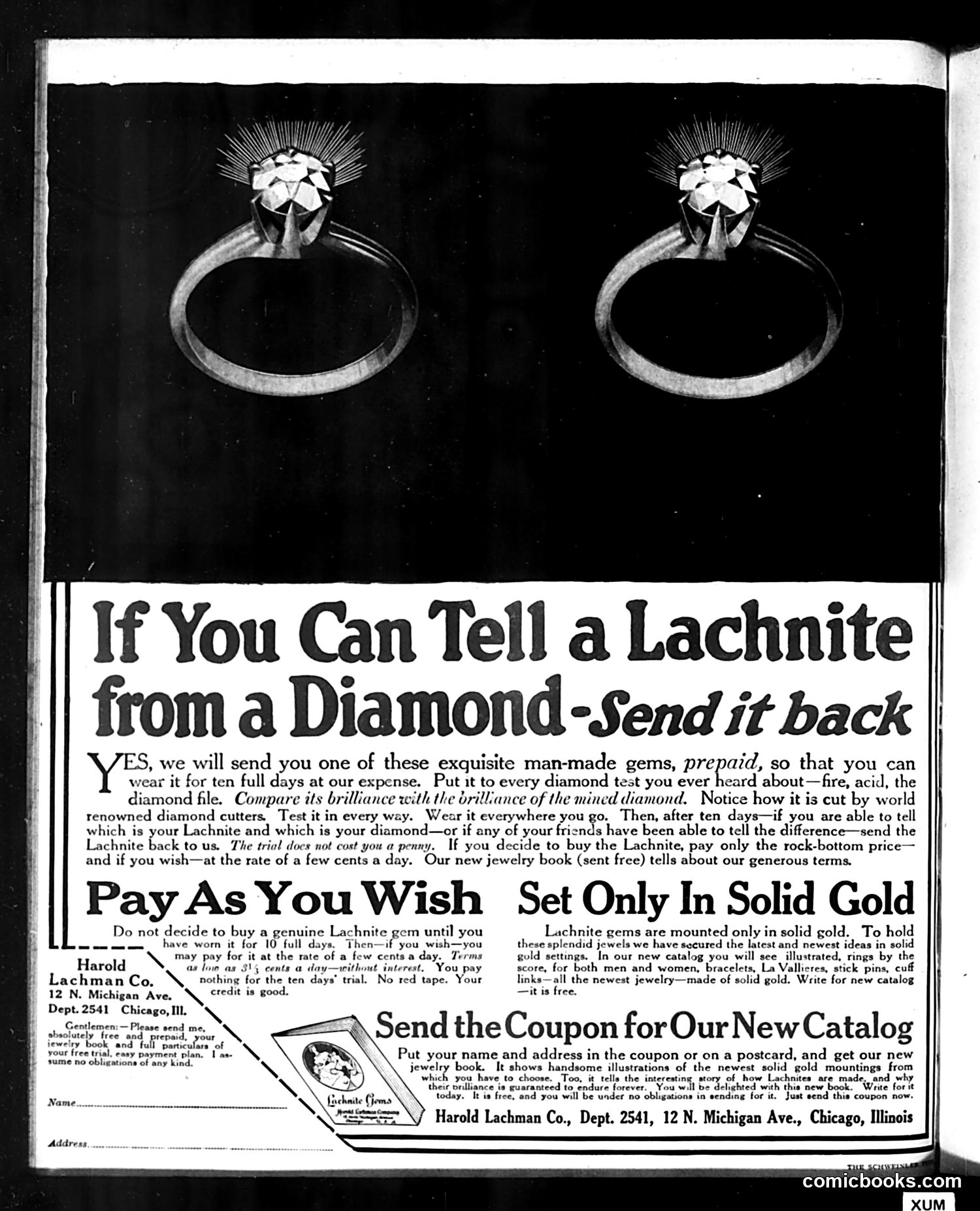
This page is **primarily advertising**, not satire or political content. It's a full-page ad for the Harold Lachman Company promoting "Lachnite," a man-made diamond substitute. **The pitch:** The company offers a ten-day free trial of a Lachnite gem set in solid gold. Customers can test it against real diamonds using various methods (fire, acid, diamond files) to see if they can distinguish it. If they can't tell the difference after ten days, they're challenged to keep it—paying installments of mere cents per day. **The implicit social commentary** (not stated but evident to period readers): This reflects early-20th-century anxieties about **synthetic goods and consumer deception**. The ad's confidence—essentially daring customers to detect the fake—suggests both pride in manufacturing quality and awareness that artificial gems threatened the diamond industry's exclusivity claims. The ad capitalizes on economic accessibility: luxury jewelry for working-class budgets through installment payments. No explicit satire is present; Judge simply ran paid advertisements alongside editorial content.