
Judge, 1917-01-20 · page 12 of 28
Judge — January 20, 1917 — page 12: what you’re looking at
What you’re looking at
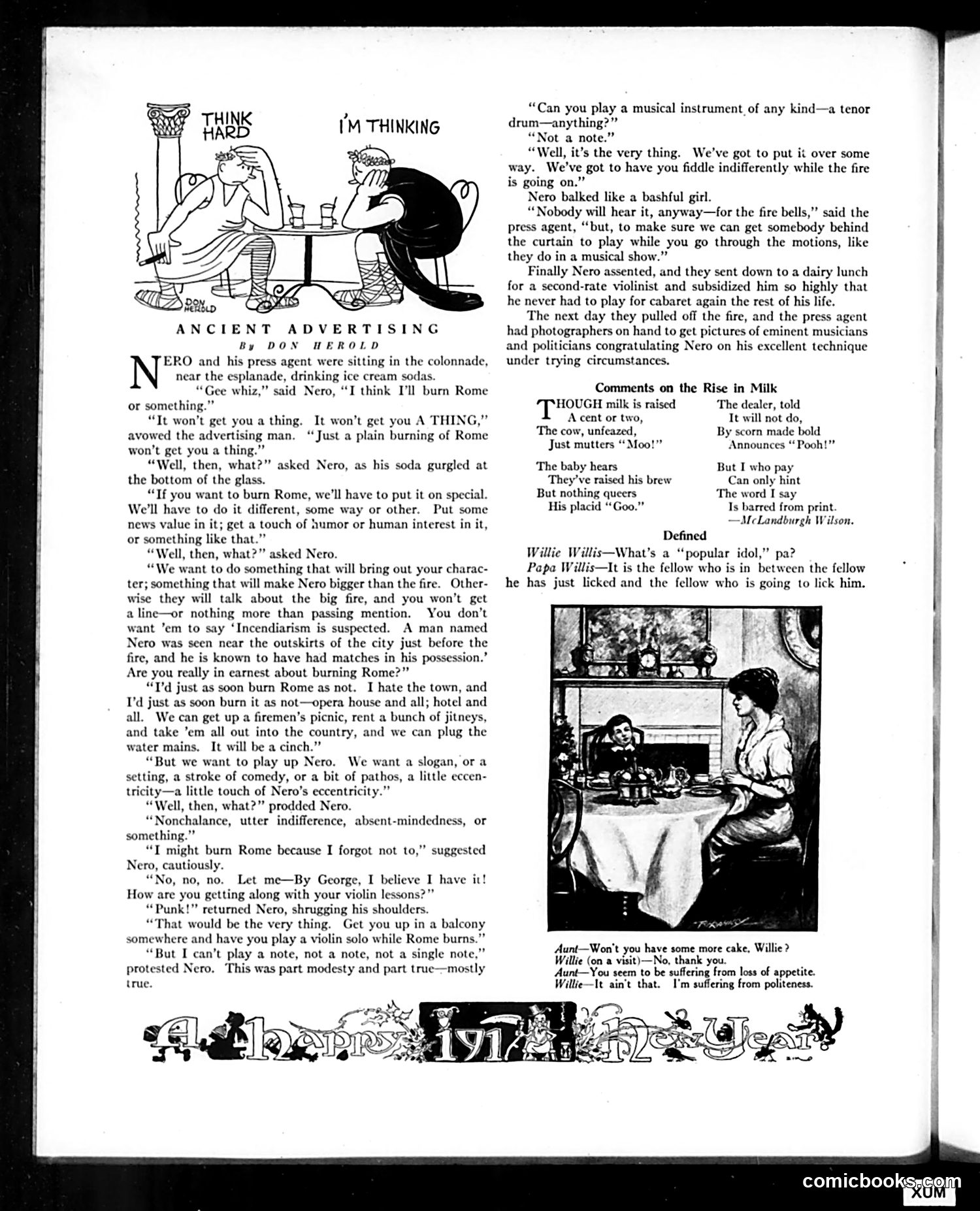
This satirical piece mocks modern advertising practices by reimagining the historical figure Nero (Roman emperor infamous for allegedly fiddling while Rome burned) as a modern celebrity managed by a PR agent. The joke: The press agent insists that simply burning Rome won't generate publicity—it needs a *narrative angle*. He coaches Nero to play violin while the city burns, creating the iconic image that will dominate coverage. Crucially, Nero can't actually play; the agent hires a stand-in to perform off-stage while Nero fakes it for photographers. The satire targets 1920s advertising culture: the obsession with manufactured image over substance, staged authenticity, and the understanding that reality matters less than the narrative presented to the public. By applying modern PR tactics to an ancient historical event, Herold highlights how advertising creates false impressions through careful staging and media manipulation. The page also includes unrelated content: poems about milk prices and a joke about "popular idols."
📄 Transcribed text from this page (OCR, searchable)
Machine-transcribed from the original scan — historical spelling and the odd misread are preserved.
ANCIENT ADVERTISING By DON HEROLD ERO and his press agent were sitting in the colonnade, N near the esplanade, drinking ice cream sodas. “Gee whiz,” said Nero, “I think I'll burn Rome or somethin; “It won't get you a thing. It won’t get you A THING,” avowed the advertising man. “Just a plain burning of Rome won't get you a thing.” “Well, then, what?” asked Nero, as his soda gurgled at the bottom of the glass. “Tf you want to burn Rome, we'll have to put it on special. We'll have to do it different, some way or other. Put some news value in it; get a touch of humor or human interest in it, or something like that.” “Well, then, what?” asked Nero. “We want to do something that will bring out your charac- ter; something that will make Nero bigger than the fire. Other- wise they will talk about the big fire, and you won't get a line—or nothing more than passing mention. You don’t want ’em to say ‘Incendiarism is suspected. A man named Nero was seen near the outskirts of the city just before the fire, and he is known to have had matches in his po ion.” Are you really in earnest about burning Rome?” “T’d just as soon burn Rome as not. I hate the town, and I'd just as soon burn it as not—opera house and all; hotel and all. We can get up a firemen’s picnic, rent a bunch of jitneys, and take ’em all out into the country, and we can plug the water mains. It will be a cinch.” “But we want to play up Nero. We want a slogan, or a setting, a stroke of comedy, or a bit of pathos, a little eccen- tricity—a little touch of Nero’s eccentricity.” “Well, then, what?” prodded Nero. “Nonchalance, utter indifference, absent-mindedness, or something.” “I might burn Rome because I forgot not to,” suggested Nero, cautiously. “No, no, no, Let me—By George, I believe I have it! How are you getting along with your violin lessons?” “Punk!” returned Nero, shrugging his shoulders. “That would be the very thing. Get you up in a balcony somewhere and have you play a violin solo while Rome burns.” “But I can’t play a note, not a note, not a single note,” protested Nero. This was part modesty and part true—mostly true. “Can you play a musical instrument, of any kind—a tenor drum—anything?” “Not a note.” “Well, it’s the very thing. We've got to put ii over some way. We've got to have you fiddle indifferently while the fire is going on.” Nero balked like a bashful girl. “Nobody will hear it, anyway—for the fire bells,” said the press agent, “but, to make sure we can get somebody behind the curtain to play while you go through the motions, like they do in a musical show.” Finally Nero assented, and they sent down to a dairy lunch for a second-rate violinist and subsidized him so highly that he never had to play for cabaret again the rest of his life. The next day they pulled off the fire, and the press agent had photographers on hand to get pictures of eminent musicians and politicians congratulating Nero on his excellent technique under trying circumstances. Comments on the Rise in Milk HOUGH milk is raised The dealer, told A cent or two, It will not do, ‘The cow, unfeazed, By scorn made bold Just mutters “Moo!” Announces “Pooh!” ‘The baby hears They've raised his brew But nothing queers His placid “Goo.” But I who pay Can only hint The word I say Is barred from print —McLandburgh Wilson. Defined Willie Willis—What’s a “popular idol,” pa? Papa Willis—It is the fellow who is in between the fellow he has just licked and the fellow who is going to lick him. Aunt—Won't you have some more cake, Willie ? Willie (on a visit)—No, thank you. Aunt—You seem to be suffering from loss of appetite. Willie—It ain't that. I'm suffering from politeness. | Vy —