
Judge, 1917-01-20 · page 13 of 28
Judge — January 20, 1917 — page 13: what you’re looking at
What you’re looking at
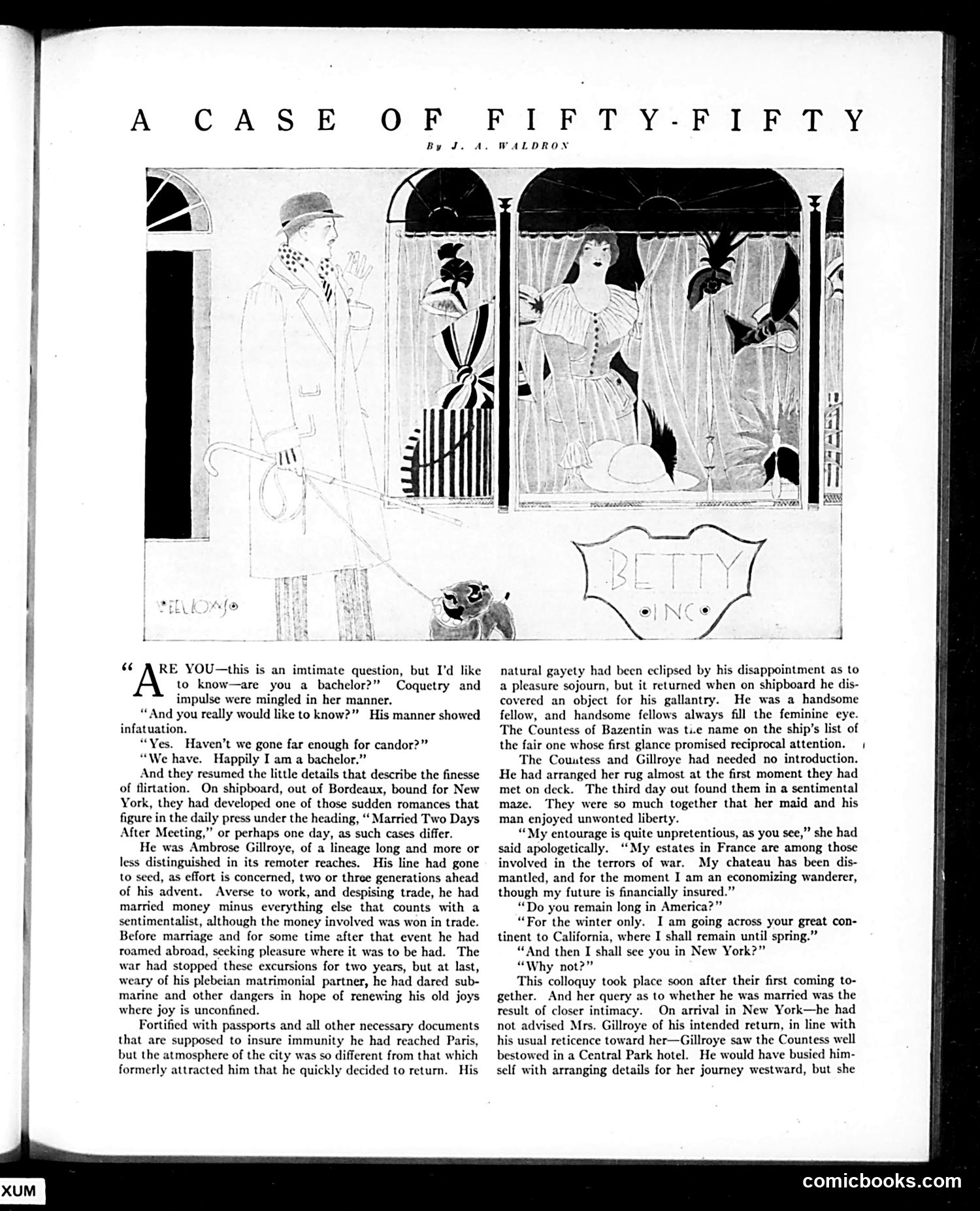
This satirical story depicts a married man, Ambrose Gillroye, who abandons his wife to pursue a shipboard romance with a woman claiming to be a French countess. The narrative mocks his shallow gallantry and class pretensions—he's from a distinguished but declining family who married for money yet despises "trade." The joke centers on infidelity and gender dynamics of the era. The woman asks pointedly whether he's a bachelor, then orchestrates their affair in New York while he keeps his wife uninformed. The "fifty-fifty" title likely refers to the equal deception both parties engage in—she may not be genuinely titled, and he's clearly not the faithful husband his wife believes. The satire critiques wealthy idlers who pursue pleasure abroad, post-WWI social upheaval, and the performative nature of romantic encounters between strangers of uncertain backgrounds.
📄 Transcribed text from this page (OCR, searchable)
Machine-transcribed from the original scan — historical spelling and the odd misread are preserved.
XUM A CASE OF FIFTY-FIFTY By J. A. 4 to know—are you a bachelor?” Coquetry and impulse were mingled in her manner. “And you really would like to know?” His manner showed infatuation. “Yes. Haven’t we gone far enough for candor?” “We have. Happily I am a bachelor.” And they resumed the little details that describe the finesse of flirtation. On shipboard, out of Bordeaux, bound for New York, they had developed one of those sudden romances that figure in the daily press under the heading, ‘‘ Married Two Days After Meeting,” or perhaps one day, as such cases differ. He was Ambrose Gillroye, of a lineage long and more or less distinguished in its remoter reaches. His line had gone to seed, as effort is concerned, two or three generations ahead of his advent. Averse to work, and despising trade, he had married money minus everything else that counts with a sentimentalist, although the money involved was won in trade. Before marriage and for some time after that event he had roamed abroad, secking pleasure where it was to be had. The war had stopped these excursions for two years, but at last, weary of his plebeian matrimonial partner, he had dared sub- marine and other dangers in hope of renewing his old joys where joy is unconfined. Fortified with passports and all other necessary documents that are supposed to insure immunity he had reached Paris, but the atmosphere of the city was so different from that which formerly attracted him that he quickly decided to return. His “cc A RE YOU—this is an imtimate question, but I'd like WALDRON natural gayety had been eclipsed by his disappointment as to a pleasure sojourn, but it returned when on shipboard he dis- covered an object for his gallantry. He was a handsome fellow, and handsome fellows always fill the feminine eye. The Countess of Bazentin was tie name on the ship’s list of the fair one whose first glance promised reciprocal attention. The Couutess and Gillroye had needed no introduction. He had arranged her rug almost at the first moment they had met on deck. The third day out found them in a sentimental maze. They were so much together that her maid and his man enjoyed unwonted liberty. “My entourage is quite unpretentious, as you see,” she had said apologetically. ‘My estates in France are among those involved in the terrors of war. My chateau has been dis- mantled, and for the moment I am an economizing wanderer, though my future is financially insured.” “Do you remain long in America?” “For the winter only. I am going across your great con- tinent to California, where I shall remain until spring.” “And then I shall see you in New York?” “Why not?” This colloquy took place soon after their first coming to- gether. And her query as to whether he was married was the result of closer intimacy. On arrival in New York—he had not advised Mrs. Gillroye of his intended return, in line with his usual reticence toward her—Gillroye saw the Countess well bestowed in a Central Park hotel. He would have busied him- self with arranging details for her journey westward, but she comicbooks.com