
Judge, 1917-01-20 · page 10 of 28
Judge — January 20, 1917 — page 10: what you’re looking at
What you’re looking at
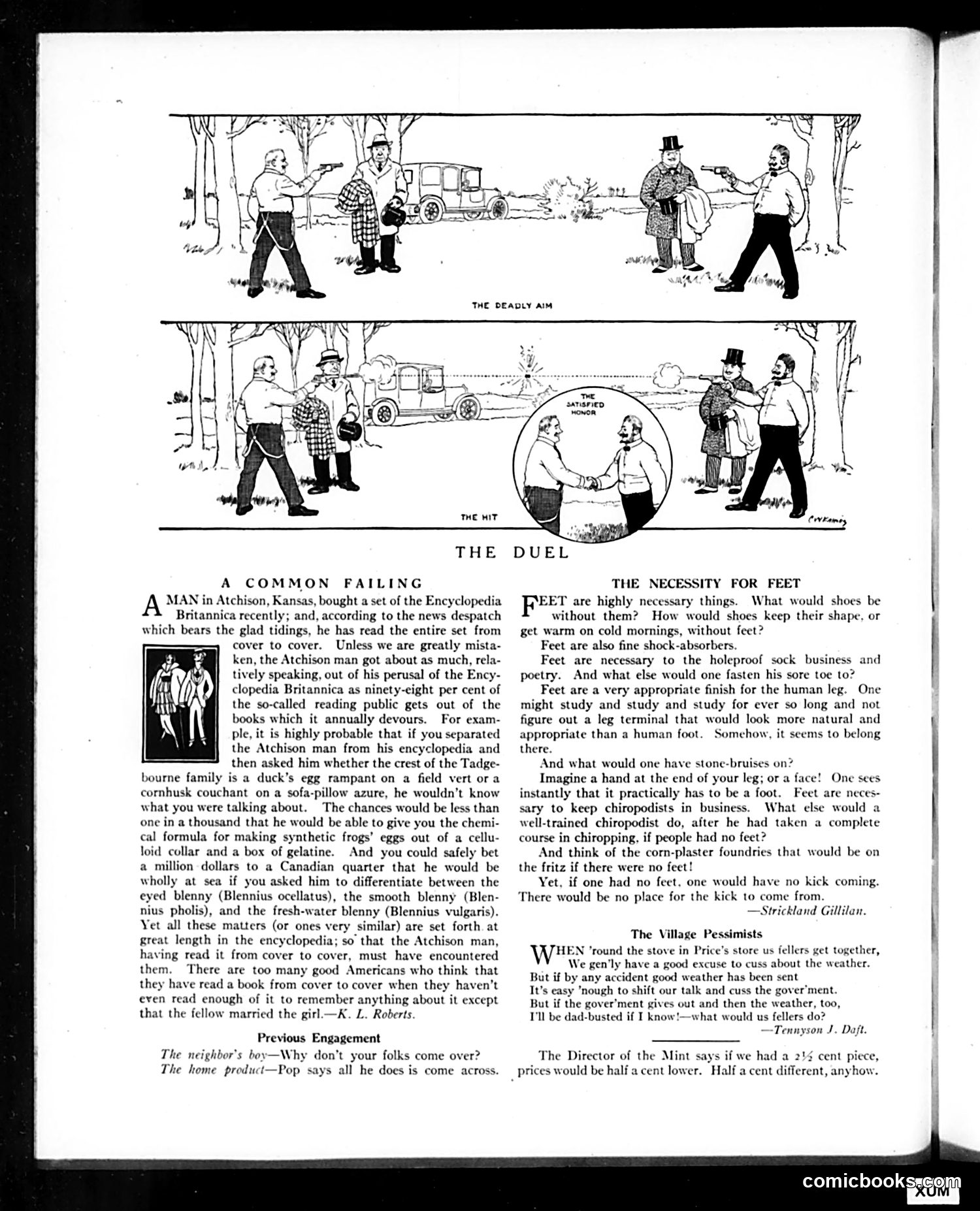
This page contains three humorous pieces from *Judge* magazine (a satirical publication): **"The Duel" (top cartoon):** A visual joke showing two men attempting to shoot each other but repeatedly missing. The caption labels the panels "The Deadly Aim" and "The Hit," with the final panel showing them shaking hands—suggesting that despite their poor marksmanship, they somehow managed to hit their target (or reconcile). It's absurdist humor about incompetence. **"A Common Failing" (left article):** Satirizes reading without retention. An Atchison, Kansas man claims to have read the entire Encyclopedia Britannica, but the author doubts he absorbed anything meaningful—he'd likely forget obscure details about fish species or heraldry within days. The piece mocks people who claim intellectual accomplishment through mere page-turning without actual learning. **Right-side poems:** Light verse about feet, optimism, and currency—filler content typical of *Judge*'s miscellaneous humor sections. These are gentle social observations rather than sharp satire. The page reflects early 20th-century American magazine style: illustrated jokes mixed with short humorous essays and poetry.
📄 Transcribed text from this page (OCR, searchable)
Machine-transcribed from the original scan — historical spelling and the odd misread are preserved.
THE HIT THE DEADLY AIM THE A COMMON FAILING A MAN in Atchison, Kansas, bought a set of the Encyclopedia Britannica recently; and, according to the news despatch which bears the glad tidings, he has read the entire set from cover to cover. Unless we are greatly mista- ken, the Atchison man got about as much, rela- tively speaking, out of his perusal of the Ency- clopedia Britannica as ninety-eight per cent of the so-called reading public gets out of the books which it annually devours. For exam- ple, it is highly probable that if you separated the Atchison man from his encyclopedia and then asked him whether the crest of the Tadge- bourne family is a duck’s egg rampant on a field vert ora cornhusk couchant on a sofa-pillow azure, he wouldn't know what you were talking about. The chances would be less than one in a thousand that he would be able to give you the chemi- cal formula for making synthetic frogs’ eggs out of a cellu- loid collar and a box of gelatine. And you could safely bet a million dollars to a Canadian quarter that he would be wholly at sea if you asked him to differentiate between the eyed blenny (Blennius ocellatus), the smooth blenny (Blen- nius pholis), and the fresh-water blenny (Blennius vulgaris). Yet all these matters (or ones very similar) are set forth at great length in the encyclopedia; so’ that the Atchison man, having read it from cover to cover, must have encountered them. There are too many good Americans who think that they have read a book from cover to cover when they haven’t even read enough of it to remember anything about it except that the fellow married the girl.—K. L. Roberts. Previous Engagement The neighbor's boy—Why don’t your folks come over? The home product—Pop says all he does is come across. DUEL THE NECESSITY FOR FEET Fret are highly necessary things. What would shoes be without them? How would shoes keep their shape, or get warm on cold mornings, without feet? Feet are also fine shock-absorbers. Feet are necessary to the holeproof sock business and poetry. And what else would one fasten his sore toe to? Feet are a very appropriate finish for the human leg. One might study and study and study for ever so long and not figure out a leg terminal that would look more natural and appropriate than a human foot. Somehow, it seems to belong there. And what would one have stone-br on? Imagine a hand at the end of your leg; or a face! One sees instantly that it practically has to be a foot. Feet are nec sary to keep chiropodists in busine What else would a well-trained chiropodist do, after he had taken a complete course in chiropping, if people had no feet? And think of the corn-plaster foundries that would be on the fritz if there were no fect! Yet, if one had no feet, one would have no kick coming. There would be no place for the kick to come from. —Strickland Gillilan. The Village Pessimists V HEN ‘round the stove in Price’s store us fellers get together, We gen'ly have a good excuse to cuss about the weather. But if by any accident good weather has been sent It’s ‘nough to shift our talk and cuss the gover’ment. But if the gover’ment gives out and then the weather, too, T'll be dad-busted if I know!—what would us fellers do? Tennyson J. Daft. The Director of the Mint says if we had a 244 cent piece, prices would be half a cent lower. Half a cent different, anyhow.