
Judge, 1917-01-20 · page 6 of 28
Judge — January 20, 1917 — page 6: what you’re looking at
What you’re looking at
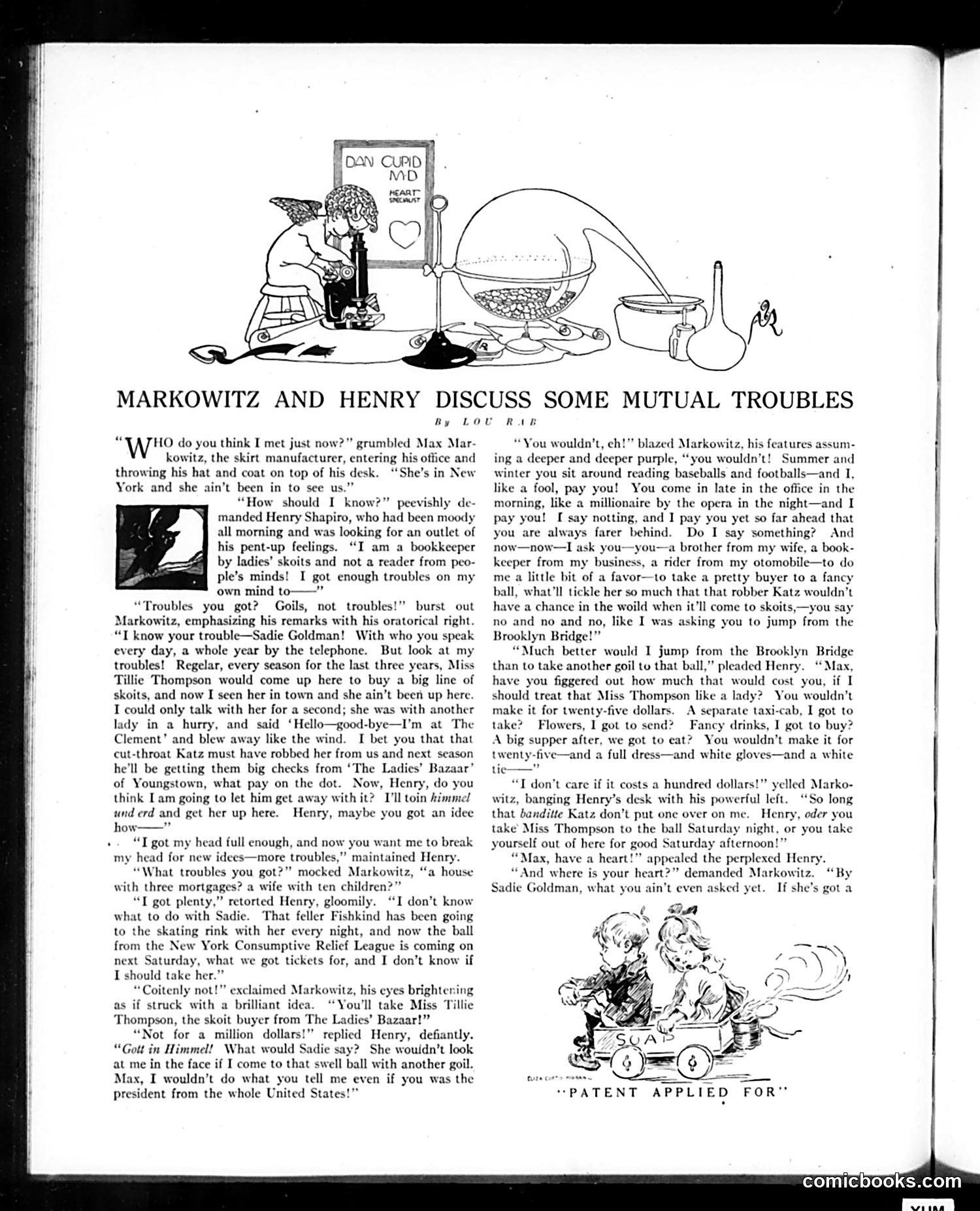
This is a humorous story about two Jewish businessmen in the garment industry (skirt manufacturers). Max Markowitz complains that a major client, Miss Tillie Thompson, has disappeared—likely stolen by a competitor named Katz. He pressures his employee Henry Shapiro to take Thompson to an upcoming charity ball to win back her business. Henry refuses, explaining he's already committed to taking his girlfriend Sadie. Markowitz grows furious, reminding Henry of all he provides (employment, a car, opera tickets) and demands this "small favor." Henry resists, calculating the expense would be ruinous. The satire targets early 20th-century immigrant business culture—the mix of Yiddish and English dialect, the personal/professional entanglement, the manipulative boss-employee dynamic, and romantic complications all converge. The humor lies in both men's desperation and the absurdity of their situation.
📄 Transcribed text from this page (OCR, searchable)
Machine-transcribed from the original scan — historical spelling and the odd misread are preserved.
By Lou “wre do you think I met just now?” grumbled Max Mar- kowitz, the skirt manufacturer, entering his office and throwing his hat and coat on top of his desk. ‘“She’s in New York and she ain’t been in to see us.” “How should I know?” peevishly de- manded Henry Shapiro, who had been moody all morning and was looking for an outlet of his pent-up feelings. “I am a bookkeeper by ladies’ skoits and not a reader from peo- ple’s minds! I got enough troubles on my own mind to—” “Troubles you got? Goils, not troubles!” burst out Markowitz, emphasizing his remarks with his oratorical right. “I know your trouble—Sadie Goldman! With who you speak every day, a whole year by the telephone. But look at my troubles! Regelar, every season for the last three years, Miss Tillie Thompson would come up here to buy a big line of skoits, and now I seen her in town and she ain’t been up here. I could only talk with her for a second; she was with another lady in a hurry, and said ‘Hello—good-bye—I’m at The Clement’ and blew away like the wind. I bet you that that cut-throat Katz must have robbed her from us and next season he'll be getting them big checks from ‘The Ladies’ Bazaar of Youngstown, what pay on the dot. Now, Henry, do you think Iam going to let him get away with it? I'll toin Aimmel und erd and get her up here. Henry, maybe you got an idec how “T got my head full enough, and now you want me to break my head for new idees—more troubles,” maintained Henry. “What troubles you got?” mocked Markowitz, “a house with three mortgages? a wife with ten children?” “I got plenty,” retorted Henry, gloomily. “I don’t know what to do with Sadie. That feller Fishkind has been going to the skating rink with her every night, and now the ball from the New York Consumptive Relief League is coming on next Saturday, what we got tickets for, and I don’t know if I should take her.” “Coitenly not!” exclaimed Markowitz, his eyes brightening as if struck with a brilliant idea. “You'll take Miss Tillie Thompson, the skoit buyer from The Ladies’ Bazaar!” “Not for a million dollars!" replied Henry, defiantly. “Gott in Himmel! What would Sadie say? She wouldn’t look at me in the face if I come to that swell ball with another goil. Max, I wouldn’t do what you tell me even if you was the president from the whole United States!” MARKOWITZ AND HENRY DISCUSS SOME MUTUAL TROUBLES RAB “You wouldn't, ch!"’ blazed Markowitz, his features assum- ing a deeper and deeper purple, “you wouldn’t! Summer and winter you sit around reading baseballs and footballs—and I, like a fool, pay you! You come in late in the office in the morning, like a millionaire by the opera in the night—and I pay you! [ say notting, and I pay you yet so far ahead that you are always farer behind. Do I say something? And now—now—I ask you—you—a brother from my wife, a book- keeper from my business, a rider from my otomobile—to do me a little bit of a favor—to take a pretty buyer to a fancy ball, what'll tickle her so much that that robber Katz wouldn’t have a chance in the woild when it’ll come to skoits,—you say no and no and no, like I was asking you to jump from the Brooklyn Bridge!” “Much better would I jump from the Brooklyn Bridge than to take another goil to that ball,” pleaded Henry. “Max, have you figgered out how much that would cost you, if I should treat that Miss Thompson like a lady? You wouldn't make it for twenty-five dollars. A separate taxi-cab, I got to take? Flowers, I got to send? Fancy drinks, I got to buy? A big supper after, we got to eat? You wouldn’t make it for twenty-five—and a full dress—and white gloves—and a white tie I don’t care if it costs a hundred dollars!” yelled Marko- witz, banging Henry’s desk with his powerful left. “So long that banditte Katz don’t put one over on me. Henry, oder you take Miss Thompson to the ball Saturday night, or you take yourself out of here for good Saturday afternoon!” “Max, have a heart!” appealed the perplexed Hen “And where is your heart?” demanded Markowitz. By Sadie Goldman, what you ain’t even asked yet. If she’s got a he Lo a sl) = a “PATENT APPLIED FOR” comicbooks.com