
Judge, 1917-01-20 · page 16 of 28
Judge — January 20, 1917 — page 16: what you’re looking at
What you’re looking at
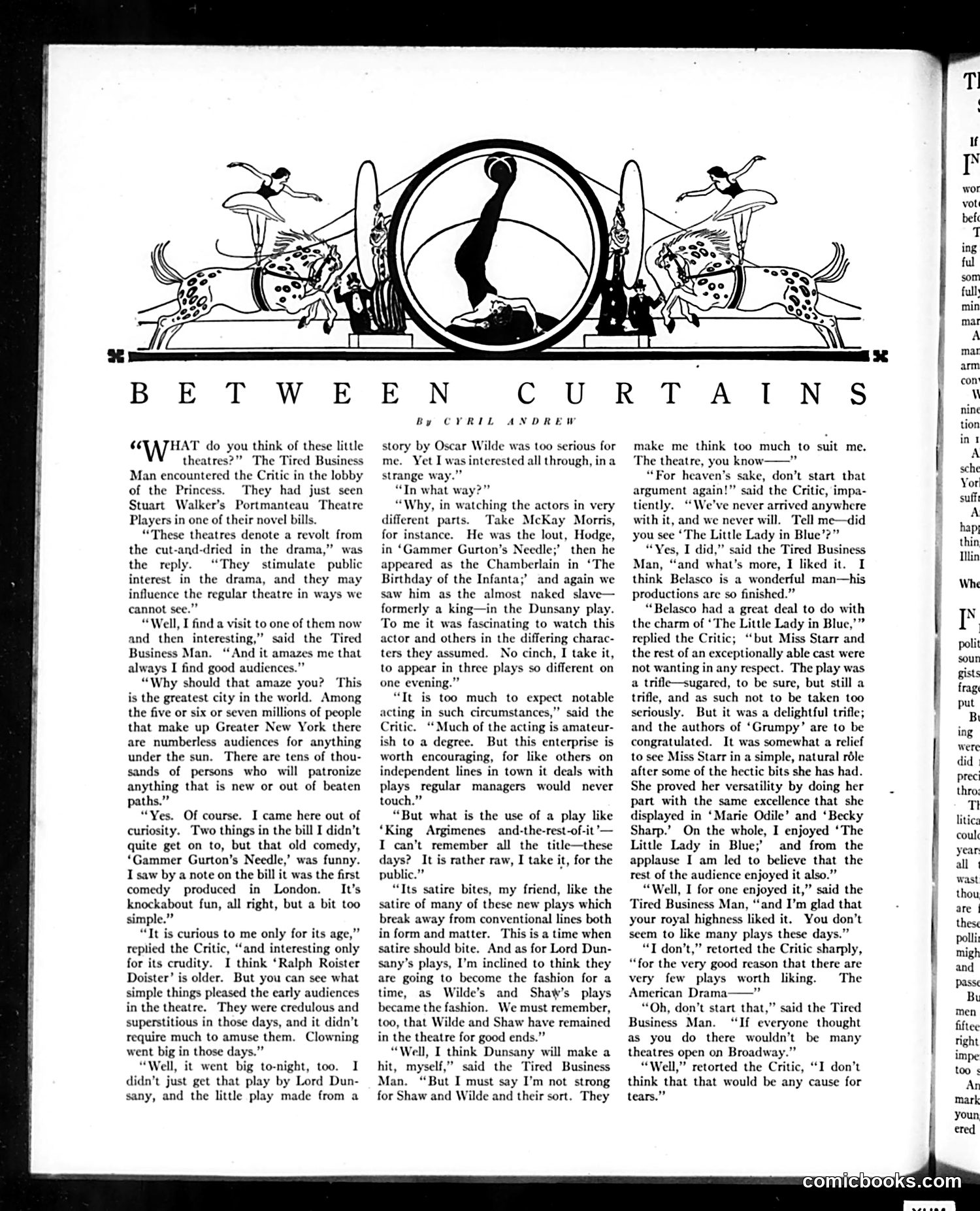
This is a dialogue between a "Tired Business Man" and a "Critic" discussing the experimental "little theatres" movement—small, avant-garde venues like Stuart Walker's Portmanteau Theatre Players that were challenging Broadway's commercial conventions in the early 20th century. The satire critiques both positions: the Businessman represents the general public's preference for simple, accessible entertainment (he enjoyed the knockabout farce *Gammer Gurton's Needle* but found Lord Dunsany's symbolist plays confusing). The Critic defends artistic innovation and intellectual challenge in drama. The cartoon above illustrates this tension visually—acrobatic figures and theatrical masks suggest both the playfulness and the serious artistic ambitions of these experimental productions. The satire suggests that both perspectives have merit: the public wants entertainment, while serious artists want to advance the medium beyond commercial formulas.
📄 Transcribed text from this page (OCR, searchable)
Machine-transcribed from the original scan — historical spelling and the odd misread are preserved.
BE TWE eyyat do you think of these little theatres?” The Tired Business Man encountered the Critic in the lobby of the Prince: They had just seen Stuart Walker's Portmanteau Theatre Players in one of their novel bills. “These theatres denote a revolt from the cut-and-dried in the drama,” was the reply. ‘They stimulate public interest in the drama, and they may influence the regular theatre in ways we cannot see.” “Well, I find a visit to one of them now and then interesting,” said the Tired Business Man. ‘‘And it amazes me that always I find good audiences.” “Why should that amaze you? This is the greatest city in the world. Among the five or six or seven millions of people that make up Greater New York there are numberless audiences for anything under the sun. There are tens of thou- sands of persons who will patronize anything that is new or out of beaten paths.” “Yes. Of course. I came here out of curiosity. Two things in the bill I didn’t quite get on to, but that old comedy, ‘Gammer Gurton’s Needle,’ was funny. I saw by a note on the bill it was the first comedy produced in London. It’s knockabout fun, all right, but a bit too simple.” “Tt is curious to me only for its age,” replied the Critic, “‘and interesting only for its crudity. I think ‘Ralph Roister Doister’ is older. But you can see what simple things pleased the early audiences in the theatre. They were credulous and superstitious in those days, and it didn’t require much to amuse them. Clowning went big in those days.” “Well, it went big to-night, too. I didn’t just get that play by Lord Dun- sany, and the little play made from a E N By CYRIL ANDREW story by Oscar Wilde was too serious for me. Yet I interested all through, ina strange way.” “Tn what way?” “Why, in watching the actors in very different parts. Take McKay Morris, for instance. He was the lout, Hodge, in ‘Gammer Gurton’s Needle;’ then he appeared as the Chamberlain in ‘The Birthday of the Infanta;’ and again we saw him as the almost naked slave— formerly a king—in the Dunsany play. To me it was fascinating to watch this actor and others in the differing charac- ters they assumed. No cinch, I take it, to appear in three plays so different on one evening.” “It is too much to expect notable acting in such circumstances,” said the Critic. ‘Much of the acting is amateur- ish to a degree. But this enterprise is worth encouraging, for like others on independent lines in town it deals with plays regular managers would never touch.” “But what is the use of a play like ‘King Argimenes and-the-rest-of-it ’— I can’t remember all the title—these days? It is rather raw, I take it, for the public.” “Its satire bites, my friend, like the satire of many of these new plays which break away from conventional lines both in form and matter. This is a time when satire should bite. And as for Lord Dun- sany’s plays, I’m inclined to think they are going to become the fashion for a time, as Wilde’s and Shaw’s plays became the fashion. We must remember, too, that Wilde and Shaw have remained in the theatre for good ends.” “Well, I think Dunsany will make a hit, myself,” said the Tired Business Man. “But I must say I’m not strong for Shaw and Wilde and their sort. They CURTAINS make me think too much to suit me. The theatre, you know——” “For heaven’s sake, don’t start that argument again!” said the Critic, impa- tiently. “We've never arrived anywhere with it, and we never will. Tell me—did you see ‘The Little Lady in Blue’?” “Yes, I did,” said the Tired Business Man, “and what’s more, I liked it. I think Belasco is a wonderful man—his productions are so finished.” “Belasco had a great deal to do with the charm of ‘The Little Lady in Blue,’” replied the Critic; “but Miss Starr and the rest of an exceptionally able cast were not wanting in any respect. The play was a trifle—sugared, to be sure, but still a trifle, and as such not to be taken too seriously. But it was a delightful trifle; and the authors of ‘Grumpy’ are to be congratulated. It was somewhat a relief to see Miss Starr in a simple, natural réle after some of the hectic bits she has had. She proved her versatility by doing her part with the same excellence that she displayed in ‘Marie Odile’ and ‘Becky Sharp.’ On the whole, I enjoyed ‘The Little Lady in Blue;’ and from the applause I am led to believe that the rest of the audience enjoyed it also.” “Well, I for one enjoyed it,” said the Tired Business Man, ‘‘and I’m glad that your royal highness liked it. You don’t seem to like many plays these days.” “T don retorted the Critic sharply, “for the very good reason that there are very few plays worth liking. The American Drama—” “Oh, don’t start that,” said the Tired Business Man. “If everyone thought as you do there wouldn’t be many theatres open on Broadway.” “Well,” retorted the Critic, “I don’t think that that would be any cause for tears.” polit sour gists frag put B ing were did prec’ thro: Tl litica coul year: all wast thou are | these polli migh and Passe Bu men fiftee right impe too s An mark youn ered