
A complete issue · 28 pages · 1917
Judge — January 13, 1917
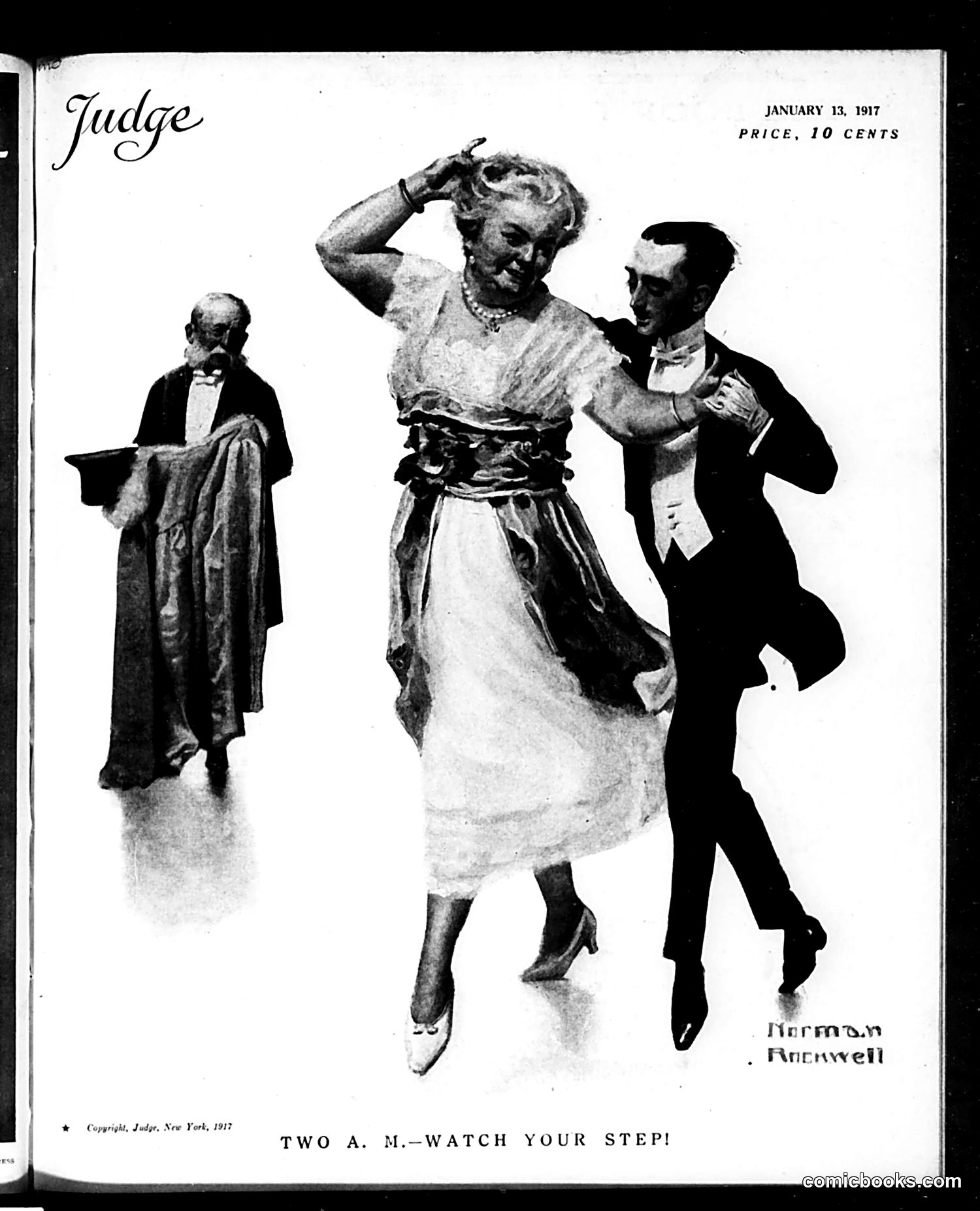
This Judge magazine cover from January 13, 1917 depicts a cautionary scene about late-night socializing. The illustration by Norman Rockwell shows a woman in an elegant dress being escorted by a man in formal attire, while an older man in a coat watches disapprovingly in the background. The caption "Two A.M.—Watch Your Step!" suggests the satire concerns propriety and scandal. The late hour, the woman's animated pose, and the observer's stern gaze imply social judgment about unmarried couples socializing at inappropriate times. This reflects early 20th-century middle-class anxieties about morality, respectability, and the changing social freedoms of women during the Jazz Age period.
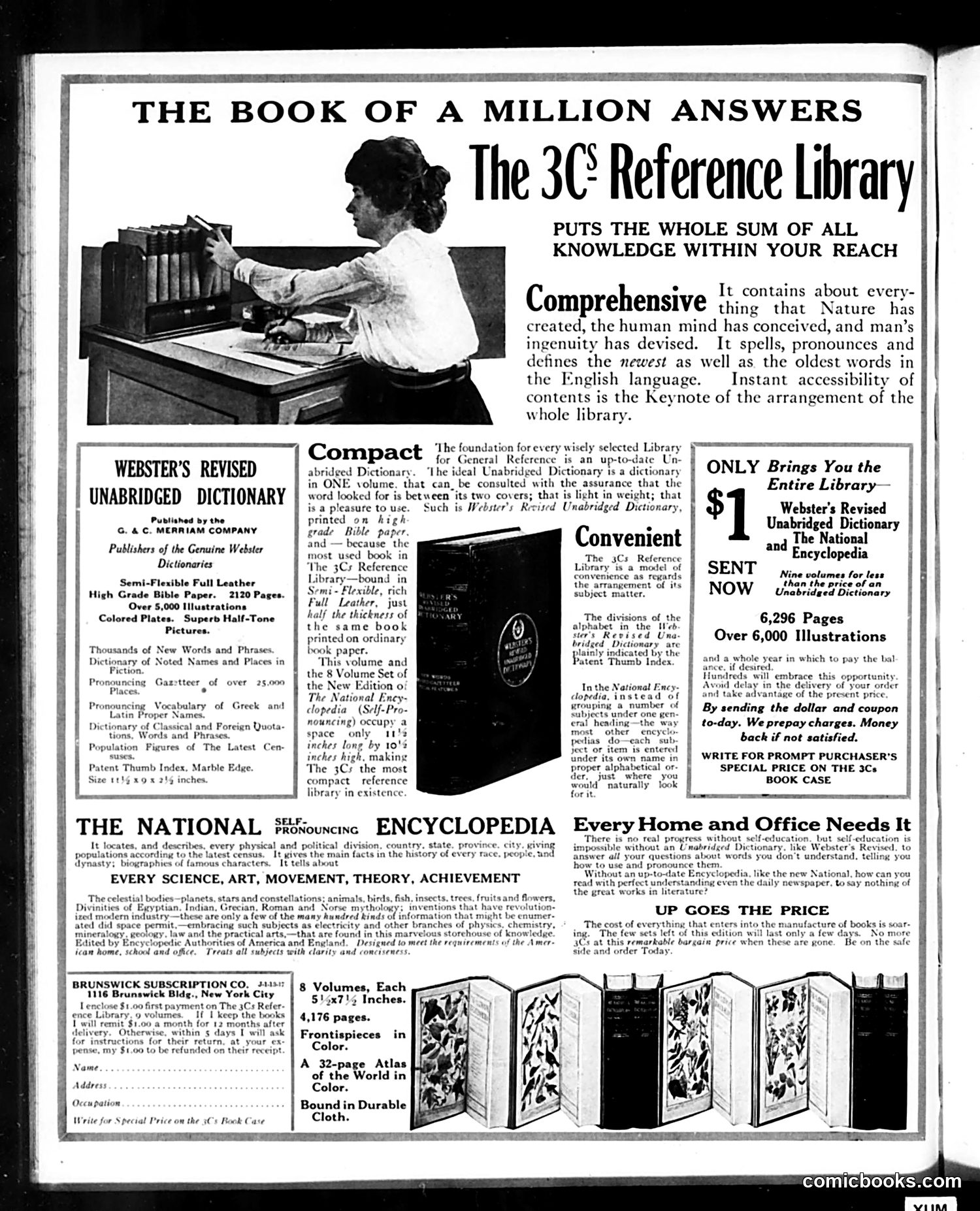
This page is **primarily advertising, not satire or political cartoon**. It consists of four product advertisements: 1. **Webster's Revised Unabridged Dictionary** - promoting comprehensive word coverage and pronunciation guides 2. **The 3C Reference Library** - advertising a complete knowledge collection in book form, with an image of a woman consulting the volumes 3. **The National Encyclopedia** - emphasizing comprehensive coverage of "every science, art, movement, theory, achievement" 4. **Brunswick Subscription Co.** - offering an 8-volume encyclopedia set with colorful illustrations and an atlas All advertisements emphasize completeness, accessibility, and affordability of knowledge—reflecting early 20th-century consumer culture. There is no political satire or caricature present on this page. The single human figure (the woman) is merely illustrative of the product's use, not a satirical subject.
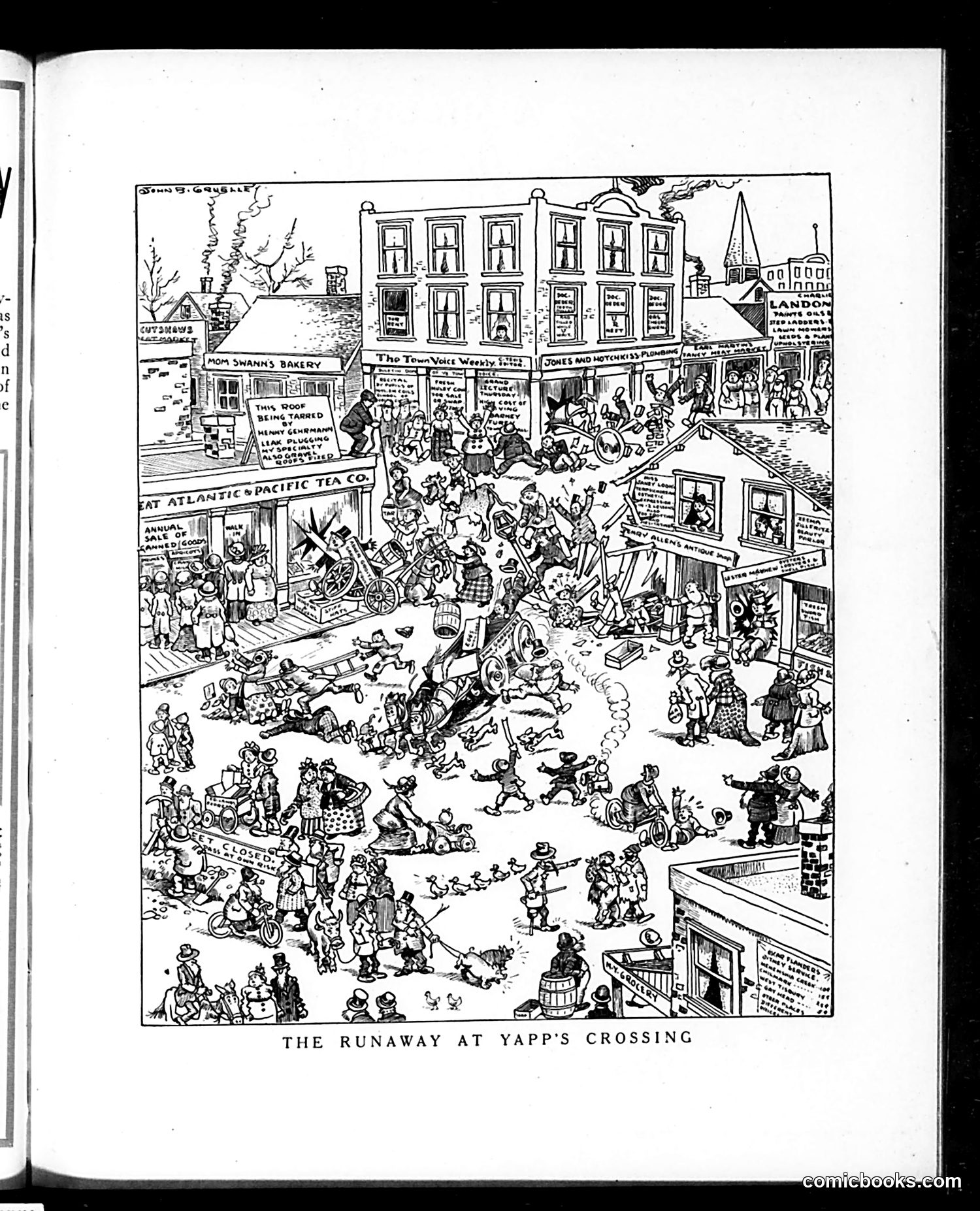
This detailed satirical illustration depicts a chaotic street scene centered on what appears to be a town square or market area. The title references "Yapp's Crossing," likely a real or fictional location familiar to Judge's contemporary readers. The cartoon captures anarchic mayhem: children running, fighting, and playing wildly; adults in various states of disorder; colliding vehicles and overturned goods; and general pandemonium. Visible storefronts include "Swann's Bakery," "Atlantic & Pacific Tea Co.," and various other shops with text-filled signs. The satire appears to mock either municipal disorder, poor civic management, or possibly runaway children—the "runaway" in the title. Without clearer context about the specific date and contemporary events, the precise political target remains unclear, though the scene suggests criticism of urban chaos or social breakdown.
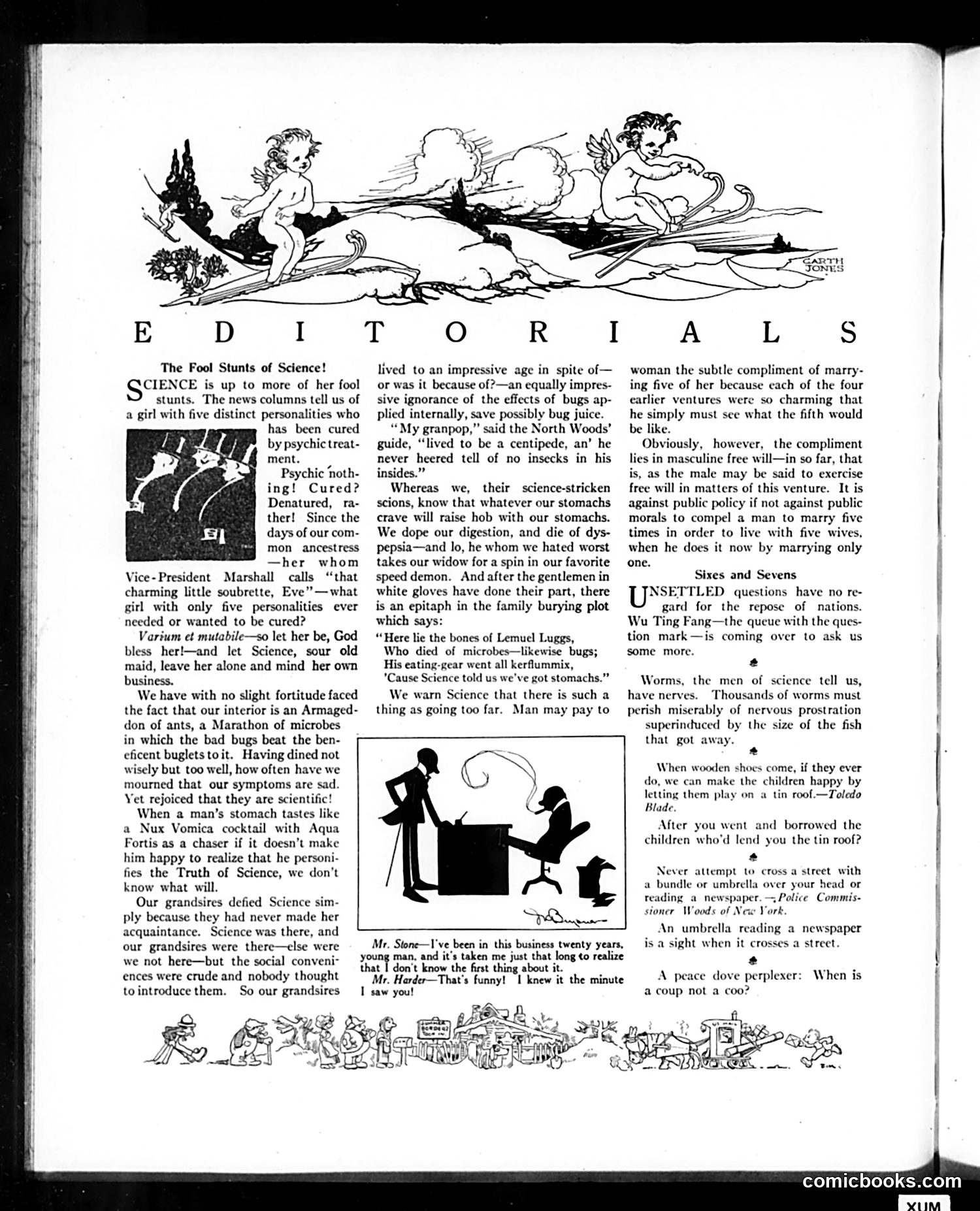
This page from *Judge* magazine features a humorous editorial titled "The Fool Stunts of Science!" The main text satirizes scientific claims about digestive health and insects, mocking what the writer considers pseudoscientific assertions—particularly regarding bugs' effects on digestion and the stomach. The decorative header shows cherubs manipulating clouds and natural elements, a classical artistic motif used for editorial framing. Below the text is a simple cartoon dialogue between two men—labeled "Mr. Stone" and "Mr. Holder"—discussing someone in business for twenty years who "knew it the minute I saw you," a joke about snap judgments or reading character. The page primarily contains satirical social commentary rather than identifying specific political figures. It targets general scientific pretension of its era through humorous exaggeration.
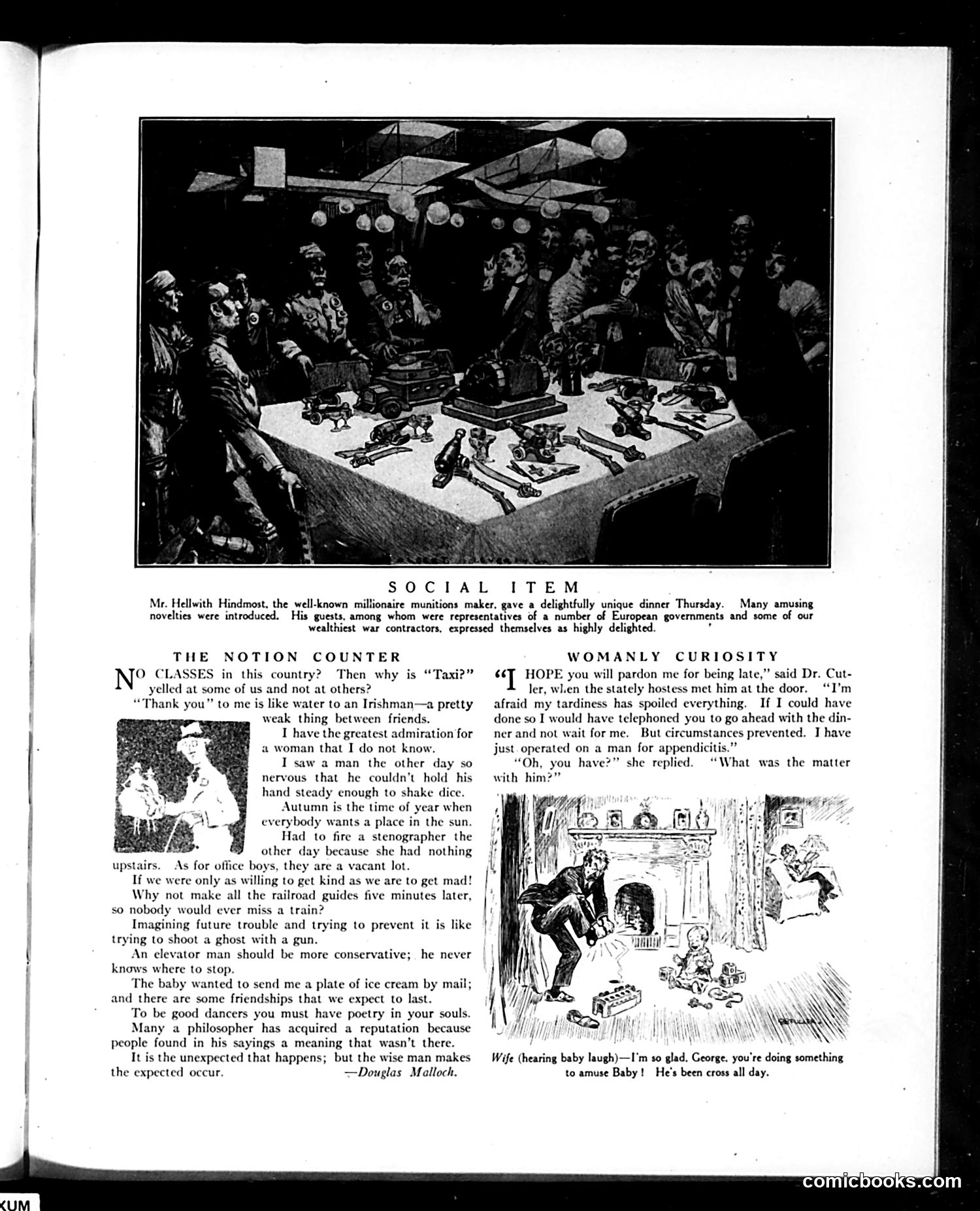
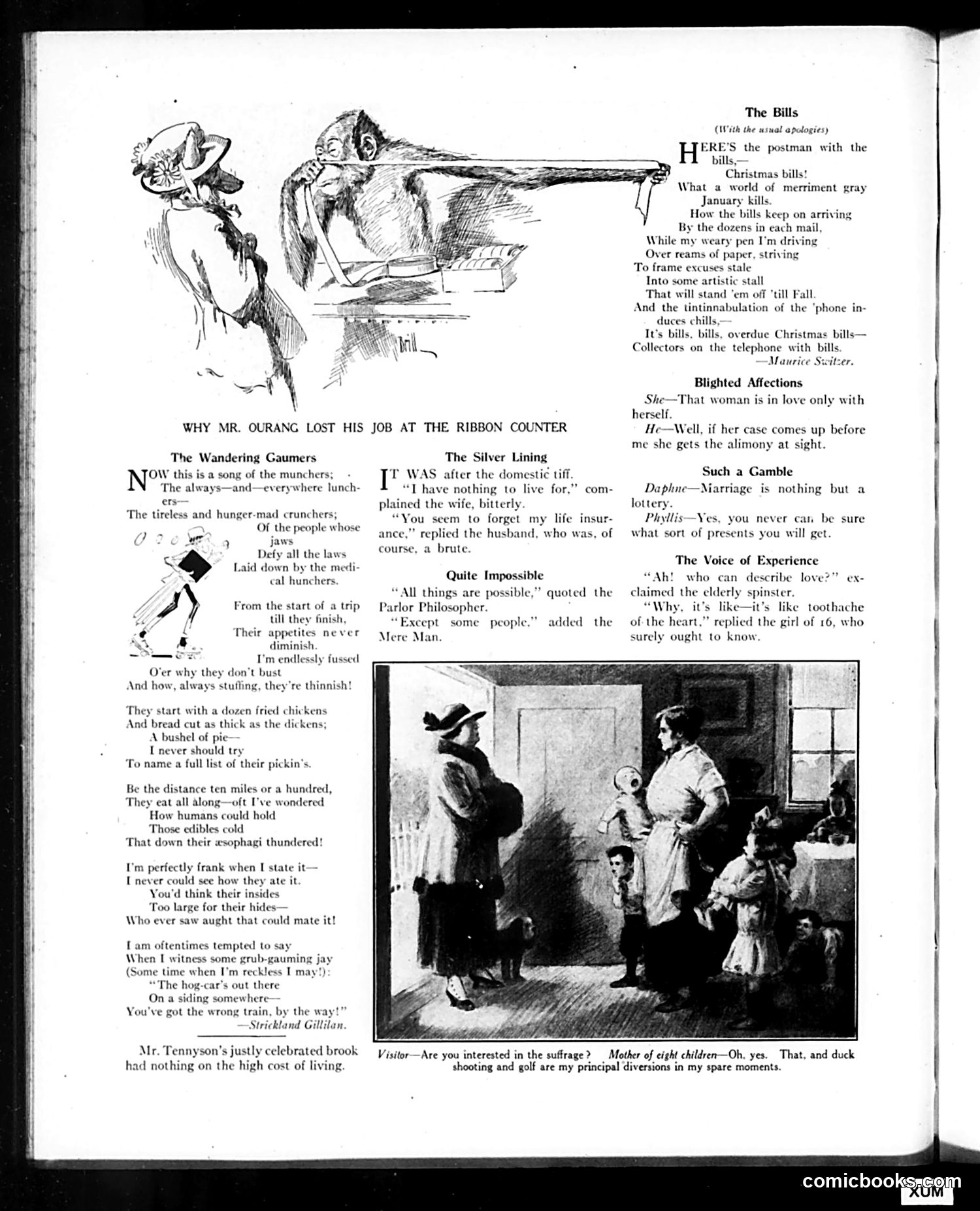
This page from Judge contains several satirical pieces reflecting early 20th-century concerns: **"The Wandering Gaumers"** (poem with illustration) mocks gluttonous travelers who eat constantly and excessively during journeys, yet remain thin—an absurdist observation on appetite and digestion. **"The Silver Lining"** presents dark marital satire: a husband consoles his suicidal wife by reminding her he has life insurance on her—implying her death would benefit him. The joke's brutality reflects period cynicism about matrimony. **"The Bills"** (parody of Poe) humorously depicts post-Christmas financial burden—bills arriving relentlessly, collectors calling, excuses needed through autumn. Relatable domestic anxiety. The bottom illustration shows a woman claiming suffrage interests while admitting her "principal diversions" are duck-shooting and golf—satirizing wealthy women activists as privileged dilettantes more concerned with leisure than genuine political engagement. Overall, the page targets contemporary anxieties: conspicuous consumption, marital discontent, holiday debt, and feminist hypocrisy among the comfortable classes.
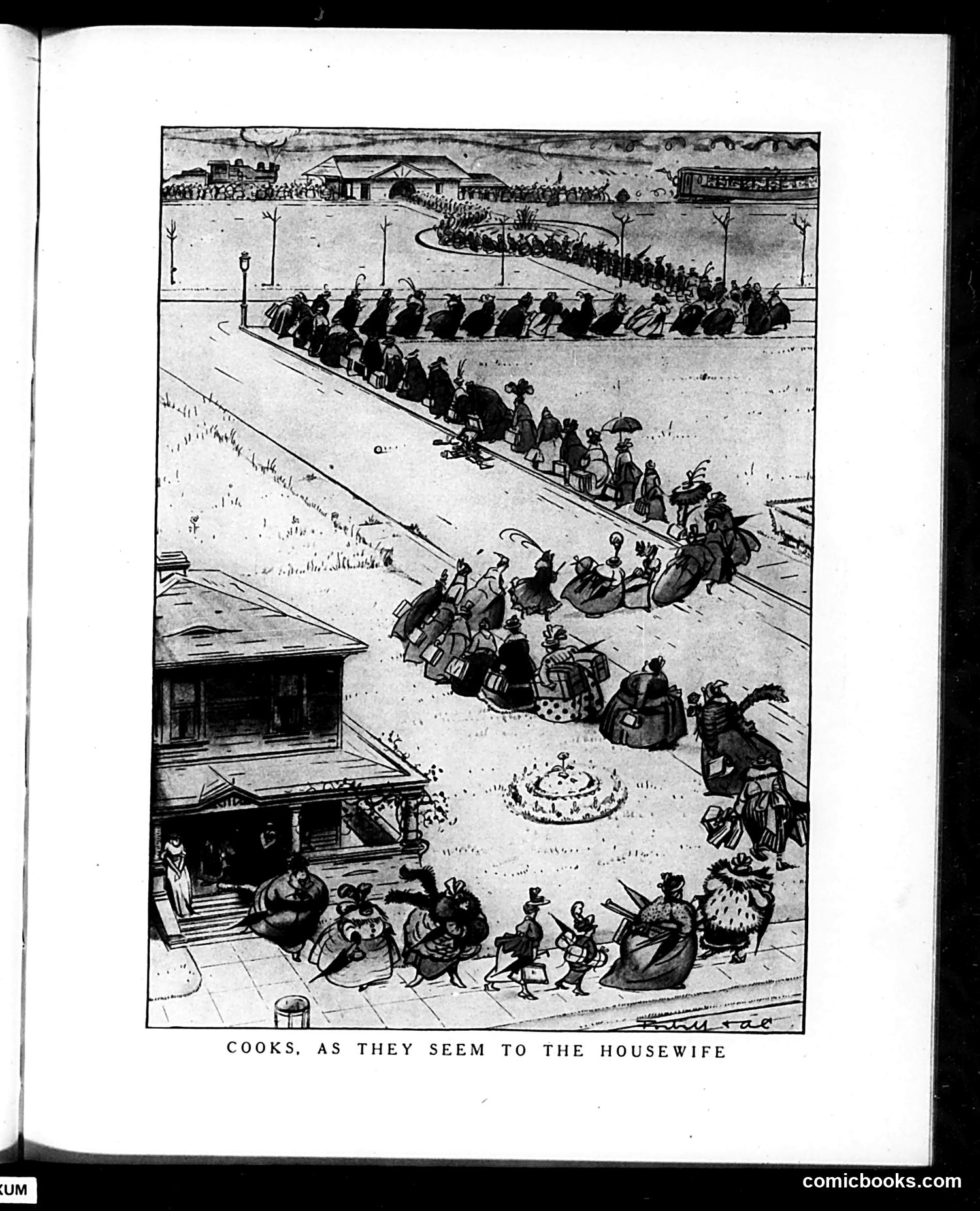
This satirical illustration depicts domestic kitchen workers from an exaggerated, humorous perspective. The caption suggests this represents how a housewife perceives or imagines her cooking staff. The image shows numerous figures in what appears to be a crowded, chaotic kitchen scene with various activities occurring simultaneously—some figures appear to be cooking, working, or moving about in an elaborate architectural setting with multiple levels and structures. The satire likely mocks the housewife's perception of kitchen chaos and inefficiency, or possibly comments on the visible vs. invisible labor of domestic servants. Without additional context, the specific social commentary remains unclear, though it appears to be commentary on household management and class dynamics typical of Judge magazine's satirical approach.
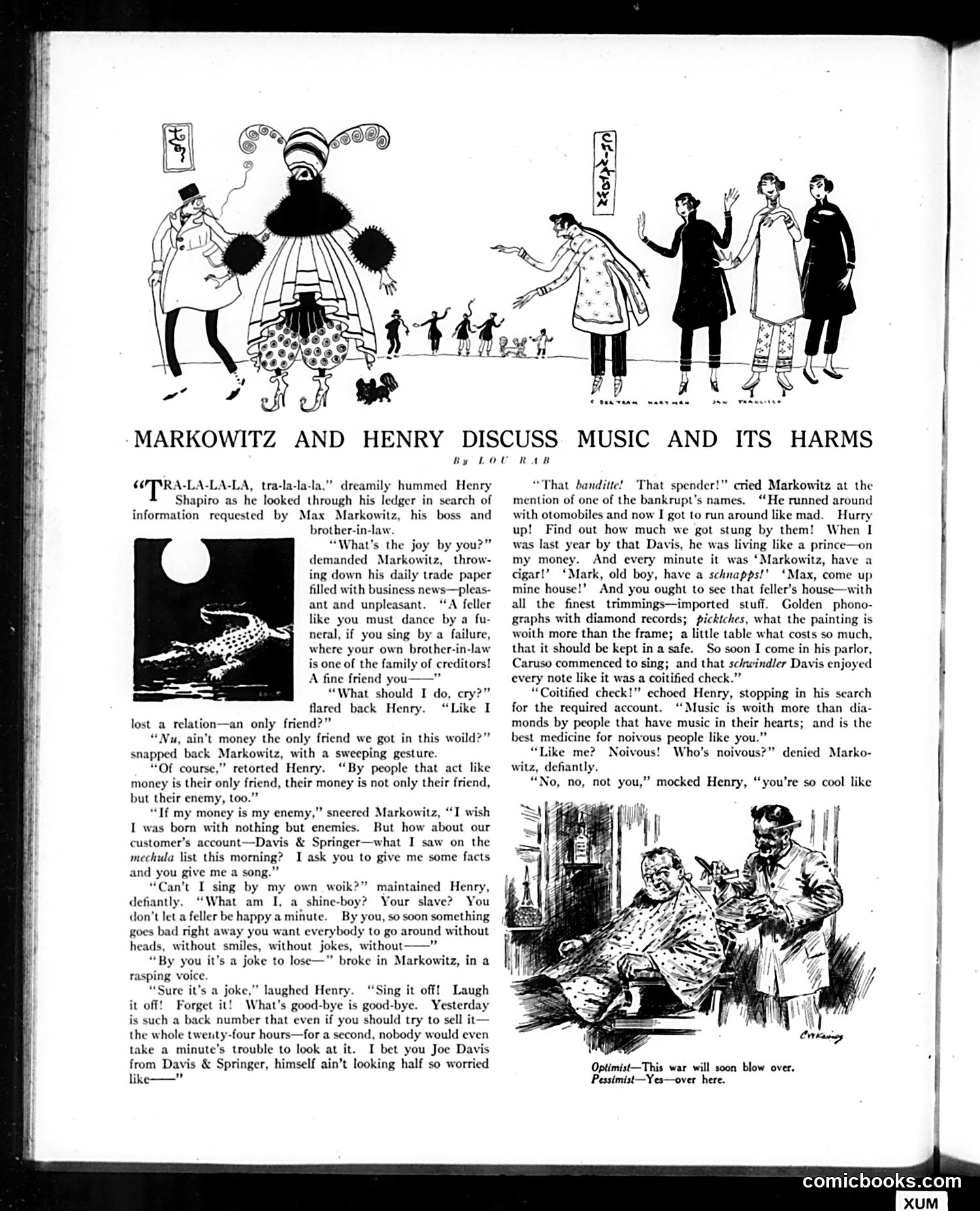
This is a comedic dialogue between two Jewish immigrant characters—Markowitz (the boss) and Henry (his employee and brother-in-law)—depicting their contrasting philosophies about money, work, and life during what appears to be WWI-era America. **The satire:** Markowitz represents the anxious, money-obsessed businessman obsessed with losses and debts. Henry represents the optimistic laborer who finds joy in singing and philosophy despite hardship. When Markowitz complains about a client (Davis) who lived lavishly before going bankrupt, Henry defends music as spiritually valuable—worth more than diamonds. Markowitz dismisses this as naive. **The humor** relies on Yiddish-inflected English dialect ("woik," "noivous," "coitified") common in early 20th-century American comedy depicting Jewish immigrants. The final panel's joke—an "Optimist" and "Pessimist" exchange about the war—suggests Henry's cheerfulness may be foolish given real hardships outside their discussion. The piece satirizes both immigrant anxieties about financial survival and American materialism.
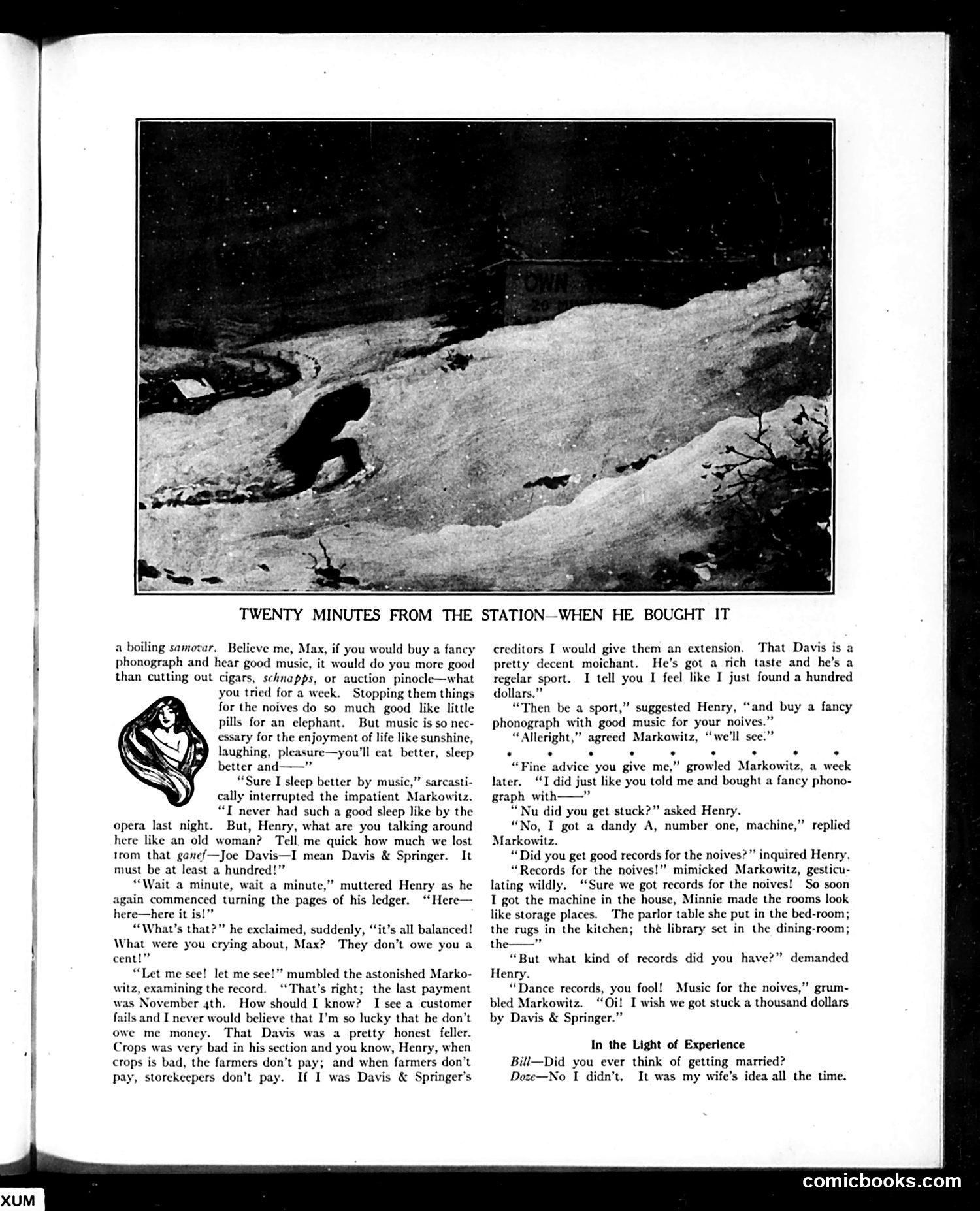
This page contains a humorous dialogue between two Jewish immigrant characters, Markowitz and Henry, rendered in exaggerated dialect ("noives" for "nerves," "moichant" for "merchant," "ganef" for "thief"). **The Main Story:** Markowitz worries he's lost money when a customer (Davis & Springer) fails to pay, but discovers the account is actually balanced. Henry suggests Markowitz celebrate by buying a fancy phonograph with good music. Markowitz does so but complains that his family filled the parlor with the phonograph's records, disrupting the house. **The Satire:** The joke mocks working-class immigrant anxiety about money and the perceived frivolity of consumer goods. The phonograph—an expensive new technology—becomes a source of domestic chaos. The final tagline about marriage reflects contemporary humor about matrimonial regret. **The Image:** Shows the purchased phonograph in what appears to be an outdoor/rural setting, likely illustrating the story's setup. This represents early 20th-century American ethnic humor, stereotyping Jewish immigrants through dialect and comedic "types."
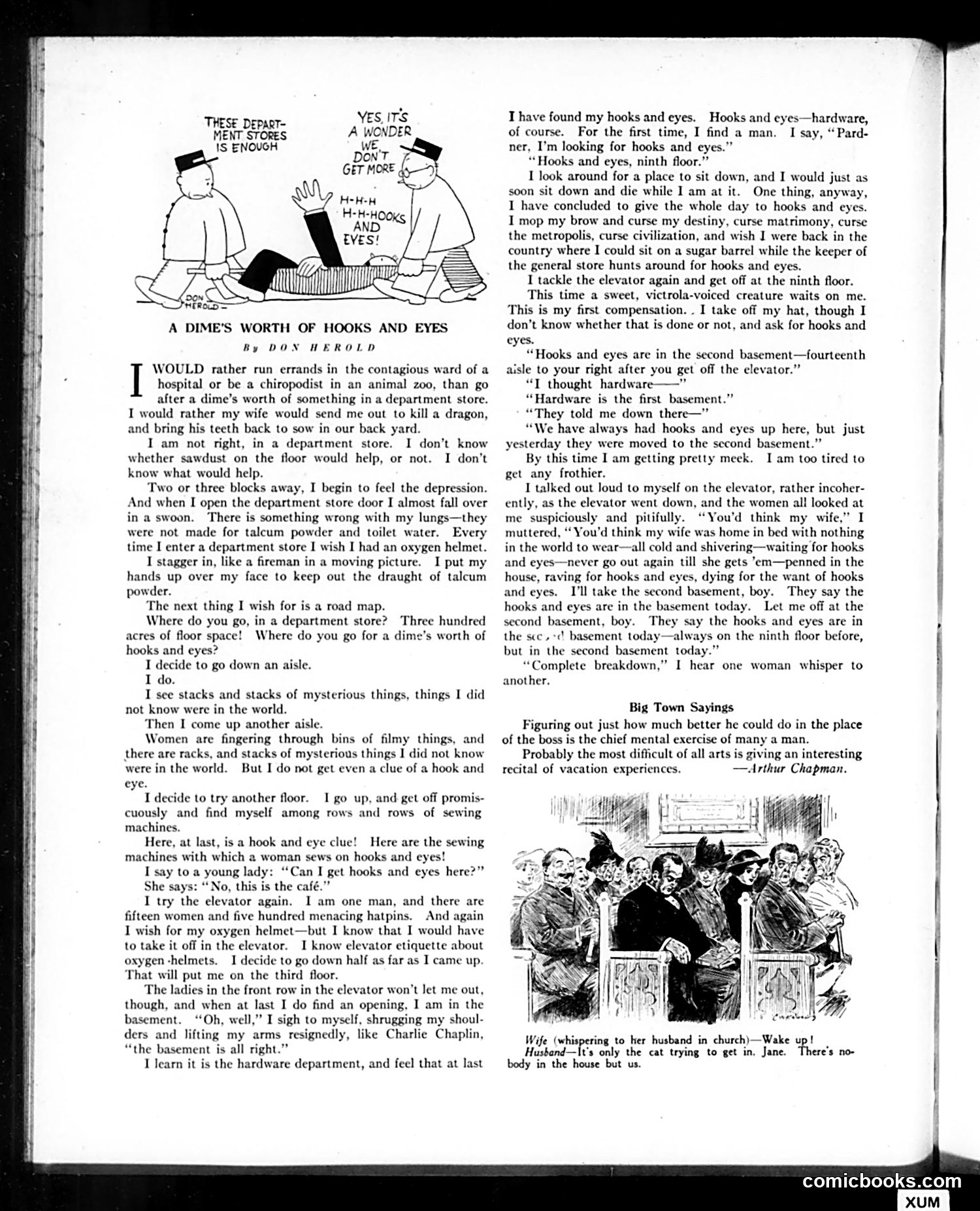
This is humorous social commentary on the bewildering experience of shopping in modern department stores, not political satire. The cartoon shows two male shoppers discussing the vastness of merchandise ("These department stores is enough"). The accompanying article narrates one man's frustrating quest to purchase hooks and eyes—a trivial sewing notions item. Herold satirizes the scale and confusion of 1920s-30s department stores: endless aisles, conflicting directions, overwhelming crowds of women with hatpins, and constantly contradictory information about where items are located. The humor targets urban consumer culture itself—the absurdity that finding a simple, inexpensive item requires navigating a massive building like a labyrinth. The narrator's comparisons (hospital wards, dragon-slaying, Charlie Chaplin) exaggerate his mild predicament for comic effect. This reflects contemporary anxiety about modern commercialism overwhelming everyday life.
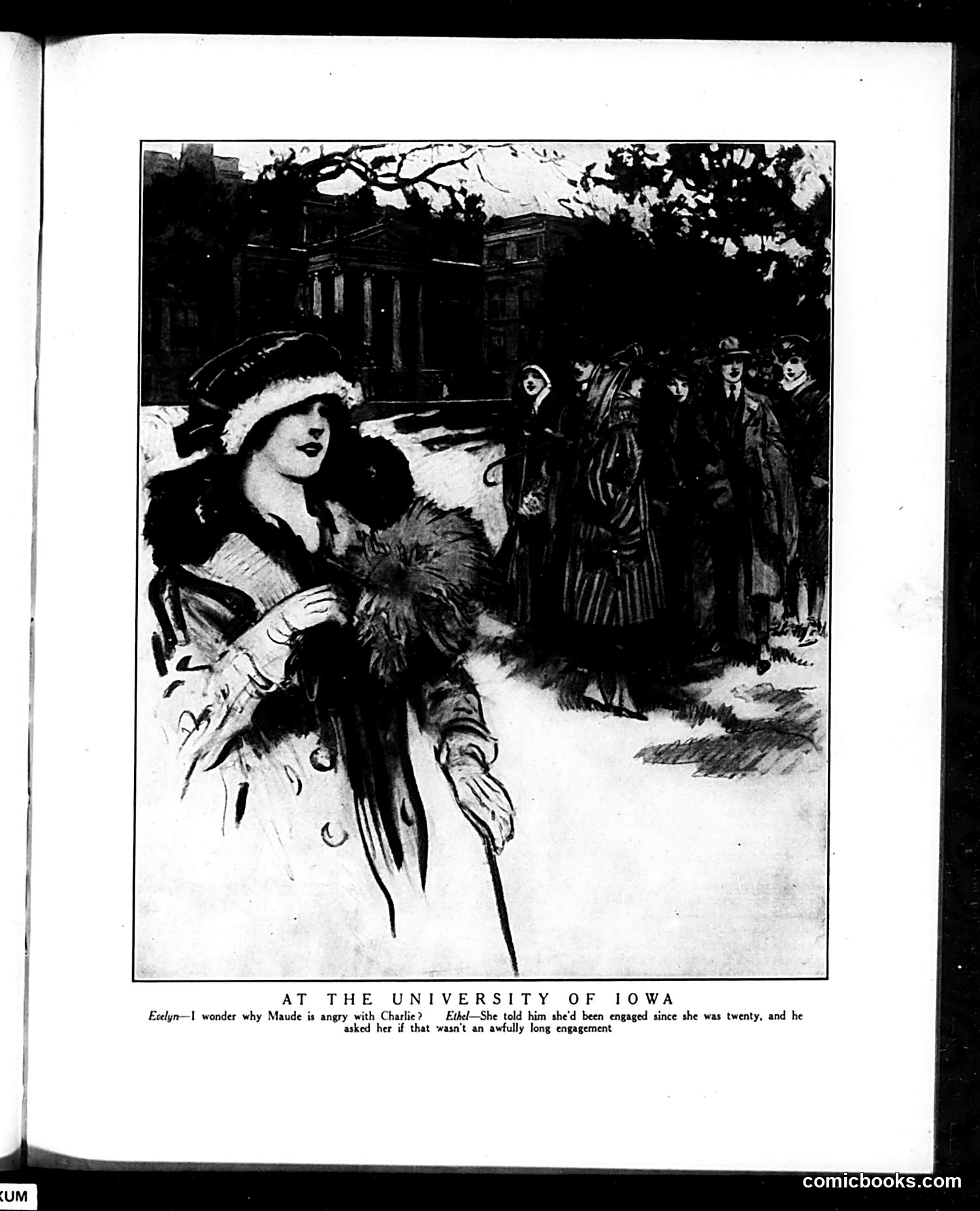
This is a social humor cartoon satirizing dating customs and courtship expectations of the early 20th century. Two women, Evelyn and Ethel, discuss why their friend Maude is upset with a man named Charlie. The joke centers on a misunderstanding: when Maude mentions being "engaged since she was twenty," Charlie interprets "engaged" as formally betrothed to be married, and questions why the engagement lasted so long. However, Maude likely meant she'd been socially active or "engaged" in dating/courtship activities generally—a common usage of the era. The satire mocks male obliviousness and the strict courtship conventions of the time, where long engagements before marriage were notable and potentially scandalous. The cartoon appeared in *Judge*, a satirical magazine, to amuse readers with this clash between different understandings of social propriety.
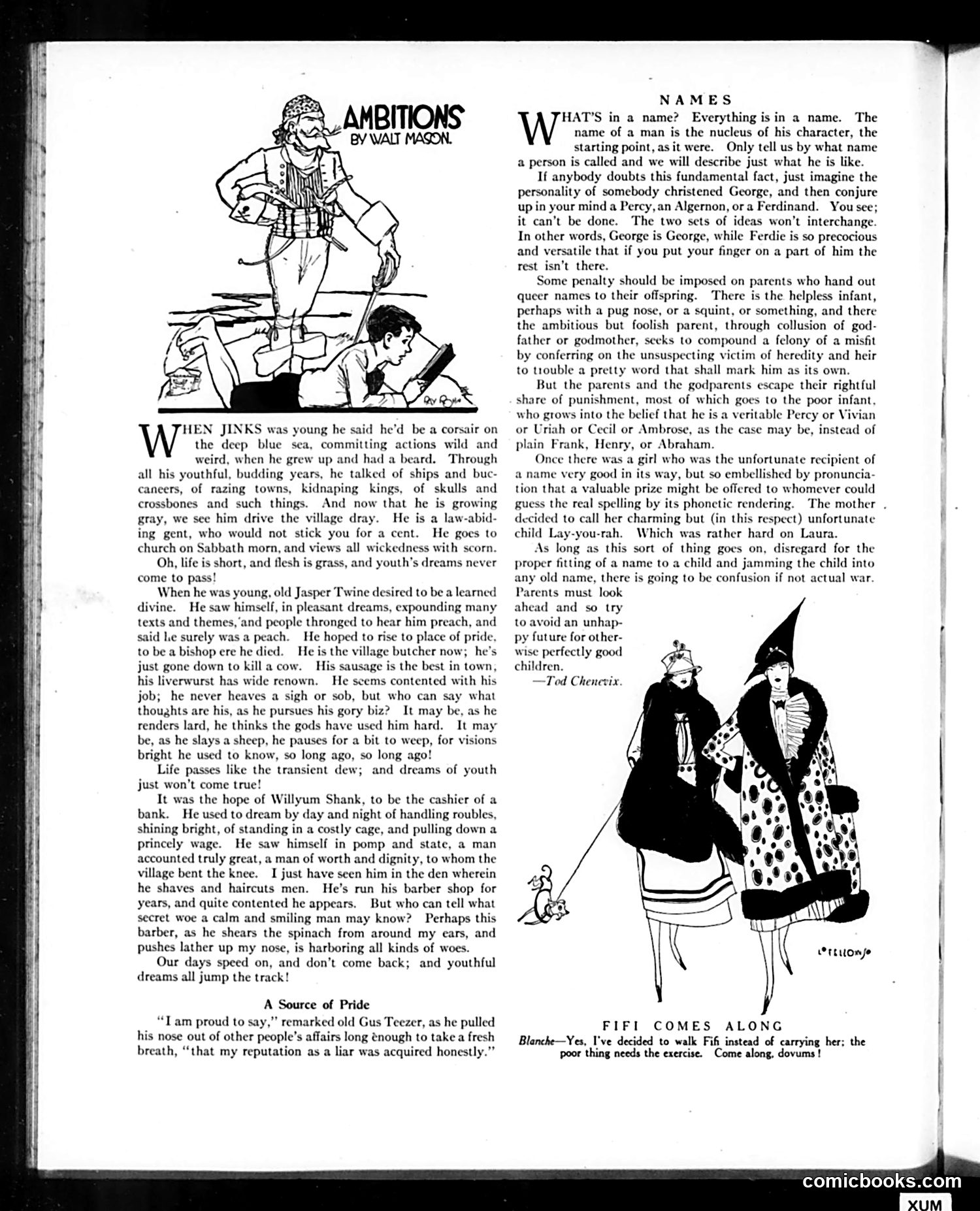
Walt Mason's "Ambitions" satirizes the gap between youthful fantasies and adult reality. Three men—Jinks, Jasper Twine, and William Shank—each dreamed grand ambitions as boys: Jinks imagined becoming a pirate; Twine aspired to be a learned preacher; Shank dreamed of banking wealth and status. As adults, all three have settled into modest, ordinary village jobs—driving a cart, butchering meat, cutting hair—yet apparently accept their fates without visible regret. Mason's point: youth's romantic dreams inevitably "jump the track" and disappear with age. The accompanying editorial on "Names" argues that a person's identity is essentially fixed—a complementary meditation on destiny and character. The satire gently mocks both youthful naiveté and the resigned acceptance of mediocrity in working-class life.
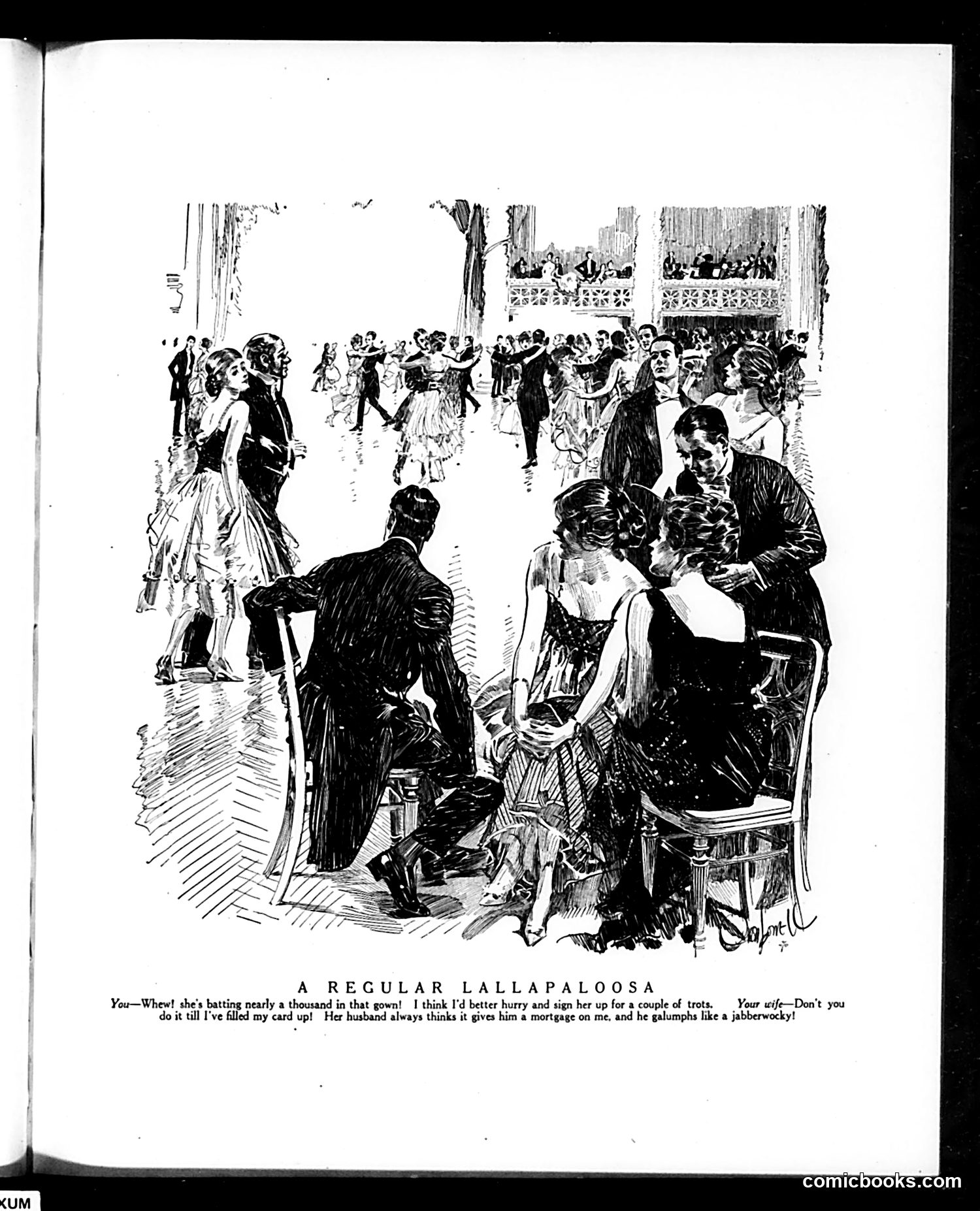
This cartoon satirizes high-society social dancing etiquette circa early 20th century. Two couples converse at what appears to be a formal ball or "lallapaloosa" (slang for an impressive event). A man compliments a woman's appearance and suggests dancing with her ("sign her up for a couple of trots"). Her female companion (likely a friend or chaperone) warns her against it, claiming that accepting a dance creates a sense of obligation or "mortgage" on her—the man will expect further attention and dance poorly ("galumphs like a jabberwocky," meaning he dances clumsily and awkwardly). The satire mocks the rigid social conventions governing dance-card protocol and the possessive attitudes men displayed toward women they danced with. The woman's resistance exposes how these "courtesies" actually constrained women's autonomy at social events.
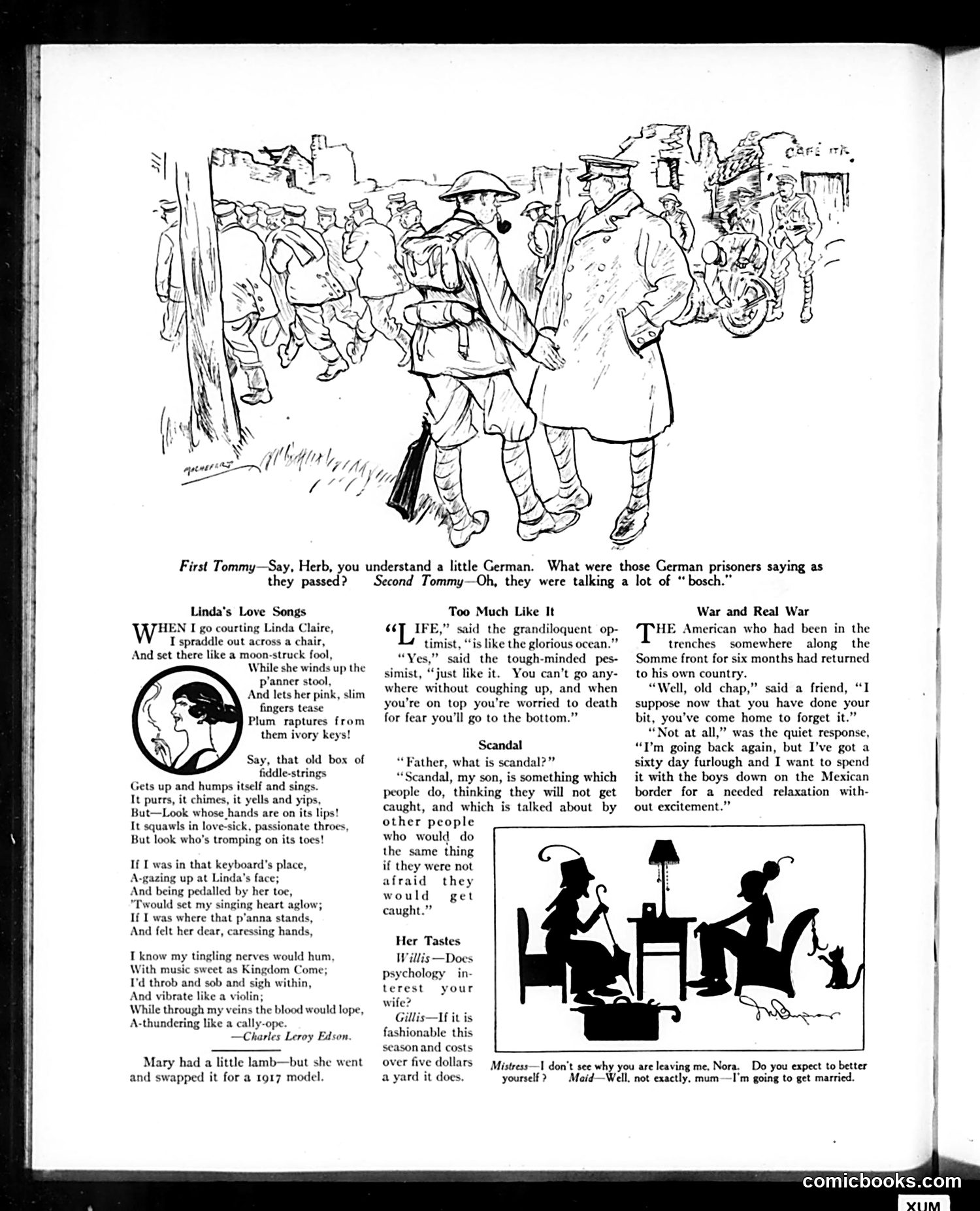
This page contains WWI-era humor and satire from Judge magazine. Key elements: **Top cartoon**: Shows American soldiers with German prisoners of war. The joke plays on "bosch" (German slur for Germans, from "Deutscher"), suggesting prisoners spoke their native language—mild ethnic humor typical of wartime publications. **"War and Real War"**: Satirizes American soldiers' priorities. A soldier returning from the brutal Somme trenches chooses a Mexican border posting for "relaxation" over going home—absurdist commentary on military life's strange logic. **Other pieces**: "Too Much Like It" compares life to the ocean (both make you cough and risk drowning)—pessimistic wit. "Scandal" defines it cynically as wrongdoing people deny. Love songs and domestic jokes round out lighter content. The page reflects 1917-1918 American attitudes: casual ethnic stereotyping, wry acceptance of war's brutality, and domestic romantic comedy as cultural counterweight.
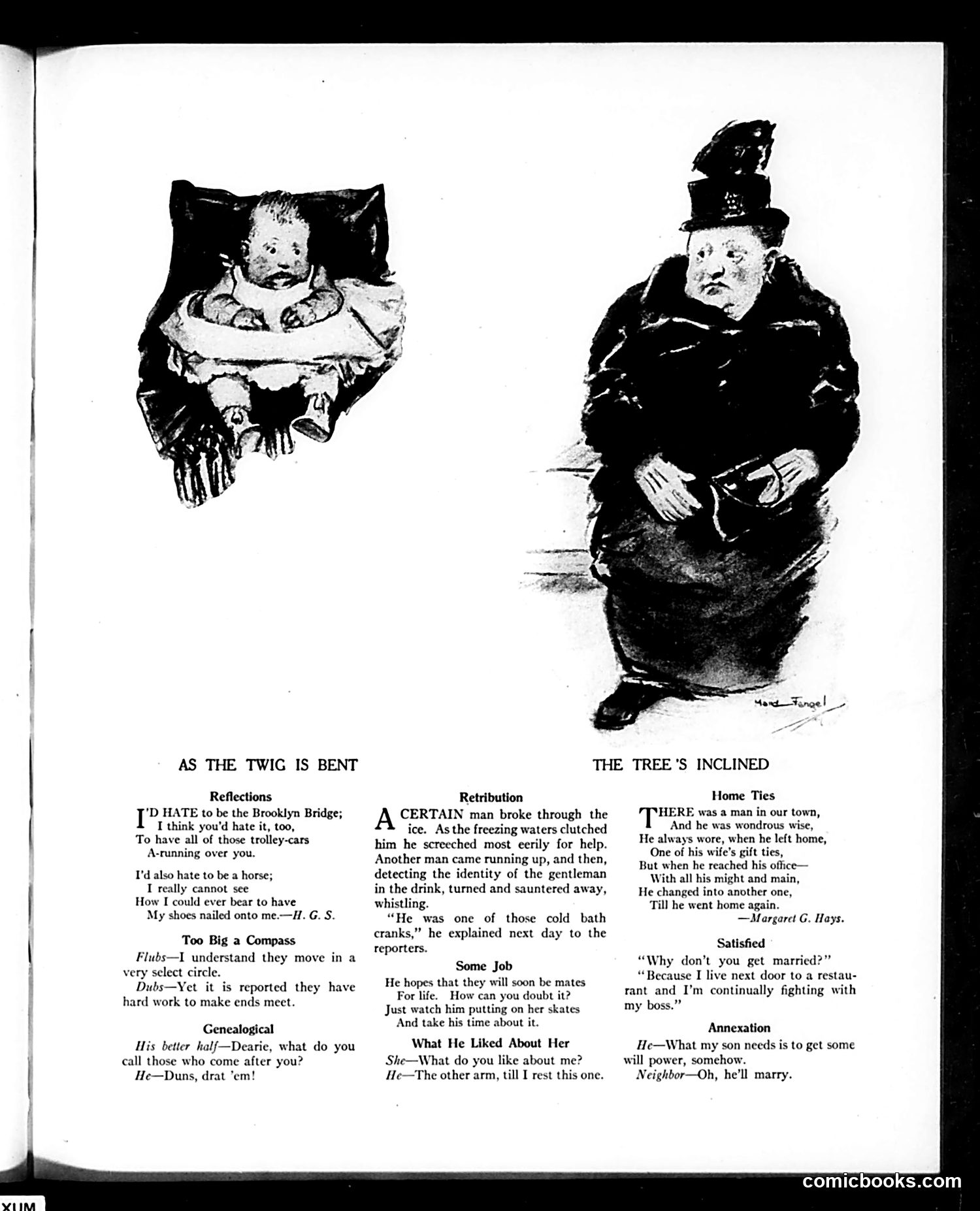
This page from the satirical magazine *Judge* contains multiple short humorous pieces rather than political cartoons. The two illustrations—showing a cherubic infant and a rotund elderly woman in Victorian dress—illustrate the proverbs "As the Twig Is Bent" and "The Tree's Inclined," suggesting character is formed in childhood. The text pieces are mostly domestic humor typical of early 20th-century magazines: complaints about structural inconveniences (Brooklyn Bridge, horseshoes), wordplay about social circles and debt ("hard work to make ends meet"), and marital observations. "Retribution" presents dark humor about a man drowning—his rescuer recognizes him as someone who advocated cold-water bathing and lets him die. Several pieces joke about courtship and marriage dynamics. The overall tone reflects era-appropriate middle-class anxieties: financial strain, domestic relations, and social pretension—presented through brief, punchy gags rather than sustained satire.
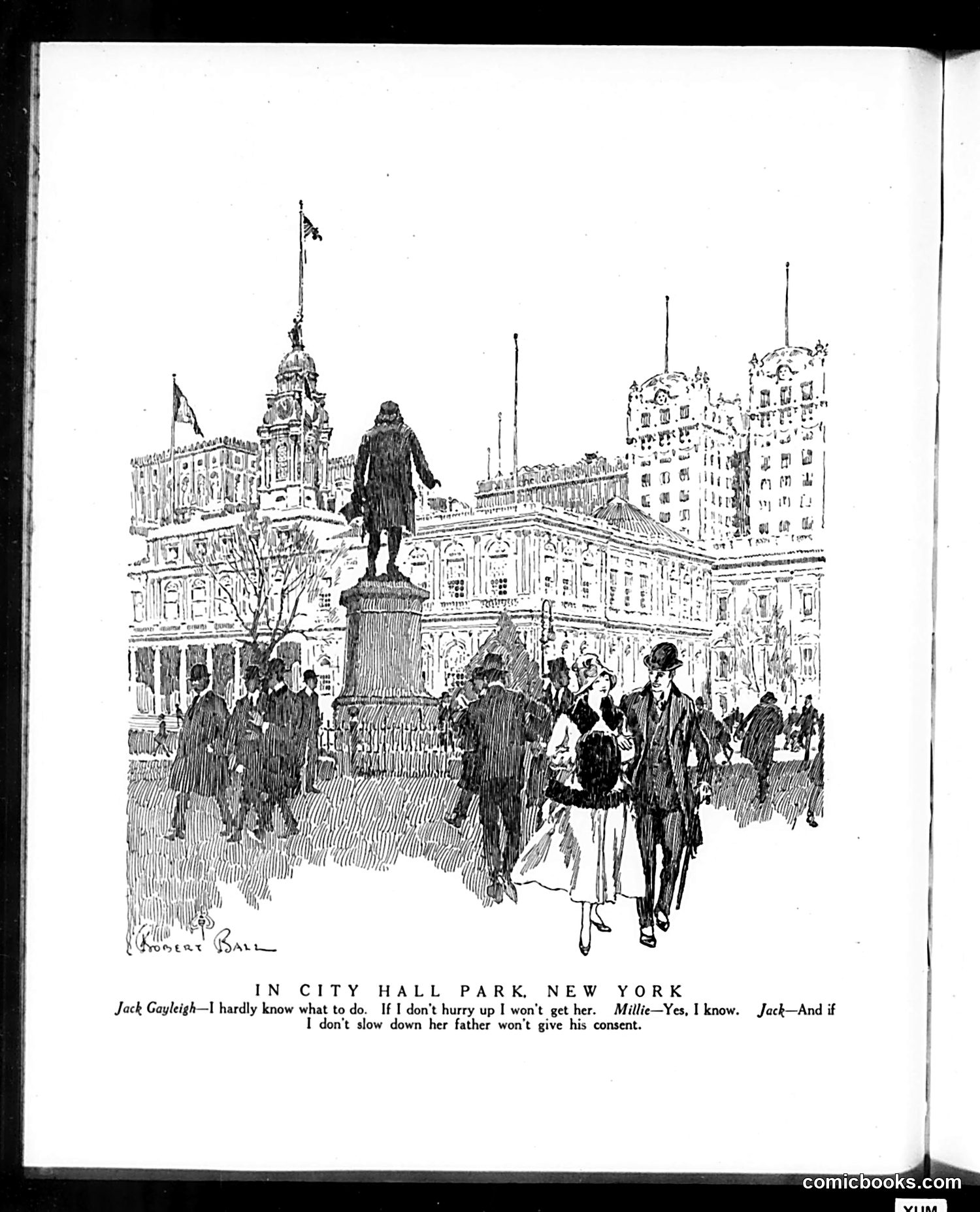
This is a single-panel cartoon depicting a scene in City Hall Park, New York. The joke concerns a romantic dilemma: Jack Gayleigh expresses anxiety about courting a woman named Millie—he fears moving too quickly will lose her, but moving too slowly will fail to secure her father's consent to marry. The humor relies on the era's social convention that a young man needed parental approval for marriage, creating an impossible middle ground. The caption suggests the tension between modern courtship urgency and Victorian-era paternal gatekeeping over marriage prospects. The sketch shows well-dressed figures strolling in the park, typical of period leisure scenes. The artist is credited as "Robert Ball" (visible signature). This reflects early 20th-century social anxieties about courtship protocol.
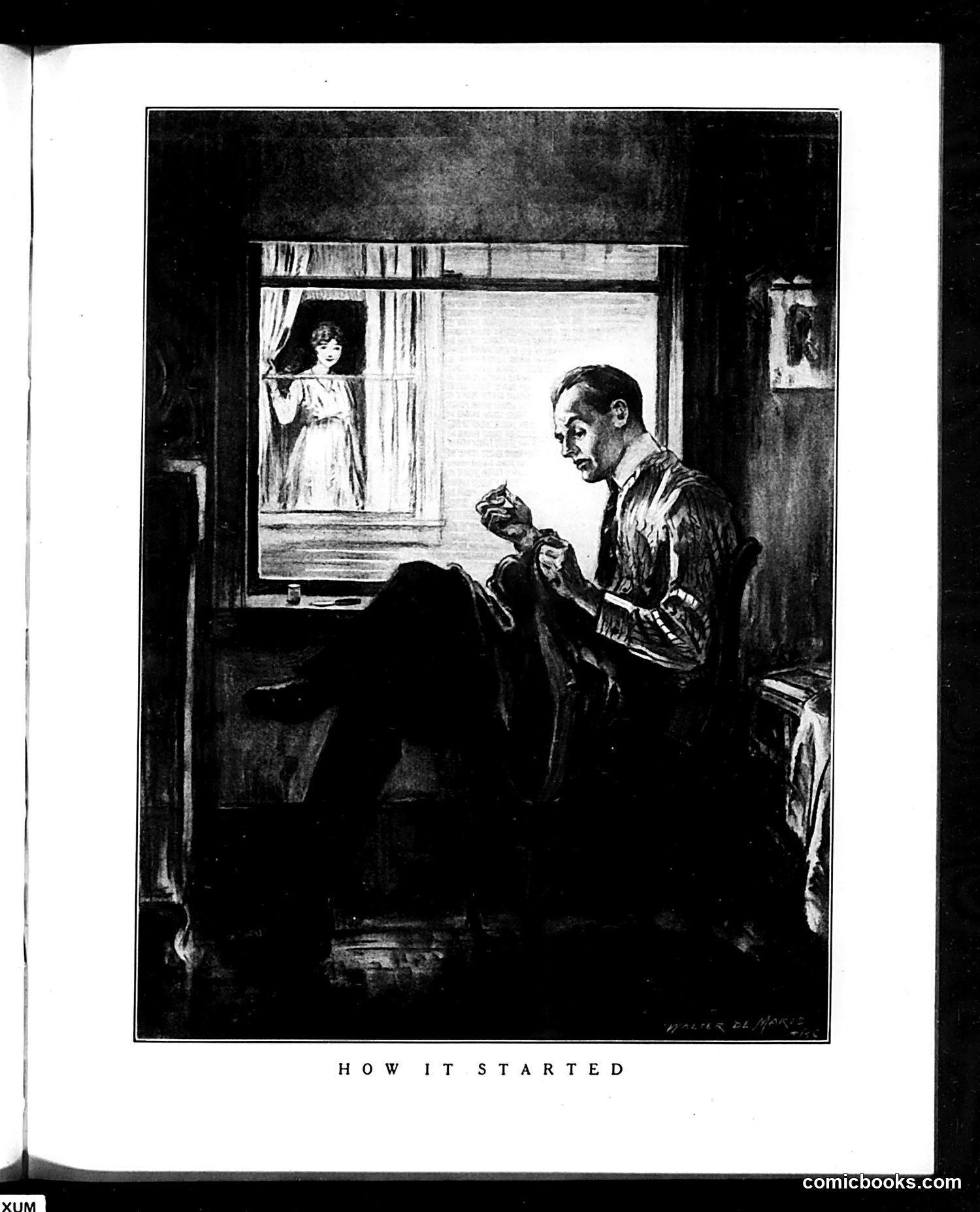
This illustration depicts a domestic scene where a man sits by a window, holding what appears to be a small animal or object, while gazing at a woman visible through the window curtains. The caption "How It Started" suggests this is the beginning of a romantic or illicit encounter. The satire likely comments on courtship rituals or the origins of romantic relationships—possibly mocking how casual or trivial beginnings can lead to significant consequences. The voyeuristic framing through the window, combined with the man's absorbed attention, suggests humor about male infatuation or the somewhat undignified nature of how relationships commence. Without additional context about Judge magazine's specific date of publication, the precise social commentary remains unclear, though it appears to be satirizing romantic behavior conventions of its era.
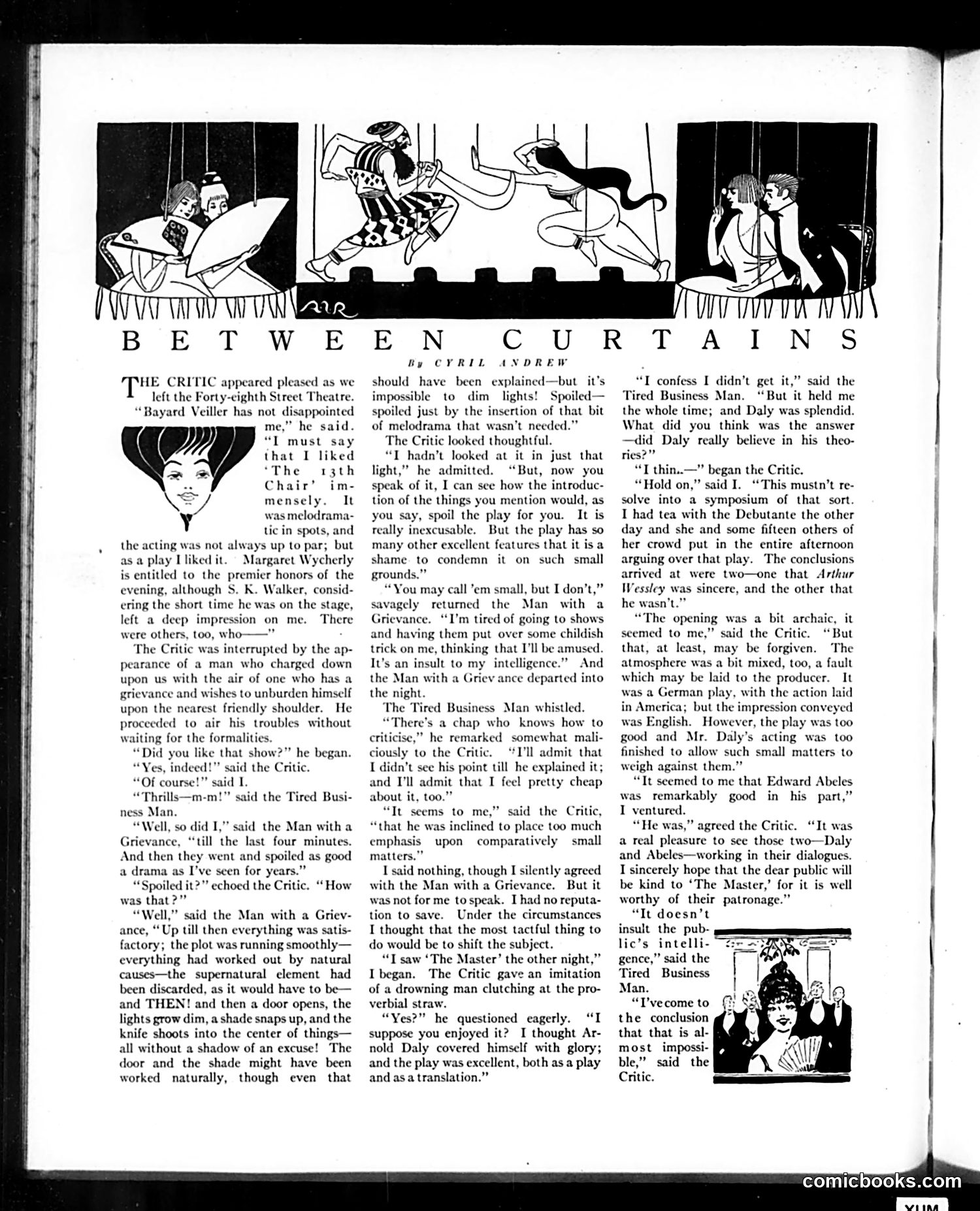
This article satirizes theatrical criticism and the gap between critics and ordinary audiences. The setup presents a "Critic" (appearing to represent professional theater reviewers) who dismisses audience complaints as pedantic. When a "Man with a Grievance" objects to *The 13th Chair* using artificial melodramatic devices (a mysteriously opening door, dimming lights, a knife appearing) to resolve the plot, the Critic acknowledges the technical flaw but dismisses it as "small grounds" given the play's other merits. The satire's point: critics prioritize overall theatrical spectacle and reputation (the actor Arnold Daly "covered himself with glory"), while regular theatergoers care about logical consistency and honest storytelling. The "Tired Business Man" and the narrator silently agree with the Grievance man but stay quiet, suggesting audiences self-censor around critics rather than voice genuine opinions. The cartoon illustrates this disconnect between critical establishment and public taste in early 20th-century American theater.
This page presents South Dakota suffragists' argument for a **federal constitutional amendment** rather than state-by-state suffrage efforts. The text is a satirical monologue addressed to President Wilson, documenting decades of failed suffrage campaigns in South Dakota despite repeated public support. The satire works through **exaggeration and irony**: the speaker catalogs absurd obstacles—a bill defeated by one vote, a governor's veto, voters confused by a seven-foot-tall ballot, and ultimately, out-of-state money and "unscrupulous speakers" reversing seeming victory. Each defeat becomes more ridiculous, emphasizing how the state-by-state approach handicaps women's suffrage efforts. The accompanying editorial argues that women deserve appointment to judgeships and other positions—that excluding them from influence while seeking their votes is hypocritical. Judge magazine appears critical of both foot-dragging on suffrage and dismissive attitudes toward women's capabilities.
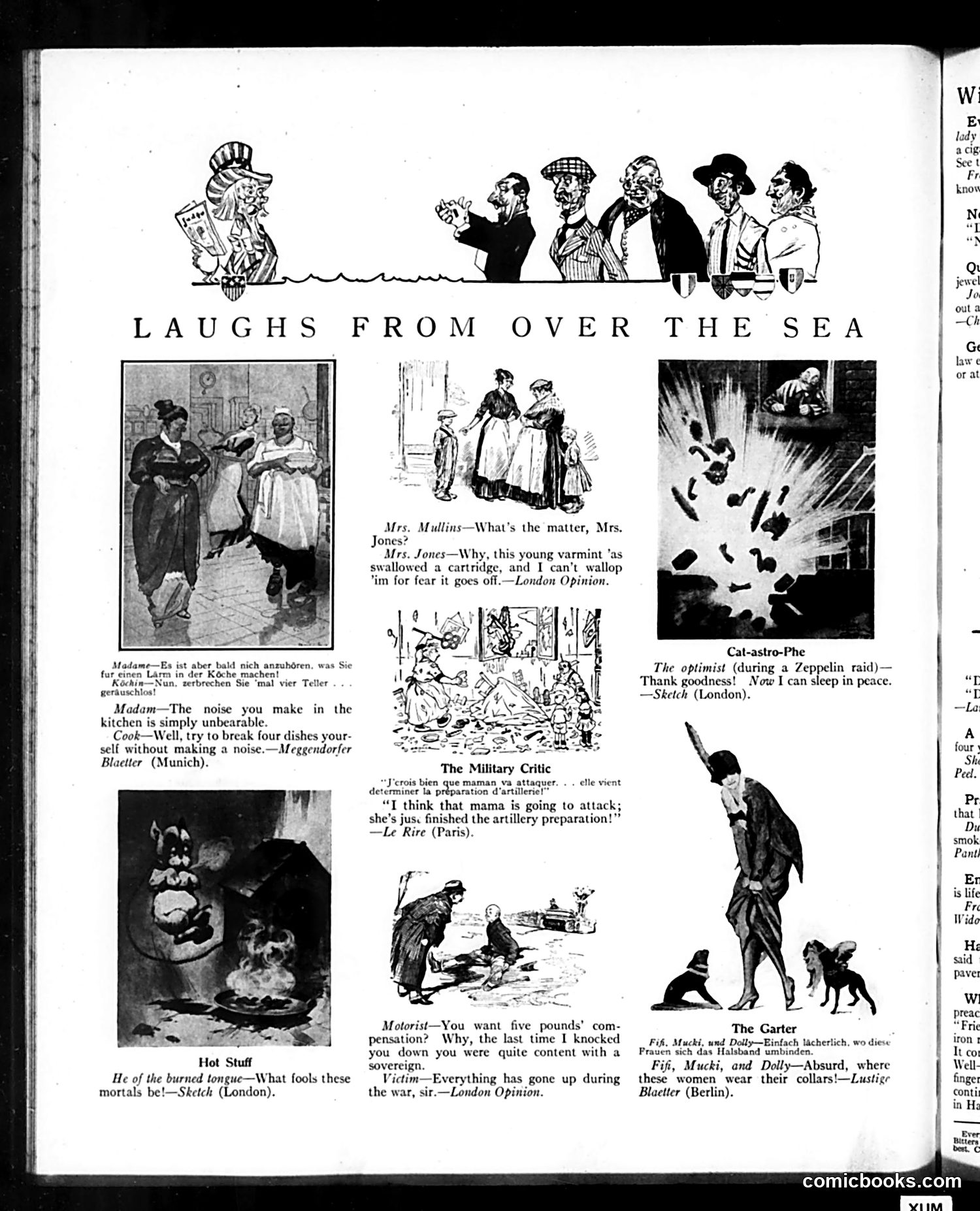
This page collects humorous cartoons from European publications during World War I, demonstrating how different nations satirized home-front life and the war itself. The jokes target domestic absurdities: a cook defending kitchen noise-making, a child who swallowed a cartridge (dark wartime humor), and a motorist arguing inflation with an accident victim. "The Military Critic" depicts a French child observing her mother's domestic activities as "artillery preparation"—joking that women's housework mirrors military operations. "Cat-astro-Phe" shows an optimist sleeping peacefully during a Zeppelin (German airship) raid, satirizing either naive optimism or exhaustion from constant bombing. "The Garter" compares women wearing dog collars to canine fashion—likely mocking trendy women imitating pet accessories. The cartoons' multilingual captions (German, French, English) suggest *Judge* was republishing international humor to amuse American readers with how Europeans coped with wartime.
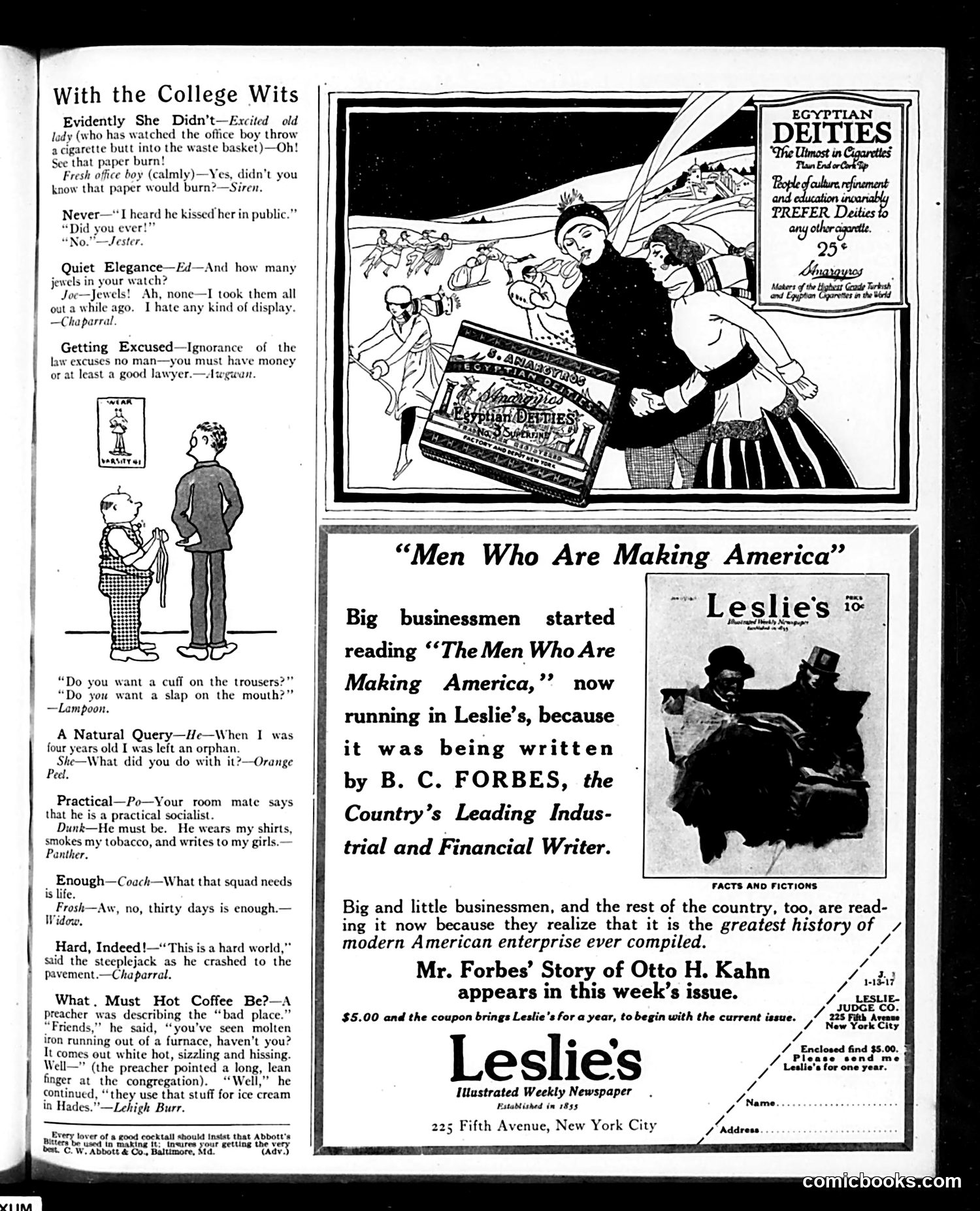
**College Humor Section**: This collects brief jokes and one-liners from college publications (Judge, Chaparral, Jester, etc.). The humor targets recognizable college stereotypes: naive freshmen, practical jokers, impractical idealists. The "Practical Socialist" joke is typical—the roommate claims socialism while exploiting his friend. Overall, light satire of youthful pretension and hypocrisy. **Main Advertisement**: Leslie's Illustrated Weekly promotes B.C. Forbes' serialized article "The Men Who Are Making America," which apparently was generating significant business interest. Forbes is positioned as an authoritative financial and industrial writer. The ad emphasizes the series as "the greatest history of modern American enterprise"—appealing to businessmen's desire for insider knowledge about industrial leaders like Otto H. Kahn (visible in this week's issue). This appears designed to attract subscriptions by promising business readers access to contemporary industrial analysis.
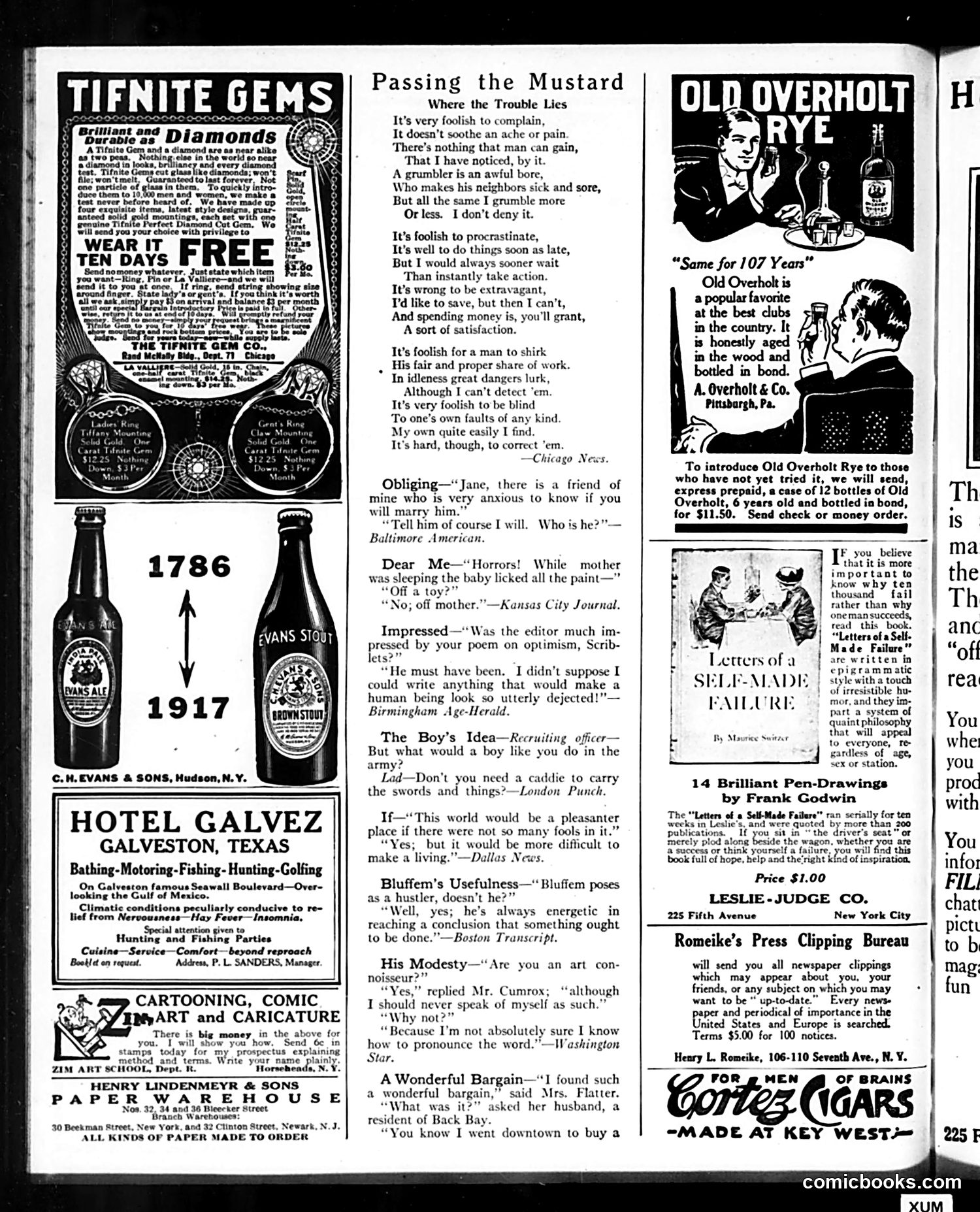
This page is primarily **advertising and humorous filler content**, typical of Judge magazine. The main text piece is a light satirical poem about human hypocrisy—the speaker denounces complaining, procrastination, extravagance, and laziness while admitting to practicing all of them. It's mild social satire about universal human failings. The surrounding content includes short joke submissions from readers, a hotel advertisement, and ads for art schools and cartooning instruction. The advertisements for Old Overholt Rye whiskey and "Letters of a Self-Made Failure" book indicate this is a magazine for educated, middle-class readers. No prominent political figures or specific contemporary events are caricatured on this page—it's general-audience humor and advertising rather than pointed political commentary typical of Judge's satirical focus.
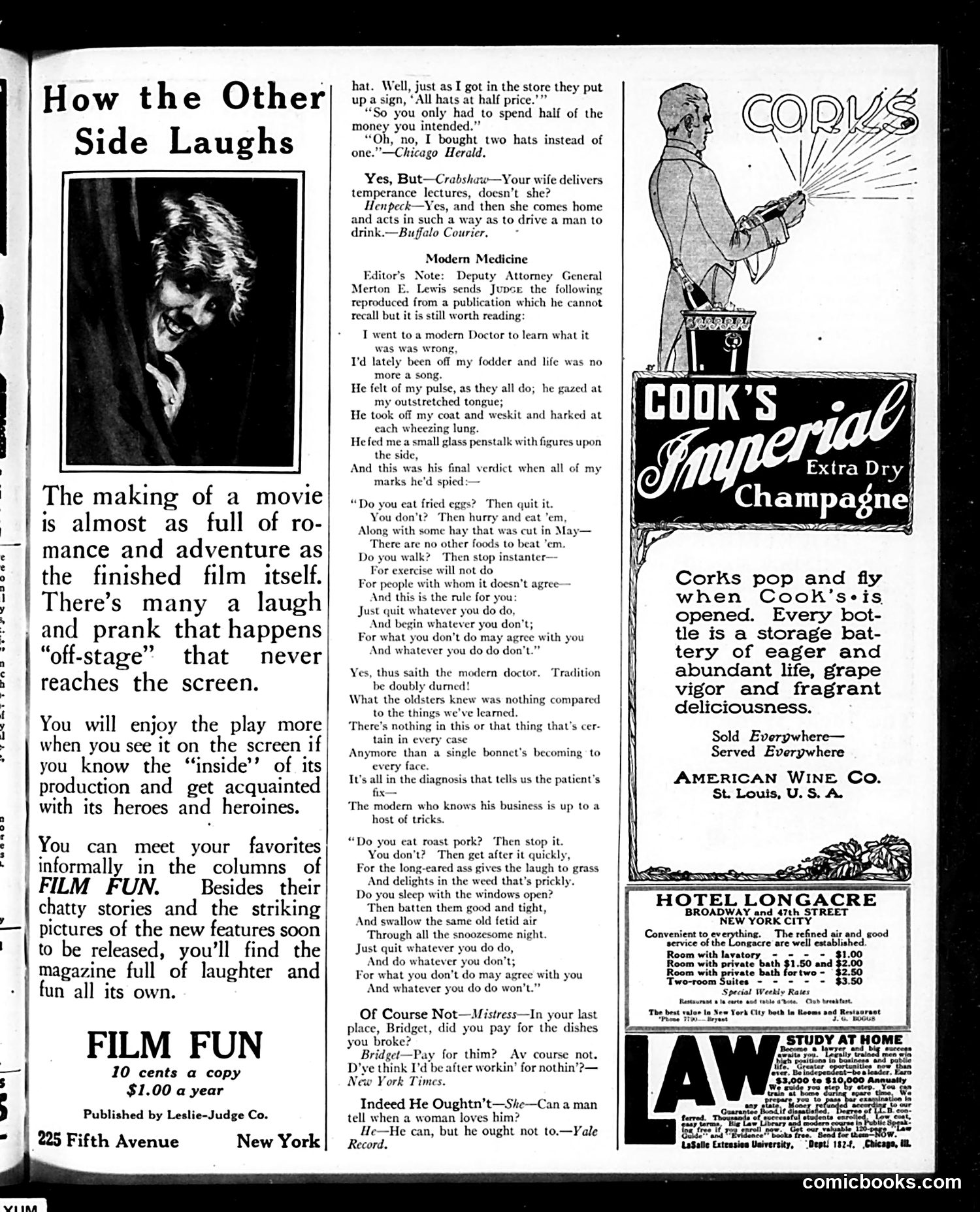
This page from Judge magazine contains humor pieces and advertisements typical of early 20th-century American satirical publishing. **Main Content:** The "Side Laughs" section features short jokes from various newspaper sources (Chicago Herald, Buffalo Courier, Yale Record, New York Times). These include: - A wife's logic about buying two hats at half price - A henpecked husband whose temperance-lecturing wife drives him to drink - A satirical poem about modern doctors giving contradictory medical advice (eat fried eggs/don't eat them; exercise/don't exercise) - Brief quips about domestic life and gender relations **Satire Target:** The medical profession receives particular mockery—the poem suggests modern doctors disguise ignorance with jargon and contradictory advice, implying they're charlatans. **Advertisements:** Cook's Imperial Champagne and Hotel Longacre dominate the right side. **Context for Modern Readers:** These jokes reflect early 1900s attitudes about marriage (henpecked husbands), consumer behavior, and professional skepticism—particularly distrust of "modern" medicine competing with traditional folk remedies.
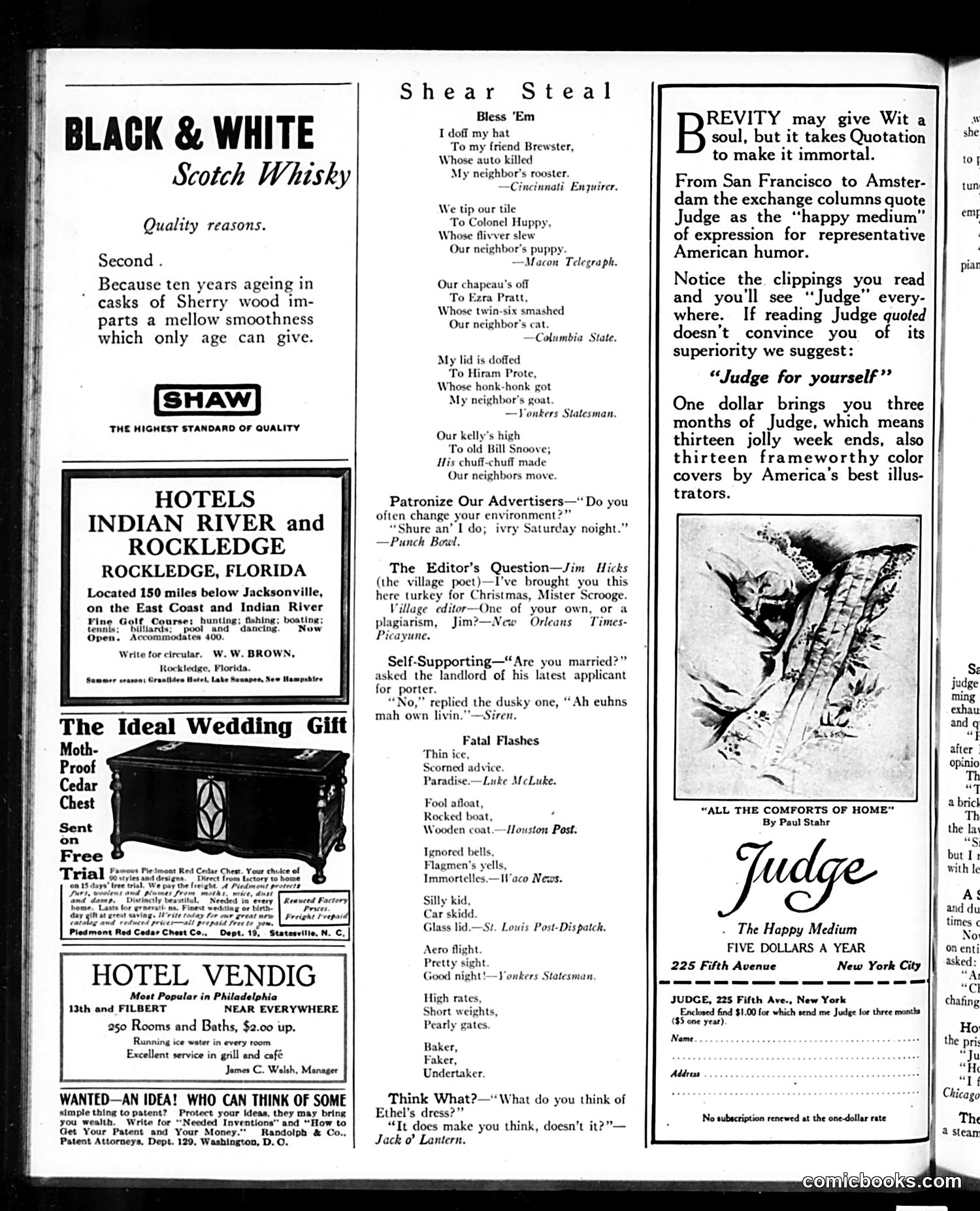
This page is primarily **advertising and self-promotion** for Judge magazine, with some humorous filler content. The central cartoon, "All the Comforts of Home" by Paul Stahr, depicts a man relaxing in a chair—a visual metaphor for the contentment Judge promises readers. The "Shear Steal" section is satire on **early automobile fatalities**. It mock-celebrates various drivers (Brewster, Huppy, Pratt, etc.) who've killed neighbors' animals with their cars, presented as if these were heroic achievements worthy of tipping one's hat. The joke exposes how cavalier society had become about automobile dangers during the early motor-car era—deaths and injuries treated as amusing rather than tragic. The tone is darkly ironic: praising carelessness that causes harm. The page also features brief humorous quotes and "Fatal Flashes"—short, punchy joke formats typical of Judge's content. The advertisements (hotels, whisky, patent services) and the large promotional box for Judge subscriptions ($1 for three months) indicate this is filler designed to monetize page space while building the magazine's brand.
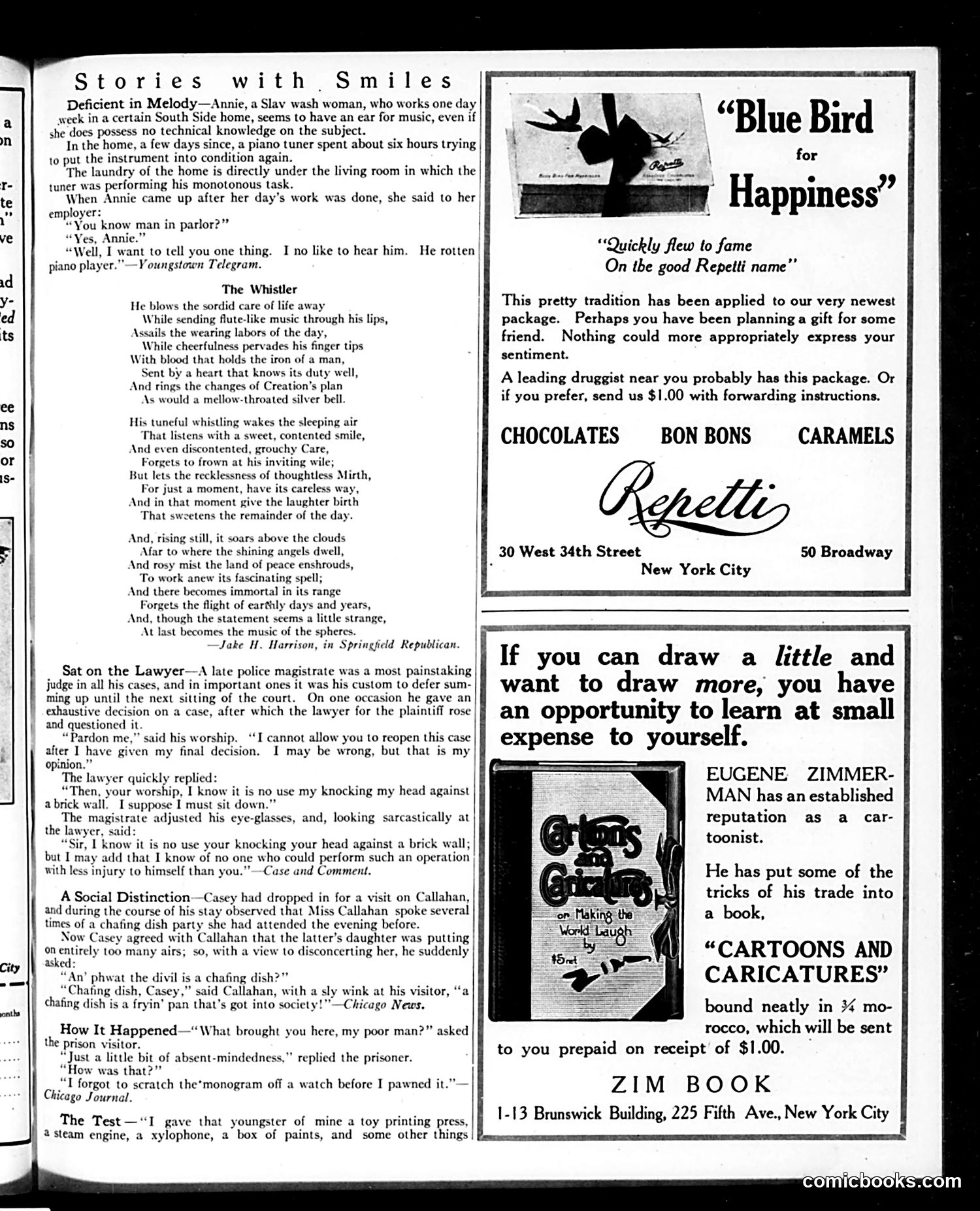
This is primarily a humor and advertising page from *Judge* magazine. The left column contains four brief comedic anecdotes mocking immigrant workers and legal/social pretension: 1. **"Deficient in Melody"**: A Slavic laundry woman complains about a piano tuner's noise, satirizing immigrants' lack of musical sophistication. 2. **"Sat on the Lawyer"**: A magistrate verbally defeats a lawyer, playing on the phrase "sat on" (humiliated him). 3. **"A Social Distinction"**: An Irishman (Casey) mocks a social-climbing girl's pretensions about a "chafing dish." 4. **"How It Happened"**: A prison visitor's opening is cut off—unclear punchline. The right side contains advertisements for Repetti chocolates and a "Cartoons and Caricatures" instructional book. The poetry "The Whistler" celebrates working-class dignity through whistling—the sole earnest content amid otherwise dismissive ethnic humor typical of 1910s-era *Judge*.
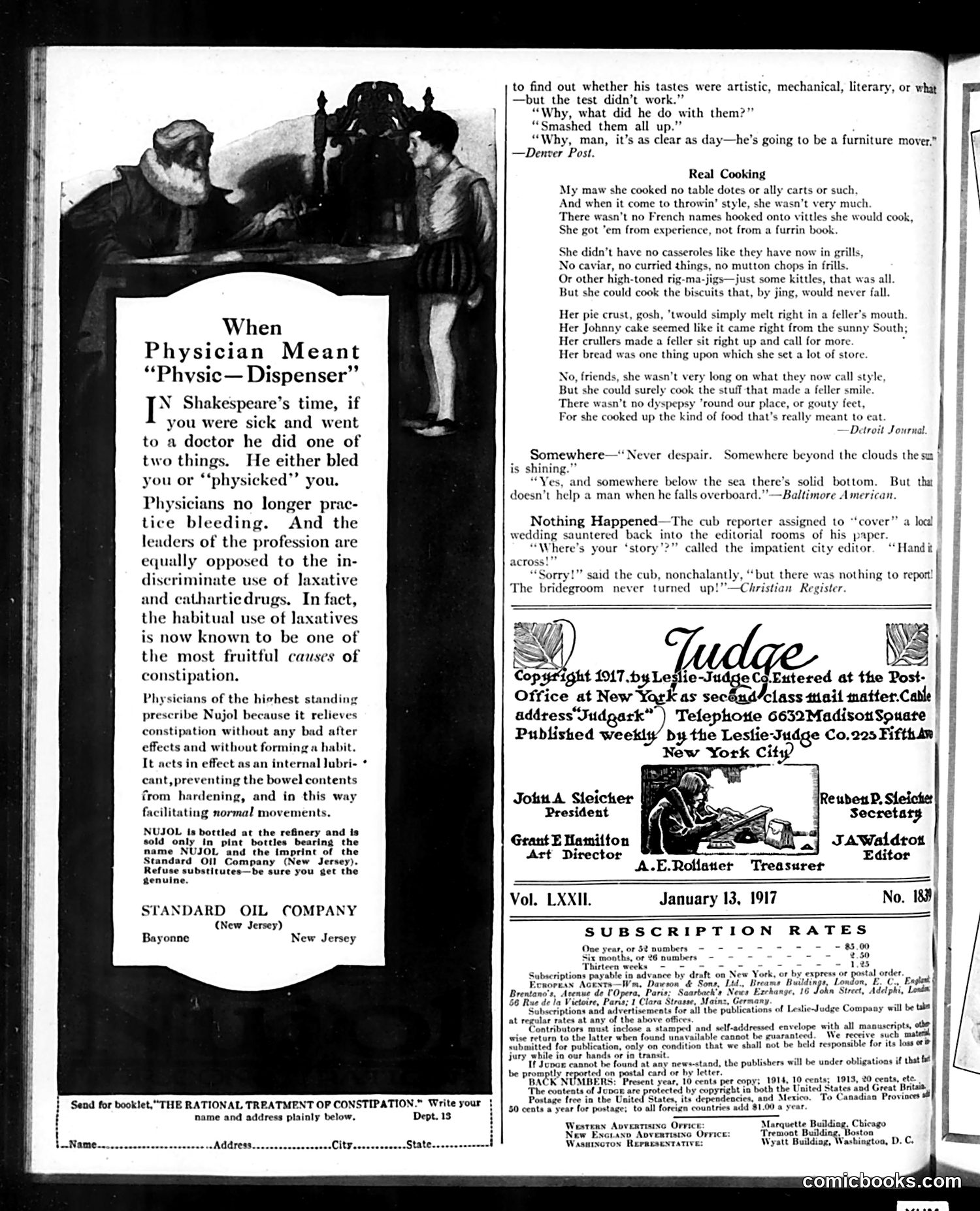
This page combines **advertising and light humor** typical of Judge's format. **The Main Content:** A Standard Oil Company advertisement for Nujol mineral oil, disguised as educational satire. It contrasts old medical practices (bloodletting, harsh laxatives) with modern "rational" treatment—positioning Nujol as a gentle internal lubricant for constipation. The historical framing ("In Shakespeare's time") gives credibility to promoting a commercial product. **The Humor Sections** feature three brief jokes: one about a child becoming a "furniture mover," one romanticizing plain home cooking versus fancy French cuisine, and one about a cub reporter covering a wedding where the groom didn't show up. **The Point:** This is primarily a **disguised advertisement** using educational/satirical framing—a common early-1900s marketing technique. The humor pieces are filler content, typical of Judge's miscellaneous joke sections. Nothing here addresses specific 1917 political events; it's generic Americana content designed to appeal broadly while promoting a product.
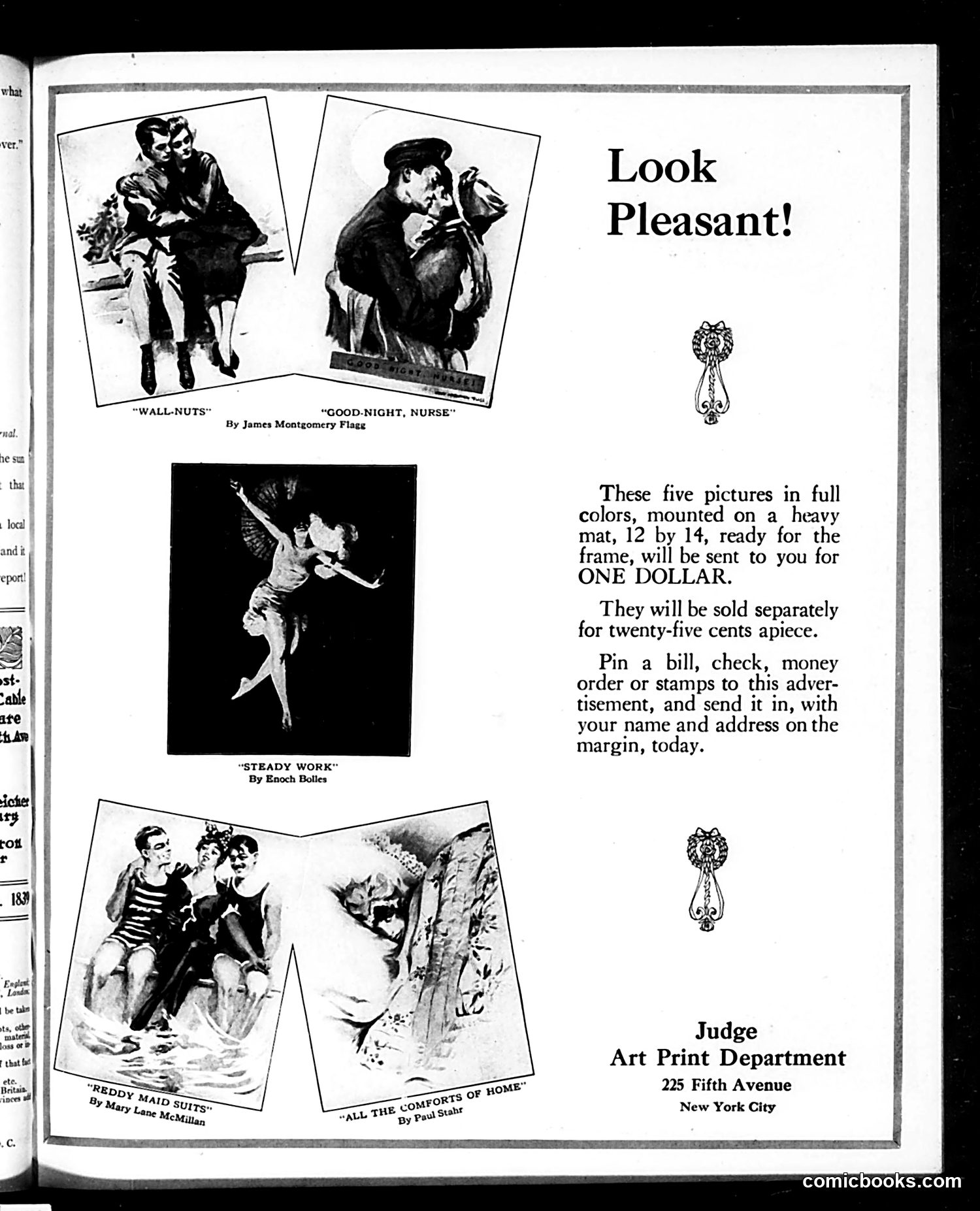
This page is primarily an advertisement for art prints rather than political satire. Judge's Art Print Department is selling five illustrations by prominent artists of the era—James Montgomery Flagg, Enoch Bolles, Mary Lace McMillan, and Paul Stahr. The images depict lighthearted domestic and romantic scenes typical of early 20th-century commercial illustration: couples in affectionate moments ("Wall-Nuts," "Good-Night, Nurse"), a woman in athletic pose ("Steady Work"), and leisure activities. These were aspirational, decorative images marketed to middle-class households. The advertisement offers a complete five-print set for one dollar (or twenty-five cents each separately)—affordable pricing for consumers. This represents Judge's business model: combining satirical editorial content with commercial print sales to generate revenue. The prints reflect the genteel, romantic aesthetic popular in that era's domestic décor.
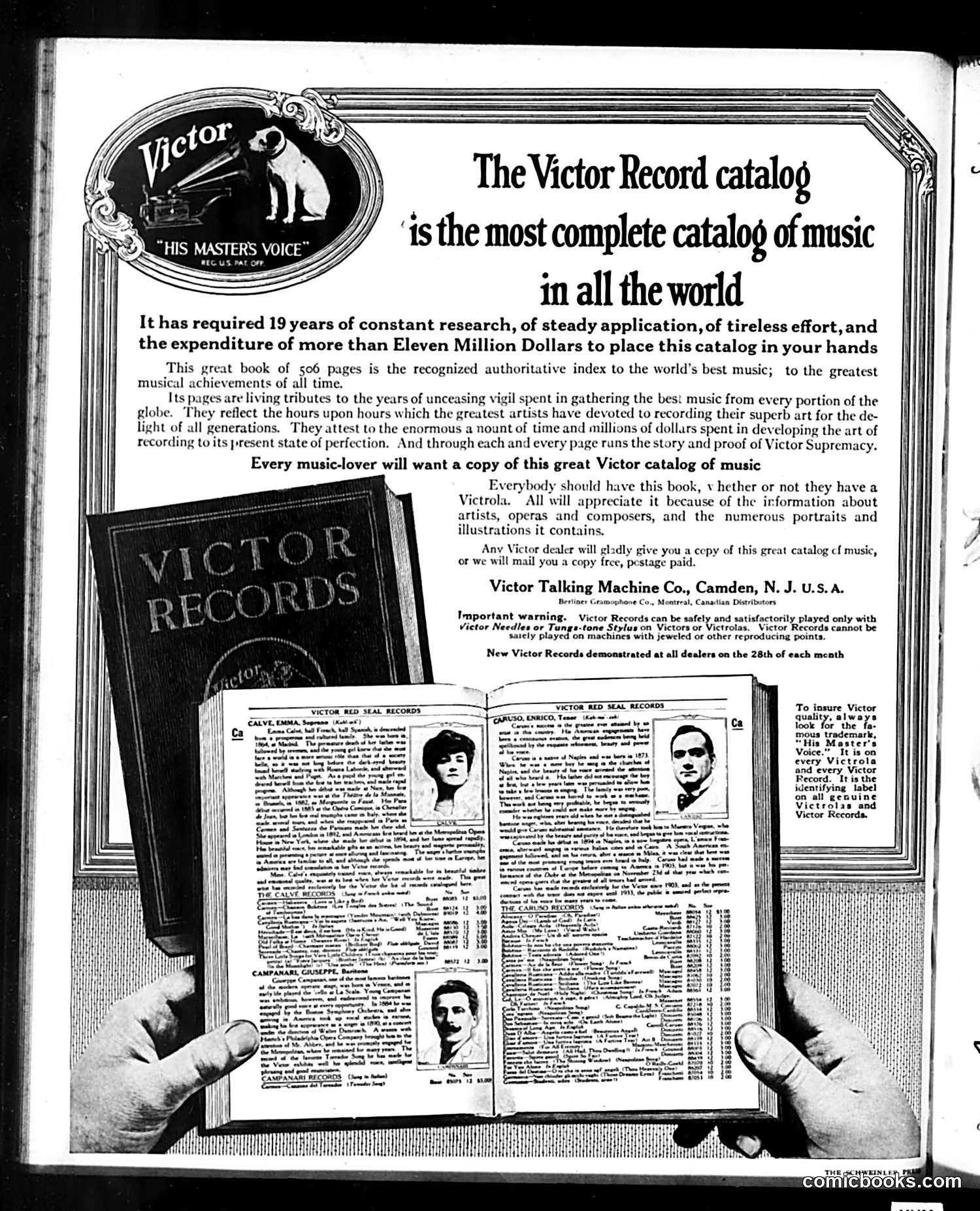
This page is **primarily advertising**, not political satire or cartoon content. It's a full-page advertisement for the Victor Talking Machine Company's record catalog, published in *Judge* magazine. The ad claims Victor's catalog is "the most complete catalog of music in all the world," requiring 19 years of research and over $11 million to produce. It features the famous "His Master's Voice" logo (the dog listening to a gramophone) and includes sample pages from the 506-page catalog showing Red Seal Records with artist photographs and biographical information. The text emphasizes Victor's supremacy in recorded music and includes a warning that Victor records should only be played on Victor machines with Victor needles—a protective claim against competing technologies. **No political cartoon or satire is evident here.** This is straightforward corporate advertising designed to promote Victor's product and brand authority within a general-interest magazine.