
Judge, 1917-01-13 · page 19 of 28
Judge — January 13, 1917 — page 19: what you’re looking at
What you’re looking at
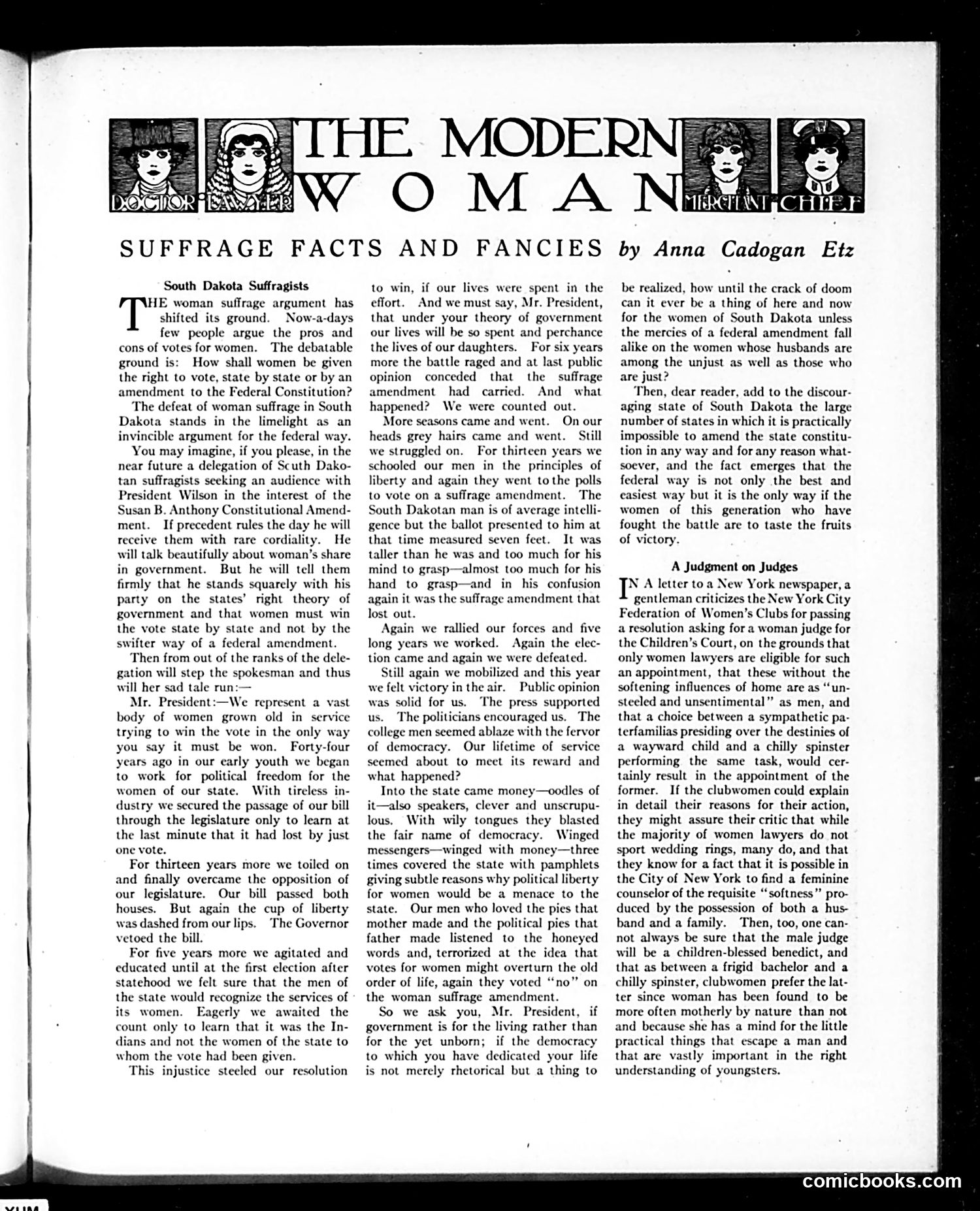
This page presents South Dakota suffragists' argument for a **federal constitutional amendment** rather than state-by-state suffrage efforts. The text is a satirical monologue addressed to President Wilson, documenting decades of failed suffrage campaigns in South Dakota despite repeated public support. The satire works through **exaggeration and irony**: the speaker catalogs absurd obstacles—a bill defeated by one vote, a governor's veto, voters confused by a seven-foot-tall ballot, and ultimately, out-of-state money and "unscrupulous speakers" reversing seeming victory. Each defeat becomes more ridiculous, emphasizing how the state-by-state approach handicaps women's suffrage efforts. The accompanying editorial argues that women deserve appointment to judgeships and other positions—that excluding them from influence while seeking their votes is hypocritical. Judge magazine appears critical of both foot-dragging on suffrage and dismissive attitudes toward women's capabilities.
📄 Transcribed text from this page (OCR, searchable)
Machine-transcribed from the original scan — historical spelling and the odd misread are preserved.
| | SUFFRAGE FACTS AND FANCIES South Dakota Suffragists HE woman suffrage argument has shifted its ground. Now-a-days few people argue the pros and cons of votes for women. The debatable ground is: How shall women be given the right to vote, state by state or by an amendment to the Federal Constitution? The defeat of woman suffrage in South Dakota stands in the limelight as an invincible argument for the federal way. You may imagine, if you please, in the near future a delegation of Scuth Dako- tan suffragists seeking an audience with President Wilson in the interest of the Susan B. Anthony Constitutional Amend- ment. If precedent rules the day he will receive them with rare cordiality. He will talk beautifully about woman’s share in government. But he will tell them firmly that he stands squarely with his party on the states’ right theory of government and that women must win the vote state by state and not by the swifter way of a federal amendment. Then from out of the ranks of the dele- gation will step the spokesman and thus will her sad tale run:— Mr. President:—We represent a vast body of women grown old in service trying to win the vote in the only way you say it must be won. Forty-four years ago in our early youth we began to work for political freedom for the women of our state. With tireless in- dustry we secured the passage of our bill through the legislature only to learn at the last minute that it had lost by just one vote. For thirteen years more we toiled on and finally overcame the opposition of our legislature. Our bill passed both houses. But again the cup of liberty was dashed from our lips. The Governor vetoed the bill. For five years more we agitated and educated until at the first election after statehood we felt sure that the men of the state would recognize the services of its women. Eagerly we awaited the count only to learn that it was the In- dians and not the women of the state to whom the vote had been given. This injustice steeled our resolution to win, if our lives were spent in the effort. And we must say, Mr. President, that under your theory of government our lives will be so spent and perchance the lives of our daughters. For six years more the battle raged and at last public opinion conceded that the suffrage amendment had carried. And what happened? We were counted out. More seasons came and went. On our heads grey hairs came and went. Still we struggled on. For thirteen years we schooled our men in the principles of liberty and again they went to the polls to vote on a suffrage amendment. The South Dakotan man is of average intelli- gence but the ballot presented to him at that time measured seven feet. It was taller than he was and too much for his mind to grasp—almost too much for his hand to grasp—and in his confusion again it was the suffrage amendment that lost out. Again we rallied our forces and five long years we worked. Again the clec- tion came and again we were defeated. ll again we mobilized and this year we felt victory in the air. Public opinion was solid for us. The press supported us. The politicians encouraged us. The college men seemed ablaze with the fervor of democracy. Our lifetime of service seemed about to meet its reward and what happened? Into the state came money—oodles of it—also speakers, clever and unscrupu- lous. With wily tongues they blasted the fair name of democracy. Winged messengers—winged with money—three times covered the state with pamphlets giving subtle reasons why political liberty for women would be a menace to the state. Our men who loved the pies that mother made and the political pies that father made listened to the honeyed words and, terrorized at the idea that votes for women might overturn the old order of life, again they voted “no” on the woman suffrage amendment. So we ask you, Mr. President, if government is for the living rather than for the yet unborn; if the democracy to which you have dedicated your life is not merely rhetorical but a thing to by Anna Cadogan Etz be realized, how until the crack of doom can it ever be a thing of here and now for the women of South Dakota unless the mercies of a federal amendment fall alike on the women whose husbands are among the unjust as well as those who are just? Then, dear reader, add to the discour- aging state of South Dakota the large number of states in which it is practically impossible to amend the state constitu- tion in any way and for any reason what- soever, and the fact emerges that the federal way is not only the best and easiest way but it is the only way if the women of this generation who have fought the battle are to taste the fruits of victory. A Judgment on Judges N A letter toa New York newspaper, a gentleman criticizes the New York City Federation of Women’s Clubs for passing a resolution asking for a woman judge for the Children’s Court, on the grounds that only women lawyers are eligible for such an appointment, that these without the softening influences of home are as “un- steeled and unsentimental” as men, and that a choice between a sympathetic pa- terfamilias presiding over the destinies of a wayward child and a chilly spinster performing the same task, would cer- tainly result in the appointment of the former. If the clubwomen could explain in detail their reasons for their action, they might assure their critic that while the majority of women lawyers do not sport wedding rings, many do, and that they know for a fact that it is possible in the City of New York to find a feminine counselor of the requisite “softness” pro- duced by the possession of both a hus- band and a family. Then, too, one can- not always be sure that the male judge will be a children-blessed benedict, and that as between a frigid bachelor and a chilly spinster, clubwomen prefer the lat- ter since woman has been found to be more often motherly by nature than not and because she has a mind for the little practical things that escape a man and that are vastly important in the right understanding of youngsters. comicbooks.com