
Judge, 1917-01-13 · page 18 of 28
Judge — January 13, 1917 — page 18: what you’re looking at
What you’re looking at
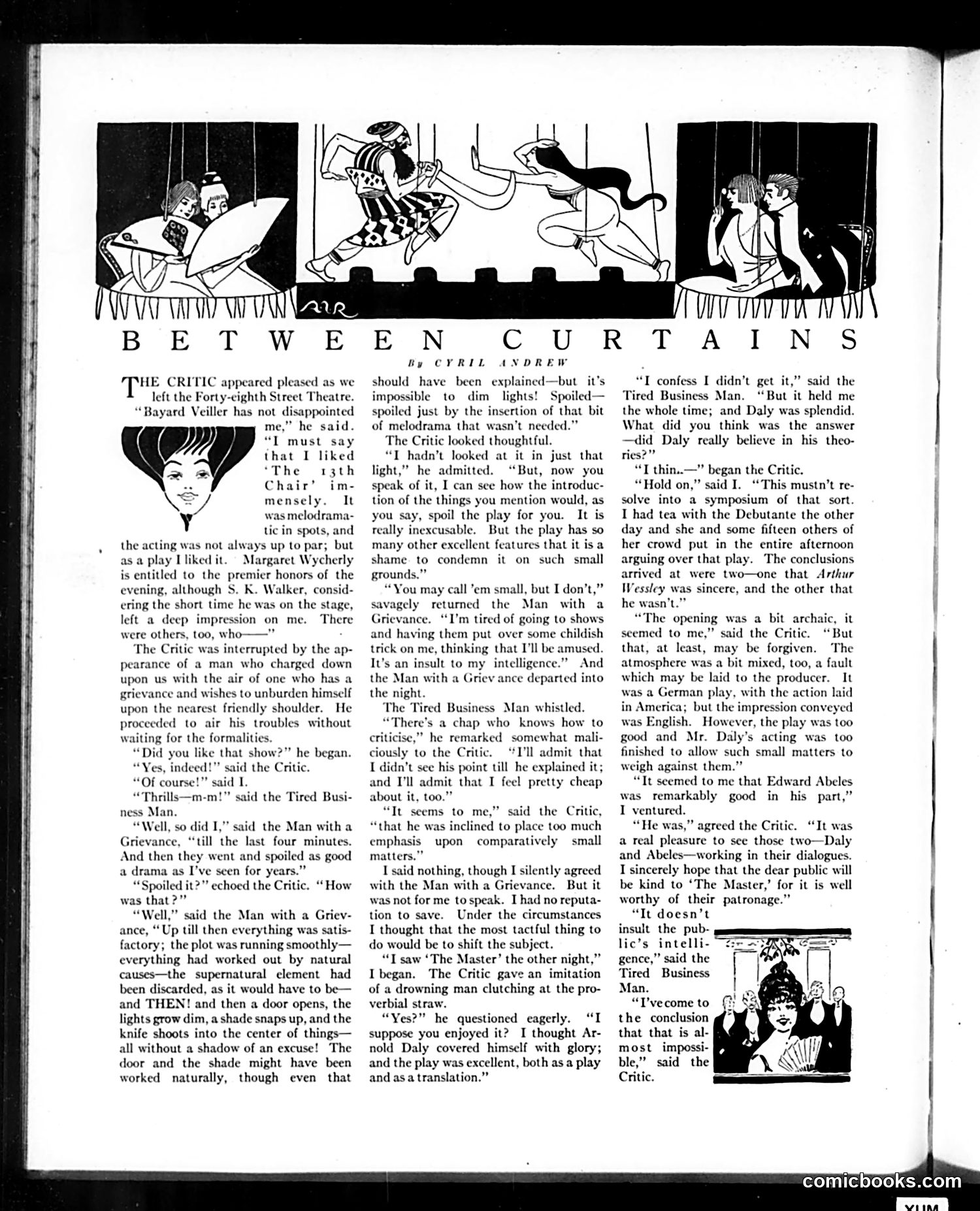
This article satirizes theatrical criticism and the gap between critics and ordinary audiences. The setup presents a "Critic" (appearing to represent professional theater reviewers) who dismisses audience complaints as pedantic. When a "Man with a Grievance" objects to *The 13th Chair* using artificial melodramatic devices (a mysteriously opening door, dimming lights, a knife appearing) to resolve the plot, the Critic acknowledges the technical flaw but dismisses it as "small grounds" given the play's other merits. The satire's point: critics prioritize overall theatrical spectacle and reputation (the actor Arnold Daly "covered himself with glory"), while regular theatergoers care about logical consistency and honest storytelling. The "Tired Business Man" and the narrator silently agree with the Grievance man but stay quiet, suggesting audiences self-censor around critics rather than voice genuine opinions. The cartoon illustrates this disconnect between critical establishment and public taste in early 20th-century American theater.
📄 Transcribed text from this page (OCR, searchable)
Machine-transcribed from the original scan — historical spelling and the odd misread are preserved.
BET W E HE CRITIC appeared pleased as we left the Forty-eighth Street Theatre. “Bayard Veiller has not disappointed me,” he said. “LT must say that I liked ‘The 13th Chair’ im- mensely. It was melodrama- tic in spots, and the acting was not always up to asa play I likedit. ering the short time he was on the stage, left a deep impression on me. There were others, too, who——"’ The Critic interrupted by the ap- pearance of a man who charged down upon us with the air of one who has a grievance and wishes to unburden himself upon the nearest friendly shoulder. He proceeded to air his troubles without waiting for the formalitie “Did you like that show?” he began. “Yes, indeed!” said the Critic. “Of course!” said I. “Thrills—m-m!” said the Tired Busi- ness Man. “Well, so did I,” said the Man with a Grievance, “till the last four minutes. And then they went and spoiled as good a drama as I’ve seen for years.” “Spoiled echoed the Critic. ‘How was that ? “Well,” said the Man with a Griev- ance, “Up till then everything was satis- factory; the plot was running smoothly— everything had worked out by natural causes—the supernatural element had been discarded, as it would have to be— and THEN! and then a door opens, the lights grow dim, a shade snaps up, and the knife shoots into the center of things— all without a shadow of an excuse! The door and the shade might have been worked naturally, though even that E N By CYRIL ANDREW should have been explained—but it’s impossible to dim Spoiled— spoiled just by the insertion of that bit of melodrama that wasn’t needed.” The Critic looked thoughtful. “T hadn’t looked at it in just that light,” he admitted. “But, now you speak of it, I can see how the introduc- tion of the things you mention would, as you say, spoil the play for you. It is really inexcusable. But the play has so many other excellent features that it is a shame to condemn it on such small grounds.” “You may call ’em small, but I don’t,” savagely returned the Man with a Grievance. “I’m tired of going to shows and having them put over some childish trick on me, thinking that I'll be It’s an insult to my intelligence the Man with a Griev ance departed into the night. The Tired Business Man whistled. “There's a chap who knows how to * he remarked somewhat mali- to the Crit “Tl admit that I didn’t see his point till he explained it; and I'll admit that I feel pretty cheap about it, too.” “It seems to me,” said the Critic, “that he was inclined to place too much emphasis upon comparatively small matters,” I said nothing, though I silently agreed with the Man with a Grievance. But it was not for me to speak. I had no reputa- tion to save. Under the circumstances I thought that the most tactful thing to do would be to shift the subject. “T saw ‘The Master’ the other night,” I began. The Critic gave an imitation of a drowning man clutching at the pro- verbial straw. “Yes?” he questioned eagerly. “I suppose you enjoyed it? I thought Ar- nold Daly covered himself with glory; and the play was excellent, both as a play and asa translation.” C U RTA I “I confess I didn’t get it,” said the Tired Business Man. “But it held me the whole time; and Daly was splendid. What did you think was the answer —did Daly really believe in his theo- ries?” “T thin..—” began the Critic. “Hold on,” said I. “This mustn’t re- solve into a symposium of that sort. I had tea with the Debutante the other day and she and some fifteen others of her crowd put in the entire afternoon arguing over that play. The conclusions arrived at were two—one that Arthur Wessley was sincere, and the other that N S$ he wasn’t.” “The opening was a bit archaic, it scemed to me,” said the Crit “But that, at least, may be forgi The atmosphere was a bit mixed, too, a fault which may be laid to the producer. It was a German play, with the action laid in America; but the impression conveyed was English. However, the play was too good and Mr. Daly’s acting too finished to allow such small matters to weigh against them.” “Tt seemed to me that Edward Abeles was remarkably good in his part,” I ventured. “He was,” agreed the Critic. “It was a real pleasure to sce those two—Daly and Abeles—working in their dialogues. I sincerely hope that the dear public will be kind to ‘The Master,’ for it is well worthy of their patronage.” “It doesn’t insult the pub- lic’s intelli- gence,” said the Tired Business Man. “T’vecome to the conclusion that that is al- most impossi- ble,” said the Critic. comicbooks.com