
Judge, 1917-01-13 · page 12 of 28
Judge — January 13, 1917 — page 12: what you’re looking at
What you’re looking at
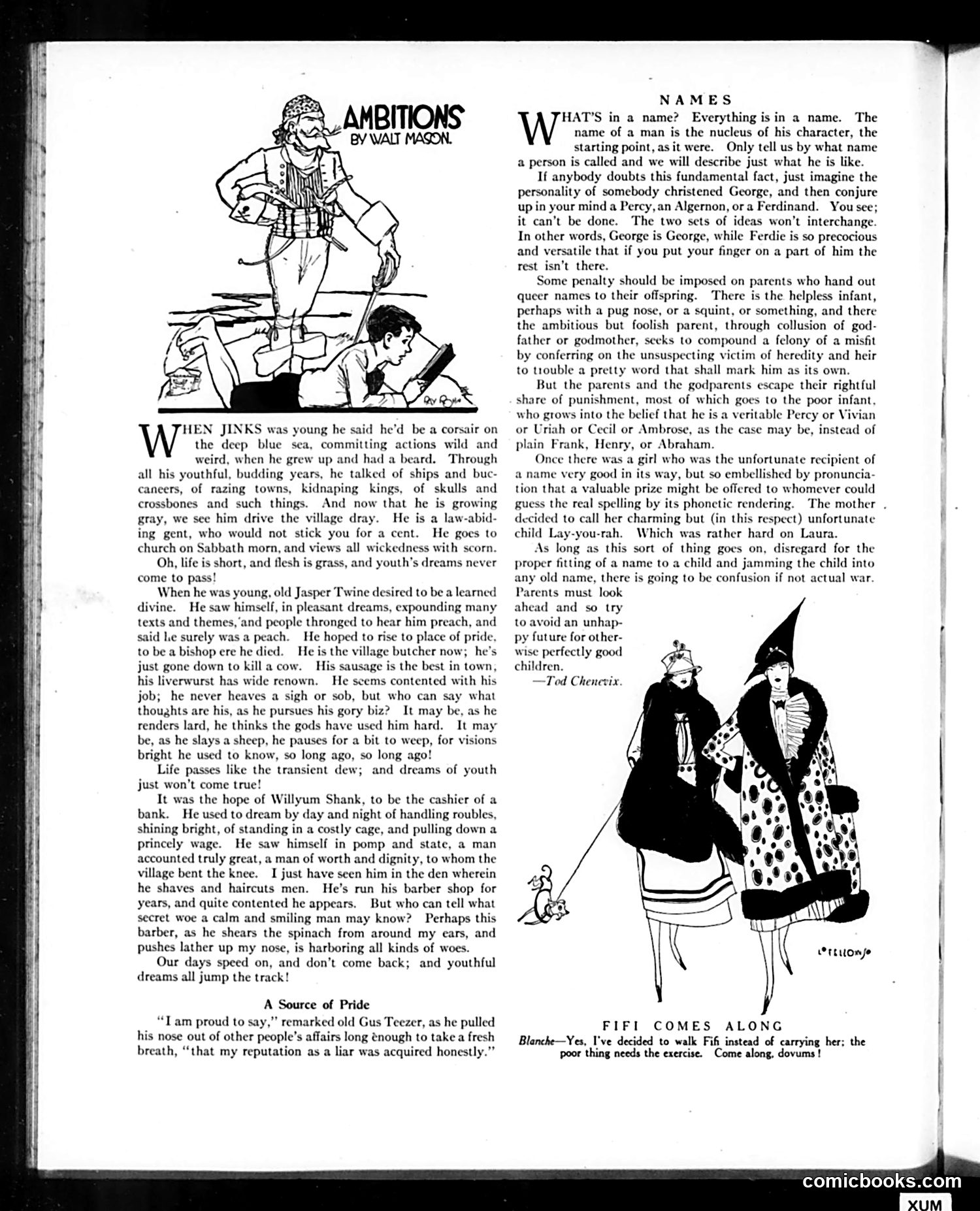
Walt Mason's "Ambitions" satirizes the gap between youthful fantasies and adult reality. Three men—Jinks, Jasper Twine, and William Shank—each dreamed grand ambitions as boys: Jinks imagined becoming a pirate; Twine aspired to be a learned preacher; Shank dreamed of banking wealth and status. As adults, all three have settled into modest, ordinary village jobs—driving a cart, butchering meat, cutting hair—yet apparently accept their fates without visible regret. Mason's point: youth's romantic dreams inevitably "jump the track" and disappear with age. The accompanying editorial on "Names" argues that a person's identity is essentially fixed—a complementary meditation on destiny and character. The satire gently mocks both youthful naiveté and the resigned acceptance of mediocrity in working-class life.
📄 Transcribed text from this page (OCR, searchable)
Machine-transcribed from the original scan — historical spelling and the odd misread are preserved.
HEN JINKS was young he said he’d be a corsair on W the deep blue sea, committing actions wild and weird, when he grew up and had a beard. Through all his youthful, budding years, he talked of ships and buc- caneers, of razing towns, kidnaping kings, of skulls and crossbones and such things. And now that he is growing gray, we see him drive the village dray. He is a law-abid- ing gent, who would not stick you for a cent. He goes to church on Sabbath morn, and v all wic! with scorn. Oh, life is short, and flesh is grass, and youth’s dreams never come to pas: When he divine. He as young, old Jasper Twine desired to be a learned w himself, in pleasant dreams, expounding many nd people thronged to hear him preach, and sa peach. He hoped to rise to place of pride, to be a bishop ere he di He is the village butcher now; he’s just gone down to kill a cow. His sausage is the best in town, his liverwurst has wide renown. He seems contented with his job; he never hea a sigh or sob, but who can say what thoughts are his, as he pursues his gory biz? It may be renders lard, he thinks the gods have used him hard. It may be, as he slays a sheep, he pauses for a bit to weep, for visions bright he used to know, so long ago, so long ago! Life passes like the transient dew; and dreams of youth just won't come true! It was the hope of Willyum Shank, to be the cashier of a bank. He used to dream by day and night of handling roubles, shining bright, of standing in a costly cage, and pulling down a princely wage. He saw himself in pomp and state, a man accounted truly great, a man of worth and dignity, to whom the village bent the knee. I just have seen him in the den wherein he shaves and haircuts men. He’s run his barber shop for years, and quite contented he appears. But who can tell what secret woe a calm and smiling man may know? Perhaps this barber, as he shears the spinach from around my ears, and pushes lather up my nose, is harboring all kinds of woes. Our days speed on, and don’t come back; and youthful dreams all jump the track! A Source of Pride “Tam proud to say,” remarked old Gus Teezer, as he pulled his nose out of other people's affairs long tnough to take a fresh breath, “that my reputation as a liar was acquired honestly.” NAMES HAT’S in a name? Everything is in a name. The W name of a man is the nucleus of his character, the starting point, asit were. Only tell us by what name a person is called and we will describe just what he is like. If anybody doubts this fundamental fact, just imagine the personality of somebody christened George, and then conjure up in your mind a Percy, an Algernon, ora Ferdinand. You see; it can’t be done. The two sets of id won't interchange. In other words, George is George, while Ferdie is so precocious and versatile that if you put your finger on a part of him the rest isn’t there. Some penalty should be imposed on parents who hand out queer names to their offspring. There is the helpless infant, perhaps with a pug nose, or a squint, or something, and there the ambitious but foolish parent, through collusion of god- father or godmother, seeks to compound a felony of a misfit by conferring on the unsuspecting victim of heredity and heir to trouble a pretty word that shall mark him as its own, But the parents and the godparents escape their rightful share of punishment, most of which goes to the poor infant, who grows into the belief that he is a veritable Percy or Vivian or Uriah or Cecil or Ambrose, as the case may be, instead of plain Frank, Henry, or Abraham. Once there was a girl who was the unfortunate recipient of -y good in its way, but so embellished by pronuncia- tion that a valuable prize might be offered to whomever could the real spelling by its phonetic rendering. The mother led to call her charming but (in this respect) unfortunate child Lay-you-rah. Which was rather hard on Laura. As long as this sort of thing goes on, disregard for the proper fitting of a name to a child and jamming the child into any old name, there is going to be confusion if not actual war. Parents must look ahead and so try to avoid an unhap- py future for other- wise perfectly good children. —Tod Chenevix ertuonje FIFI COMES ALONG Blanche—Yes, I've decided to walk Fifi instead of carrying her; the poor thing needs the exercise. Come along, dovums ! comicbooks.com