
A complete issue · 32 pages · 1916
Judge — November 25, 1916
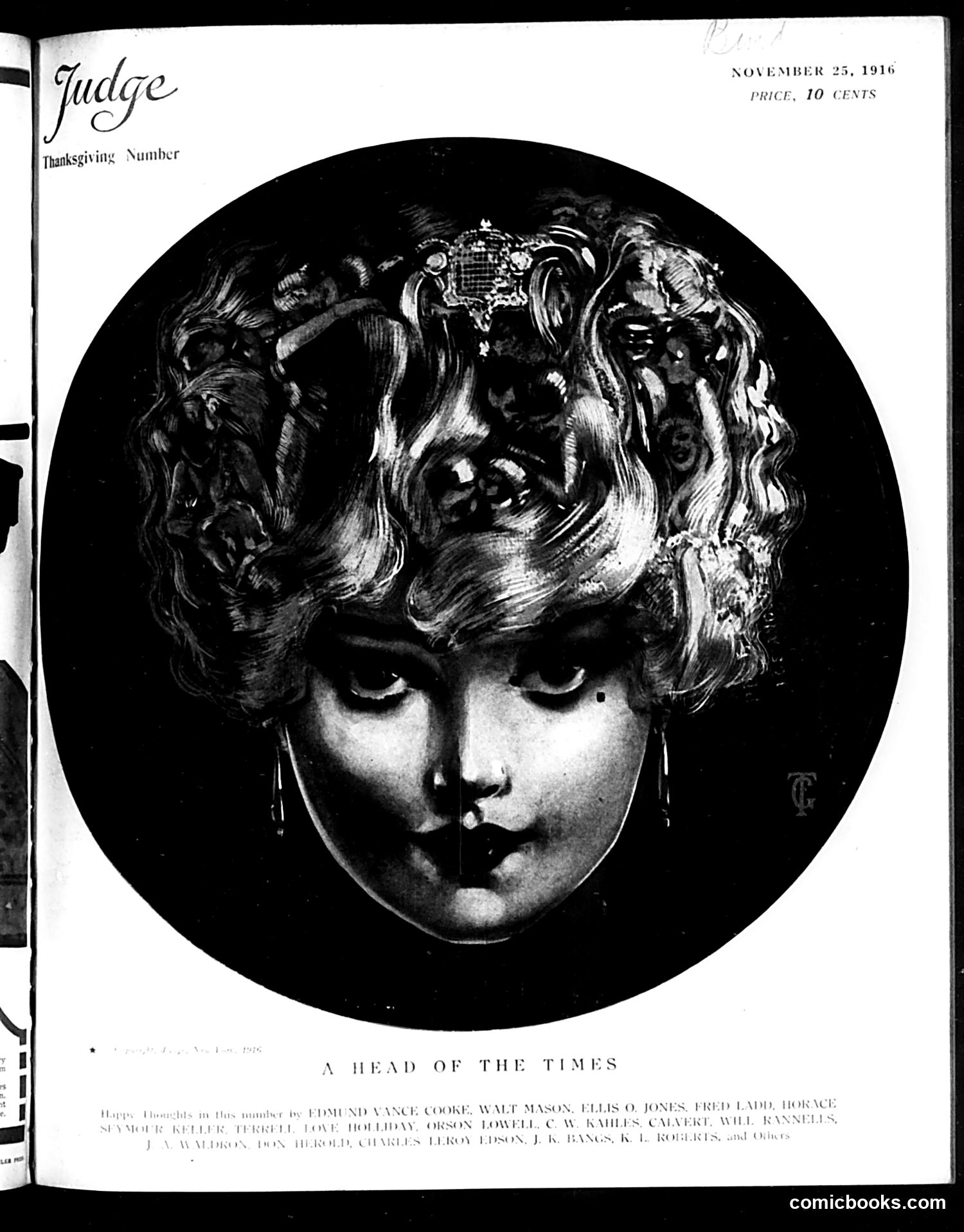
This is the Thanksgiving issue's cover illustration, presenting a stylized female head with elaborate period hairstyling and decorative ornaments. The title "A Head of the Times" is a pun referencing contemporary fashions and social trends. The lengthy caption lists contributors including Edmund Vance Cooke, Walt Mason, Ellis O. Jones, and others—prominent humorists and writers of the era. Rather than a specific political cartoon, this appears to be a decorative cover celebrating fashionable, modern womanhood during the 1910s, likely satirizing women's hairstyles and accessories as markers of cultural "progress" and modernity. The artwork's Art Deco influence reflects the period's aesthetic sensibilities.
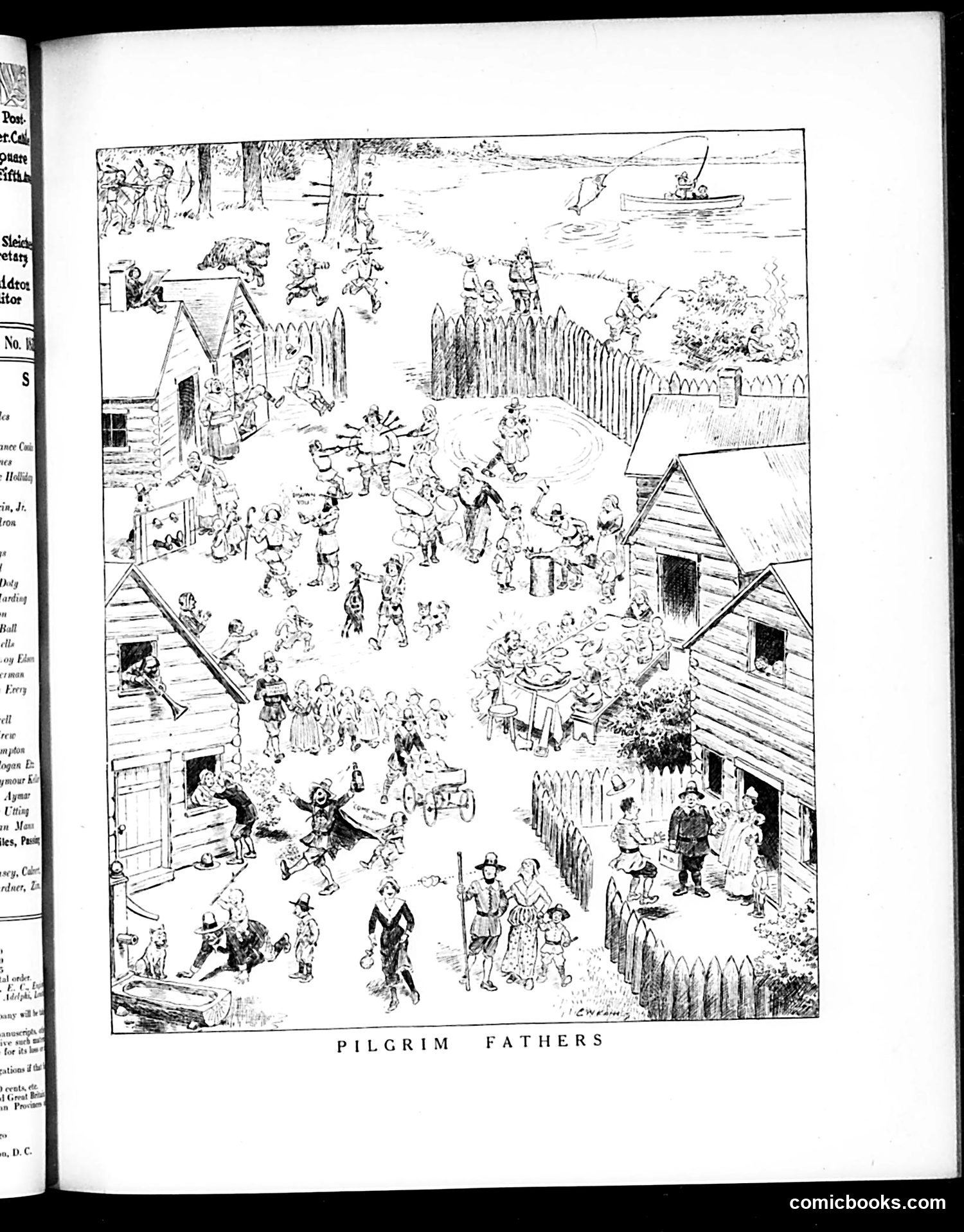
This illustration depicts a bustling colonial settlement scene titled "Pilgrim Fathers," referencing the English Separatists who founded Plymouth Colony in 1620. The detailed engraving shows everyday community life with numerous settlers engaged in various activities—children playing, adults working, families interacting—around wooden buildings, fences, and waterfront areas with boats visible. The image appears to be a nostalgic or commemorative illustration rather than political satire. It celebrates early American colonial life and community, presenting an idealized vision of Pilgrim settlement and industriousness. The comprehensive detail of daily activities—work, leisure, commerce, and family life—emphasizes the industrious nature of these founding colonists and their establishment of organized society in the New World.
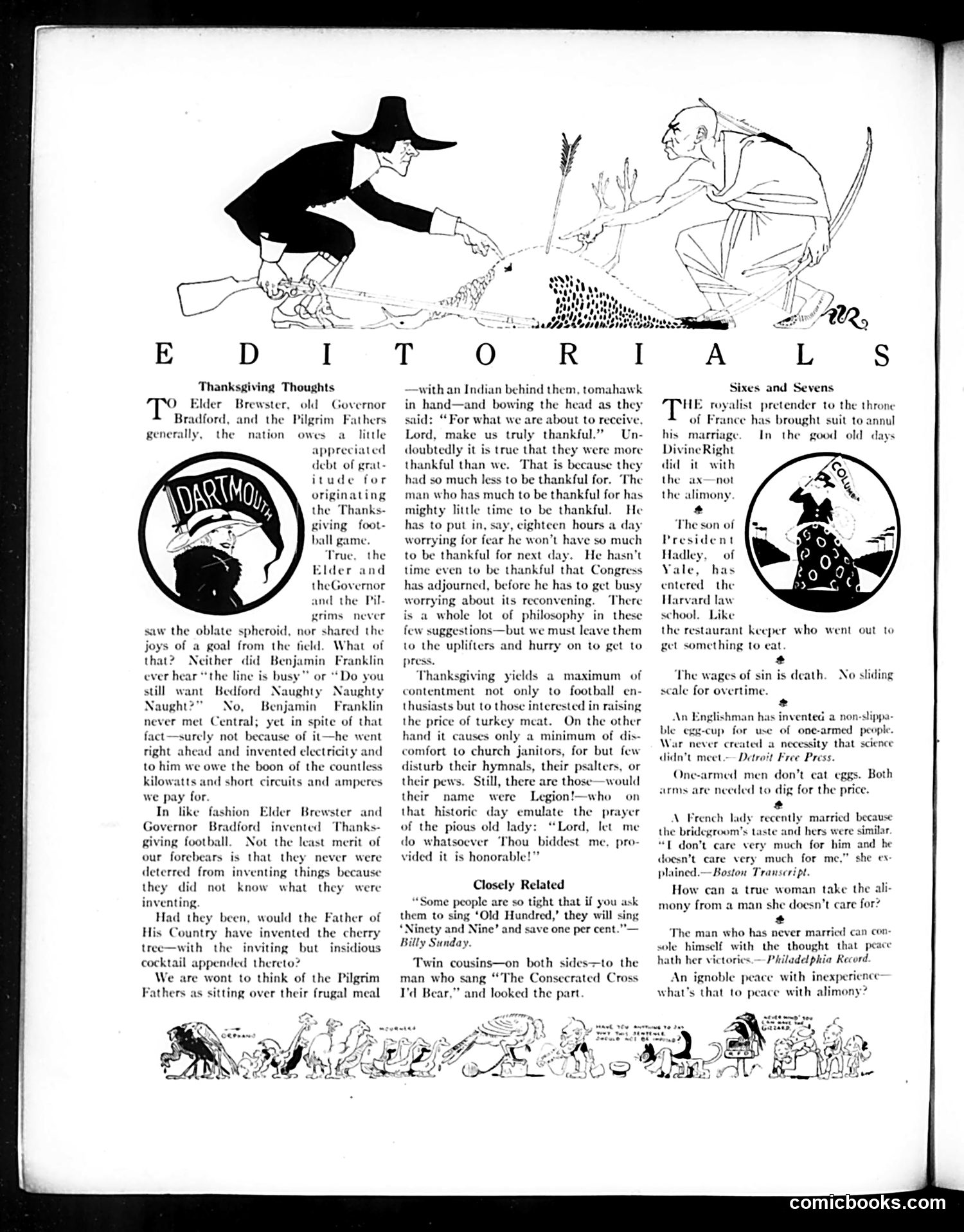
The top cartoon illustrates "Thanksgiving Thoughts," depicting two figures—appearing to be Native Americans and Pilgrims—over a fish, referencing the historical Thanksgiving narrative. The satire critiques gratitude: the text argues that while Elder Brewster and the Pilgrim Fathers had reason to be thankful (having less), modern Americans with far more possess less gratitude. The piece mocks this irony, noting Benjamin Franklin never invented things from gratitude—only necessity. The right column contains social commentary on topics including French royalist pretensions, Harvard's social elite, and various moral observations presented as brief witticisms. The page functions primarily as editorial commentary rather than comic strips, using humor to critique American social attitudes and contemporary society.
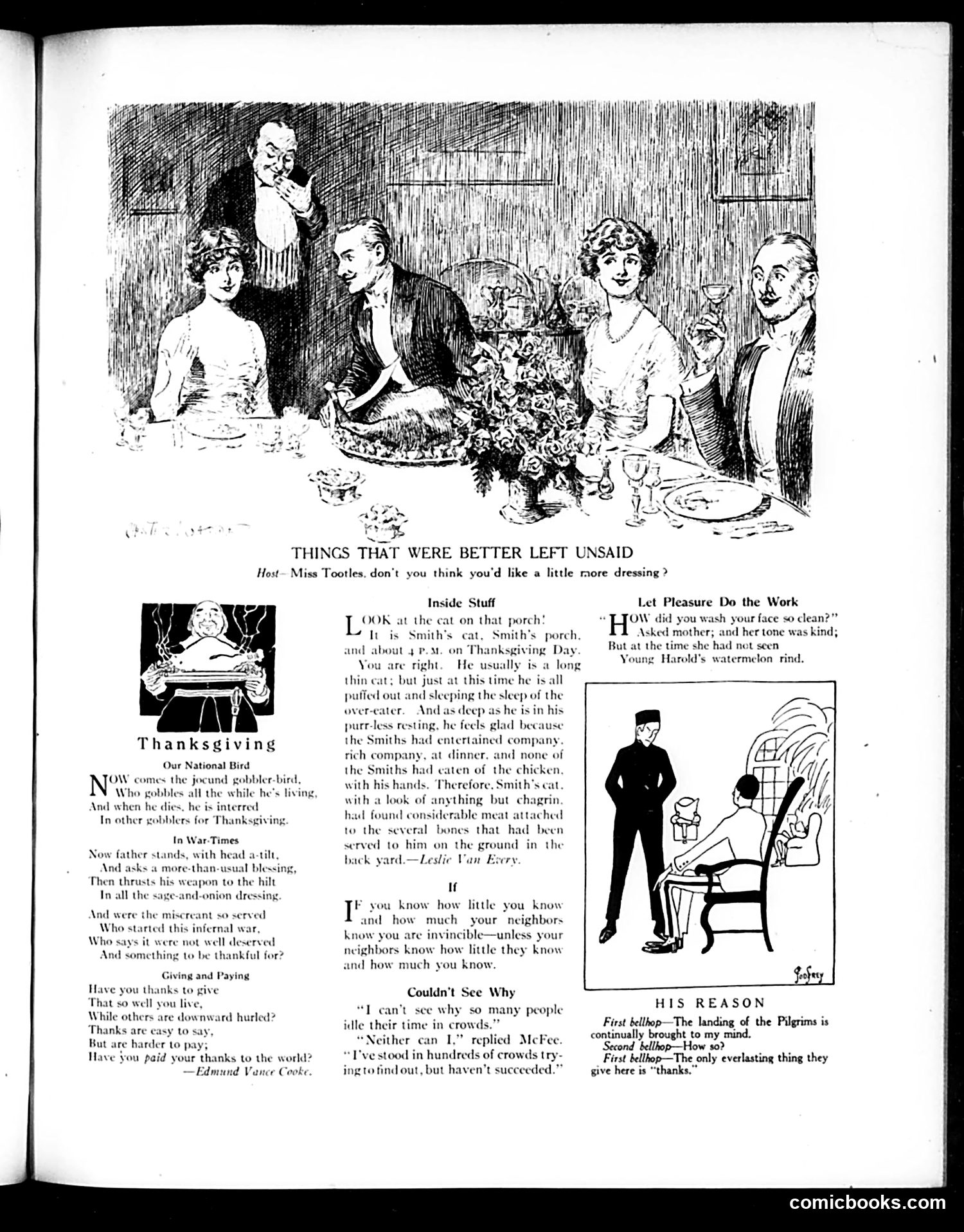
This page contains social humor and advice columns rather than political satire. The main cartoon, "Things That Were Better Left Unsaid," depicts a dinner party where the host asks a guest about wanting more dressing—an awkward social moment. Below are several humorous pieces: "Thanksgiving" celebrates the national holiday; "Inside Stuff" humorously describes a cat's behavior on Thanksgiving; "Let Pleasure Do the Work" presents a joke about a child washing their face; and "His Reason" shows a cartoon about neighbors' knowledge and gossip. The content reflects early 20th-century domestic humor focused on etiquette mishaps, holiday customs, and neighborly relations rather than partisan politics.
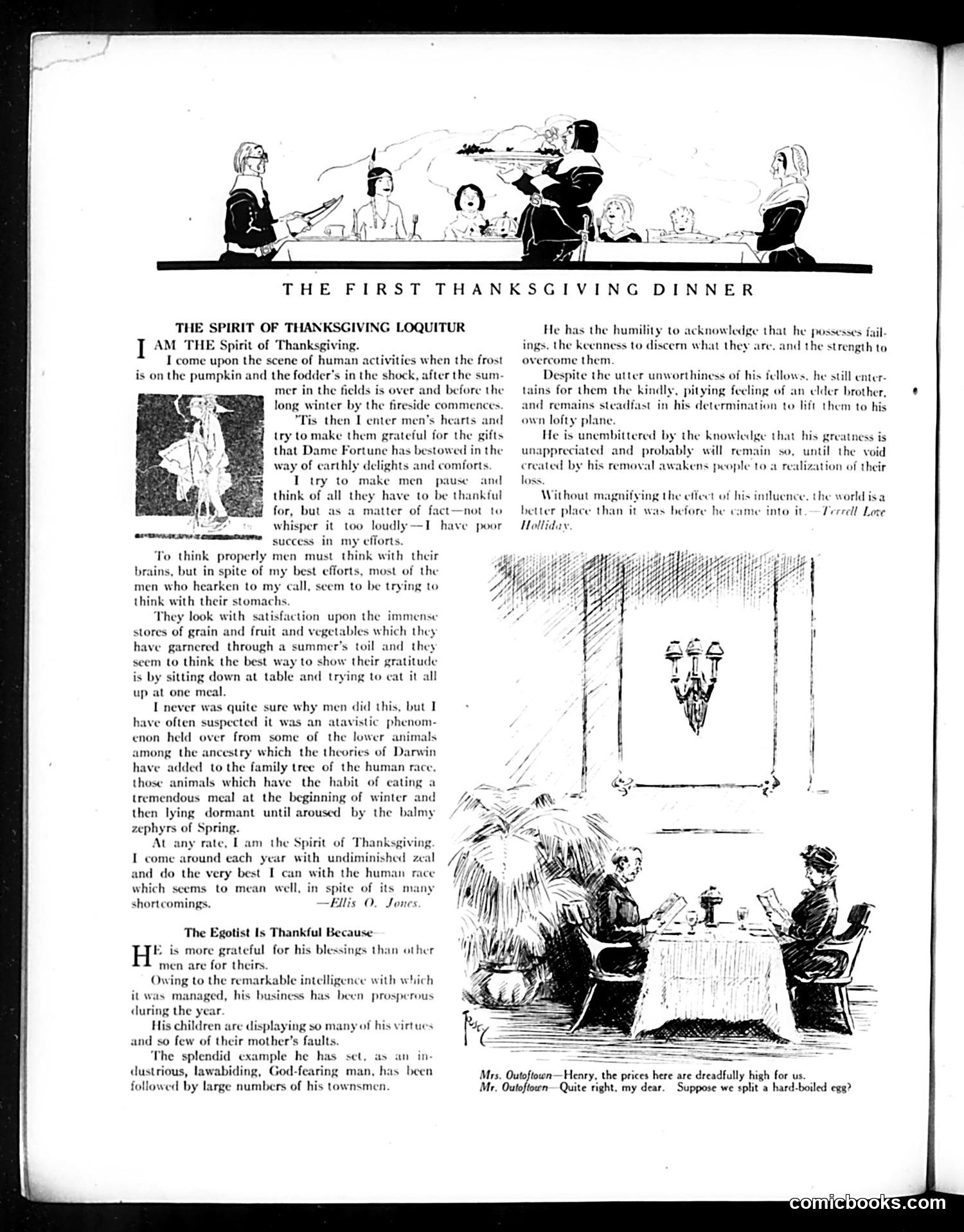
This page presents Thanksgiving satire targeting American materialism and self-regard. **Top section**: "The Spirit of Thanksgiving" personified laments that humans celebrate the holiday by gorging themselves rather than practicing genuine gratitude. The Spirit wryly suggests this gluttony is an "atavistic" holdover from animals that feast before winter hibernation—a Darwinian jab at human behavior. **Bottom cartoon**: Satirizes the self-important "egotist" who attributes his business success entirely to his own intelligence and his children's virtues to his genes (not their mother's influence). He condescendingly pities his inferior townsmen. The final exchange mocks this smugness: when his wife notes high prices, he smugly suggests they economize by splitting one hard-boiled egg—revealing his cheap nature beneath the self-aggrandizing rhetoric. The satire targets wealthy, self-made men of the era who credited personal merit alone for success while demonstrating miserliness and moral superiority.
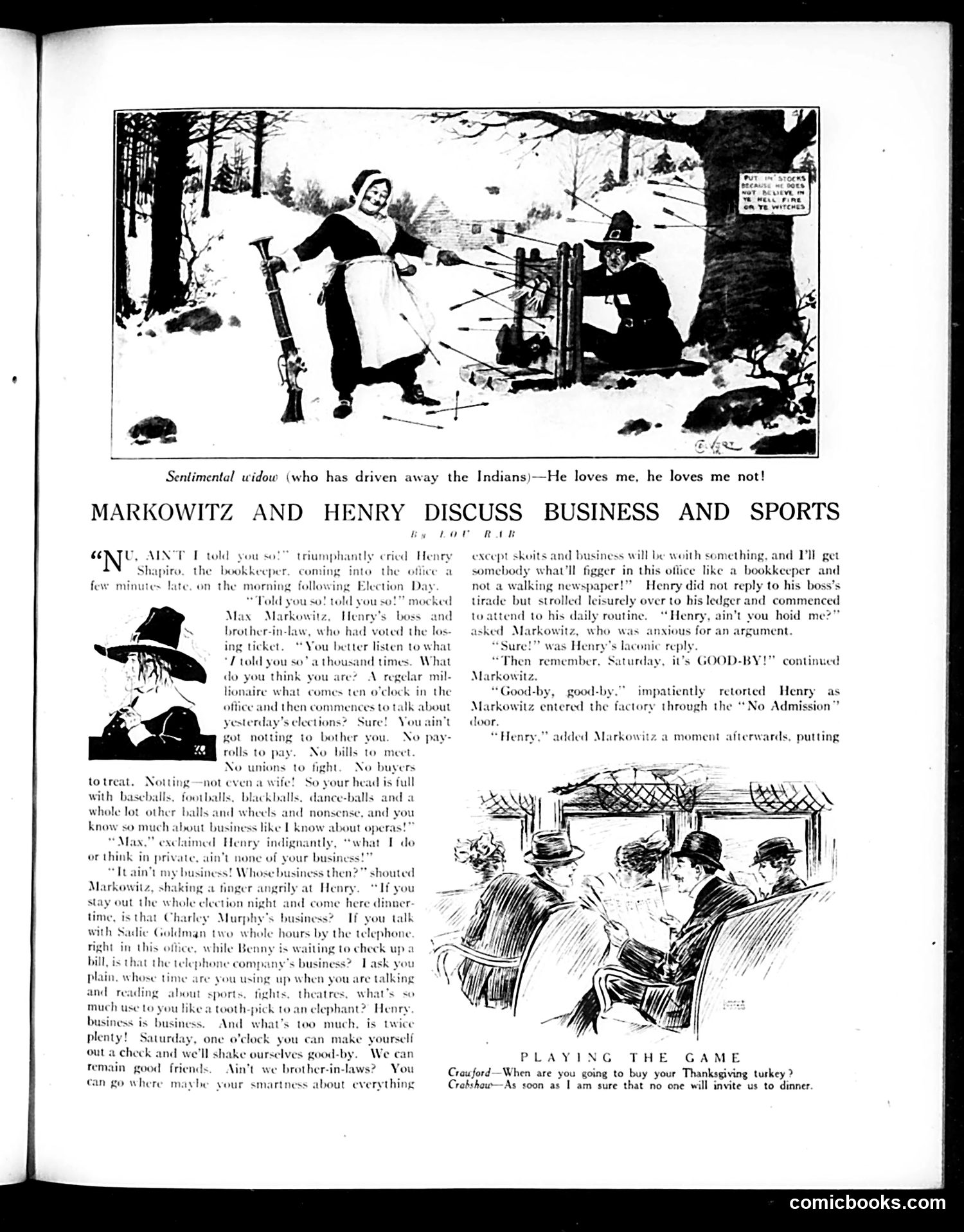
This page from *Judge* magazine contains two satirical pieces: **Top cartoon:** A "Sentimental Widow" plucking flower petals ("he loves me, he loves me not") while a Pilgrim-era figure sits nearby with a rifle. The caption implies she's driven away Native Americans. This is dark colonial-era satire, likely mocking sentimental romanticism about frontier conquest. **Main story:** "Markowitz and Henry Discuss Business and Sports" depicts a boss-employee conflict. Max Markowitz (the owner) berates his bookkeeper Henry for being late the day after an election, then launches into a tirade about Henry wasting company time thinking about sports, elections, and entertainment instead of work. Henry responds tersely, and Markowitz fires him, saying they'll "shake hands good-by Saturday." The satire targets working-class immigrant characters (Jewish surnames) and mocks both the overbearing, chatty boss and the disengaged employee. The bottom cartoon jokes about buying Thanksgiving turkey only if no one invites you to dinner—social commentary on economic hardship or social isolation.
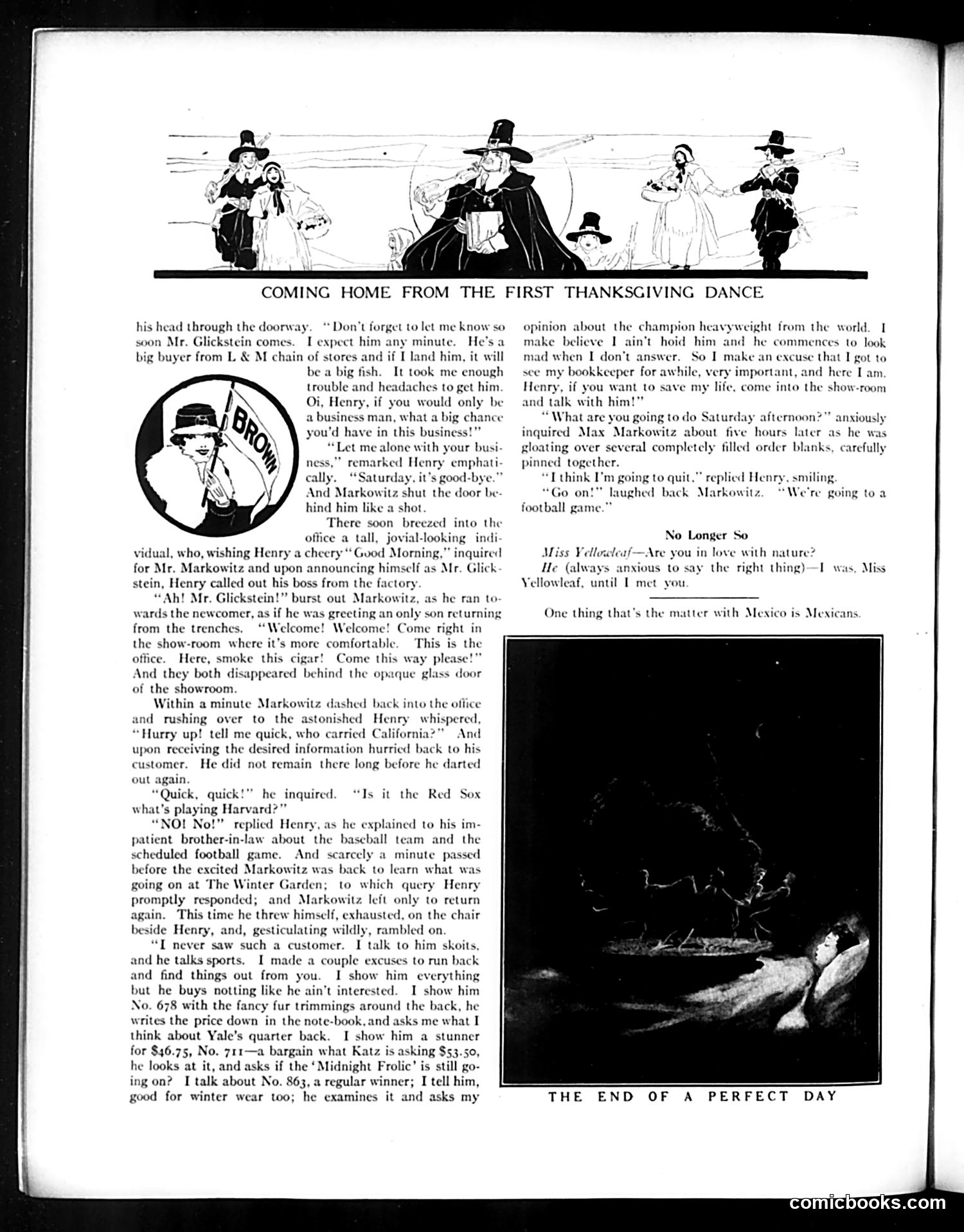
This page contains a humorous story about Henry and his brother-in-law Markowitz, a garment businessman. The satire centers on **immigrant Jewish character types** common in early 20th-century American comedy. Markowitz is portrayed as an anxious, excitable merchant obsessed with making a sale to "Mr. Glickstein," a big buyer. He repeatedly interrupts Henry (his employee/brother-in-law) with urgent questions about sports—baseball, football, Yale's quarterback, boxing—desperately trying to engage his customer in casual conversation while neglecting to actually sell merchandise. The joke relies on ethnic stereotyping: Markowitz speaks in exaggerated Yiddish-inflected English ("oi," "skoits," "notting") and embodies the "nervous businessman" archetype. The humor derives from his frantic behavior and misplaced priorities—he knows nothing about sports but frantically learns facts to entertain his customer, while Henry (the more grounded character) remains calm. The page also contains an unrelated romantic vignette ("No Longer So") and an advertisement, typical of Judge's mixed-content format.
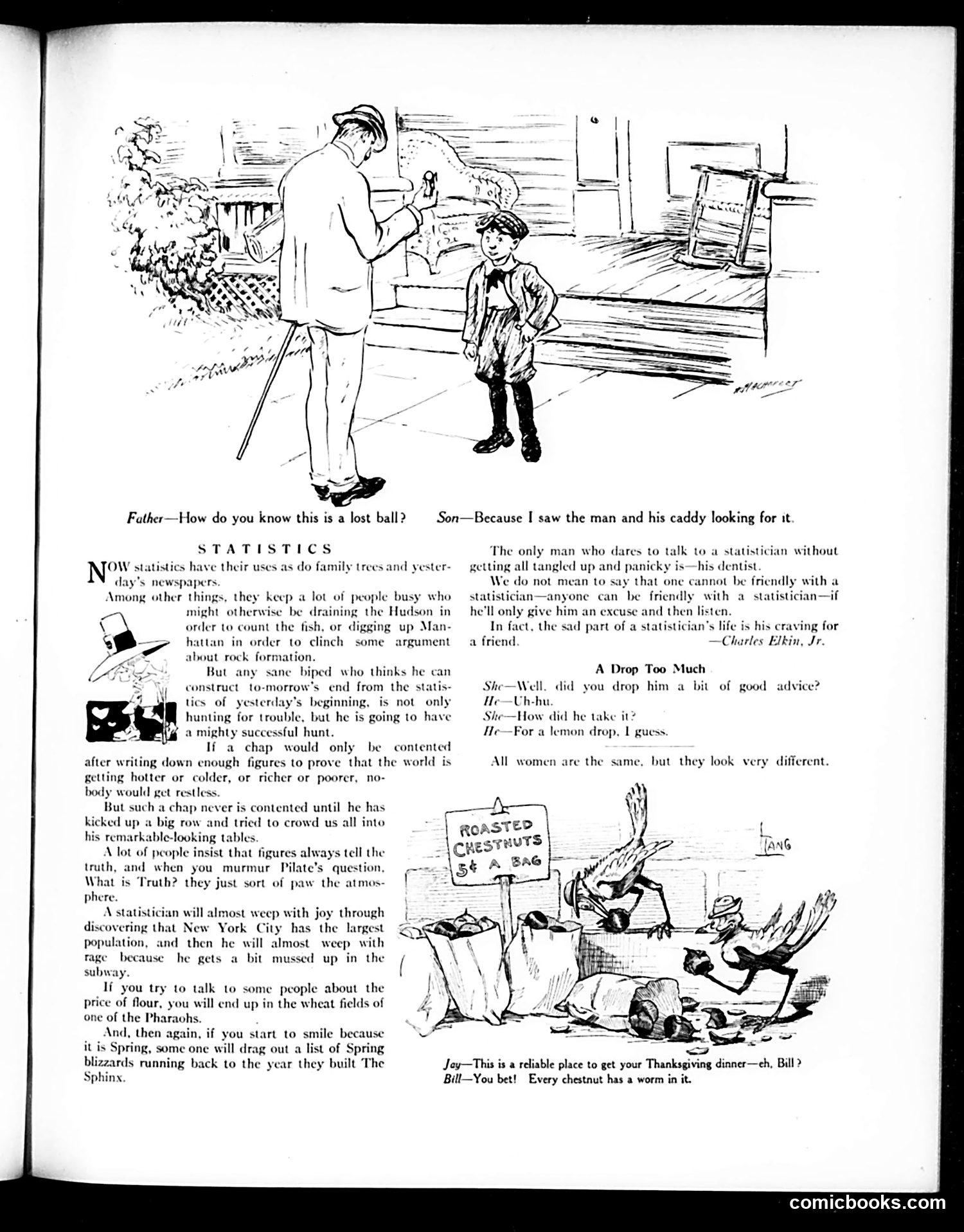
This page contains three separate humorous items typical of early 20th-century satirical magazines: **Top cartoon**: A father and son discuss a golf ball. The joke plays on perspective—the son assumes it's "lost" because he observed someone searching for it, demonstrating childish but logical reasoning. **"Statistics" article**: Satirizes statisticians as obsessive number-crunchers who extract meaning from data to justify arguments about society's improvement or decline, then become upset when their own subway experience contradicts their conclusions. The satire suggests statisticians are emotionally invested in their theories rather than objectively analytical. The accompanying dentist joke implies only professionals who listen without judgment can befriend statisticians. **Two brief jokes**: "A Drop Too Much" plays on a woman's assumption that advice-giving involves literal drops (of liquor). The final quip ("All women are the same, but they look very different") is observational humor about female appearance. **Bottom cartoon**: Men buying roasted chestnuts are warned the product contains worms—a cynical commentary on urban food safety or vendor trustworthiness.
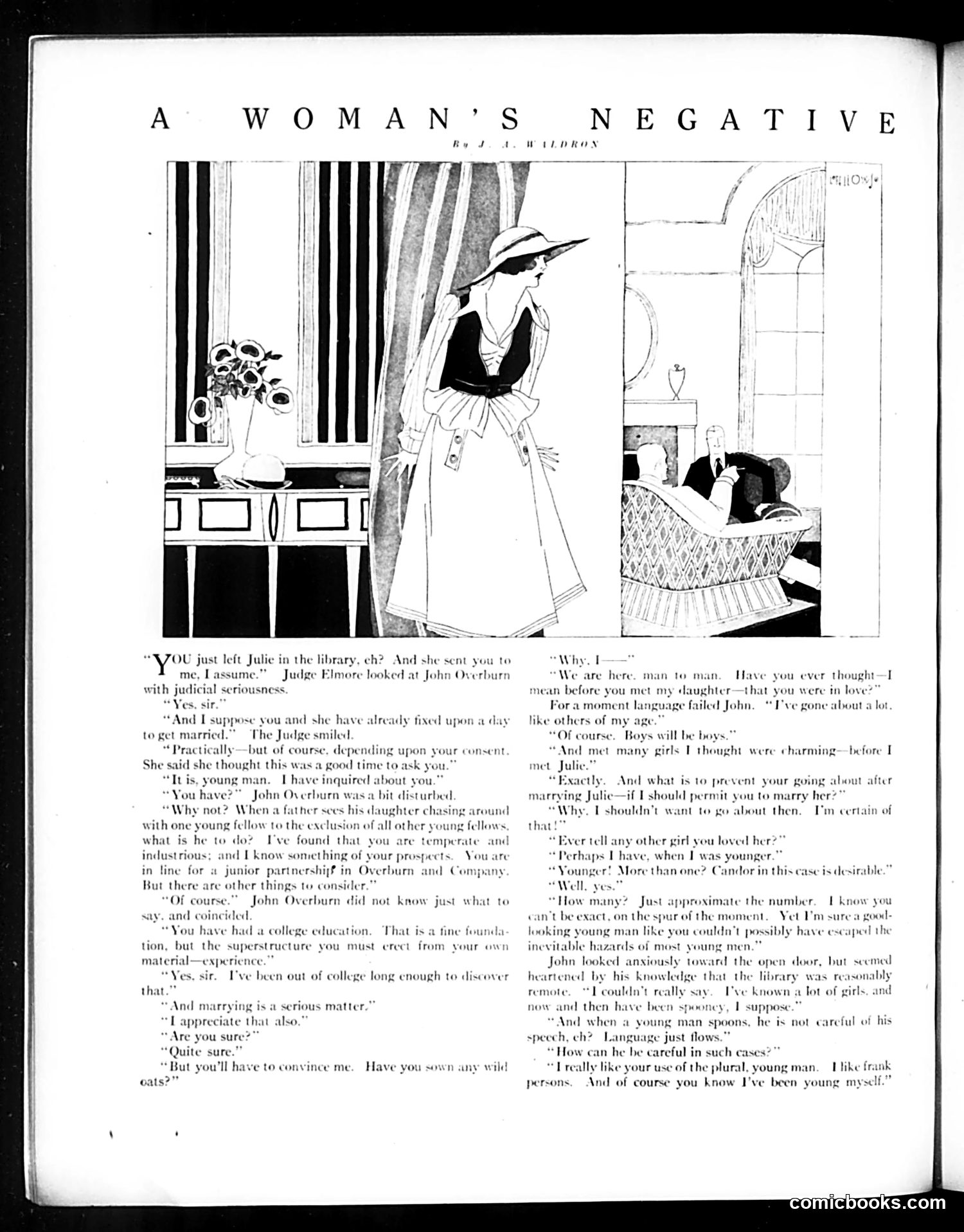
This is a satirical dialogue between a young man (John Overburn) and Judge Elmore, the father of the woman he wishes to marry. The satire targets the hypocrisy of Victorian-era courtship standards. The Judge interrogates John about his past romantic history—whether he's "sown wild oats," loved other girls, and "spooned" (courted) before meeting Julie. John admits to multiple past romantic entanglements. The Judge then reveals the cartoon's title: the woman's "negative"—her refusal to marry him. **The joke**: The Judge uses John's own frank admissions against him, showing that a man with a romantic past is deemed unsuitable for marriage, despite the Judge himself admitting "I've been young myself." The satire exposes the double standard: men were expected to have youthful indiscretions, yet these same indiscretions disqualify them from marrying respectable women. The "negative" is the woman's rejection based on the man's candid honesty about his past—a critique of restrictive courtship customs and female autonomy in marriage decisions.
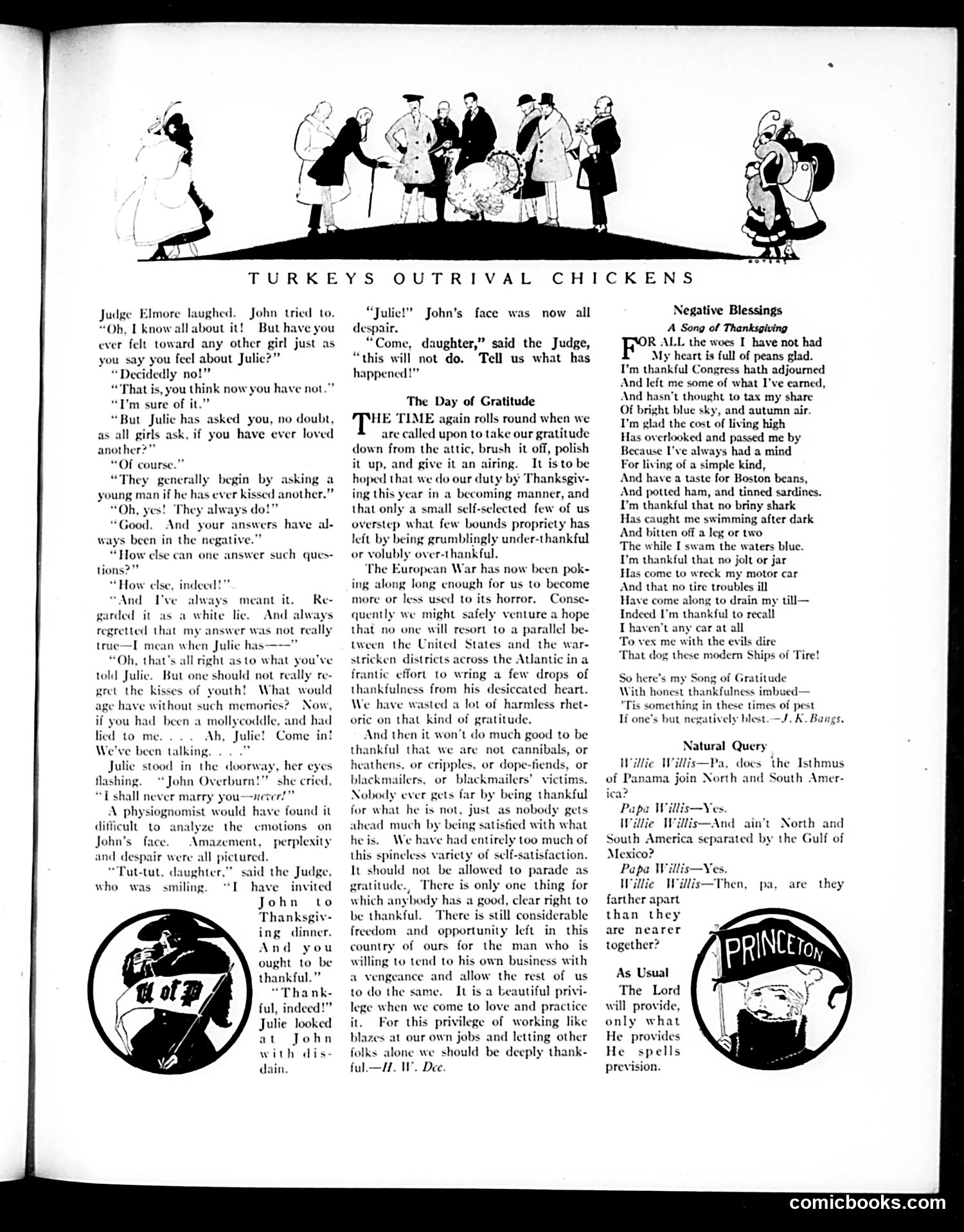
This page contains a serialized romantic story and Thanksgiving-themed editorial commentary from Judge magazine (likely early 20th century, given references to "The European War"). **The Main Story** depicts a domestic drama: John confesses to Julie (presumably his fiancée) about a romantic past. When Julie learns John has kissed other women, she refuses to marry him—despite the Judge (her father) attempting to convince her that youthful romantic experience is harmless and even desirable. The story's title likely compares Julie's indignation to a turkey's proud display compared to a chicken's meekness. **The Editorial Section** argues that true Thanksgiving gratitude should focus on tangible blessings—specifically, the freedom to conduct one's own business unmolested and the right to be left alone by others. It critiques both excessive complaining and empty thankfulness "for what he is not," warning against shallow patriotism that compares America favorably to war-torn Europe. The tone is satirically cynical about how Americans practice gratitude. The page reflects early-20th-century gender attitudes and concerns about courtship propriety.
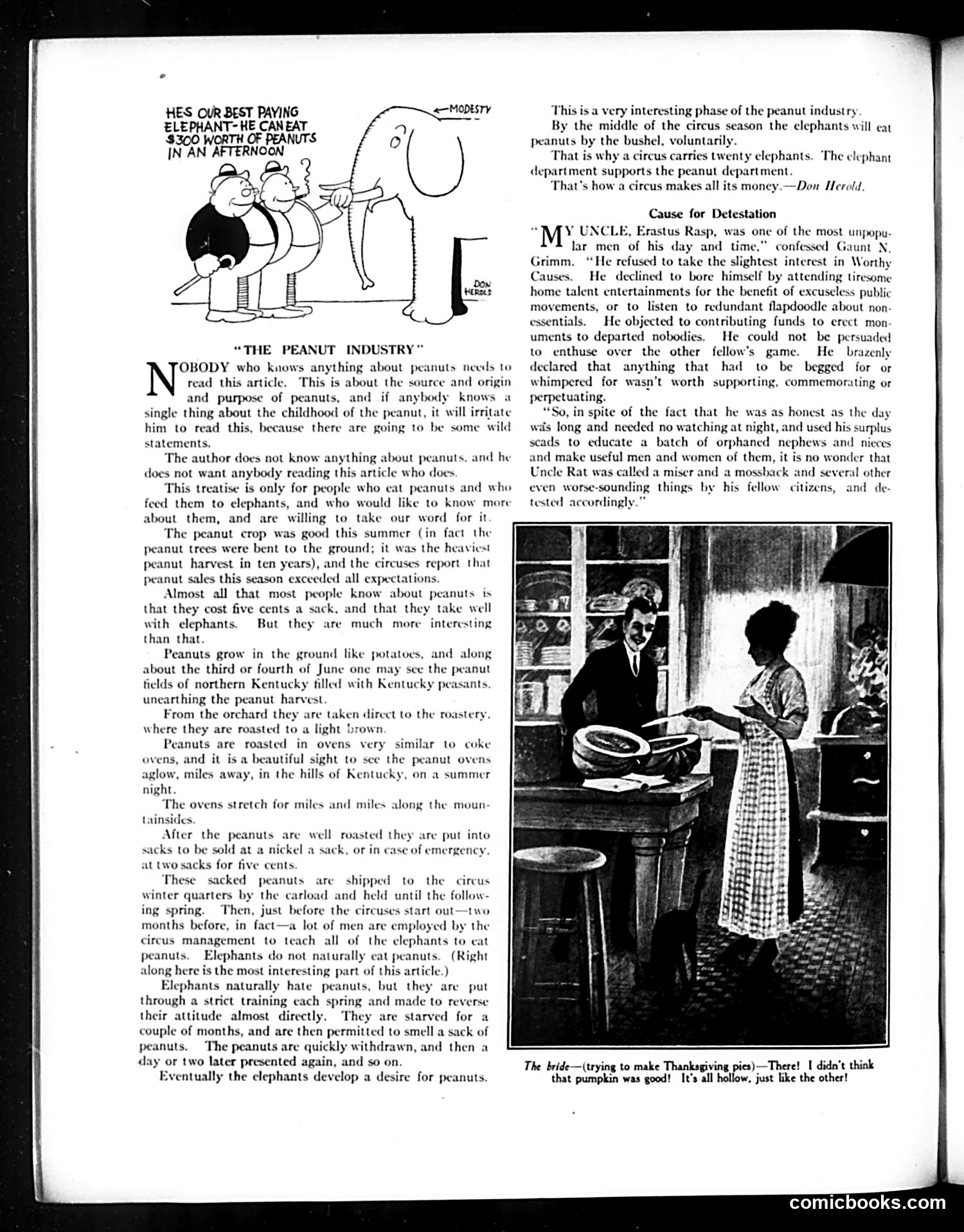
**"The Peanut Industry" (top cartoon and article):** This is humorous satire about circus economics. The cartoon shows two men praising an elephant as their "best paying" animal because it consumes $300 worth of peanuts daily. The accompanying article by Don Herold (a real humorist) presents mock-serious "facts" about peanuts—claiming they naturally grow in Kentucky, require special roasting ovens, and that elephants must be trained to eat them through months of starvation and conditioning. The joke: circuses don't actually profit from peanut sales to audiences; rather, elephants eating peanuts (which circuses buy cheaply) provides the real revenue model. It's satirizing the absurd economics and public ignorance about circus operations. **"Cause for Detestation" (right section):** A separate article beginning a character sketch about Uncle Erastus Rasp, a widely disliked man who refuses to participate in charitable causes, community entertainments, or social conventions—making him controversial in his era's values.
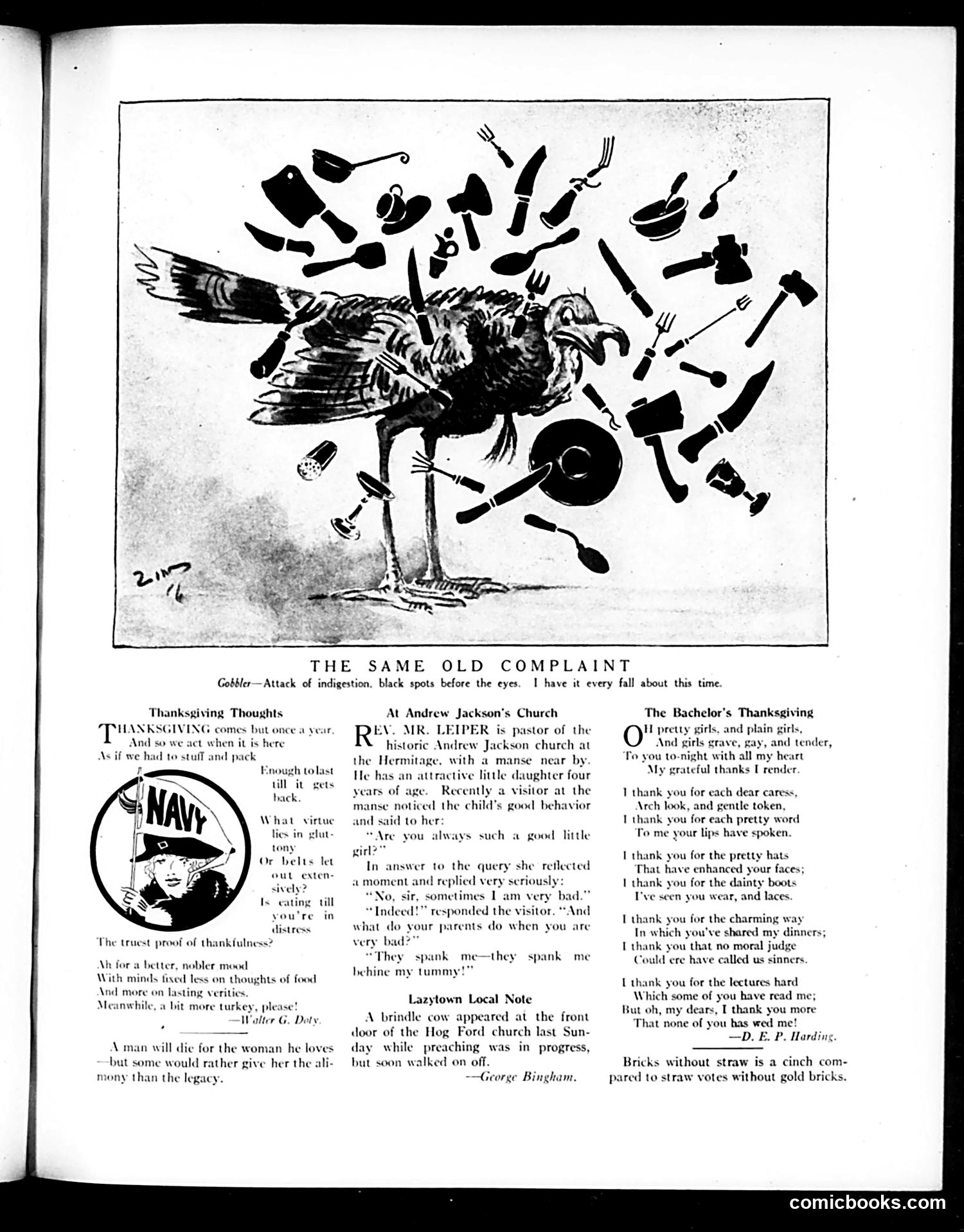
**Main Cartoon:** "The Same Old Complaint" depicts a turkey exploding outward, scattering kitchen implements and food. The caption describes it as a gobbler suffering "indigestion" with "black spots before the eyes"—a satirical visual metaphor for the digestive distress caused by Thanksgiving overindulgence. **Surrounding Content:** The page offers humorous commentary on Thanksgiving excess and related social matters: - "Thanksgiving Thoughts" ironically advocates restraint while requesting "a bit more turkey" - "At Andrew Jackson's Church" recounts a child admitting her parents spank her when misbehaving - "The Bachelor's Thanksgiving" is a tongue-in-cheek poem thanking women for various charms while ultimately expressing relief that none have married him - "Lazytown Local Note" provides a brief anecdote about a cow interrupting church service The overall theme satirizes American excess, hypocrisy, and bachelor attitudes circa the early 20th century. The satire assumes readers will recognize the humor in contradictions between stated values and actual behavior.
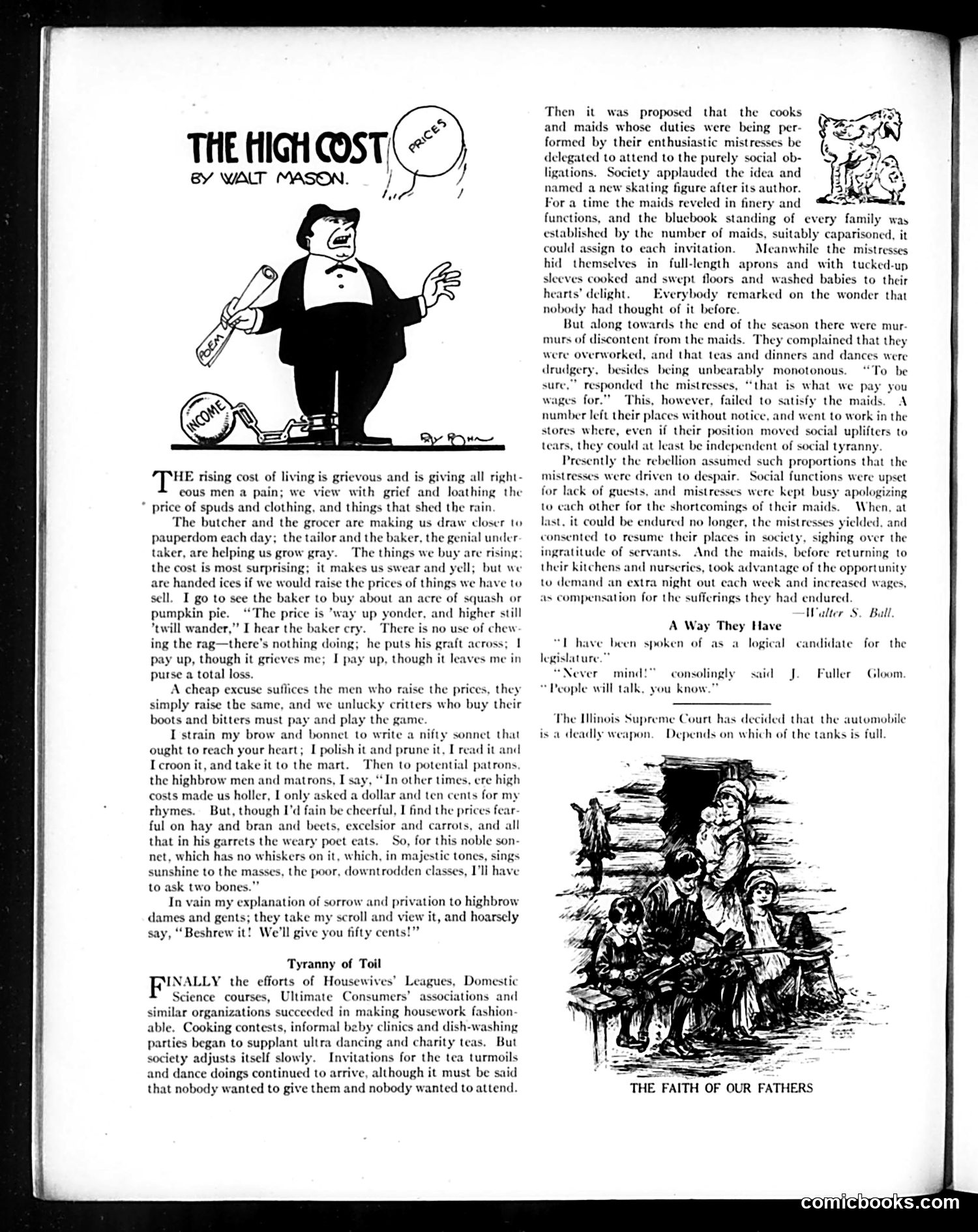
This satirical piece critiques the economic squeeze of the early 20th century. **The cartoon figure** (left) represents an ordinary citizen or worker being financially strangled—his gesture and posture suggest helplessness as costs rise daily. **The satire:** Mason complains that while working people suffer from inflated prices for food, clothing, and services, merchants simply raise prices in response to demands for higher wages. There's no relief—whether you're a baker, poet, or laborer, you're caught paying more while earning less. **The secondary section** lampoons fashionable reformers: wealthy women's groups promoted "scientific housework" as a status symbol, pressuring society ladies to do domestic labor themselves while their maids attended fancy social events as stand-ins. This backfired when maids realized they were being overworked without actual independence—so they quit for retail jobs offering dignity instead. **The point:** Economic systems exploit both workers and the working/middle classes, and well-intentioned social movements often create new problems.
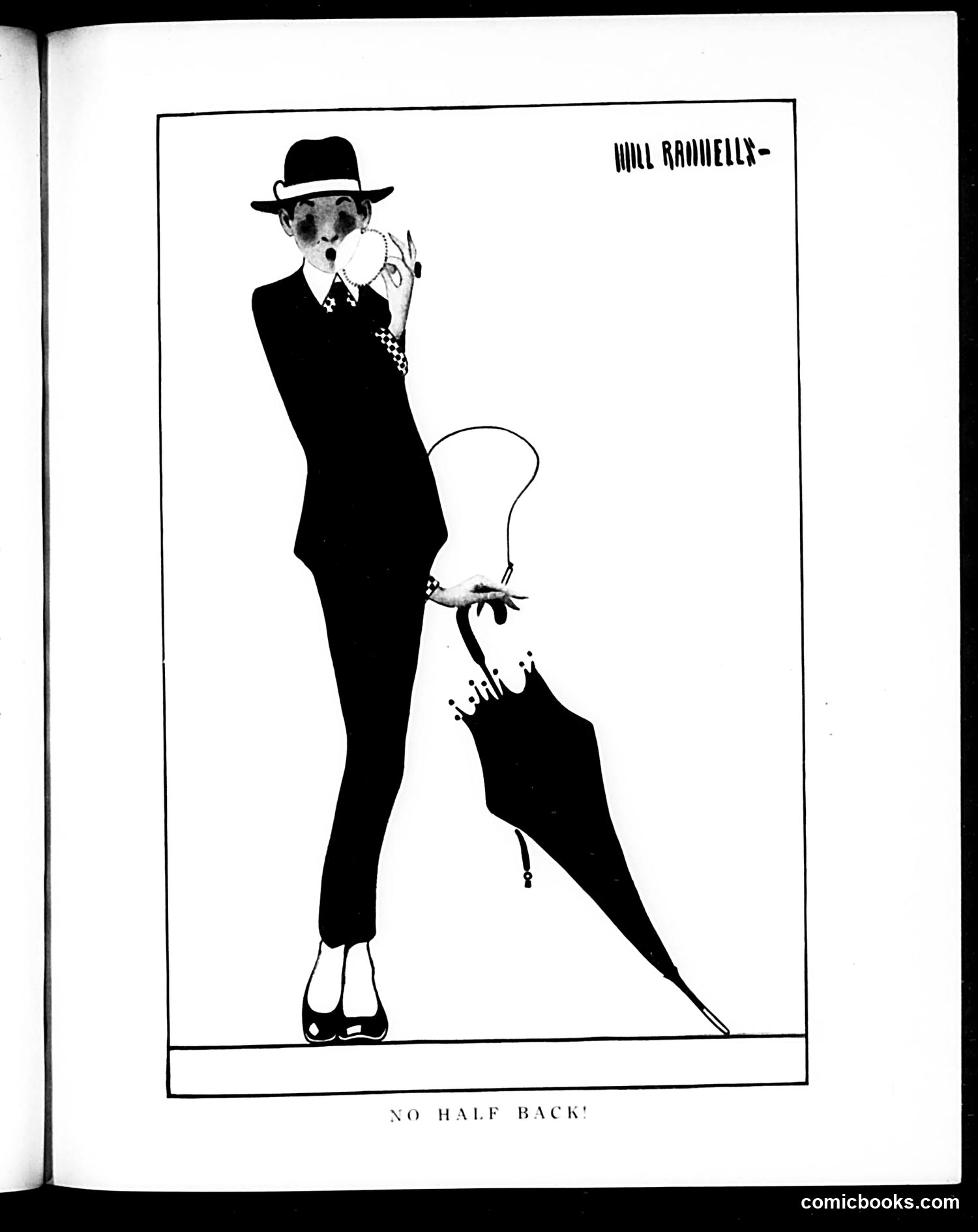
This cartoon by Will Ranelli depicts a stylishly dressed woman in 1920s fashion—bowler hat, long coat, and heeled shoes—holding an umbrella. The caption "NO HALF BACK!" appears to be a play on words referencing football terminology. The satire likely comments on women's changing social roles and fashion during the Jazz Age. "No half back" suggests the woman won't compromise or retreat from modern behavior—possibly referring to women's increasing independence, shortened skirts, or other contemporary social changes that conservatives resisted. The fashionable, assertive pose reinforces this message of women refusing to return to traditional constraints. The cartoon reflects Judge magazine's satirical commentary on evolving gender norms of the era.
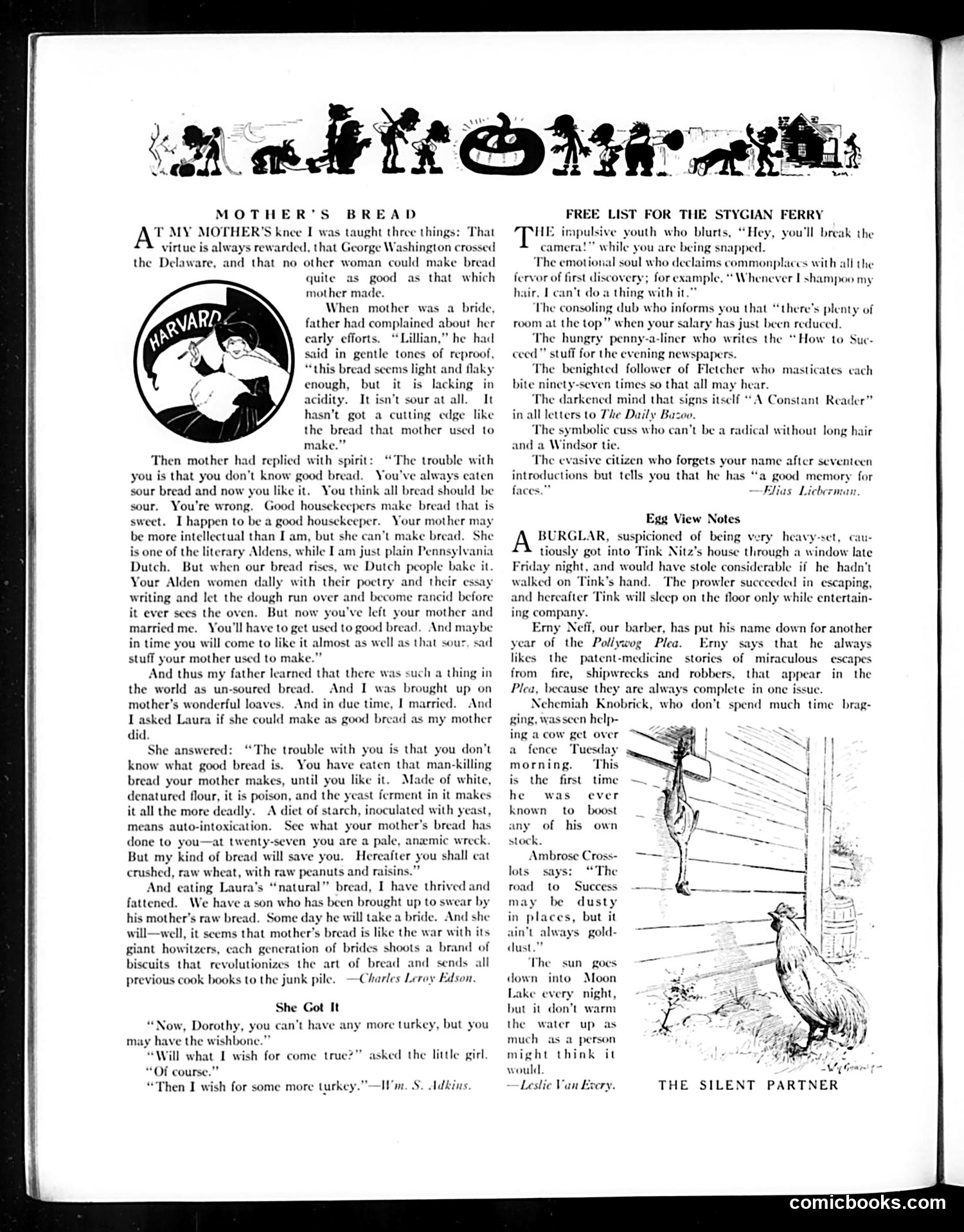
The main essay humorously traces generational conflict over bread-baking styles. A Pennsylvania Dutch mother insists on "sweet" bread; her Alden (literary, intellectual) mother-in-law preferred "sour" bread. The son later marries Laura, who rejects both traditions for "natural" raw wheat bread—claiming his mother's white bread has made him a "pale, anaemic wreck" by age twenty-seven. The satire mocks dietary fads and the endless cycle of women criticizing each other's housekeeping through bread. The page's secondary content includes brief comic pieces and "Free List for the Stygian Ferry"—a satirical list mocking pretentious modern types: the pushy photographer, emotional cliché-spouters, and obsessive "Fletcherites" (followers of Horace Fletcher's extreme chewing diet). The humor targets early 20th-century food crazes and social affectation rather than specific political figures.
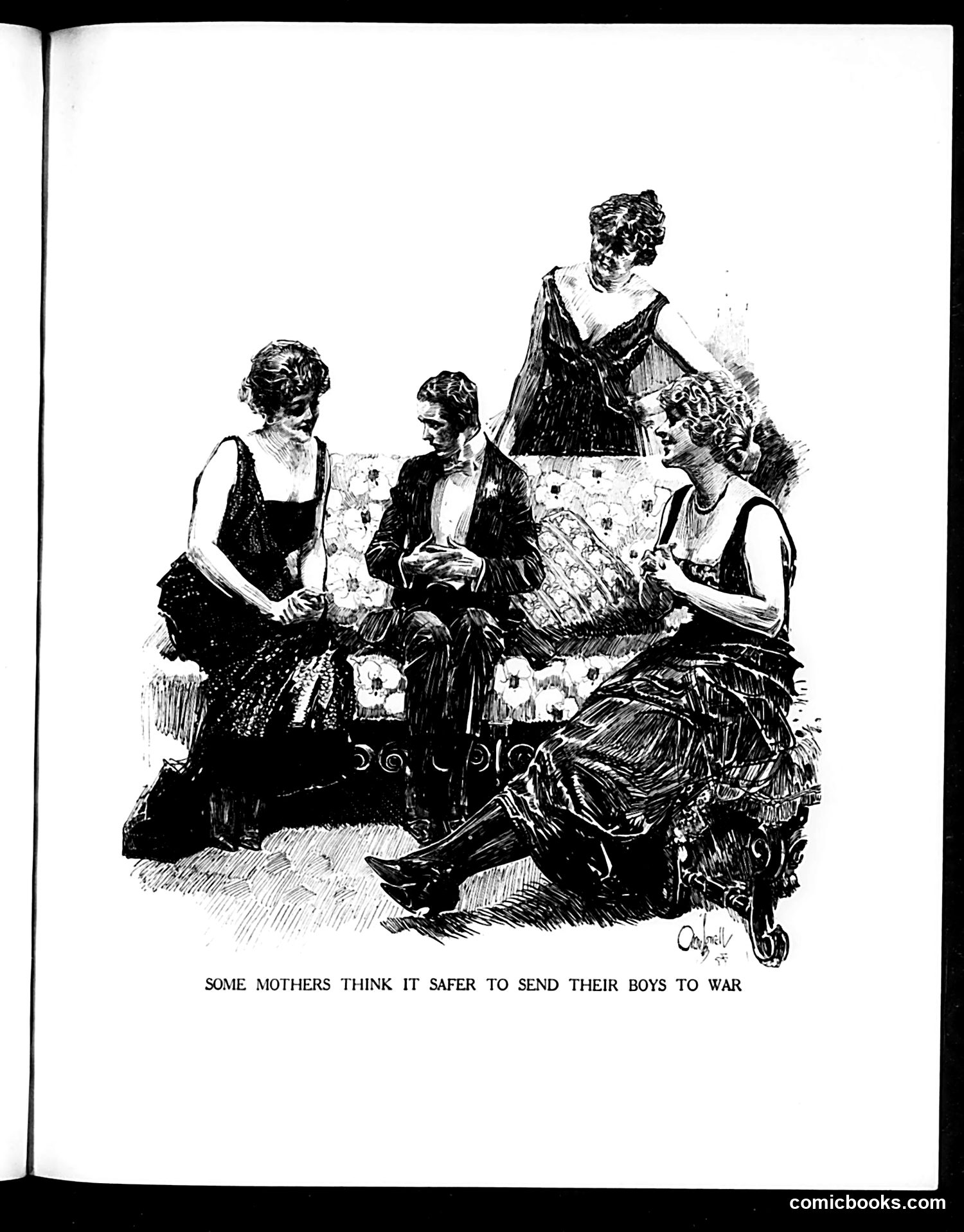
This satirical illustration critiques mothers who support military service for their sons as supposedly "safer" than civilian life. The sketch depicts five well-dressed women in an elegant interior setting, apparently discussing this counterintuitive position. The cartoon's irony is clear: war is objectively dangerous, yet some mothers apparently reasoned that military service provided structure, discipline, and protection—perhaps safer than urban industrial work, poverty, or moral hazards of civilian society. This reflects early 20th-century anxieties about modernization and youth welfare. The artist (signed "Cesare") uses the women's refined appearance and comfortable setting to highlight the disconnect between their safe domestic circumstances and the grave risks they're endorsing for their sons, making the logic appear absurd.
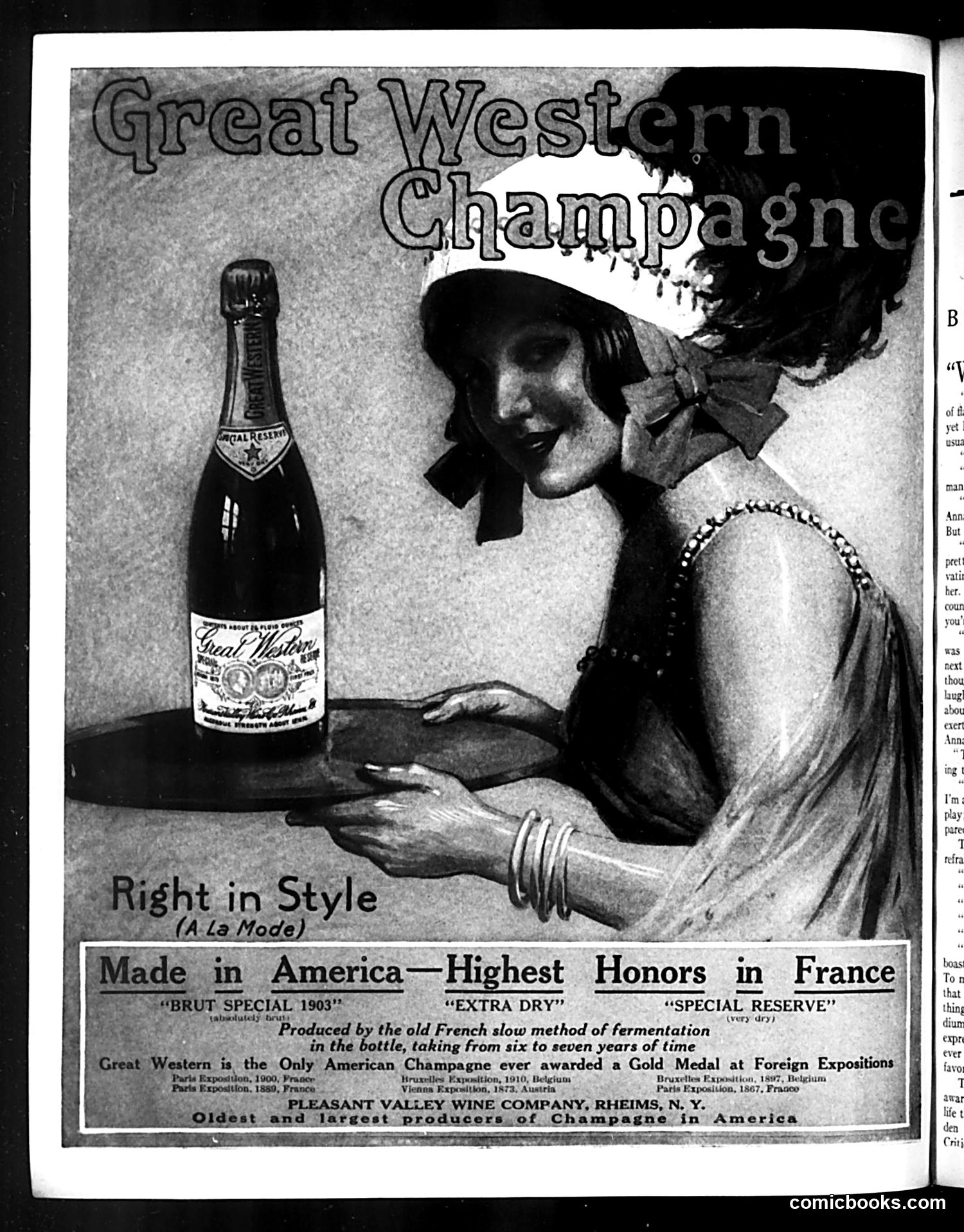
This is a **full-page advertisement**, not political satire. It promotes Great Western Champagne, made by Pleasant Valley Wine Company in Rheims, New York. The ad uses a stylized illustration of an elegant woman in a wide-brimmed hat with a large bow, positioned "Right in Style (À La Mode)," gazing at a champagne bottle. The imagery associates the product with sophisticated, fashionable femininity—a common advertising strategy of the early 1900s. The text emphasizes American manufacturing credentials while claiming French-style prestige: "Made in America—Highest Honors in France." It boasts of gold medals from multiple international expositions and notes the product uses traditional French fermentation methods. This reflects pre-Prohibition American champagne production and the era's marketing of domestic luxury goods through appeals to European refinement and feminine elegance.
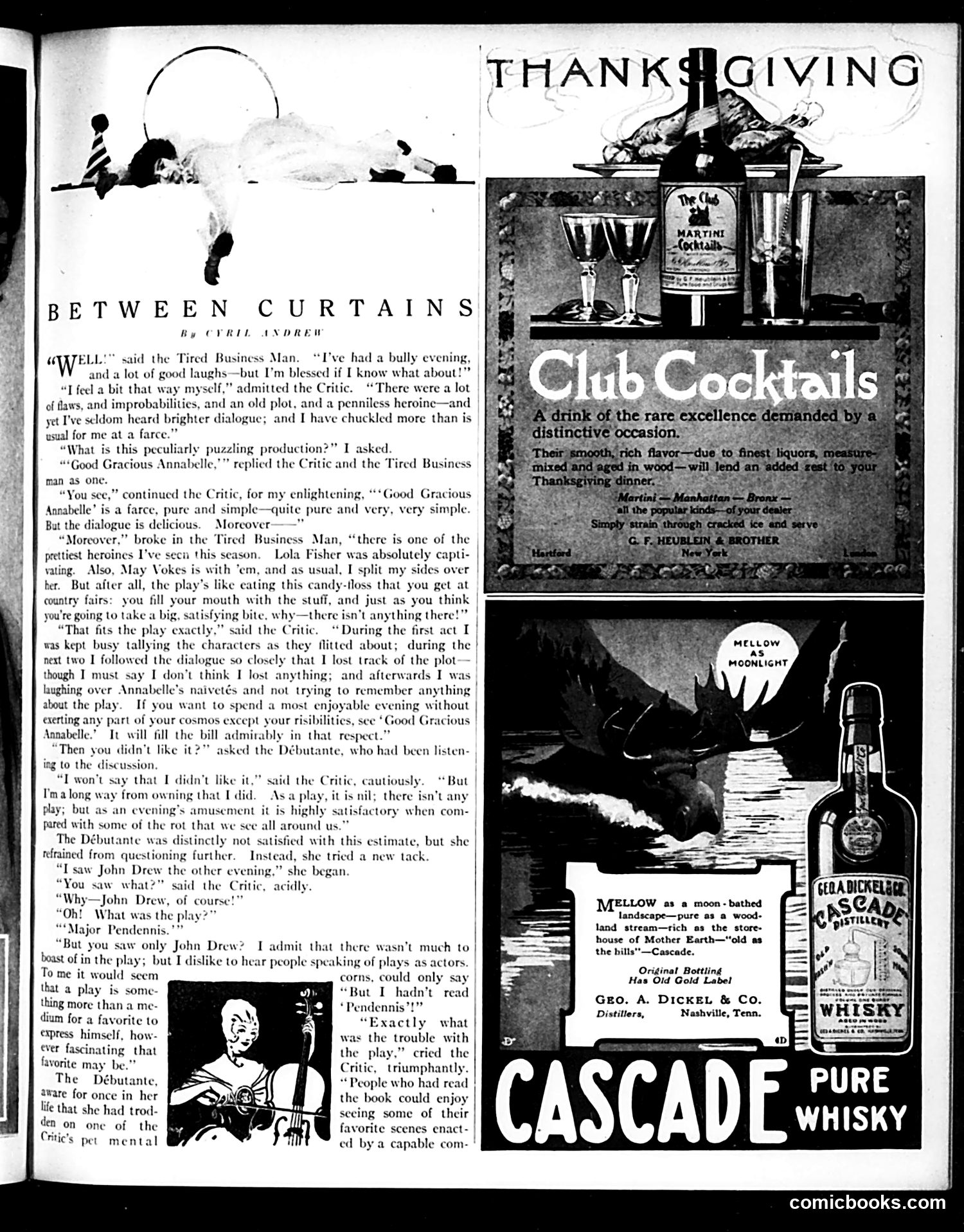
This theater critique satirizes the disconnect between critical analysis and popular entertainment enjoyment. A "Tired Business Man" and a "Critic" discuss the play "Good Gracious Annabelle," praising its dialogue and performers (Lola Fisher and May Vokes) while admitting the plot is thin and the play itself artistically hollow—mere "candy-floss." The satire's target: critics who intellectually dismiss entertainment yet enjoy it anyway. The Critic later ridicules theatergoers who praise John Drew (a prominent actor of the era) as a "play" rather than judging the play itself, revealing the cultural tendency to conflate performer celebrity with dramatic merit. The page predominantly features liquor and whisky advertisements, typical of Judge's era when alcohol advertising was unrestricted. The cartoons humorously capture the pretension of theater criticism versus the simple pleasure of being entertained.
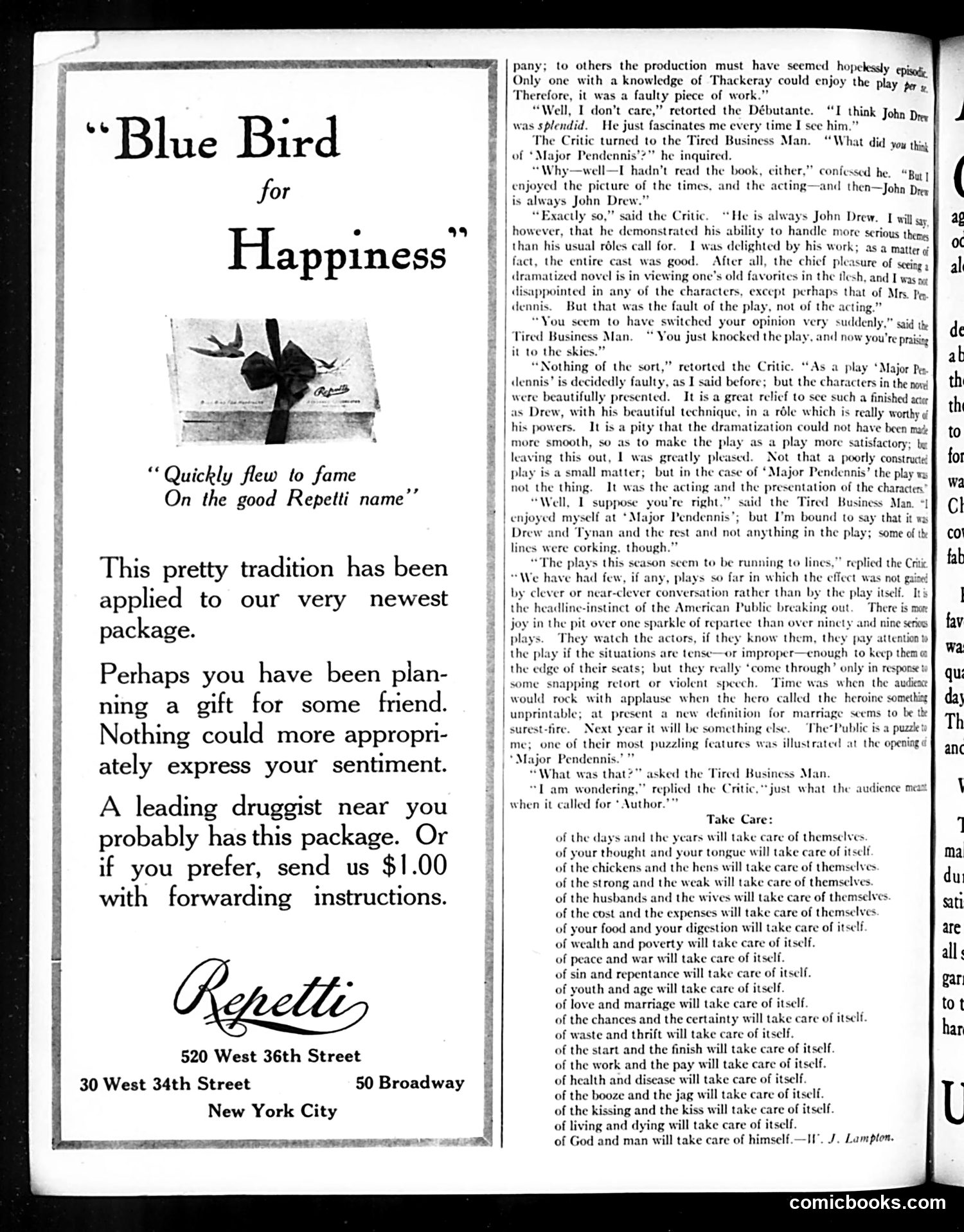
This page is primarily **advertising**, not political satire. The left side promotes Repetti's "Blue Bird for Happiness" gift package—a commercial product marketed as an appropriate gift item for friends. The right side contains a **theater review** discussing a stage adaptation of Thackeray's *Major Pendennis*, featuring the popular actor John Drew. The critic and a "Tired Business Man" debate the production's merits. The satire here is **social commentary** on American theater audiences, not politics: critics mock playgoers' preference for clever dialogue and sensational moments over substantive drama, and their puzzling habit of demanding the author appear after performances. The bottom section, "Take Care," is inspirational verse (unrelated to the page's main content). **Context for modern readers:** This reflects early 20th-century concerns about mass entertainment's quality and audience taste—concerns that remain relevant today.
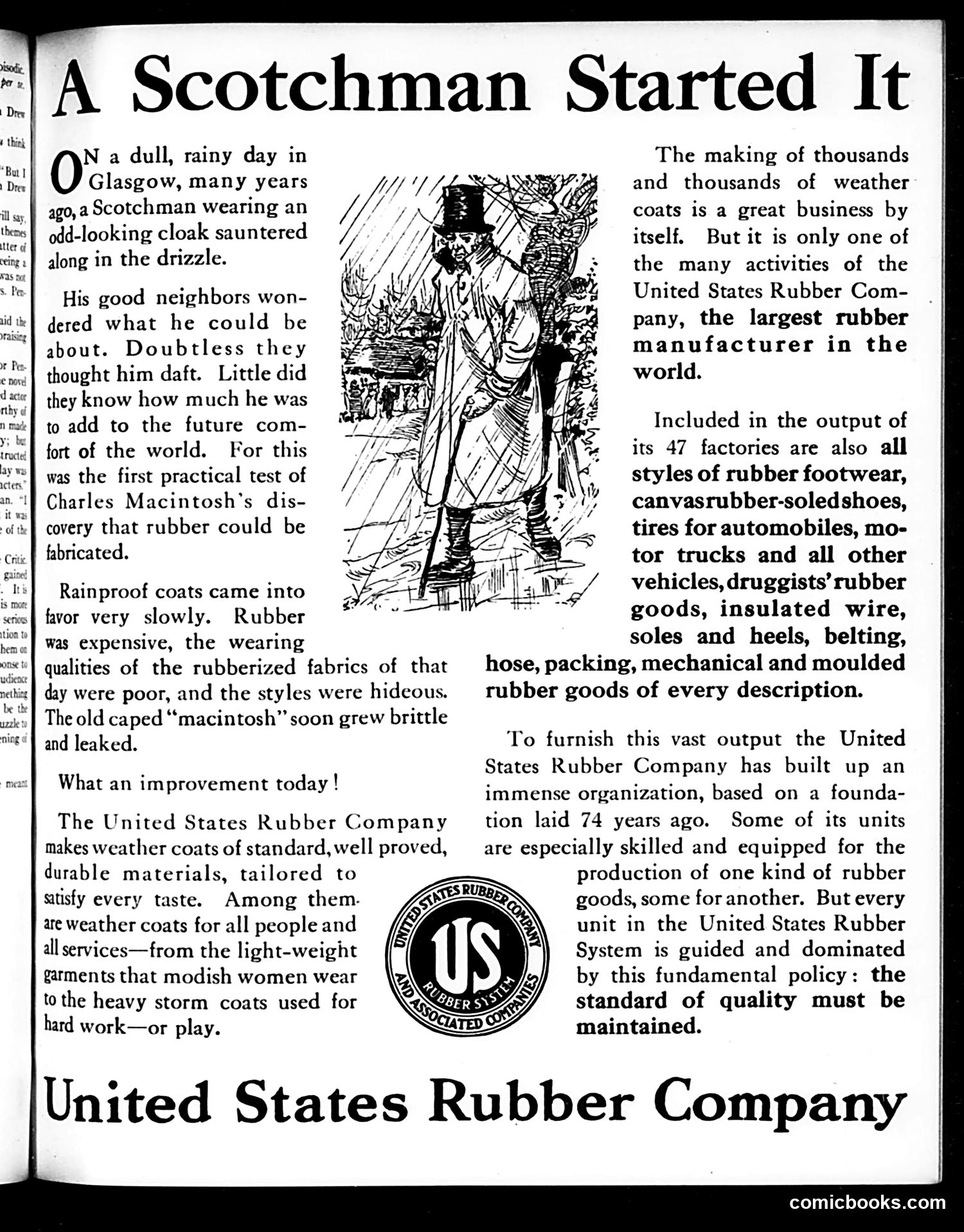
This is **advertising content**, not satire. The page celebrates the United States Rubber Company by tracing rubber manufacturing back to Scottish inventor Charles Macintosh's waterproof fabric discovery. The illustration shows a Scotsman in traditional dress wearing an early "macintosh" raincoat—a historical reference point. The narrative contrasts the original invention's poor quality (expensive, brittle, leaking) with modern U.S. Rubber Company products, which are "standard, well proved, durable." The copy emphasizes the company's scale (47 factories) and product diversity (footwear, tires, wire insulation, mechanical goods), while claiming quality as its guiding principle. The company's seal appears centrally. For modern readers: this is **corporate myth-making**—presenting commercial success as a natural evolution from a clever Scotsman's invention, positioning U.S. Rubber as the rightful heir to that legacy. It's typical early-20th-century advertising rhetoric emphasizing industrial progress and standardization.
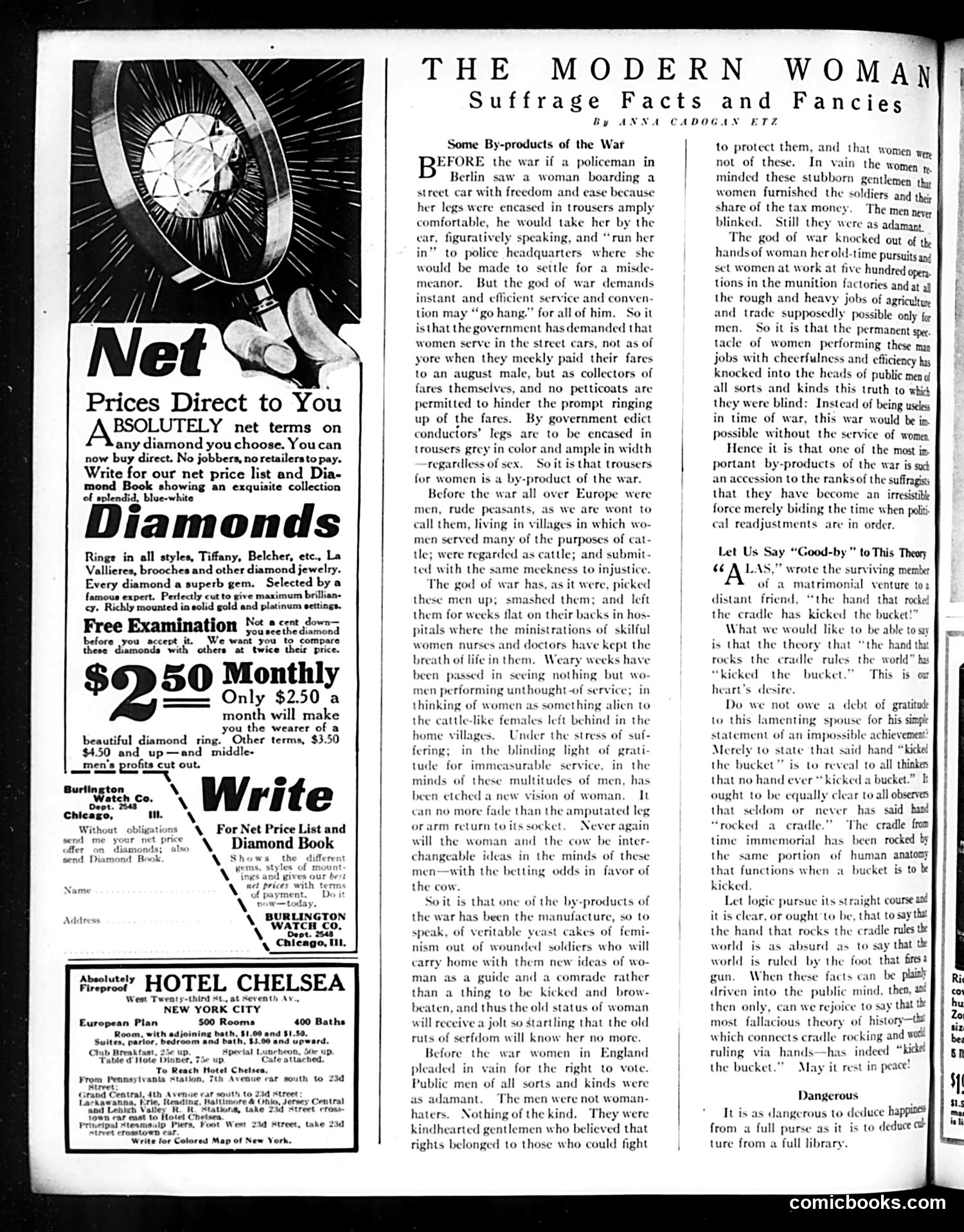
This page is primarily **advertising** (diamonds, hotels, watches) with a column by Anna Cadogan Etz discussing women's wartime roles as a suffrage argument. The article's central claim: WWI has inadvertently advanced women's rights by demonstrating their capabilities. Pre-war examples include: - **Berlin police enforcing anti-trousers laws** for women—now governments mandate female streetcar conductors wear practical trousers, normalizing them - **Rural European women** previously treated as "cattle-like" by peasant soldiers—now these same wounded men, nursed back to health by skilled female nurses and doctors, return home with transformed views of women's capabilities The satire is **pro-suffrage**: Etz argues war has created "yeast cakes of feminism" by forcing society to recognize women's essential labor and competence. She suggests this newfound respect cannot "fade" any more than an amputated limb regrows—implying women's equality is now irreversible. The cartoon (top left) appears decorative rather than directly satirical—its exact meaning is unclear from the image alone.
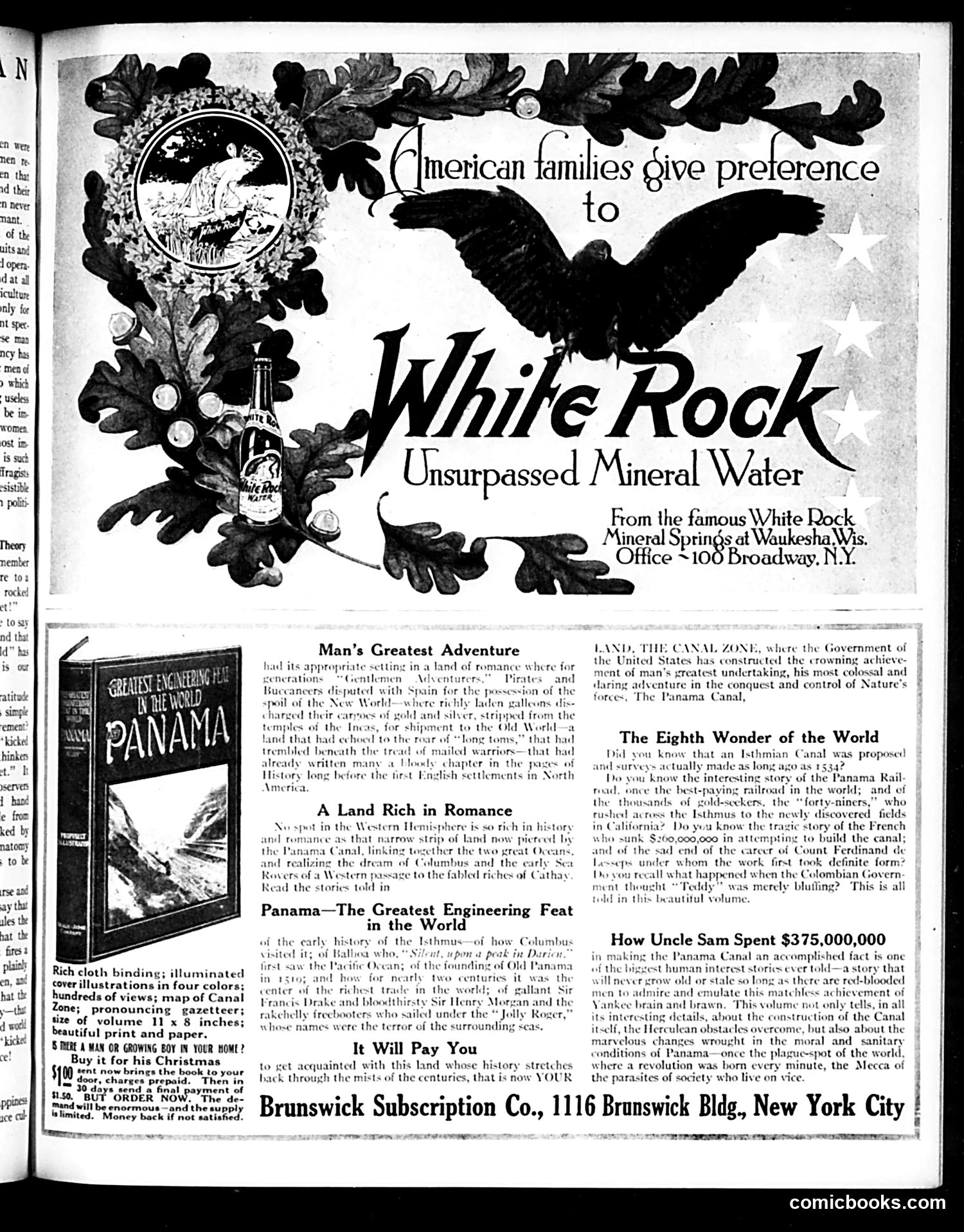
This page is **primarily advertising**, not political satire. The dominant content promotes two products: 1. **White Rock Mineral Water** (top): An advertisement claiming "American families give preference to" this bottled water from Wisconsin springs. The decorative eagle and classical imagery suggest premium quality and patriotism. 2. **Panama Canal Book** (bottom): A subscription offer for a lavishly illustrated volume about the Panama Canal's construction. The text emphasizes America's engineering achievement ("Uncle Sam Spent $375,000,000") and romanticizes the Canal Zone's history through adventure narratives—Columbus, pirates, Drake, and French failures. The page reflects early 20th-century American confidence in industrial progress and imperial expansion. The Canal book particularly frames the Canal as proof of American superiority, contrasting successful U.S. completion with French failure. The ornate design and historical framing are typical of *Judge's* advertising aesthetic rather than satirical commentary.
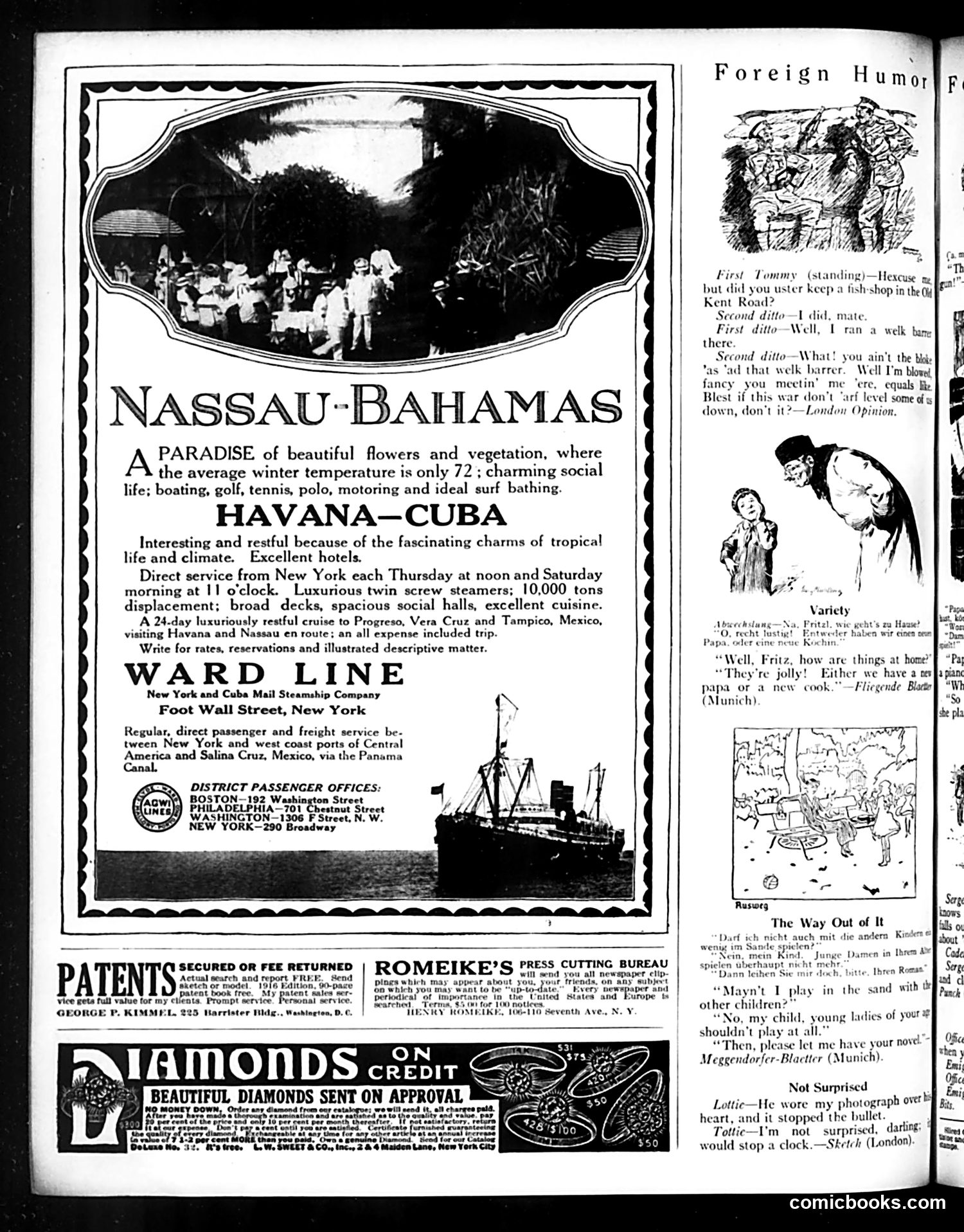
This page is primarily **advertising** for vacation cruises and other services, with small comic jokes interspersed. The main cartoon features two British working-class soldiers ("Tommy") reuniting during World War I. One asks if the other ran a whelk (shellfish) stand in Kent Road before the war. The joke's satirical point: the war has temporarily erased class distinctions—two men from humble civilian occupations now meet as equals in military service. The caption "the war don't 'arf level some of us down" suggests war's democratizing effect, though with darkly ironic undertones about death and destruction. Secondary cartoons are brief jokes: "Fritz" discusses home life; a child asks about playing in sand; a woman's photograph stops a bullet (physical humor playing on the phrase "would stop a clock" meaning unattractive). The bulk of the page advertises Ward Line cruise ships to Cuba and the Bahamas, plus services for patents and diamonds—typical Judge magazine content mixing satire with revenue-generating ads.
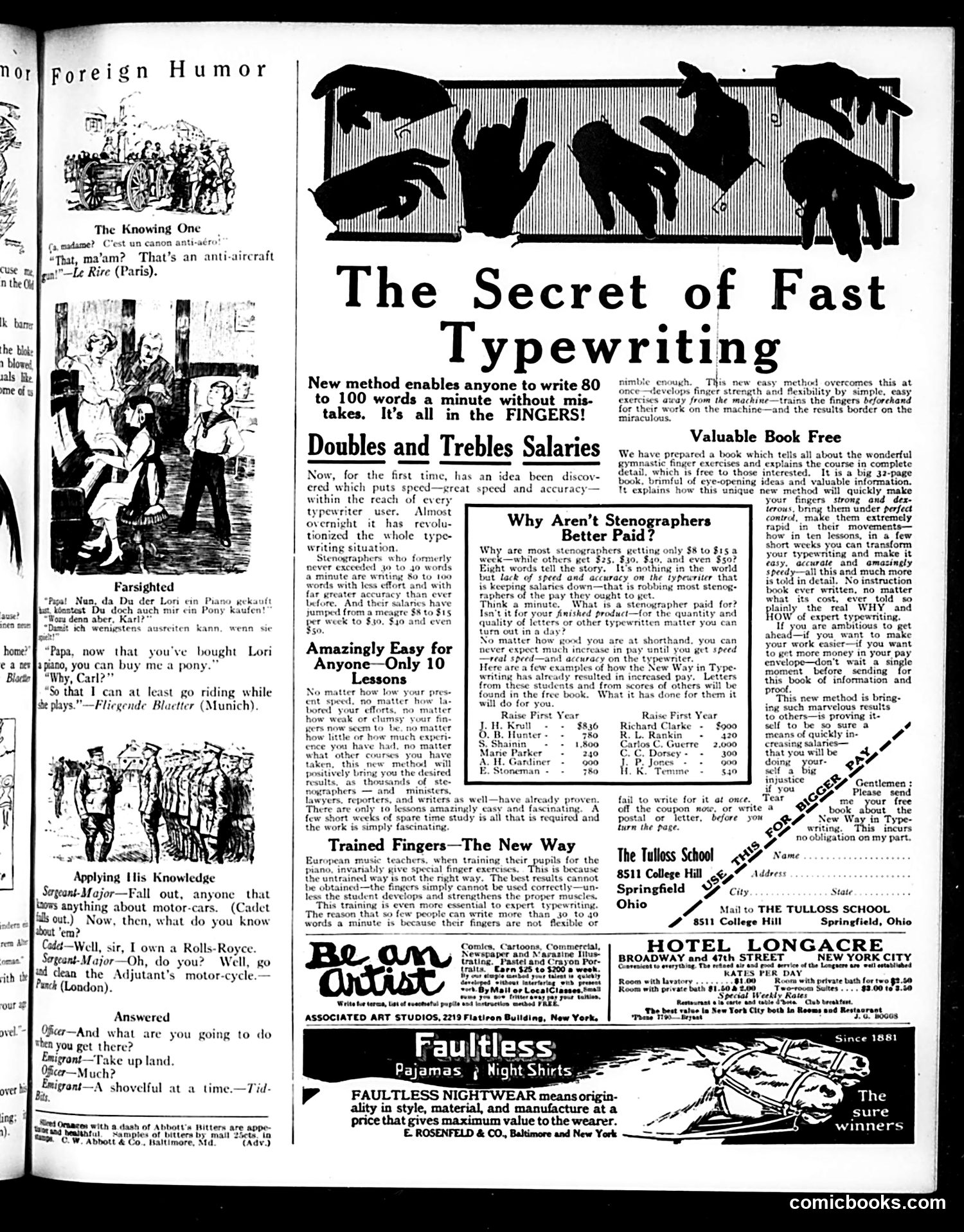
This page is primarily a **commercial advertisement** for a typewriting course, not political satire. The small cartoons at the top are unrelated foreign humor pieces from *Le Rire* (Paris) and *Punch* (London). The main content promotes a typing method claiming to enable 80-100 words per minute through finger exercises alone. It targets stenographers and office workers, arguing they earn low wages ($8-15/week) due to poor typing speed, not shorthand skills. The ad promises that proper finger training will "double and triple salaries." The pitch emphasizes "only 10 lessons" of simple exercises developing finger flexibility and speed. A free 32-page instructional book is offered as incentive. The Tullos School (Springfield, Ohio) is the advertiser. **Context for modern readers:** This reflects early-20th-century office work's gender dynamics—stenography was feminized, low-wage labor. The advertisement exploits economic anxiety while promoting dubious speed-improvement claims typical of period self-improvement marketing.
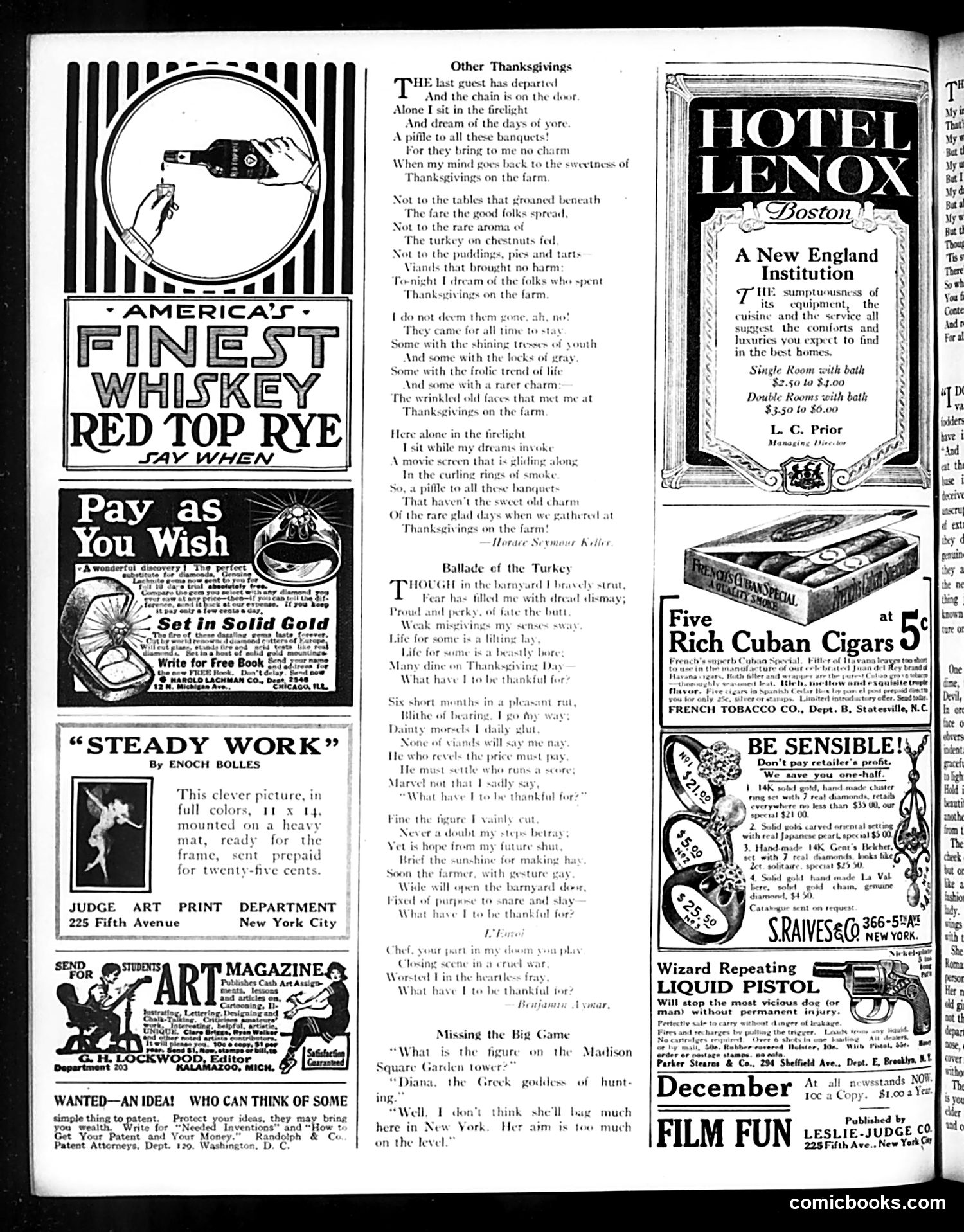
This page is primarily **advertising and poetry**, not political satire. The dominant elements are: **Poetry Section**: Multiple Thanksgiving-themed verses ("Other Thanksgivings," "Ballade of the Turkey," "Missing the Big Game") celebrating rural nostalgia and farm life—typical sentimental holiday content for the era. **Advertisements dominate**: - Red Top Rye whiskey ("America's Finest Whiskey") - Hotel Lenox in Boston - Cuban cigars and jewelry - A "Wizard Repeating Liquid Pistol" (likely a water gun) - Art prints and patent/invention services **Social context**: The ads reflect 1920s consumer culture and leisure (liquor during Prohibition's enforcement, upscale hotels, luxury goods). The poetry romanticizes agricultural life amid America's urbanization. **No clear political cartoon** appears here—this is a commercial magazine page mixing nostalgic content with consumer appeals typical of Judge's format as a general-interest satirical publication.
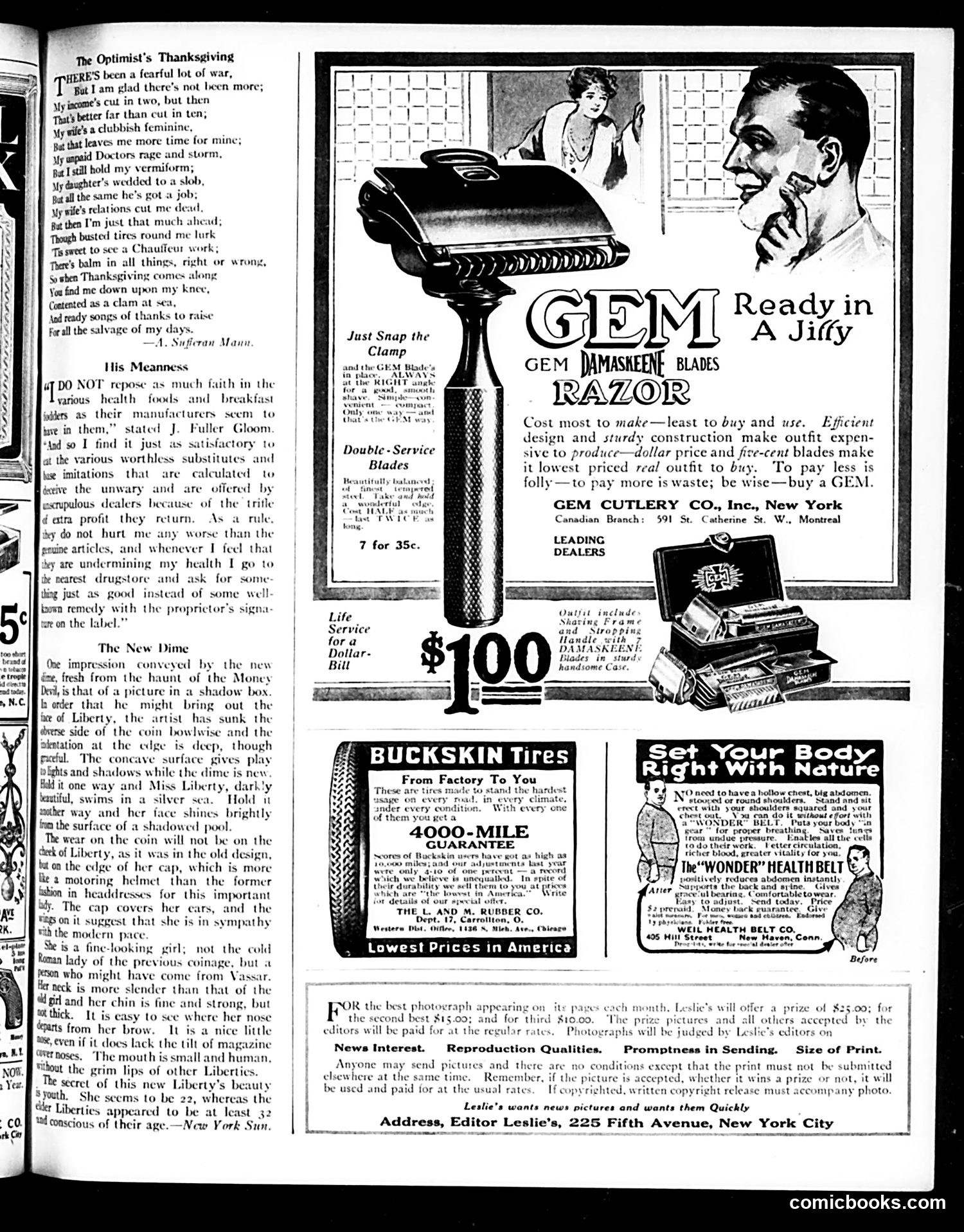
This page is primarily **advertising**, with some satirical content. The main cartoon is "The Optimist's Thanksgiving," a poem by A. Sufirian Mann that uses dark humor to find silver linings in hardship—war, financial loss, family problems, and broken car tires. The joke is the character's stubborn refusal to be depressed, finding gratitude even in misery. The other text pieces ("His Meanness," "The New Dime") are brief satirical observations: one mocking a cheapskate who buys worthless substitutes, another describing the artistic qualities of a newly-minted dime featuring Liberty. The bulk of the page consists of **period advertisements**: a GEM safety razor, Buckskin tires (with a "4000-mile guarantee"), and a "Wonder Health Belt"—a dubious device claiming to fix posture and health issues. These ads reflect common early 20th-century consumer products and medical quackery typical of Judge magazine's revenue model.
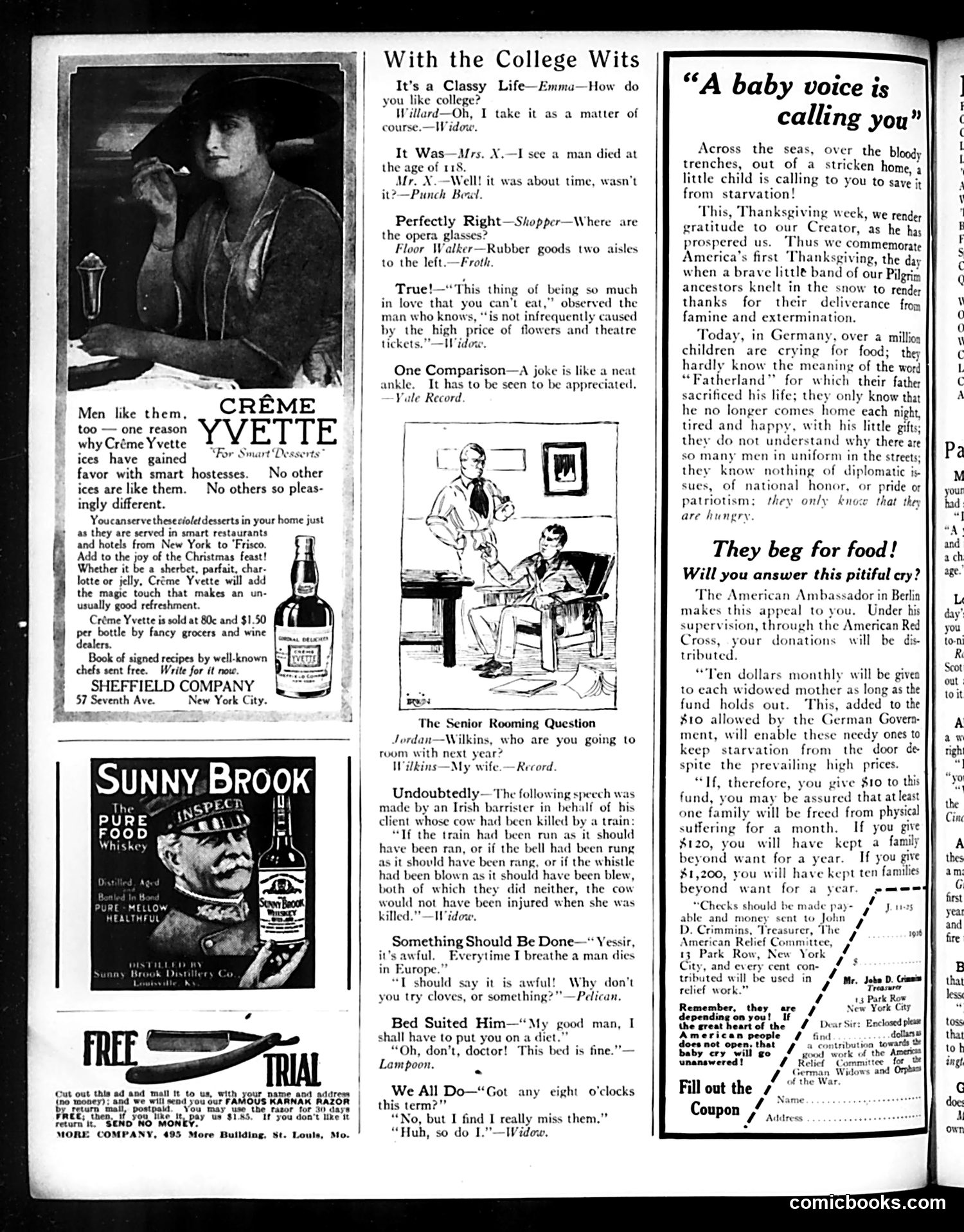
This page mixes **lighthearted college humor** with **serious wartime charity appeal**. The "College Wits" section contains brief jokes about college life—playing on student stereotypes about romance, laziness, and academic indifference. These are genteel, pun-based humor typical of early 20th-century magazines. However, the dominant content is a **Thanksgiving-era fundraising appeal** for starving German children. The text contrasts America's first Thanksgiving (Pilgrims escaping famine) with current German child starvation caused by WWI. It solicits donations ($10 monthly sustains one family) through the American Red Cross and German Relief Committee, channeled via the American Ambassador in Berlin. The juxtaposition is striking: collegiate witticisms about trivial romantic disappointments appear alongside pleas for hungry children. This likely reflects **1918-1919 post-WWI conditions**, when American relief efforts attempted to feed civilian populations in defeated Germany. The appeal frames charity as both gratitude and Christian obligation.
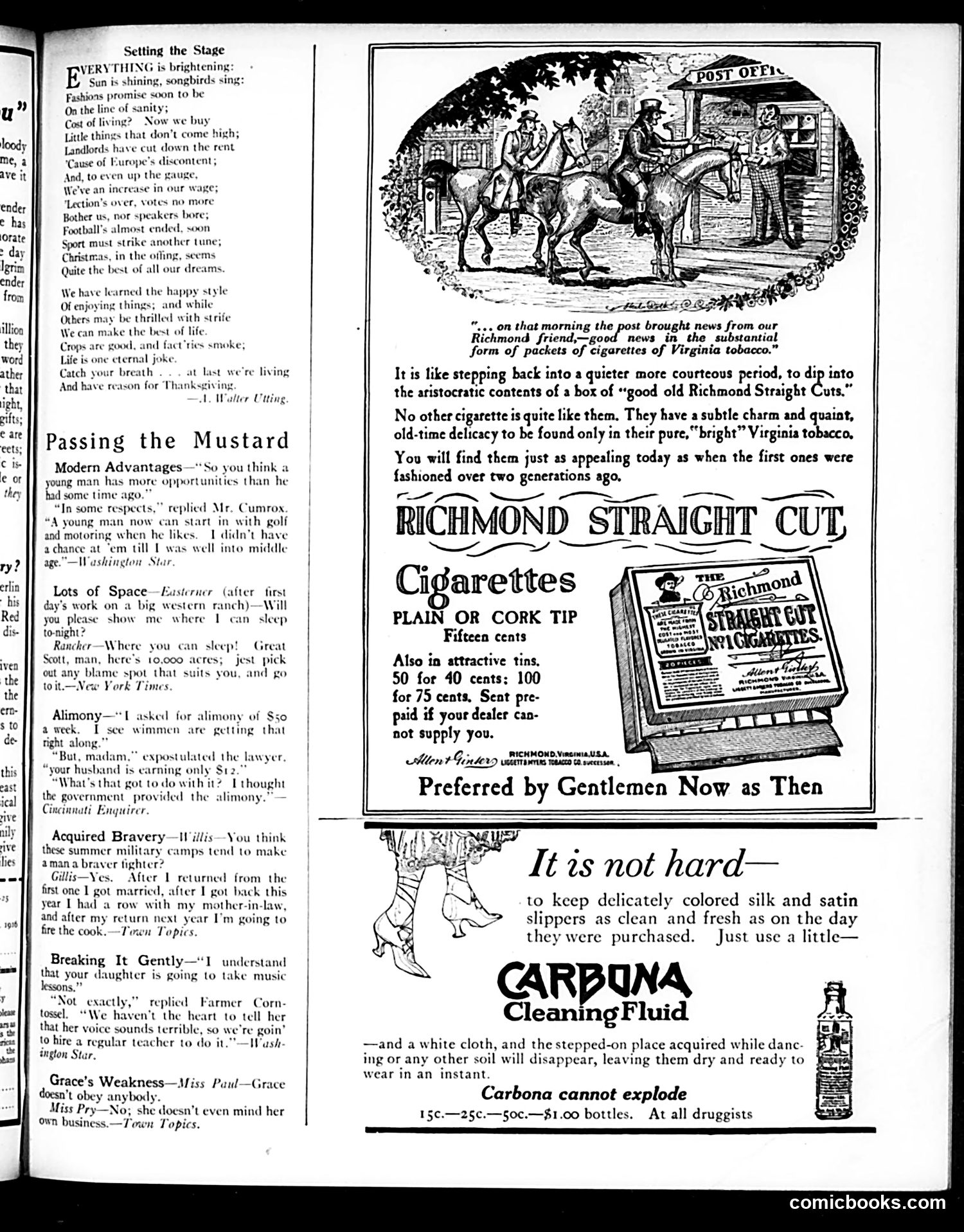
This page mixes humor columns with period advertising. The left side contains short satirical anecdotes about modern life (1910s-1920s era), touching on post-WWI social changes: reduced living costs, landlord rent cuts due to "Europe's discontent," and returning soldiers' newfound courage. The humor is gentle, observational—a young man can now afford golf and motoring; a rancher offers a hired hand vast empty space to sleep; divorce alimony becomes absurd when a woman assumes "the government provided" it. The dominant right-side advertising promotes Richmond Straight Cut cigarettes and Carbona cleaning fluid. The cigarette ad explicitly invokes nostalgia ("two generations ago"), positioning the product as timeless aristocratic refinement. The Carbona ad addresses women maintaining delicate silk slippers—reflecting period gender assumptions about domestic labor. Overall, this reflects post-WWI American optimism mixed with traditional social hierarchies and emerging consumer culture targeting both masculine indulgence (cigarettes) and feminine domestic duty (cleaning).
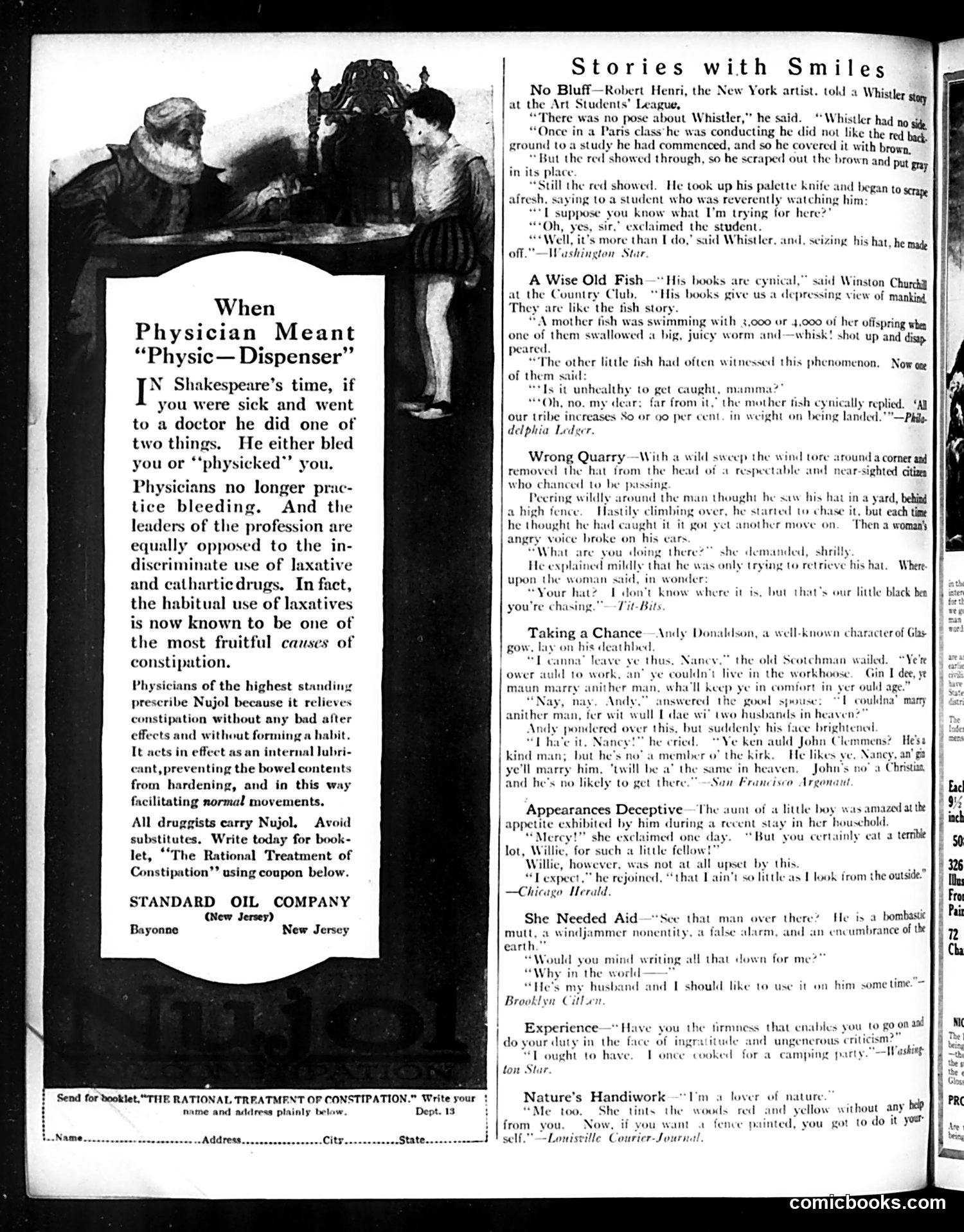
This page is primarily **advertising** for Nujol (a Standard Oil laxative product), which dominates the left side with a historical argument: Shakespeare-era doctors used "physicking" (purging) or bloodletting, but modern medicine now opposes habitual laxatives—positioning Nujol as the "rational" alternative that works without forming dependency. The right side contains **humorous anecdotes** unrelated to the ad: - **"No Bluff"**: A story about painter James McNeill Whistler's refusal to compromise or pose, even in his own teaching - **"A Wise Old Fish"**: A cynical joke about overfishing—the mother fish cynically notes the species gains weight when caught and sold - **"Wrong Quarry"**: A man chases what he thinks is his hat over a fence; it's actually someone's black hen - **"Taking a Chance"**: A dying Scottish man worries his widow can't remarry—then realizes she could marry in the afterlife These are mild, family-friendly jokes typical of *Judge* magazine's "Stories with Smiles" humor section—gentle satire and wordplay with no heavy political content on this particular page.
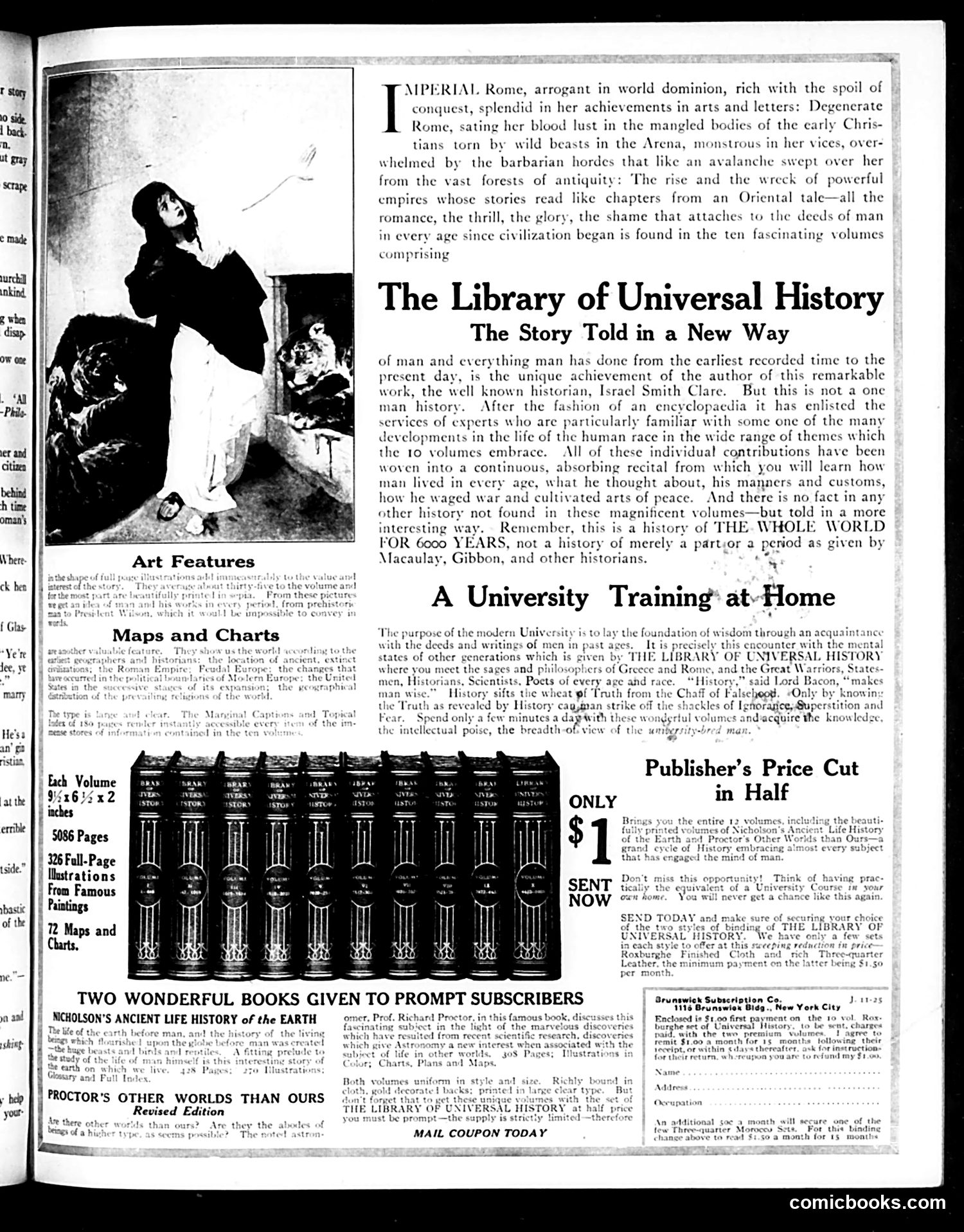
This page is **primarily an advertisement**, not political satire. It promotes "The Library of Universal History," a 10-volume encyclopedia by historian Israel Smith Clare, marketed as comprehensive world history from 6000 years ago to the present. The imagery—a classical figure contemplating Rome's rise and fall—serves as thematic decoration for the product pitch. The text contrasts Imperial Rome's glory with its moral decay and barbarian conquest, using this as a hook for why readers need this complete historical reference. The advertisement emphasizes the work's uniqueness: it covers "the whole world" comprehensively, unlike partial histories by Macaulay or Gibbon. It appeals to self-improvement ("University Training at Home") and offers promotional incentives—two bonus books for prompt subscribers and a "Publisher's Price Cut" offering all volumes for $1. This reflects early 20th-century marketing practices targeting middle-class readers seeking affordable education and cultural refinement.
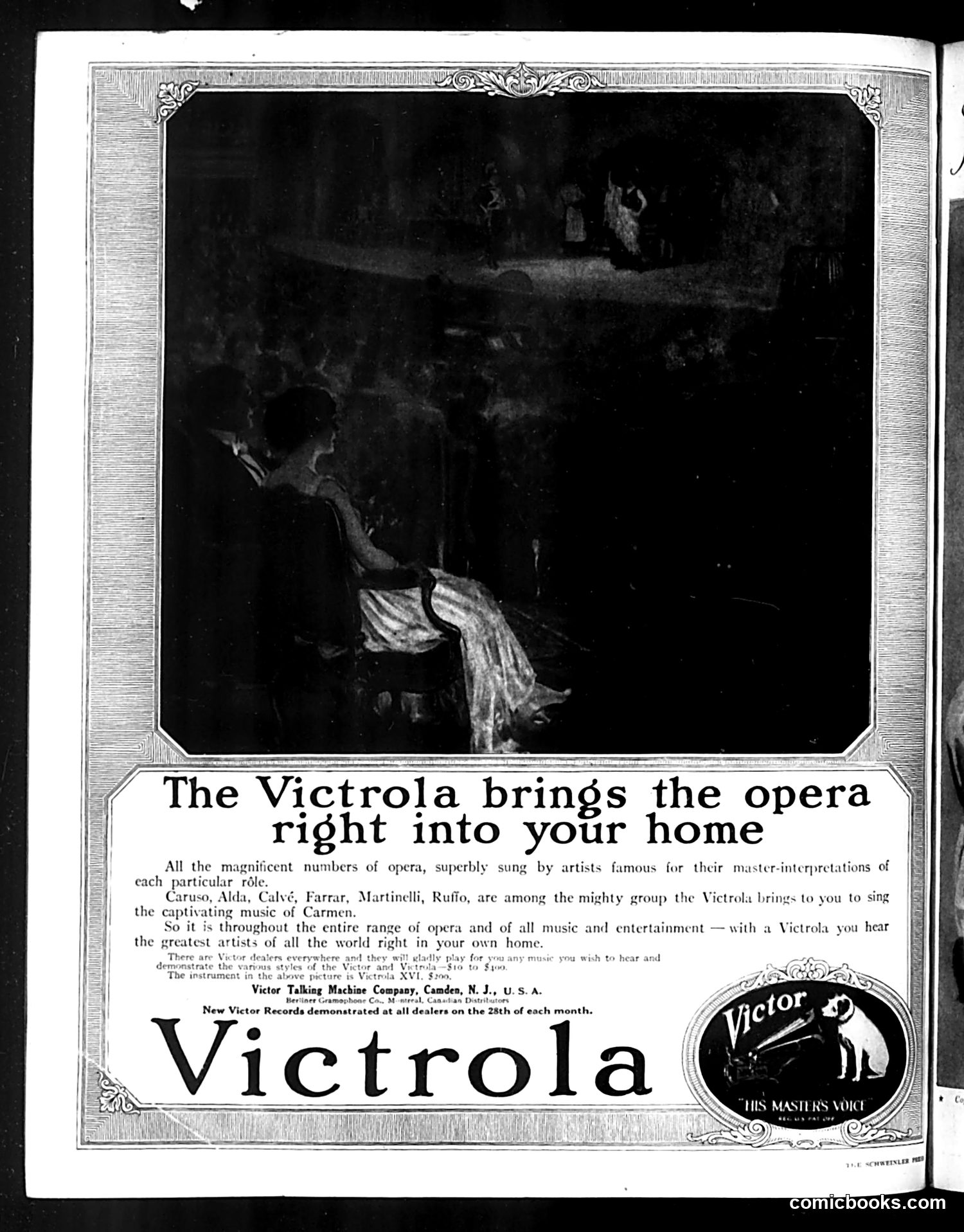
This is a **Victrola phonograph advertisement**, not a political cartoon. The page promotes the Victor Talking Machine Company's gramophone by claiming it brings opera performances into homes. The ad emphasizes that famous opera singers—named artists like Caruso, Aida, Calvé, Farrar, Martinelli, and Ruffo—have their performances available on Victor Records. The image shows people gathered to listen to the device in a darkened room, suggesting intimate home entertainment. The "His Master's Voice" logo (featuring a dog listening to a gramophone) appears at bottom right. This reflects early 20th-century marketing: selling new technology by promising access to world-class performances previously only available in concert halls.