
Judge, 1916-11-25 · page 14 of 32
Judge — November 25, 1916 — page 14: what you’re looking at
What you’re looking at
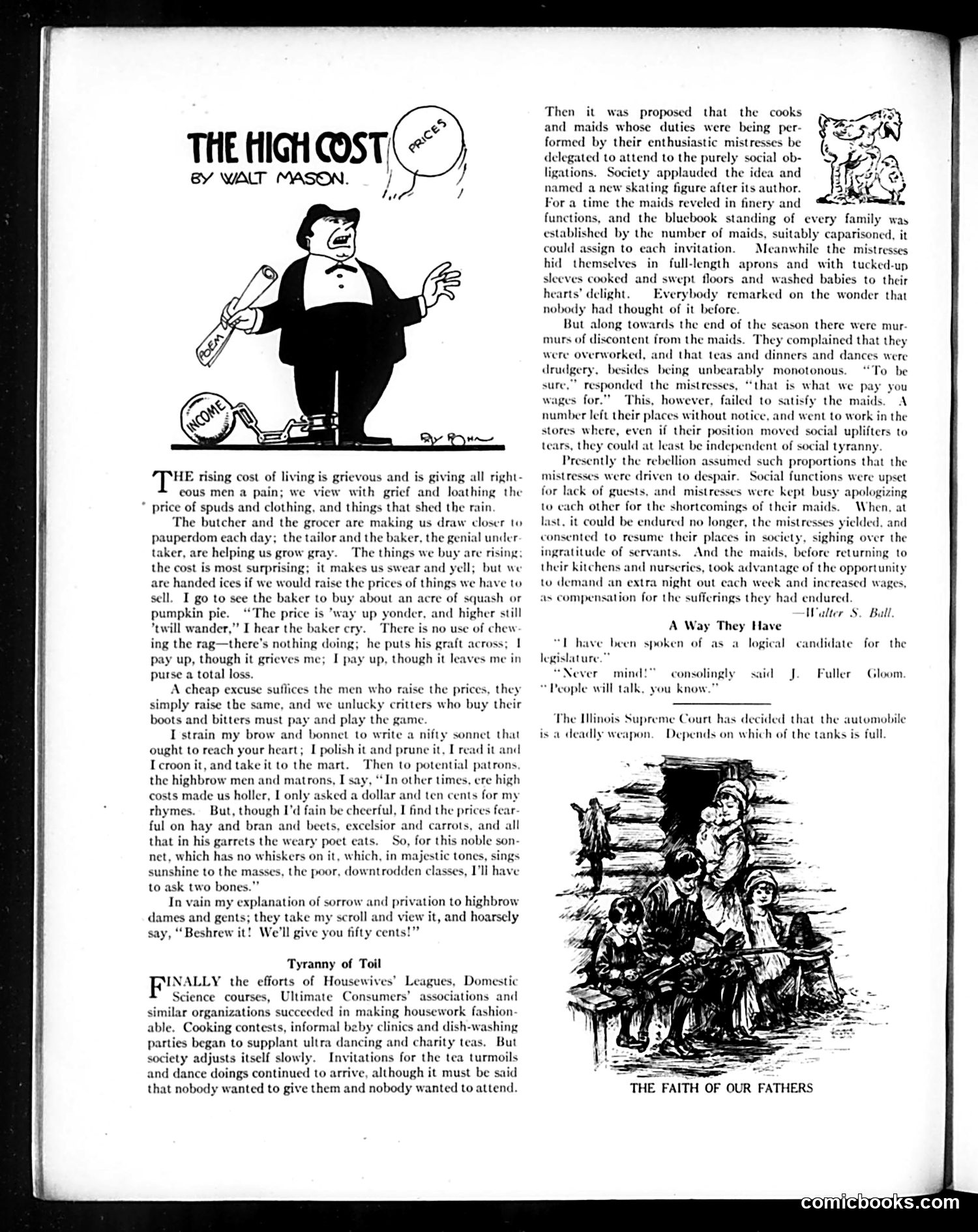
This satirical piece critiques the economic squeeze of the early 20th century. **The cartoon figure** (left) represents an ordinary citizen or worker being financially strangled—his gesture and posture suggest helplessness as costs rise daily. **The satire:** Mason complains that while working people suffer from inflated prices for food, clothing, and services, merchants simply raise prices in response to demands for higher wages. There's no relief—whether you're a baker, poet, or laborer, you're caught paying more while earning less. **The secondary section** lampoons fashionable reformers: wealthy women's groups promoted "scientific housework" as a status symbol, pressuring society ladies to do domestic labor themselves while their maids attended fancy social events as stand-ins. This backfired when maids realized they were being overworked without actual independence—so they quit for retail jobs offering dignity instead. **The point:** Economic systems exploit both workers and the working/middle classes, and well-intentioned social movements often create new problems.
📄 Transcribed text from this page (OCR, searchable)
Machine-transcribed from the original scan — historical spelling and the odd misread are preserved.
HE rising cost of living is grievous and is giving all right- cous men a pain; we view with grief and loathing the * price of spuds and clothing, and things t hed the rain The butcher and the grocer are making us draw closer to pauperdom each day; the tailor and the baker, the genial under taker, are helping us grow gray. The things we buy are rising; the cost is most surprising; it makes us swear and yell; but we are handed ices if we would raise the prices of things we have to sell. I go to see the baker to buy about an acre of squash or pumpkin pie. “The price is way up yonder, and higher still “twill wander,” I hear the baker cry. There is no use of chew ing the rag—there’s nothing doing; he puts his graft across; | pay up, though it grieves me; I pay up, though it leaves me in purse a total loss. A cheap excuse suflices the men who raise the prices, they simply raise the same, and we unlucky critters who buy their boots and bitters must pay and play the game: I strain my brow and bonnet to write a ni! ought to reach your heart; I polish it and prune it, I read it and Icroon it, and take it to the mart. Then to potential patrons the highbrow men and matrons, I say, “In other times, ere high costs made us holler, I only asked a dollar and ten cents for my rhymes. But, though I'd fain be cheerful, I find the prices fear ful on hay and bran and bects, excelsior and carrots, and all that in his garrets the weary poct eats. So, for this noble son- net, which has no whiskers on it, which, in majestic tones, sings sunshine to the masses, the poor, downtrodden classes, I'll have to ask two bon In vain my explanation of sorrow and privation to highbrow dames and gents; they my scroll and view it, and hoarsely say, “Beshrew it! We'll give you fifty cents!” y sonnet that Tyranny of Toil Fixatty the efforts of Housewives’ Leagues, Domestic Science courses, Ultimate Consumers’ associations and similar organizations succeeded in making housework fashion able. Cooking contests, informal beby clinics and dish-washing parties began to supplant ultra dancing and charity teas. But society adjusts itself slowly. Invitations for the tea turmoils and dance doings continued to arrive, although it must be said that nobody wanted to give them and nobody wanted to attend. Then it was proposed that the cooks and maids whose duties were being per- formed by their enthusiastic mistresses be delegate tend to the purely social ob- Society applauded the idea and [SF named a new skating figure after its author. For a time the maids reveled in finery and functions, and the bluebook standing of every family was established by the number of maids, suitably caparisoned, it sign to each invitation. Meanwhile the mistresses hid themselves in full-length aprons and with tucked-up sleeves cooked and swept floors and washed babies to their hearts’ delight. © Everybody remarked on the wonder that nobody had thought of it before. But along towards the end of the season there were mur- murs of discontent from the maids. They complained that thi were overworked, and that teas and dinners and dances were drudgery, besides being unbearably monotonous. “To be sure,” responded the mistresses, “that is what we pay you wages for.” This, however, failed to satisfy the maids. A number left their places without notice, and went to work in the stores where, even if their position moved social uplifters to tears, they could at least be independent of social tyranny. Presently the rebellion assumed such proportions that the mistresses were driven to despair. Social functions were upset for lack of guests, and mistresses were kept busy apologizing to cach other for the shortcomings of their maids. When, at last, it could be endured no longer, the mistresses yielded. and consented to resume their places in society, sighing over the ingratitude of servants. And the maids, before returning to their kitchens and nurseries, took advantage of the opportunity to demand an extra night out cach week and increased wages, as compensation for the sufferings they had endured Walter S. Ball a | Wen Al; A Way They Have “L have been spoken of as a logical candidate for the legislature.” “Nevermind! consolingly “People will talk, you know.” Fuller Gloom. said J The Ilinois Supreme Court has decided that the automobile is a deadly weapon. Depends on which of the tanks is full. THE FAITH OF OUR FATHERS