
Judge, 1916-11-25 · page 16 of 32
Judge — November 25, 1916 — page 16: what you’re looking at
What you’re looking at
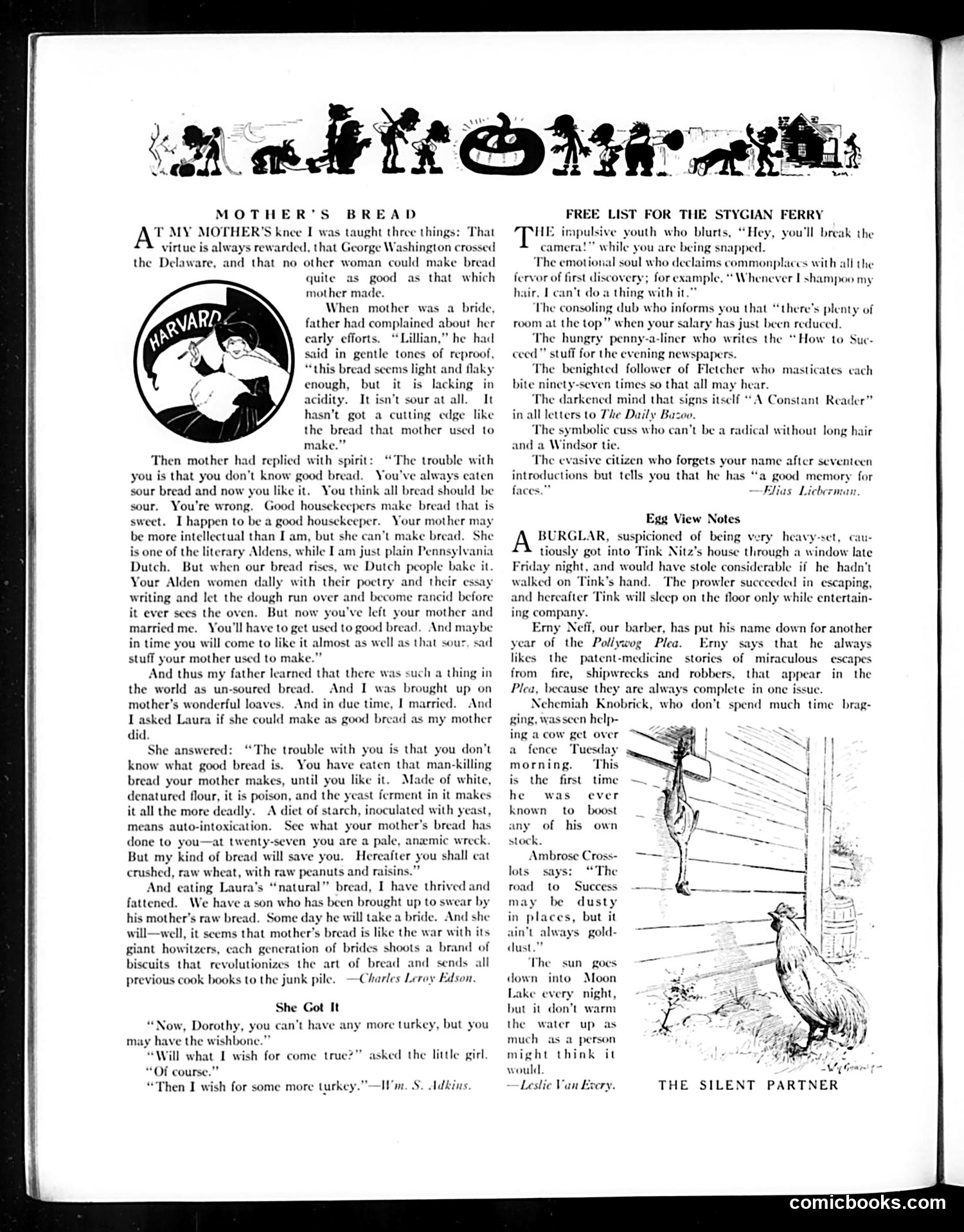
The main essay humorously traces generational conflict over bread-baking styles. A Pennsylvania Dutch mother insists on "sweet" bread; her Alden (literary, intellectual) mother-in-law preferred "sour" bread. The son later marries Laura, who rejects both traditions for "natural" raw wheat bread—claiming his mother's white bread has made him a "pale, anaemic wreck" by age twenty-seven. The satire mocks dietary fads and the endless cycle of women criticizing each other's housekeeping through bread. The page's secondary content includes brief comic pieces and "Free List for the Stygian Ferry"—a satirical list mocking pretentious modern types: the pushy photographer, emotional cliché-spouters, and obsessive "Fletcherites" (followers of Horace Fletcher's extreme chewing diet). The humor targets early 20th-century food crazes and social affectation rather than specific political figures.
📄 Transcribed text from this page (OCR, searchable)
Machine-transcribed from the original scan — historical spelling and the odd misread are preserved.
mae ake MOTHER’S BREAD . MY MOTHER'S knee I was taught three things: That rtue is always rewarded, that George Washington crossed the Delaware, and that no other woman could make bread quite as good as that which mother made. When mother was a bride, father had complained about her early efforts. “Lillian,”” he had tid in gentle tones of reproof, “this bread seems light and flaky enough, but it is lacking in acidity. It isn’t sour at all. It hasn't got a cutting edge like the bread that mother used to make.” Then mother had replied with spirit you is that you don’t know good bread. You've always caten sour bread and now you like You think all bread should be sour. You're wrong. Good housekeepers make bread that is sweet. I happen to be a good housekeeper. Your mother may be more intellectual than I am, but she can’t make bread. She is one of the literary Aldens, while Iam just plain Pennsylvania Dutch. But when our bread rises, we Dutch people bake it. Your Alden women dally with their poctry and their essay writing and let the dough run over and become rancid before it ever sees the oven. But now you've left your mother and married me. You'll have to get used to good bread. And maybe in time you will come to like it almost as well as that sour, sad stuff your mother used to maki And thus my father learned that there was such a thing in the world as un-soured bread. And I was brought up on mother’s wonderful loaves. And in due time, I married. And I asked Laura if she could make as good bread as my mother did. She answered: “The trouble with you is that you don’t know what good bread is. You have eaten that man-killing bread your mother makes, until you like it. Made of white, denatured flour, it is poison, and the yeast ferment in it makes it all the more deadly. A diet of starch, inoculated with yeast, means auto-intoxication. See what your mother’s bread has done to you—at twenty-seven you are a pale, anaemic wreck. But my kind of bread will save you. Hereafter you shall eat crushed, raw wheat, with raw peanuts and raisins.” And eating Laura’s “natural” bread, I have thrived and fattened. We have a son who has been brought up to swear by his mother’s raw bread. Some day he will take a bride. And she will—well, it seems that mother’s bread is like the war with its giant howitzers, h generation of brides shoots a brand of biscuits that revolutionizes the art of bread and sends all previous cook hooks to the junk pile. —Charles Leray Edson. The trouble with She Got It “Now, Dorothy, you can’t have any more turkey, but you may have the wishbone.” Will what I wish for come true? “Of course.” “Then I wish for some more turkey. * asked the little girl Wm. S. Adkins 4 FREE LIST FOR THE STY HE impulsive youth who blurts, “Hey. camera!” while you are being snapped. The emotional soul who declaims commonplaces with all the fervor of first discovery; for example,“ Whenever I shampoo my hair, I can’t do a thing with it.” The consoling dub who informs you that “there's plenty of room at the top” when your salary has just been reduced. The hungry penny iner who writes the “How to Suc- ceed” stuff for the evening newspapers. The benighted follower of Fletcher who masticates cach bite ninety-seven times so that all may hear. Phe darkened mind that signs itself “A Constant Reader” in all letters to The Daily Bazoo, The symbolic cuss who can’t be a radical without long hair Windsor ti The evasive citizen who forgets your name after seventeen introductions but tells you that he has “a good memory for f * Elias Licherm IAN FERRY you'll break the faces. Egg View Notes BUR R, suspicioned of being very heavy: tiously got into Tink Nitz’s house through a window late riday night, and would have stole considerable if he hadn't walked on Tink’s hand. The prowler succeeded in escaping, nd hereafter Tink will sleep on the floor only while entertain- ing company. Erny Neff, our barber, has put his name down for another year of the Pollywog Plea. Emmy says that he always likes the patent-medicine storics of miraculous escapes from fire, shipwrecks and robbers, that appear in the Plea, ecause they are always complete in one issue. Nehemiah Knobrick, who don’t spend much time brag- ging, wasscen help- ing a cow get over GS a fence Tuesd: morning. his is the first’ time he ow ever known to boost any of his own stock. Ambrose Cross- lots says: “The road to Success be dusty in places, but it ain’t always gold- dust.” The sun goes down into Moon Lake every night, but it don’t warm the water up as much as a person might think it would. Leslie Van Exery. comicbooks.com