
Judge, 1916-11-25 · page 20 of 32
Judge — November 25, 1916 — page 20: what you’re looking at
What you’re looking at
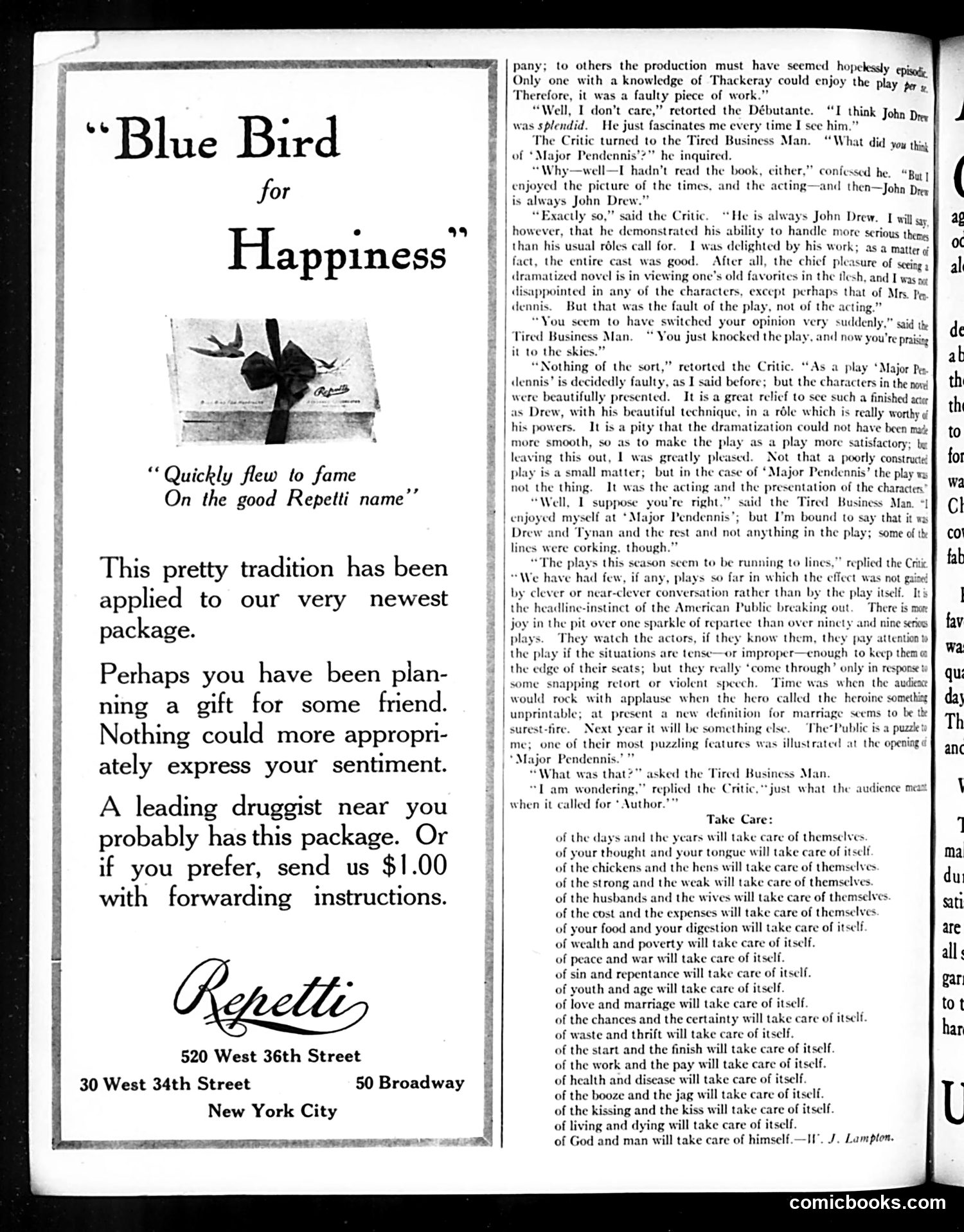
This page is primarily **advertising**, not political satire. The left side promotes Repetti's "Blue Bird for Happiness" gift package—a commercial product marketed as an appropriate gift item for friends. The right side contains a **theater review** discussing a stage adaptation of Thackeray's *Major Pendennis*, featuring the popular actor John Drew. The critic and a "Tired Business Man" debate the production's merits. The satire here is **social commentary** on American theater audiences, not politics: critics mock playgoers' preference for clever dialogue and sensational moments over substantive drama, and their puzzling habit of demanding the author appear after performances. The bottom section, "Take Care," is inspirational verse (unrelated to the page's main content). **Context for modern readers:** This reflects early 20th-century concerns about mass entertainment's quality and audience taste—concerns that remain relevant today.
📄 Transcribed text from this page (OCR, searchable)
Machine-transcribed from the original scan — historical spelling and the odd misread are preserved.
2 NCEE ae Pat AP TR TL Awe as a Blue Bird for Happiness” “Quickly flew to fame On the good Repetti name’’ This pretty tradition has been applied to our very newest package. Perhaps you have been plan- ning a gift for some friend. Nothing could more appropri- ately express your sentiment. A leading druggist near you probably has this package. Or if you prefer, send us $1.00 with forwarding instructions. 520 West 36th Street 30 West 34th Street 50 Broadway New York City SC PLEO GIT EE AOE § SMe ABE EY re Peco eae Ta Aa yt | dramatized novi | disappointed any; to others the production must have seemed hopelessly episod one with a knowledge of Thackeray could enjoy the play per» Therefore, it was a faulty piece of wor! “Well, I don’t care,” retorted the Débutante. “I think John Drey was splendid. He just fascinates me every time I see him.” The Critic turned to the Tired Business Man. “What did you this of ‘Major Pendennis’?” he inquired. % Vhy—well—I hadn't read the book, either,” confessed he. “By yf enjoyed the picture of the times, and the acting—and then—John Drer is always John Drew.” tly so,”” said the Critic Iways John Drew. I will gy however, that he demonstrated his to handle more serious thems than his usual roles call for. I was delighted by his work; as a matter g fact, the entire cast was good. After all, the chief pleasure of seeing in viewing one’s old favorites in the flesh, and I was ye uny of the ch: Ts, except perhaps that of Mrs. Pe, dennis, But that was the fault of the play, not of the acting.” “You seem to have switched your opinion very suddenly the Tired Business Man.“ You just knocked the play, and now you're praiiy it to the skies.” “Nothing of the sort,” retorted the Critic. dennis’ is decidedly fault were beautifully presen as Drew, with his be: $a play ‘Major Pe. as I said before; but the characters in the now - It isa great relief to see such a finished ace tiful technique, in a rdle which is really worthy ¢ lines were corking, though.” “The plays this season scem to be running to lines,” replied the Ct “We have had few, if any, plays so far in which the effect was not gai by clever or near-clever conversation rather than by the play itse the headline-instinet of the American Public breaking out. There is joy in the pit over one sparkle of repartee than over nincty and nine series plays. They watch the actors, if they know them, they pay atten! the play if the situations are tense—or improper—enough to keep theme the edge of their seats; but they really ‘come through’ only in respons some snapping retort or violent speech. Time was when the audiex would rock with applause when the hero called the heroine somet unprintable; at present a new definition for marriage scems to be th surest-fire. Next year it will be something else. The*Public is a puzzles me; one of their most puzzling features was illustrated at the opening ¢ *Major Pendennis.’ “What was that?” asked the Business Man. am wondering,” replied the Critic,” just what the audience when it called for * Author.’ Take Care: of the days and the years will take care of themselves of your thought and your tongue will ta are of itself of the chickens and the hens will take care of themselves. of the strong and the weak will tal are of themselv of the husbands and the wives will take care of themselves of the cost and the expenses will take care of themselves. of your food and your digestion will take care of itself of wealth and poverty will take care of itself. of peace and war will tal ¢ of itself. of sin and repentance will take care of itself. of youth and age will take care of itself. of love and marriage will ta of the chances and the certainty will take care of itself. of waste and thrift will take of the start and the finish of the work and the pay will take of health and disease will take care of of the booze and the jag will take ¢ iss will take care of itself. of living and dying will take care of itself. of God and man will take care of himself.—Il". J. Lampton. comicbooks.com of, = al his powers. It isa pity that the dramatization could not have been mf tg more smooth, so as to make the play a play more satisfactory leaving this out, 1 was greatly pleased. Not that a poorly consteuce: | {01 play is a small matter; but in the case of ‘Major Pendennis’ the play ws not the thing. It was the acting and the presentation of the characters wa “Well, T suppose you're right.” said the Tired Business Man. “If Q] | enjoyed myself at * Major Pendennis’; but I'm bound to say that it Drew and Ty nd the rest and not anything in the play; some of thf CO! ‘are of itself. tot