
Judge, 1916-11-25 · page 6 of 32
Judge — November 25, 1916 — page 6: what you’re looking at
What you’re looking at
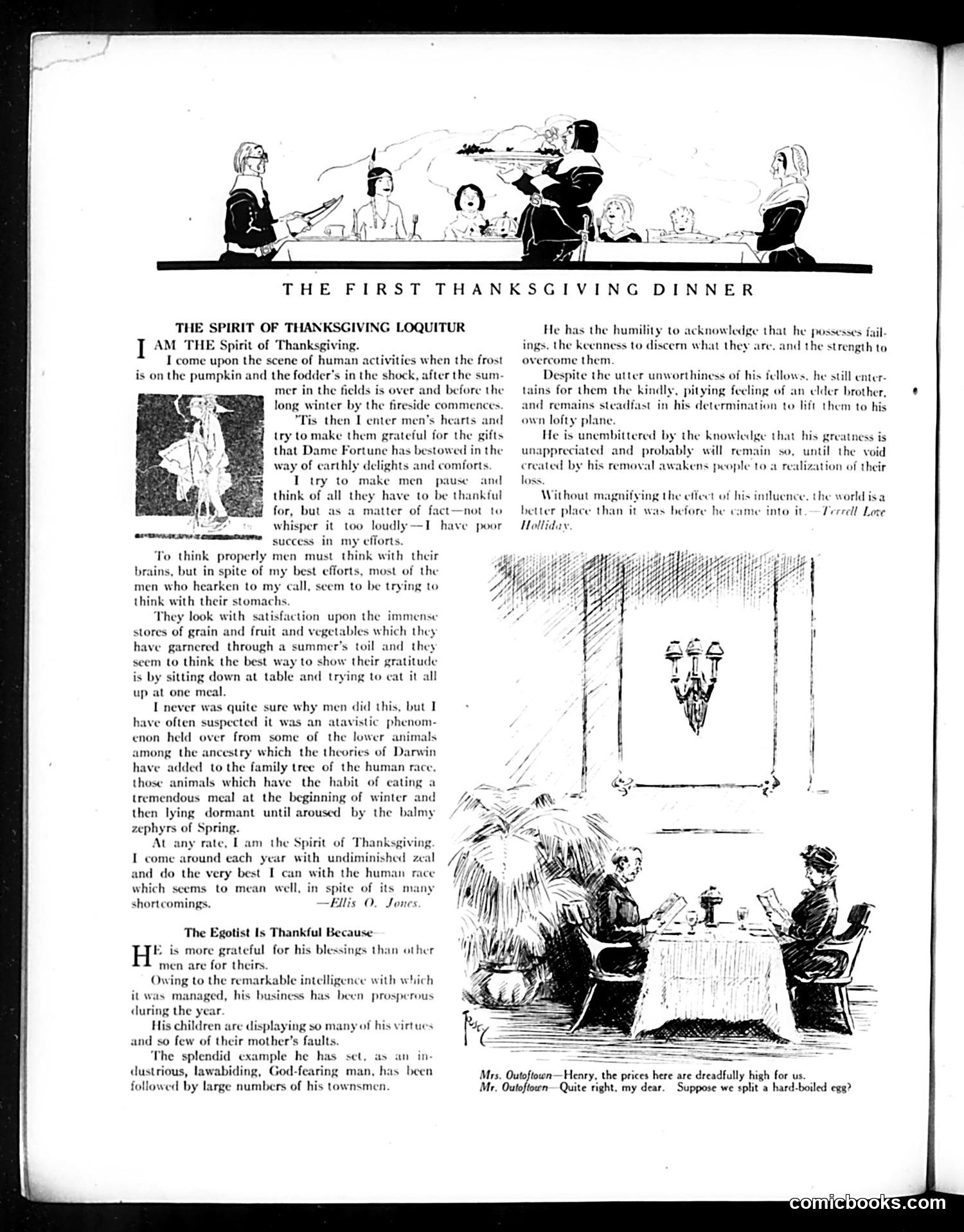
This page presents Thanksgiving satire targeting American materialism and self-regard. **Top section**: "The Spirit of Thanksgiving" personified laments that humans celebrate the holiday by gorging themselves rather than practicing genuine gratitude. The Spirit wryly suggests this gluttony is an "atavistic" holdover from animals that feast before winter hibernation—a Darwinian jab at human behavior. **Bottom cartoon**: Satirizes the self-important "egotist" who attributes his business success entirely to his own intelligence and his children's virtues to his genes (not their mother's influence). He condescendingly pities his inferior townsmen. The final exchange mocks this smugness: when his wife notes high prices, he smugly suggests they economize by splitting one hard-boiled egg—revealing his cheap nature beneath the self-aggrandizing rhetoric. The satire targets wealthy, self-made men of the era who credited personal merit alone for success while demonstrating miserliness and moral superiority.
📄 Transcribed text from this page (OCR, searchable)
Machine-transcribed from the original scan — historical spelling and the odd misread are preserved.
THE FIRST THANKSGIVING DINNER THE SPIRIT OF THANKSGIVING LOQUITUR AM THE Spirit of Thanksgiving. I come upon the scene of human activities when the frost is on the pumpkin and the fodder’s in the shock, after the sum- mer in the fields is over and before the long winter by the fireside commences. ‘Tis then I enter men’s hearts and try to make them grateful for the gifts that Dame Fortune has bestowed in the way of carthly delights and comforts. I try to make men pause and think of all they have to be thankful for, but as a matter of fact—not to whisper it too loudly—I have poor success in my efforts. To think properly men must think with their brains, but in spite of my best efforts, most of the men who hearken to my call, seem to be trying to think with their stomachs. They look with satisfaction upon the immense stores of grain and fruit and vegetables which they have garnered through a summer’s toil and they seem to think the best way to show their gratitude is by sitting down at table and trying to cat it all up at one meal. I never was quite sure why men did this, but I have often suspected it was an atavistic phenom- enon held over from some of the lower animals among the ancestry which the theories of Darwin have added to the family tree of the human race, those animals which have the habit of eating a tremendous meal at the beginning of winter and then lying dormant until aroused by the balmy zephyrs of Spring. At any rate, Lam the Spirit of Thanksgiving: I come around each year with undiminished zeal and do the very best I can with the human race which seems to mean well, in spite of its many -Fllis O. Jones DAs SET shortcomings. The Egotist Is Thankful Because H is more grateful for his blessings than other men are for theirs Owing to the remarkable intelligence with which it was managed, his business has been prosperous during the year. His children are displaying so many of his virtues and so few of their mother’s faults. ‘The splendid example he has dustrious, lawabiding, God-fearing man, has been followed by large numbers of his townsmen. set, as an in Mr. Outoftown He has the humility to acknowledge that he possesses fail- ings. the keenness to discern what they are, and the strength to overcome them Despite the utter unworthiness of his fellows. he still enter- tains for them the kindly, pitying feeling of an clder brother, and remains steadfast in his determination to lift them to his own lofty plane. He is unembittered by the knowledge that his greatness is unappreciated and probably will remain so, until the void created by his removal awakens people to a realization of their loss. Without magnifying the effect of his influence. the world isa better place than it was before he came into it.— Terrell Lore Holliday —_ Mrs. Outoftown—Henry, the prices here are dreadfully high for us Quite right, my dear. Suppose we split a hard-boiled egg? icbooks.com