
Judge, 1916-11-25 · page 12 of 32
Judge — November 25, 1916 — page 12: what you’re looking at
What you’re looking at
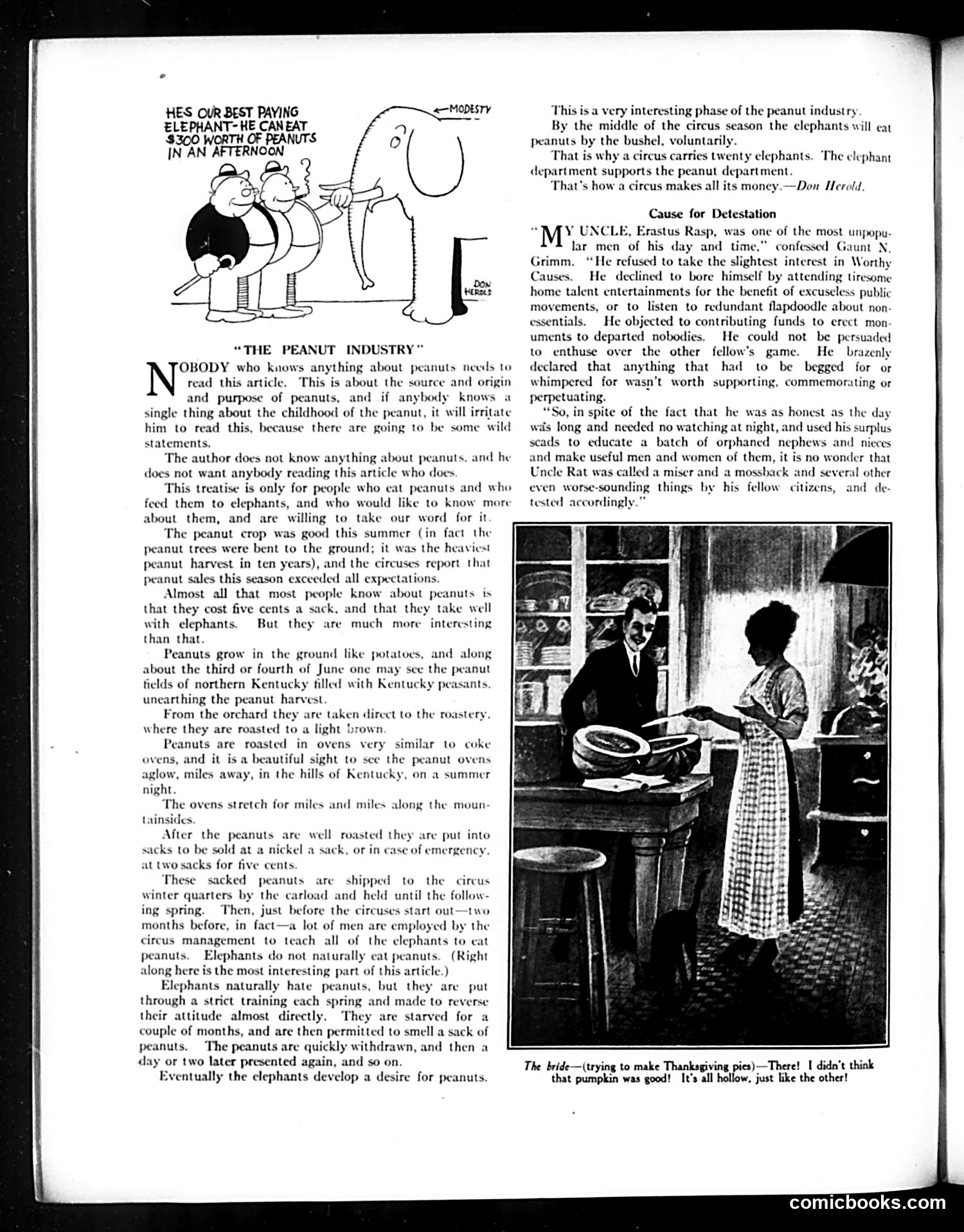
**"The Peanut Industry" (top cartoon and article):** This is humorous satire about circus economics. The cartoon shows two men praising an elephant as their "best paying" animal because it consumes $300 worth of peanuts daily. The accompanying article by Don Herold (a real humorist) presents mock-serious "facts" about peanuts—claiming they naturally grow in Kentucky, require special roasting ovens, and that elephants must be trained to eat them through months of starvation and conditioning. The joke: circuses don't actually profit from peanut sales to audiences; rather, elephants eating peanuts (which circuses buy cheaply) provides the real revenue model. It's satirizing the absurd economics and public ignorance about circus operations. **"Cause for Detestation" (right section):** A separate article beginning a character sketch about Uncle Erastus Rasp, a widely disliked man who refuses to participate in charitable causes, community entertainments, or social conventions—making him controversial in his era's values.
📄 Transcribed text from this page (OCR, searchable)
Machine-transcribed from the original scan — historical spelling and the odd misread are preserved.
HES OUR BEST PAVING ELEPHANT HE CANEAT $300 WORTH OF PEANUTS IN AN AFTERNOON A “THE PEANUT INDUSTRY” OBODY who knows anything about peanuts needs to N read this article. This is about the source and origin and purpose of peanuts, and if anybody knows a single thing about the childhood of the peanut, it will irritate him to read this, because there are going to be some wild statements. The author does not know anything about peanuts. and he does not want anybody reading this article who does. This treatise is only for people who cat peanuts and who feed them to elephants, and who would like to know more about them, and are willing to take our word for it The peanut crop was good this summer (in fact the peanut trees were bent to the ground; it was the heaviest peanut harvest in ten years), and the circuses report that peanut sales this season exceeded all expectations. Almost all that most people know about peanuts is that they cost five cents a sack, and that they take well with elephants. But they are much more interesting than that. Peanuts grow in the ground like potatoes, and along about the third or fourth of June one may see the peanut fields of northern Kentu filled with Kentucky peasants. unearthing the peanut harvest From the orchard they are taker where they are roasted to a light wn. Peanuts are roasted in ovens very similar to ovens, and it is a beautiful sight to see the peanut ovens aglow, miles away, in the hills of Kentucky, on a summer night. The ovens stretch for miles and miles along the moun- lirect to the roastery, coke tainsides. After the peanuts are well roasted they are put into sacks to be sold at a nickel a sack, or in case of emergency. at two sacks for five cents. These sacked peanuts are shipped to the winter quarters by the carload and held until the follow- ing spring. Then, just before the circuses start out—two months before, in fact—a lot of men are employed by the circus management to teach all of the elephants to cat peanuts. Elephants do not naturally eat peanuts. (Right along here is the most interesting part of this article.) Elephants naturally hate peanuts, but they are put through a strict training cach spring and made to reverse their attitude almost directly. They are starved for a couple of months, and are then permitted to smell a sack of peanuts. The peanuts are quickly withdrawn, and then a day or two later presented again, and so on. Eventually the elephants develop a desire for peanuts. circus This is a very interesting phase of the peanut industry By the middle of the circus season the elephants will eat peanuts by the bushel, voluntarily. That is why a circus carries twenty elephants. The elephant department supports the peanut department. at's how a circus makes all its money.—Don Herold. Cause for Detestation “ Y UNCLE, Erastus Rasp, was one of the most unpopu- lar men of his day and time,” confessed Gaunt N, Grimm. “He refused to take the slightest interest in Worthy Causes. He declined to bore himself by attending tiresome home talent entertainments for the benefit of excuseless public ents, or to listen to redundant flapdoodle about non- He objected to contributing funds to erect mon He could not be persuaded move essentials. uments to departed nobodies. to enthuse over the other fellow’s game. He brazenly declared that anything that had to be begged for or whimpered for wasn't worth supporting, commemorating or perpetuating. “So, in spite of the fact that he was as honest as the day long and needed no watching at night, and used his surplus scads to educate a batch of orphaned nephews and nieces and make useful men and women of them, it is no wonder that Uncle Rat was called a miser and a mossback and several other even worse-sounding things by his fellow citizens, and de- tested accordingly.” The bride—(trying to make Thanksgiving pies)—There! I didn’t think that pumpkin was good! It's all hollow, just like the other! comicbooks.com