
A complete issue · 28 pages · 1916
Judge — September 16, 1916
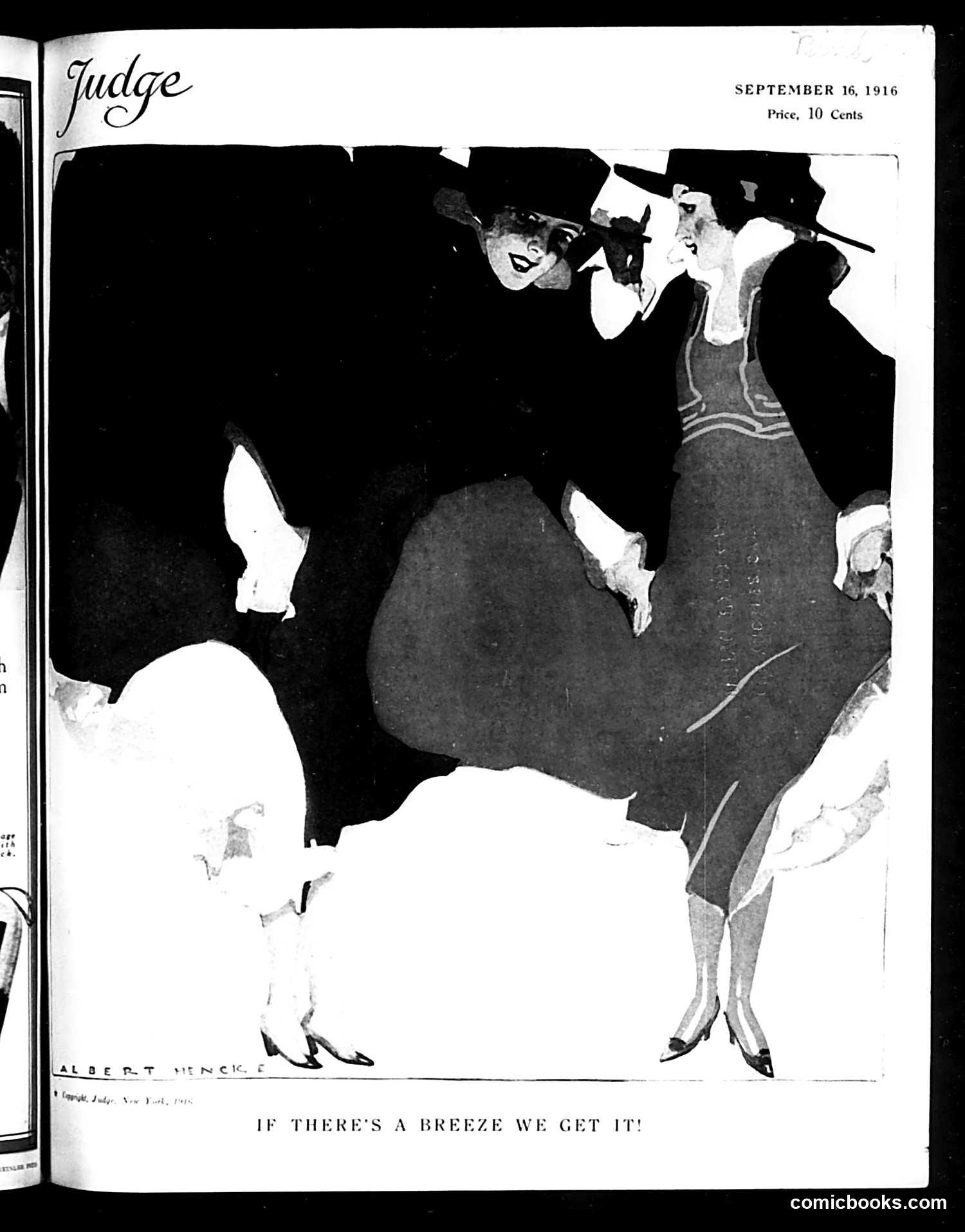
This cartoon by Albert Hinckle depicts women in fashionable dress with the caption "If There's a Breeze We Get It!" The joke plays on contemporary anxieties about women's evolving hemlines and skirt lengths during the 1910s. As women's fashion modernized with shorter skirts, conservative critics worried about modesty and propriety—particularly regarding exposure during windy conditions. The cartoon satirizes both the fashion trend itself and the public obsession with women's clothing scandals. The women's confident, somewhat mischievous expressions suggest they're aware of and unbothered by the scandal their hemlines create, which itself mocks the era's prudishness. This reflects broader 1910s social tensions between traditional morality and women's increasing social liberation and independence.
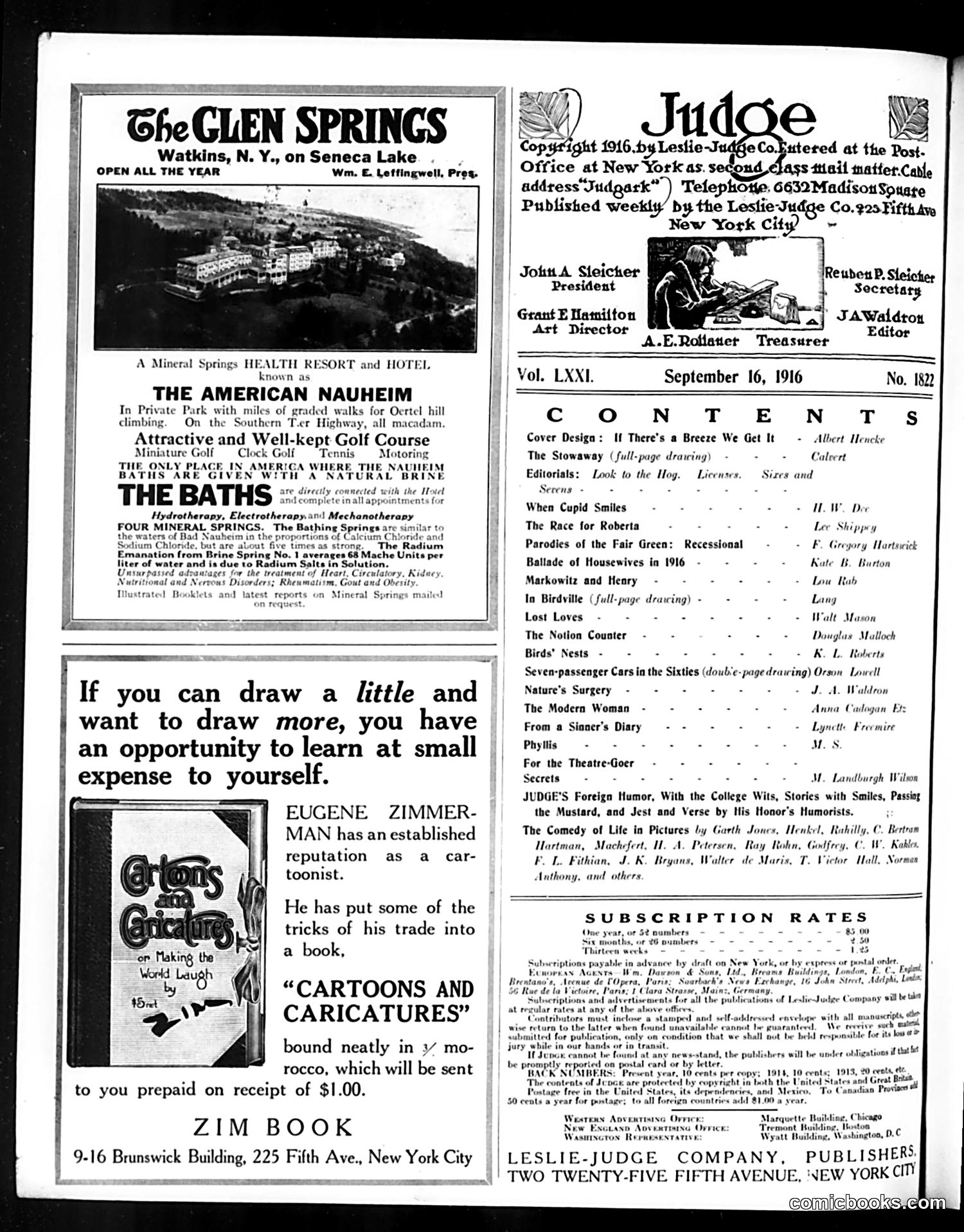
This page is primarily **advertising and masthead information** rather than political satire. The main content includes: - A resort advertisement for "The Glen Springs" in Watkins, New York - An ad for Eugene Zimmermann's cartooning instruction book, "Cartoons and Caricatures," promoting his established reputation as a cartoonist - Table of contents listing various articles and illustrations in that week's issue The page lacks prominent political cartoons or satire targeting specific figures or events. The Zimmermann ad is notable only as a self-promotional piece aimed at aspiring artists. Without examining the actual interior illustrations listed, we cannot identify specific satirical targets or social commentary from this particular page.
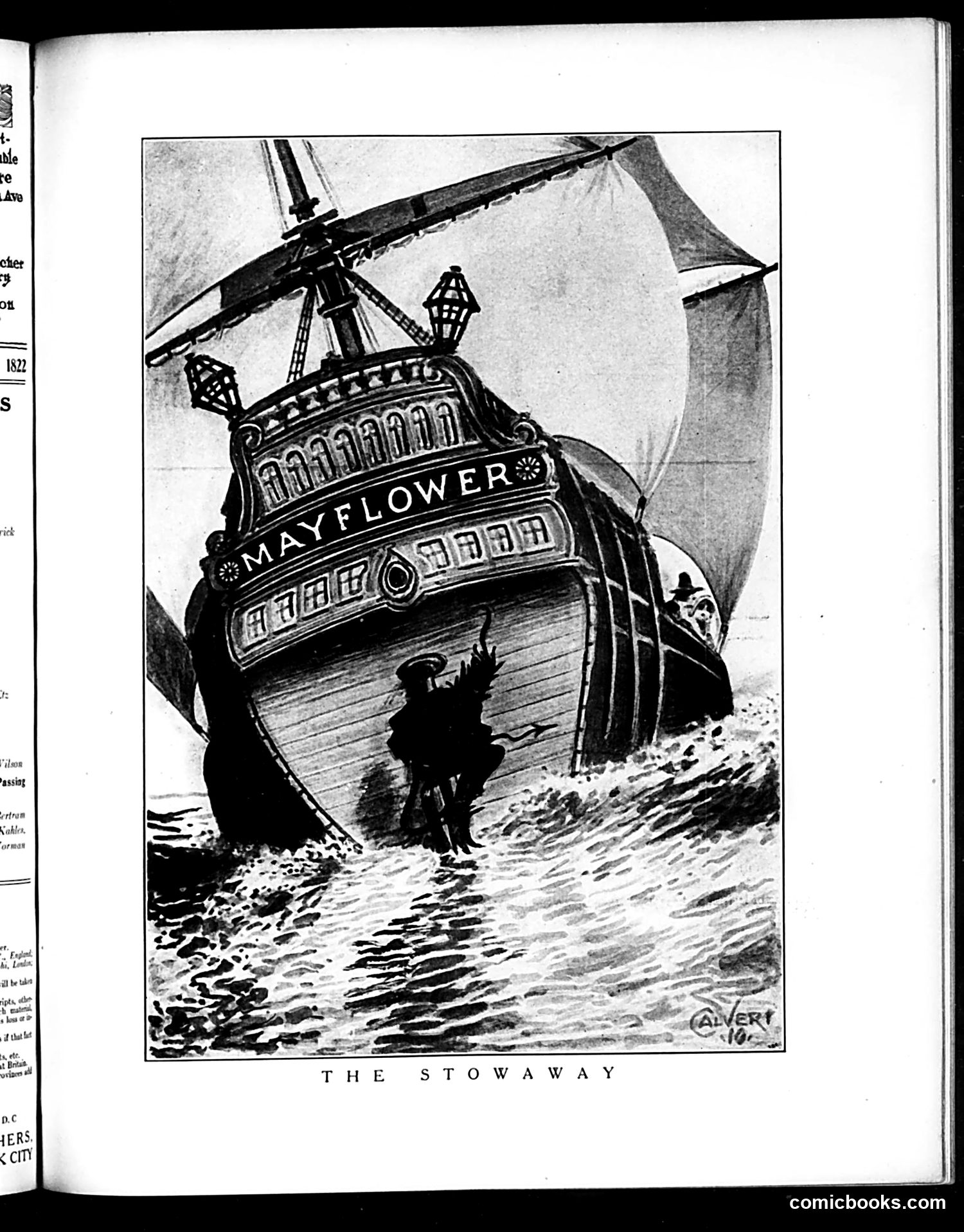
This illustration depicts a stowaway hiding in the hull of the Mayflower, the famous ship that carried Pilgrims to America in 1620. The cartoon's title and the ship's name painted on the hull make this reference clear. The satire likely comments on immigration and unauthorized passage to America—a timely theme in early 20th-century America when Judge magazine was active. By invoking the Mayflower's historical voyage, the cartoon ironically suggests that even America's founding involved "stowaways" seeking passage to the New World. The figure's silhouette in the ship's shadow emphasizes concealment and secrecy, central to the "stowaway" concept. The artist's signature appears as "ALVERT" or similar in the lower right.
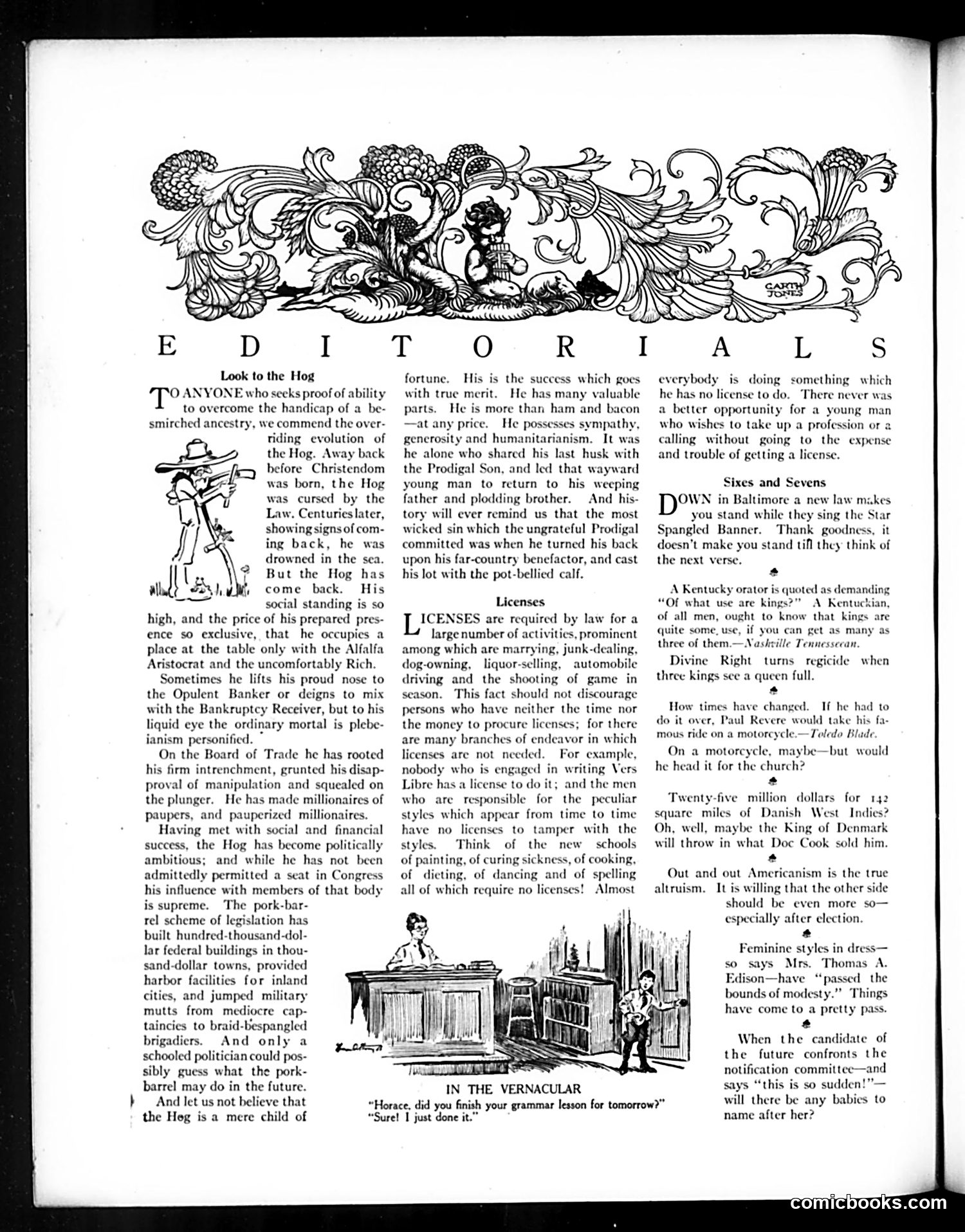
This "Editorials" page contains satirical commentary on American society rather than visual political cartoons. The main illustrated piece depicts a schoolroom scene captioned "In the Vernacular" with dialogue about grammar lessons—likely mocking either educational standards or colloquial speech patterns of the era. The text sections critique various targets: the "Hog" piece appears to praise someone rising from poverty through merit (possibly referencing self-made success stories); "Licenses" satirizes bureaucratic overregulation of professions; "Sixes and Sevens" mocks patriotic songs; and brief quips target everything from motorcycles to women's fashion trends. The overall tone suggests Judge was using humor to comment on contemporary American excess, regulation, and cultural pretension circa early 1900s.
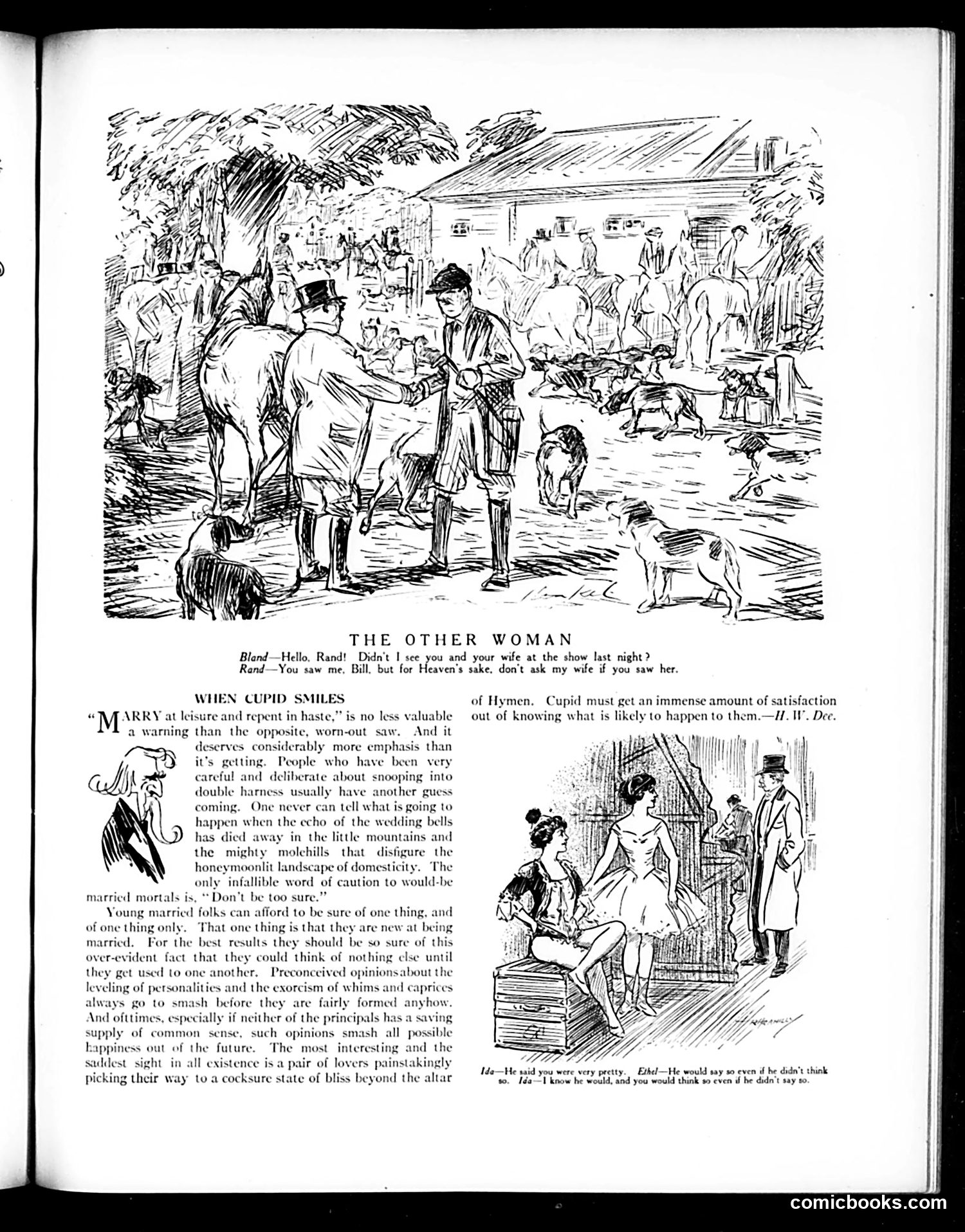
This page contains two separate satirical pieces about marriage and infidelity. **Top cartoon** depicts a social gathering where a man named Rand encounters someone who saw him with "your wife" at a show. Rand urgently requests secrecy, claiming the woman wasn't actually his wife. The joke satirizes infidelity and the anxieties of maintaining deceptive relationships in public spaces. **"When Cupid Smiles" essay** mocks newlyweds' naive assumptions that marriage will be blissful. It sardonically warns that young couples often fail to anticipate marital problems, instead becoming consumed with each other while ignoring practical concerns. The accompanying illustration shows what appears to be a domestic scene, reinforcing the essay's cynical view of romantic ideals versus reality. Both pieces target marital discord and deception as recurring social problems.
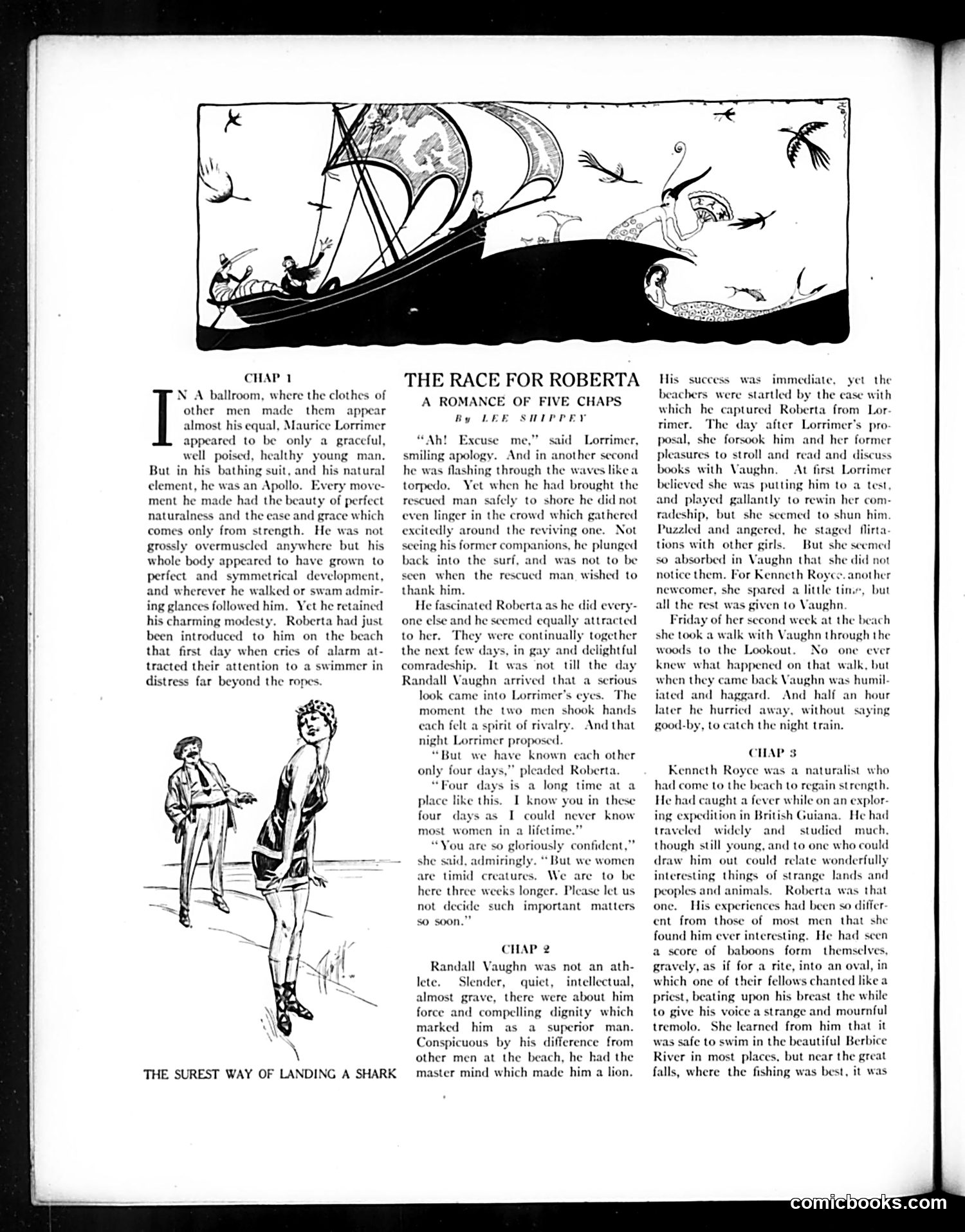
This is a serialized romantic fiction story (not political satire), illustrated with pen-and-ink drawings. The narrative depicts a romantic competition among three men for a woman named Roberta at a beach resort. **The setup:** Maurice Lorrimer, an exceptionally handsome and physically perfect man, rescues a swimmer and attracts Roberta. Randall Vaughn, described as quiet, intellectual, and dignified despite being less athletic, arrives and competes for her attention. She abandons Lorrimer for Vaughn's intellectual companionship. A third suitor, Kenneth Royce—a naturalist and world traveler—appears to enter the competition. **The satire implied:** The story gently mocks the shallow nature of romantic competition, contrasting physical attractiveness (Lorrimer's "Apollo" physique) against intellectual appeal (Vaughn's "master mind"). The illustration "The Surest Way of Landing a Shark" appears to be a humorous aside about beach life. This reflects early-20th-century magazine serialized fiction targeting middle-class readers interested in romance and vacation settings.
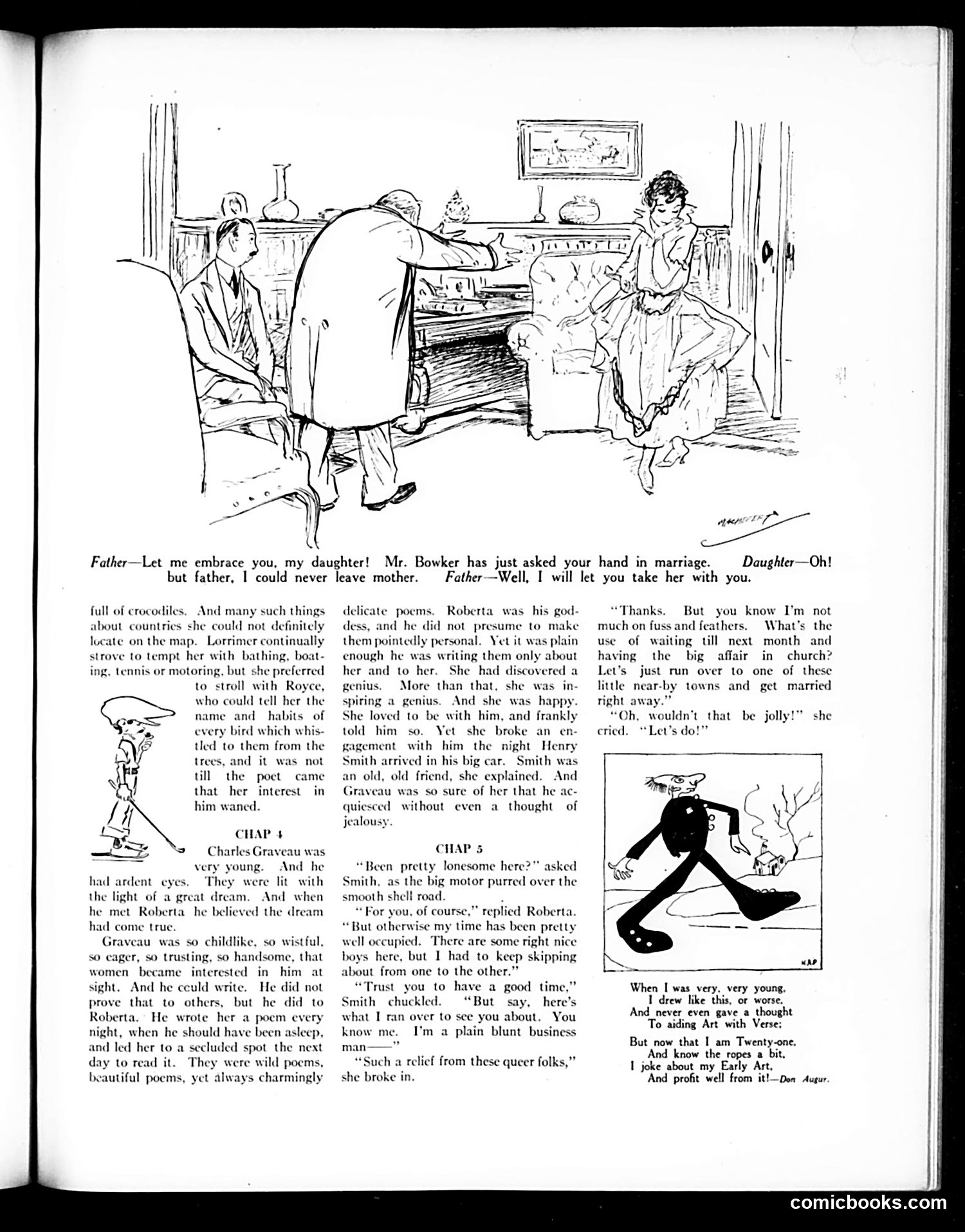
This page from *Judge* magazine presents a serialized romantic story with satirical commentary. The main narrative (Chapters 4-5) follows Roberta, a young woman courted by the sensitive poet Charles Graveau, who abandons him when her old friend Henry Smith arrives in an automobile. Smith proposes immediate marriage without ceremony—a practical, business-like approach that Roberta enthusiastically accepts over the romantic poet's devotion. The satire targets **early 20th-century courtship conventions**: the clash between idealized romantic poetry and pragmatic materialism. Graveau represents artistic sensitivity; Smith embodies modern efficiency and wealth (signaled by his "big motor"). Roberta's swift rejection of the poet for the businessman satirizes women's supposed superficiality and materialism. The small cartoon at bottom-right is autobiographical commentary by the artist (Don Augur), joking about trading youthful artistic pretensions for commercial success—mirroring the story's theme of romance surrendered for practical gain.
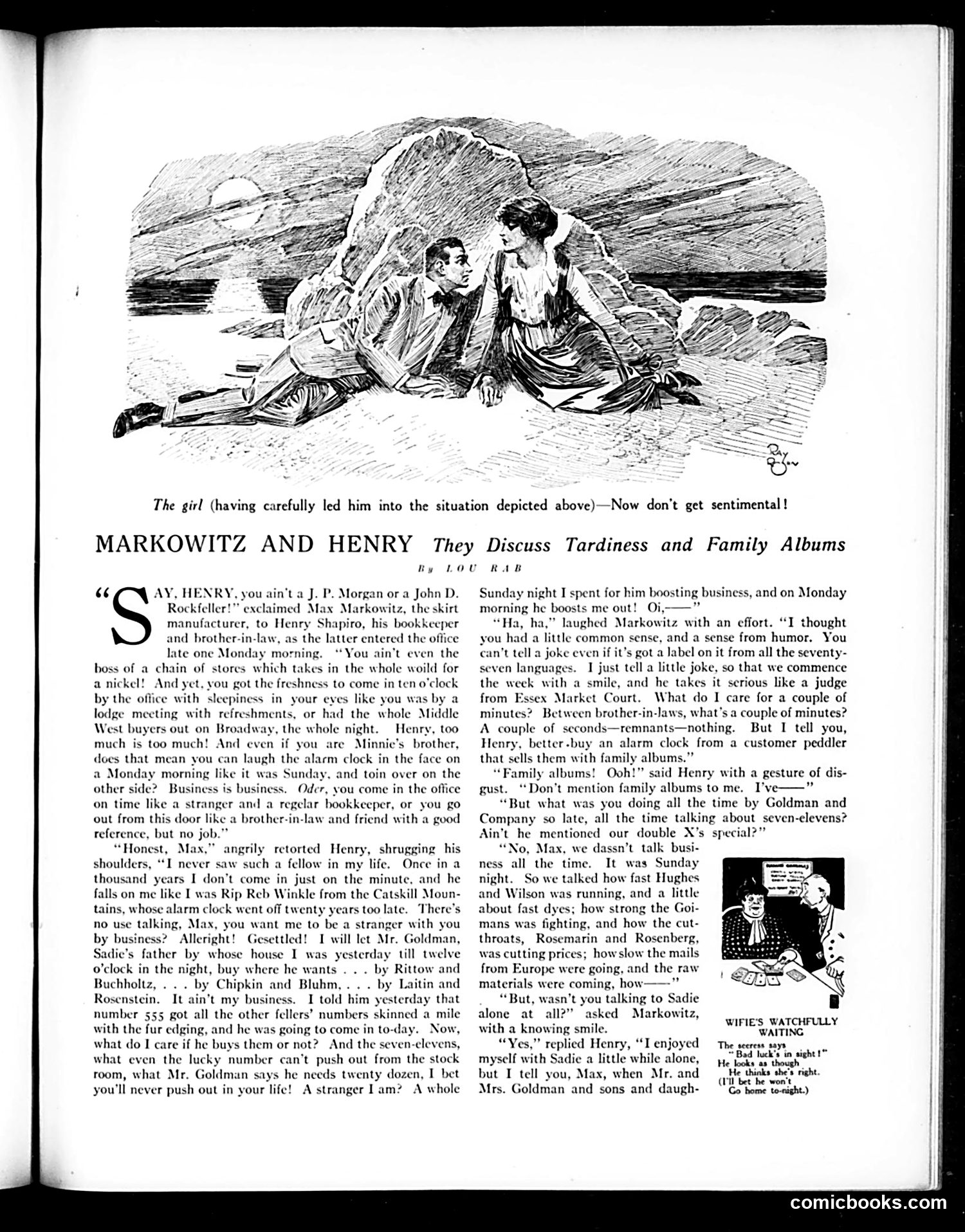
This is a Yiddish-inflected comedy sketch by Lou Rab depicting two Jewish immigrant businessmen—Max Markowitz (skirt manufacturer/boss) and Henry Shapiro (bookkeeper and brother-in-law)—arguing about Henry's chronic lateness to work. **The Setup:** Max angrily confronts Henry for arriving at 10 a.m. with "sleepiness," sarcastically noting Henry isn't important enough to deserve such behavior. **The Humor:** Henry responds by threatening to redirect Mr. Goldman's business (and his twenty-dozen orders) elsewhere, then boasts of Sunday night spent promoting their products. Max jokes about buying an "alarm clock from a customer peddler that sells them with family albums"—absurdist comedy mocking both the trivial complaint and Henry's lack of humor. **The Satire:** The sketch satirizes early-20th-century Jewish immigrant business culture and Yiddish-accented English ("Oder," "Oi"). The bottom illustration shows a romantic couple—likely Henry with Sadie (Goldman's daughter)—hinting the real reason for Henry's late arrival and distraction is romance, not business. The page captures period ethnic humor popular in Judge magazine.
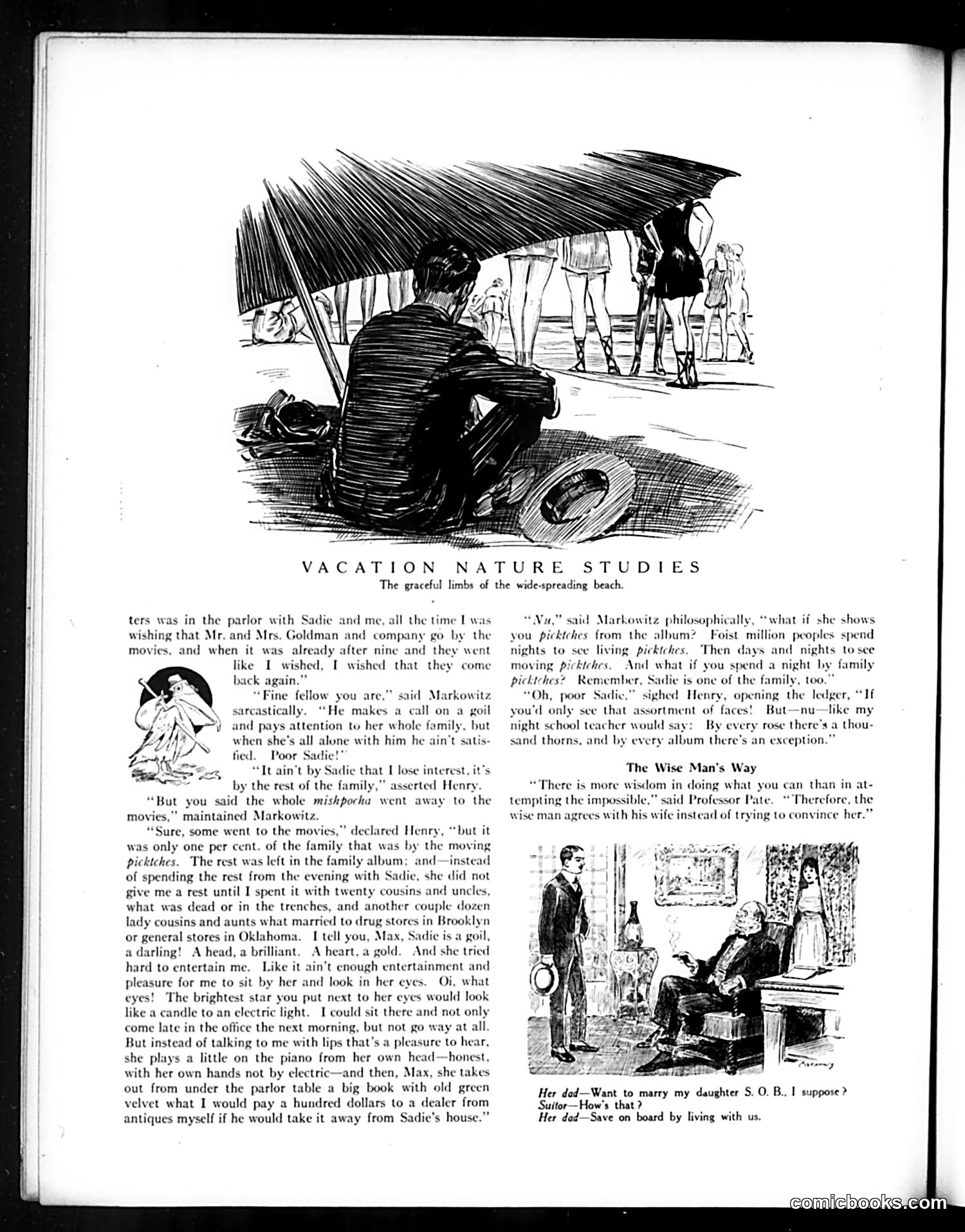
This page contains two satirical pieces from *Judge* magazine targeting early 20th-century Jewish immigrant life and domestic relations. **Top cartoon & text:** A Yiddish-inflected dialogue between Henry and his friend Markowitz about dating. Henry complains that visiting his girlfriend Sadie means enduring her entire extended family—dozens of relatives, photo albums, and piano recitals—while Markowitz philosophically counters that family obligations are simply part of courting within the community. The satire mocks the clash between romantic desire and tight-knit immigrant family culture, using comedic Yiddish expressions ("goil" for girl, "mishpocha" for family, "nu" for "well"). **Bottom cartoon:** A brief joke about an impoverished sailor's marriage proposal. The father agrees to the match only because the son-in-law will reduce household expenses by boarding with them. The humor targets working-class economic desperation. Both pieces employ ethnic stereotyping common to the era's "humor," depicting Jewish and working-class life as comedically foreign and economically precarious to middle-class readers.
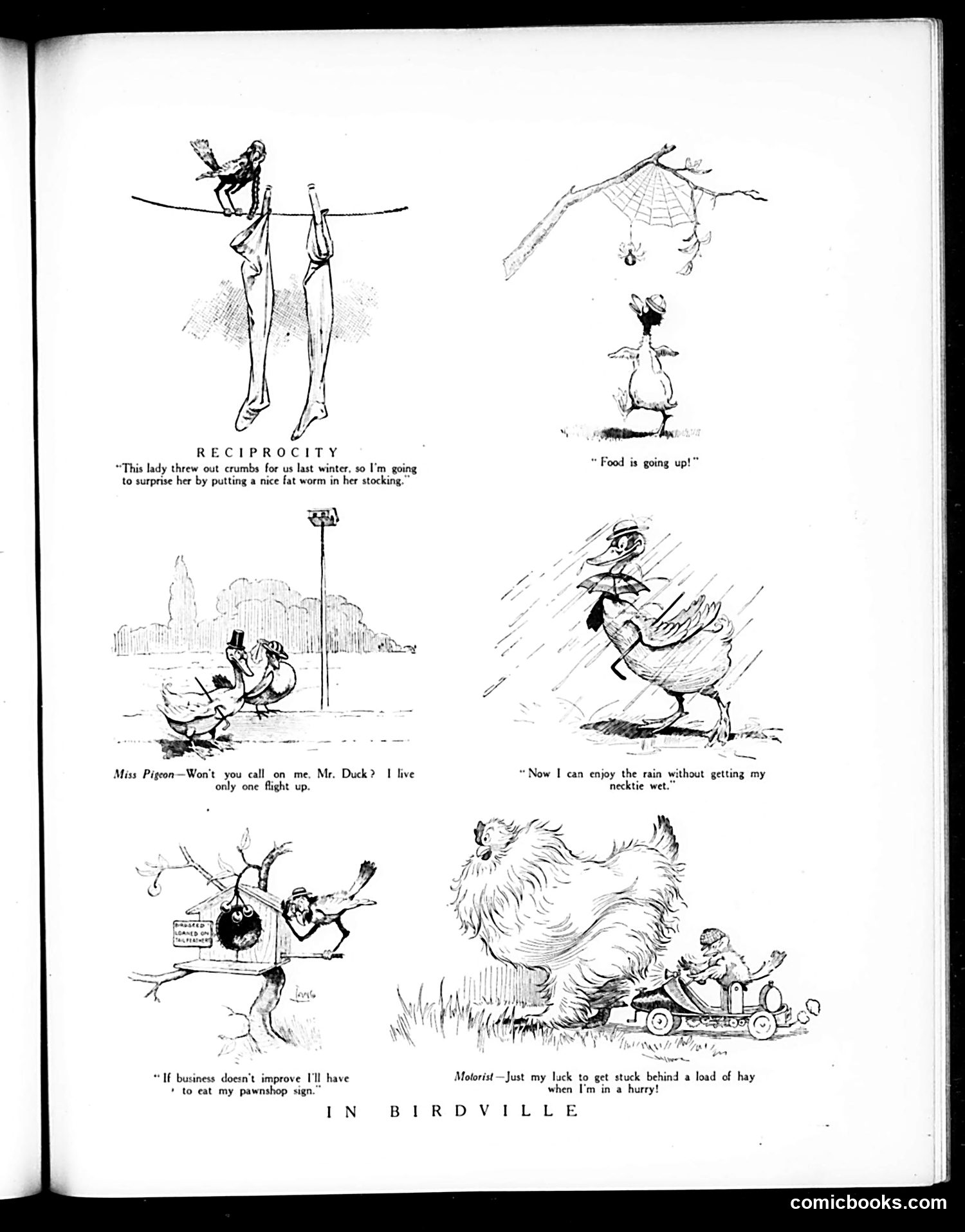
This is a collection of anthropomorphic animal humor strips set in "Birdville." The cartoons use animal characters to satirize human social behaviors and situations: **"Reciprocity"**: A bird plans revenge by putting a worm in a woman's stocking—repaying her winter kindness with an unwanted "gift," satirizing transactional relationships. **"Miss Pigeon"**: A female pigeon flirts with a duck, playing on courtship and class-consciousness ("only one flight up"). **"Necktie"**: A duck enjoys rain under a spider-web umbrella, humorously depicting animals adopting human fashion concerns. **"Pawnshop sign"**: A struggling business owner threatens self-cannibalization, dark humor about economic desperation. **"Motorist"**: A character stuck behind a hay wagon, satirizing modern frustrations with rural obstacles on roads. The page uses animal characters as a lighthearted vehicle for commentary on human vanity, greed, courtship rituals, and modern inconveniences.
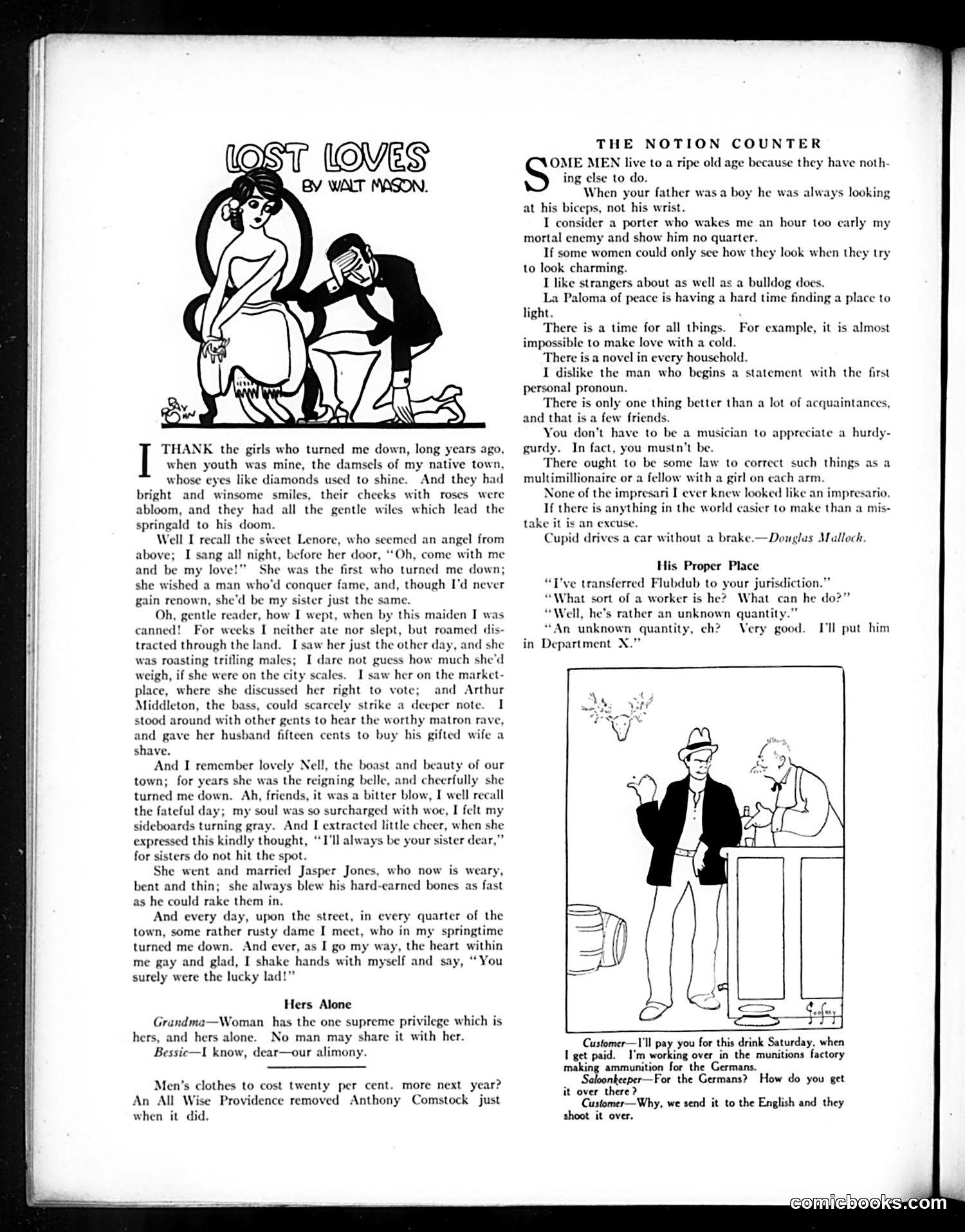
This page presents nostalgic humor typical of early 20th-century American satire. Walt Mason's "Lost Loves" poem mocks the narrator's romantic rejections decades earlier. The joke hinges on social changes: the women who rejected him are now older, voting, and discussing politics—depicted as unladylike behavior. The punchline is darkly ironic: he's grateful they rejected him, yet he also mocks their aging and newfound independence (one even requires a "shave," implying coarseness). The cartoon below shows a bartender and customer discussing wartime ammunition manufacturing—likely WWI-era commentary on industrial priorities. "The Notion Counter" section offers bite-sized observations about modern life, including a quip about alimony (suggesting women exploit divorce laws) and a swipe at Anthony Comstock (the famous censor), implying relief at his recent death. The satire targets women's suffrage, changing gender roles, and modernization with period-typical cynicism.
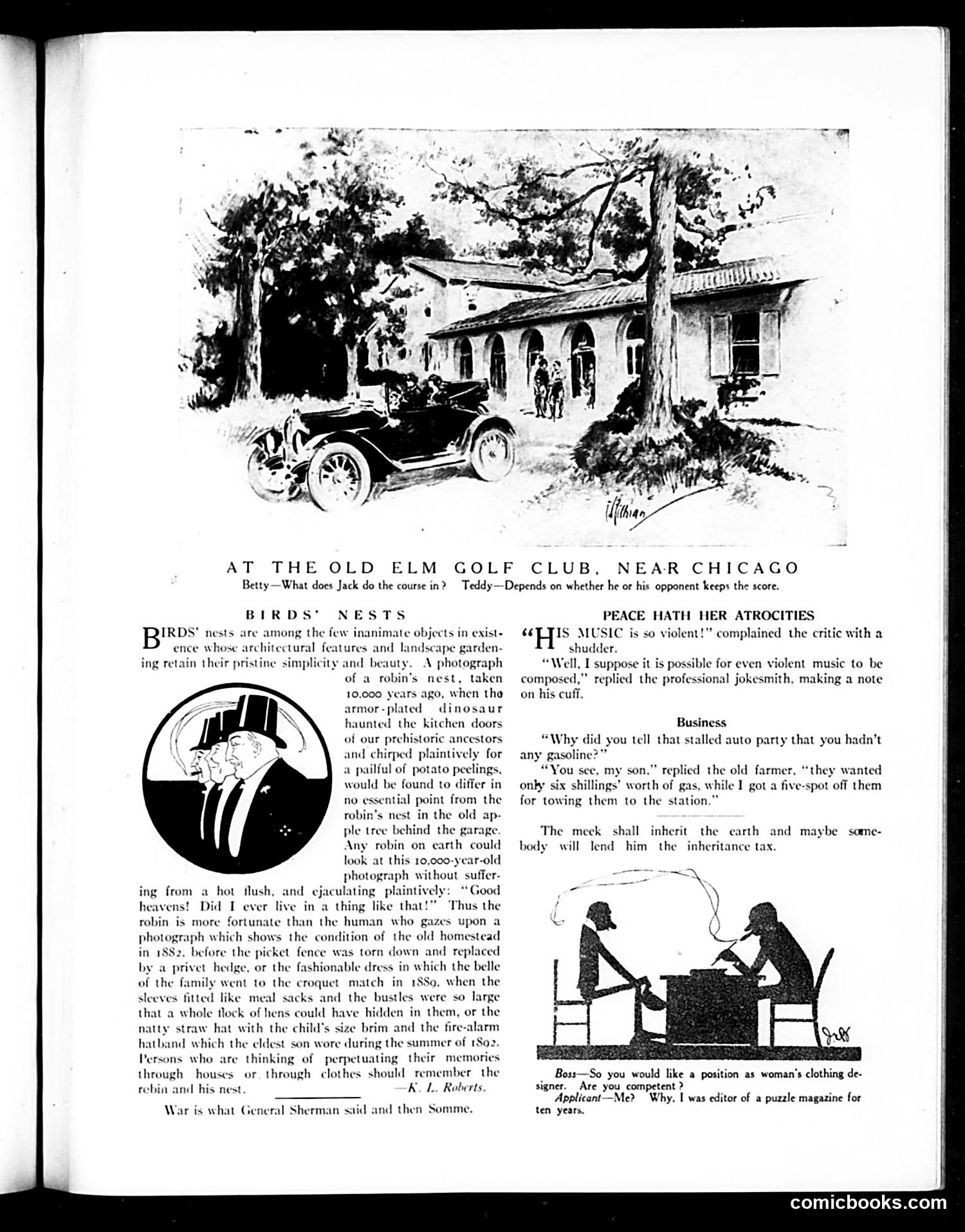
This page contains three satirical pieces typical of early-20th-century Judge humor: **Top cartoon:** A golf club scene referencing "Teddy" (likely Theodore Roosevelt), joking that score-keeping depends on whether he or his opponent controls it—mocking Roosevelt's reputation for aggressive competitiveness. **"Birds' Nests" essay:** A humorous nostalgic piece by K.L. Roberts contrasting robin nests' unchanging simplicity with human fashion's ridiculous evolution. It critiques the vanity of preserving memories through outdated photographs of homes and particularly clothing (referencing the 1880s–1890s fashion of enormous bustles and oversleeves). **Three short jokes:** - A critic complains music is "violent"; a professional humorist deflects the complaint - A farmer overcharges stranded motorists for a tow, illustrating rural shrewdness - A puzzle magazine editor applies for a fashion design job, absurdly unqualified—satirizing either overconfidence or the supposed simplicity of fashion design The page exemplifies Judge's genteel satire targeting fashion, social pretension, and small hypocrisies of American life.
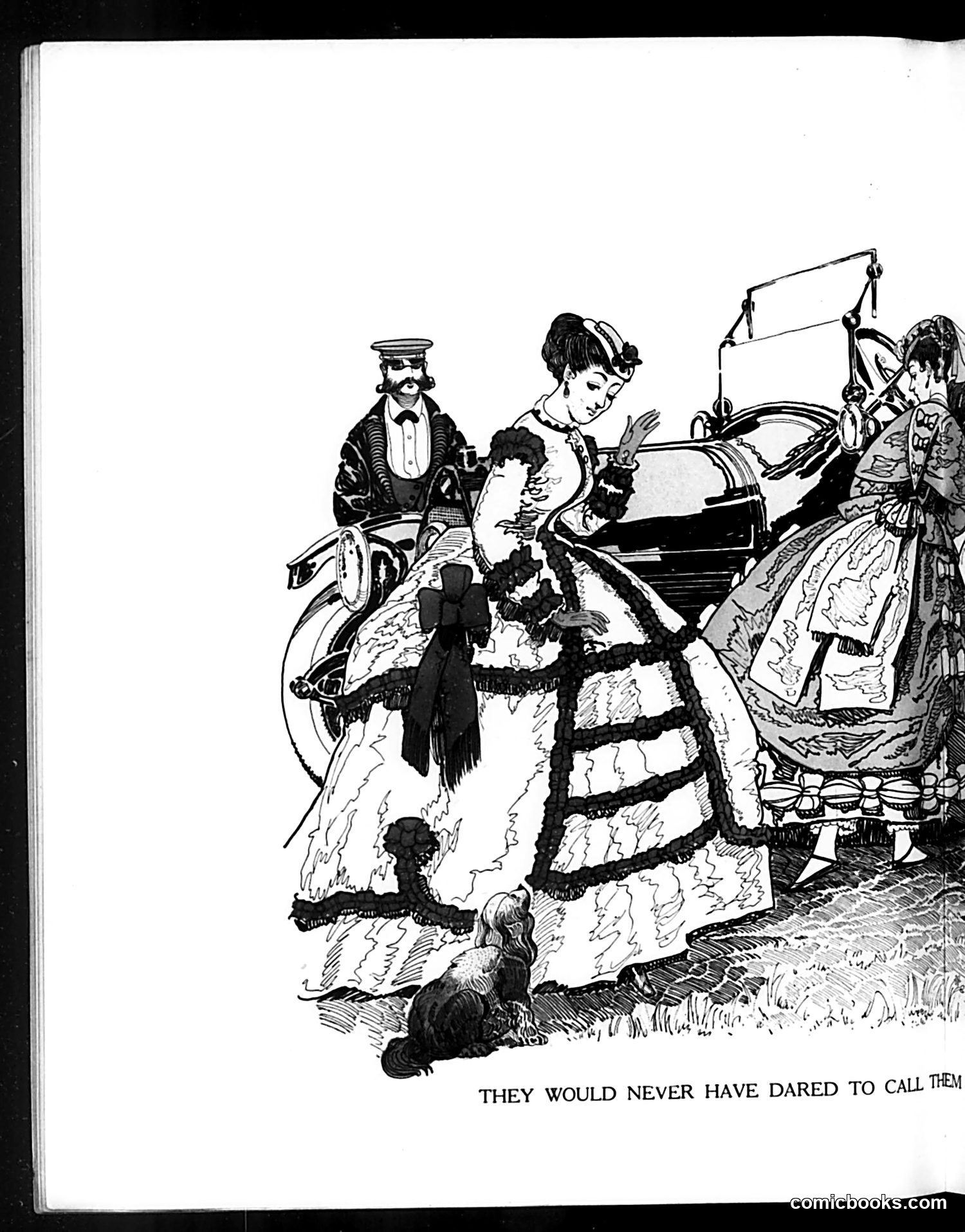
This illustration satirizes social class and propriety in what appears to be the Edwardian era (early 1900s, based on the clothing and carriage style). The caption "THEY WOULD NEVER HAVE DARED TO CALL THEM" suggests the joke concerns what these fashionably dressed women can be called versus what they actually are. The cartoon likely mocks wealthy women's social pretensions—the elaborate gowns, carriages, and attendants suggest they present themselves as respectable society ladies. However, the satire implies there's a gap between their public image and private reality or reputation. The small dog and their ostentatious display emphasize the vanity being lampooned. Without additional context, the specific target remains unclear, but it appears to critique female social climbing or moral hypocrisy among the affluent classes.
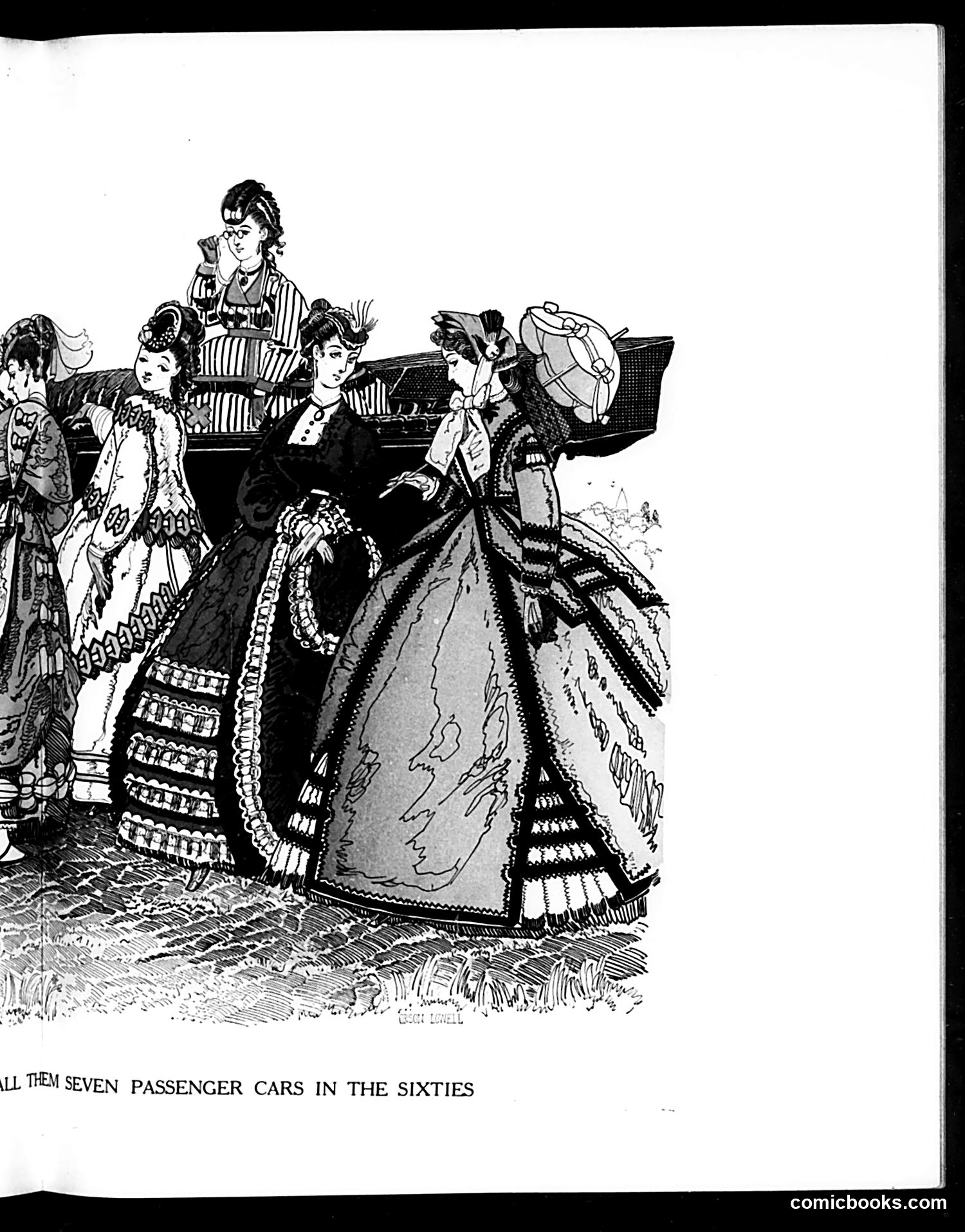
This appears to be a satirical illustration from Judge magazine depicting fashionably dressed women in 1860s attire boarding or positioned near railroad passenger cars. The caption "ALL THEM SEVEN PASSENGER CARS IN THE SIXTIES" suggests social commentary about the era's transportation and gender dynamics. The cartoon likely satirizes either: - The popularity of rail travel among wealthy women during the 1860s - Gender segregation in Victorian transportation (separate "ladies' cars") - Women's elaborate, impractical fashion taking up excessive space The detailed rendering of the women's ornate dresses with extensive trim, bustles, and accessories emphasizes the visual joke—their voluminous clothing appears exaggerated, potentially mocking both Victorian fashion excess and women's presence in public spaces. Without additional context or artist attribution visible, the precise satirical target remains somewhat unclear.
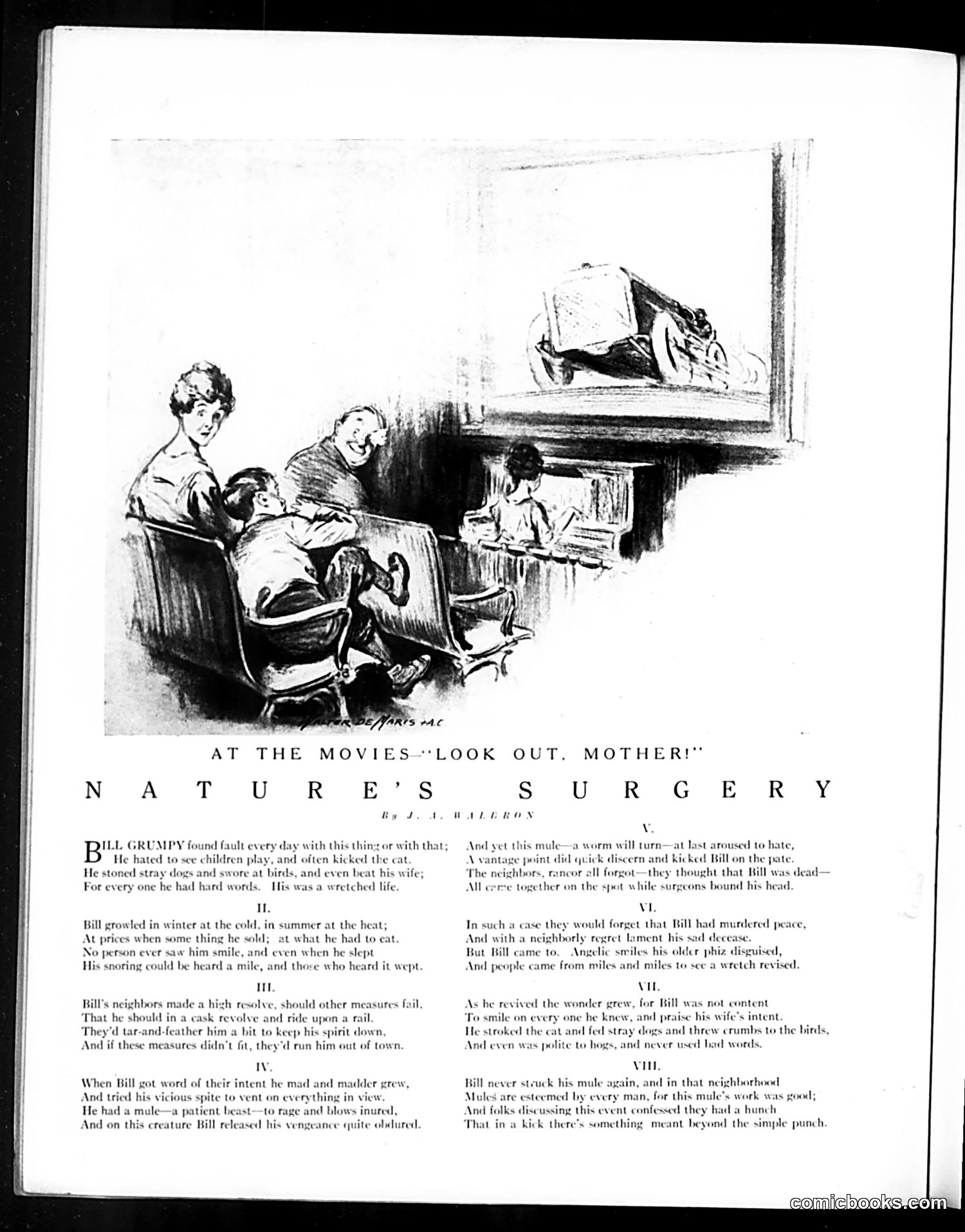
This is a morality tale illustrated by a cinema scene showing a family at the movies watching the story unfold on screen. **The story**: Bill Grumpy is a universally despised curmudgeon—cruel to animals, his wife, and neighbors. When they plot to tar-and-feather him, he vents his rage on his patient mule, which finally retaliates, kicking him in the head. **The satire**: The joke is that Bill's violent blow to the head miraculously transforms him into a virtuous man. He becomes kind to animals, respectful to his wife, and beloved by all. The title "Nature's Surgery" suggests the mule's kick functioned as accidental brain surgery, curing his moral affliction. **The point**: This is dark satirical humor about whether cruelty and malice are unchangeable character traits or can be literally knocked out of someone. The cinema framing emphasizes this as popular entertainment—people watching Bill's redemption-through-violence unfold as a movie story.
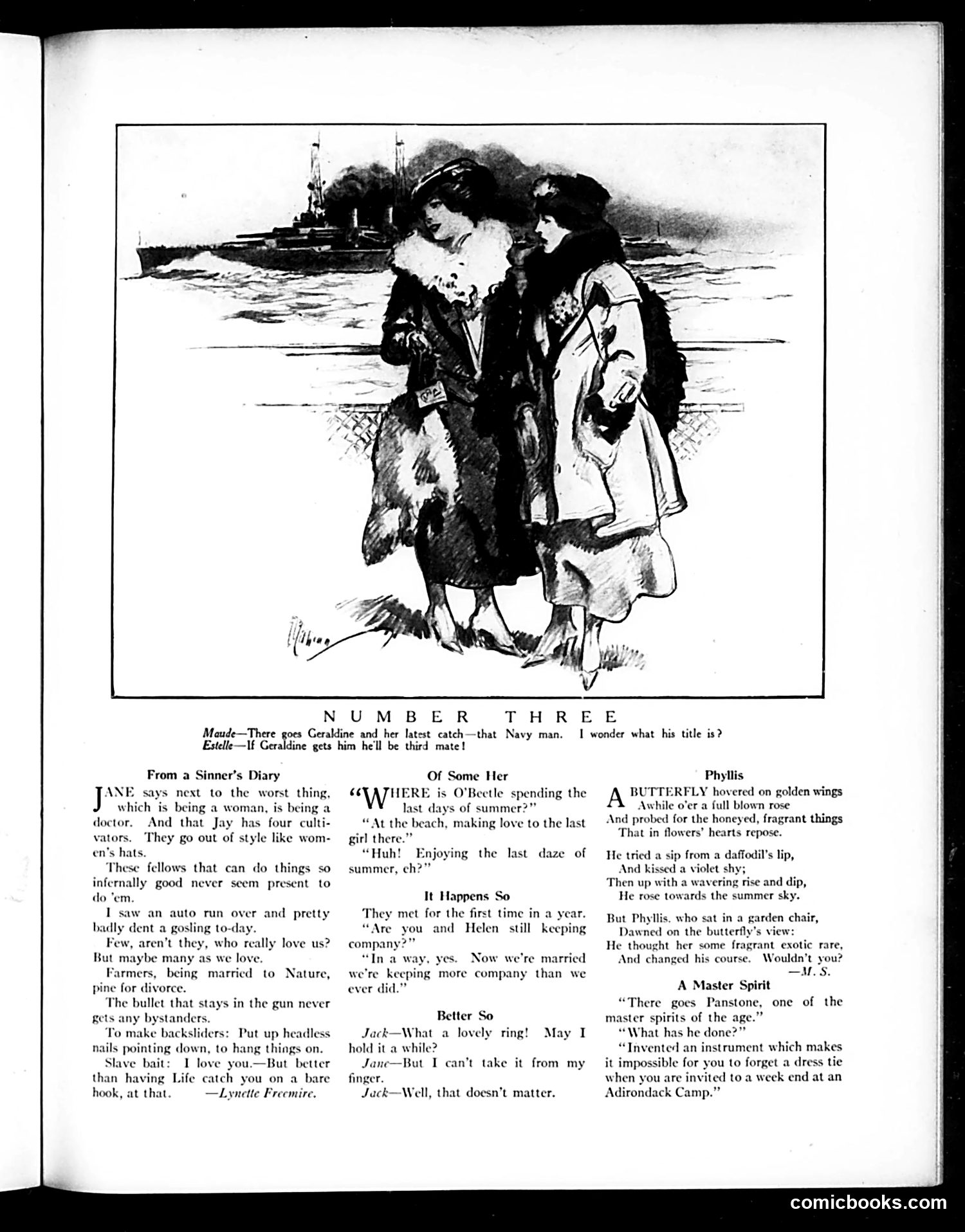
This page presents several short humorous pieces typical of early 20th-century American satire: **Main Cartoon ("Number Three"):** Two women observe a third woman, "Geraldine," with a Navy man. The joke plays on Geraldine's romantic history—if she "catches" this man, he'll be her "third mate," a pun on the naval rank that implies she's had multiple previous romantic conquests. **Surrounding Content:** The page includes: - *"From a Sinner's Diary"*: Cynical observations about modern life (doctors, farm machinery, divorce, courtship) - *"Of Some Her"*: Brief comedic dialogues about summer romance and marriage - *"Phyllis"*: A whimsical poem about a butterfly mistaking a woman for a flower - *"A Master Spirit"*: A joke about inventing a device to prevent forgetting dress ties at weekend retreats **Social Context:** These pieces mock contemporary concerns—romantic fickleness, the constraints of married life, newfound leisure culture (beach trips, Adirondack camps)—through light, breezy humor typical of Judge's satirical approach to early 1900s American society.
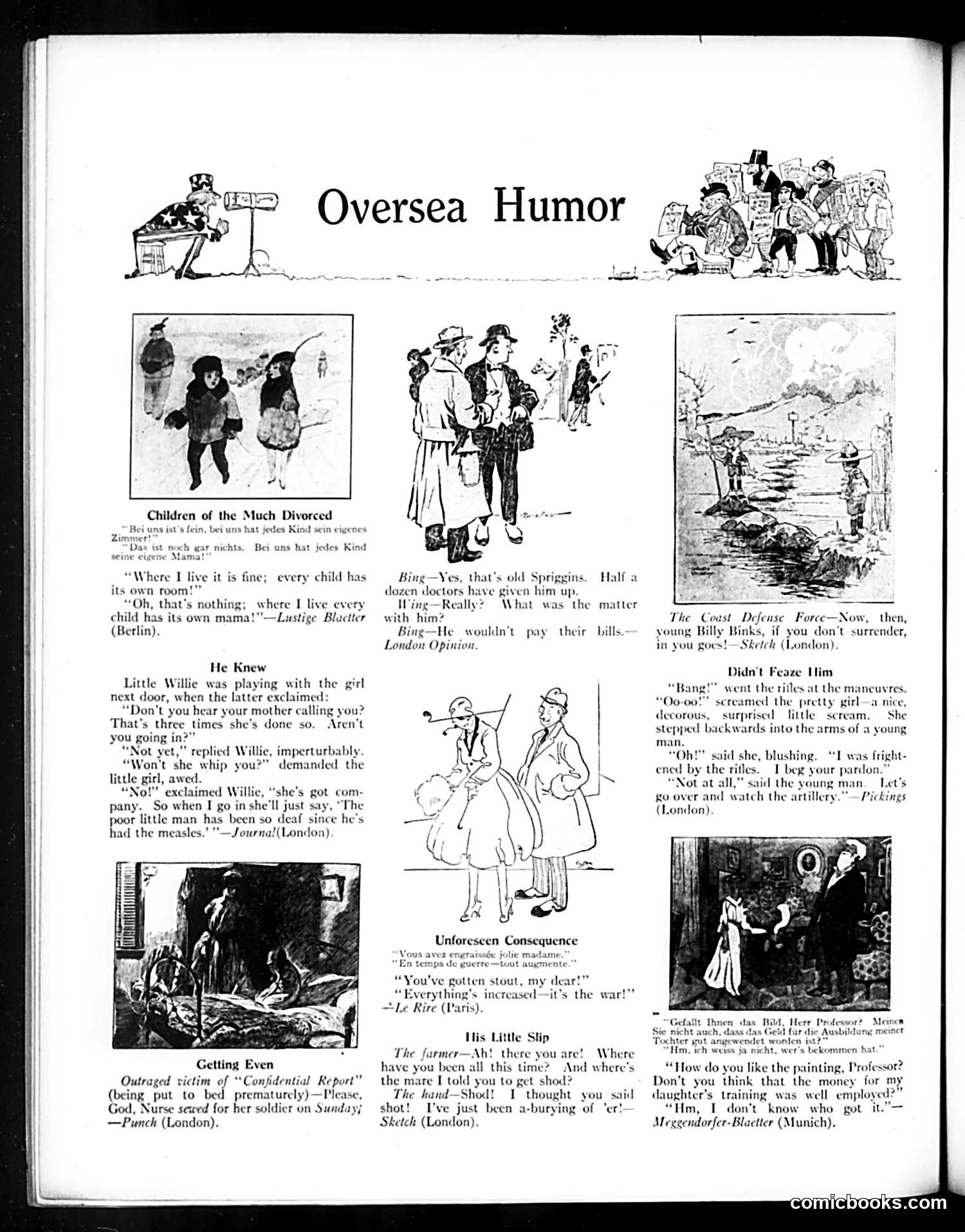
This page collects humorous anecdotes and cartoons from European publications, satirizing WWI-era social conditions. Key themes include: **Divorce & Family Disruption**: "Children of the Much Divorced" mocks German/European divorce rates through a dark joke—one child boasts having "its own mama" (implying multiple stepmothers from remarriage), treating family fragmentation as absurd competition. **Wartime Privation**: "He Wouldn't Pay Their Bills" references doctors abandoning a patient over unpaid fees, reflecting economic hardship. "Getting Even" shows a soldier punished by a nurse for Sunday work—commentary on civilian wartime resentment. **Military Life**: "Didn't Feaze Him" plays on young women's exaggerated fear responses to military maneuvers as romantic opportunity. "Coast Defense Force" depicts child evacuations or coastal defense drills. **Class & Miscommunication**: "His Little Slip" features a farmhand mishearing "shod" (horseshoes) as "shot," burying the mare—slapstick commentary on rural/working-class confusion. The cartoons collectively present European wartime society as economically strained, socially disrupted, and darkly comedic.
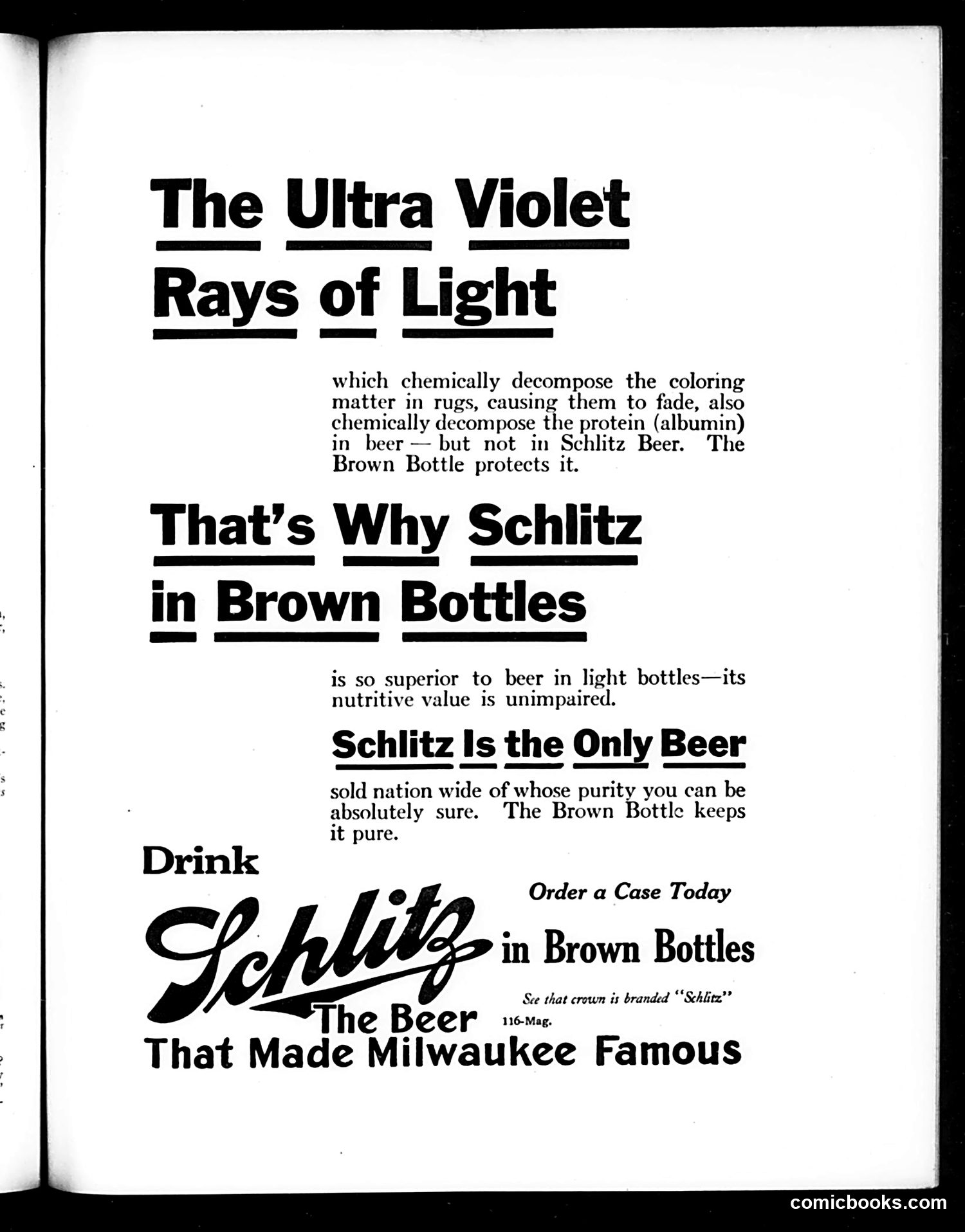
This is a **Schlitz beer advertisement**, not a political cartoon or satire. It's a straightforward product pitch from Judge magazine's advertising section. The ad uses pseudo-scientific reasoning to justify Schlitz's brown bottle packaging. It claims ultraviolet light chemically decomposes beer's protein content (albumin), damaging nutritional value—but brown glass supposedly blocks these harmful rays, preserving the product's quality and purity. The appeal to purity and superior nutritional value was a common beer marketing tactic of this era. The "Beer That Made Milwaukee Famous" tagline references Schlitz's actual historical prominence in that brewing center. The ad contains no satire, caricature, or political commentary—it's a manufacturer's claim about product superiority through packaging design.
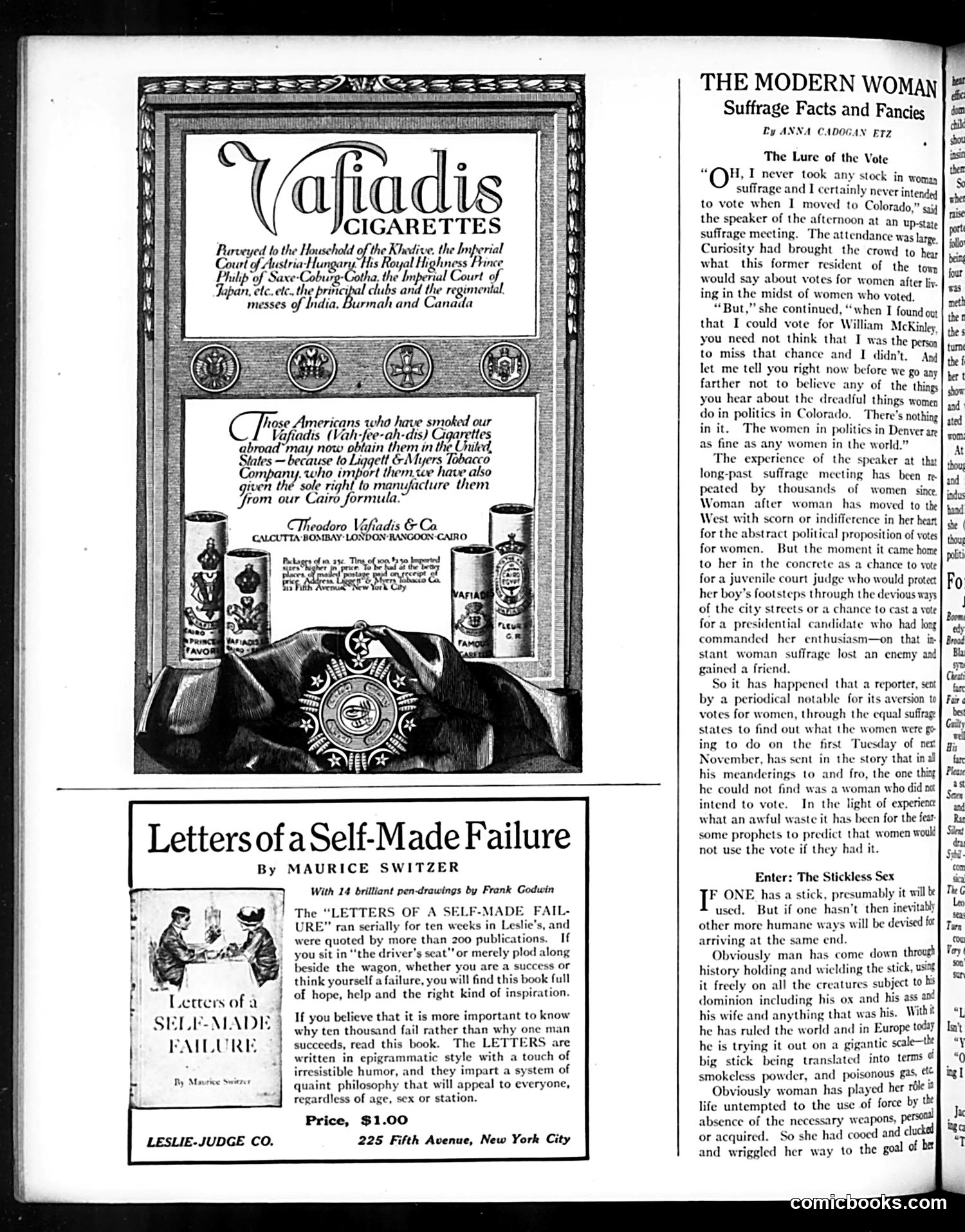
This page contains three distinct sections: a **Vafiadis Cigarettes advertisement** (top), a book advertisement for *Letters of a Self-Made Failure* by Maurice Switzer (bottom left), and an article titled **"The Modern Woman: Suffrage Facts and Fancies"** by Anna Cadogan Etz (right). The suffrage article recounts a former Colorado resident's conversion to women's voting advocacy. The woman initially opposed suffrage but, when able to vote in Colorado (an early women's suffrage state), cast ballots for causes affecting women—a juvenile court judge and presidential candidate. The piece argues that abstract opposition to women's voting shifts to support when women experience voting's *practical benefits*. It references a reporter's 1920 tour finding no women unwilling to vote. The satire's point: women weren't naturally political but became engaged voters when voting addressed their concrete concerns (child protection, presidential choice). This counters anti-suffrage predictions that women wouldn't use the ballot. The ads are contextual period pieces, unremarkable to the analysis.
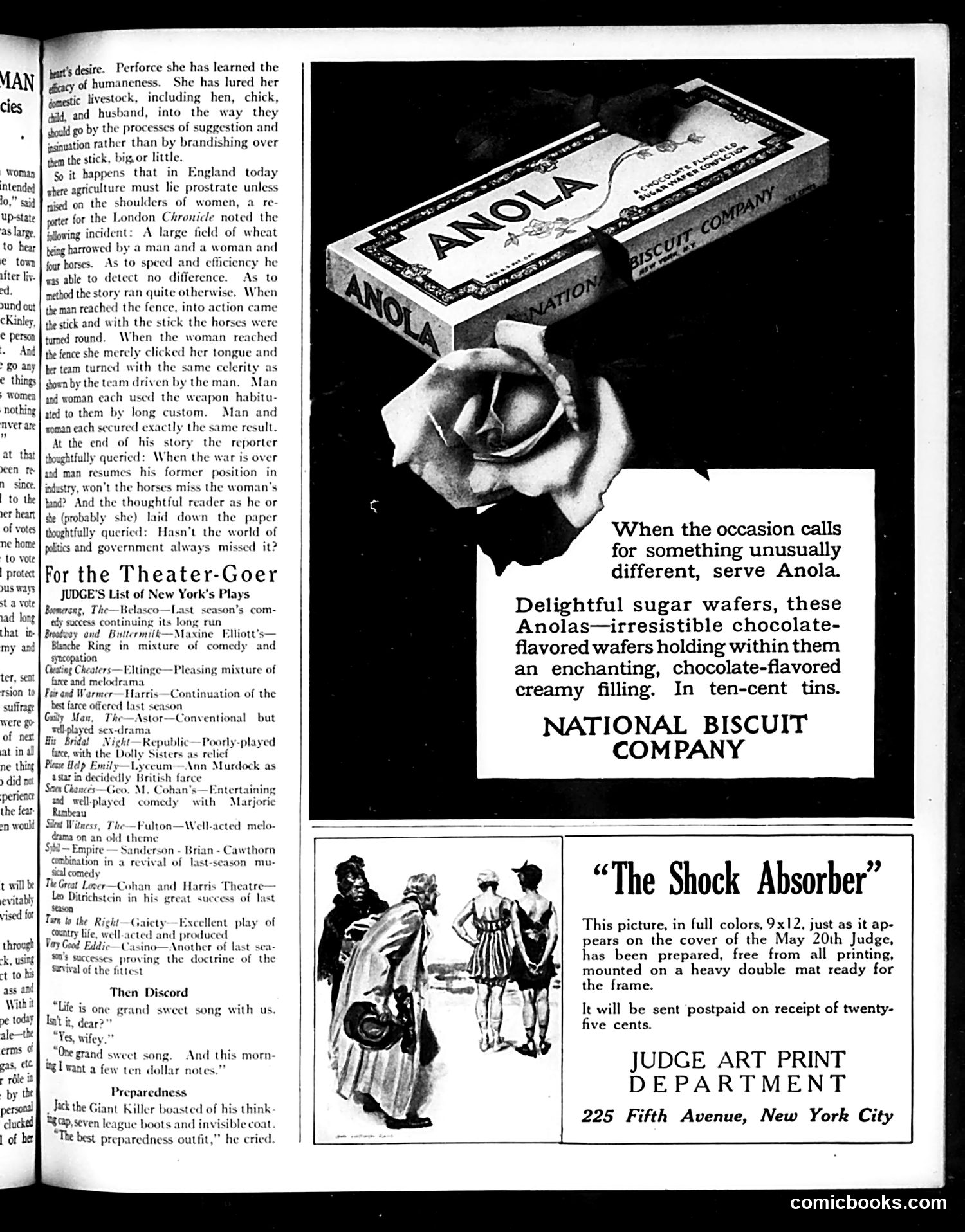
This page contains a satirical article and advertisements rather than a traditional political cartoon. **The Main Article:** "For the Theater-Goer" reviews New York plays—standard theater criticism, not satire. **The Satirical Content:** The opening text discusses women's agricultural labor during wartime (appears to reference WWI era). It contrasts a man and woman plowing a field: the man uses a stick to drive horses; the woman merely clicks her tongue and achieves identical results. The satire suggests women possess natural persuasive abilities ("the processes of suggestion") that men lack, implying women are inherently better suited to certain tasks—including, the article wickedly implies, politics and governance. **The Advertisements:** Two product ads appear—Anola chocolate wafers and a Judge Art Print reproduction of "The Shock Absorber"—typical magazine content unrelated to satire. The underlying point mocks both traditional gender assumptions and postwar anxieties about women's expanded roles.
This page is primarily **advertising** for typewriter courses, cleaning products, hotels, and legal services—typical of early 20th-century magazines. The editorial content includes an announcement about the **American Press Humorists' annual meeting in Nashville, Tennessee** (October 1916), detailing social activities like fox hunts, automobile trips, and banquets—reflecting the leisured social world of newspaper humorists of that era. Two brief humor pieces appear: "Listening" jokes that a husband's silence mirrors romance in literature, and "Secrets" is a poem (by M. Londbargh Wilson) playing on the idea that if walls could talk, they'd reveal household secrets. These are gentle domestic humor typical of the period, poking fun at marriage and household life rather than anything political or controversial.
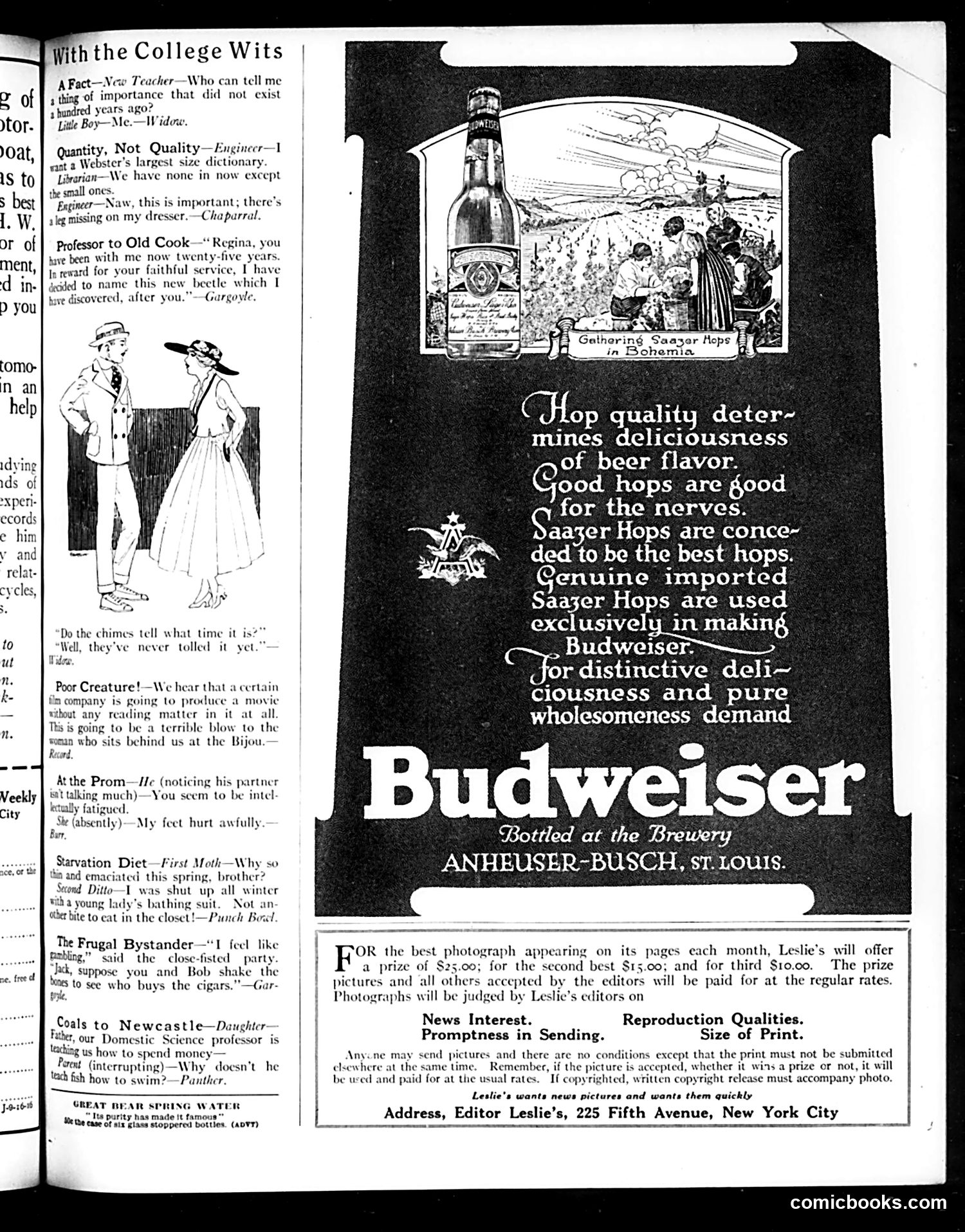
This page combines **satirical humor with advertising**. The left column features "College Wits"—brief jokes poking fun at academia and social situations typical of early 20th-century college life. Examples include a teacher's trick question about things that didn't exist (answered "widow"), wordplay about missing dictionary entries, and romantic mishaps at proms. The dominant right side is a **Budweiser advertisement**, which frames beer consumption as healthful—claiming "good hops are good for the nerves" and emphasizing Saazer Hops' quality. This reflects pre-Prohibition advertising (likely 1910s), when beer promotion was still openly published in mainstream magazines. A secondary notice offers **photography prizes** to readers, soliciting news images for the magazine. The satire is gentle, aimed at college students and young professionals rather than political figures. No identifiable caricatures appear—the humor relies on situational comedy and wordplay rather than topical commentary.
This page is primarily **advertising for Leslie's Weekly magazine**, promoting a serialized article series by B.C. Forbes titled "The Men Who Are Making America." The main feature focuses on **John D. Archibold, President of Standard Oil Company**, described as "America's least-known great man." The satire is subtle: positioning an oil monopoly executive as both powerful and obscure. Standard Oil was notorious for Gilded Age corporate dominance; calling Archibold "least-known" while featuring him prominently is ironic commentary on hidden industrial power. The right column contains unrelated **humor fillers**—brief jokes from provincial newspapers (Youngstown, Kansas City, etc.) about domestic life, marriage, and minor social mishaps. These were typical filler content for period magazines. The overall page reflects early 20th-century magazine format: advertising wrapped around editorial content, with syndicated humor padding the layout. The Archibold feature represents corporate PR dressed as journalism.
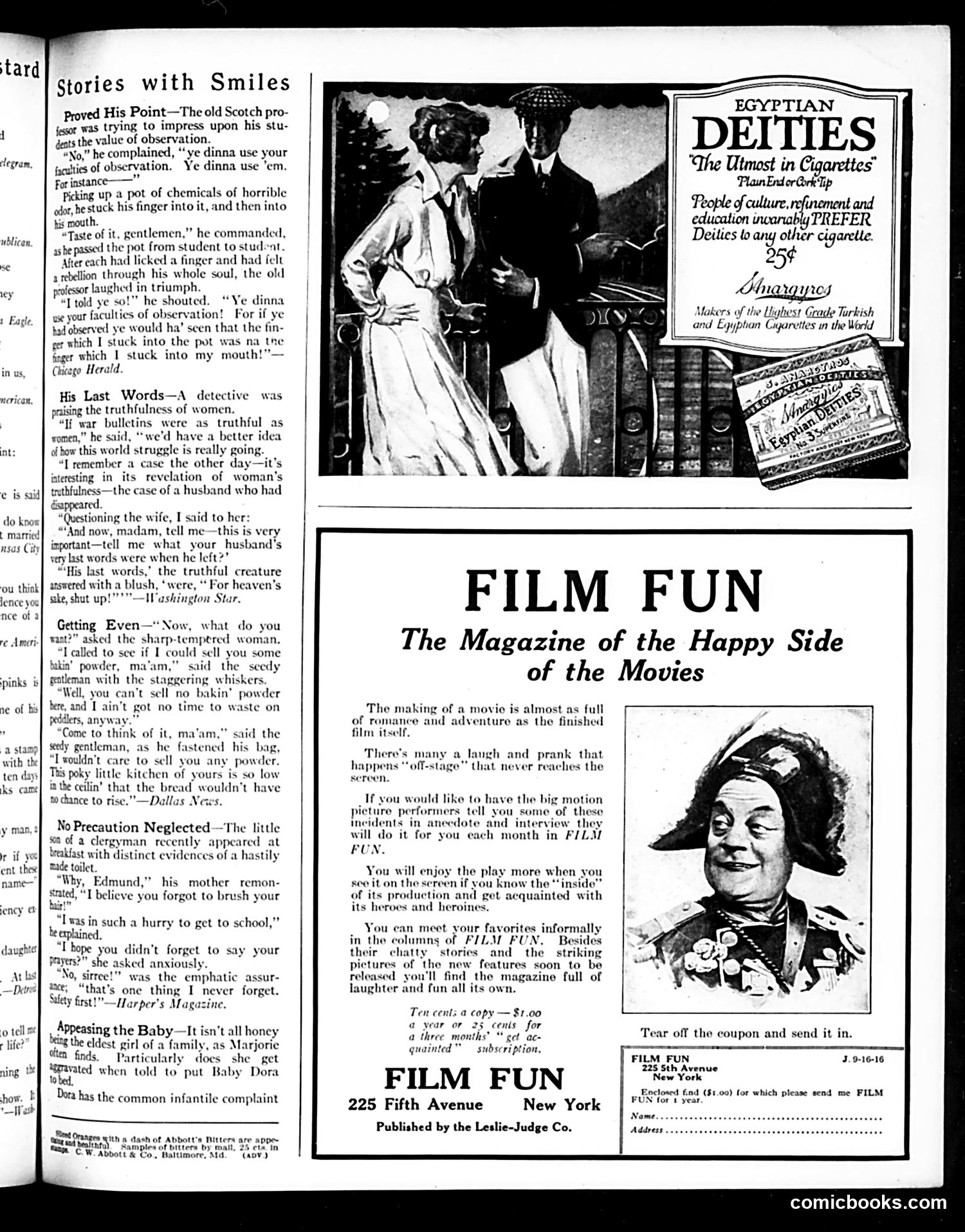
This page primarily contains **humor columns and advertisements** rather than political cartoons. The "Stories with Smiles" section features three lighthearted anecdotes: a Scottish professor tricks students into tasting chemicals to teach observation; a detective observes that women are untruthful (reflecting period gender stereotypes); and a salesman insults a housewife's kitchen ceiling height. The main visual content is an **advertisement for Egyptian Deities cigarettes** (25¢) and a promotion for *Film Fun* magazine. The cigarette ad uses "Egyptian Deities" branding and appeals to "people of culture, refinement"—typical early 20th-century luxury marketing. The *Film Fun* promotion promises behind-the-scenes movie gossip and anecdotes. **No clear political satire is evident** on this page. The humor is domestic and genteel, reflecting 1910s-era attitudes about gender, class, and consumer culture. The page functions primarily as **content and advertising filler** rather than editorial commentary.
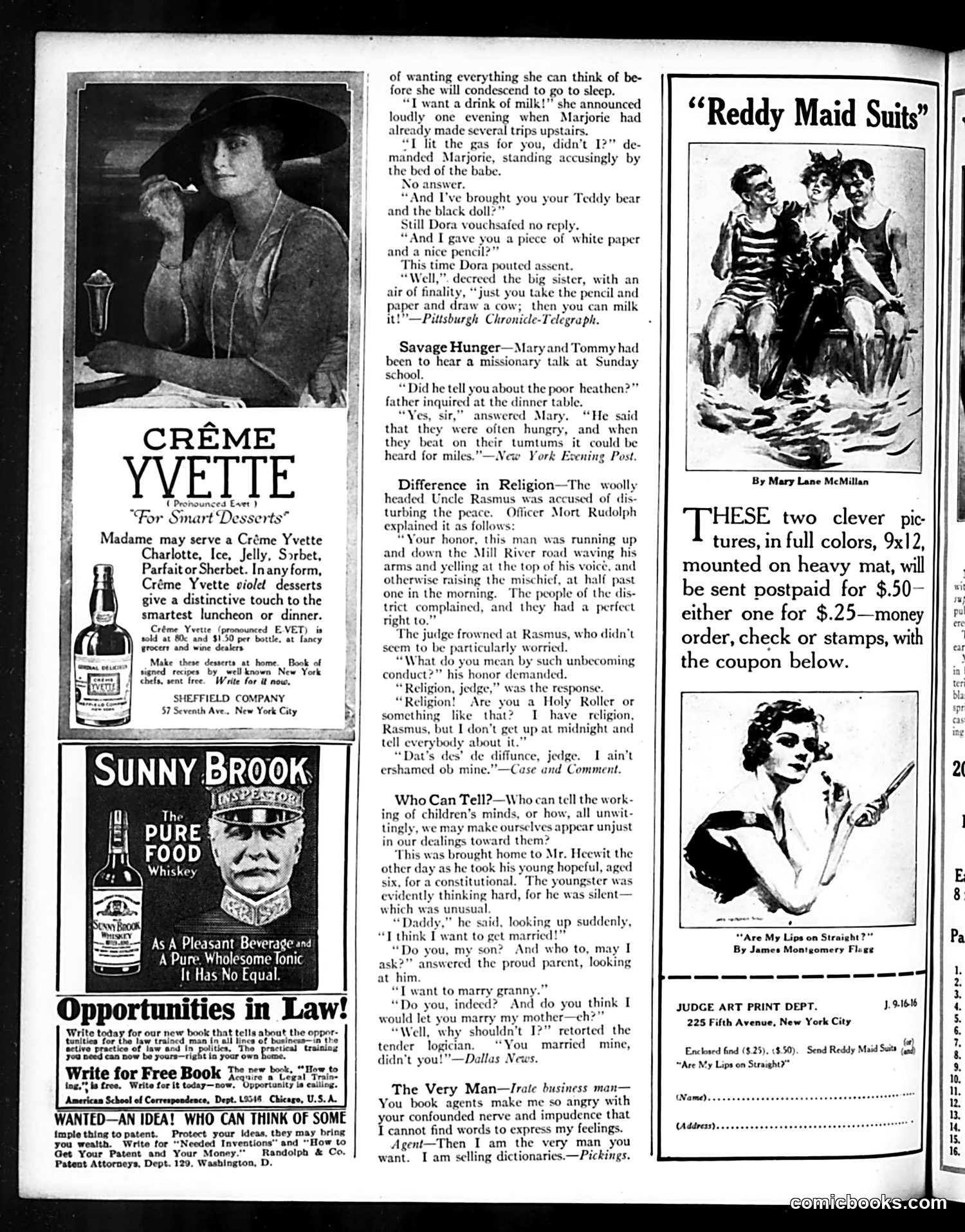
This page consists primarily of **advertisements and humorous anecdotes** rather than political cartoons. The ads promote luxury goods (Crème Yvette dessert liqueur, Sunny Brook whiskey) and services (law school correspondence courses, patent attorneys). The humor pieces are short jokes about family life and social interactions: - **"Savage Hunger"**: A child's innocent misunderstanding of missionary stories about distant peoples - **"Difference in Religion"**: A racial stereotype depicting an African American man (Uncle Rasmus) arrested for noisy religious enthusiasm, contrasted with the judge's more restrained faith - **"Who Can Tell?"**: A child's logical but inappropriate suggestion to marry his grandmother, since his father married his mother These reflect early 20th-century **attitudes toward childhood innocence, racial caricature, and family hierarchies**—treating these topics as light comedy. The "Reddy Maid Suits" advertisement on the right shows children's clothing. The page illustrates *Judge* magazine's blend of consumer advertising and genteel domestic humor, now historically notable for its casual racial stereotyping.
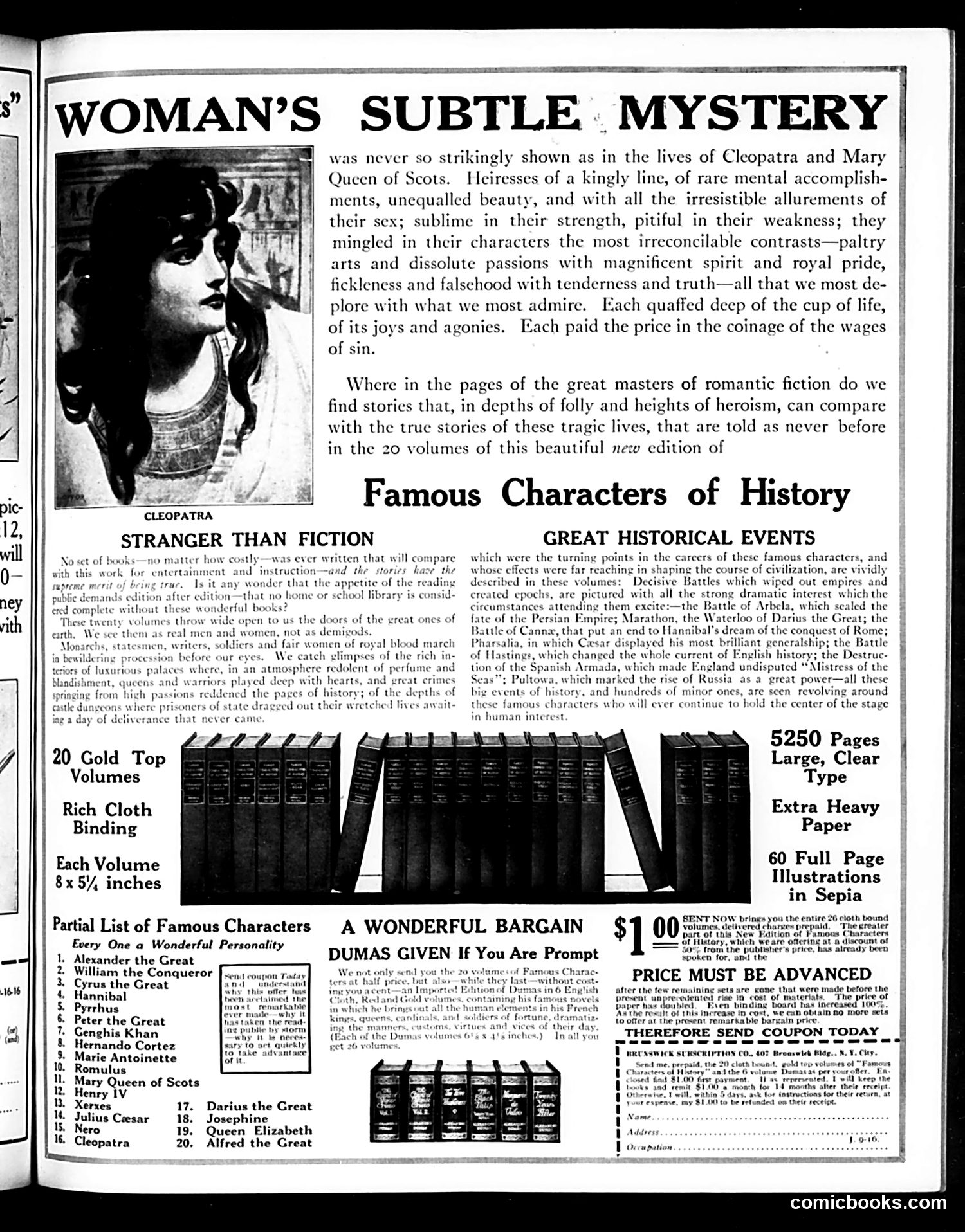
This is **not a cartoon or satire page**, but rather a **book advertisement** from Judge magazine. The page promotes a 20-volume encyclopedia titled *Famous Characters of History*. The single image—a portrait labeled "Cleopatra"—serves as marketing. The surrounding text employs rhetorical appeals common to early 20th-century advertising: it argues that real historical figures like Cleopatra and Mary Queen of Scots embody drama superior to fiction. Their lives supposedly demonstrate moral complexity—beauty paired with dissolution, strength with weakness—making them irresistible subjects for educated readers. The ad emphasizes the edition's physical grandeur (5,250 pages, gilt binding, 60 sepia illustrations) and lists famous historical figures to demonstrate scope. A coupon at bottom enables immediate ordering at a discounted pre-publication price, with urgency messaging: prices will rise once the limited "remaining sets" sell out. **This is fundamentally a sales pitch**, not satire or political commentary. Judge's editors inserted it as paid content among editorial material.
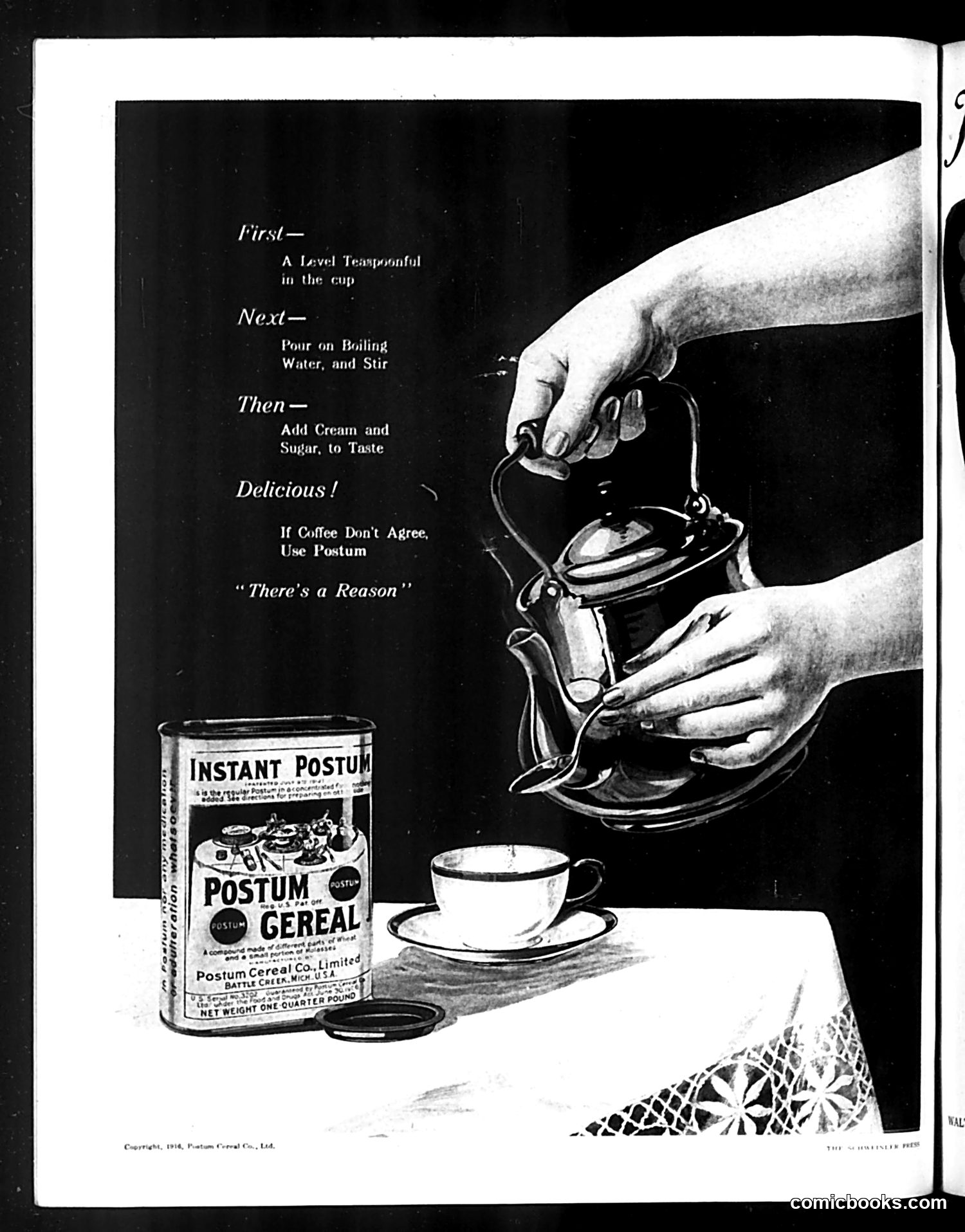
This is a **Postum cereal advertisement**, not a political cartoon. Postum was a caffeine-free coffee substitute popular in the early 20th century. The ad shows step-by-step instructions for preparing the beverage: adding a teaspoon to a cup, pouring boiling water, then adding cream and sugar. The tagline "If Coffee Don't Agree, Use Postum" and "There's a Reason" reference Postum's marketing strategy, which positioned the product as a healthier alternative to regular coffee for people with digestive issues. The slogan became famous in American advertising of this era. The image depicts hands pouring from a kettle into a teacup—a domestic, everyday scene meant to appeal to housewives of the period.