
Judge, 1916-09-16 · page 10 of 28
Judge — September 16, 1916 — page 10: what you’re looking at
What you’re looking at
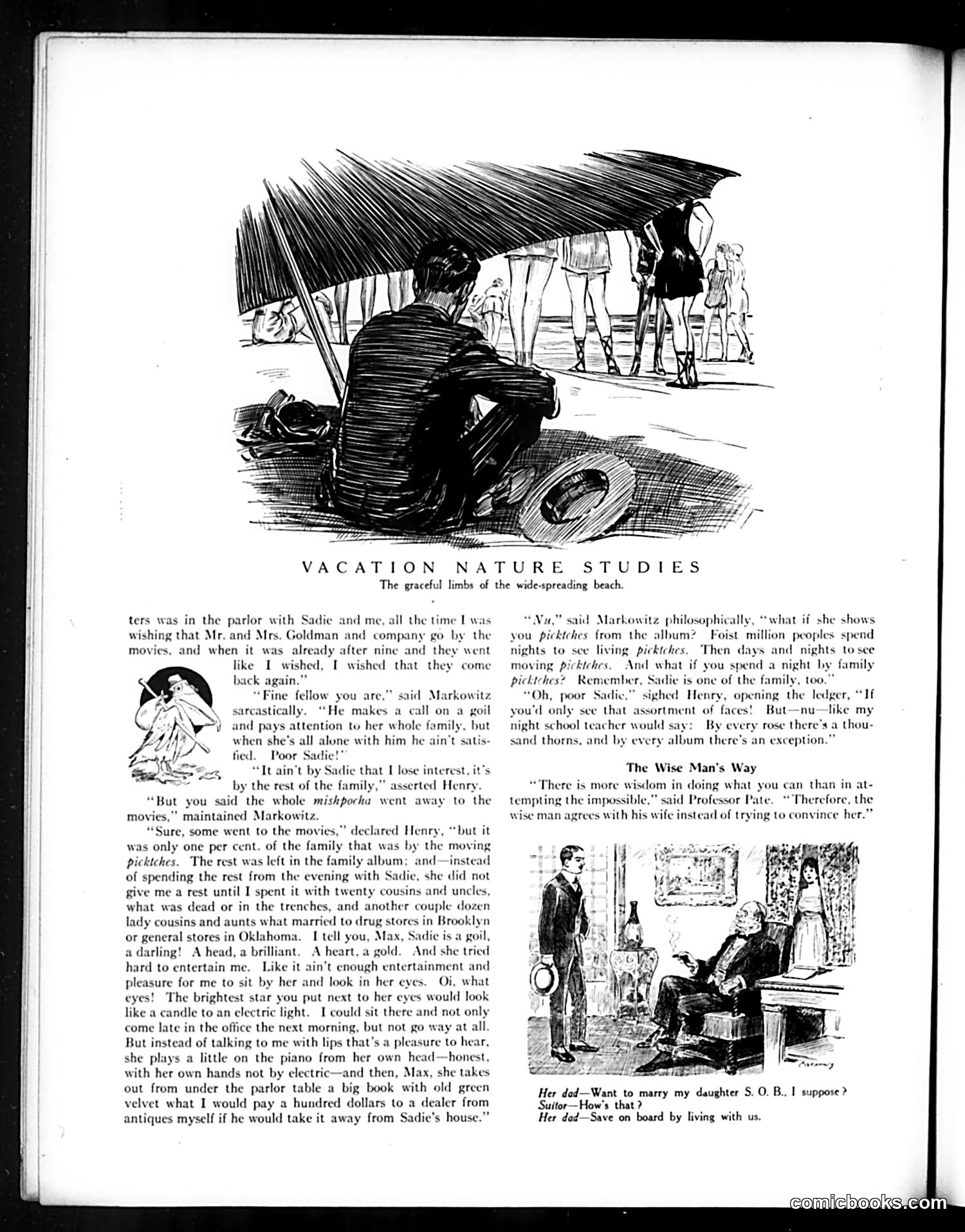
This page contains two satirical pieces from *Judge* magazine targeting early 20th-century Jewish immigrant life and domestic relations. **Top cartoon & text:** A Yiddish-inflected dialogue between Henry and his friend Markowitz about dating. Henry complains that visiting his girlfriend Sadie means enduring her entire extended family—dozens of relatives, photo albums, and piano recitals—while Markowitz philosophically counters that family obligations are simply part of courting within the community. The satire mocks the clash between romantic desire and tight-knit immigrant family culture, using comedic Yiddish expressions ("goil" for girl, "mishpocha" for family, "nu" for "well"). **Bottom cartoon:** A brief joke about an impoverished sailor's marriage proposal. The father agrees to the match only because the son-in-law will reduce household expenses by boarding with them. The humor targets working-class economic desperation. Both pieces employ ethnic stereotyping common to the era's "humor," depicting Jewish and working-class life as comedically foreign and economically precarious to middle-class readers.
📄 Transcribed text from this page (OCR, searchable)
Machine-transcribed from the original scan — historical spelling and the odd misread are preserved.
VACATION NATURE STUDIES The graceful limbs of the wide-spreading beach. ters was in the parlor with Sadie and me, all the time I was wishing that Mr. and Mrs. Goldman and company go by the movies, and when it was already after nine and they went like I wished, I wished that they come back again.” oe ~ “Fine fellow you are,” said Markowitz mN sarcastically. “He makes a call on a goil } \w>) and pays attention to her whole family, but 97) YX, when she’s all alone with him he ain't satis- Up * fied. Poor Sadie!" ing ‘It ain't by Sadie that I lose interest, it's by the rest of the family,” asserted Henry. “But you said the whole mishpocha went away to the movies,”” maintained Markowit “Sure, some went to the movies,” declared Henry, “but it was only one per cent. of the family that was by the moving picktches. The rest was left in the family album: and—instead of spending the rest from the evening with Sadie, she did not give me a rest until I spent it with twenty cousins and uncles, what was dead or in the trenches, and another couple dozen lady cousins and aunts what married to drug stores in Brooklyn or general stores in Oklahoma. I tell you, Max, Sadie is a goil, a darling! A head, a brilliant. A heart, a gold. And she tried hard to entertain me. Like it ain’t enough entertainment and pleasure for me to sit by her and look in her ey Oi, what eyes! The brightest star you put next to her eyes would look like a candle to an electric light. I could sit there and not only come late in the office the next morning, but not go way at all But instead of talking to me with lips that’s a pleasure to hear, she plays a little on the piano from her own head—honest, with her own hands not by electric—and then, Max, she takes out from under the parlor table a big book with old green velvet what I would pay a hundred dollars to a dealer from antiques myself if he would take it away from Sadie’s house.”” grr “Nu,” said Markowitz philosophically, “what if she shows you picktches from the album? Foist million peoples spend nights to sce living picktches. Then days and nights to see moving picktches. And what if you spend a night by family picktches? Remember, Sadie is one of the family, too. “Oh, poor Sadie,” sighed Henry, opening the ledger, “If you'd only see that assortment of faces! But—nu—like my night school teacher would say: By every rose there's a thou- sand thorns, and by every album there’s an exception.” The Wise Man’s Way “There is more wisdom in doing what you can than in at- tempting the impossible,” said Professor Pate. “Therefore, the wise man agrees with his wife instead of trying to convince her.” Her ded—Want to marry my daughter S. O. B., 1 suppose > Suitor—How's that ? Her dad—Save on board by living with us.