
Judge, 1916-09-16 · page 7 of 28
Judge — September 16, 1916 — page 7: what you’re looking at
What you’re looking at
This page from *Judge* magazine presents a serialized romantic story with satirical commentary. The main narrative (Chapters 4-5) follows Roberta, a young woman courted by the sensitive poet Charles Graveau, who abandons him when her old friend Henry Smith arrives in an automobile. Smith proposes immediate marriage without ceremony—a practical, business-like approach that Roberta enthusiastically accepts over the romantic poet's devotion. The satire targets **early 20th-century courtship conventions**: the clash between idealized romantic poetry and pragmatic materialism. Graveau represents artistic sensitivity; Smith embodies modern efficiency and wealth (signaled by his "big motor"). Roberta's swift rejection of the poet for the businessman satirizes women's supposed superficiality and materialism. The small cartoon at bottom-right is autobiographical commentary by the artist (Don Augur), joking about trading youthful artistic pretensions for commercial success—mirroring the story's theme of romance surrendered for practical gain.
📄 Transcribed text from this page (OCR, searchable)
Machine-transcribed from the original scan — historical spelling and the odd misread are preserved.
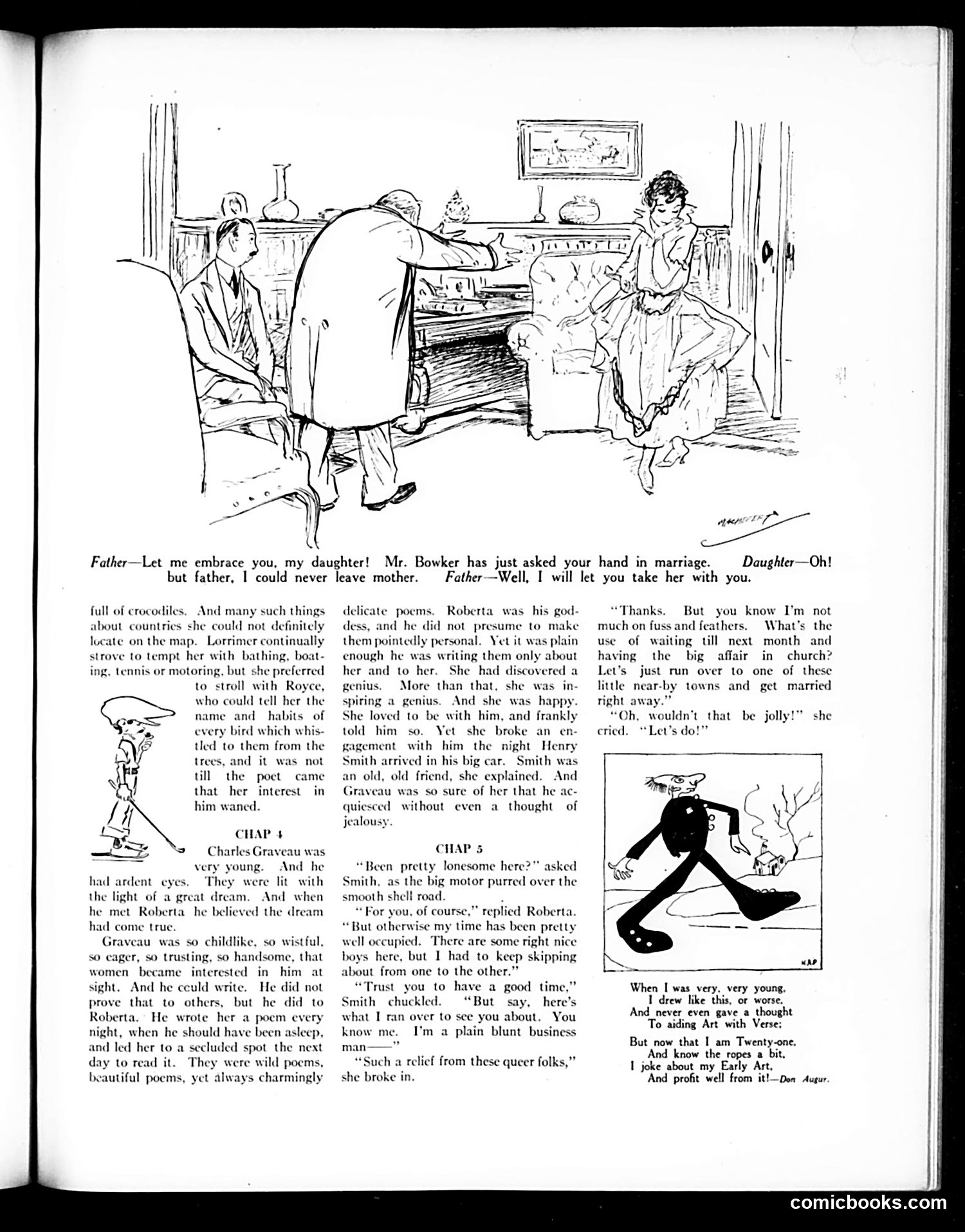
Father—Let me embrace you, my daughter! but father, I could never leave mother. full of crocodiles, And many such things about countries she could not definitely lucate on the map. Lorrimer continually strove to tempt her with bathing, boat- ing. tennis or motoring, but she preferred to stroll with Royce, who could tell her the name and habits of every bird which whis- tled to them from the trees, and it was not till the poct came that her interest in him waned. CHAP 4 Charles Graveau was very young. And he They were lit with the light of a great dream. And when he met Roberta he believed the dream had come true. Graveau was so childlike, so wistful, so cager, so trusting, so handsome, that women became interested in him at sight. And he ceuld write. He did not prove that to others, but he did to Roberta. He wrote her a poem every night, when he should have been asleep, and led her to a secluded spot the next day to read it. They were wild poems, beautiful poems, yet always charmingly delicate poems. Roberta was his god- dess, and he did not presume to make them pointedly personal. Yet it was plain enough he was writing them on bout her and to her. She had discovered a genius. More than that, she was in- spiring a genius. And she was happy. She loved to be with him, and frankly told him so. Yet she broke an en- gagement with him the night Henry Smith arrived in his big car. Smith was an old, old friend, she explained. And Graveau was so sure of her that he ac- quiesced without even a thought of jealousy: CHAP 5 “Been pretty lonesome here?” asked Smith, as the big motor purred over the smooth shell road. ‘ “For you, of course,” replied Roberta “But otherwise my time has been prett well occupied. There are some right nice boys here, but I had to keep skipping about from one to the other.” “Trust you to ha Smith chuckled. say, here's what I ran over to see you about. You know me. I’m a plain blunt business man—” “Such a relief from these queer folks,” she broke in. Mr. Bowker has just asked your hand in marriage. Father—Well, 1 will let you take her with you. Daughter—Oh! “Thanks. much on fuss and feather use of waiting till next’ month and having the big affair in church? Let’s just run over to one of these little near-by towns and get married right away. “Oh, wouldn't cried. “Let's do!” But you know I'm not What's the that be jolly | When I was very. very young. I drew like this, or worse, And_never even gave a thought To aiding Art with Verse; But now that I am Twenty-one, And know the ropes a bit, I joke about my Early Art, And profit well from it!—Don Augur comicbooks.com