
A complete issue · 28 pages · 1916
Judge — August 12, 1916
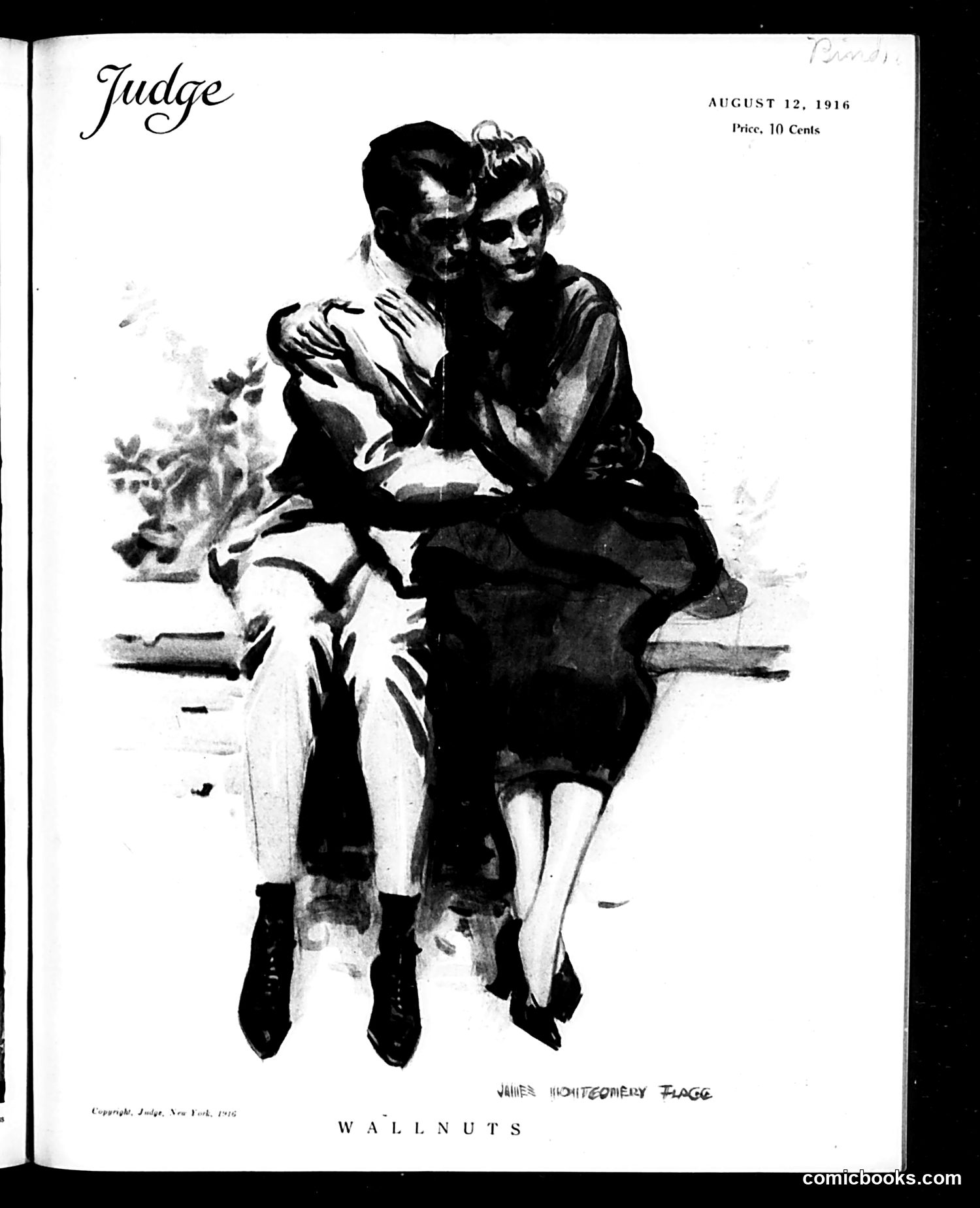
This illustration by James Montgomery Flagg depicts a couple sitting together on what appears to be a park bench, titled "Wallnuts" (a pun on "wall" and "nuts," suggesting foolish behavior against a wall or in public). The cartoon likely satirizes public displays of affection or courting behavior considered scandalous or improper for the era. The intimate pose—the man embracing the woman while she looks away demurely—suggests criticism of modern courtship customs or changing social mores regarding romantic behavior in public spaces. The title's wordplay reinforces the satirical intent: the couple are "nuts" (foolish) for their "wall"-side behavior, mocking both their actions and contemporary attitudes toward courtship and propriety.
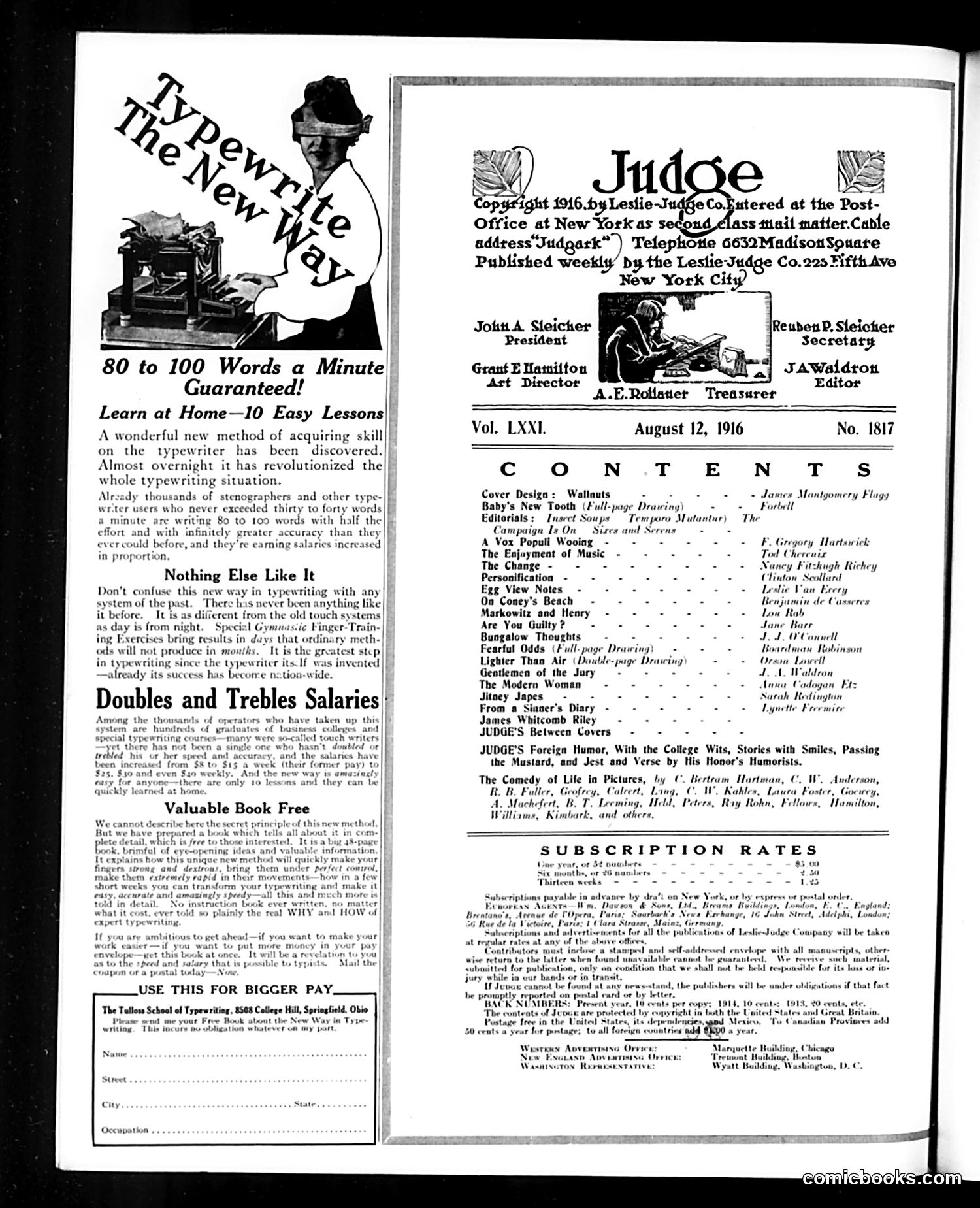
The left side features an advertisement for "The New Way" typewriter typing method, promising "80 to 100 Words a Minute Guaranteed" through home lessons. The copy emphasizes this as revolutionary—claiming previous typists rarely exceeded 30-40 words per minute. This reflects early 20th-century enthusiasm for efficiency and mechanization in office work. The right side shows the magazine's masthead and contents listing for this issue. The cover design by James Montgomery Flagg (noted artist) depicts "Wallnuts" and includes various editorial pieces and cartoons typical of Judge's satirical content from this WWI-era period. No specific political cartoon is clearly identifiable from this particular page image.
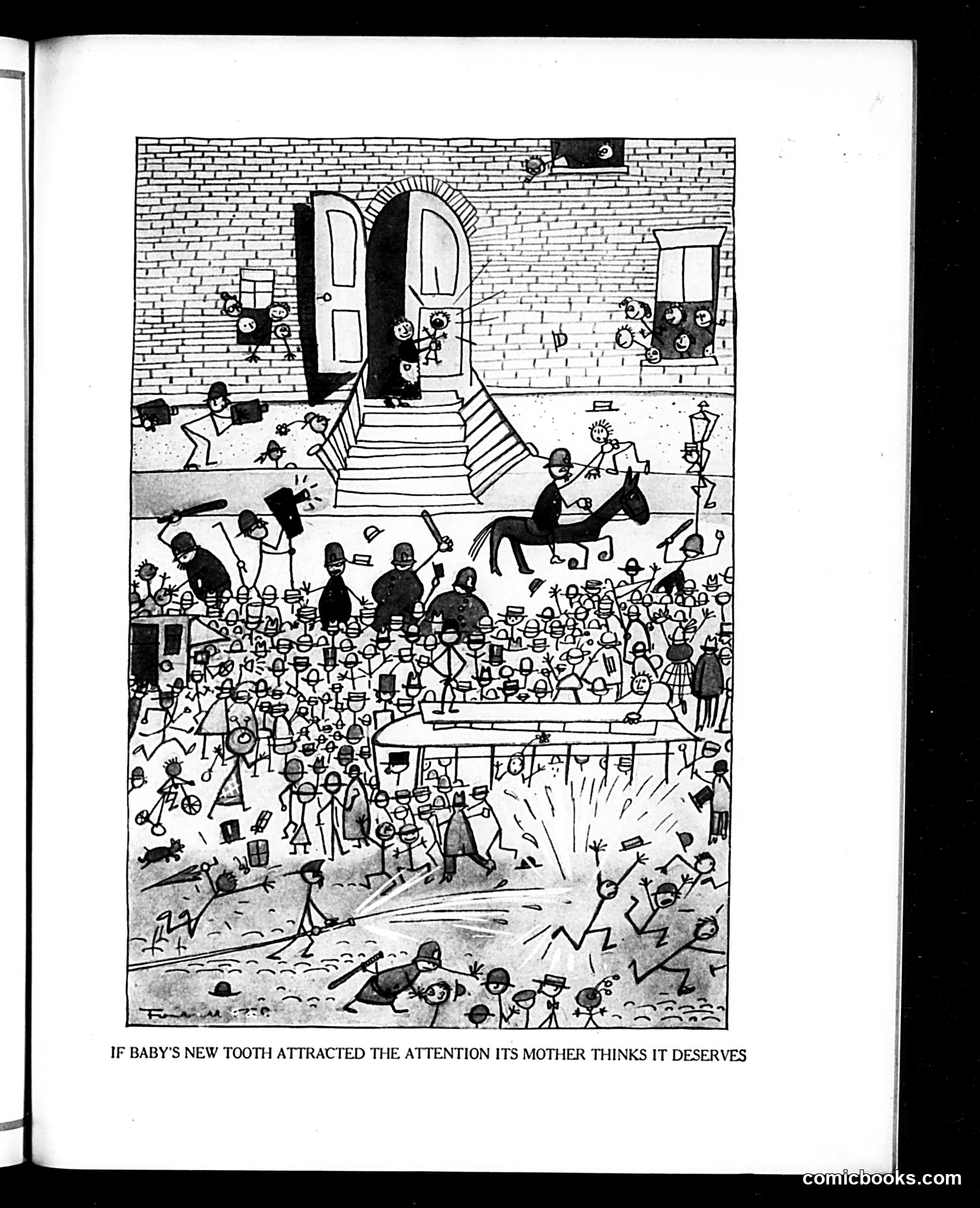
This is a satirical illustration depicting a chaotic public gathering before a grand building. The caption reads: "IF BABY'S NEW TOOTH ATTRACTED THE ATTENTION ITS MOTHER THINKS IT DESERVES." The humor is domestic satire—it mocks maternal pride and overestimation of how remarkable a child's milestones are. The joke suggests that if a baby's new tooth were truly as momentous as the proud mother believes, it would warrant the kind of massive public spectacle shown here: crowds, official ceremonies, possibly dignitaries, and complete civic disruption. This reflects Judge magazine's typical satirical approach, using exaggeration to mock everyday social pretensions, particularly parental vanity. The cartoon employs a contrasting scale (intimate domestic event versus grand public display) for comedic effect, targeting middle-class attitudes and parental self-importance rather than political figures or specific events.
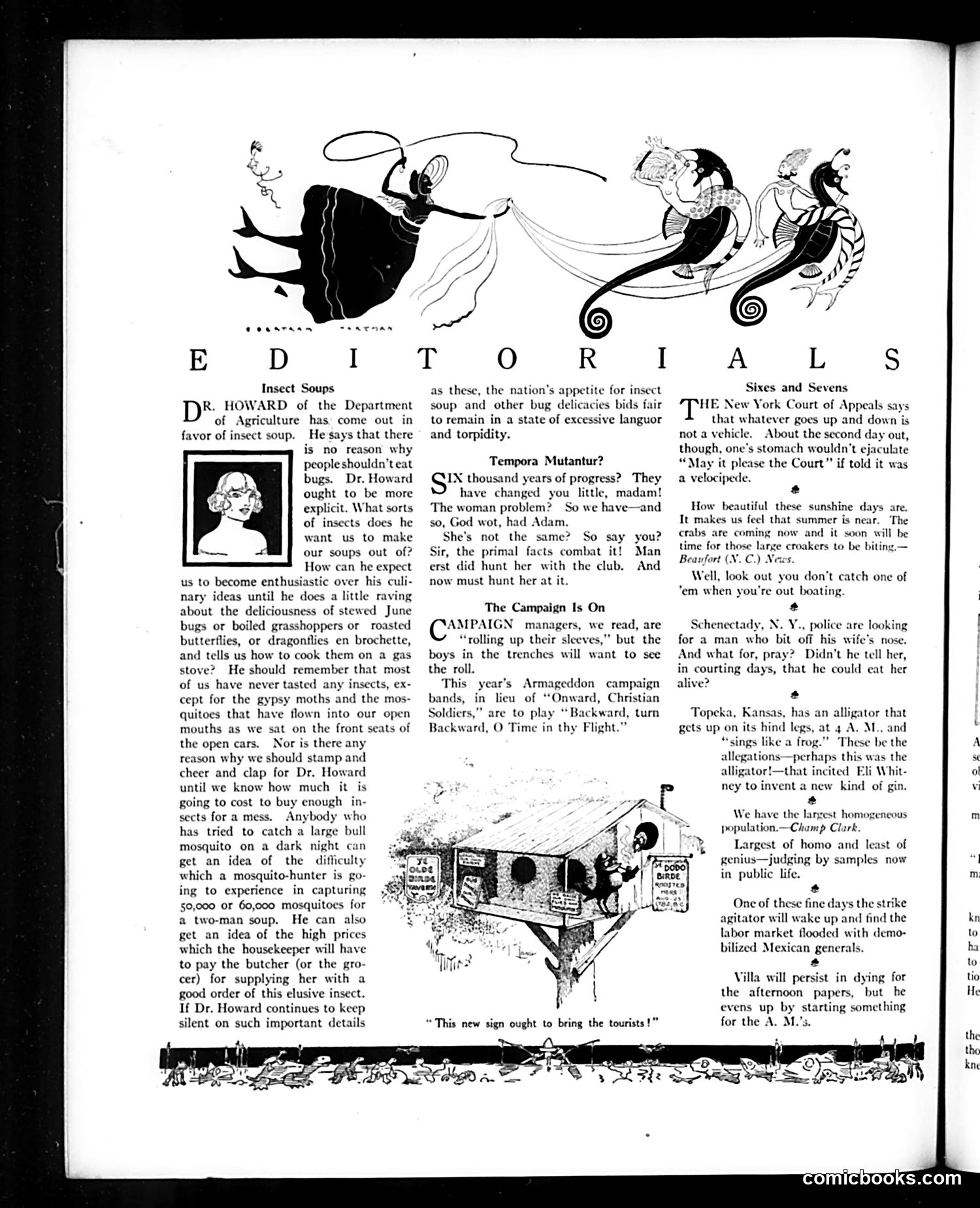
This page satirizes Dr. Howard of the Department of Agriculture's advocacy for eating insects as food. The left column mocks the idea that Americans should embrace entomophagy (insect consumption)—particularly grasshoppers and beetles—arguing it requires significant cultural conditioning before the public will accept "bug soup." The illustrated cartoon depicts a roadside shack with a sign reading "This new sign ought to bring the tourists!" - sarcastically suggesting that promoting insect-based cuisine would attract visitors. The right column contains brief news items and social commentary typical of Judge's format. Overall, the piece ridicules what appears to be a genuine USDA initiative, using humor to question whether Americans would ever voluntarily adopt insects as dietary staples, regardless of nutritional arguments.
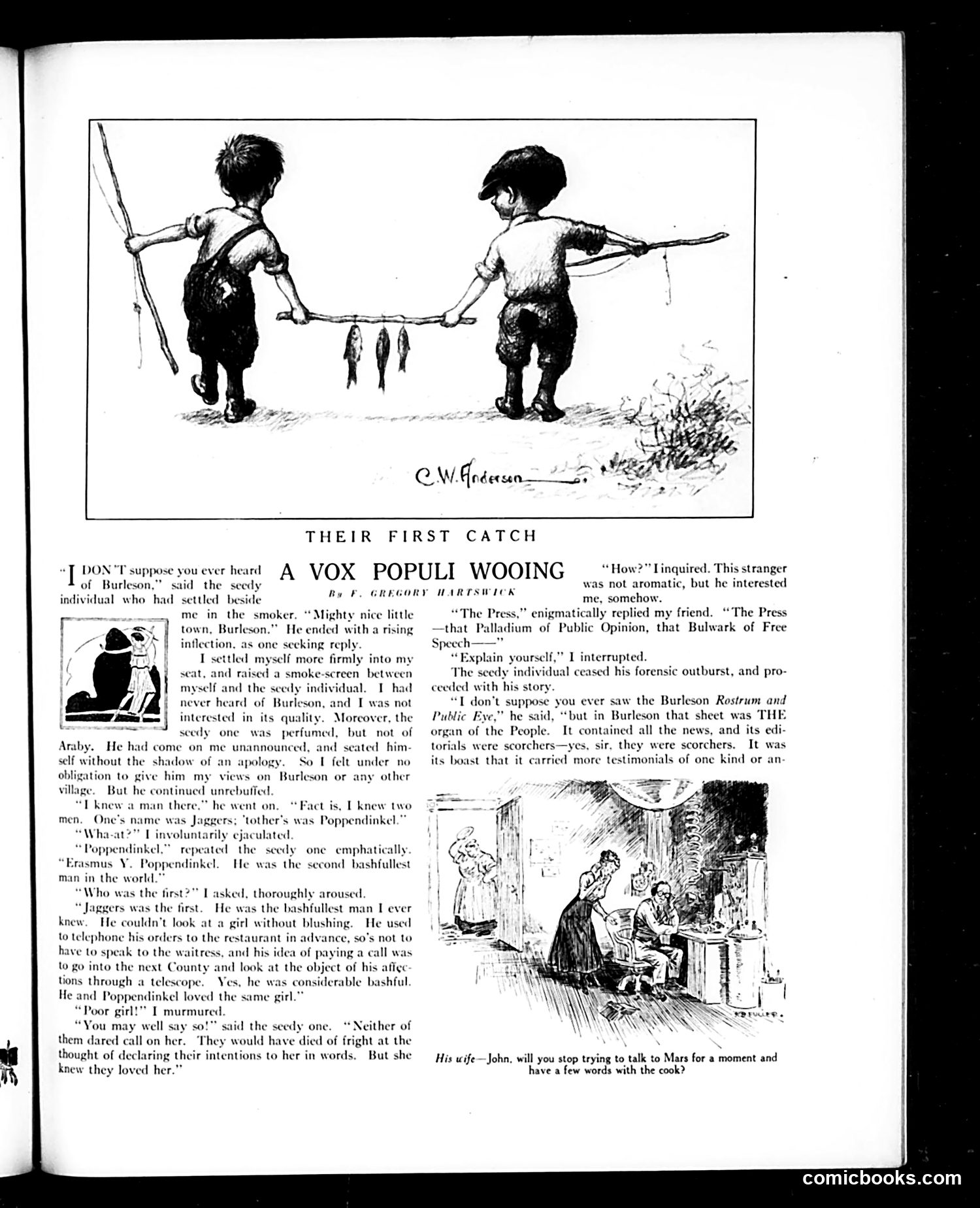
The top cartoon "Their First Catch" depicts two Indigenous children holding a string of fish, illustrated by C.W. Edoerson. This appears to be a nostalgic or ethnographic illustration rather than satirical content. The main article "A Vox Populi Wooing" by F. Gregory Hartswick is a narrative story, not political satire. It concerns two bashful men named Jaggers and Poppendinkel competing for a girl's affection, with the story advancing through their contrasting personalities—one bold, one timid. The lower illustration shows a domestic scene of a man interrupting his wife's conversation with someone named Mars (possibly a servant or visitor), asking her to speak with the cook. This page appears primarily **narrative fiction and illustration** rather than political or social satire typical of Judge magazine's satirical content.
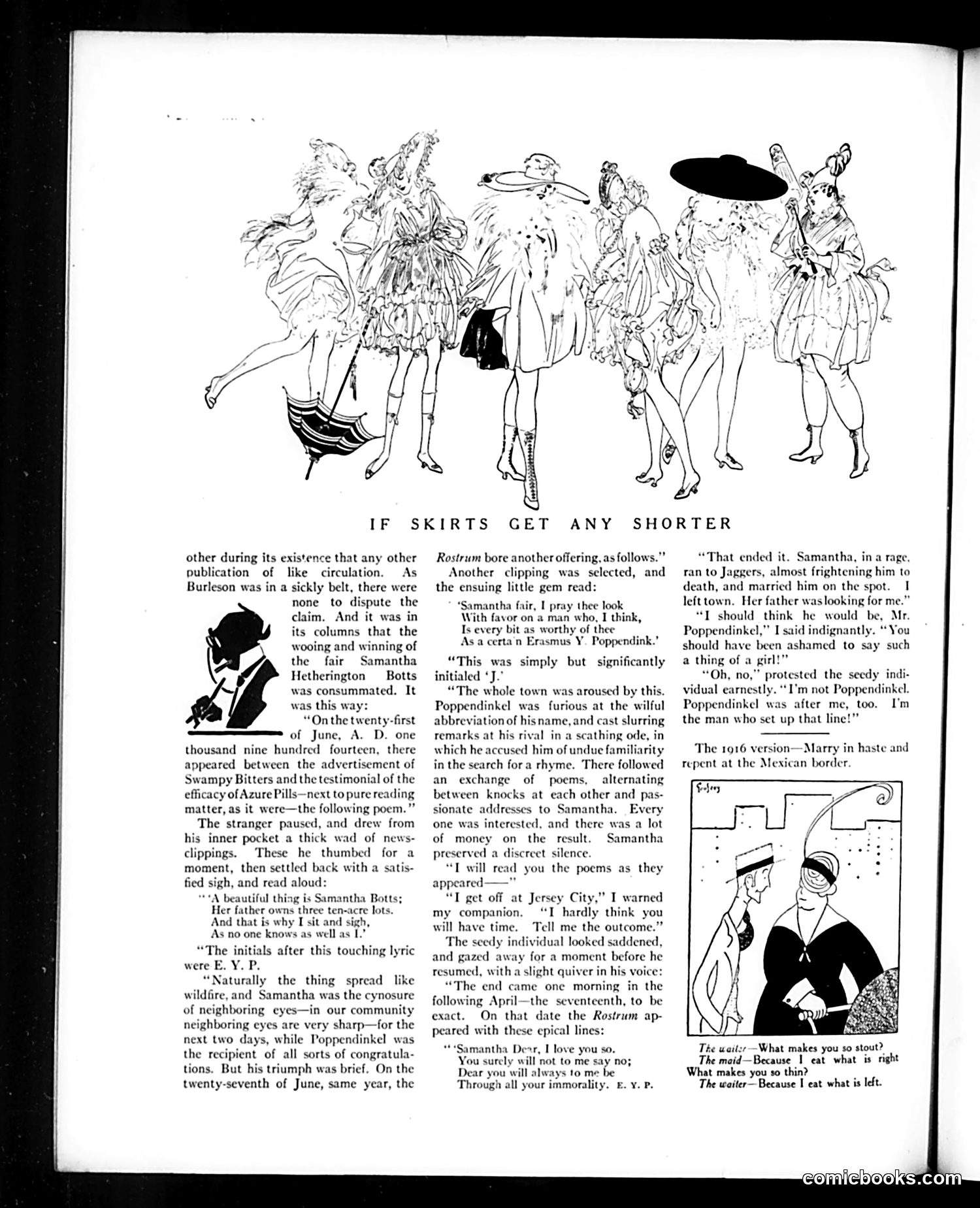
This page from *Judge* magazine presents a humorous story about a romantic competition told by a shabby stranger to the narrator. **The Main Story:** In 1914, two men—E.Y. Poppendinkel and another unnamed rival—compete for Samantha Hetherington-Botts' affections through anonymous poems published in the town's "Rostrum" (likely a newspaper column). The competition escalates until Poppendinkel's final poem carelessly includes the phrase "through all your immorality," which outrages Samantha. She marries a third party (Jaggers) impulsively and leaves town. The narrator reveals he's actually the *other* poet who wrote that fatal line. **The Satire:** The piece mocks small-town gossip, romantic desperation, and the absurdity of courtship rituals. The title references contemporary concerns about women's fashion (shorter skirts), contrasting with this old-fashioned romantic melodrama. **The Bottom Cartoon:** A brief joke about waiters and maids' diets provides light comic relief, unrelated to the main story.
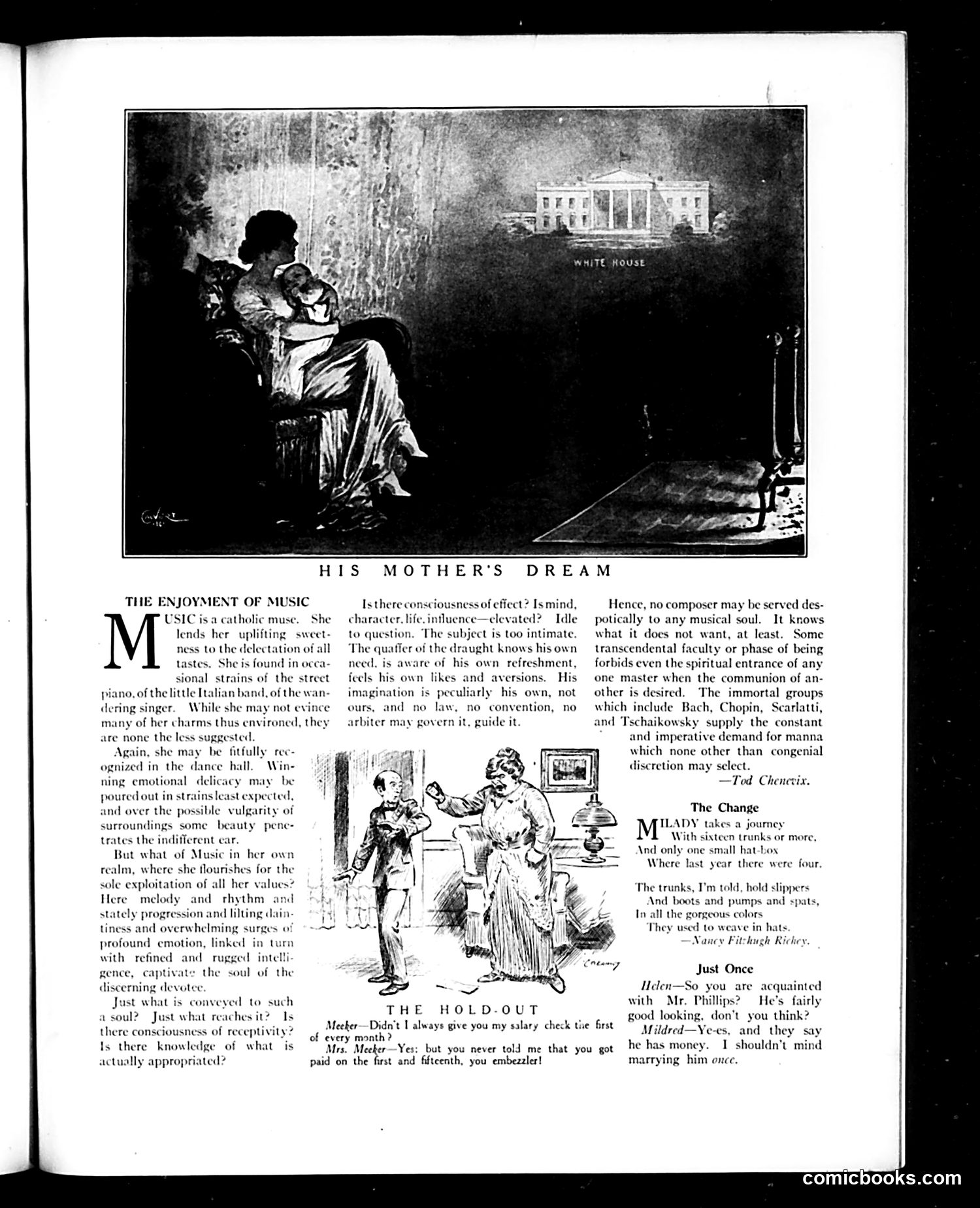
**Top Image - "His Mother's Dream":** A silhouetted woman gazes from a window at the White House, suggesting aspirational dreams of her son achieving high political office. This appears to be a sentimental illustration accompanying an essay on music appreciation. **"The Hold-Out" cartoon:** A domestic dispute where a husband admits giving his salary check monthly, but the wife catches him—he's actually been paid twice monthly (first and fifteenth) and concealing the extra income. She calls him an "embezzler." The satire mocks husbands who hide earnings from wives, a common marital deception during this era when wives often had limited financial control. **Remaining content:** The page primarily features an essay on music appreciation philosophy, plus light comedic pieces ("The Change" about a lady's travel trunks, and "Just Once" about a woman's mercenary marriage prospects). These are social humor rather than political satire, reflecting early-20th-century domestic and gender dynamics that Judge regularly lampooned.
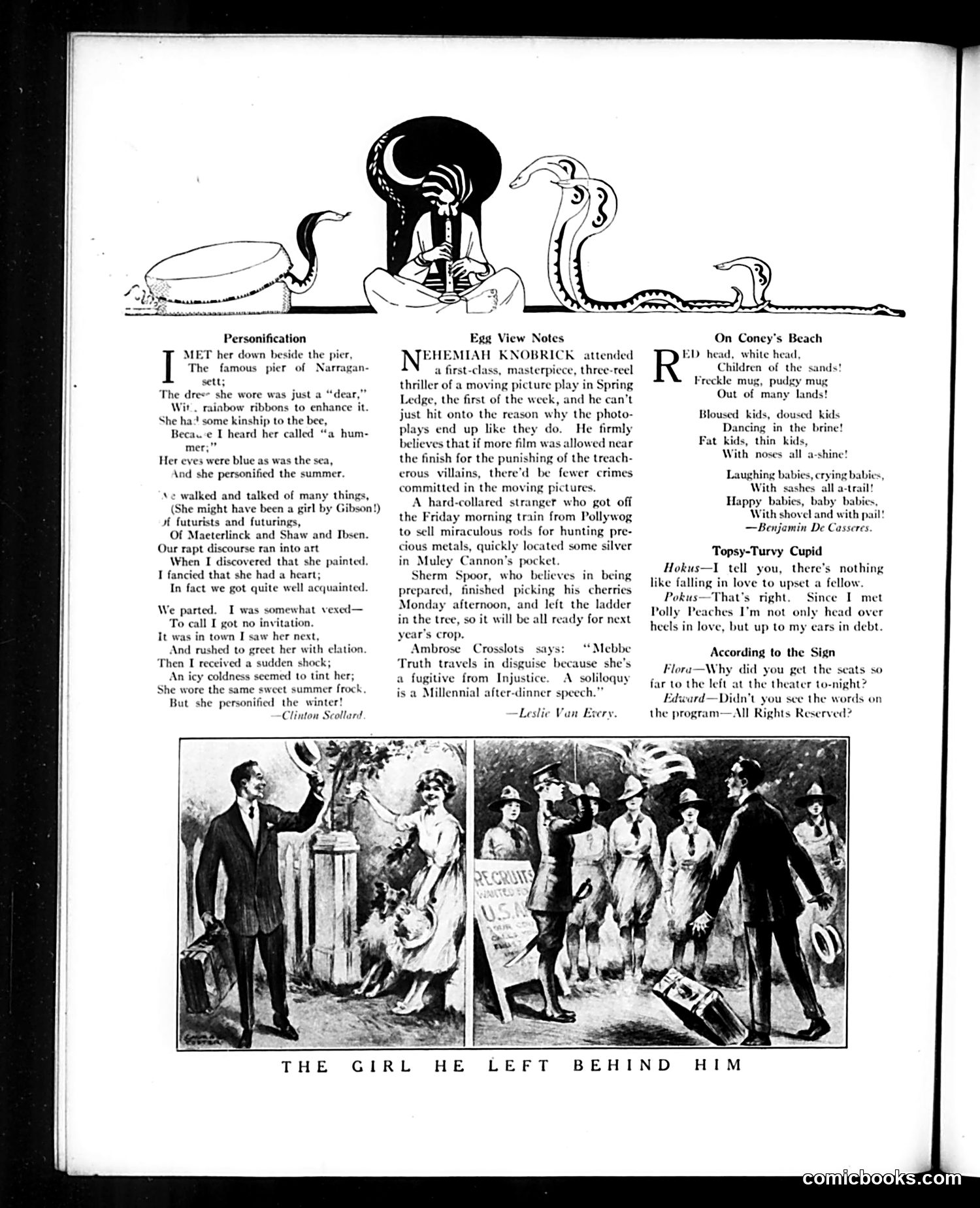
This page contains several short literary pieces and illustrations typical of early 20th-century satirical magazines. **The main cartoon** ("The Girl He Left Behind Him") depicts a romantic reversal: a man meets an attractive woman at Narragansett pier during summer. They share intellectual conversation (Gibson Girl-esque, referencing artist Charles Dana Gibson's idealized women). After parting without exchanging contact information, he encounters her again in town—but she now treats him coldly, having "personified the winter" instead of summer. The joke satirizes romantic disappointment and how women's affections can shift. **The bottom two illustrations** appear to show related scenes from the narrative, though the exact story connection is unclear from the image alone. The page also includes brief humorous prose pieces about small-town life ("Egg View Notes") and light poetry about Coney Island children and romantic mishaps. The humor is gentle, domestic satire aimed at middle-class readers—no overt political content is evident on this particular page.
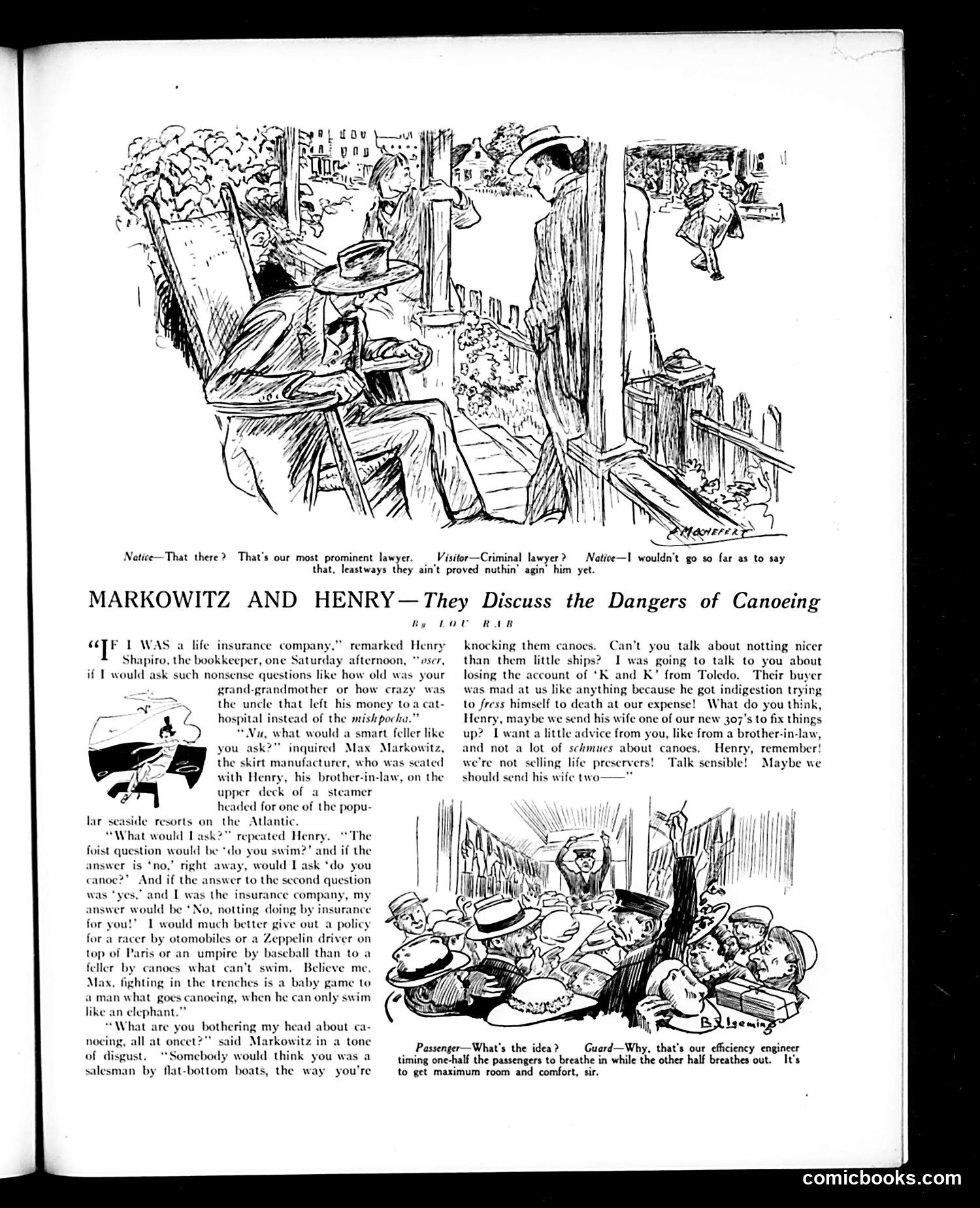
This page from *Judge* magazine contains two separate satirical pieces about impractical safety measures. **Top cartoon**: A lawyer sits on a porch while visitors discuss him. The joke plays on euphemism—they call him their "most prominent lawyer" but won't claim he's a "criminal lawyer" because nothing has been proven against him *yet*. The satire mocks both the lawyer's questionable reputation and the euphemistic language people use to avoid direct accusations. **Main article**: Two Jewish businessmen (indicated by Yiddish words like "nu," "mish pocha," "schmues," "fress") debate whether to sell life insurance policies to canoeists who can't swim. Henry argues this is absurdly dangerous; Max dismisses the concern while trying to sell policies anyway. The satire ridicules insurance companies for prioritizing sales over safety, and includes period ethnic humor through the characters' dialogue and speech patterns typical of early 20th-century American comedy. **Bottom cartoon**: An efficiency expert times passengers' breathing on a crowded vessel to maximize space—satirizing corporate "efficiency" taken to absurd extremes.
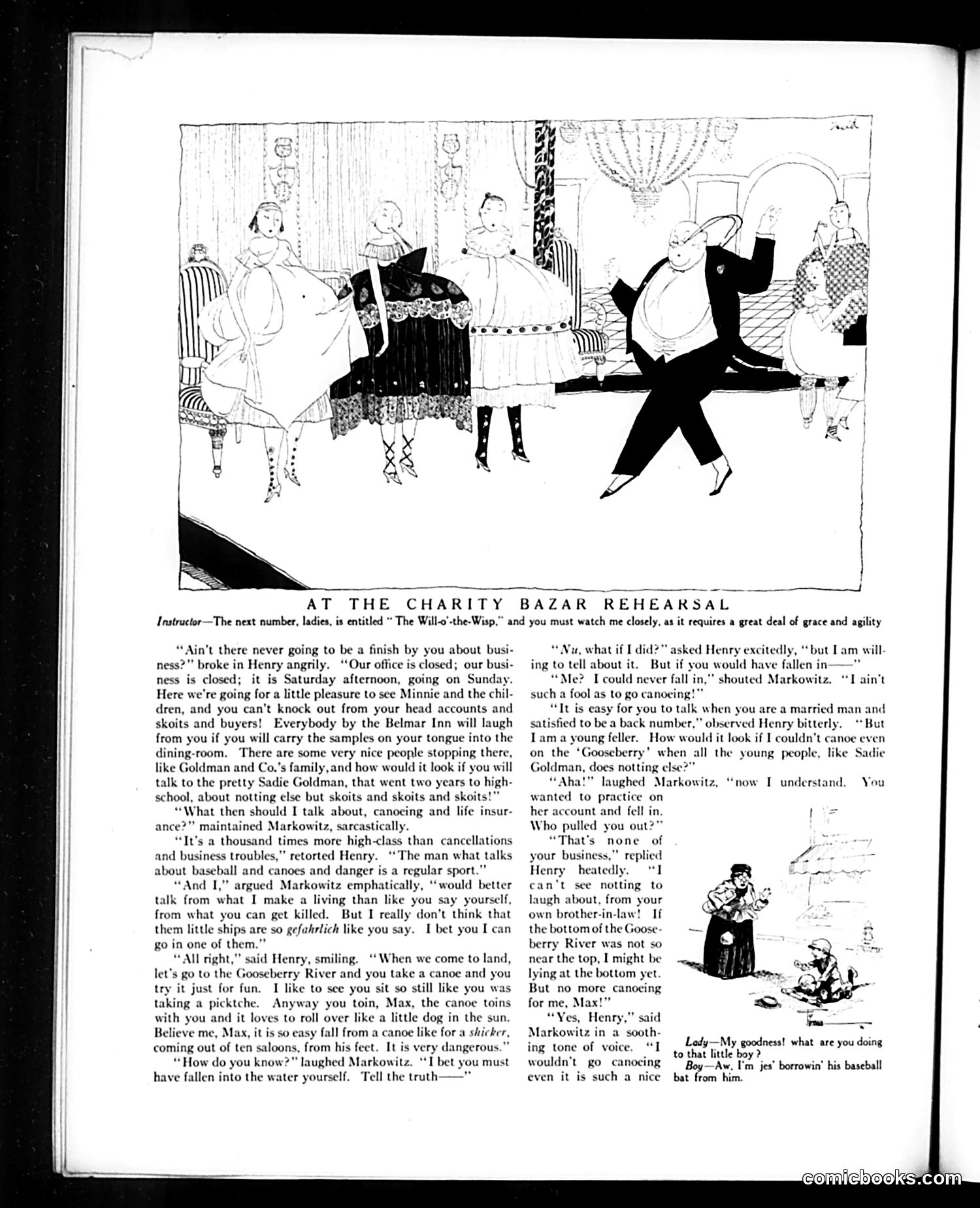
This page combines a satirical cartoon with humorous dialogue featuring two Jewish characters—Henry and Markowitz—debating canoeing safety at a charity event rehearsal. **The Cartoon**: The top illustration shows a formal charity bazaar rehearsal where an instructor demonstrates "The Will-o'-the-Wisp," a dance number. The scene depicts upper-class attendees in an elegant ballroom. **The Satire**: The accompanying dialogue mocks working-class Jewish immigrants and their social aspirations. Henry and Markowitz argue about whether canoeing is dangerous—Henry insists he fell in the Gooseberry River, while Markowitz boasts he never could. Their Yiddish-inflected English ("gefahrlich," "shicker," "toin") and obsession with impressing wealthy families like the Goldmans reflects period stereotypes about Jewish social climbing and business-focused mentality. **The Humor**: The joke relies on ethnic caricature—depicting Jewish characters as socially awkward, risk-averse, yet status-conscious. The dialect humor and petty squabbling were typical of early 20th-century American satire.
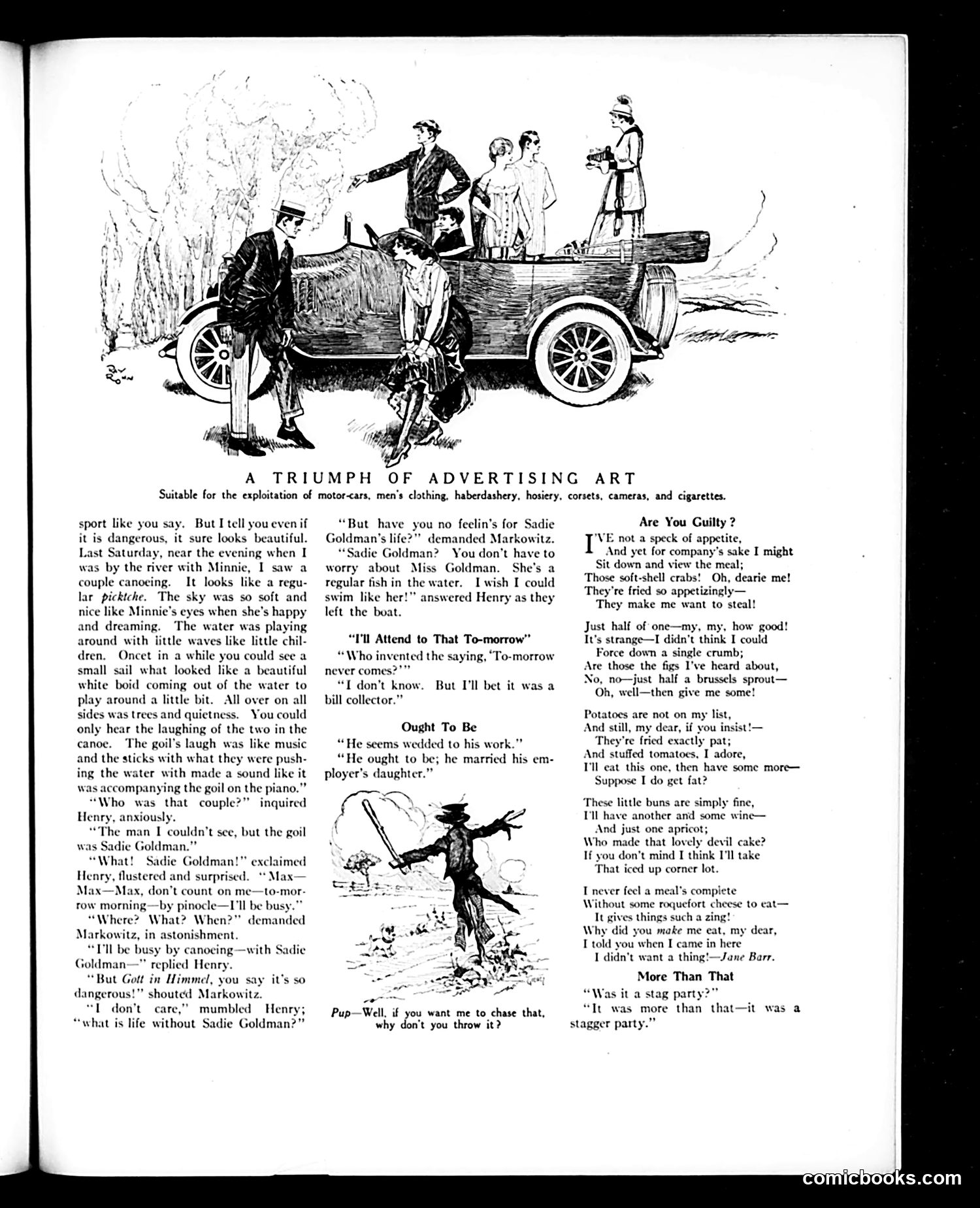
This page contains multiple satirical pieces from *Judge* magazine. The top illustration shows an early automobile filled with well-dressed passengers, captioned as "a triumph of advertising art"—satirizing how advertisers use appealing imagery (beautiful scenery, attractive people) to sell products like cars and clothing, regardless of actual utility or safety. Below are three humorous dialogue pieces: 1. **"I'll Attend to That To-morrow"** - A joke about procrastination, with the punchline that a bill collector invented "tomorrow never comes." 2. **"Ought To Be"** - A pun about a man "wedded to his work" who actually married his employer's daughter. 3. **"Are You Guilty?" and "More Than That"** - Humorous poems about overeating and the euphemism of a "stagger party" (drunk gathering) versus a "stag party" (bachelor event). The page satirizes consumer culture, advertising manipulation, and everyday human weaknesses like procrastination and gluttony.
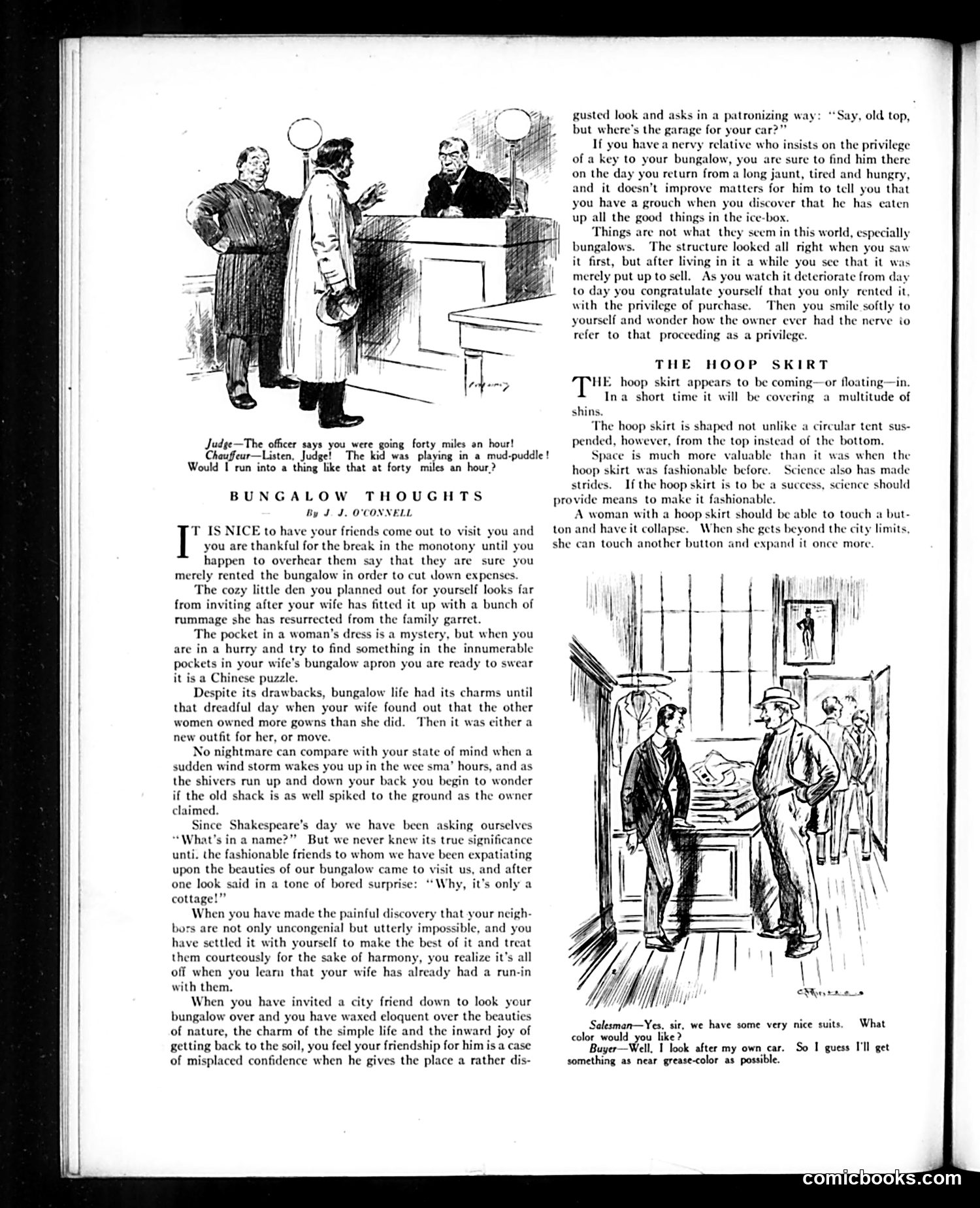
This page contains two distinct pieces of satire: **The Judge cartoon (top):** A speeding driver claims he wouldn't hit a child in a mud puddle at forty miles per hour—an absurd defense. The satire targets reckless drivers who make ridiculous excuses for dangerous behavior. **"Bungalow Thoughts" (main article):** A humorous essay about the disappointments of bungalow ownership. The satire targets early-20th-century middle-class aspirations: friends assume the modest home signals financial desperation; wives fill it with family castoffs; neighbors prove insufferable; city visitors condescendingly ask where the garage is. The piece mocks the gap between romantic ideals of "simple living" and rural authenticity versus suburban reality—a property deteriorates quickly, and renting with purchase option proves hollow. **"The Hoop Skirt" (bottom):** Brief commentary on fashion's cyclical nature, predicting hoop skirts' return while sardonically noting modern space constraints make them impractical. All three target contemporary middle-class pretensions and social anxieties.
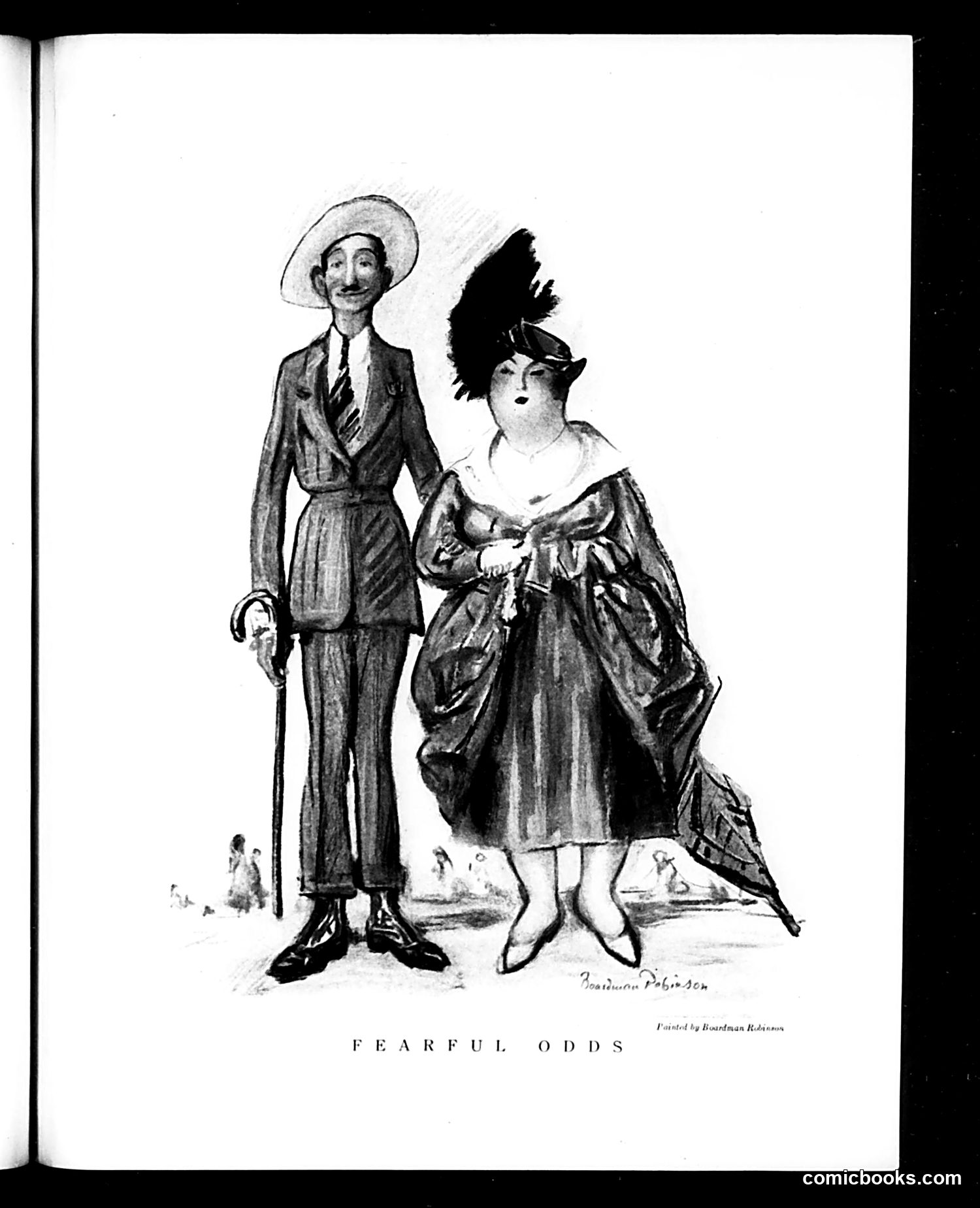
This satirical illustration, credited to Boardman Robinson, depicts two figures in contrasting attire: a tall, thin man in a conservative suit and hat, and a woman in an elaborate, expensive-looking dress with a dramatic feathered hat and fur stole. The title "Fearful Odds" suggests an unequal contest or disadvantage. The cartoon likely satirizes gender dynamics and class disparity, possibly commenting on marital economics or courtship inequality. The man's modest appearance versus the woman's ostentatious wealth and fashion—including what appears to be luxury goods—implies commentary on materialism, consumer culture, or the financial burden placed on men by women's fashion expectations. The composition emphasizes the visual contrast as the "odds" being referenced.
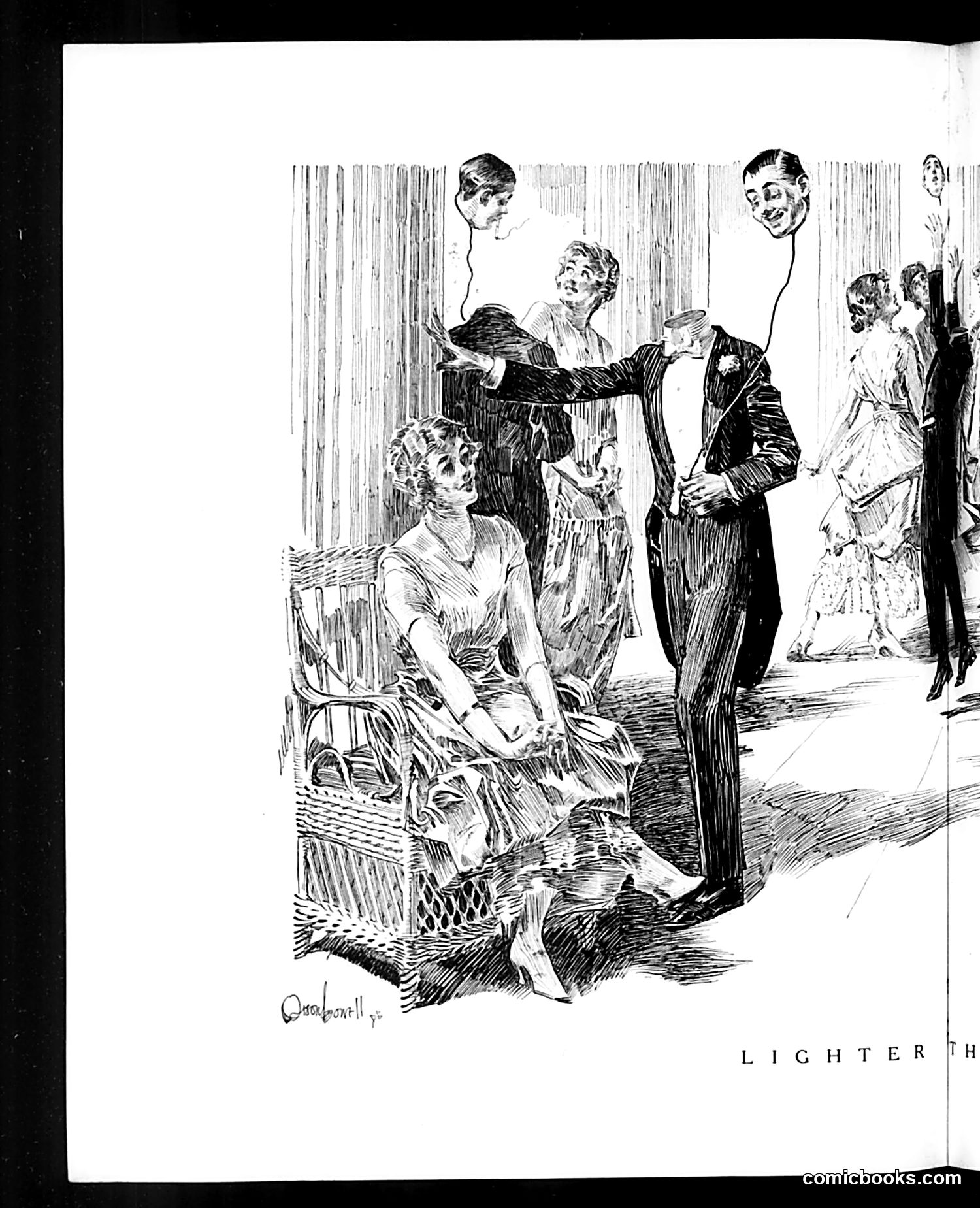
This is an ink sketch signed by what appears to be "Cesare Lombardi" (or similar), showing a social scene at what looks like a formal gathering or party. The illustration depicts several well-dressed figures in early 20th-century attire. A woman sits while men in suits stand around her, with additional figures visible in the background. The partial text "LIGHTER TH" at the bottom suggests this may be part of a larger piece, though the complete caption and context are not visible. Without the full text, the specific satirical point remains unclear—it could comment on social etiquette, class dynamics, or contemporary social behavior, but the exact subject cannot be determined from the image alone.
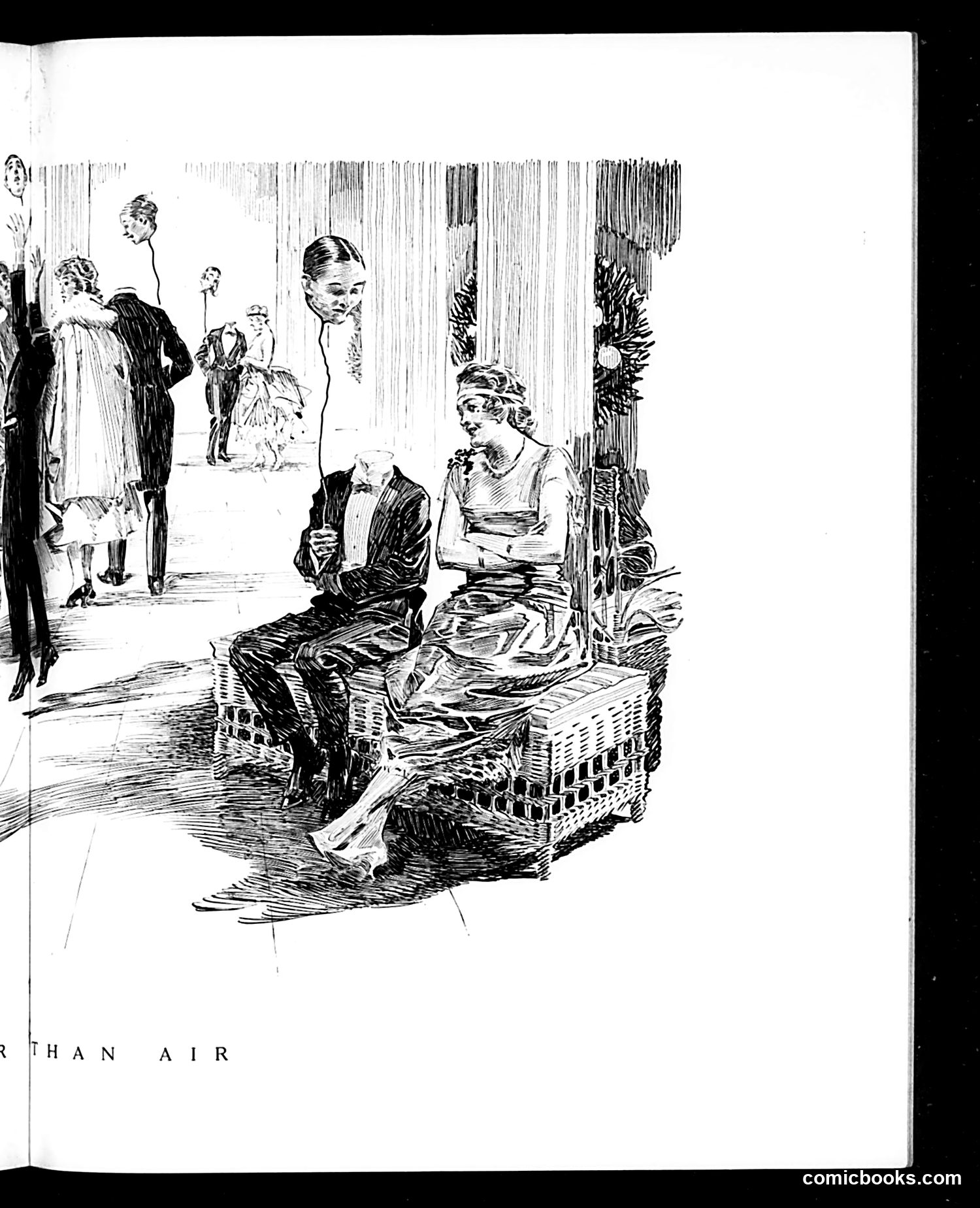
This appears to be an illustration from *Judge* magazine showing a social scene at what looks like a formal gathering or ball. The visible text fragment "THAN AIR" (likely part of a longer title) is insufficient to identify the specific cartoon's subject or satirical point. The image depicts well-dressed figures in an interior setting with draped curtains. A young couple sits prominently in the foreground while other elegantly attired guests stand in the background. The style and clothing suggest late 19th or early 20th century. **Without the complete title or caption**, I cannot reliably determine what social or political critique this illustration makes. The OCR text is too fragmentary to establish context. The cartoon likely comments on contemporary social customs, class dynamics, or romantic/courtship conventions of the era, but I cannot specify which without additional text.
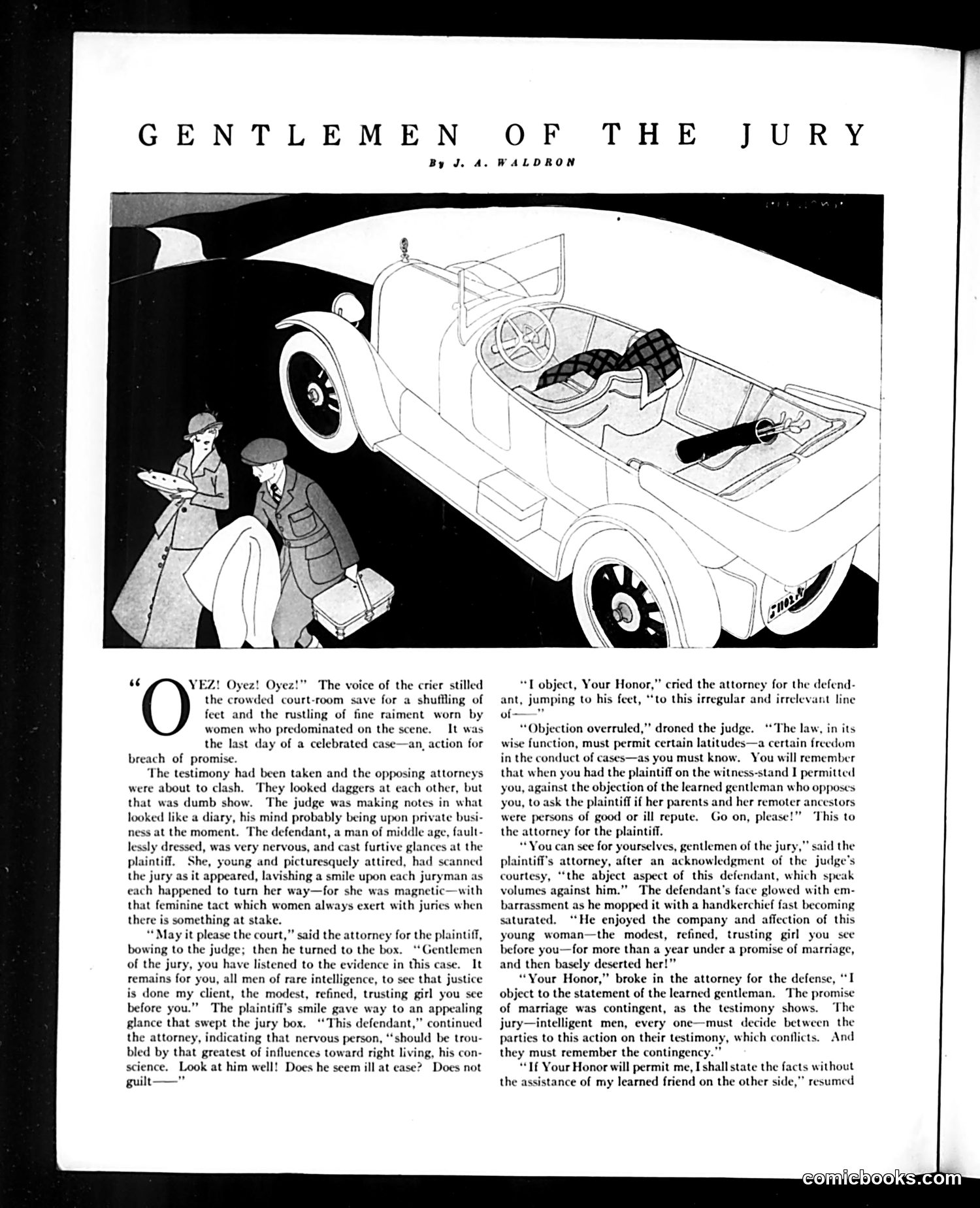
This is a satirical story illustrated with a courtroom scene depicting a breach-of-promise lawsuit—a common legal action in early 20th-century America where a woman could sue a man who broke an engagement. The satire targets **jury manipulation and courtroom bias**. The plaintiff's attorney exploits the all-male jury's susceptibility to the young woman's appearance and charm ("lavishing a smile upon each juryman"), while the judge repeatedly permits improper emotional appeals and questionable questions. The defendant's nervousness and guilty appearance become evidence merely because the attorney points them out dramatically. The cartoon shows the woman's supporters arriving with luggage, suggesting opportunistic gold-digging or premeditated legal strategy. The satire mocks how juries ignore actual evidence in favor of emotional performance and how the judicial system permits such manipulation, particularly when an attractive woman is the plaintiff. The defense attorney's technical objections cannot compete with the performative nature of the trial.
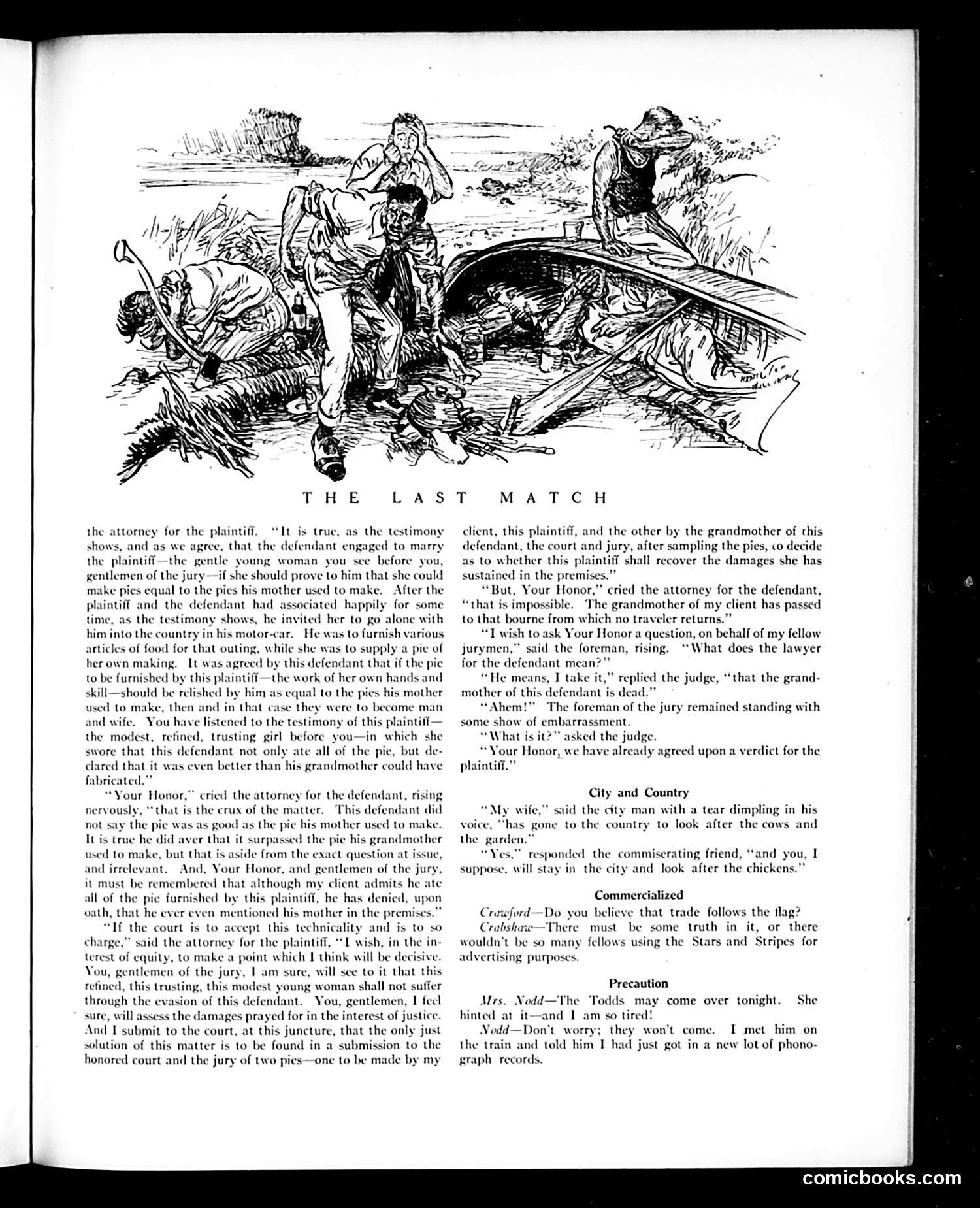
The main cartoon depicts a breach-of-promise lawsuit where a man agreed to marry a woman if her homemade pie equaled his mother's. She made an excellent pie; he admitted it surpassed even his *grandmother's* cooking. The defendant's lawyer exploits a technicality: he never specifically praised it against his *mother's* pie, making the contract condition technically unfulfilled. The satire mocks how lawyers weaponize procedural loopholes to evade justice. When the defendant's attorney argues the grandmother's pie cannot be compared (she's deceased), the jury foreman reveals they've already ruled for the plaintiff anyway—suggesting common sense and justice override legal hair-splitting. The page also includes lighter social commentary: "City and Country" jokes about urban vs. rural life, and "Commercialized" discusses whether trade follows flags (imperialism). These filler pieces were typical Judge magazine content.
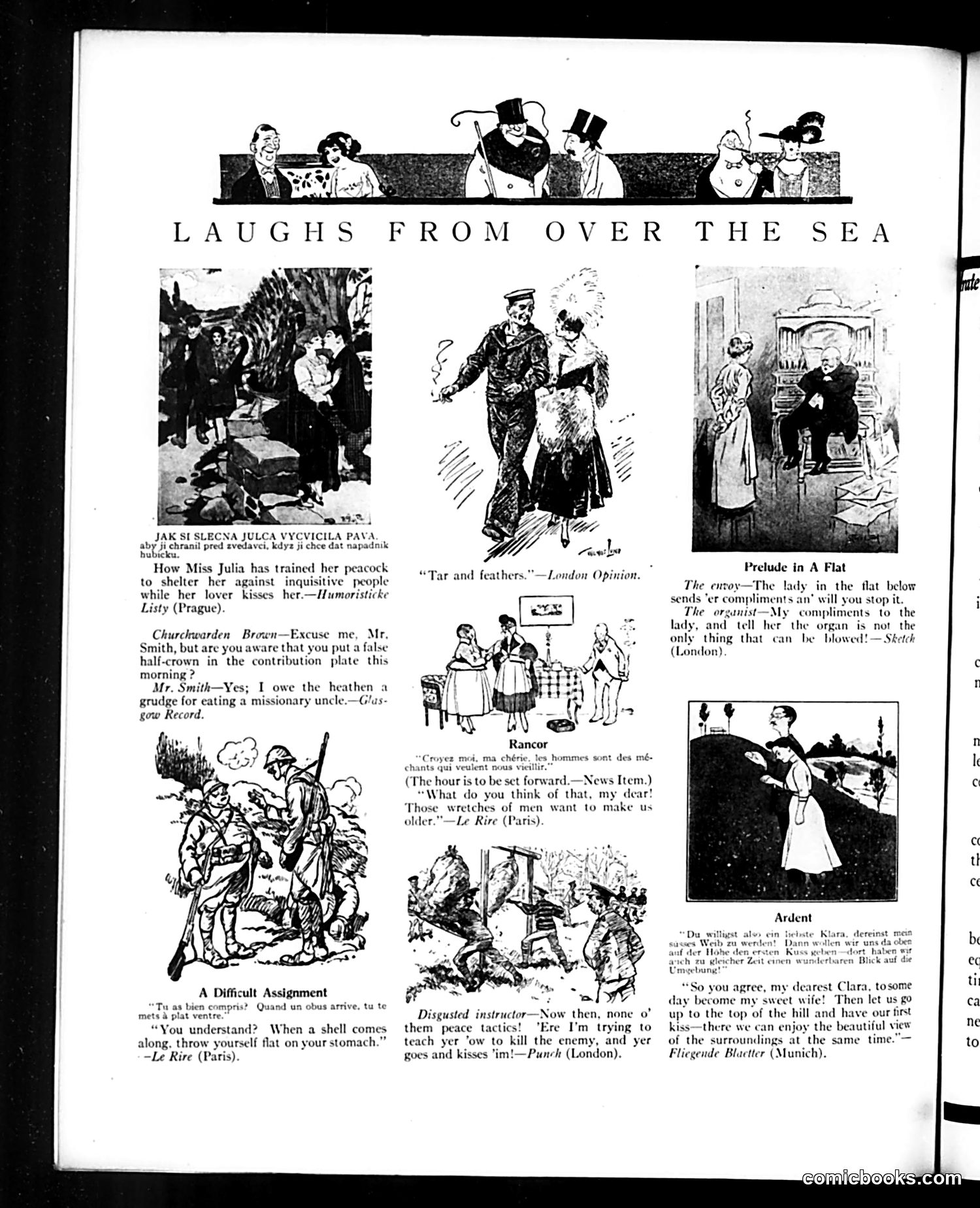
This page collects international satirical cartoons from European magazines (Prague, Paris, London, Munich). The humor relies on common early 20th-century themes: **Military/War humor**: "A Difficult Assignment" and "Disgusted Instructor" joke about soldier incompetence—men unable to follow orders (lying flat during shelling, kissing enemies instead of fighting them). **Romance/Propriety**: "Prelude in a Flat" mocks an organist whose loud playing disturbs neighbors; "Ardent" shows a suitor proposing on a hillside. Both play on social anxieties about proper behavior. **Religious hypocrisy**: "Churchwarden Brown" depicts a man putting counterfeit coins in church collection plates, then justifying it as revenge against missionaries. **Animal humor**: The peacock cartoon suggests using the bird as a privacy screen while kissing—absurdist humor about courtship propriety. These represent pre-WWI international comic sensibilities, emphasizing military incompetence, romantic fumbling, and moral contradictions.
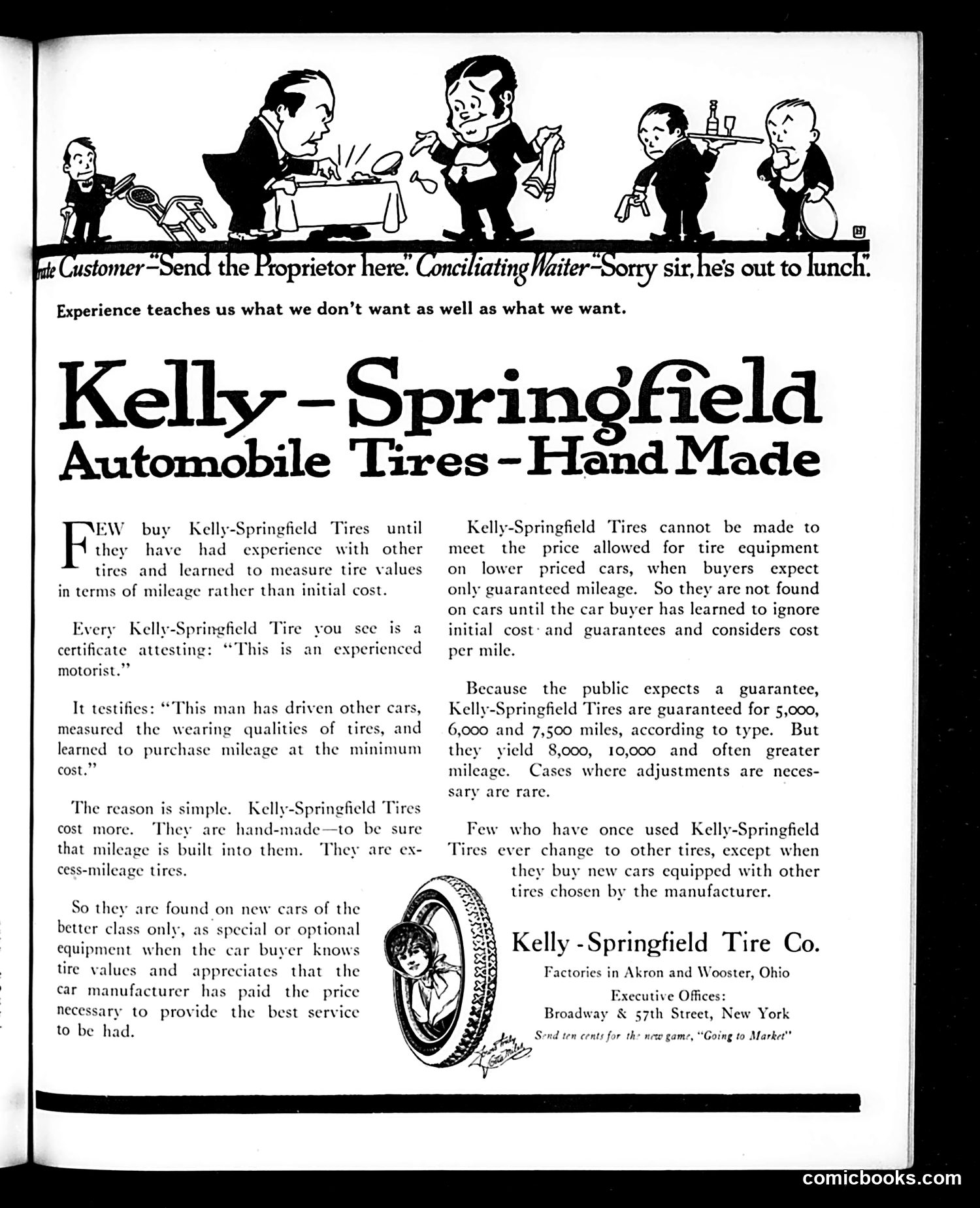
This is primarily a **product advertisement** rather than political satire. The small cartoon at top depicts a restaurant scene where a customer demands the proprietor, but the waiter explains he's at lunch—a joke about poor service and unavailable management. The main content advertises Kelly-Springfield Tires as premium, hand-made products for discerning buyers. The pitch argues that **experienced motorists** understand value through mileage-per-dollar rather than initial cost. The company positions itself as exclusive equipment on "better class" automobiles, guaranteeing 5,000-7,500 miles but typically delivering 8,000-10,000. The marketing strategy appeals to **class consciousness and consumer sophistication**—suggesting only educated buyers appreciate quality over price. This reflects early-20th-century consumer culture where "experience" and brand loyalty justified premium pricing. The satirical element is subtle: the opening joke about unavailable proprietors mirrors the advertisement's message about reliability and service quality.
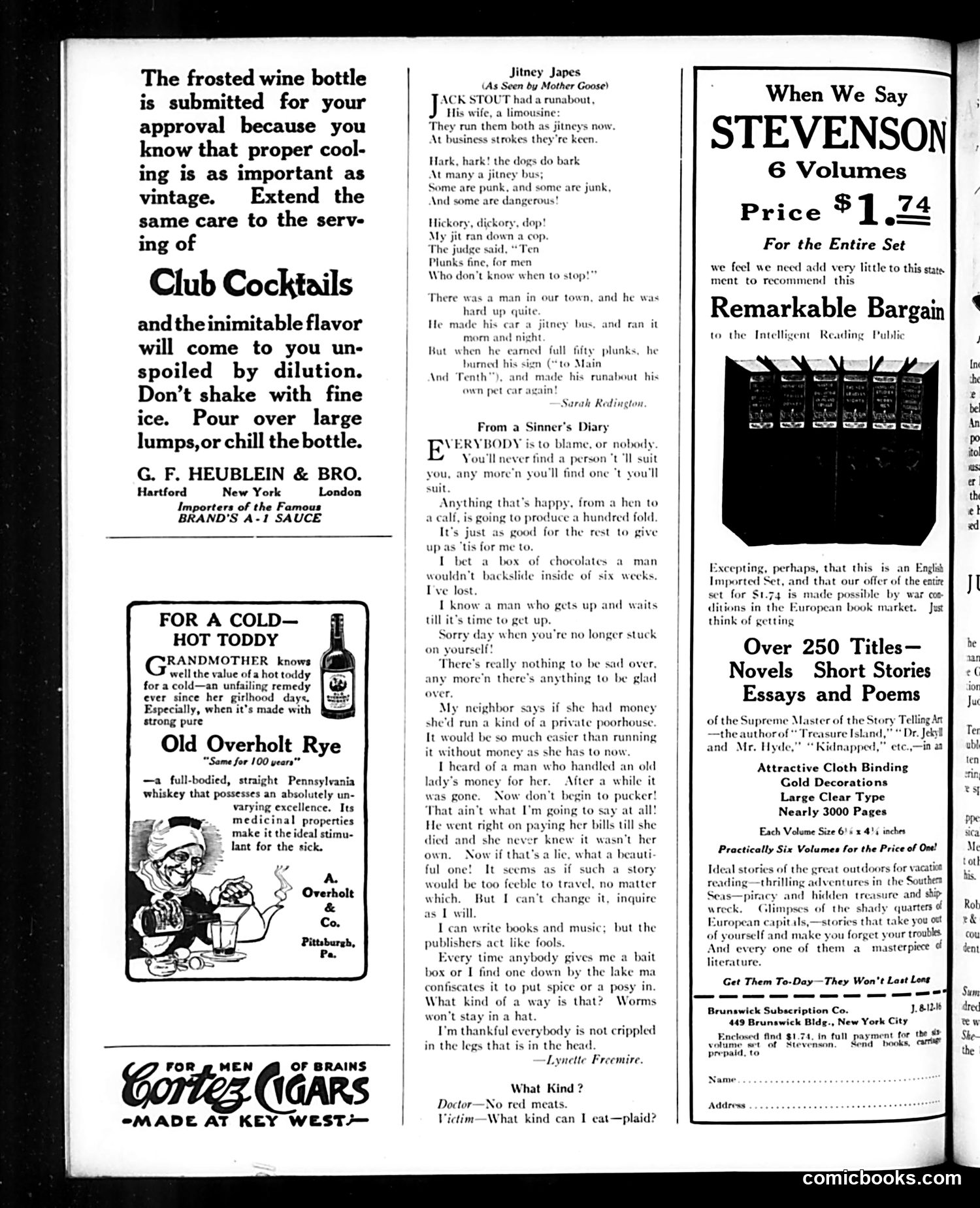
This page is primarily **advertising with light satirical content**, not political cartoons. The "Jitney Japes" section satirizes the **jitney craze**—informal shared-ride services using private automobiles that became popular during WWI as cheap alternatives to taxis. The nursery rhyme parodies mock how common these vehicles had become, joking about dangerous drivers ("My jit ran down a cop") and reckless operation. The humor relies on readers' familiarity with this transportation trend and its associated traffic hazards. The remaining content consists of period advertisements (Club Cocktails, Old Overholt Rye whiskey, Cortez Cigars) and a Stevenson book set offer—typical Judge magazine fare. "From a Sinner's Diary" is philosophical filler, not satire. The final joke about "plaid" meats is mild wordplay unrelated to current events. This page reflects 1910s-1920s American consumer culture and everyday concerns rather than sustained political commentary.
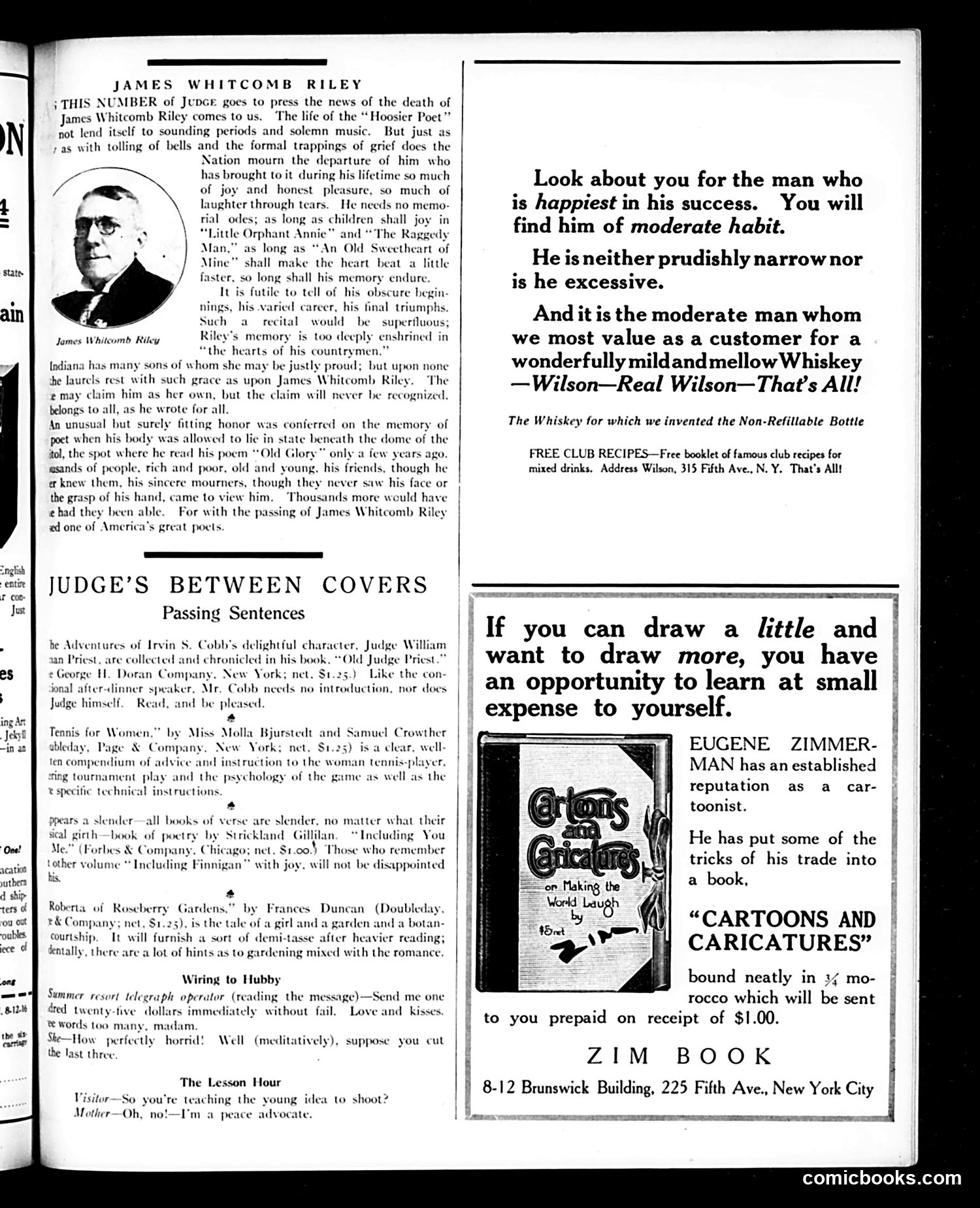
This page is primarily a **memorial tribute to James Whitcomb Riley**, the famous American poet (1849-1916) who died recently. The left side features his portrait and an extended eulogy praising Riley as the "Hoosier Poet" whose works like "Little Orphant Annie" and "The Raggedy Man" brought joy to Americans. The text notes the honor of his body lying in state beneath the Capitol dome. The right side contains a **whiskey advertisement** for "Wilson—Real Wilson—That's All!" that ironically exploits Riley's death by positioning itself alongside the memorial. The ad promotes "moderate habit" and appeals to customers of "mellow Whiskey." Below are book reviews and brief humorous pieces, including a telegraph operator joke and a joke about teaching children. **The satire**: The juxtaposition of solemn mourning with a liquor advertisement creates unintentional (or deliberate) dark humor typical of Judge's irreverent style—mixing high sentiment with commercial opportunism on the same page.
This page combines advertisement and satirical editorial commentary on women's suffrage, a heated political issue of the early 20th century. **The Advertisement** (left) promotes a serialized fiction story in *Collier's* magazine about "Baron Starkheim" by Melville Davisson Post. **The Editorial Content** (right), by Anna Cadogan Etz, uses humor to critique anti-suffrage arguments. It presents several satirical scenarios: men claiming women should remain silent and domestic because they distract from business; a rural voter refusing to sign a suffrage petition out of superstitious distrust of all humans; and a Colorado man opposing suffrage because his wife might ask him about tariff policy. The piece also notes that women jurors, contrary to male fears, prove competent and agreeable. The satire's point: male objections to women's voting rights are absurd, contradictory, and rooted in self-interest rather than principle.
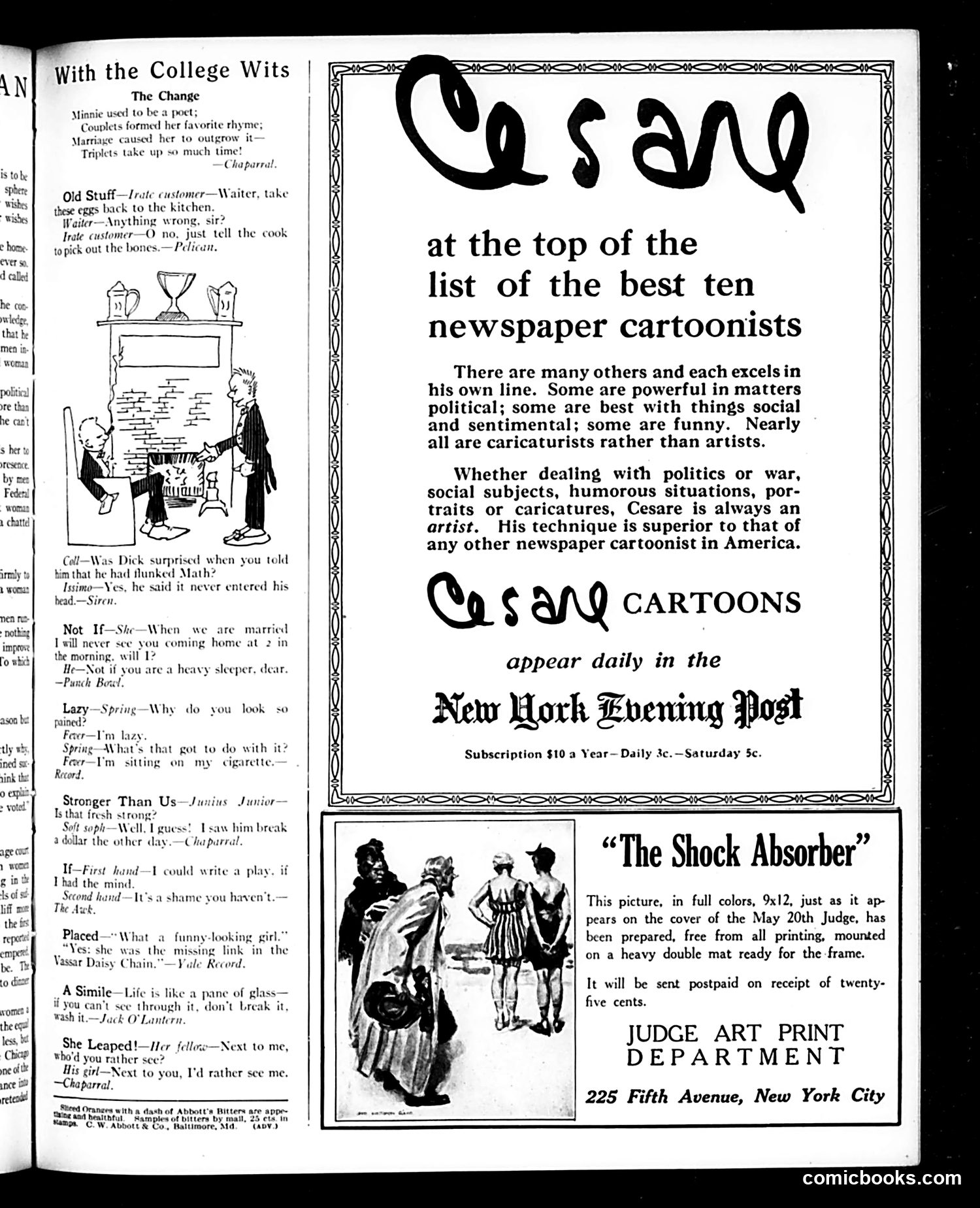
This page contains two distinct sections: **Left side:** A humor column featuring brief jokes attributed to various college publications (Chaparral, Pelican, Siren, Punch Bowl, etc.). The jokes employ wordplay and light social satire—poking fun at marriage anxieties, laziness, courtship dynamics, and academic failure. They reflect early 20th-century college social humor with predictable punchlines about romantic mishaps and student life. **Right side:** Advertisement and promotion for cartoonist Cesare, ranked among the top ten newspaper cartoonists. The text praises his superior technique and artistic skill across political, social, and humorous subjects. It advertises his daily cartoons in the *New York Evening Post* and promotes a print reproduction ("The Shock Absorber") available from Judge's art department for twenty-five cents. The page primarily serves as advertising disguised as editorial content—a common magazine practice. No specific political figures or events are referenced; the humor is generic collegiate comedy.
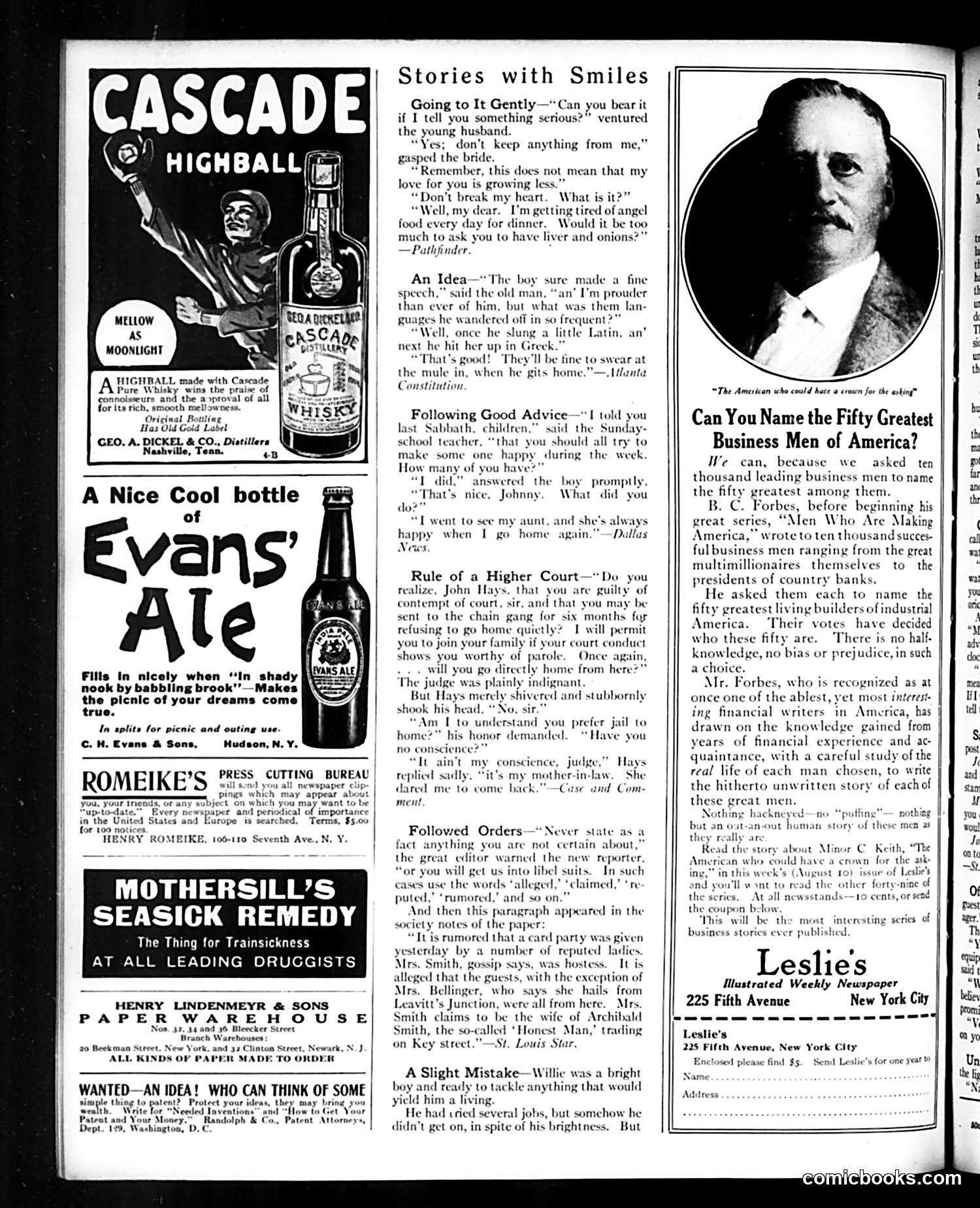
This page is primarily **advertisements and humorous anecdotes**, not political cartoons. The "Stories with Smiles" section contains brief jokes typical of early 20th-century Judge magazine. **The humor depends on period assumptions:** - "Going to It Gently": A newlywed husband confesses he's tired of angel food cake—a "delicate" way to broach domestic disappointment, playing on expectations of newlywed politeness. - "Rule of a Higher Court": A man refuses to leave court because his mother-in-law dares him to return home—the joke relies on the stock "oppressive mother-in-law" stereotype. - "An Idea" and "Following Good Advice": Rural/dialect humor about Latin swearing and visiting aunts—reflecting class attitudes toward education and family obligation. - "Followed Orders": Satirizes journalistic timidity by showing how excessive use of "alleged" and "rumored" creates absurdity when describing routine social events. These are gentle, domestic comedies without sharp political content—reflecting Judge's shift toward lighter humor. The advertisements (whisky, seasickness remedy, patent attorney services) anchor this as a middle-class publication.
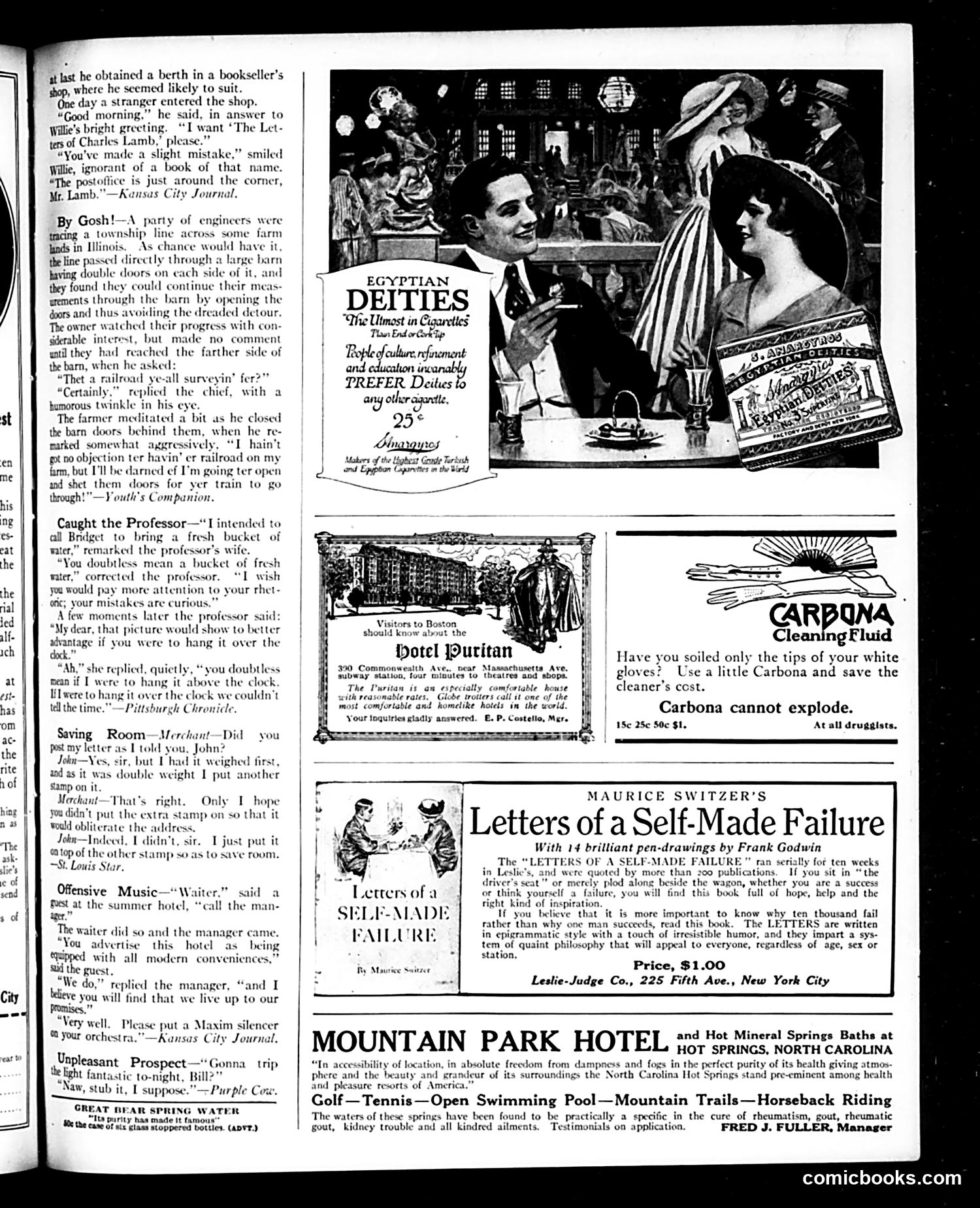
This page contains **multiple short humorous anecdotes** rather than political cartoons. The jokes satirize everyday social situations with gentle irony: 1. **"The Letters of Charles Lamb"** — A bookshop clerk mistakes a customer's request for a literary classic as asking for mail addressed to "Mr. Lamb," confusing letters (correspondence) with a book title. 2. **The Railroad Survey** — Engineers measure land through a farmer's barn to avoid a detour. The farmer allows it but sarcastically warns he won't open the doors for actual trains—mocking rural skepticism of progress. 3. **The Professor's Wife** — A pedantic professor corrects his wife's grammar ("fresh water" not "fresh miter"), only for her to humiliate him by pointing out his own error (hanging a picture "over" vs. "above" a clock). The **advertisements** (Egyptian Deities cigarettes, Hotel Puritan, Carbona cleaning fluid) and promotion for Maurice Switzer's serialized book fill remaining space. The humor targets pretentiousness, miscommunication, and the ironies of daily life—typical Judge magazine fare from this era.
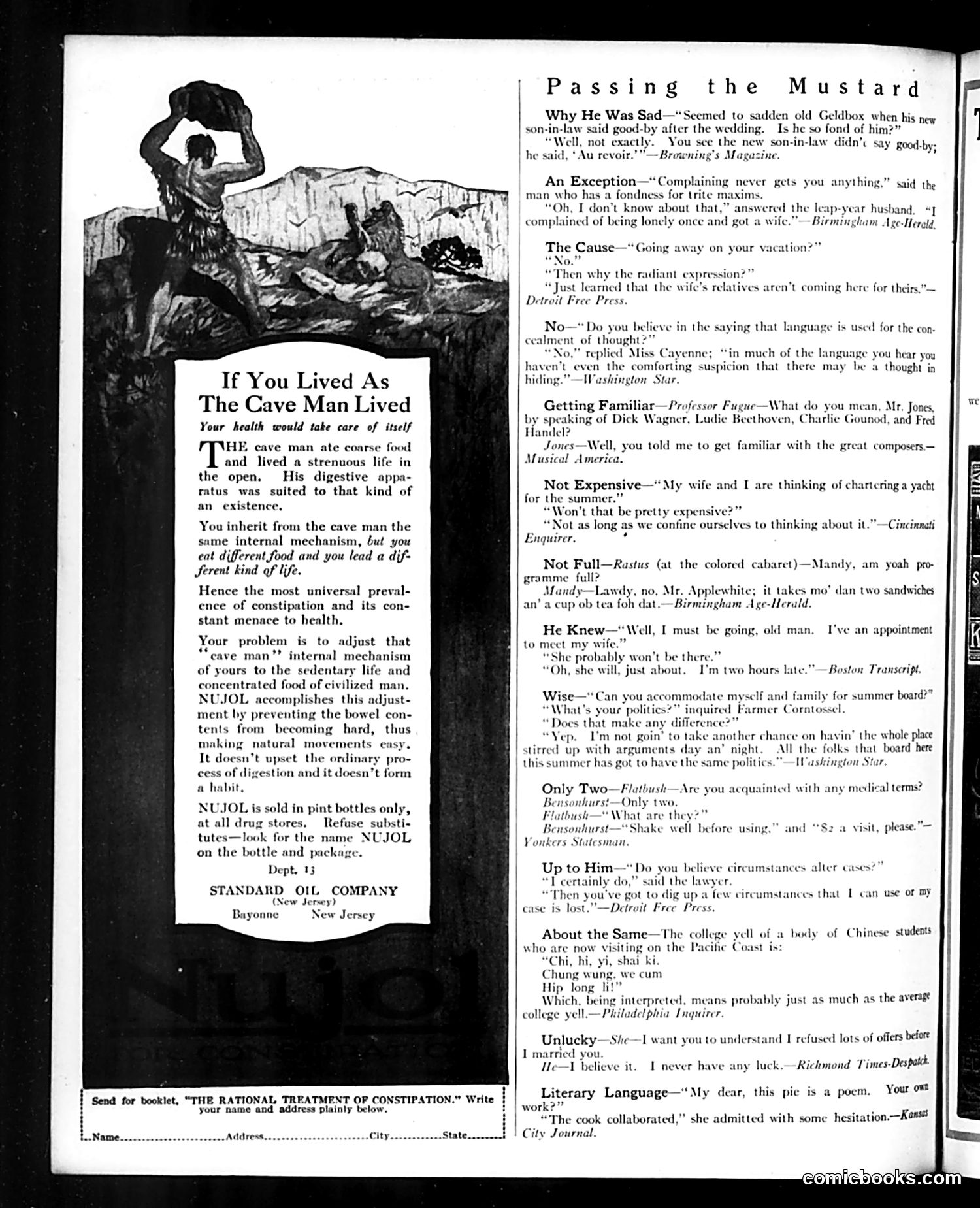
This is primarily an **advertisement page** disguised as editorial content. The large left-side illustration shows a caveman and promotes NUJOL, a mineral oil laxative, using pseudo-scientific reasoning: modern humans inherited "caveman" digestive systems but eat processed foods, causing constipation. NUJOL claims to solve this without forming habits. The right side contains **"Passing the Mustard,"** a humor column with brief jokes typical of Judge magazine's satirical style: - Jokes about newlyweds and in-laws - A husband happy his wife's relatives aren't visiting - Casual racism (the "Ruastus" joke uses dialect stereotypes common to that era) - Wordplay and social observations (a farmer refusing boarders with different politics) The humor is genteel, domestic, and non-political—aimed at middle-class readers. The "caveman" advertisement reflects early 20th-century popular pseudo-Darwinism, presenting "primitive" biology as explanation for modern health problems. Nothing here references specific current events or identifiable political figures.
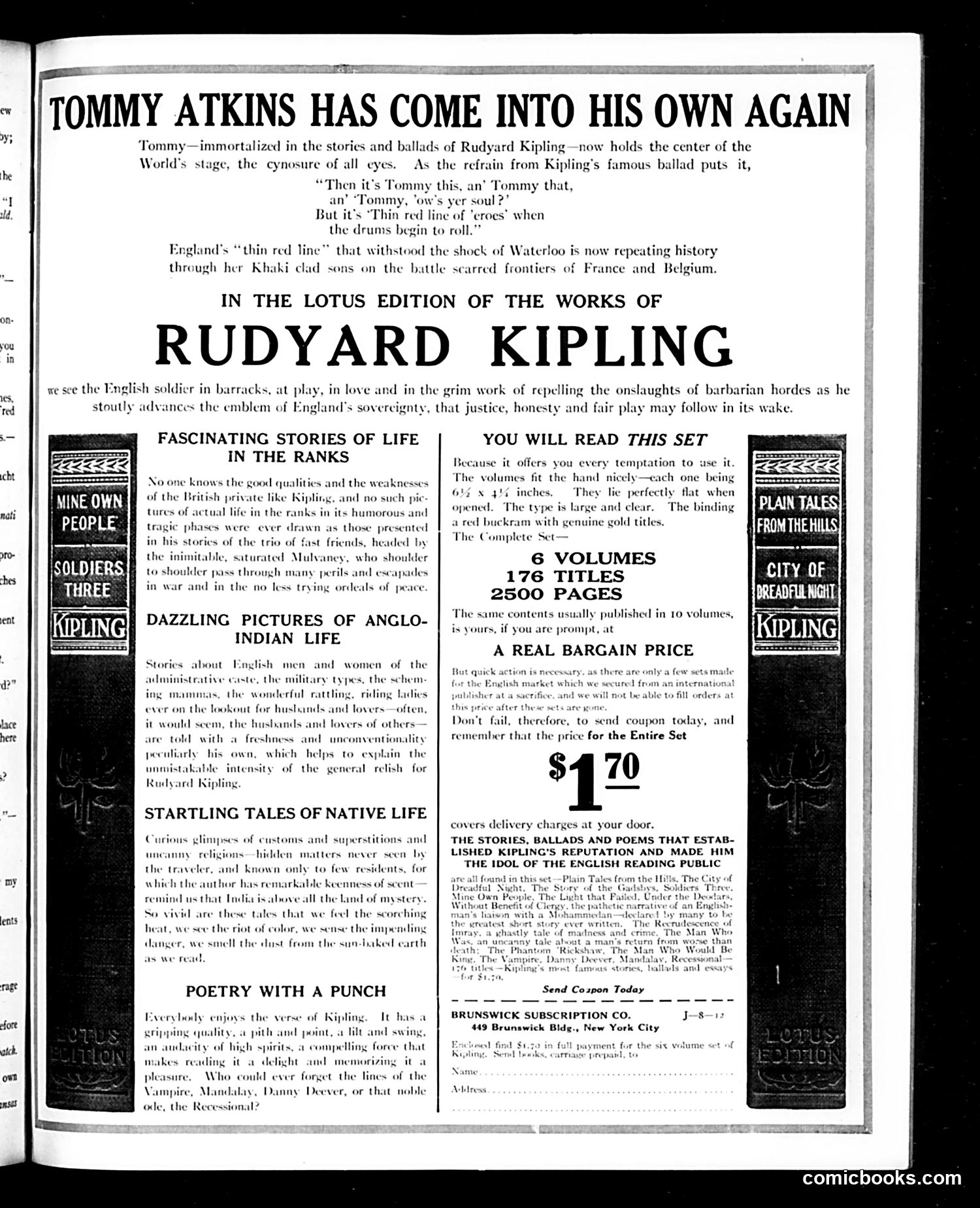
This is primarily a **Rudyard Kipling book advertisement**, not a political cartoon. The page celebrates the Lotus Edition of Kipling's collected works during World War I. "Tommy Atkins" refers to the archetypal British soldier—a figure Kipling immortalized in his stories and poems. The headline's claim that Tommy "has come into his own again" references WWI: Britain's soldiers are now actively fighting on the "battle scarred frontiers of France and Belgium," echoing England's famous military tradition (the "thin red line" at Waterloo). The advertisement highlights why Kipling's work resonates during wartime: his stories capture authentic soldier life, Anglo-Indian military culture, and native perspectives—all relevant to a nation mobilized for war. The patriotic framing ("England's sovereignty, that justice, honesty and fair play") connects Kipling's literary celebration of British soldiers to contemporary wartime propaganda. The price ($1.70 for six volumes) emphasizes accessibility, encouraging patriotic reading during the conflict.
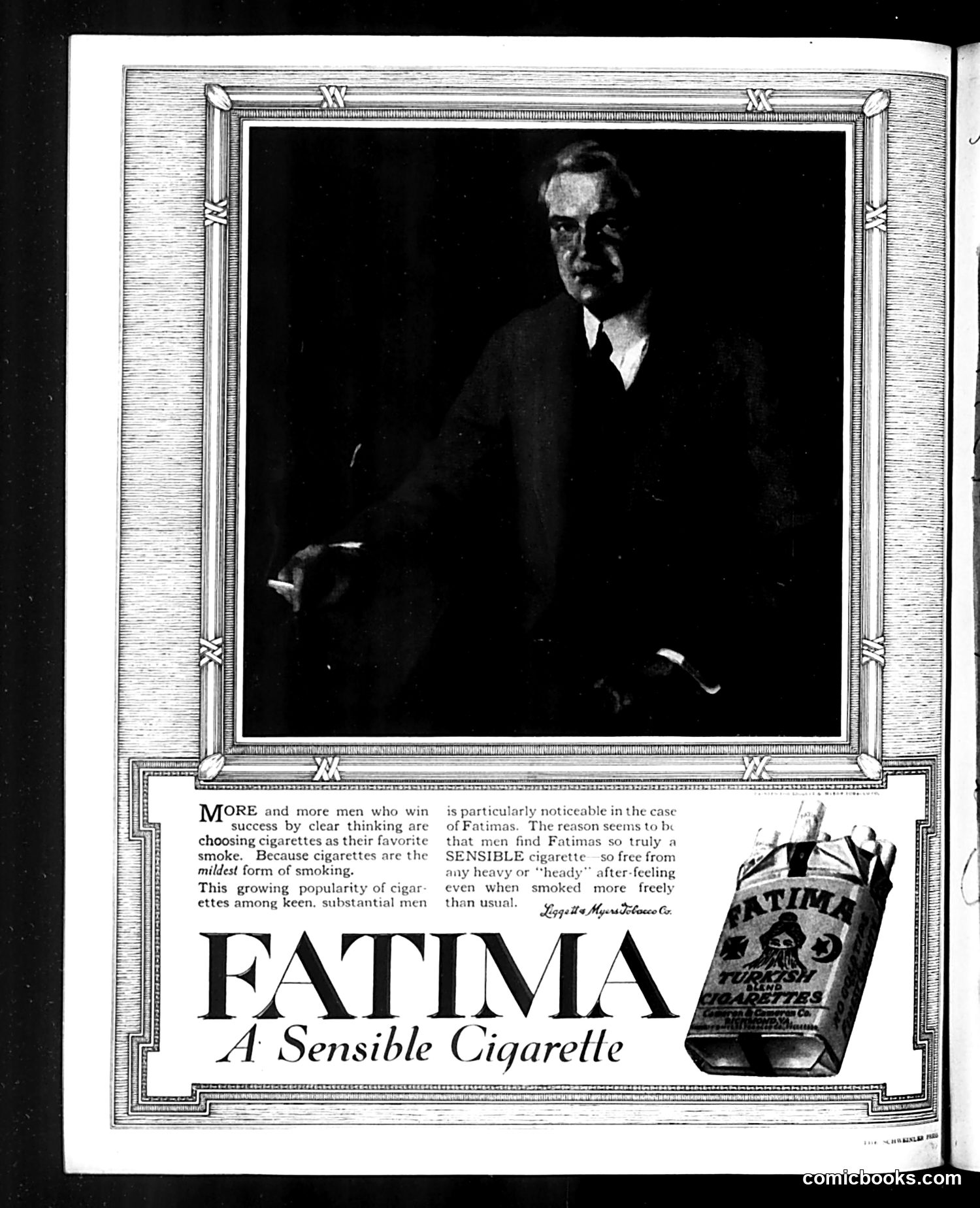
This is a **cigarette advertisement**, not political satire or a cartoon. The page features a formal portrait photograph of a distinguished-looking man in dark formal wear, positioned above advertising copy for "Fatima: A Sensible Cigarette." The ad's appeal targets successful, thoughtful men ("men who win success by clear thinking"), claiming Fatima cigarettes are the "mildest form of smoking" and notably free from a "heavy" or "heady" after-feeling. This positioning as a rational choice for businessmen reflects early 20th-century marketing strategies that associated cigarette consumption with sophistication and business success. The photograph's formal, serious tone—typical of period advertising—aims to convey respectability and trustworthiness. The term "sensible" in the headline suggests the manufacturers were responding to emerging health concerns about smoking, emphasizing their product's comparative gentleness. This represents vintage tobacco advertising before cigarette health warnings were mandated.