
Judge, 1916-08-12 · page 17 of 28
Judge — August 12, 1916 — page 17: what you’re looking at
What you’re looking at
The main cartoon depicts a breach-of-promise lawsuit where a man agreed to marry a woman if her homemade pie equaled his mother's. She made an excellent pie; he admitted it surpassed even his *grandmother's* cooking. The defendant's lawyer exploits a technicality: he never specifically praised it against his *mother's* pie, making the contract condition technically unfulfilled. The satire mocks how lawyers weaponize procedural loopholes to evade justice. When the defendant's attorney argues the grandmother's pie cannot be compared (she's deceased), the jury foreman reveals they've already ruled for the plaintiff anyway—suggesting common sense and justice override legal hair-splitting. The page also includes lighter social commentary: "City and Country" jokes about urban vs. rural life, and "Commercialized" discusses whether trade follows flags (imperialism). These filler pieces were typical Judge magazine content.
📄 Transcribed text from this page (OCR, searchable)
Machine-transcribed from the original scan — historical spelling and the odd misread are preserved.
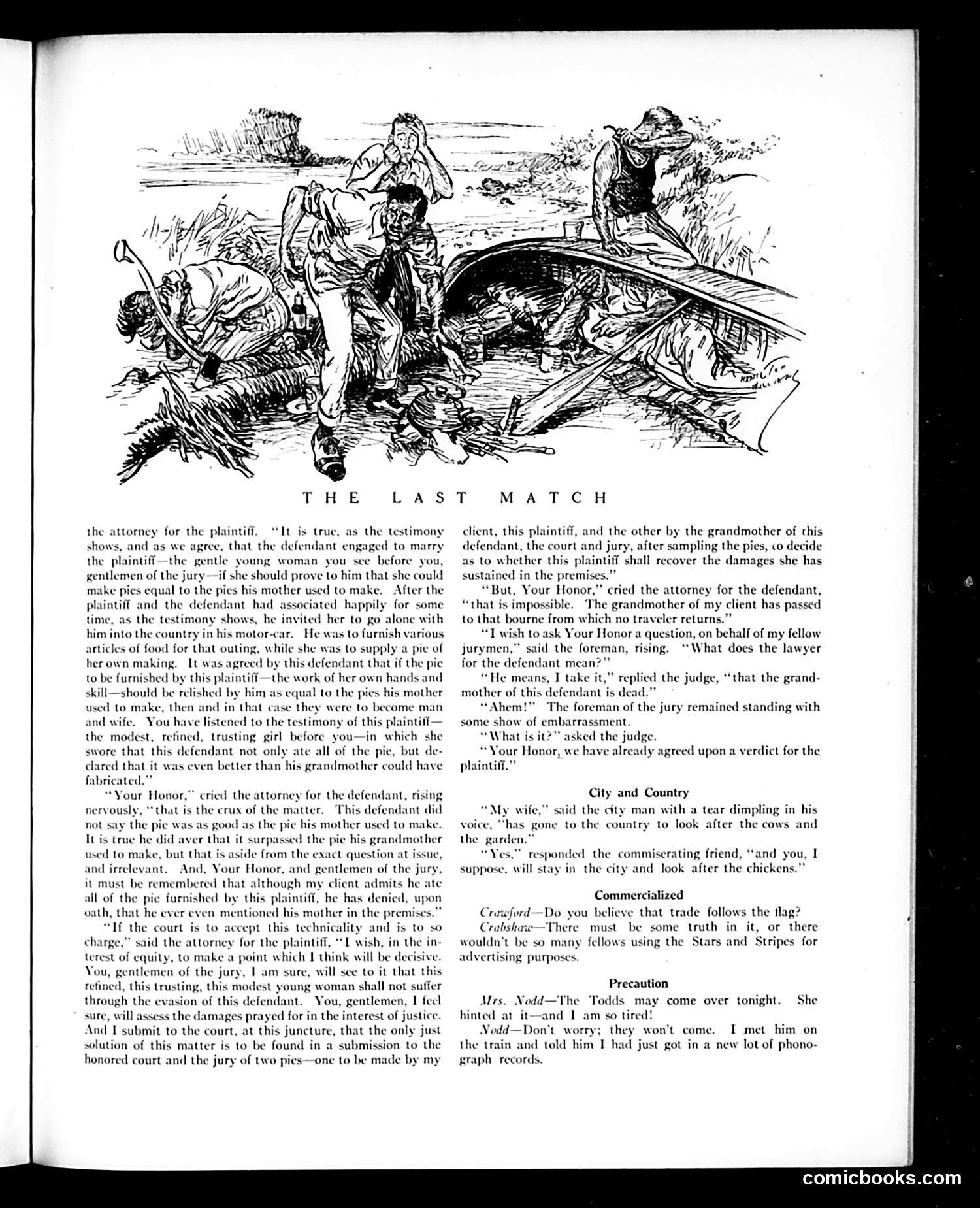
THE y for the plaintiff. “It is true, as the testimony we agree, that the defendant engaged to marry -the gentle young woman you see before you, gentlemen of the jury—if she should prove to him that she could make pies equal to the pies his mother used to make. After the plaintiff and the defendant had associated happily for some time, as the testimony shows, he invited her to go alone with him into the country in his motor-car. He was to furnish various articles of food for that outing, while she was to supply a pie of her own making. It was agreed by this defendant that if the pie to be furnished by this plaintiff—the work of her own hands and skill—should be relished by him as equal to the pics his mother used to make, then and in that case they were to become man and wife. You have listened to the testimony of this plaintiff— the modest, refined, trusting girl before you—in which she swore that this defendant not only ate all of the pic, but de- clared that it was even better than his grandmother could have fabricated.” “Your Honor,” cried the attorney for the defendant, rising nervously, “that is the crux of the matter. ‘This defendant did not say the pie was as good as the pic his mother used to make. It is true he did aver that it surpassed the pie his grandmother used to make, but that is aside from the exact question at issue, and irrelevant. And, Your Honor, and gentlemen of the jury, it must be remembered that although my client admits he ate all of the pie furnished by this plaintiff, he has denied, upon oath, that he ever even mentioned his mother in the premises.” If the court is to accept this technicality and is to so charge,” said the attorney for the plaintiff, “I wish, in the in. terest of equity, to make a point which I think will be decisive. You, gentlemen of the jury, | am sure, will see to it that this refined, this trusting, this modest young woman shall not suffer through the evasion of this defendant. You, gentlemen, I feel sure, will assess the damages prayed for in the interest of justice. And I submit to the court, at this juncture, that the only just solution of this matter is to be found in a submission to the honored court and the jury of two pies—one to be made by my the attorne shows, anc the plaintiff LAST MATCH client, this plaintiff, and the other by the grandmother of this defendant, the court and jury, after sampling the pies, vo decide as to whether this plaintiff shall recover the damages she has sustained in the premises.” “But, Your Honor,” cried the attorney for the defendant, “that is impossible. The grandmother of my client has passed to that bourne from which no traveler returns,” “T wish to ask Your Honor a question, on behalf of my fellow jurymen,” said the foreman, rising. ‘What does the lawyer for the defendant mean?” “He means, I take it,” replied the judge, “that the grand- mother of this defendant is dead. “Ahem!” The foreman of the jury remained standing with some show of embarrassment. “What is it?” asked the judge. “Your Honor, we have already agreed upon a verdict for the plaintiff.” City and Country y stid the city man with a tear dimpling in his “has gone to the country to look after the cows and the garden.” “Yes,” responded the commiserating friend, “and you, I suppose, will stay in the city and look after the chickens. Commercialized Crawford—Do you believe that trade follows the flag? Crabshaw—There must be some truth in it, or there wouldn't be so many fellows using the Stars and Stripes for advertising purposes. Precaution Mrs. Nodd—The Todds may come over tonight. hinted at it—and I am so tired! »dd—Don't worry; they won't come. I met him on in and told him I had just got in a new lot of phono- She graph records. comicbooks.com