
Judge, 1916-08-12 · page 6 of 28
Judge — August 12, 1916 — page 6: what you’re looking at
What you’re looking at
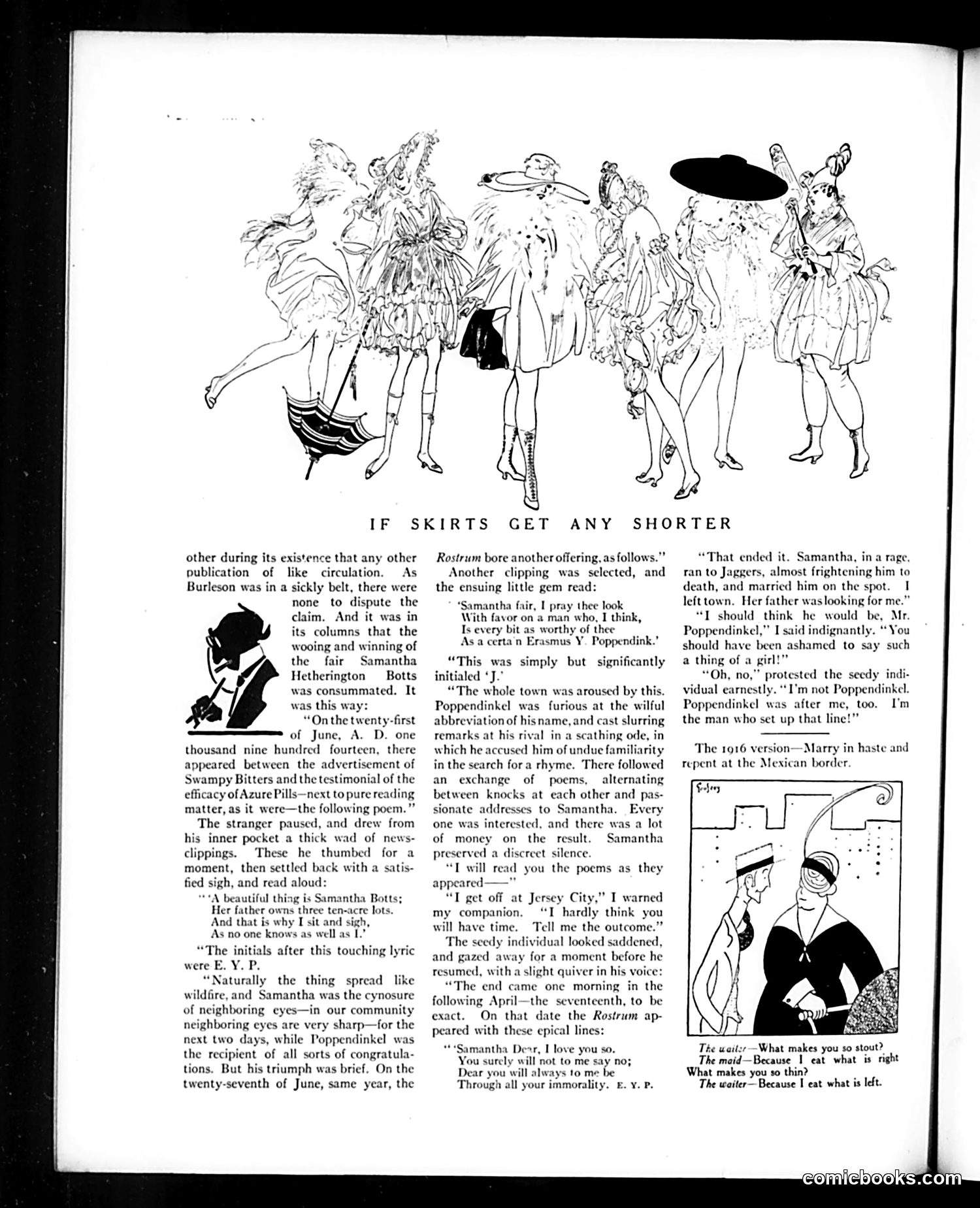
This page from *Judge* magazine presents a humorous story about a romantic competition told by a shabby stranger to the narrator. **The Main Story:** In 1914, two men—E.Y. Poppendinkel and another unnamed rival—compete for Samantha Hetherington-Botts' affections through anonymous poems published in the town's "Rostrum" (likely a newspaper column). The competition escalates until Poppendinkel's final poem carelessly includes the phrase "through all your immorality," which outrages Samantha. She marries a third party (Jaggers) impulsively and leaves town. The narrator reveals he's actually the *other* poet who wrote that fatal line. **The Satire:** The piece mocks small-town gossip, romantic desperation, and the absurdity of courtship rituals. The title references contemporary concerns about women's fashion (shorter skirts), contrasting with this old-fashioned romantic melodrama. **The Bottom Cartoon:** A brief joke about waiters and maids' diets provides light comic relief, unrelated to the main story.
📄 Transcribed text from this page (OCR, searchable)
Machine-transcribed from the original scan — historical spelling and the odd misread are preserved.
IF SKIRTS GET ANY SHORTER other during its existence that any other publication of like circulation. As Burleson was in a sickly belt, there were none to dispute the claim. And it was in its columns that the wooing and winning of the fair Samantha Hetherington —_ Botts was consummated. It was this way: “Onthe twenty-first of June, A. D. one thousand nine hundred fourteen, there appeared between the advertisement of Swampy Bitters and the testimonial of the efficacy of Azure Pills—next to pure reading matter, as it were—the following poem.” The stranger paused, and drew from his inner pocket a thick wad of news- clippings. These he thumbed for a moment, then settled back with a satis- fied sigh, and read aloud: “A beautiful thing is Samantha Botts; Her father owns three ten-acre lots. And that is why I sit and As no one knows as well as 1. “The initials after this touching lyric were E. Y. P. “Naturally the thing spread like wildfire, and Samantha was the cynosure of neighboring eyes—in our community neighboring eyes are very sharp—for the next two days, while Poppendinkel was the recipient of all sorts of congratula- tions. But his triumph was brief. On the twenty-seventh of June, same year, the Rostrum bore another offering, as follows.” Another clipping was selected, and the ensuing little gem reat “Samantha fair, I pray thee look With favor on a man who, I think, Is every bit as worthy of thee As a certa'n Erasmus Y. Poppendink.’ is was simply but significantly aled ‘J.’ “The whole town was aroused by this. Poppendinkel was furious at the wilful abbreviation of hisname, and cast slurring remarks at his rival in a scathing od which he accused him of undue familiarity in the search fora rhyme. There followed an exchange of poems, alternating between knocks at each other a sionate addresses to Samantha. one was interested, and there was a lot of money on the result. Samantha preserved a discreet silence. “T will read you the poems as they appeared ——" “T get off at Jersey City,” I warned my compani “T hardly think you will have time. Tell me the outcom The seedy individual looked saddened, and gazed away for a moment before he resumed, with a slight quiver in his voice: “The end came one morning in the following April—the seventeenth, to be exact. On that date the Rostrum ap- peared with these epical lines: “Samantha Dear, I love you so. You surely will not to me say no; Dear you will always 10 me be Through all your immorality. &. ¥. P. “That ended it. Samantha, ina rage, ran to Jaggers, almost frightening him to death, and married him on the spot. I lefttown. Her father was looking for me.” “I should think he would be, Mr. Poppendinkel,”’ I said indignantly. “ You should have been ashamed to say such a thing of a girl!” “Oh, no,” protested the seedy indi- vidual earnestly. ‘I'm not Poppendinkel. Poppendinkel was after me, too. I'm the man who set up that line!” The 1016 version—Marry in haste and repent at the Mexican border. The waitzr —What makes you so stout? The maid—Because | eat what is right What makes you so thin? The waiter—Because I eat what is left.