
A complete issue · 29 pages · 1916
Judge — June 24, 1916
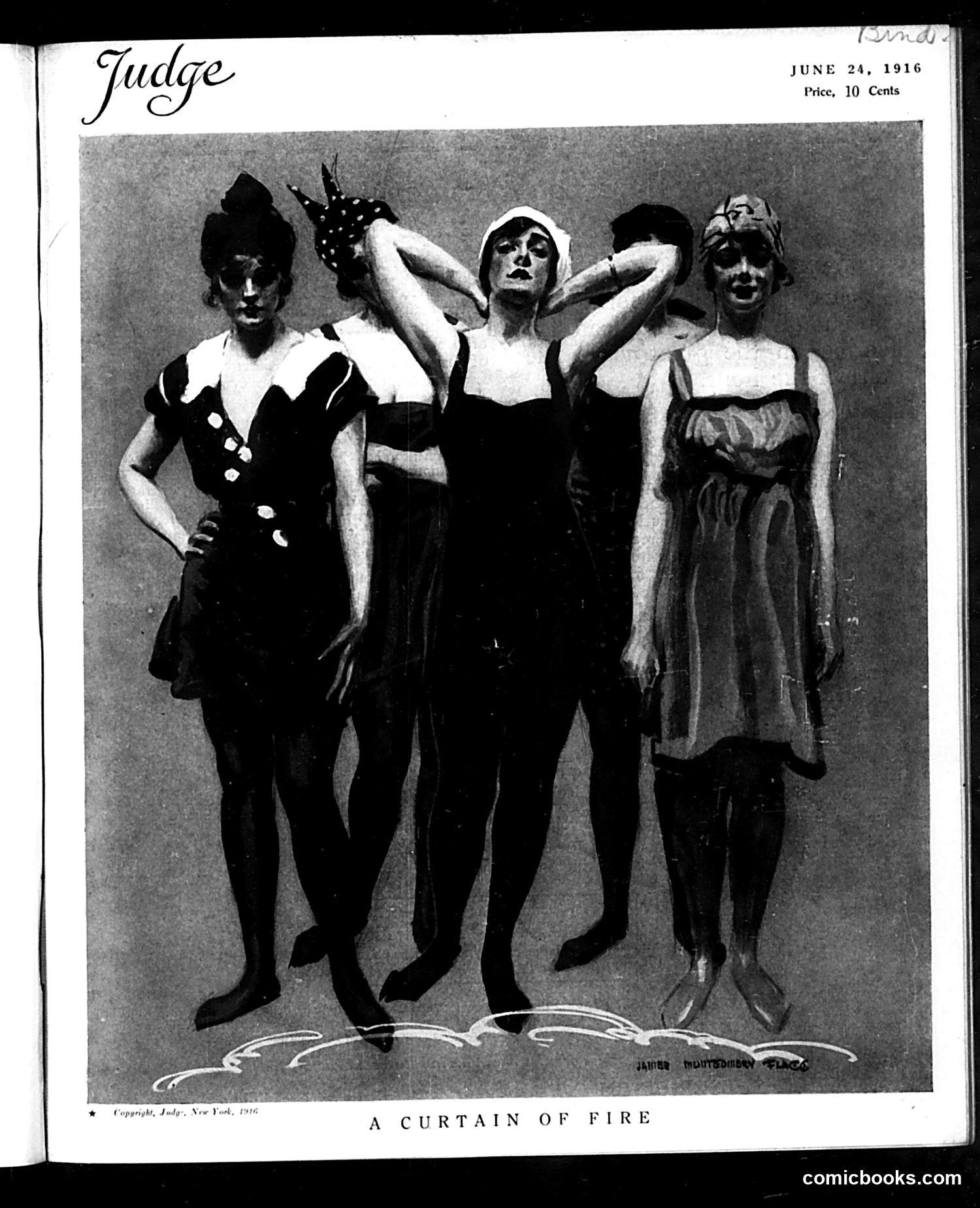
This June 1916 Judge magazine cartoon depicts five women in various bathing costumes posed against a wavy line suggesting water or a beach. The title "A Curtain of Fire" appears to satirize women's swimwear of the era—specifically the contrast between modest, fully-covering swimming attire and more revealing modern designs. The cartoon likely comments on the heated social debate of the 1910s about appropriate female bathing costumes. Conservative society viewed shorter, less concealing swimwear as scandalous, while progressives advocated more practical, less restrictive designs. The "fire" reference likely suggests the controversy ignited by evolving swimwear standards, with different costume styles representing the generational and moral battle over women's bodies and fashion modernity.
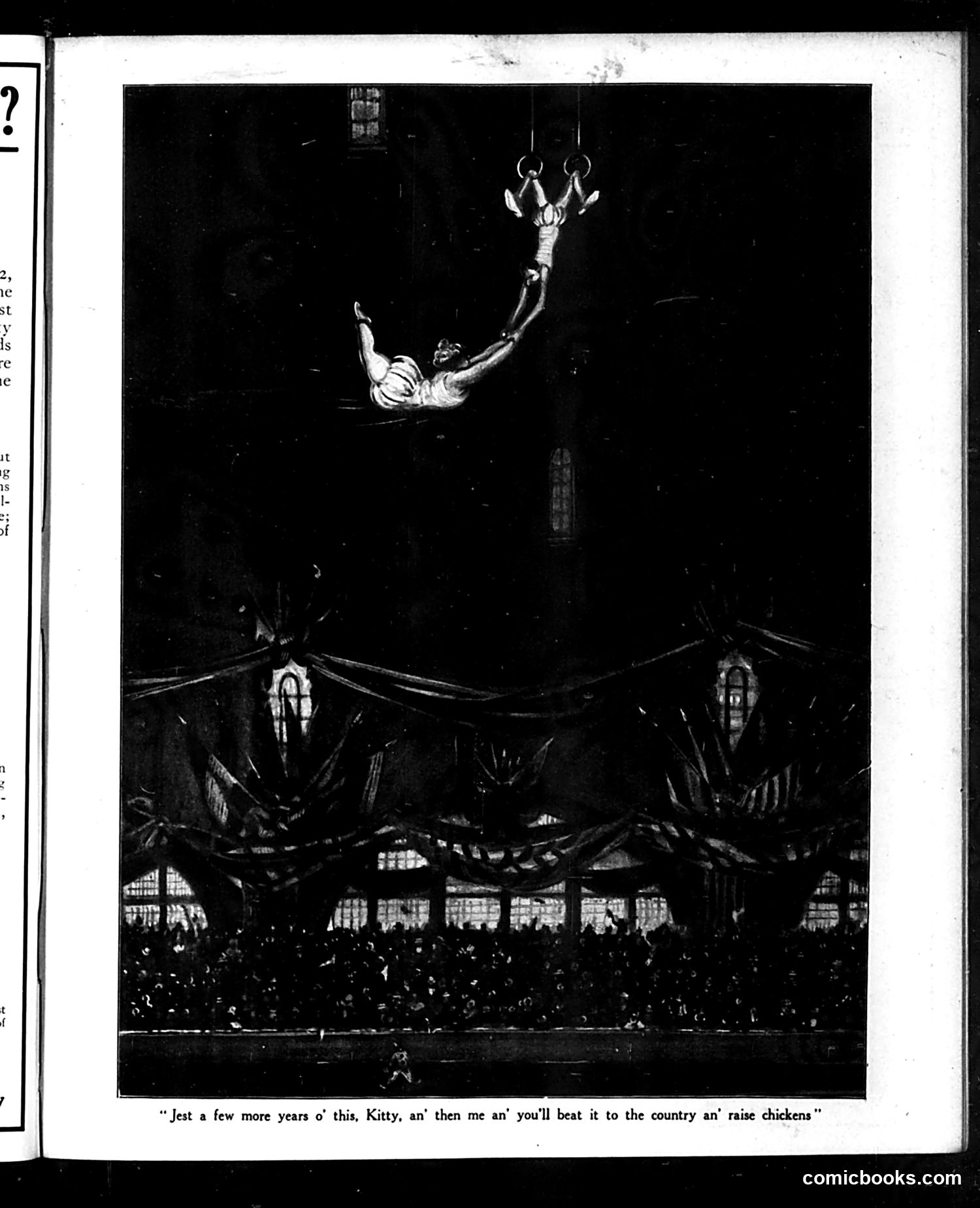
This appears to be a circus or performance scene satirizing urban labor and aspiration. The acrobat suspended mid-air with the trident-like apparatus suggests a high-wire performer, while the darkened crowd below and draped staging indicate a big-top venue. The caption—"Jest a few more years o' this, Kitty, an' then me an' you'll beat it to the country an' raise chickens"—is a working-class dialogue expressing the performer's desire to escape circus life for rural simplicity. The satire likely mocks the gap between glamorous public spectacle and performers' harsh reality: dangerous acrobatic work for low wages, sustained only by dreams of pastoral retirement. "Kitty" appears to be a fellow performer or spouse. This reflects Judge magazine's frequent commentary on labor conditions and class aspirations in early 20th-century America.
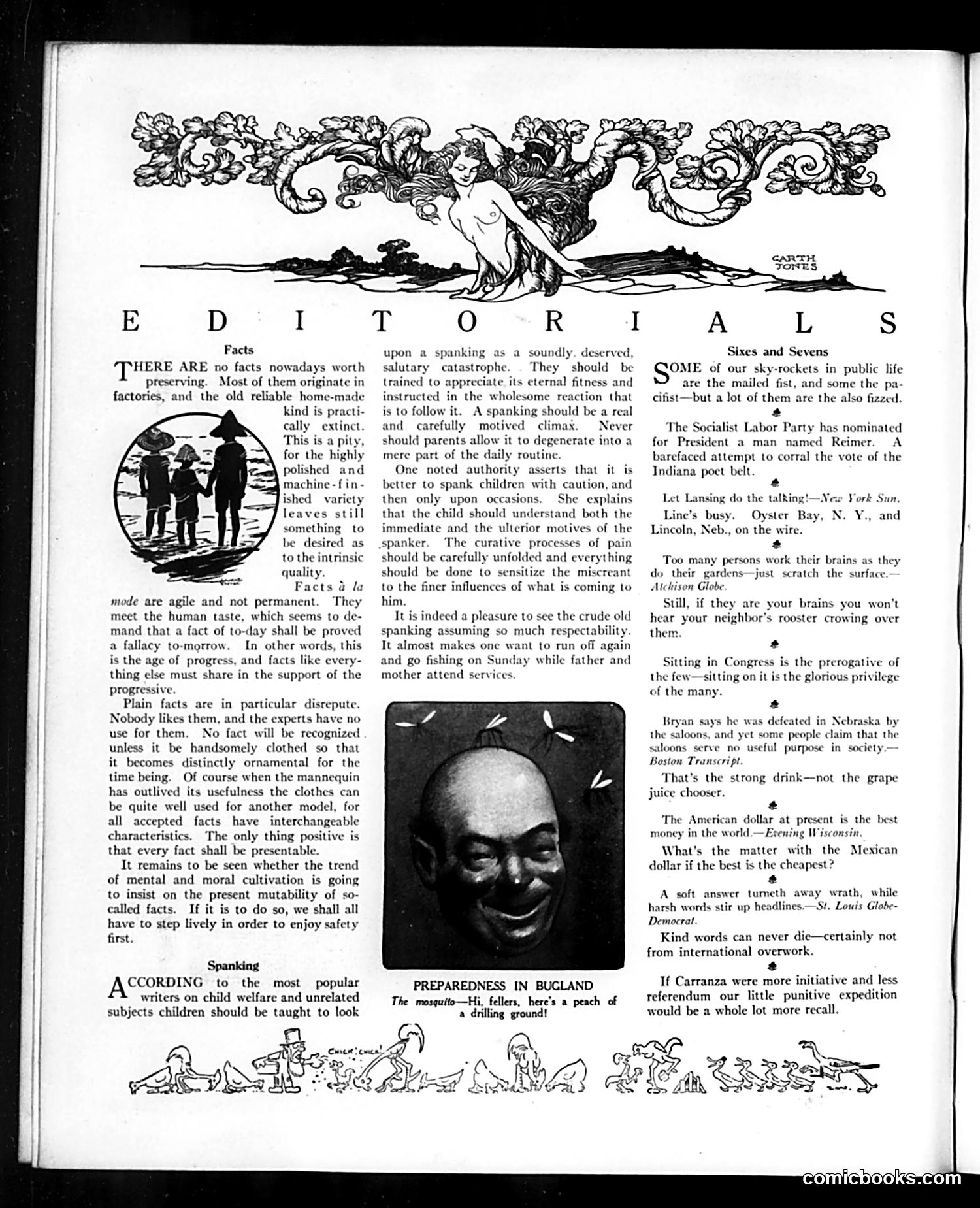
This is primarily an opinion/editorial page rather than a political cartoon. The main content consists of short satirical commentary pieces on contemporary topics: 1. **"Facts à la Mode"** — A critique of how "facts" are selected and presented for fashion rather than truth, arguing people should care about substantive facts. 2. **"Spanking"** — Discusses child welfare debate about corporal punishment, noting tension between old home remedies and modern approaches. 3. **"Sixes and Sevens"** — A section of brief, disconnected satirical quips about public figures and events (mentions Bryan, Mexican dollars, Carranza). The photograph labeled "Preparedness in Bugland" appears to be a humorous or possibly racist image, though its specific reference is unclear without additional context. Overall, this represents Judge's satirical editorial commentary on early 20th-century American social and political issues.
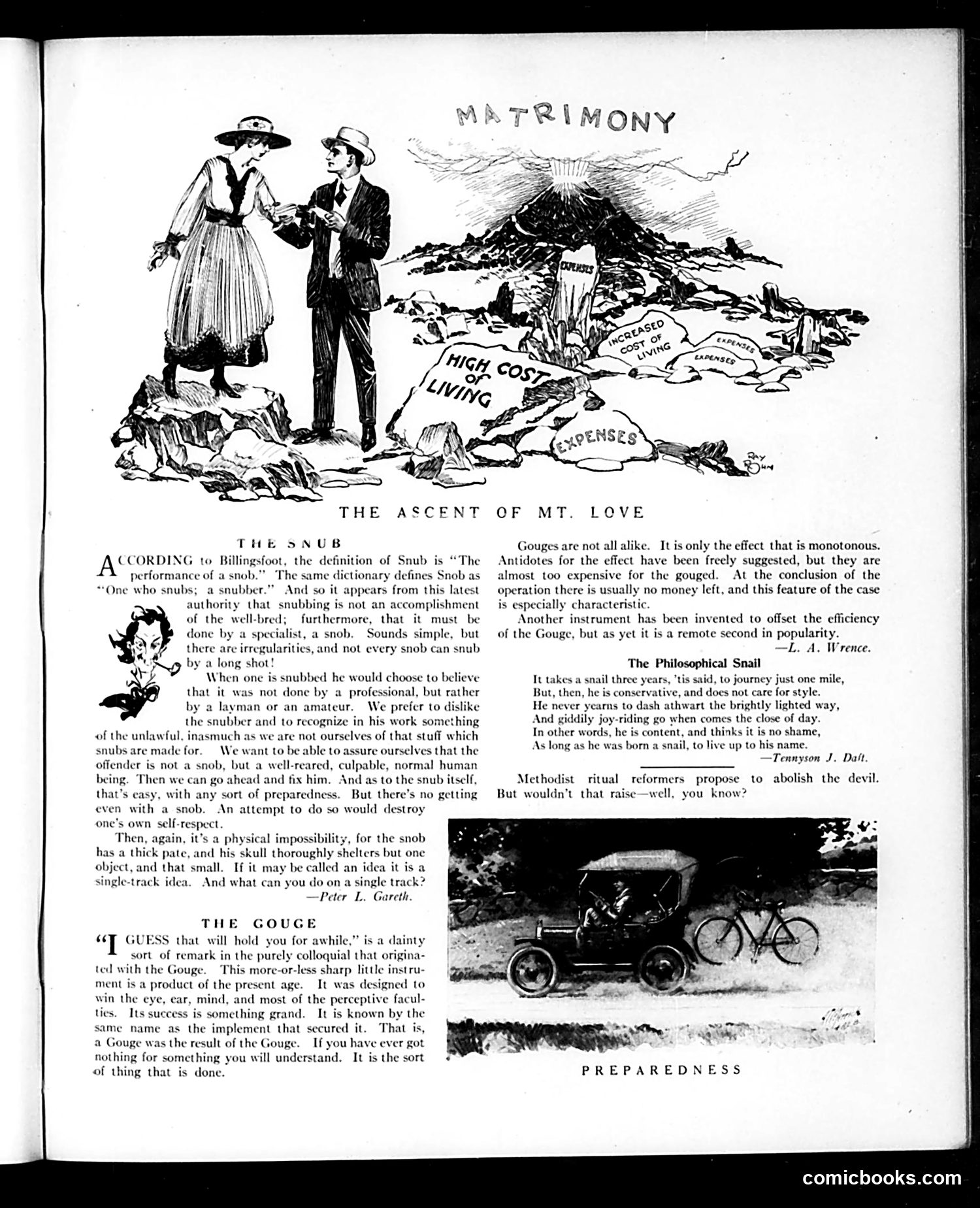
This cartoon satirizes **matrimony as a difficult, expensive climb**. The couple ascending "Mt. Love" encounters obstacles labeled "High Cost of Living," "Expenses," and "Cost of Living"—suggesting marriage is financially treacherous. The illustration critiques **early 20th-century economic pressures on newlyweds**. Rather than romance, the satire emphasizes material hardships. The volcano imagery reinforces danger and instability. The accompanying text discusses linguistic quirks ("snub," "gouge") in period slang, treating marriage metaphorically as hazardous terrain. The separate photograph captioned "Preparedness" appears unrelated—likely advertising or filler content. Overall, *Judge* uses humor to comment on **class anxieties and consumer culture's impact on relationships** during an era of rising living costs.
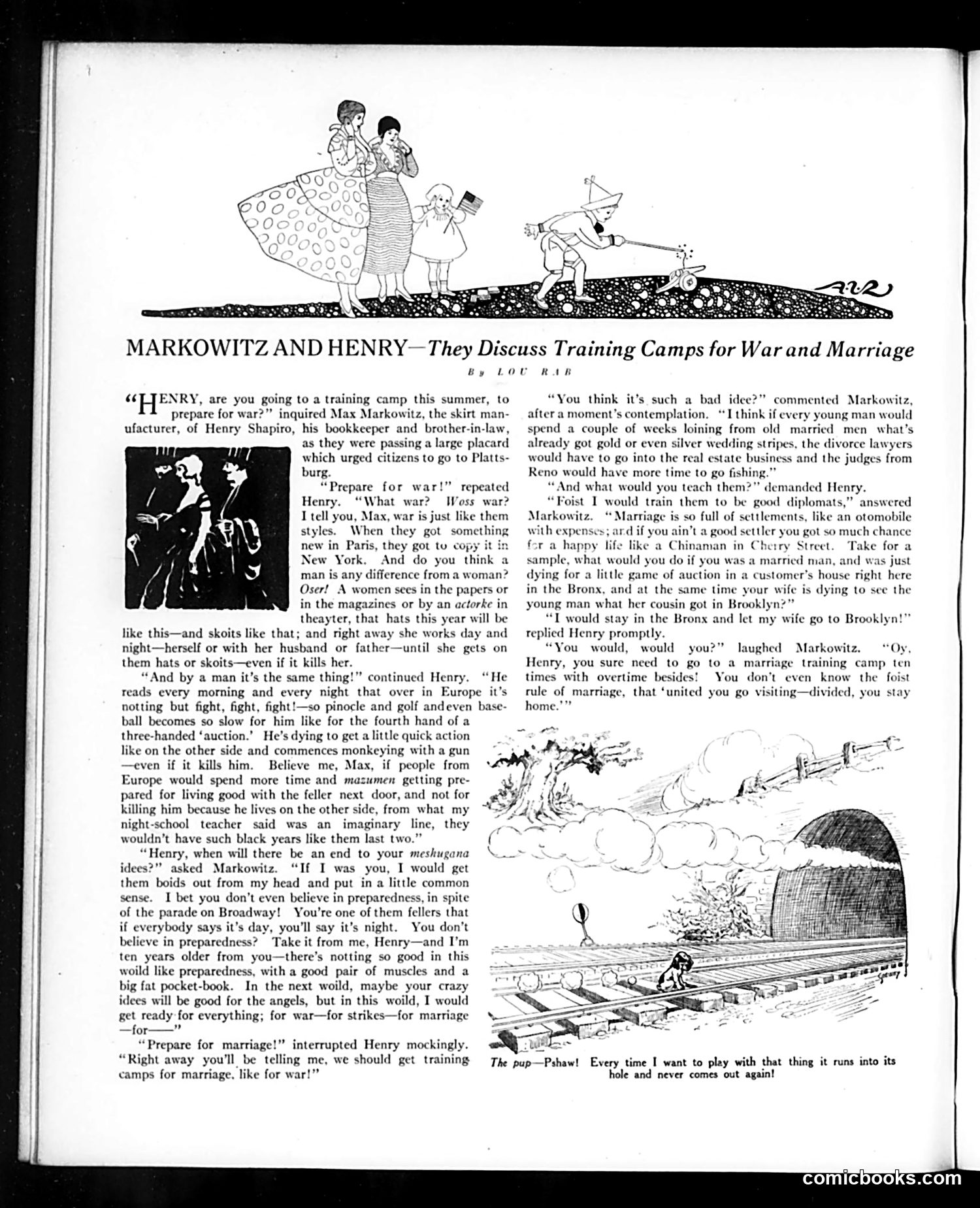
This satirical dialogue features two Jewish-American characters (identifiable by their Yiddish-inflected English) debating military preparedness around World War I. Henry Shapiro argues that war is merely fashion-driven mass hysteria, like Paris hat styles spreading to New York. Markowitz counters with practical cynicism: prepare for everything—war, strikes, marriage—because unpreparedness ruins lives. The humor escalates when they joke about "training camps for marriage," with Markowitz seriously suggesting married men teach young men diplomatic skills to reduce divorce. Henry absurdly claims he'd skip an auction game to let his wife visit Brooklyn alone, prompting Markowitz to mock his obvious need for marriage training. The satire targets both pacifist sentiment (Henry's dismissal of war preparation) and immigrant pragmatism, using their comic dialect to explore serious tensions between idealism and self-interest in pre-WWI America.
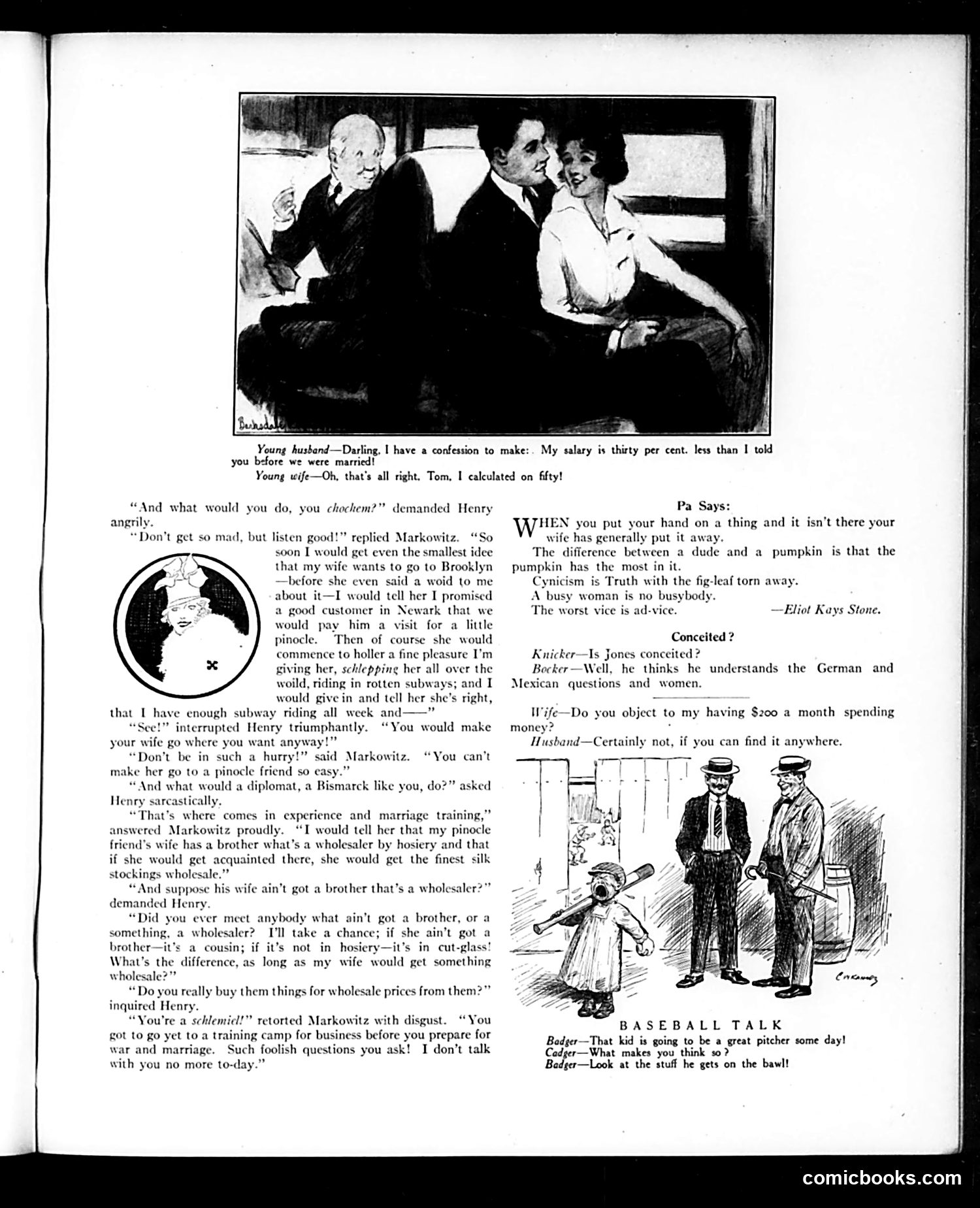
This page contains three distinct humor pieces satirizing early 20th-century American life: **Main Comic:** A dialogue between Henry and Markowitz (identifiable as Jewish characters by Yiddish phrases like "schlemiel" and "pinocle") about marriage strategy. Markowitz explains how to manipulate his wife into accepting his plans by reverse psychology—pretending he wants to visit a friend, which makes her object, then "conceding" to her wishes. The satire mocks both marital gamesmanship and the stereotype of Jewish immigrant shrewdness in business dealings. **Right Column Jokes:** Three separate aphorisms and brief gags: one about husbands and wives, another mocking Jones's pretension to understand complex political questions, and a final baseball joke playing on double meanings ("stuff on the bawl"). **Top Cartoon:** Shows a young couple where the husband confesses his salary is 30% less than stated; the wife replies she'd calculated he was lying by 50%—mocking both marital deception and women's supposed financial cynicism. The humor targets marital conflict and immigrant working-class life circa 1910s.
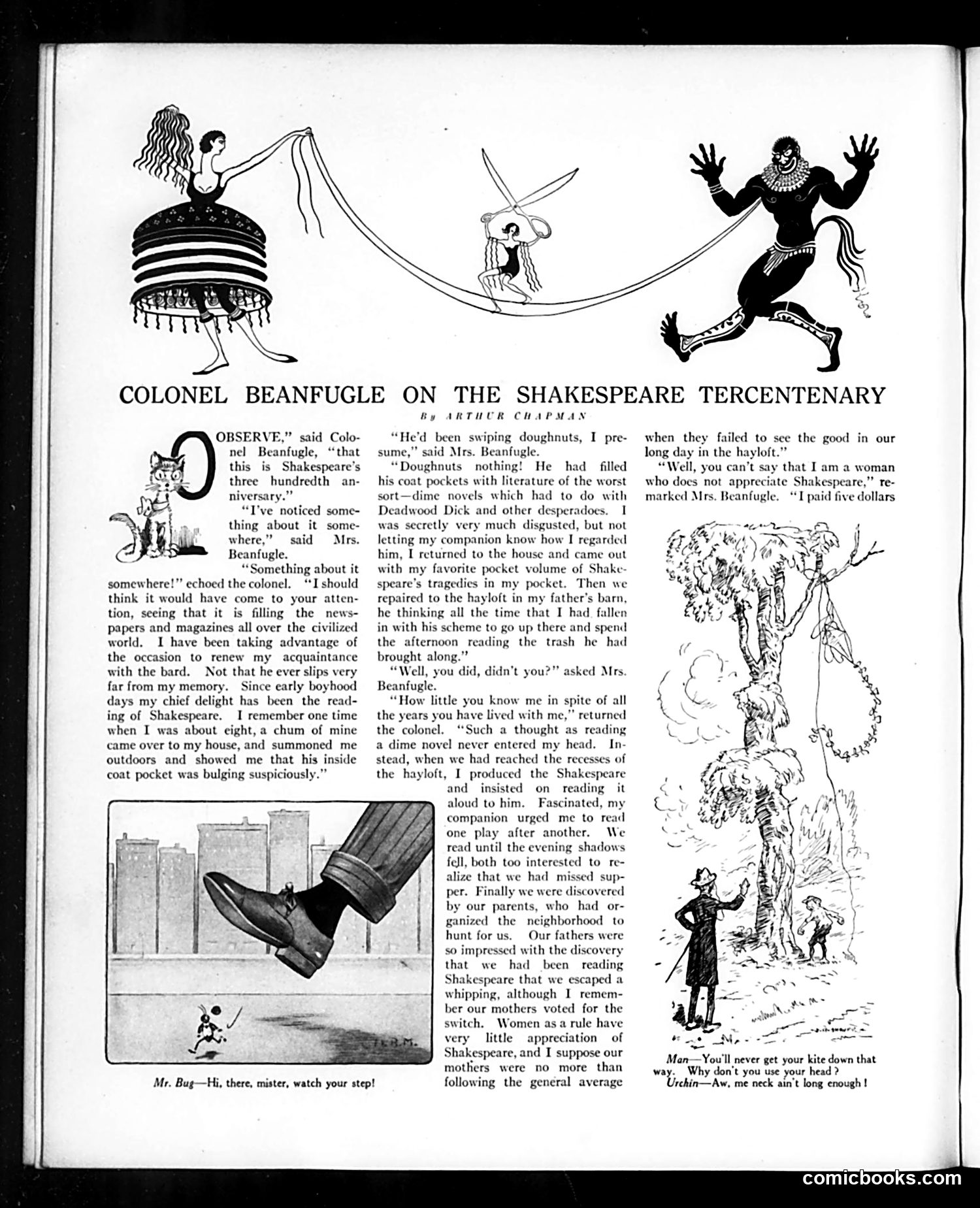
This satirical piece mocks pretentious male intellectualism during Shakespeare's 300th anniversary celebration (1916). Colonel Beanfugle boasts endlessly about his lifelong Shakespeare devotion, claiming he preferred Shakespeare's tragedies to dime novels even as a child. His story—reading Shakespeare aloud in a hayloft instead of playing—is meant to demonstrate his superior cultural refinement. The satire targets his pomposity and self-aggrandizing nostalgia. Mrs. Beanfugle's dry responses ("I paid five dollars") undercut his pretension. The accompanying illustrations show absurd circus performers and a slapstick "Mr. Bug" scene, reinforcing that Beanfugle's earnest self-regard is ridiculous. The page satirizes how men weaponize cultural "sophistication" (Shakespeare) as status markers while dismissing women's legitimate skepticism about such performative intellectualism.
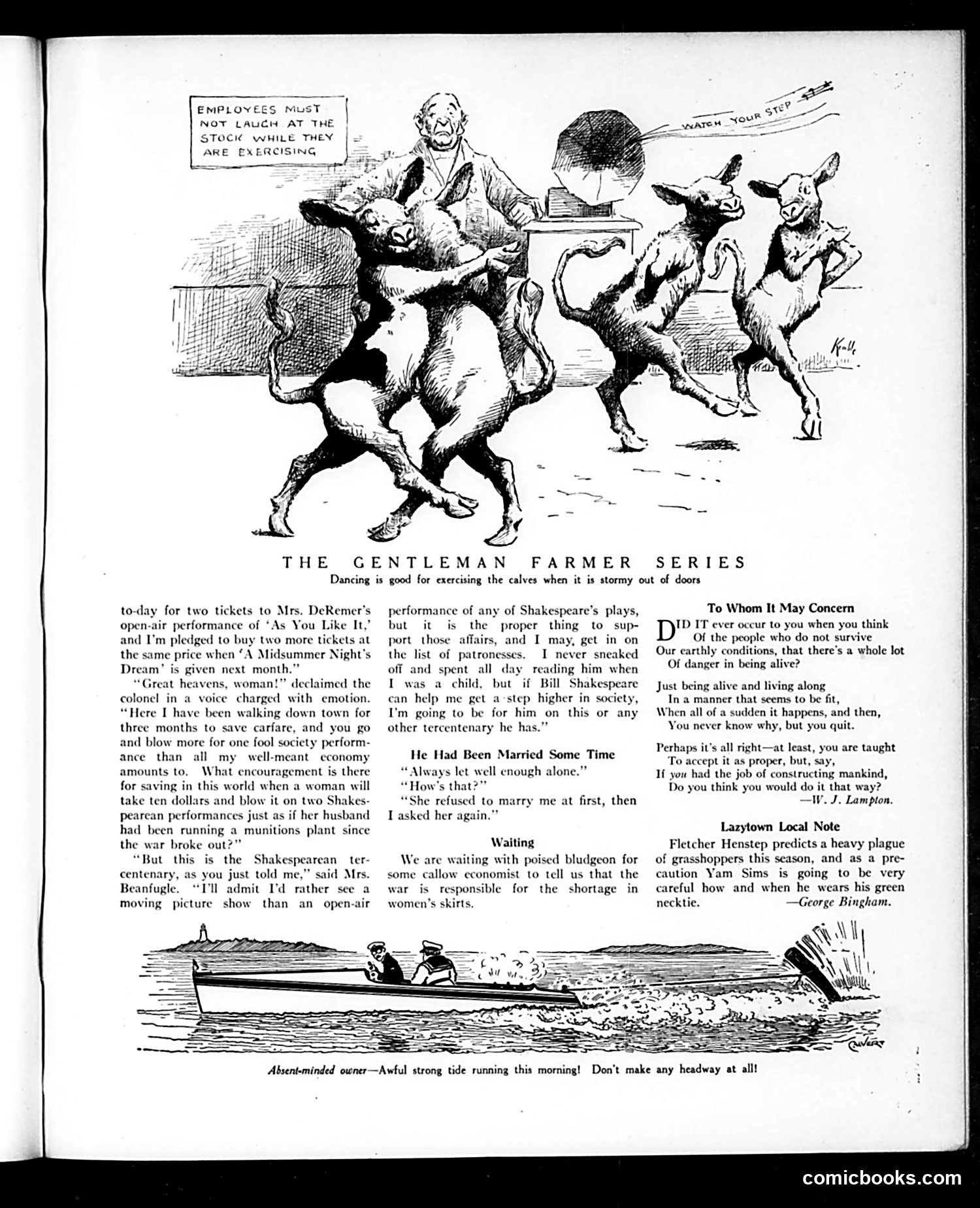
The top cartoon satirizes WWI-era labor conditions. A man (representing management) watches anthropomorphized calves dancing while holding a sign ordering employees not to laugh during exercise. The joke: management makes workers perform pointless physical exertion ("exercising the calves"—a pun on livestock and leg muscles) under strict supervision, treating them like animals. Below, domestic comedy contrasts a husband angry about his wife spending money on Shakespeare tercentenary performances with her defense that cultural patronage brings social status. The satire mocks both upper-class pretension and working-class penny-pinching during wartime. A separate item jokes that economists will blame the war for fabric shortages causing shorter women's skirts—a sardonic commentary on wartime economic scarcity and how authorities attribute all problems to the conflict. The bottom cartoon shows an absentminded boat owner failing to navigate despite strong tides—presumably commentary on incompetent leadership.
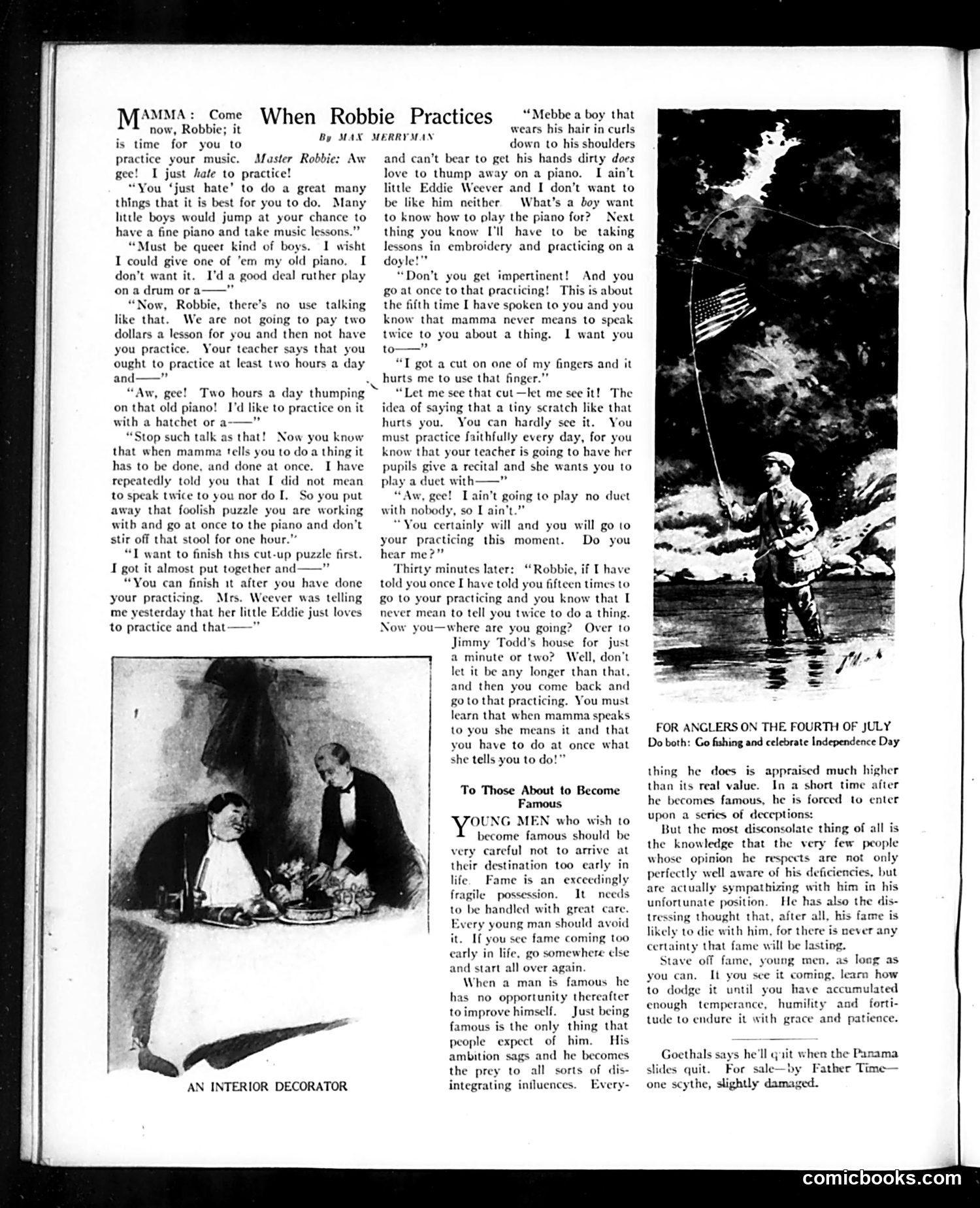
This domestic humor piece satirizes the clash between parental authority and childhood resistance to piano lessons. The unnamed mother represents the Victorian ideal of "cultured" child-rearing—music education as a mark of refinement—while young Robbie embodies boyish defiance. His complaints (preferring drums or hatchets, the tiny finger-cut excuse, sneaking off to friends' houses) are universal stalling tactics. The humor lies in the mother's repeated threats—"I never mean to speak twice"—which she violates constantly, undercutting her authority. The accompanying illustration "An Interior Decorator" (caption only visible) appears unrelated. The satirical thrust targets both parental hypocrisy and the era's obsession with genteel accomplishments for children, particularly boys forced into "feminine" pursuits like piano and embroidery. Robbie's resistance to curled hair and "dainty" pursuits reflects period anxieties about masculinity.
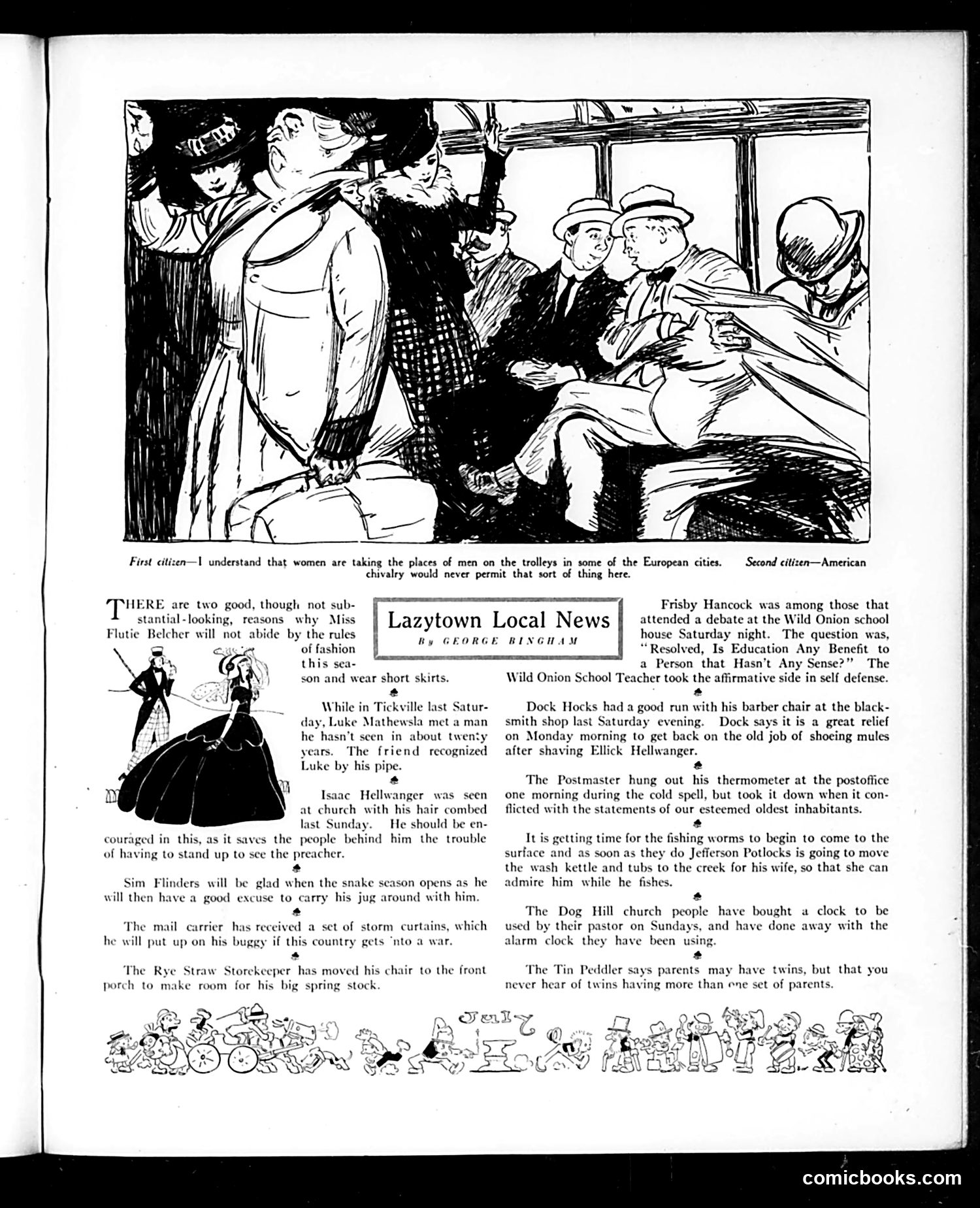
This page contains satirical commentary on early 20th-century American life, centered on two topics: **Top Cartoon:** A dialogue mocking American chivalry. Two citizens debate whether American men would permit women to work as trolley operators (as happening in European cities). The cartoon implies American "chivalry" is actually just conservative resistance to women's employment—satirizing the excuse-making around gender roles. **"Lazytown Local News" Column:** A humorous small-town gossip section filled with absurdist observations: a man recognized only by his pipe after twenty years; Isaac Hellwanger praised for combing his hair; someone using snake season as cover to carry alcohol; the postmaster removing a thermometer because it contradicts locals' claims about temperature. The humor works through exaggeration of rural provincialism and resistance to change—combing hair is noteworthy, education is debated, women's work is taboo. The satire targets small-town conservatism and the gap between American ideals ("chivalry") and actual motivations (maintaining traditional social hierarchy).
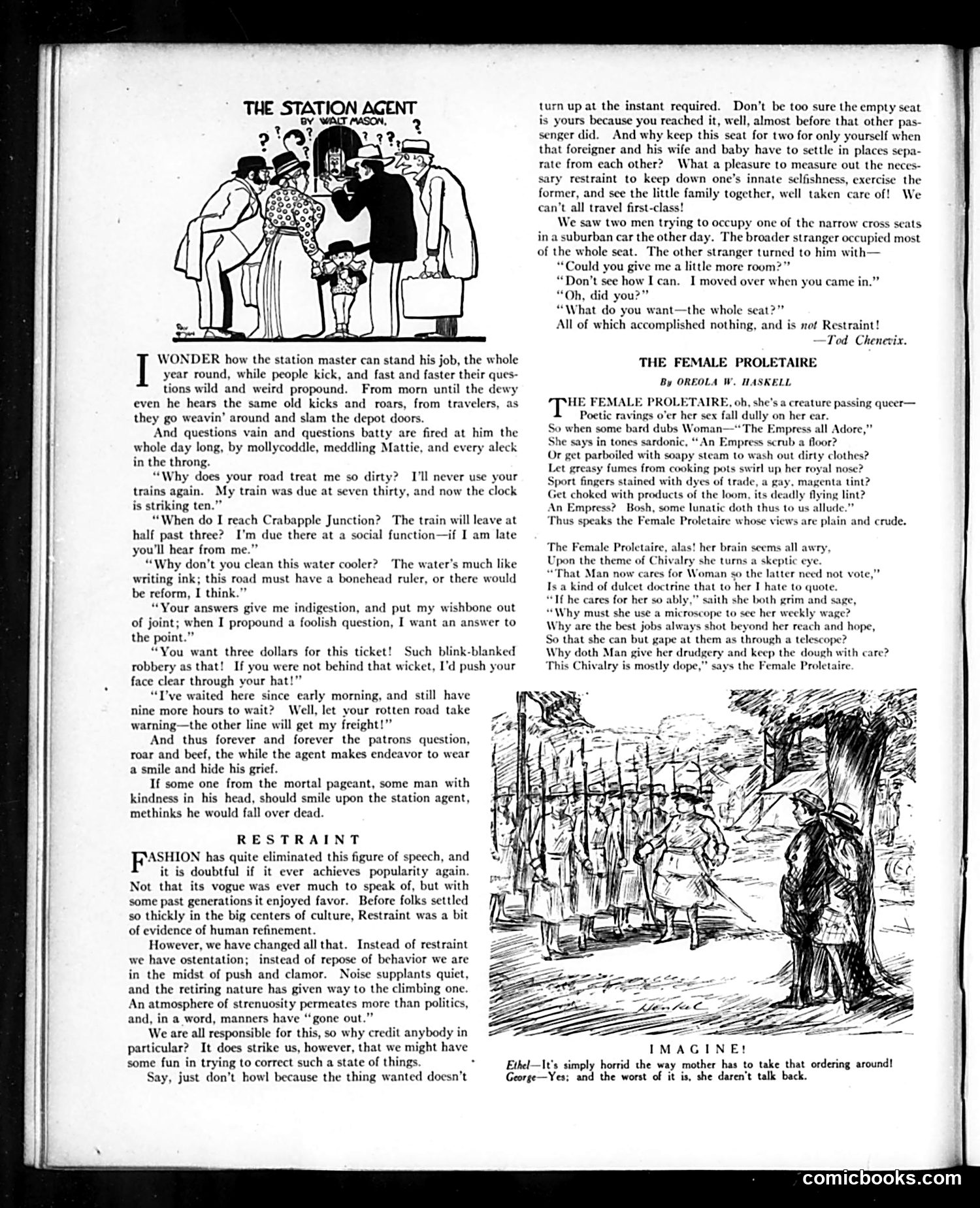
**"The Station Agent"** satirizes the relentless complaints railway workers endured. The cartoon depicts impatient passengers bombarding the station master with unreasonable demands—about late trains, dirty water coolers, expensive tickets—accompanied by threats to use competing rail lines. The joke: a station agent who receives even one kindness would "fall over dead." This reflects growing frustrations with industrialized rail service and public rudeness in crowded urban stations. **"Restraint"** essay laments the loss of mannerly behavior. The author contrasts an earlier era's "restraint" and "refinement" with modern "ostentation" and "push and clamor." Examples include someone refusing to share a train seat or demanding entire seats themselves. The concluding cartoon joke involves a domineering woman whose husband notes she "daren't talk back"—satirizing both modern assertiveness and domestic power dynamics. Both pieces critique modern rudeness and selfishness in public transportation—reflecting early 20th-century anxieties about urbanization eroding civility.
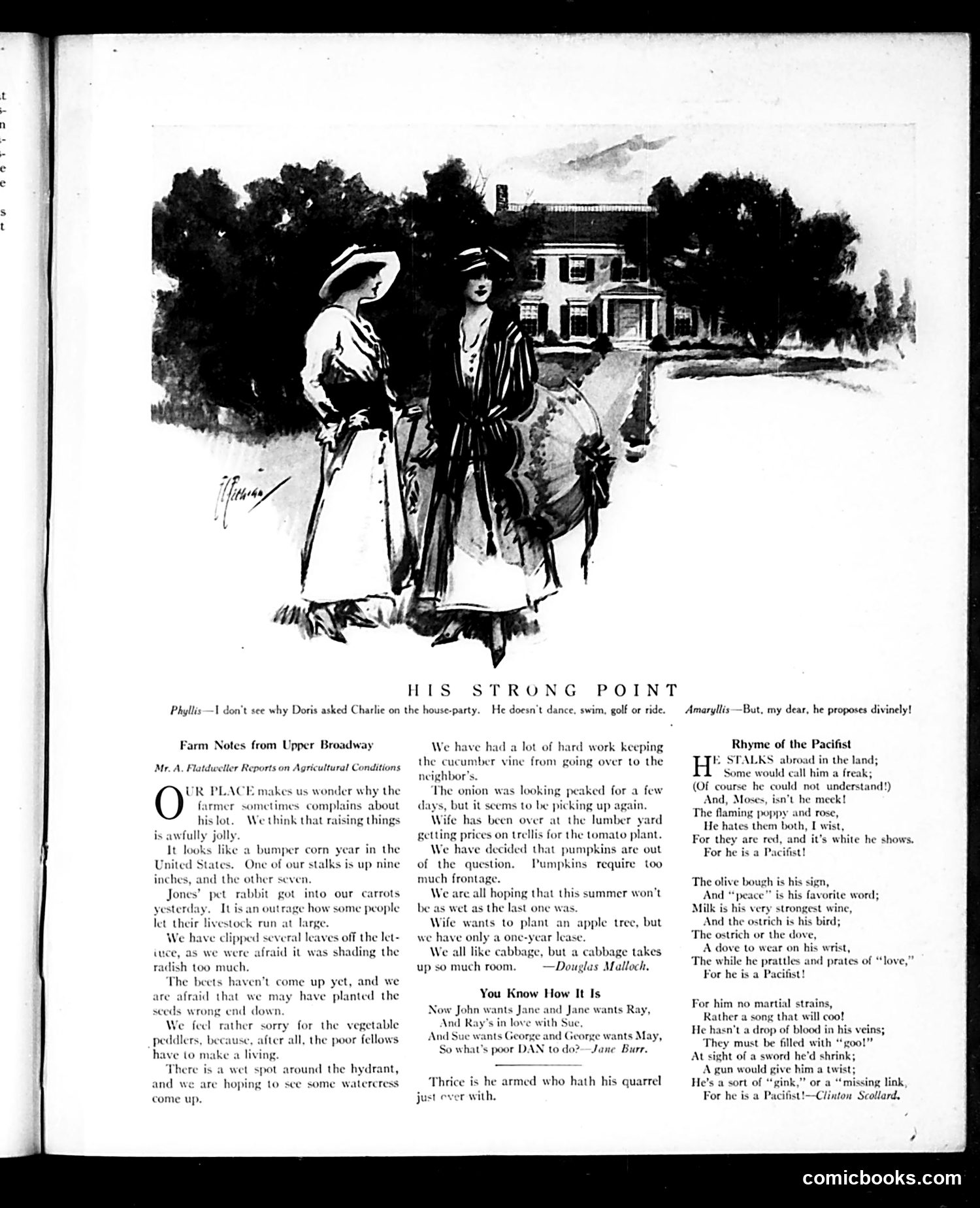
This page contains three distinct pieces of satire: **"His Strong Point"** (top cartoon): A drawing of two women discussing a man named Charlie at a house party. The joke is that Charlie's only attractive quality is that he "proposes divinely"—he's romantically eloquent—despite being otherwise useless (doesn't dance, swim, golf, or ride). This mocks superficial courtship where smooth talk compensates for lack of substance. **"Farm Notes from Upper Broadway":** A humorous column satirizing urban apartment-dwellers attempting to garden on their fire escapes or small spaces. The narrator's incompetence (planting beet seeds upside-down, a nine-inch corn stalk) and misplaced concerns (the carrot/rabbit incident) mock both naive city people playing farmer and their condescension toward actual farmers' difficulties. **"Rhyme of the Pacifist":** A poem mocking pacifists (likely pre-WWI context) as weak, effeminate, and cowardly—describing someone who avoids all martial imagery and "has no blood in his veins." This reflects the era's contempt for anti-war advocates.
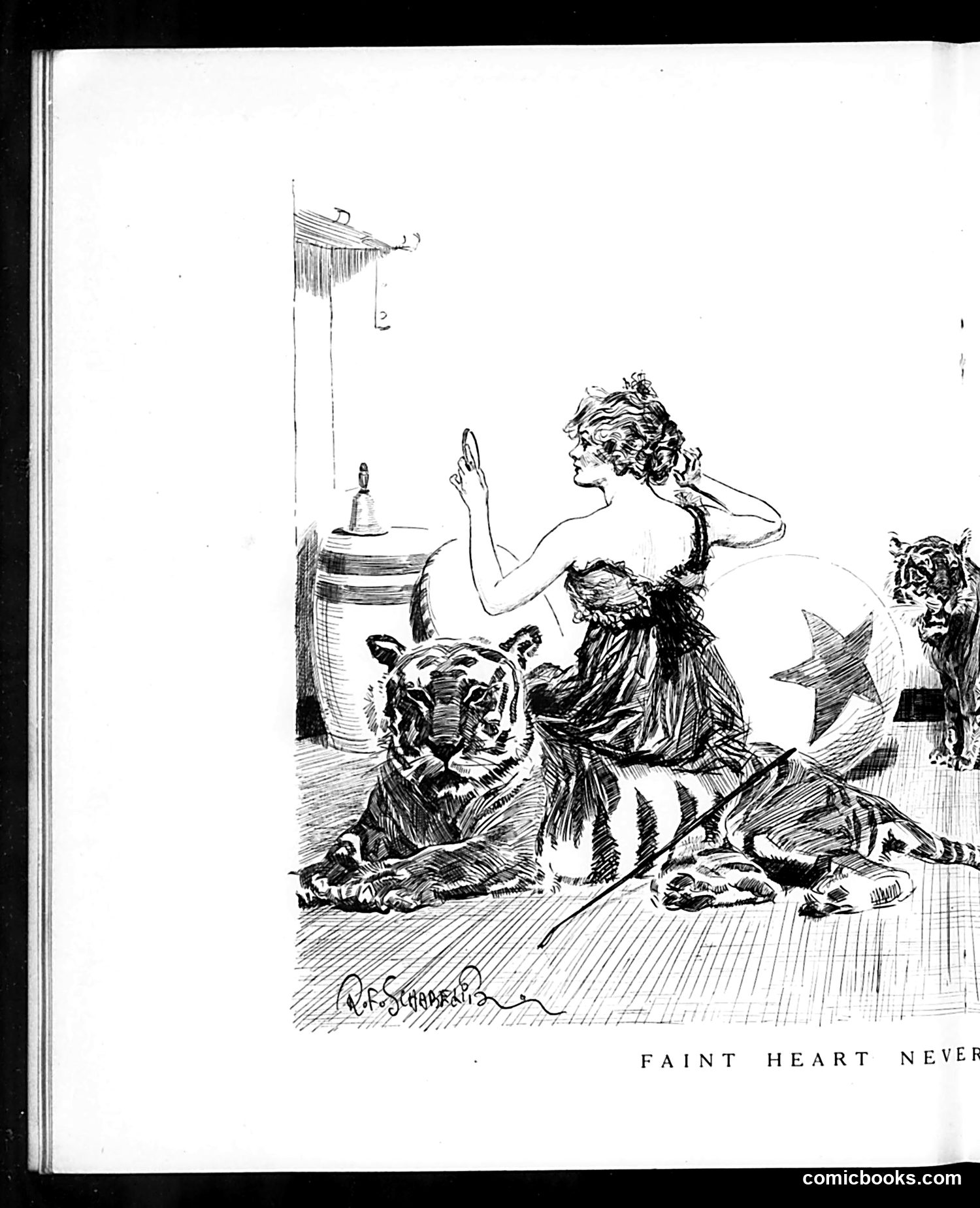
This ink illustration depicts a woman in an elegant gown seated between two tigers in what appears to be a domestic interior. The text "FAINT HEART NEVER" (likely completing the phrase "Faint heart never won fair lady") suggests a humorous commentary on romantic courage. The satire appears to work on multiple levels: the woman is positioned literally *between* dangers (the tigers), implying that romantic success requires bravery despite risks. The domestic setting with household items (a bell, pitcher) contrasts absurdly with the wild animals, heightening the joke. The cartoon likely mocks either overly timid suitors or, conversely, the reckless boldness required to "win" a woman's affection. The artist's signature appears in the lower left. Without additional context about Judge magazine's publication date, the specific satirical target remains somewhat unclear.
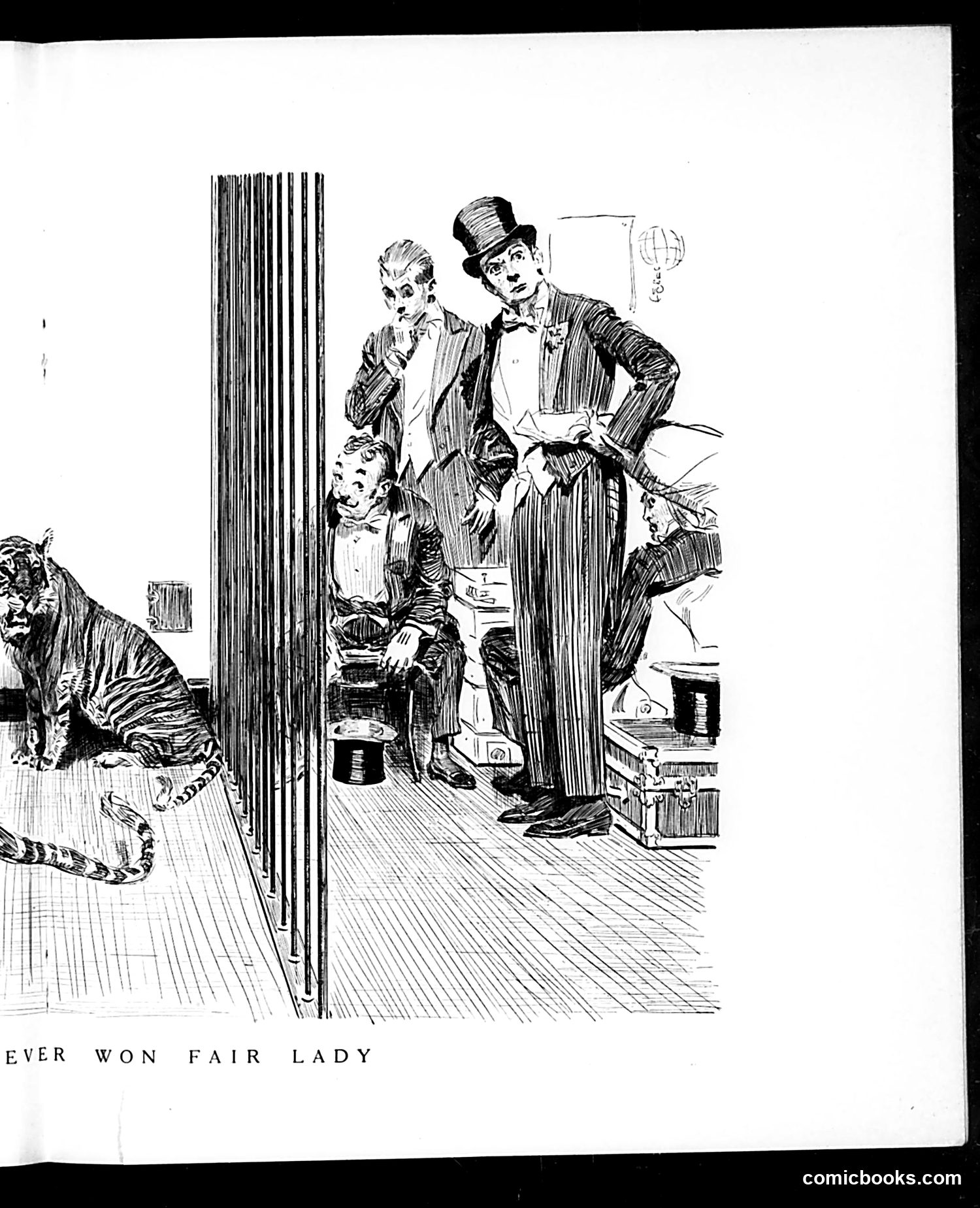
This Judge magazine cartoon satirizes courtship and romance, likely from the early 20th century based on the art style. The scene depicts three well-dressed gentlemen in formal attire (top hats, suits) apparently competing for or discussing a woman's affections. A fourth man sits nearby, possibly representing a rival or rejected suitor. The title "Ever Won Fair Lady" suggests the cartoon jokes about the difficulty or absurdity of romantic conquest—likely mocking the pretensions of wealthy suitors or the conventions of courtship among the upper classes. The men's exaggerated poses and expressions suggest they're being ridiculed for their earnest (or foolish) romantic pursuits. There's also what appears to be a lion on the left, though its symbolic meaning remains unclear from the image alone.
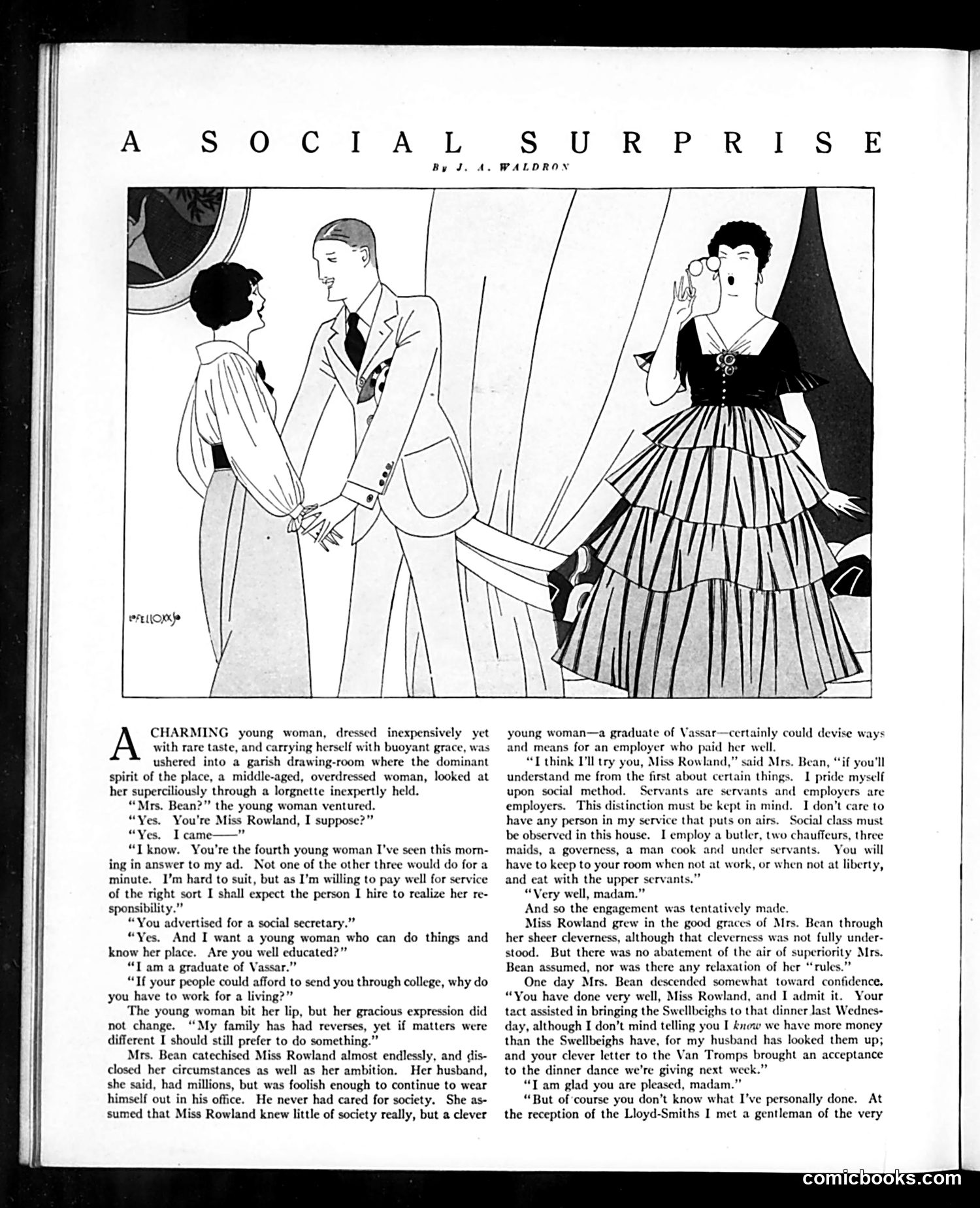
This illustration satirizes early 20th-century class pretension and social climbing. Mrs. Bean, a wealthy but insecure woman married to a self-made millionaire, hires Miss Rowland—an educated Vassar graduate forced to work due to financial reversal—as a social secretary. The satire targets Mrs. Bean's obsessive status anxiety: she rigidly enforces class distinctions (servants eat separately, must stay in their rooms) while simultaneously depending on Miss Rowland's actual refinement and education to climb socially. The joke is ironic: Mrs. Bean claims superiority over her employee while needing that employee's genuine social competence to secure invitations and impress wealthy acquaintances like the Swellbeighs and Van Tromps. The cartoon mocks nouveau riche pretension—those with money but lacking inherited social standing who desperately police hierarchies they don't truly understand.
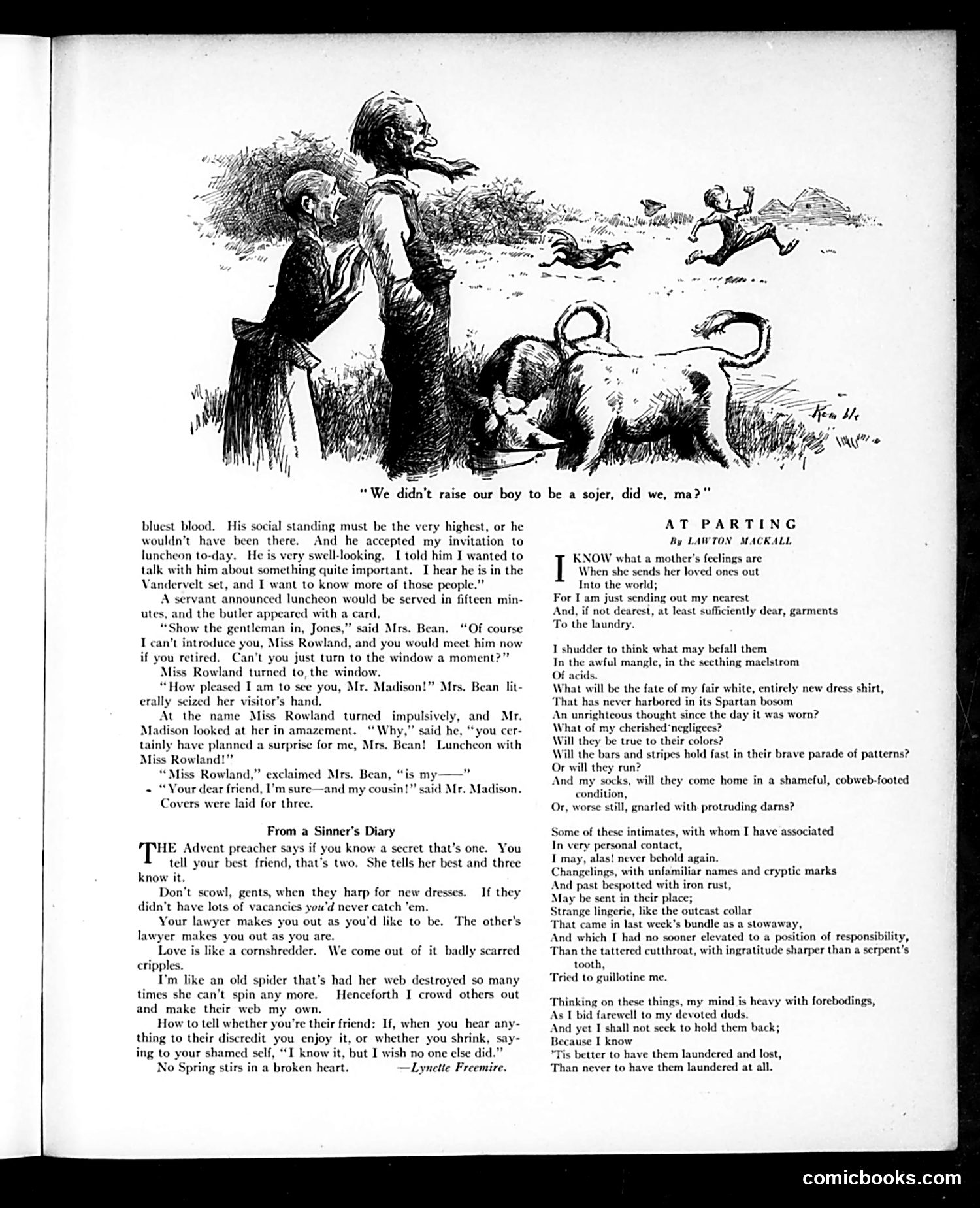
This page contains two satirical pieces mocking middle-class anxieties: **Top Cartoon:** Shows a woman (Mrs. Bean) arranging a surprise meeting between two people—likely implying she's playing matchmaker or orchestrating an awkward social situation. The caption "We didn't raise our boy to be a sojer, did we, ma?" references the popular WWI-era song "I Didn't Raise My Boy to Be a Soldier," repurposing it for domestic/social humor. **"At Parting" (poem by Lawton Mackall):** Humorously personifies laundry as beloved companions being sent away to an uncertain fate. It satirizes middle-class sentimentality by treating clothes with exaggerated emotional attachment—worrying they'll be damaged, lost, or "replaced" by inferior substitutes in the laundry process. The extended metaphor of saying goodbye to cherished items pokes fun at both laundry anxieties and overly sentimental attitudes toward possessions. Both pieces use humor to deflate pretension and middle-class concerns.
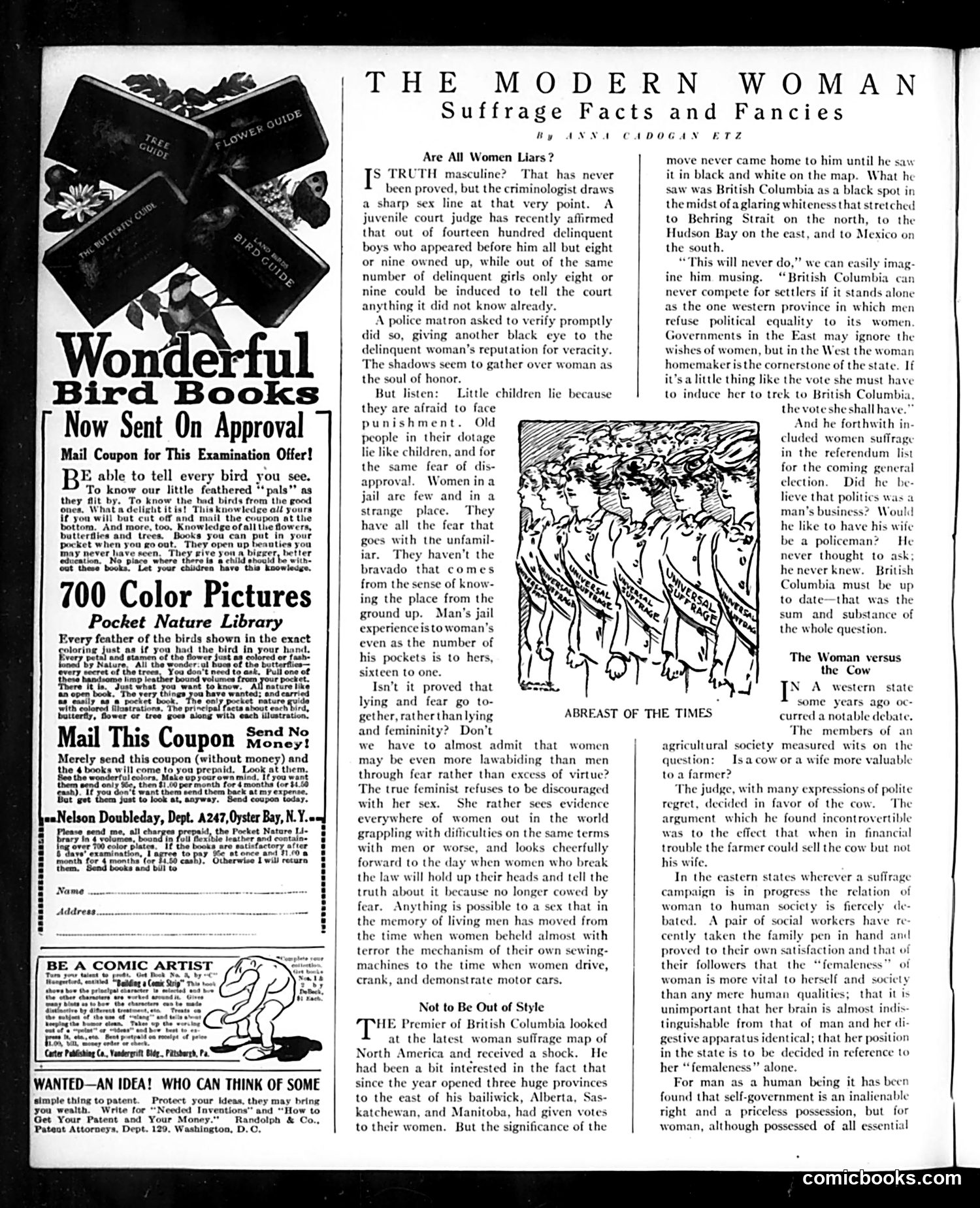
This page contains two distinct sections: **advertising** (left) and **opinion journalism** (right). The **left side** is a mail-order advertisement for "Wonderful Bird Books" from Nelson Doubleday—standard early-20th-century direct marketing with a coupon offer. The **right side** presents "The Modern Woman: Suffrage Facts and Fancies" by Anna (surname unclear), addressing debates about women's suffrage and capabilities. The article "Are All Women Liars?" tackles a specific anti-suffrage argument: that criminological data showed women delinquents were more dishonest than men. The author refutes this by arguing fear—not femininity—drives lying in both children and incarcerated women unfamiliar with jail environments. She defends women's character and argues they're actually *more* law-abiding than men. The small cartoon titled **"Arreast of the Times"** (center) shows elephants in a line—likely representing political conservatism—being arrested, satirizing opposition to women's rights as outdated. This reflects pre-19th Amendment suffrage debates when anti-suffragists used pseudo-scientific arguments about women's supposed moral inferiority.

This is a **Schlitz beer advertisement**, not satire or political content. It uses a pseudo-scientific analogy to market the product. The ad draws a parallel between human skin's natural protection (tanning from UV exposure) and Schlitz's brown bottle protection. It claims that just as skin develops a protective tan, the brown bottle protects beer's delicate proteins (albumin) from light degradation—preserving taste and nutritional value. The logic is deliberately stretched: equating biological UV protection with packaging is speculative marketing dressed in scientific language. By framing brown bottles as scientifically necessary rather than merely practical, the ad attempts to position Schlitz as superior to competitors using clear or lighter bottles. The tagline "The Beer That Made Milwaukee Famous" reinforces Schlitz's established brand reputation during what was likely the early-to-mid 20th century, when Milwaukee was America's brewing capital.
This page is primarily **book reviews and advertising**, not political cartoons. The left side advertises Collier's magazine with a teaser for William Almon Wolff's article "A Point of Etiquette" about Yale-Harvard boat races. The right column contains the substantive content: a **suffrage argument** in the opening text. The passage sarcastically critiques anti-women's-suffrage logic, comparing women to livestock ("the cow") and attacking the notion that women lack "humanness" for self-governance. It references "election day" as "judgment day" and women's ongoing "suffrage campaign" to fight for voting rights. This reflects the **1910s women's suffrage debate**—specifically the argument that voting eligibility should depend on intellectual capacity ("humanness"), not sex. The piece mocks those who measure women by different standards than men ("livestock" metrics rather than individual merit). The remaining reviews discuss contemporary drama translations and war literature, typical magazine content of the era.
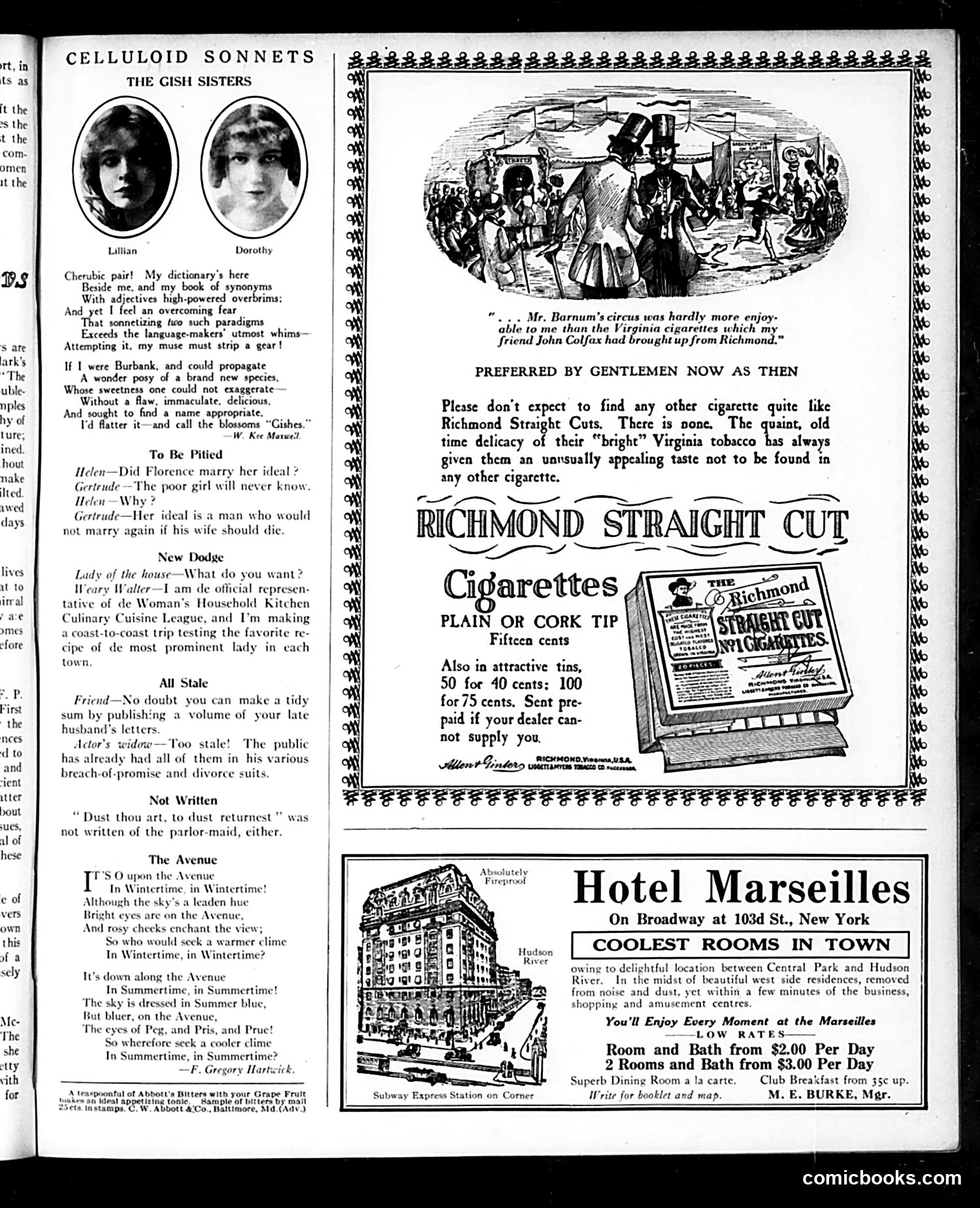
This page mixes **literary content with advertising**. The left side features "Celluloid Sonnets"—humorous poems about the Gish Sisters (Lillian and Dorothy), famous silent film actresses. The sonnets playfully struggle to find adequate words to describe their beauty, a joke about their celebrity status and the challenge of praising them sufficiently. Below are several brief comedic anecdotes typical of Judge's humor: a widow profiting from publishing her late husband's scandal-filled letters, and observations about romantic ideals and domestic life. **The dominant content is advertising**: Richmond Straight Cut Cigarettes (featuring nostalgia about Barnum's circus and Virginia tobacco), Abbott's Bitters tonic, and Hotel Marseilles. These ads reflect early 1900s luxury marketing targeting gentlemen—emphasizing tradition, quality, and elegance. The page is primarily **commercial rather than satirical**, showing how magazines of this era blended entertainment with substantial advertising revenue.
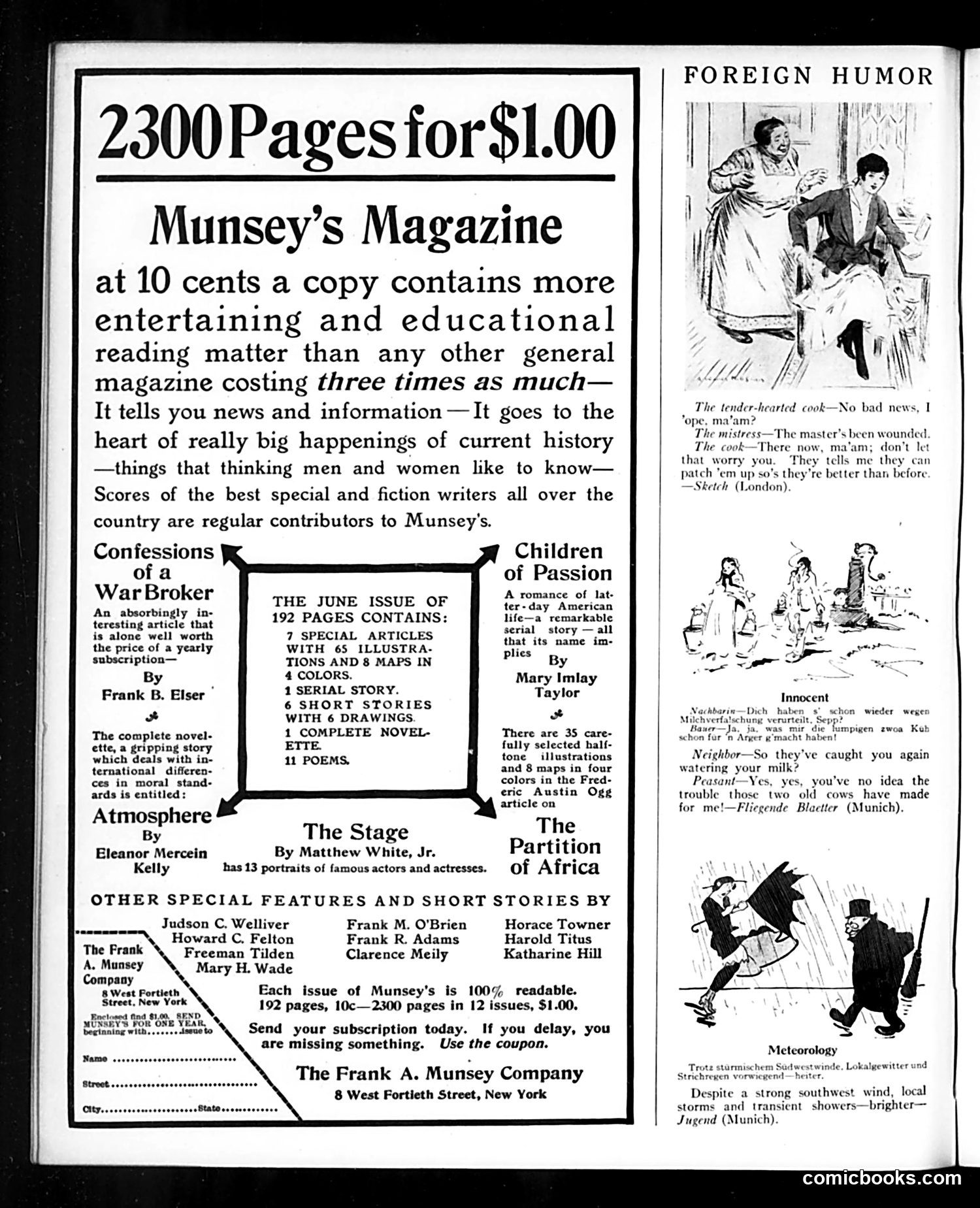
This is primarily an **advertisement page** for Munsey's Magazine, not satirical content. The left side promotes Munsey's as an affordable competitor to pricier magazines, highlighting its serialized fiction and special articles. The right side, labeled "Foreign Humor," reproduces cartoons from European publications—primarily German (*Jugend*, *Fliegende Blätter*) and British (*Sketch*, *London*) sources. These are gentle domestic comedies: - **"The tender-hearted cook"**: A servant reassures her mistress after the master's injury, promising the wounds will heal - **"Neighbors"**: Dialogue about watering milk—a common peasant survival tactic, played for humorous relatability - **"Meteorology"**: A figure being knocked over by wind, illustrating unexpected weather These sketches represent the era's **cross-Atlantic cultural exchange**—American magazines regularly reprinted European humor to entertain readers. The jokes rely on universal domestic scenarios (servants, neighbors, weather) rather than topical satire. They reflect turn-of-century middle-class life and gentle comedic sensibilities.
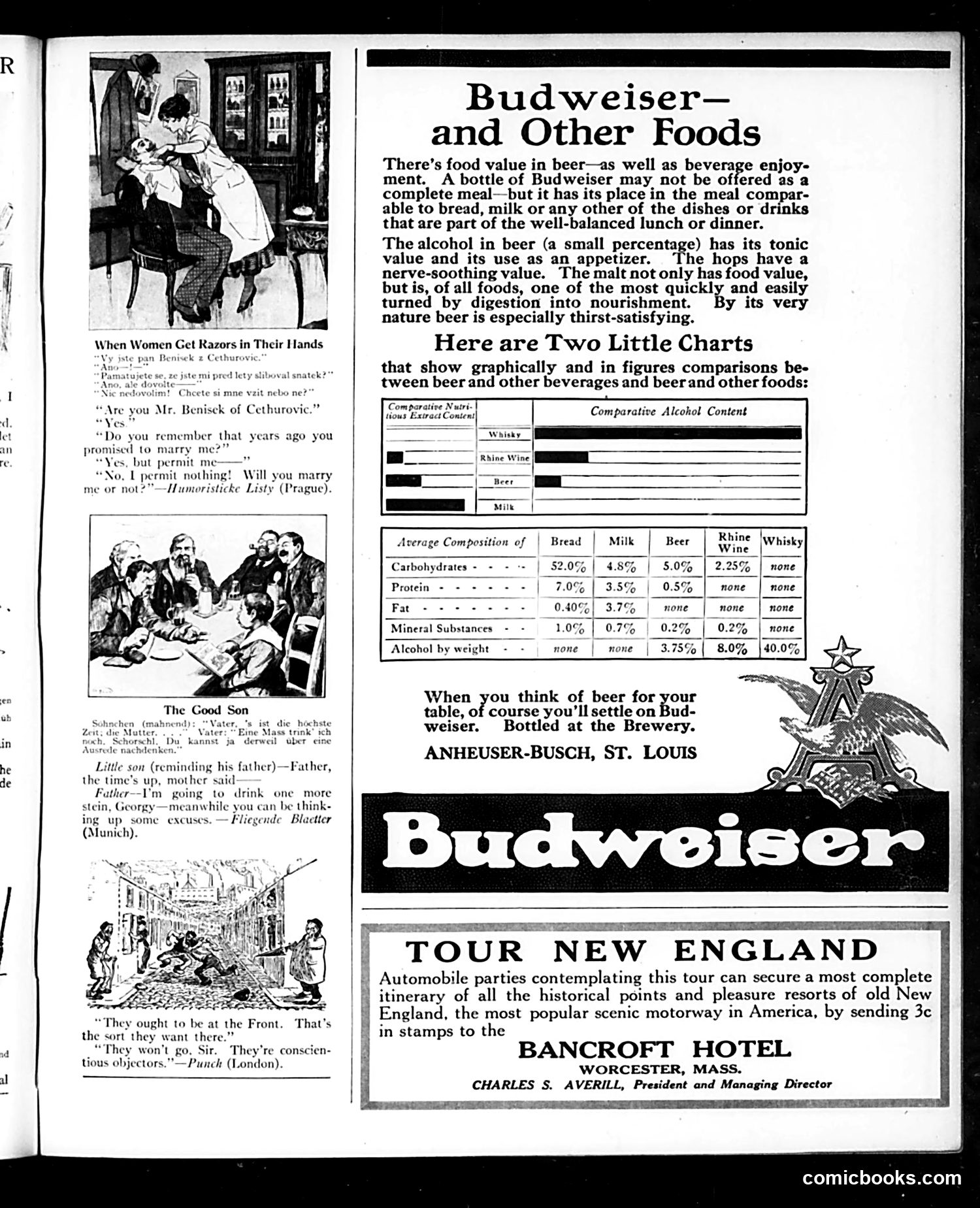
This page is primarily **advertising**, dominated by a large Budweiser ad promoting beer as nutritious food. The ad includes comparative charts claiming beer contains beneficial carbohydrates, protein, and minerals comparable to bread and milk, while containing less alcohol than whiskey or wine. The page includes several **humorous cartoons** unrelated to the main ad: 1. "When Women Get Razors in Their Hands"—a domestic comedy about a wife threatening her husband 2. "The Good Son"—a father-son scene where the son asks permission to drink while the mother is away 3. A street scene joke about conscientious objectors during wartime These cartoons reflect early 20th-century concerns: gender dynamics in marriage, intergenerational drinking attitudes, and **WWI-era conscientious objector debates**—referencing men who refused military service on moral grounds, a controversial topic during the war. The Budweiser messaging uses nutritional pseudo-science to legitimize beer consumption during this period.
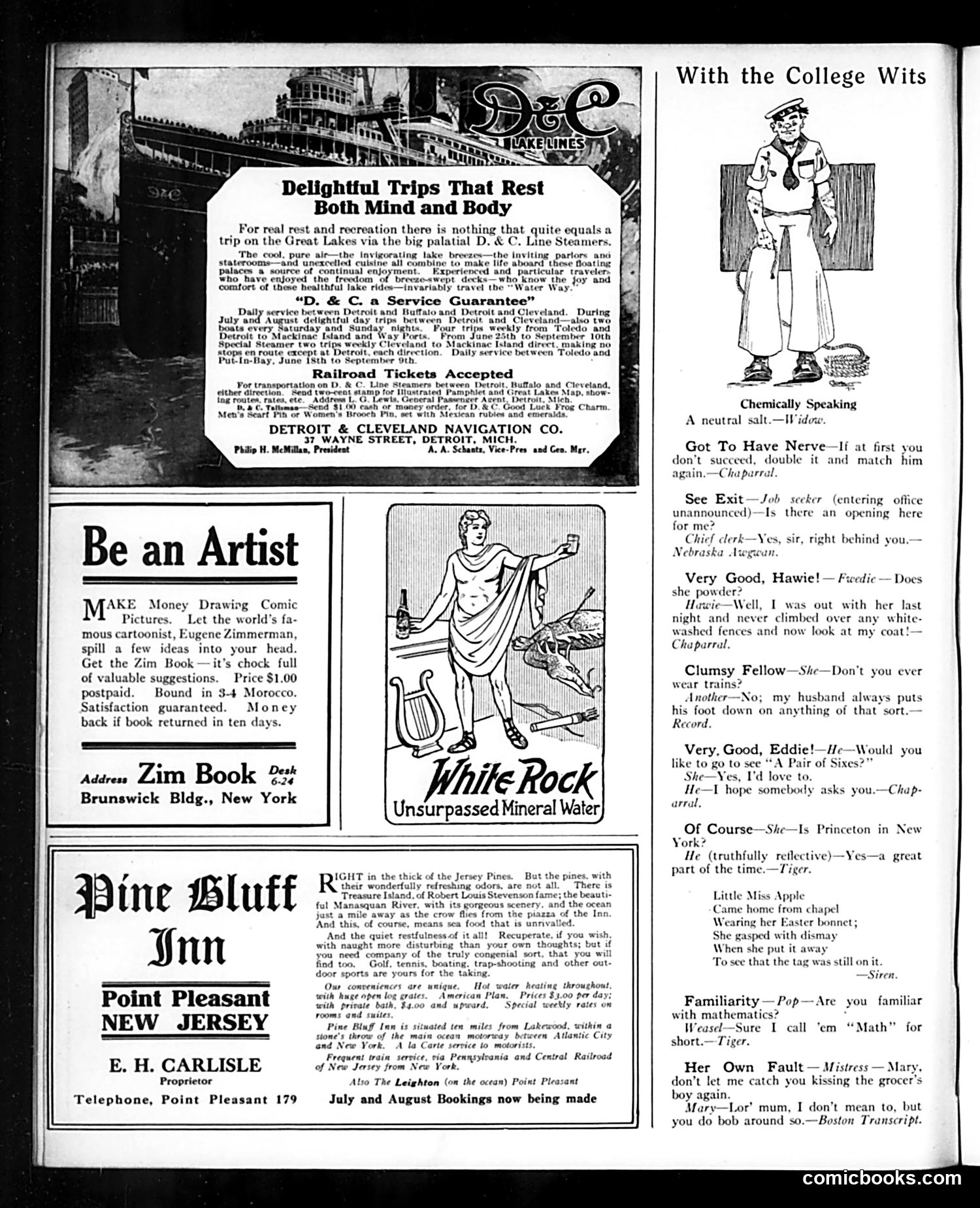
This page is primarily **advertising**, not political satire. The main content includes ads for: 1. **D&C Line Steamers** — Great Lakes shipping offering recreational cruises ("Water Way") 2. **Pine Bluff Inn** — A New Jersey resort in the Pine Barrens 3. **White Rock Mineral Water** — A beverage brand 4. **"Be an Artist"** — A mail-order instructional book by cartoonist Eugene Zimmerman The "**With the College Wits**" section is a humor column featuring short jokes about romantic misunderstandings and misheard conversations—typical early 1900s light comedy with names like "Chaparral" and "Tiger" indicating publication sources. There is **no significant political content or social satire** on this page. It reflects period advertising, leisure culture (lake steamers, resort hotels), and the genteel humor style of Judge magazine's readership.
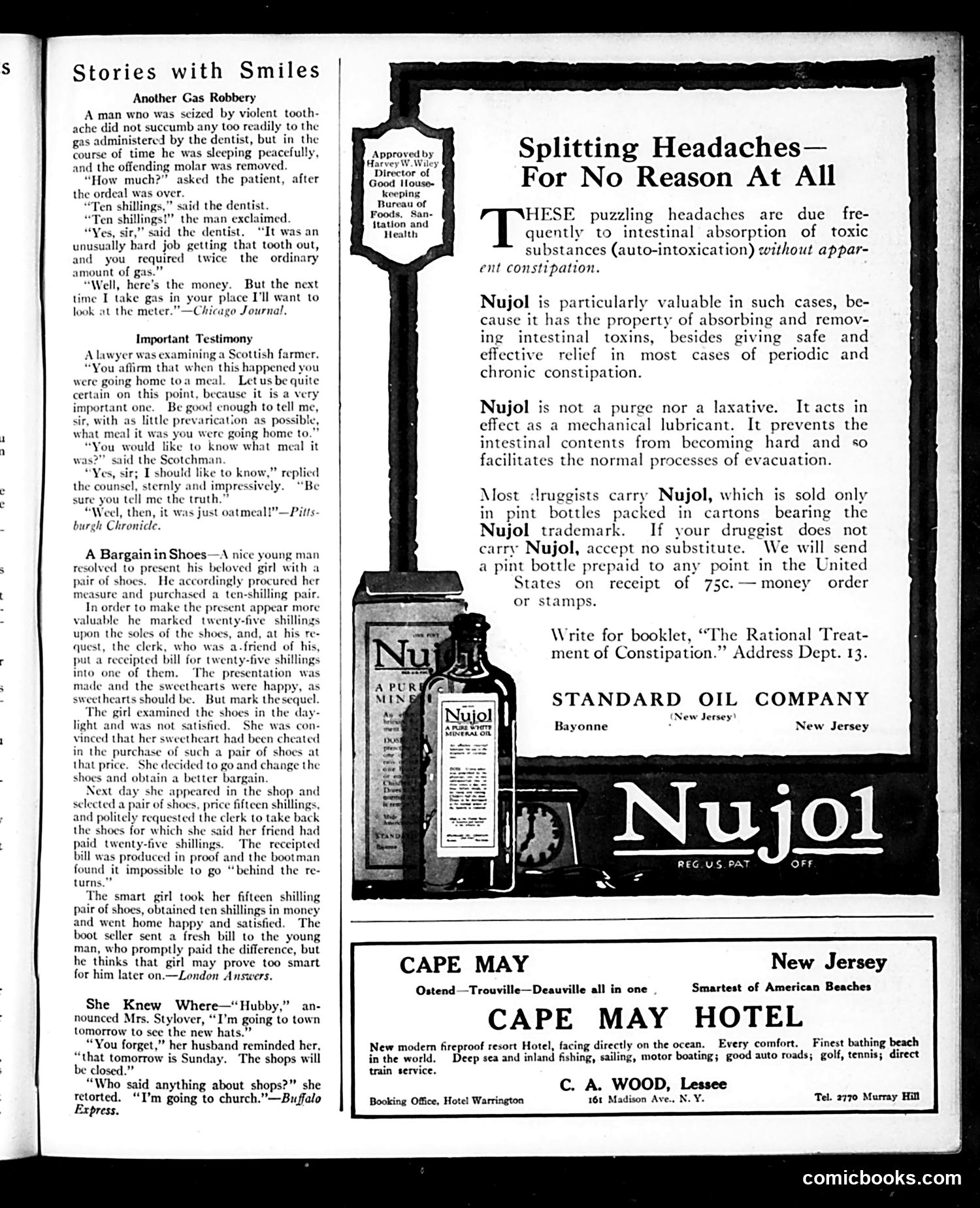
This page contains four humorous short stories and advertisements—no political cartoons. The stories satirize everyday situations through wordplay and social commentary: 1. **"Gas Robbery"**: A dental patient, charged double for anesthesia, jokes he'll "look at the meter" next time—satirizing inflated medical bills. 2. **"Important Testimony"**: A lawyer's formal questioning of a Scottish farmer about "what meal" he ate is answered literally as "oatmeal"—poking fun at Scottish frugality and verbal misunderstandings. 3. **"Bargain in Shoes"**: A clever young woman returns shoes marked at inflated prices, using a false receipt to demand a refund plus discount—mocking both consumer fraud and female cunning. 4. **"She Knew Where"**: A wife announces Sunday shopping; when reminded stores close, she reveals she's "going to church"—slyly suggesting churches were actually social venues for women. The **Nujol advertisement** (approved by Harvey W. Wiley, Pure Food Bureau director) promotes a mineral oil laxative for mysterious headaches caused by intestinal toxins—reflecting early 20th-century pseudo-medical beliefs about constipation causing systemic illness.
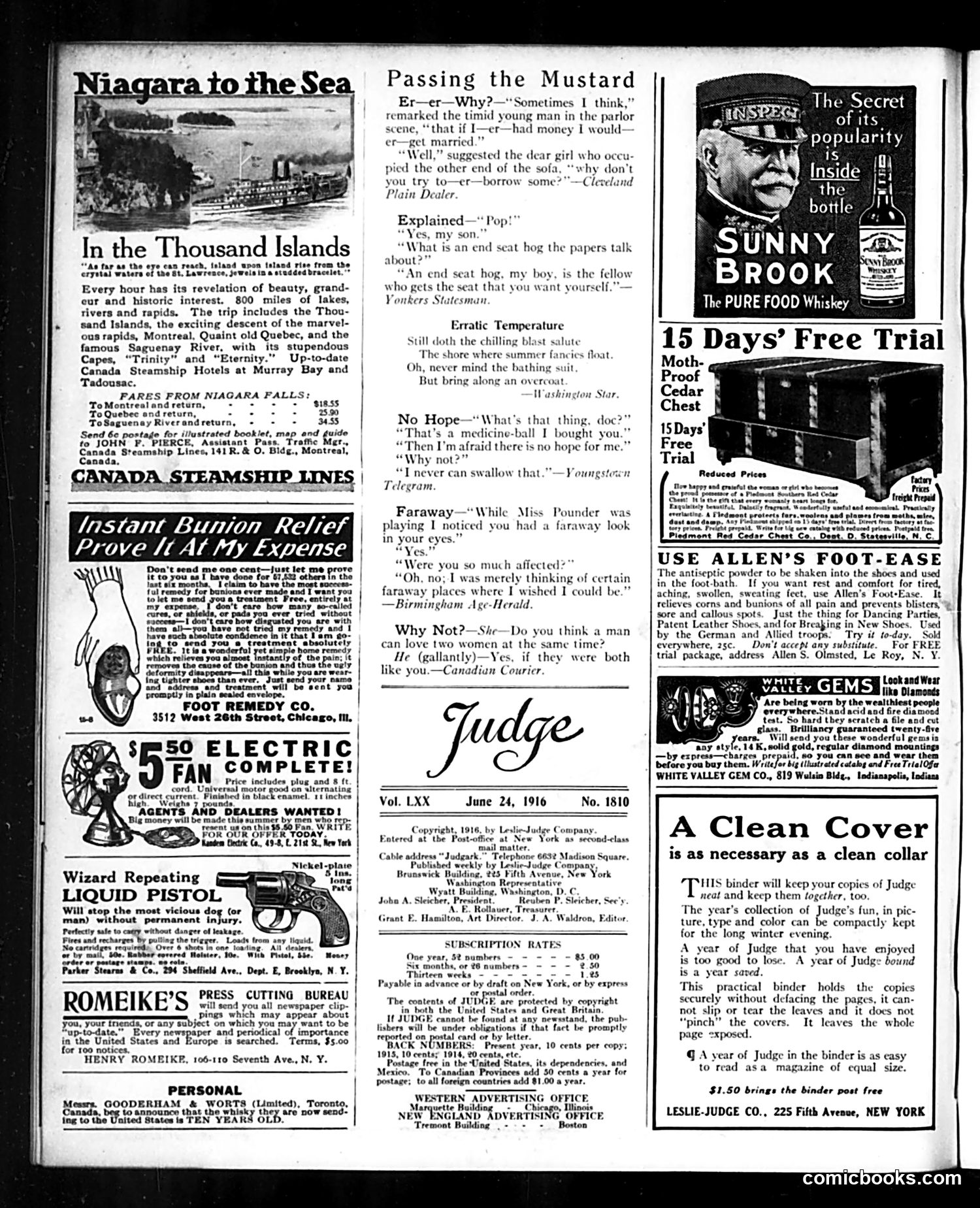
This page is primarily **advertisements and humor content**, not political cartoons. It contains: **Humor Section:** Brief joke columns with generic scenarios—a timid suitor afraid to propose without money, complaints about "end seat hogs" on transportation, romantic faraway daydreams, and whether men can love two women simultaneously. These are lighthearted domestic/social observations with no specific political targets. **Advertisements:** Typical 1916 products including bunion remedies, electric fans, a "Liquid Pistol" (appears to be a spray device for dog deterrent), and Canadian steamship tourism. **Notable:** A Gooderham & Worts whisky advertisement emphasizes their product is "ten years old"—likely reflecting WWI-era concerns about product quality and authenticity during wartime. The page lacks the satirical political commentary one might expect from Judge magazine. It's a standard commercial/entertainment page from the magazine's June 1916 issue.
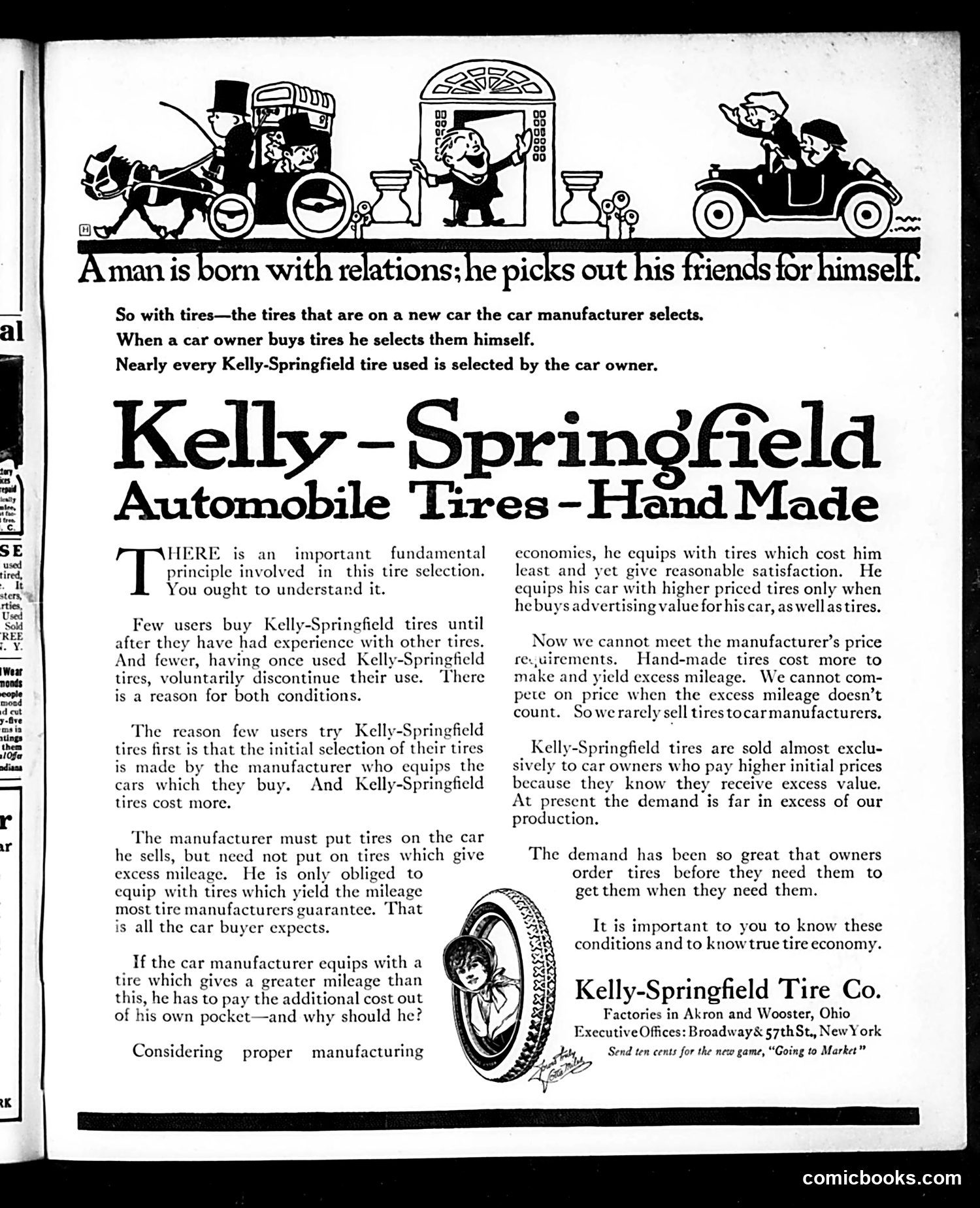
This is a **full-page advertisement**, not satire. The opening illustration and headline ("A man is born with relations; he picks out his friends for himself") use a folksy analogy to argue that car owners, like people choosing friends, should personally select their tires rather than accept manufacturer defaults. The ad's core pitch: Kelly-Springfield tires cost more but deliver superior mileage. Car manufacturers equip new vehicles with cheaper tires meeting only minimum guarantees—they won't pay extra for better performance. However, informed buyers who replace tires themselves recognize Kelly-Springfield's value and willingly pay premium prices. The company claims demand so exceeds supply that customers pre-order tires before needing them. This positions Kelly-Springfield as a premium, sought-after product chosen by discerning consumers rather than foisted upon them by manufacturers. It's a straightforward argument for conscious consumption and brand loyalty in early automobile culture.
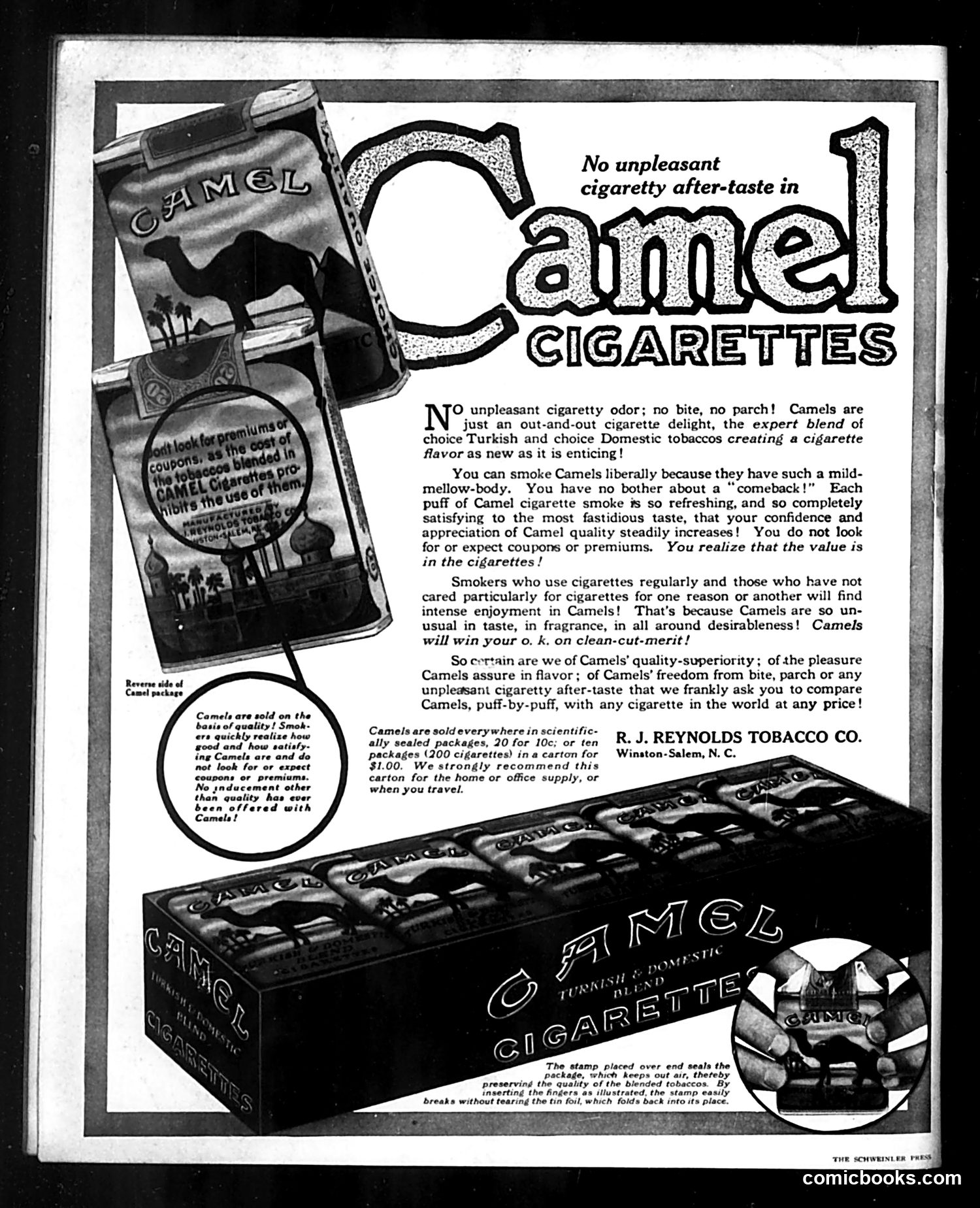
This page is **not a cartoon or satire**—it's a **cigarette advertisement** for Camel cigarettes by R.J. Reynolds Tobacco Co. The ad makes marketing claims typical of early-20th-century tobacco advertising: Camels have "no unpleasant after-taste," "no bite, no parch," and a "mild-mellow body." It emphasizes the "expert blend of choice Turkish and choice Domestic tobaccos" and invites consumers to compare Camels "puff-by-puff" with competitors. The page includes product images (the Camel package, a carton, and a tin seal detail) and pricing information (20 cigarettes for 10 cents). **For modern readers:** This represents an era when cigarettes were openly advertised in mainstream magazines with health-related claims that would be illegal today. The language ironically emphasizes health benefits and lack of negative effects—precisely what modern regulation prohibits.
I can see this is a page from *Judge* magazine with "comicbooks.com" credited at the bottom, but the image is almost entirely black with very minimal visible detail. The darkness makes it impossible to discern any cartoon illustrations, text content, caricatures, or political/social references that would normally be visible on such a page. This appears to be either a scanning/digitization error, a heavily damaged or deteriorated original, or an improperly exposed photograph of the source material. Without visible imagery or readable text beyond the attribution, I cannot identify figures, explain satirical intent, or provide historical context for the content. To analyze this *Judge* page properly, a clearer image would be necessary.