
Judge, 1916-06-24 · page 20 of 29
Judge — June 24, 1916 — page 20: what you’re looking at
What you’re looking at
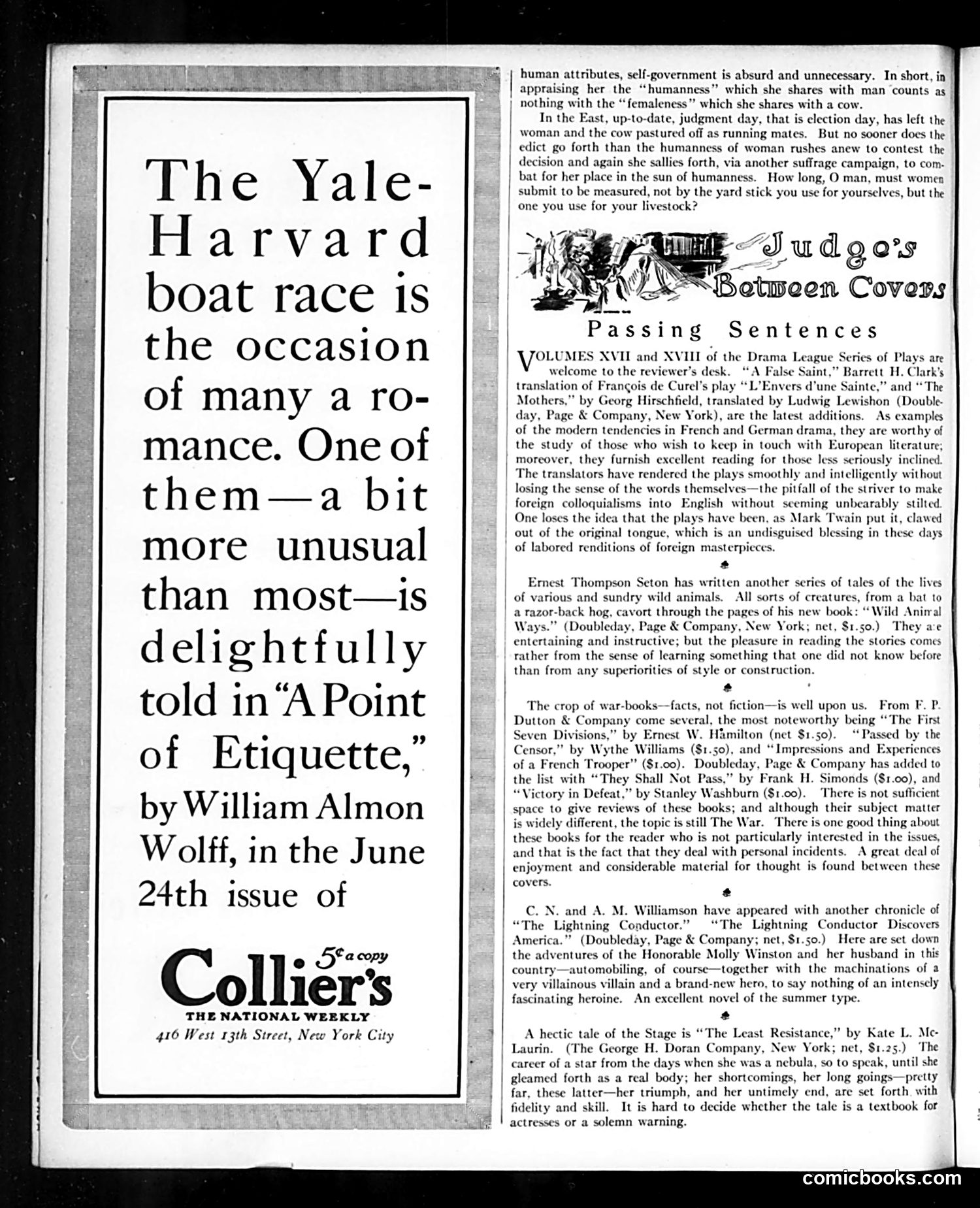
This page is primarily **book reviews and advertising**, not political cartoons. The left side advertises Collier's magazine with a teaser for William Almon Wolff's article "A Point of Etiquette" about Yale-Harvard boat races. The right column contains the substantive content: a **suffrage argument** in the opening text. The passage sarcastically critiques anti-women's-suffrage logic, comparing women to livestock ("the cow") and attacking the notion that women lack "humanness" for self-governance. It references "election day" as "judgment day" and women's ongoing "suffrage campaign" to fight for voting rights. This reflects the **1910s women's suffrage debate**—specifically the argument that voting eligibility should depend on intellectual capacity ("humanness"), not sex. The piece mocks those who measure women by different standards than men ("livestock" metrics rather than individual merit). The remaining reviews discuss contemporary drama translations and war literature, typical magazine content of the era.
📄 Transcribed text from this page (OCR, searchable)
Machine-transcribed from the original scan — historical spelling and the odd misread are preserved.
" ocak a4 pe hee SPS | human attributes, self-government is absurd and unnecessary. In short, in aD ee Satla taalia n inlae e . | appraising her the “humanness” which she shares with man ‘counts as nothing with the “femaleness” which she shares with a cow. In the East, up-to-date, judgment day, that is election day, has left the woman and the cow pastured off as running mates. But no sooner does the edict go forth than the humanness of woman rushes anew to contest the decision and again she sallies forth, via another suffrage campaign, to com- bat for her place in the sun of humanness. How long, O man, must women (S a e = F submit to be measured, not by the yard stick you use for yourselves, but the one you use for your livestock? boat race is the occasion oun welcorie ‘to the reviewer’ § translation of Frangois de Curel’s play “L’Envers d’une Sainte,” and "The ot n lany a fOo- | Mothers,” by Georg Hirschfield, translated by Ludwig Lewishon (Double- day, Page & Company, New York), are the latest additions. As examples of the modern tenden in French and German drama, they are worthy of mance One of the study of those who wish to keep in touch with European literature; e moreover, they furnish excellent reading for those less seriously inclined . The translators have rendered the plays smoothly and intelligently without fi h losing the sense of the words themselves—the pitfall of the striver to make em—a 1 t foreign colloquialisms into English without seeming unbearably. stilted One loses the idea that the plays have been, as Mark Twain put it, clawed out of the original tongue, which is an undisguised blessing in these days mo re unu sual of labored renditions of foreign masterpieces. 2 2 Emest Thompson Seton has written another series of tales of the lives t an most—1S of various and sundry wild animals. All sorts of creatures, from a bat to ror-ba . cavort through the pages of his new book: “Wild Anitral ‘ Vays.” day, Page & Company, New York; net, $1.50.) They ae d l h f entertaining and instructive; but the pleasure in reading the stories comes e 1 23 t Uu y rather from the sense of learning something that one did not know before | than from any superiorities of style or construction. * 6 : * : told in A Point | The crop of war-books—facts, not fiction—is well upon us. From F. P. Dutton & Company come several, the most noteworthy being ‘The First Seven Divisions,” by Ernest W. Hamilton (net $1.50). “Passed by the e of Eti uette ” Censor,” by Wythe Williams ($1.50), “Impressions and Experiences q 9 of a French Trooper” ($1.00). c4 age & Compa has added to e list with “They Shall Not Pass,” by Frank H. Simonds ($1.00), and . . |“ ory in Defe by Stanley Washburn ($1.00). There is not sufficient by William Almon | space to give reviews of these books; and although their subject matter | is widely different, the topic is still The War. There is one good thing a these books for the reader who is not particularly interested i Wol ff, int h e J une and that is the fact that they deal with personal incidents. A great deal of enjoyment and considerable material for thought is found between these covers. 24th i f | . t 1ssue€ O and A. M. Williamson have appeared with another chronicle of Lightning Conductor.” “The Lightning Conductor Discovers * (Doubleday, Page & Company; net, $1.50.) Here are set down = Nimo the adventures of the Honorable Molly Winston and her husband in this country—automobiling, of course—together with the machinations of a ¢ olli rr very villainous villain and a brand-new hero, to say nothing of an intensely fascinating heroine. An excellent novel of the summer type. THE NATIONAL WEEKLY ¢ 416 West 13th Street, New York City J A hectic tale of the Stage is “The Least Resistance,” by Kate L. Me- Laurin. (The George H. Doran Compan rw York; net, $ -) The career of a star from the ¢ when she was a nebula, so to speak, until she gleamed forth as a real body; her shortcomings, her long goings—pretty far, these latter—her triumph, and her untimely end, are set forth. with fidelity and skill. It is hard to decide whether the tale is a textbook for actresses or a solemn warning. comicbooks.com