
Judge, 1916-06-24 · page 16 of 29
Judge — June 24, 1916 — page 16: what you’re looking at
What you’re looking at
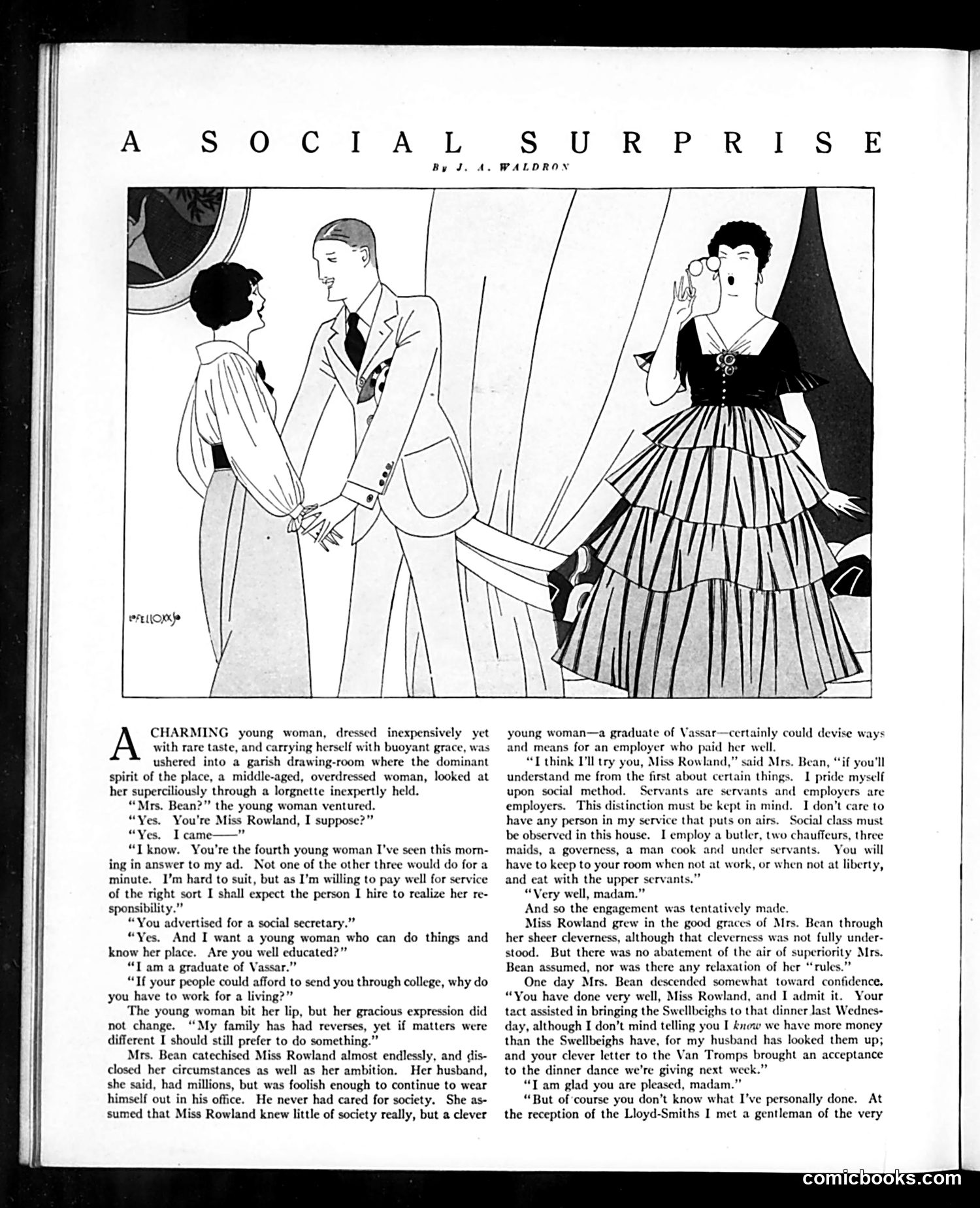
This illustration satirizes early 20th-century class pretension and social climbing. Mrs. Bean, a wealthy but insecure woman married to a self-made millionaire, hires Miss Rowland—an educated Vassar graduate forced to work due to financial reversal—as a social secretary. The satire targets Mrs. Bean's obsessive status anxiety: she rigidly enforces class distinctions (servants eat separately, must stay in their rooms) while simultaneously depending on Miss Rowland's actual refinement and education to climb socially. The joke is ironic: Mrs. Bean claims superiority over her employee while needing that employee's genuine social competence to secure invitations and impress wealthy acquaintances like the Swellbeighs and Van Tromps. The cartoon mocks nouveau riche pretension—those with money but lacking inherited social standing who desperately police hierarchies they don't truly understand.
📄 Transcribed text from this page (OCR, searchable)
Machine-transcribed from the original scan — historical spelling and the odd misread are preserved.
A 78 (O°-C-I A L By J. A. SURPRISE WALDRON PFELLOKY® CHARMING young woman, dressed inexpensivel A with rare taste, and carrying herself with buoyant gr: was ushered into a garish drawing-room where the dominant spirit of the place, a middle-aged, overdressed woman, looked at her superciliously through a lorgnette inexpertly held. irs. Bean?” the young woman ventured. You're Miss Rowland, I suppose?” I came— “Tknow. You're the fourth young woman I've scen this morn- ing in answer to my ad. Not one of the other three would do for a minute. I’m hard to suit, but as I’m willing to pay well for service of the right sort I shall expect the person I hire to realize her re- sponsibility.” “You advertised for a social secretary.” “Yes. And I want a young woman who can do things and know her place. Are you well educated?” “T am a graduate of Vassar.” “If your people could afford to send you through college, why do you have to work for a living?” The young woman bit her lip, but her gracious expression did not change. “My family has had reverses, yet if matters were different I should still prefer to do something.” Mrs. Bean catechised Miss Rowland almost endlessly, and dis- closed her circumstances as well as her ambition. Her husband, she said, had millions, but was foolish enough to continue to wear himself out in his office. He never had cared for society. She as- sumed that Miss Rowland knew little of society really, but a clever y Hf Yf \Y INN /| Ai Ai i f ah lea young woman—a graduate of Vassar—certainly could devise ways and means for an employer who paid her well. “T think I'll try you, Miss Rowland,” said Mrs. Bean, “if you'll understand me from the first about certain things. 1 pride myself upon social method. ts are servants and employers are employers. This distinction must be kept in mind. I don’t care to have any person in my service that puts on airs. Social class must be observed in this house. I employ a butler, two chauffeurs, three maids, a govern a man cook and under servants. You will have to keep to your room when not at work, or when not at liberty, and eat with the upper servants.” “Very well, madam. And so the engagement was tentatively made. Miss Rowland grew in the good graces of Mrs. Bean through her sheer cleverness, although that cleverness was not fully under- stood. But there was no abatement of the air of superiority Mrs. Bean assumed, nor was there any relaxation of her “rules. One day Mrs. Bean descended somewhat toward confidence. “You have done very well, Miss Rowland, and I admit it. Your tact assisted in bringing the Swellbeighs to that dinner last Wednes- day, although I don’t mind telling you I knew we have more moncy than the Swellbeighs have, for my husband has looked them up; and your clever letter to the Van Tromps brought an acceptance to the dinner dance we're giving next week.” “Tam glad you are pleased, madam.” “But of course you don’t know what I've personally done. At the reception of the Lloyd-Smiths I met a gentleman of the very