
Judge, 1916-06-24 · page 10 of 29
Judge — June 24, 1916 — page 10: what you’re looking at
What you’re looking at
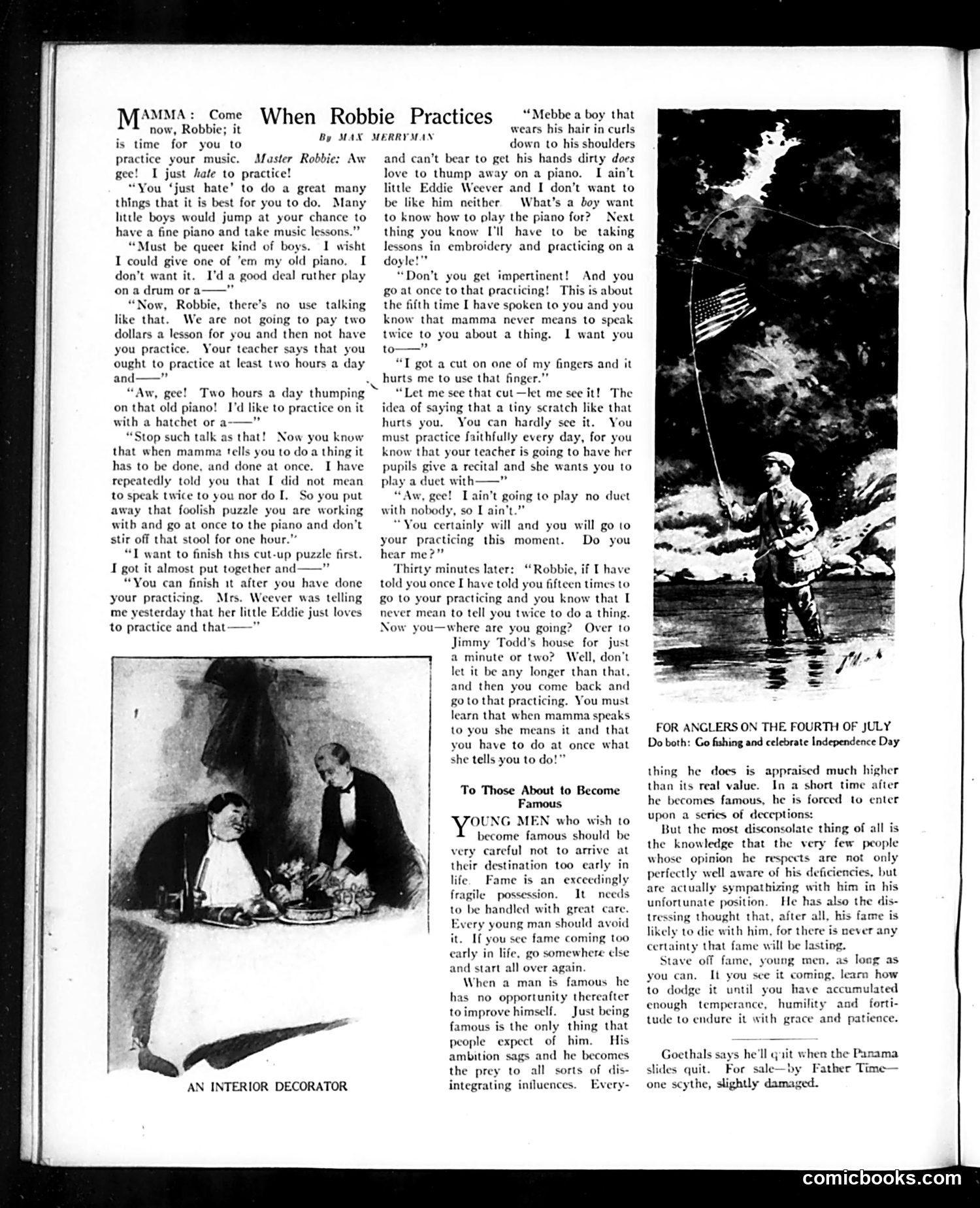
This domestic humor piece satirizes the clash between parental authority and childhood resistance to piano lessons. The unnamed mother represents the Victorian ideal of "cultured" child-rearing—music education as a mark of refinement—while young Robbie embodies boyish defiance. His complaints (preferring drums or hatchets, the tiny finger-cut excuse, sneaking off to friends' houses) are universal stalling tactics. The humor lies in the mother's repeated threats—"I never mean to speak twice"—which she violates constantly, undercutting her authority. The accompanying illustration "An Interior Decorator" (caption only visible) appears unrelated. The satirical thrust targets both parental hypocrisy and the era's obsession with genteel accomplishments for children, particularly boys forced into "feminine" pursuits like piano and embroidery. Robbie's resistance to curled hair and "dainty" pursuits reflects period anxieties about masculinity.
📄 Transcribed text from this page (OCR, searchable)
Machine-transcribed from the original scan — historical spelling and the odd misread are preserved.
AMMA: Come “now, Robbie; ii By MAX is time for you to practice your music. Muster Robbi gece! I just hate to practice! “You ‘just hate’ to do a great many things that it is best for you todo. Many little boys would jump at your chance to have a fine piano and take music lessons.” “Must be queer kind of boys. I wisht I could give one of ‘em my old piano. I don’t want it. I'd a good deal ruther play on a drum or a——" “Now, Robbie, there’s no use talking like that. We are not going to pay two dollars a lesson for you and then not have you practice. Your teacher says that you ought to practice at t two hours a day and——” Aw, gee! Two hours a day thumping on that old piano! I'd like to practice on it with a hatchet or a-——” Stop such talk as that! Now you know that when mamma tells you to do a thing it has to be done, and done at once. I have repeatedly told you that [ did not mean to speak twice to you nor do I, So you put away that foolish puzzle you are working with and go at once to the piano and don’t stir off that stool for one hour.’ “T want to finish this cut-up puzzle first. I got it almost put together and——” “You can finish it after you have done your practicing. Mrs. Weever was telling me yesterday that her little Eddie just loves to practice and that——" Aw AN INTERIOR DECORATOR When Robbie Practices MERRY MAN ~ “Mebbe a boy that wears his hair in curls down to his shoulders and can’t bear to get his hands dirty does love to thump away on a piano. I ain't little Eddie Weever and I don’t want to be like him neither What’s a boy want to know how to play the piano for? Next thing you know I'll have to be taking lessons ia embroidery and practicing on a doyle “Don’t you get impertinent! And you go at once to that practicing! This is about the fifth time I have spoken to you and you know that mamma never means to speak twice to you about a thing. I want you to—" “T got a cut on one of my fingers and it hurts me to use that finger. “Let me see that cut—let me see it! The idea of saying that a tiny scratch like that hurts you. You can hardly see it. You must practice faithfully every day, for you know that your teacher is going to have her pupils give a recital and she wants you to play a duet with——” Aw, gee! Lain’t going to play no duct with nobody, so I ain't.” “You certainly will and you will go to your practicing this moment. Do you hear me?” Thirty minutes later: “Robbie, if T have told you once I have told you fifteen times to go to your practicing and you know that I never mean to tell you twice to do a thing. Now you—where are you going? Over to Jimmy Todd’s house for just a minute or two? Well, don’t let it be any longer than that, and then you come back and go to that practicing. You must learn that when mamma speaks to you she means it and that you have to do at once what she tells you to do!” To Those About to Become Famous OUNG MEN who wish to become famous should be very careful not to arrive at their destination too early in life. Fame is an exceedingly fragile possession. It needs to be handled with great care. Every young man should avoid it. If you see fame coming too early in life, go somewhere else and start all over again. When a man is famous has no opportunity thereafter toimprove himself. Just being famous is the only thing that people expect of him. His ambition sags and he becomes the prey to all sorts of dis- integrating intluences. Every- he FOR ANGLERS ON THE FOURTH OF JULY Do both: Go fishing and celebrate Independence Day he does is appraised much higher than its real value. In a short time after he becomes famous, he is forced to enter upon a series of deceptions: But the most disconsolate thing of all is the knowledge that the very few people whose opinion he respects are not only perfectly well aware of his deficiencies, but are actually sympathizing with him in his unfortunate position. He has also the di tressing thought that, after all, his fame is likely to die with him, for there is never any certainty that fame will be lasting. Stave off fame, young men, as long you can. It you sce it coming, learn how to dodge it until you have accumulated enough temperance, humility and fort tude to endure it with grace and patience. Goethals says he'll quit when the Panama slides quit. For sale—by Father Time— one scythe, slightly damaged. comicbooks.com