
A complete issue · 28 pages · 1916
Judge — June 3, 1916
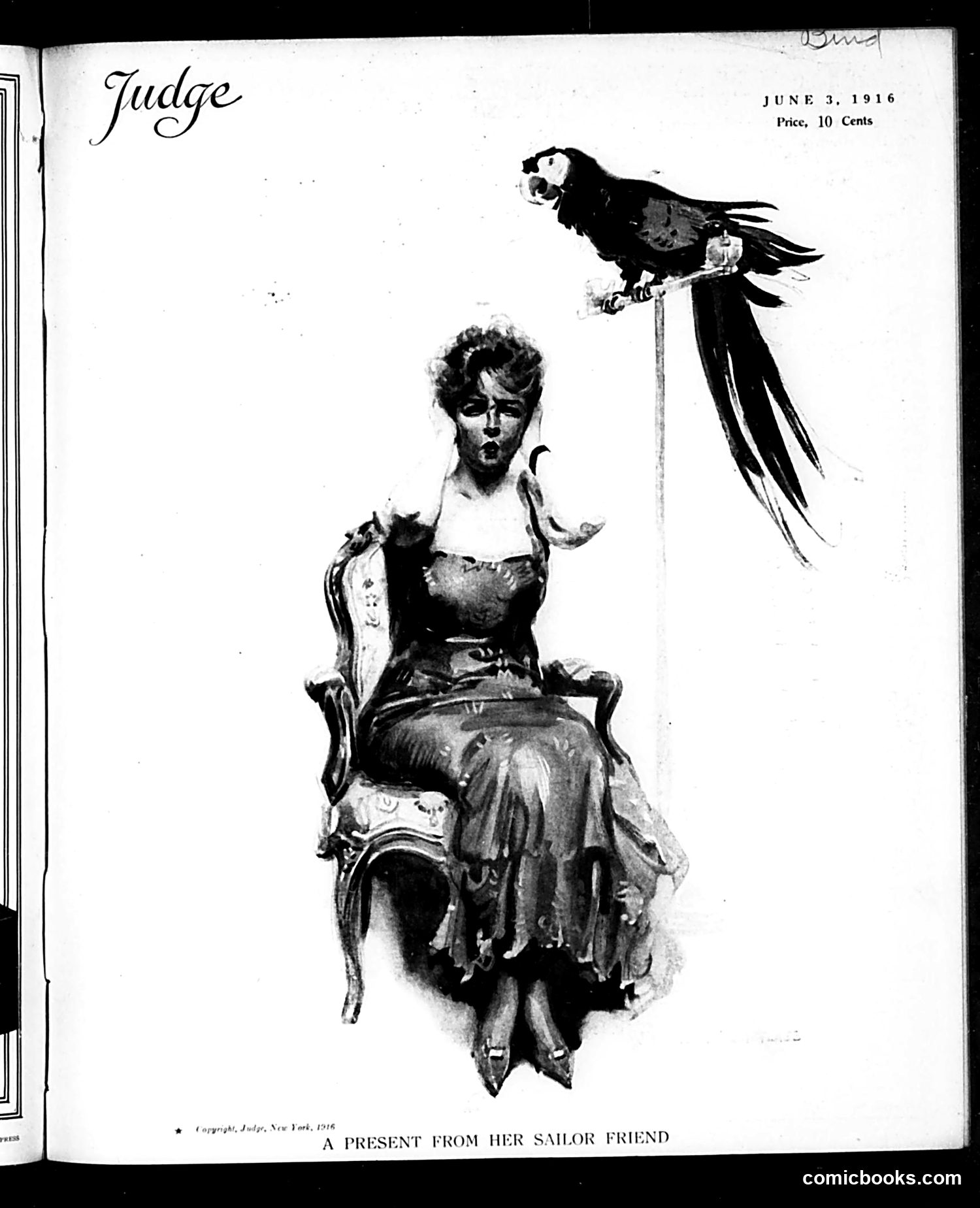
**Title:** "A Present from Her Sailor Friend" **Image:** An elegantly dressed woman sits in a chair, appearing startled or delighted. A large macaw perches on a stand behind her, with its distinctive long tail feathers prominently displayed. **Meaning:** This appears to be a romantic/comedic illustration suggesting that a woman has received an exotic macaw as a gift from a sailor boyfriend. The humor likely plays on the incongruity of such an unusual pet as a romantic gesture, and possibly the bird's loud, raucous nature creating domestic chaos—a common comedic trope of the era. The 1916 date places this during WWI, when many American men served in naval positions, making the "sailor friend" reference timely for contemporary readers.
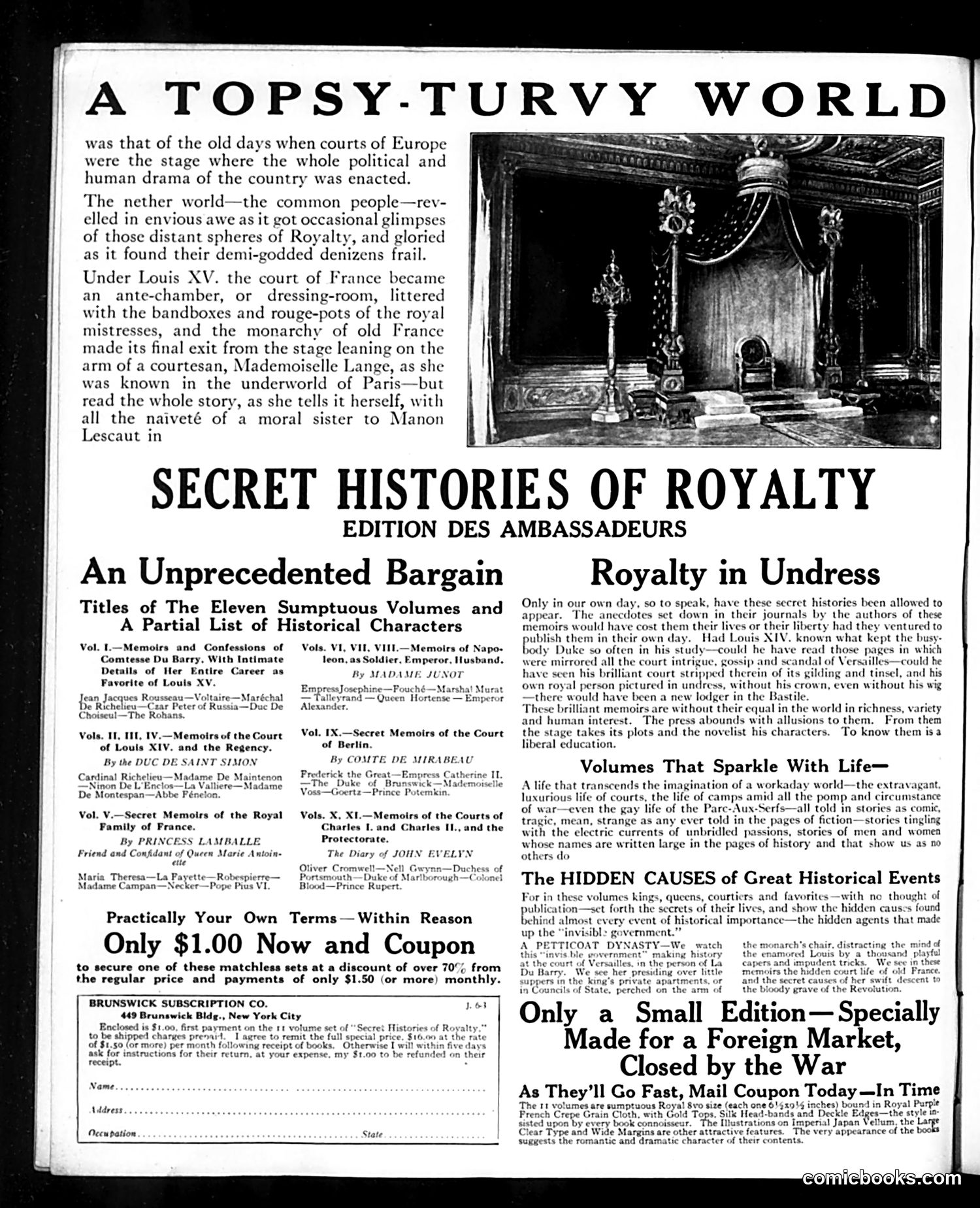
This page is primarily **advertising rather than satire or commentary**. It promotes "Secret Histories of Royalty: Edition Des Ambassadeurs"—a multi-volume set of purported memoirs about European royal courts, particularly French aristocracy under Louis XV. The ad emphasizes scandalous revelations about royal mistresses and court intrigue, marketing them as forbidden historical secrets. The ornate palace interior illustration reinforces the luxury appeal. The pitch uses classic mail-order tactics: claiming extreme rarity ("small edition...closed by the war"), urgency ("as they'll go fast"), and aggressive discounting ("only $1.00 now...regular price" much higher). There's no identifiable political cartoon here—just a period example of how publishers marketed sensationalized "insider" accounts of royalty to American readers, exploiting fascination with European scandal and intrigue.
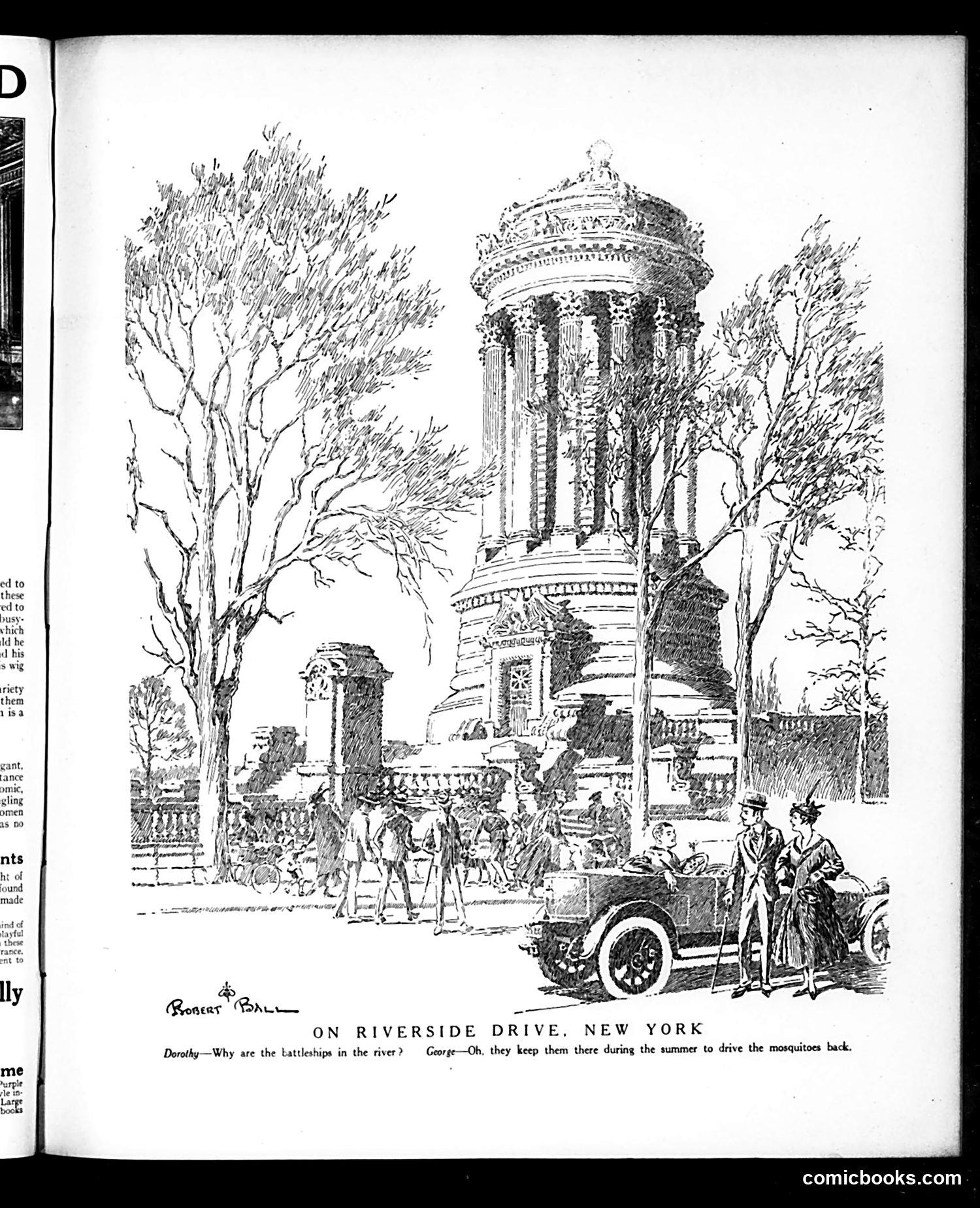
This is a humorous sketch by Robert Ball depicting an early 20th-century scene on Riverside Drive in New York City. The cartoon shows a fashionable motorcar with well-dressed passengers beside an ornate cylindrical structure (likely a monument or pavilion) flanked by bare trees. The joke, revealed in the caption dialogue between "Dorothy" and "George," concerns battleships in the river. George explains they're positioned there "during the summer to drive the mosquitoes back"—an absurdist non-answer to Dorothy's question about their presence. The humor relies on the incongruity of using military vessels for pest control, satirizing either New York's mosquito problem or perhaps contemporary military concerns and their perceived irrelevance to urban life.
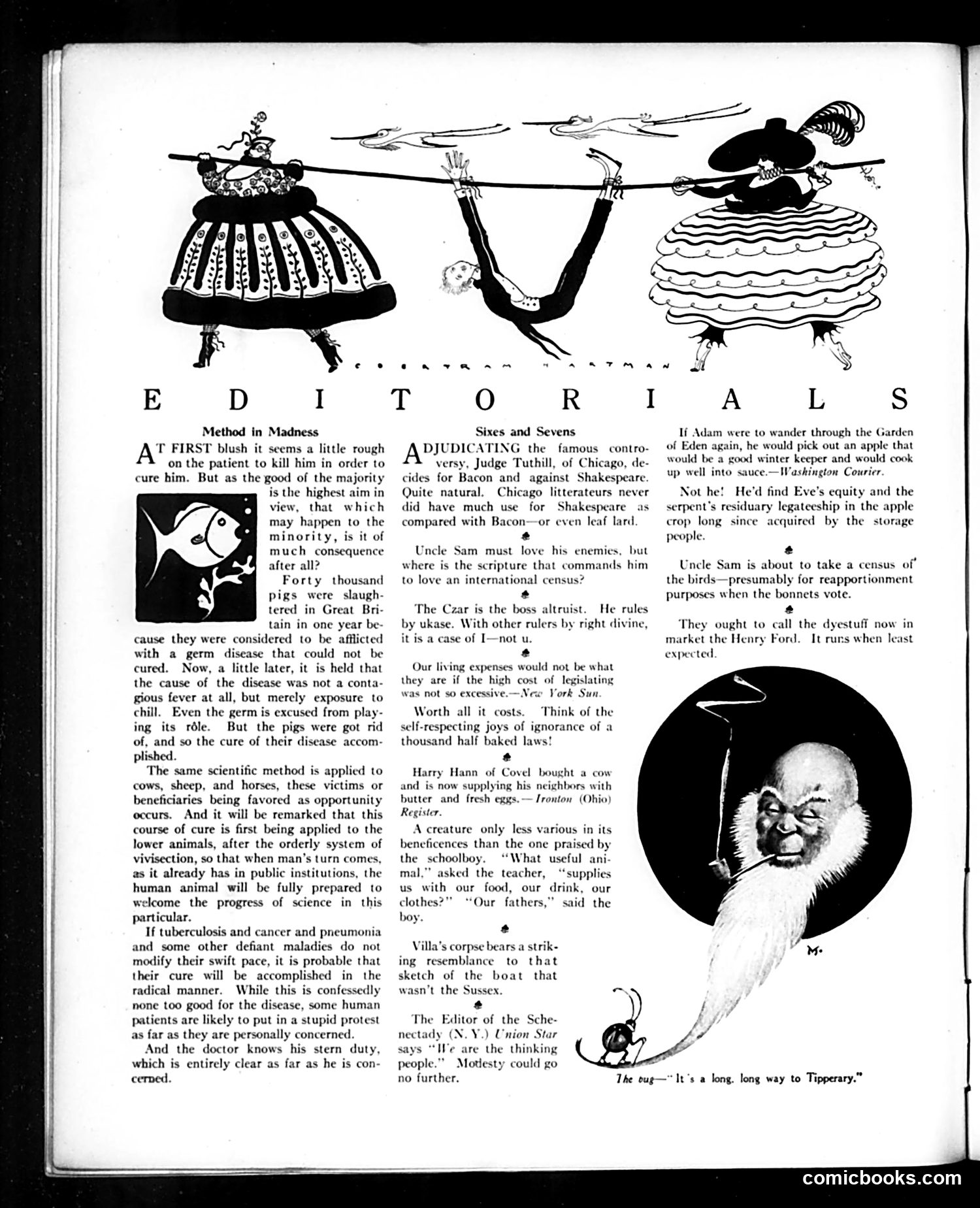
This page contains editorial commentary and satirical pieces from *Judge* magazine. The top illustration shows three figures on a clothesline in a playful "Sixes and Sevens" section—likely depicting social types or fashionable characters of the era in exaggerated dress. The editorials below critique various contemporary issues: one mocks a Chicago judge's views on Shakespeare versus Bacon; another discusses animal disease control and scientific methods applied to livestock. There's commentary on legislation costs and a reference to Harry Hann of Covey supplying neighbors with butter and eggs. A portrait illustration appears to accompany discussion of corporate practices or public figures, though the specific identity isn't clear from visible text. The overall tone is satirical commentary on current events, social attitudes, and public figures typical of *Judge's* format as a humor and satire publication.
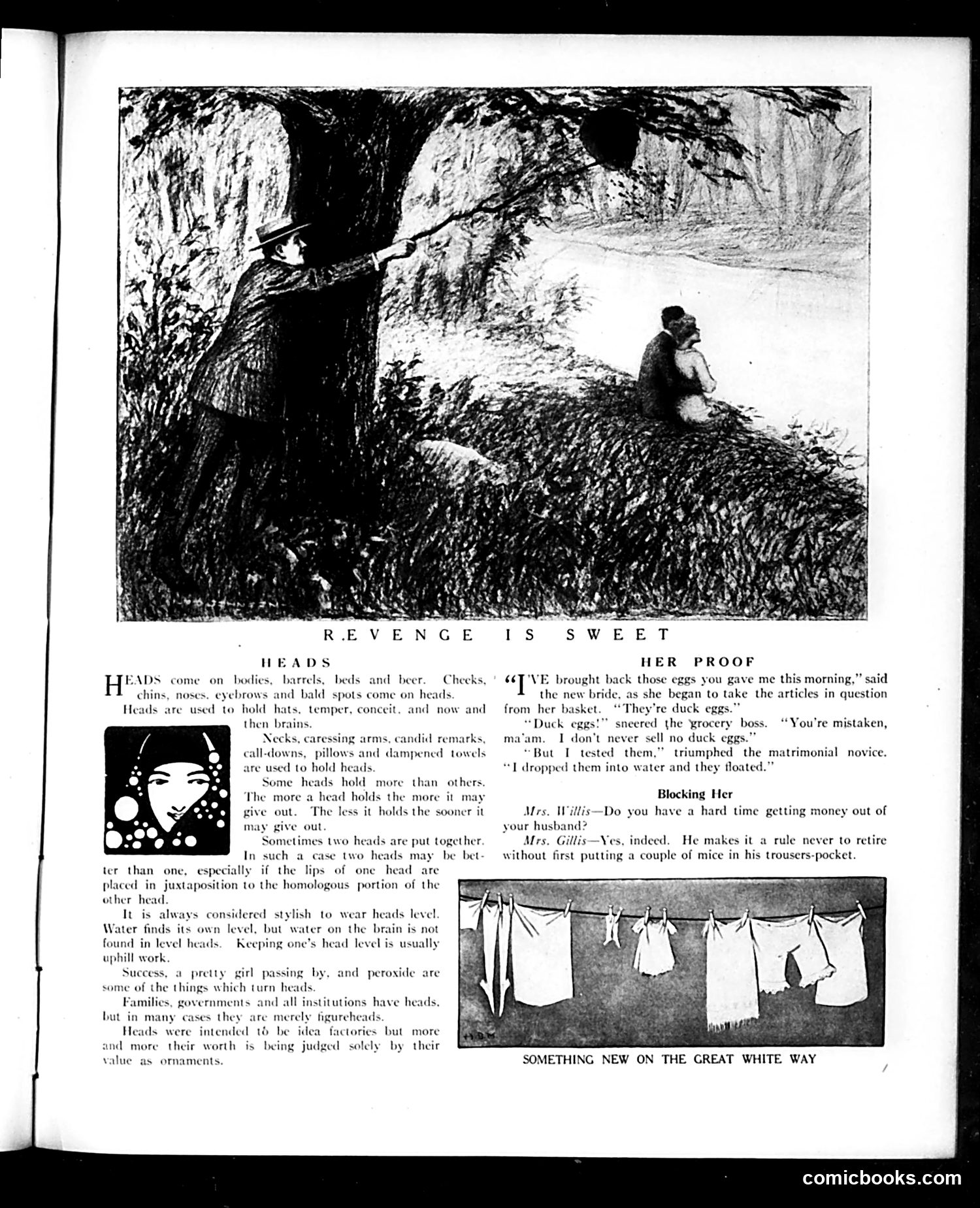
This page from *Judge* magazine contains two distinct sections: **"Heads" (left):** A brief humorous essay about the cultural and practical significance of heads—how they hold hats, display intelligence, and serve as ornaments. It's light satirical commentary on human vanity and social pretension. **"Her Proof" (right):** A domestic humor piece about a newlywed bride who bought duck eggs at market but dropped them in water, causing them to float away. When her husband questions the purchase, she defensively insists she never sells duck eggs—implying he's mistaken about what happened. The joke plays on her unconvincing excuse and marital miscommunication. **"Something New on the Great White Way" (bottom):** An illustration showing laundry on a clothesline, likely satirizing theatrical fashion or urban domestic life, though the specific reference is unclear without additional context.
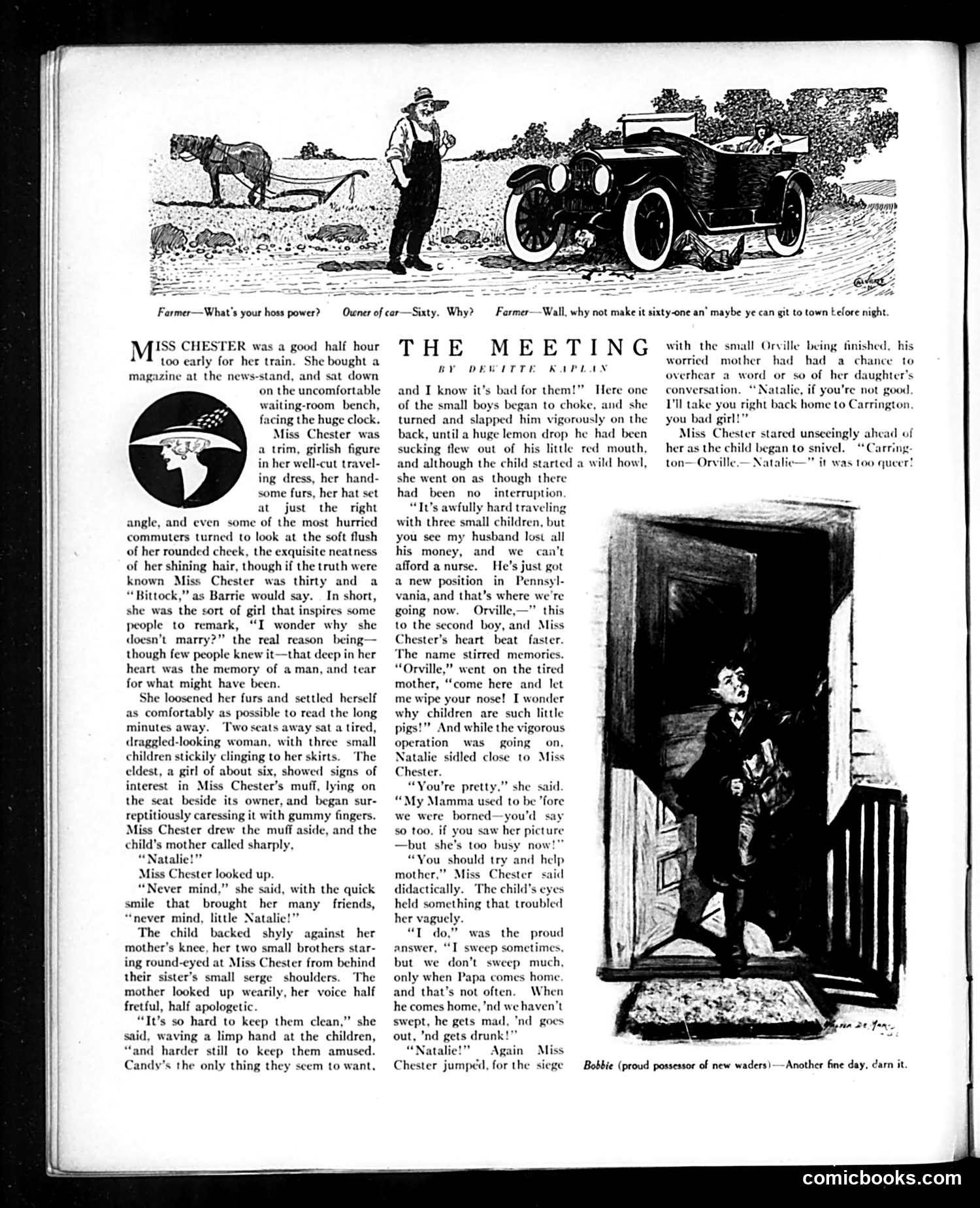
The top cartoon satirizes the clash between old and new transportation. A farmer with a horse-drawn plow encounters an automobile owner. When asked his "horsepower," the farmer responds that he'll make it to town by nightfall—implying the car owner's boast of "sixty" horsepower is absurdly excessive. This reflects early-20th-century tensions between traditional agriculture and modern automotive technology, mocking both the farmer's skepticism of cars and motorists' grandiose speed claims. The accompanying story "The Meeting" explores class and lost romance. Miss Chester, an unmarried thirty-year-old woman of means, encounters a shabby mother with three children on a train platform. Through conversation, she learns the woman's husband is named Orville and they're relocating to Carrington—names and places that emotionally affect Miss Chester, suggesting she once knew this man romantically. The story emphasizes class difference: Miss Chester's refined appearance contrasts sharply with the exhausted, struggling mother, hinting at what might have been had circumstances differed.
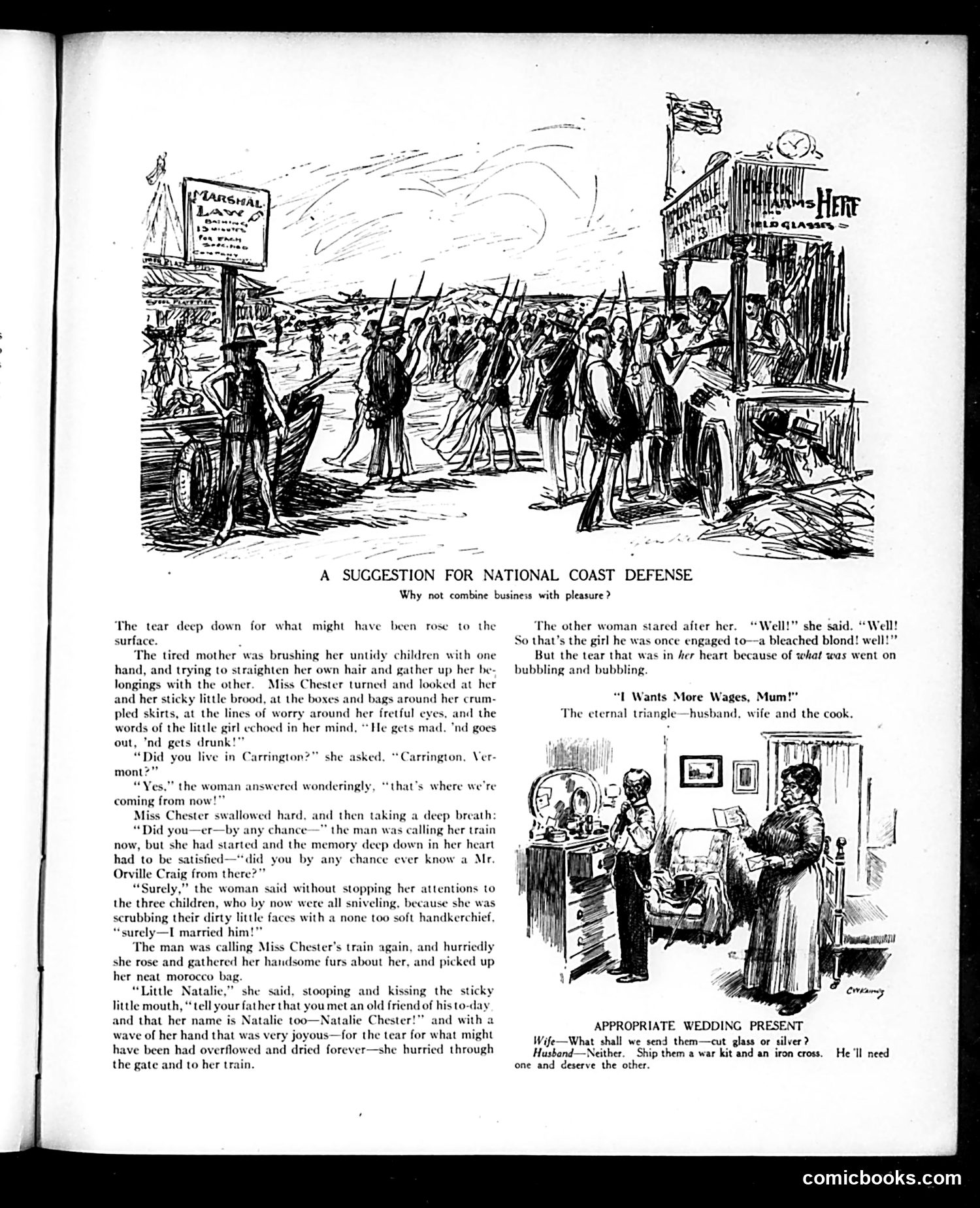
**Top Cartoon - "National Coast Defense":** This depicts a beach scene where civilians (appearing to be families with children) are militarized, carrying rifles. The satire suggests combining "business with pleasure" by turning recreational coastal areas into military training grounds—a commentary on early 20th-century militarization anxieties and preparedness debates, likely pre-WWI. **Story - "I Wants More Wages, Mum!":** A domestic comedy about class tension. The caption "The eternal triangle—husband, wife and the cook" uses humor to mock working-class domestic service relationships. The joke satirizes household power dynamics where servants demand better treatment. **Bottom Cartoon - "Appropriate Wedding Present":** A couple debates wedding gifts. The husband suggests sending "a war kit and an iron cross," meaning military supplies and a German decoration. This satirizes either recent conflict with Germany or pre-war tensions, suggesting the newlyweds will need weapons—dark humor about anticipated warfare. **Overall Context:** This appears to be wartime or pre-war satirical commentary, likely from WWI era, mixing domestic comedy with military/national defense humor.
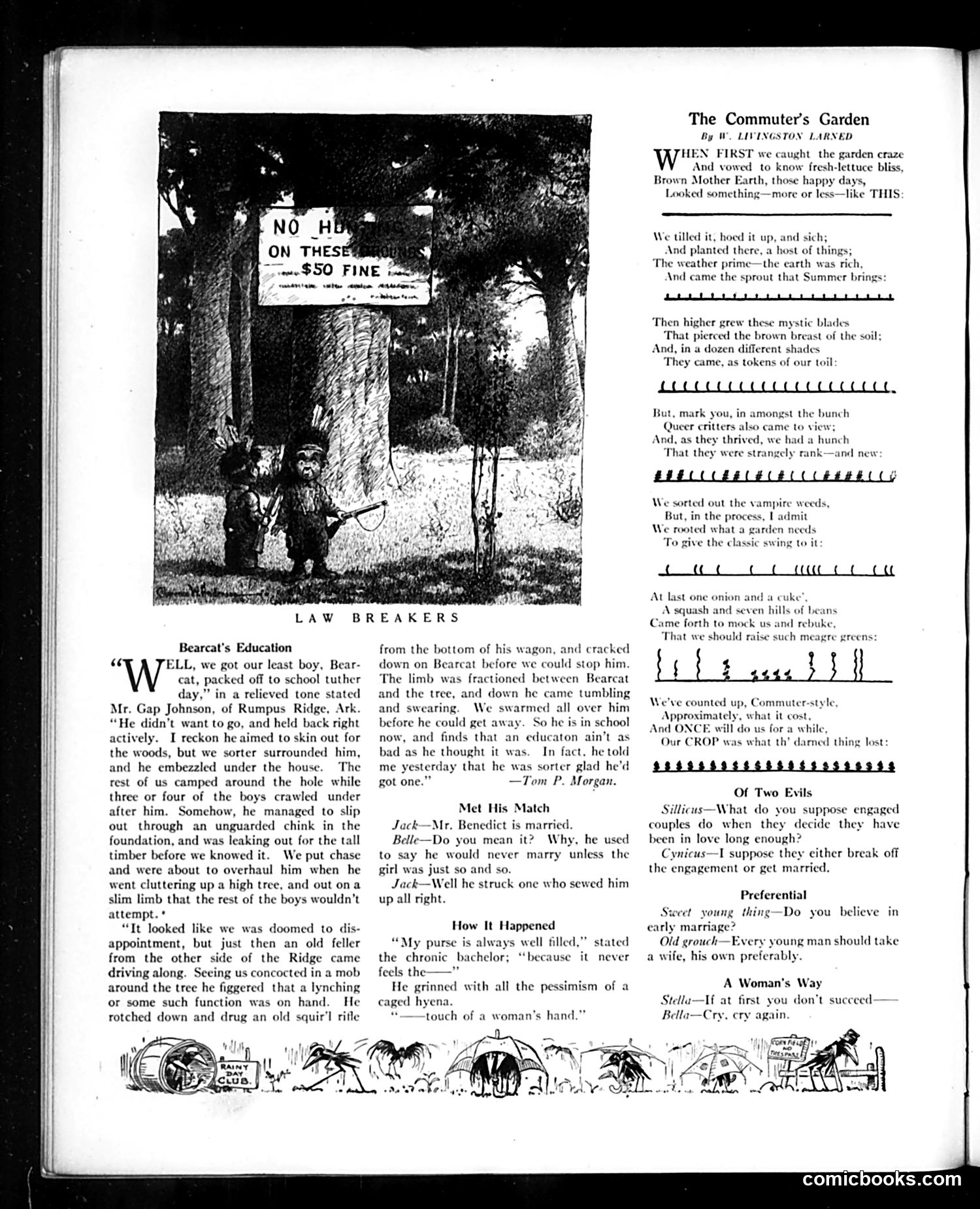
This Judge page contains two separate humorous pieces typical of early 20th-century American rural satire. **"Bearcat's Education"** depicts backwoods Arkansas dialect humor. Mr. Gap Johnson recounts capturing his reluctant son "Bearcat" to send to school. The boy hides under the house and escapes up a tree; a neighbor accidentally shoots the limb, forcing him down. The joke: the accidental gunshot accomplishes what parental persuasion couldn't—getting the boy to school, where he's now oddly content. **"The Commuter's Garden"** (verse by W. Livingston Larned) mocks urban professionals attempting amateur gardening. Despite tilling, planting, and battling weeds and pests, they harvest only one onion, one cucumber, seven beans—a humiliating yield. The satire: their careful accounting reveals the crop cost far more than store-bought produce would have. Both pieces traffic in contemporary humor about class (rural vs. urban) and American self-reliance myths.
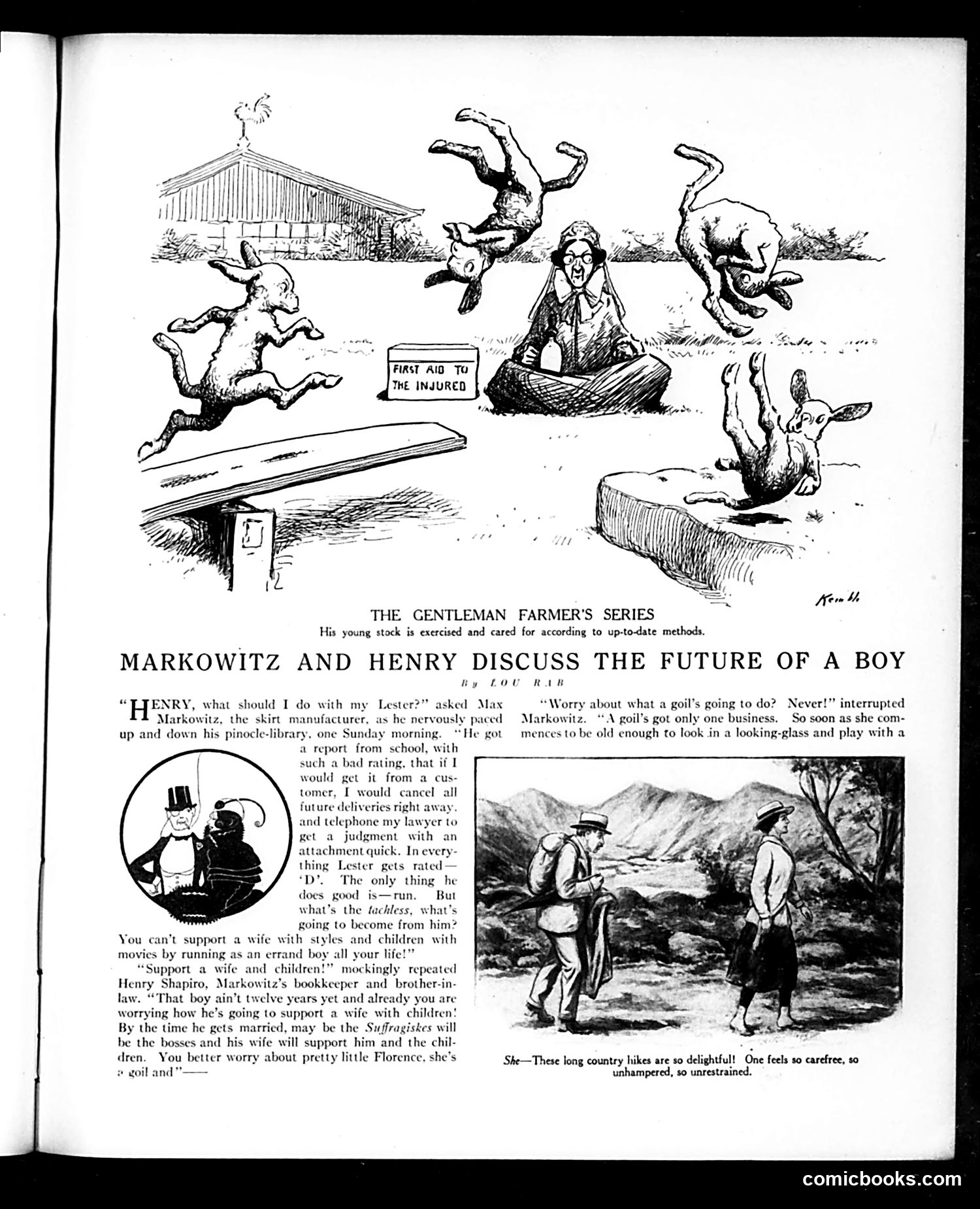
This satirical piece uses Jewish immigrant characters (Markowitz, a skirt manufacturer, and Henry Shapiro, his bookkeeper) to mock middle-class anxieties about children's futures and gender roles. **The Setup:** Markowitz worries his son Lester is a failure—poor grades, only good at running—and can't support a family. Henry dismisses the concern, arguing a boy's success doesn't matter since women will soon become breadwinners anyway (a jab at the suffrage movement). **The Satire:** The piece ridicules both: 1. Immigrant parents' obsession with financial security and "respectable" careers 2. Contemporary anxieties about women's liberation and changing gender roles The counterpoint photograph shows carefree hikers, suggesting modern youth enjoy freedoms their parents' generation never had—a contrast to the characters' Old World concerns. **Context:** Written when women's suffrage was actively debated (pre-1920), this reflects period anxiety that female voting rights would fundamentally alter family economics and male authority.
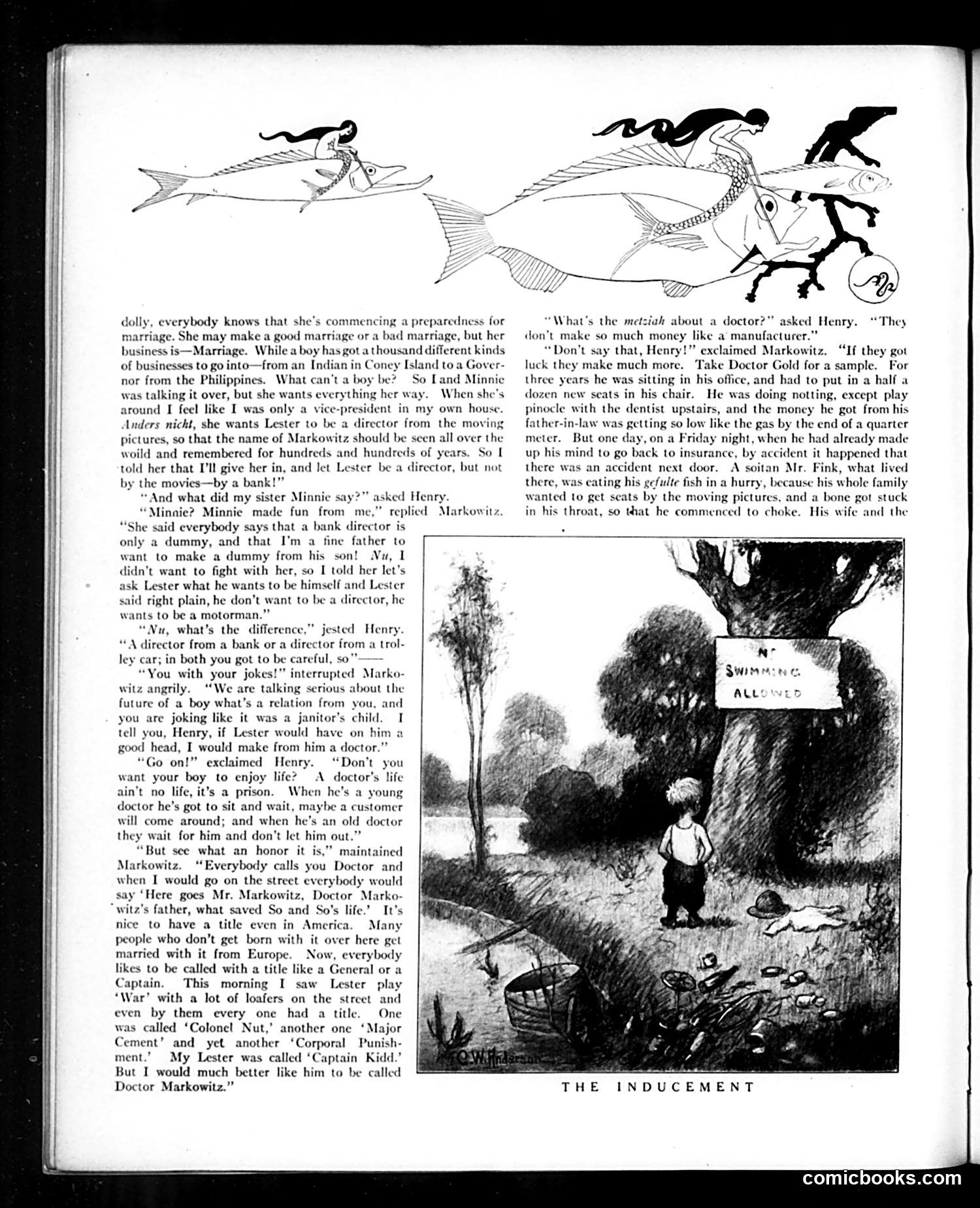
This page satirizes Jewish immigrant aspirations and parenting anxieties in early 20th-century America. The dialogue between Markowitz and his friend Henry concerns what career path Markowitz's son Lester should pursue. **The satire:** Markowitz obsesses over prestigious titles and social status—wanting Lester to become a doctor or bank director so he can boast to neighbors ("Here goes Mr. Markowitz, Doctor Markowitz's father"). Henry counters that a doctor's life is actually grinding drudgery with no real reward. **The humor relies on:** - Yiddish-inflected English ("metziah," "gefulte fish") reflecting immigrant speech patterns - The irony that street children already mimic adult titles ("Colonel Nut," "Corporal Punishment"), mocking the very status-seeking Markowitz values - Class tension: Markowitz dreams of white-collar respectability while his son plays with "loafers" The cartoon illustration (labeled "The Inducement") appears to show a child by water, possibly depicting one of these street games. The piece gently ridicules immigrant parents' obsessive concern with credentials and social climbing as markers of American success.
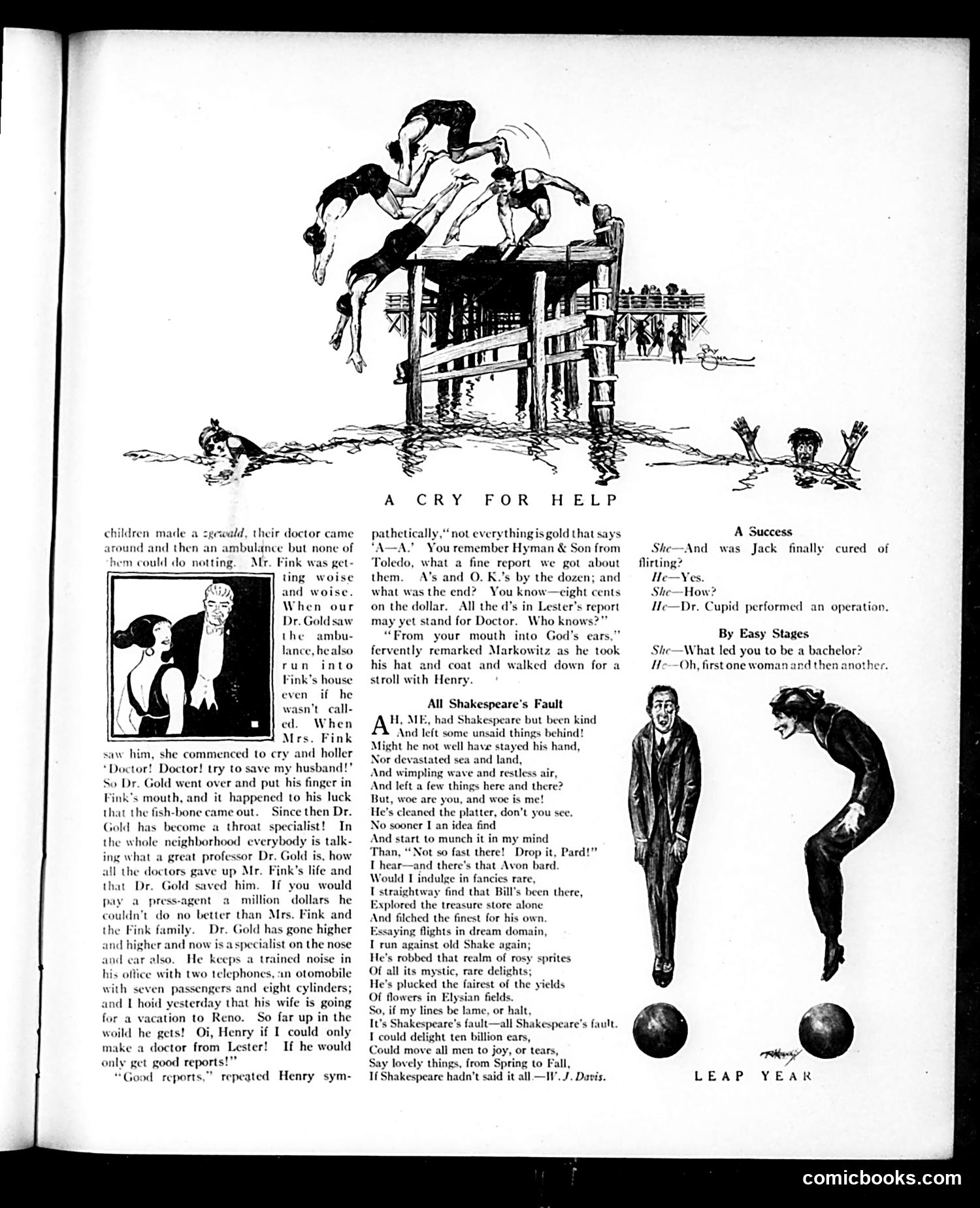
This page contains three distinct pieces of humor: **Top cartoon ("A Cry for Help"):** Depicts Dr. Gold, a throat specialist who gained fame by removing a fishbone from Mr. Fink's throat. The story satirizes how one lucky medical success—even a trivial one—can launch someone to celebrity and prosperity. The joke mocks both the gullibility of neighborhoods that elevate doctors based on anecdotal success and the tendency of successful professionals to reinvent themselves (Gold now claims expertise in noses and ears). The Yiddish-inflected dialogue suggests this targets immigrant communities' attitudes toward professionals. **Middle poem ("All Shakespeare's Fault"):** A humorous complaint that Shakespeare exhausted all possible literary ideas, leaving modern writers unable to express original thoughts. **Bottom section:** Brief comedic exchanges about romance and marriage, typical of Judge's light humor fare. The page exemplifies early 20th-century American satire mixing social observation with ethnic humor and romantic comedy.
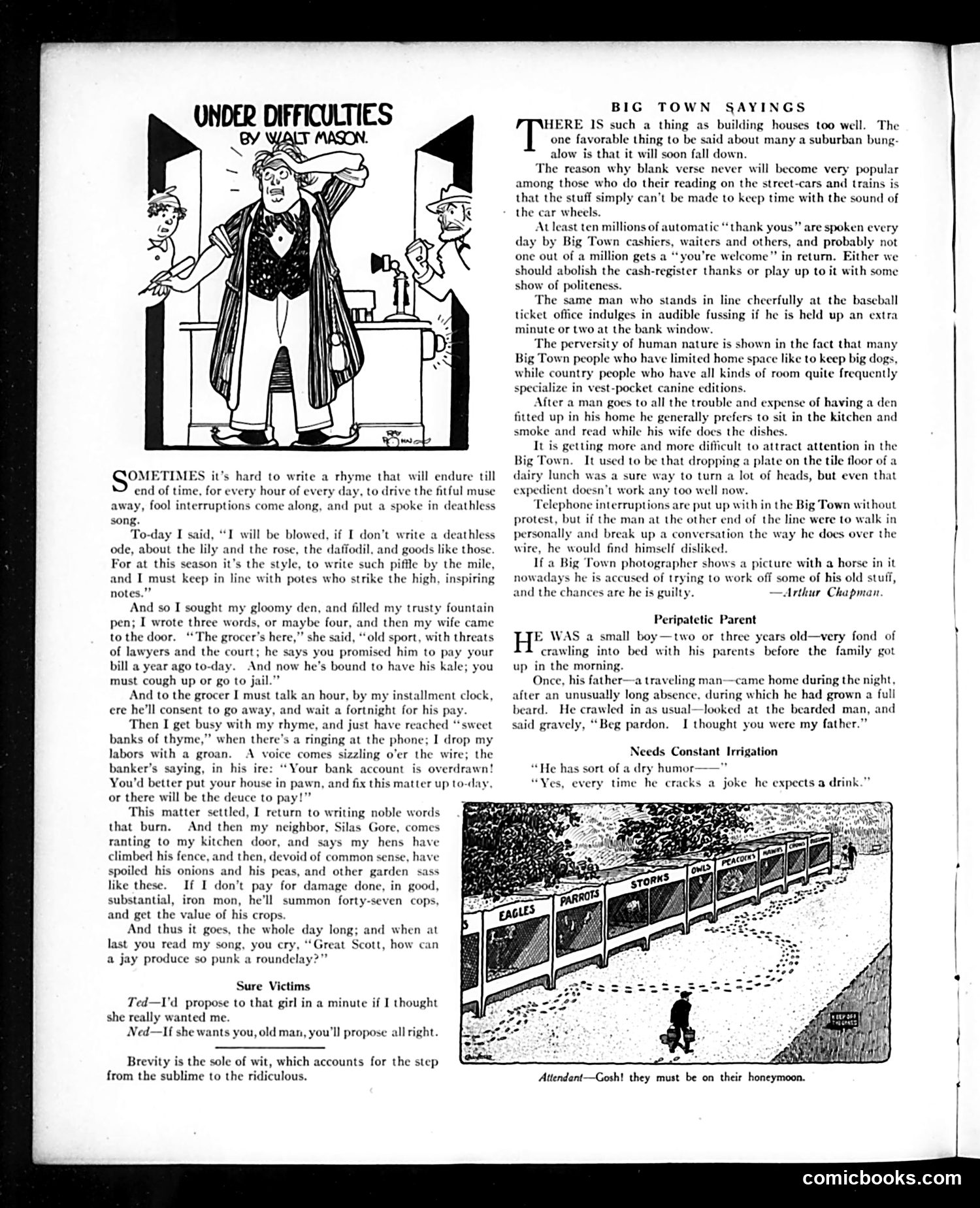
**"Under Difficulties" by Walt Mason** is a humorous poem about a writer's inability to compose because of constant domestic and financial interruptions. The speaker attempts to write "noble words" about flowers but is repeatedly disturbed by his grocer demanding payment, his banker announcing an overdraft, and his neighbor Silas Gore complaining about escaped chickens damaging his garden. By day's end, exhausted and harassed, the writer produces mediocre verse—hence "how can a jay produce so punk a roundelay?" The satire targets the frustrations of middle-class life: bills, creditors, nosy neighbors, and household chaos that prevent intellectual or creative pursuits. It's relatable humor about financial stress and social obligations in early-1900s urban America. The page also contains "Big Town Sayings"—brief witty observations about urban life contrasting city and country behavior, touching on politeness, dog ownership, and attention-getting.
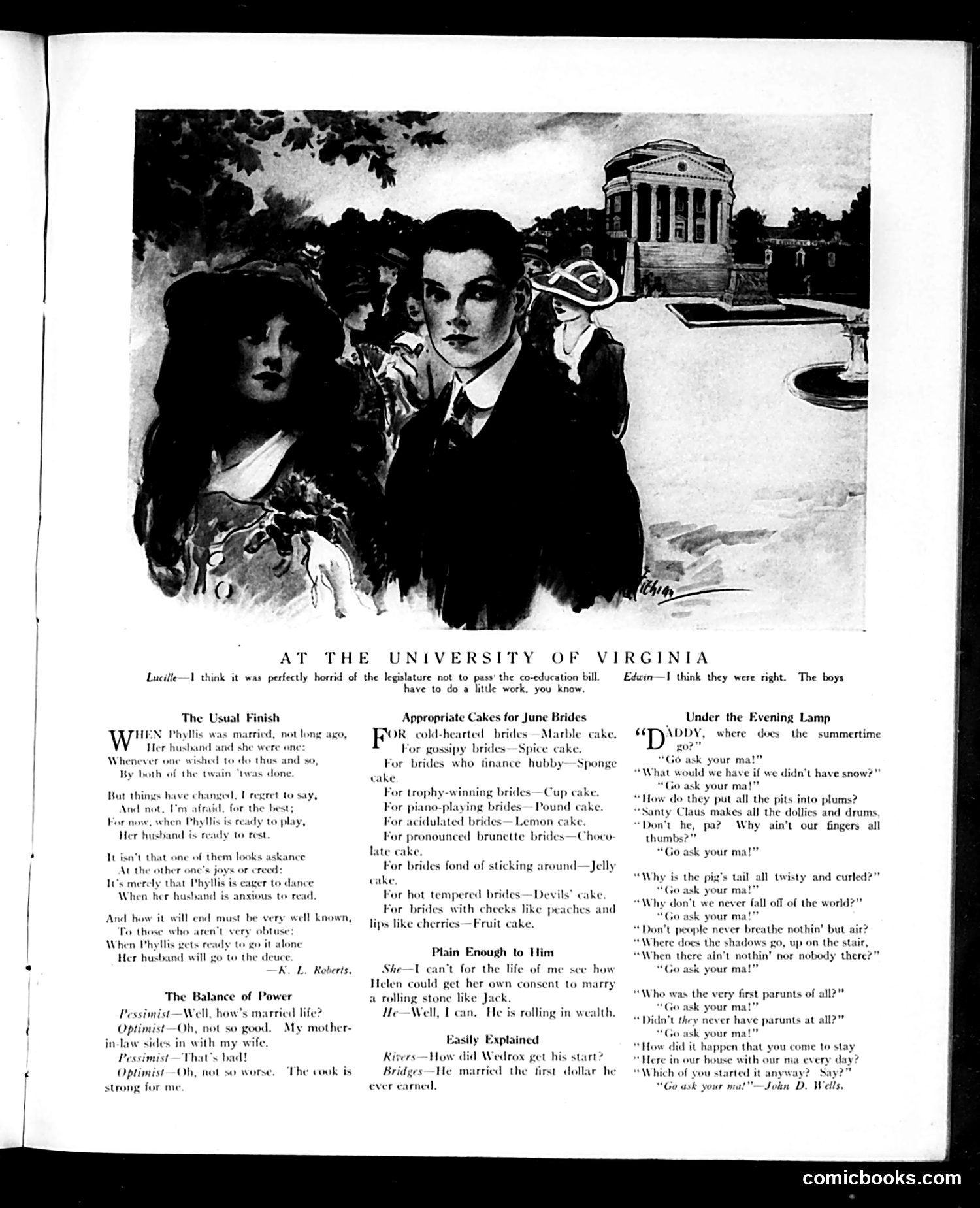
This page contains several short humor pieces satirizing early 1900s marriage and gender dynamics, set at the University of Virginia. The main cartoon depicts a couple at the university with the caption contrasting two views on co-education (allowing women to attend). One character argues the legislature was "horrid" not to pass a co-education bill; the other counters they were "right"—implying women should stay home and "do a little work." The surrounding jokes mock married life: husbands and wives with conflicting desires ("The Usual Finish"), mothers-in-law siding with wives ("The Balance of Power"), and a woman marrying a wealthy "rolling stone" ("Easily Explained"). A section on "Appropriate Cakes for June Brides" humorously categorizes brides by personality type. "Under the Evening Lamp" features a child pestering parents with endless questions, told repeatedly to "Go ask your ma!"—satirizing both childhood curiosity and the expectation that mothers handle domestic education. The humor reflects anxieties about changing women's roles and domestic authority in the Progressive Era.
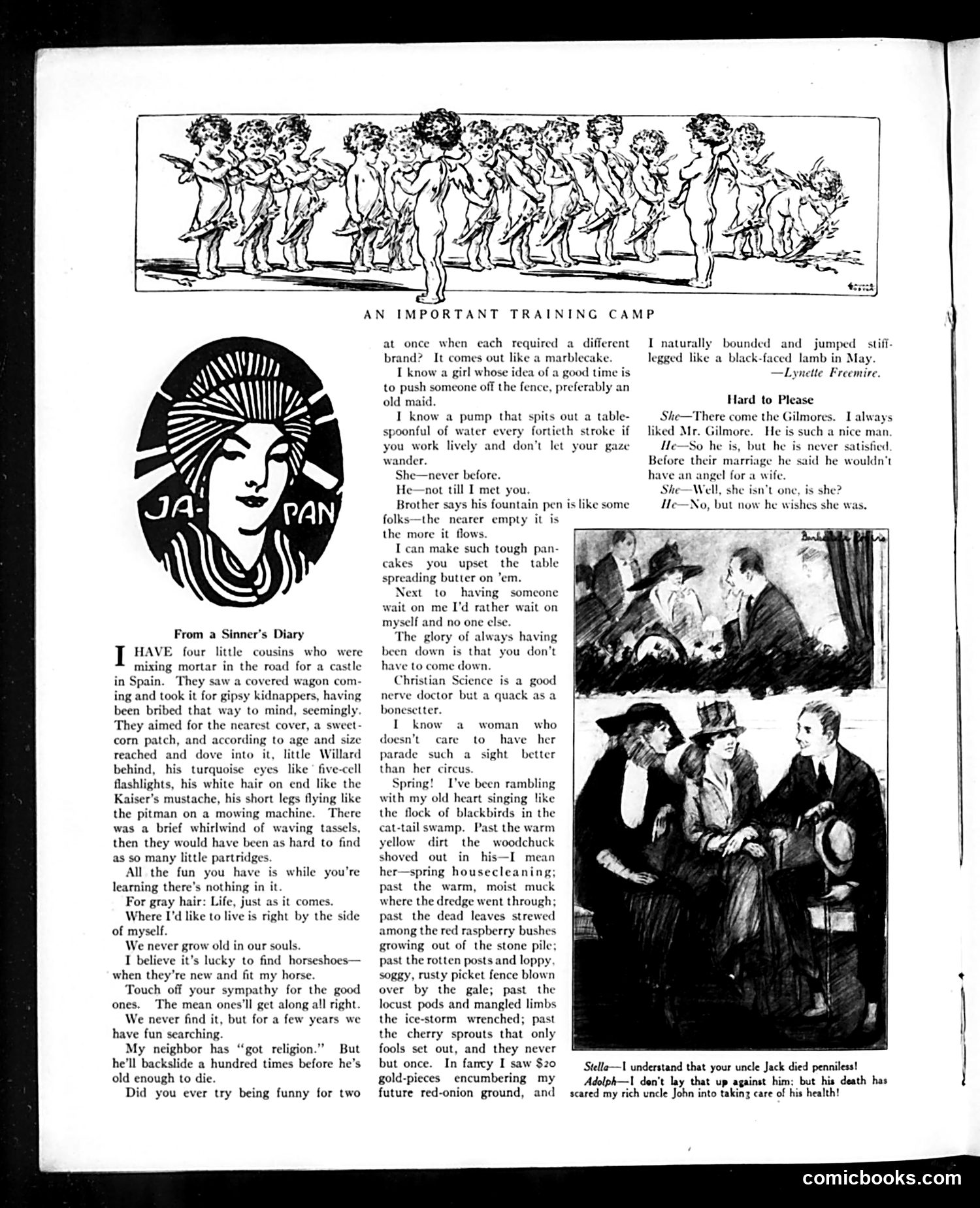
This page contains two distinct pieces of satirical content: **"An Important Training Camp"** (top illustration): The drawing depicts cherubs in a line, likely satirizing rigid military or institutional training methods of the era. The accompanying text mocks various social situations—poorly made pancakes, unsatisfactory service, fountain pens that malfunction—using military/training metaphors to humorously suggest that life's everyday frustrations require endurance training. **"From a Sinner's Diary"** (left column): A first-person account of domestic observations and social commentary. Notable is the reference to "the Kaiser's mustache"—a contemporary allusion to Kaiser Wilhelm II of Germany, suggesting this magazine predates or addresses World War I tensions. The observations are gently cynical reflections on marriage, religion, and human nature. **"Hard to Please"** (right side): A brief dialogue joke about a husband perpetually dissatisfied with his wife, contrasting his pre-marital and post-marital attitudes. The bottom photograph and dialogue appear to be an unrelated comedic sidebar about an uncle's death creating financial incentives. The overall tone is gentle domestic satire typical of early 20th-century American humor magazines.
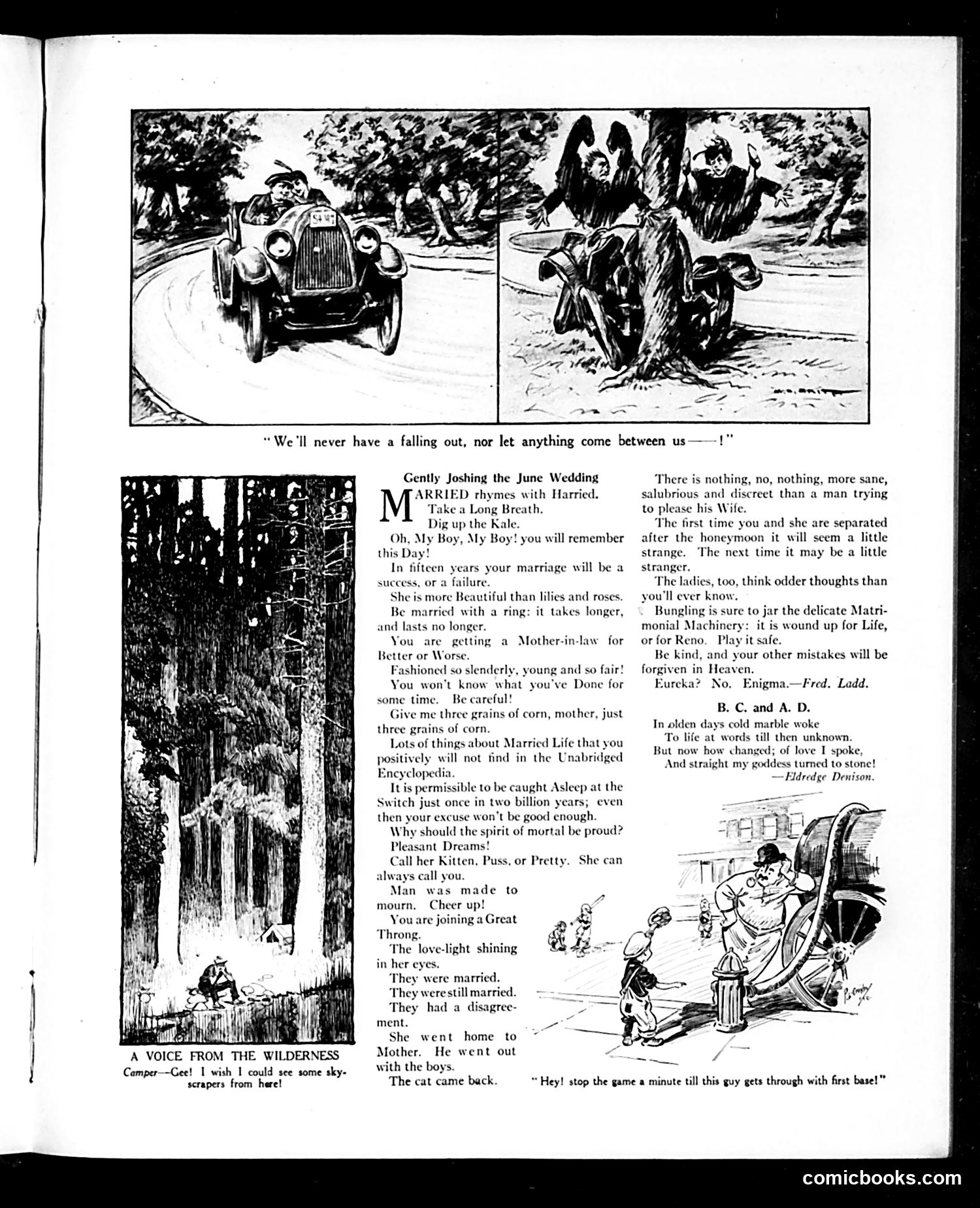
This Judge magazine page contains light satirical commentary on marriage aimed at newlyweds, particularly grooms. **The Main Content:** "Gently Joshing the June Wedding" offers tongue-in-cheek advice to newly married men. It plays on the contrast between romantic ideals and marital reality—jokes about acquiring a mother-in-law "for Better or Worse," warnings that wives will eventually visit their mothers while husbands go out with the boys, and the cynical quip that "the cat came back" (suggesting marital discord is temporary but recurring). **Key Satirical Points:** - Marriage rhymes with being "harried" (harassed) - The romantic love-light in her eyes won't prevent disagreements - "Play it safe" in this delicate "Matrimonial Machine" - References to "Reno" (Nevada divorce capital) as an alternative to making marriage work **The Cartoons:** The top panel shows a couple pledging eternal devotion; the bottom right shows a domestic scene with children. The left panel ("A Voice from the Wilderness") depicts a camper frustrated with tree coverage. The tone is affectionate mockery—cynical about marriage's challenges but not hostile, typical of early 20th-century men's magazine humor.
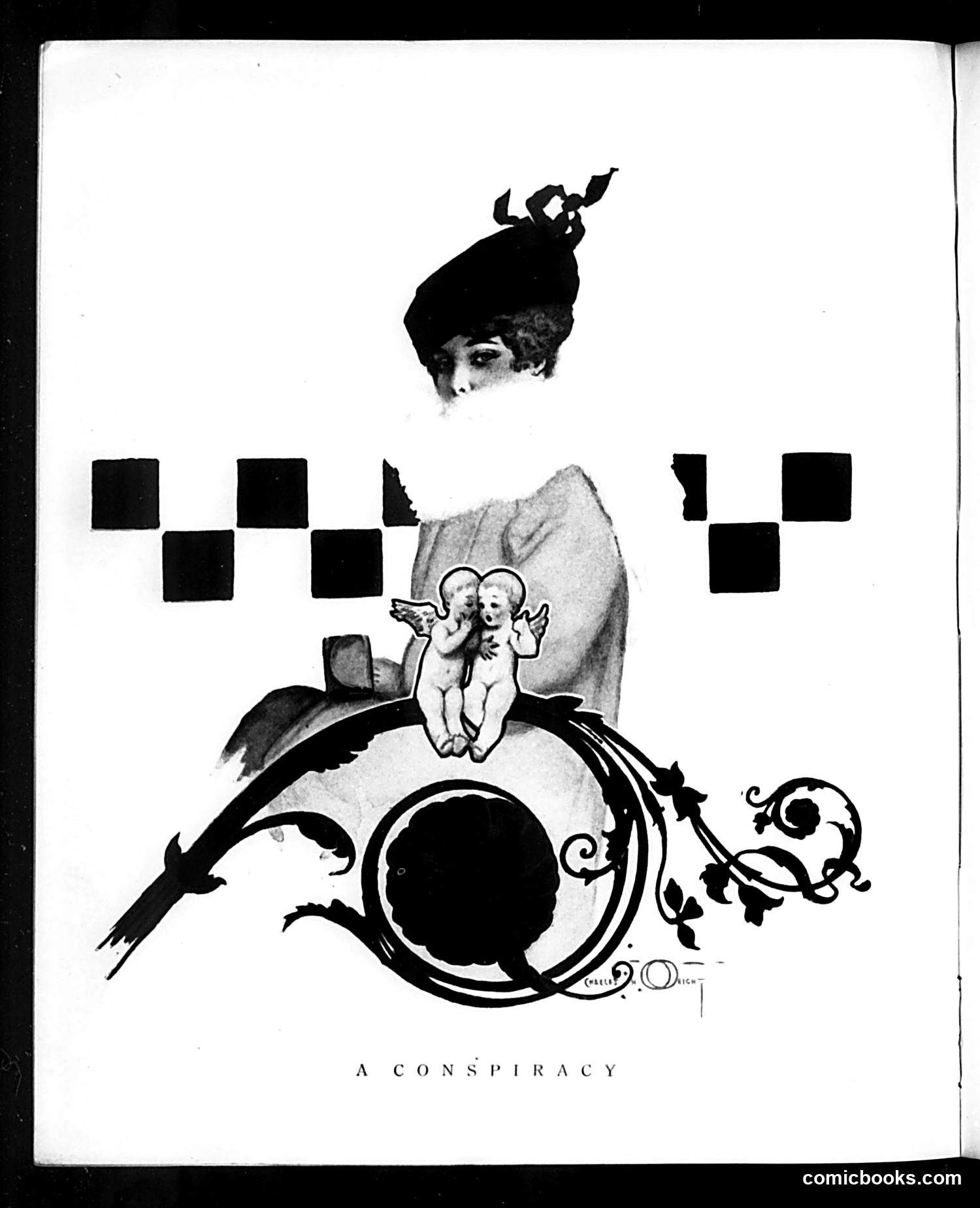
This Judge magazine cartoon satirizes political intrigue through allegorical imagery. A fashionably dressed woman's head floats above an ornate circular design containing cherubs (symbolizing innocence or cupids), with decorative scrollwork and what appears to be a raven or dark bird. The black squares scattered across the upper portion likely represent censored or redacted text—a visual metaphor for hidden secrets and covered-up information. The title "A Conspiracy" suggests the cartoon mocks some alleged plot or secret scheme, probably involving prominent figures of its era. The woman's elegant attire and the romanticized cherub imagery create ironic contrast with the serious accusation of conspiracy. Without specific historical context or visible names, the precise political target remains unclear, though the censorship blocks emphasize themes of hidden dealings and public deception.

This page reprints international jokes and cartoons from European publications, demonstrating early 20th-century cross-cultural humor. The content includes: **"From a Gentle Hand"** (German): A waitress, formerly a chambermaid before the war, requests another haircut—satirizing wartime social mobility. **"Confidential"** (German/Munich): A restaurant joke where the waiter admits the fancy menu descriptions are deliberately misleading for regular customers, mocking pretentious dining. **"Wonderful Woman"** (British): Contrasts pre-war feminine delicacy (screaming at mice) with wartime courage under artillery fire—celebrating women's wartime resilience. **"By Comparison"** (German): A husband reads about bad weather at home while ignoring beautiful local weather—humor about displaced persons' homesickness. **"A Splendid Father"** (British): Darkly comic—a poor man's children praise their father for never raising a hand except "in self-defence," revealing class poverty and rough parenting norms. The page showcases how Judge magazine featured translated European humor to entertain American readers with different cultural perspectives.
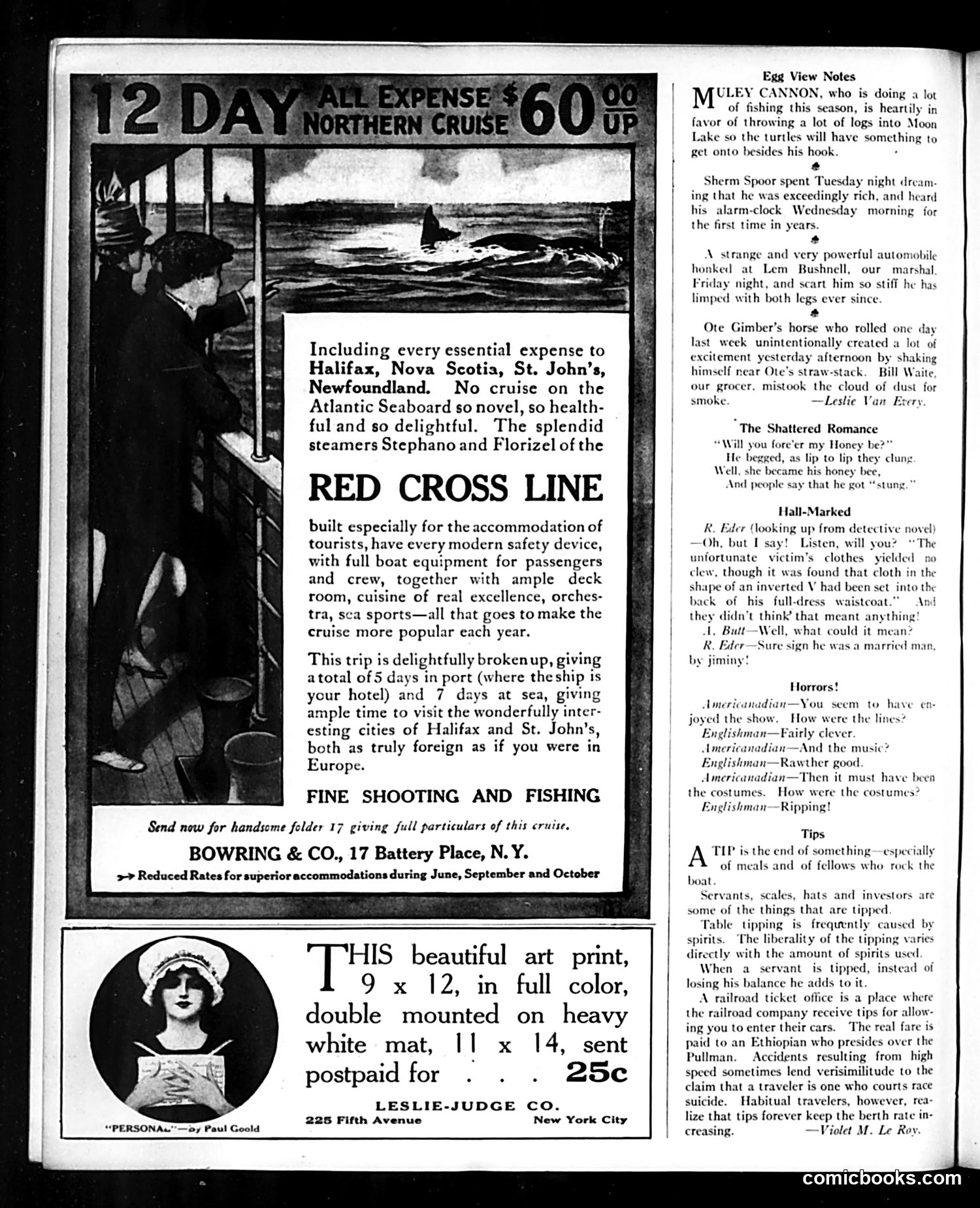
This page is primarily **advertising and humor columns**, not political satire. The top half features a Red Cross Line cruise advertisement for a 12-day Northern voyage to Halifax and Newfoundland for $60—positioned as an exotic, European-like experience for American tourists. The right side contains **"Egg View Notes,"** a humor column with local small-town anecdotes (fishing mishaps, horses rolling in dust, etc.). Below are light comic sketches: "The Shattered Romance" plays on the phrase "honey bee" (stung); "Hall-Marked" jokes about inverted V-shaped cloth on a waistcoat supposedly signaling marriage; and a conversation between an American and Englishman contains mild cultural ribbing. The final piece, "Tips," humorously discusses tipping customs—servants, railroad porters, etc.—suggesting tips correlate with alcohol consumption and that habitual travelers accept constant tipping as inevitable. The humor is gentle, domestic, and focused on everyday social observations rather than political commentary.
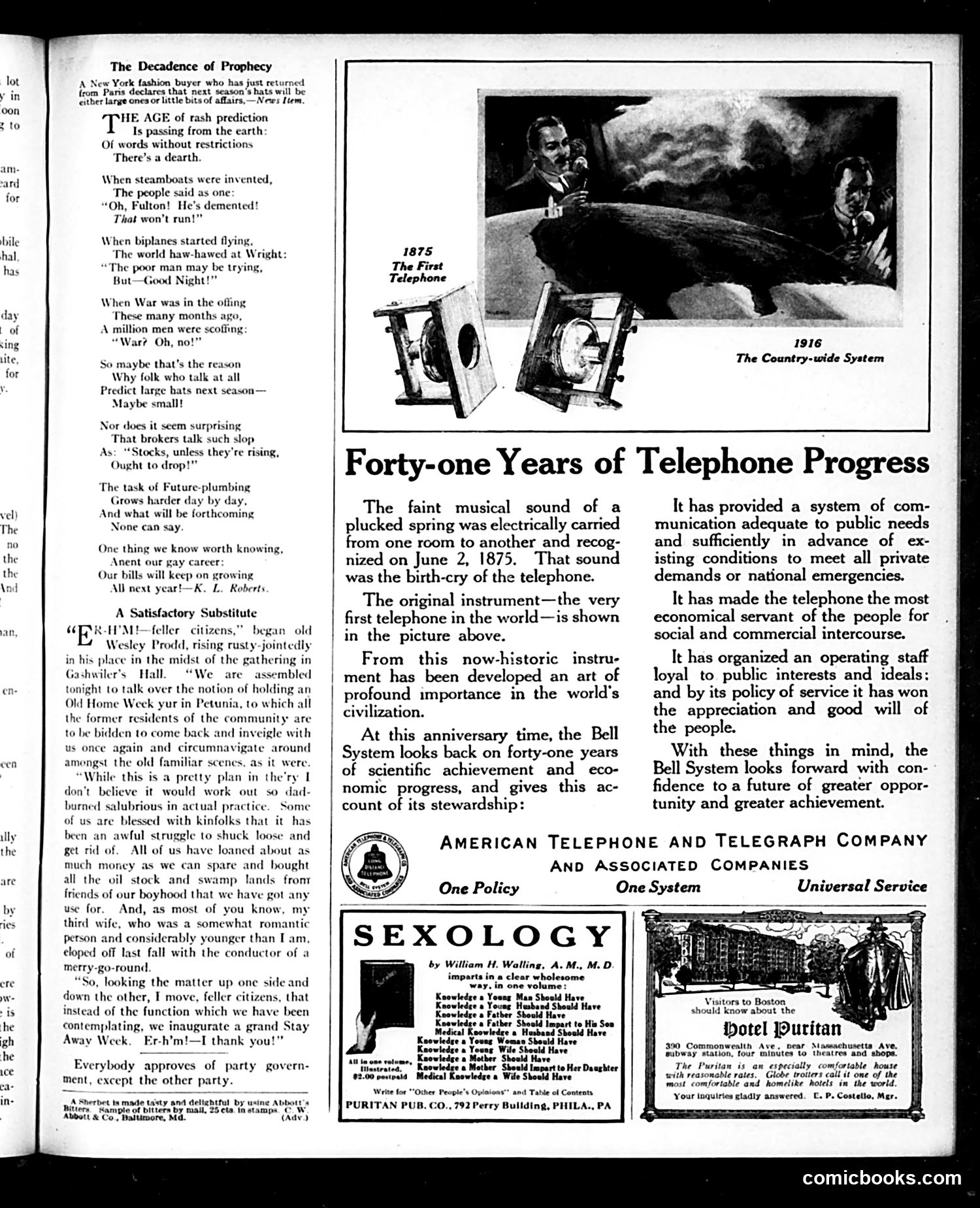
This Judge magazine page contains three distinct elements: **"The Decadence of Prophecy"** (poem, left): A satirical piece mocking failed predictions. It references historical skeptics who doubted steamboats, Wright brothers' airplanes, and denied war was coming—yet all occurred anyway. The joke: people make confident predictions that prove wrong, so a fashion buyer's claim that next season's hats will be "either large ones or little bits" is equally unreliable. The poem ends cynically: only one certain prediction exists—"Our bills will keep on growing." **"A Satisfactory Substitute"** (story, lower left): A small-town character proposes replacing "Old Home Week" (a community reunion) with "Stay Away Week" because reconnecting with old acquaintances, rivals, and creditors would be unbearable. The humor lies in his frank admission that nostalgia doesn't withstand practical reality. **Bell System Advertisement** (right): Celebratory copy marking 41 years since the telephone's invention (1875), praising the company's civic responsibility and service. The page exemplifies Judge's satirical voice: skeptical of grand claims, cynical about human nature, yet accepting advertisements promoting progress.
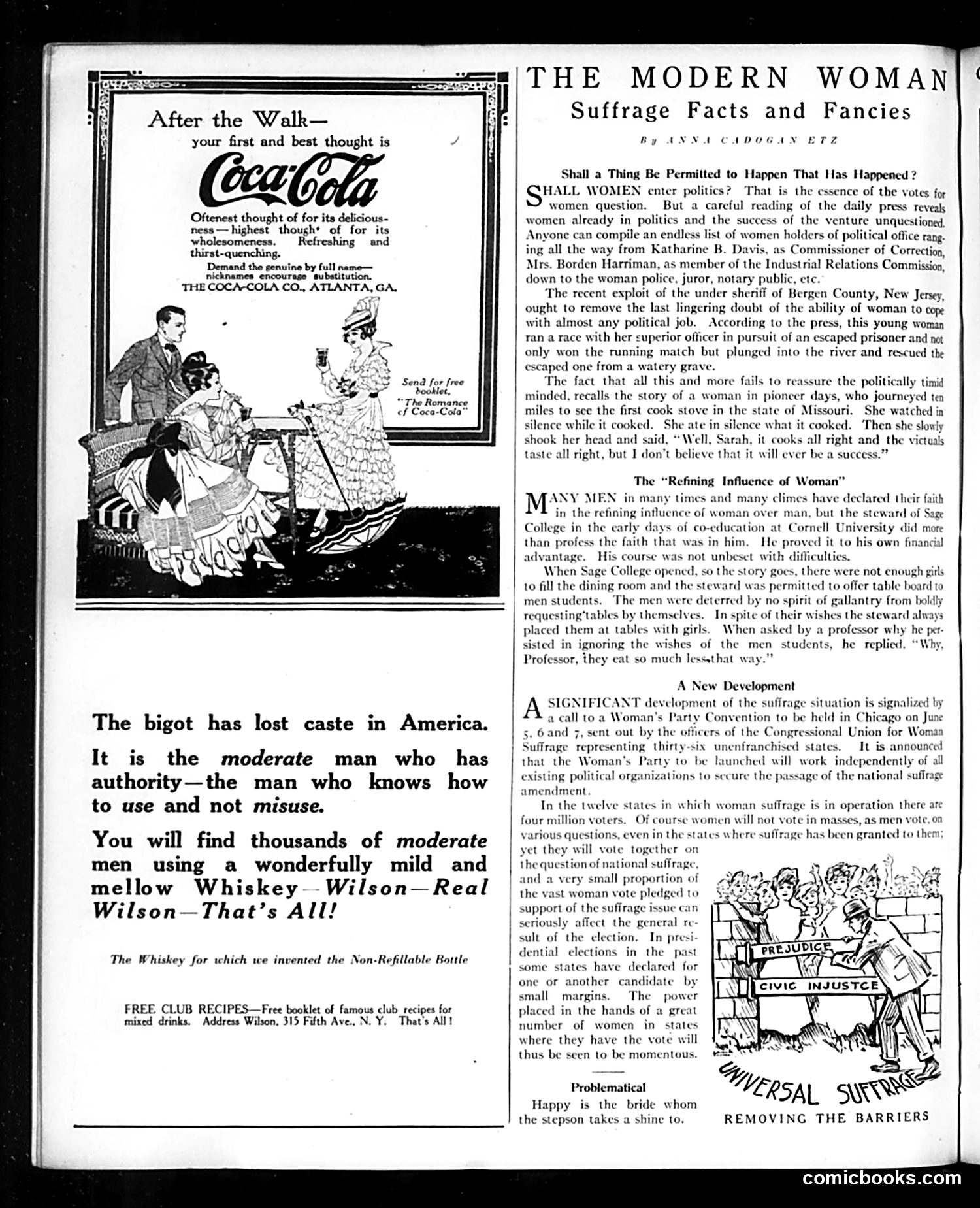
This page combines **advertisements with pro-suffrage editorial content**, creating an ironic juxtaposition typical of Judge's satirical approach. **Left side:** Coca-Cola and Wilson Whiskey ads promoting "moderation" and reasonableness—concepts the magazine ironically applies to suffrage debate on the right. **Right side:** "The Modern Woman: Suffrage Facts and Fancies" by Anna Cadogan Etz argues for women's voting rights. The text catalogs women already holding political office (naming Katharine B. Davis, Mrs. Borden Harriman) and recounts a New Jersey woman under-sheriff's heroic rescue of an escaped prisoner—demonstrating women's capability in demanding roles. **The satire:** The article mocks opponents' resistance as absurd, comparing them to a pioneer woman skeptical that a cook stove would ever work. It also notes men's illogical objection to women's presence at Cornell College dining tables—they ate *less* when seated with women, yet still opposed it. **Bottom cartoon:** "Universal Suffrage—Removing the Barriers" depicts women breaking through barriers to civic participation, supporting the article's argument.
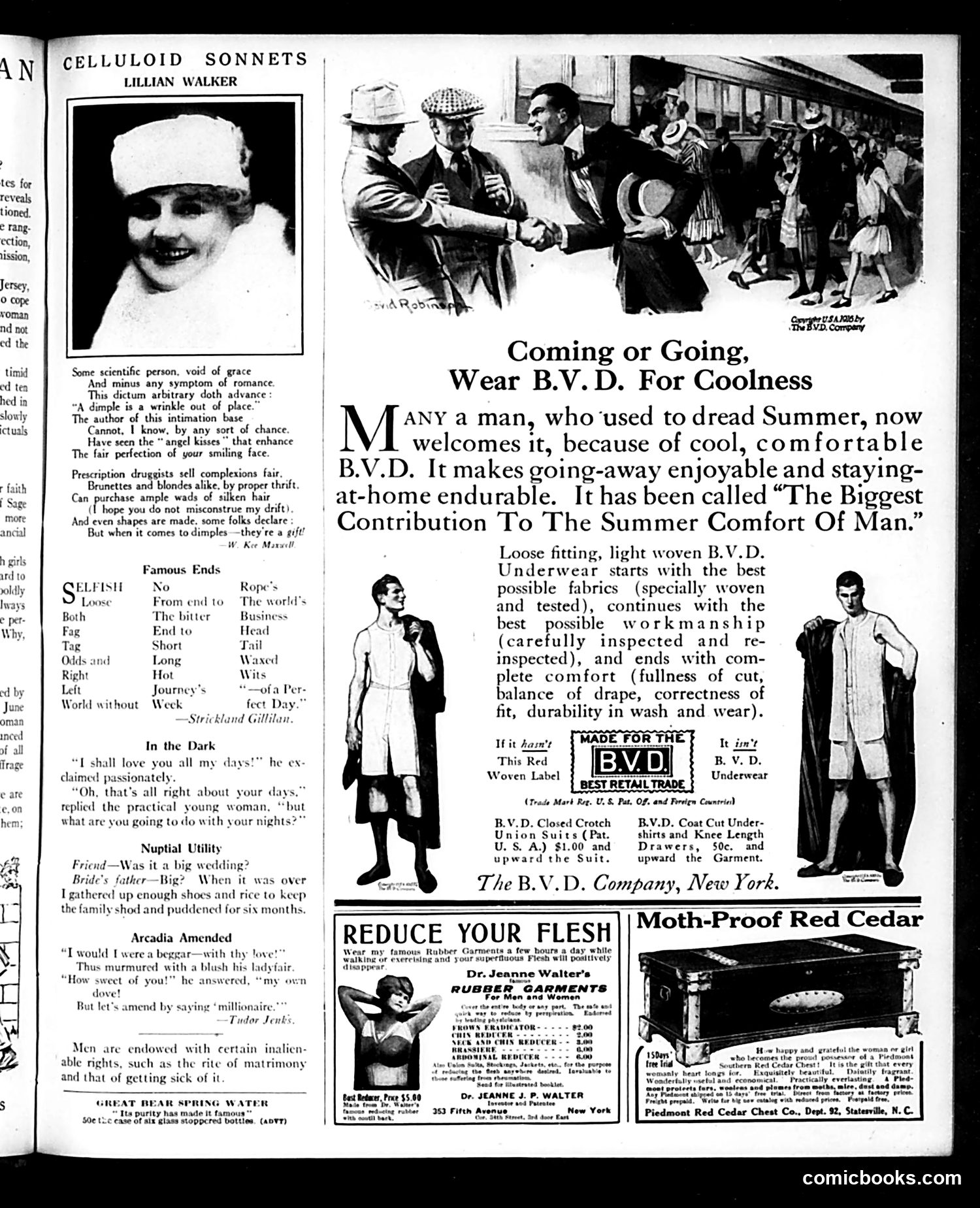
This page contains satirical poetry and advertisements rather than political cartoons. The "Celluloid Sonnets" by Lillian Walker mock romantic poetry and modern dating attitudes. One poem playfully argues that dimples cannot be artificially manufactured (unlike other beauty products), while another presents a young woman's practical response to marriage vows—she accepts promises of love "all my days" but pointedly asks what he'll do with "your nights?" The bulk of the page advertises B.V.D. underwear, marketing summer comfort to men. The copy emphasizes that loose-fitting, lightweight undergarments make summer tolerable and travel enjoyable—essentially selling the idea that proper underwear improves quality of life. Below that sits an advertisement for Dr. Jeanne Walter's rubber garments, promising weight reduction. This juxtaposes the underwear ad's comfort messaging with the era's obsession with body modification and slimming. The content reflects 1920s consumer culture and evolving attitudes toward marriage and courtship.
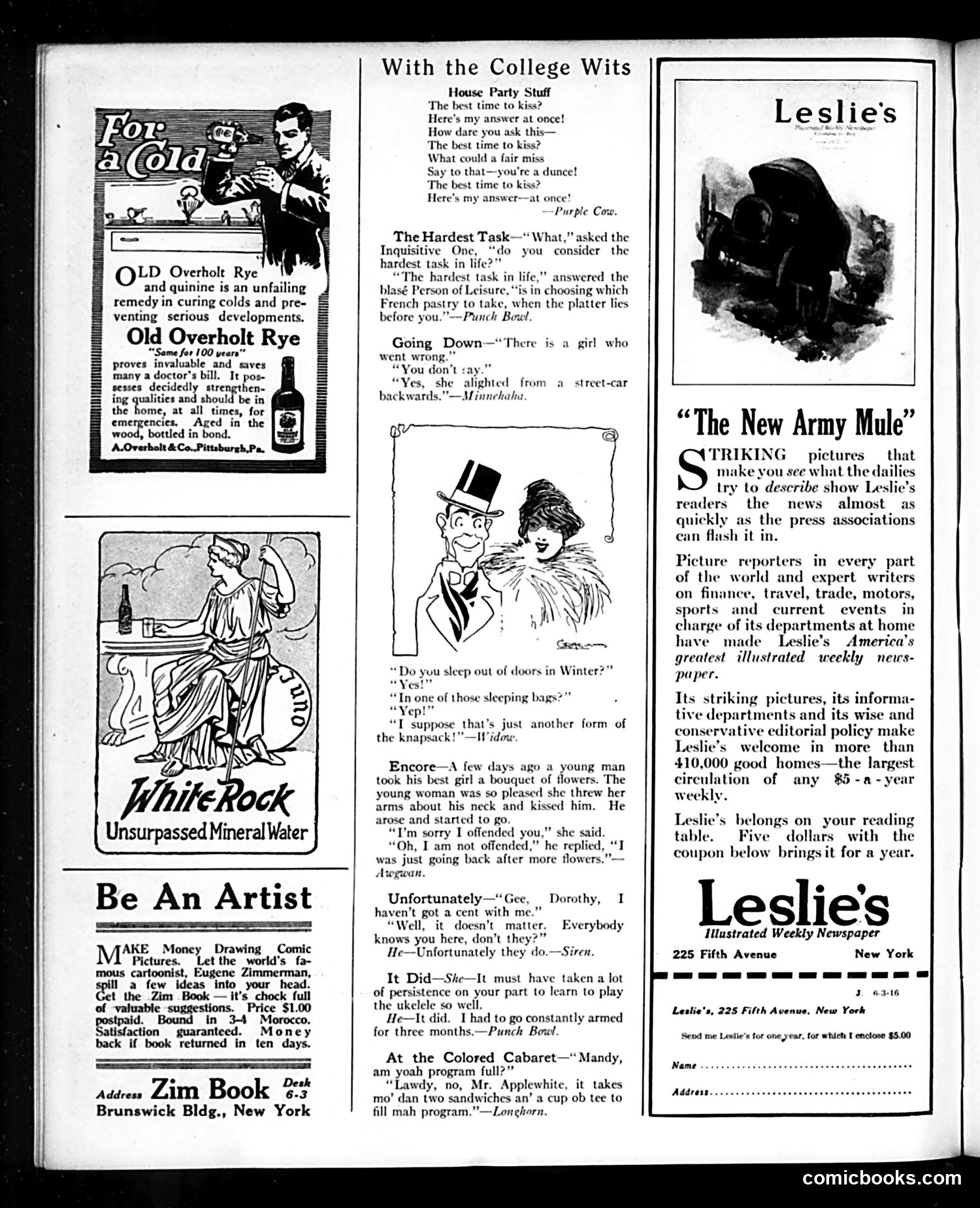
This page is primarily **advertising and humor content** rather than political satire. The main material consists of: **"With the College Wits"**: A humor section featuring collegiate jokes about romance and courtship—typical early 20th-century campus humor. The jokes are light, wholesome observations about dating ("The best time to kiss?") and social awkwardness. **Notable joke**: "At the Colored Cabaret" uses a racial stereotype (minstrel-dialect humor about an African American woman at a nightclub), reflecting casual racial caricature common in this era's "mainstream" publications. **Advertisements**: The page features ads for Old Overholt Rye whiskey (marketed as a cold remedy—pre-Prohibition), White Rock mineral water, a cartooning instruction book by Eugene Zimmerman, and Leslie's Illustrated Weekly Newspaper. **Context**: This represents typical Judge content: lighthearted college humor, period racism presented without critique, and commercial advertising—all standard for American humor magazines of the 1910s.
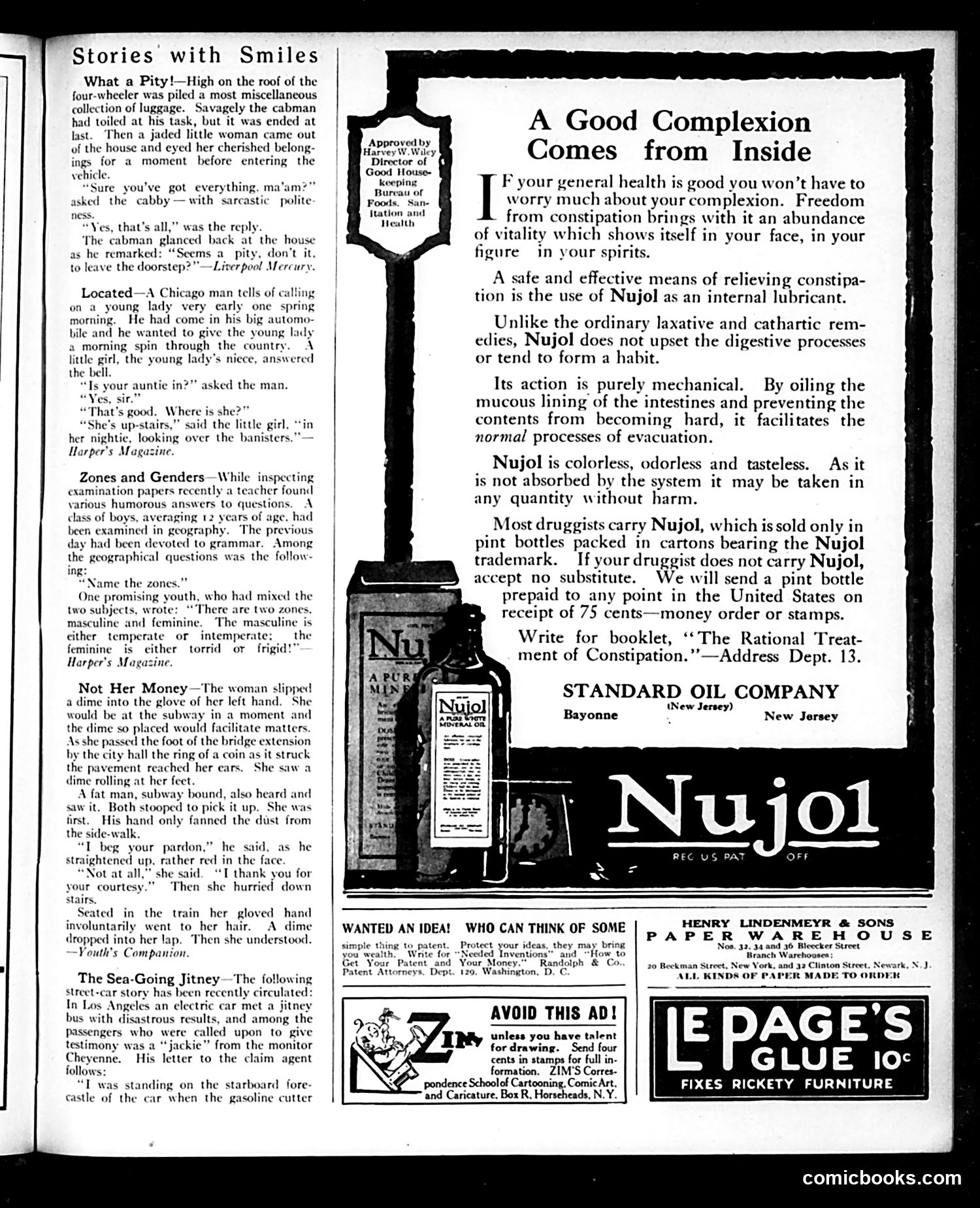
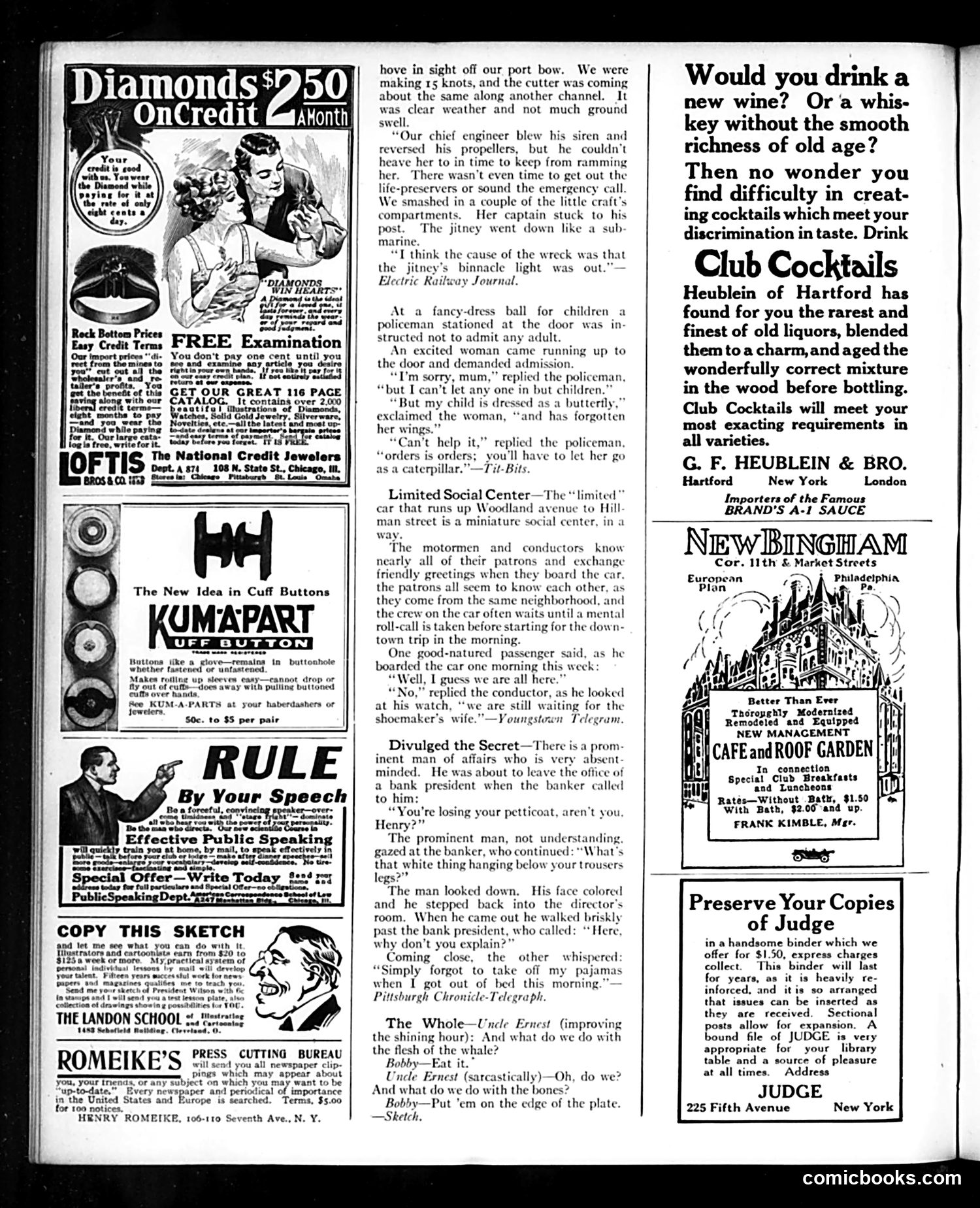
This page is primarily **advertising and humor anecdotes**, not political cartoons. The advertisements include diamonds on credit, cuff buttons, public speaking courses, and a press clipping service. The dominant content consists of short humorous stories typical of Judge's satirical format. The narratives include: a maritime collision blamed on a broken binnacle light; a policeman enforcing an adults-only restriction at a children's ball, turning away a woman dressed as a butterfly; a streetcar conductor who knows all regular passengers so well he takes mental roll calls; and an absent-minded businessman embarrassed when a bank president publicly points out his exposed petticoat (slip). These anecdotes mock everyday absurdities—bureaucratic rigidity, social embarrassment, and the quirks of urban life. They represent Judge's trademark style: gentle satire of middle-class American society rather than hard political commentary. No specific political figures or events are referenced.
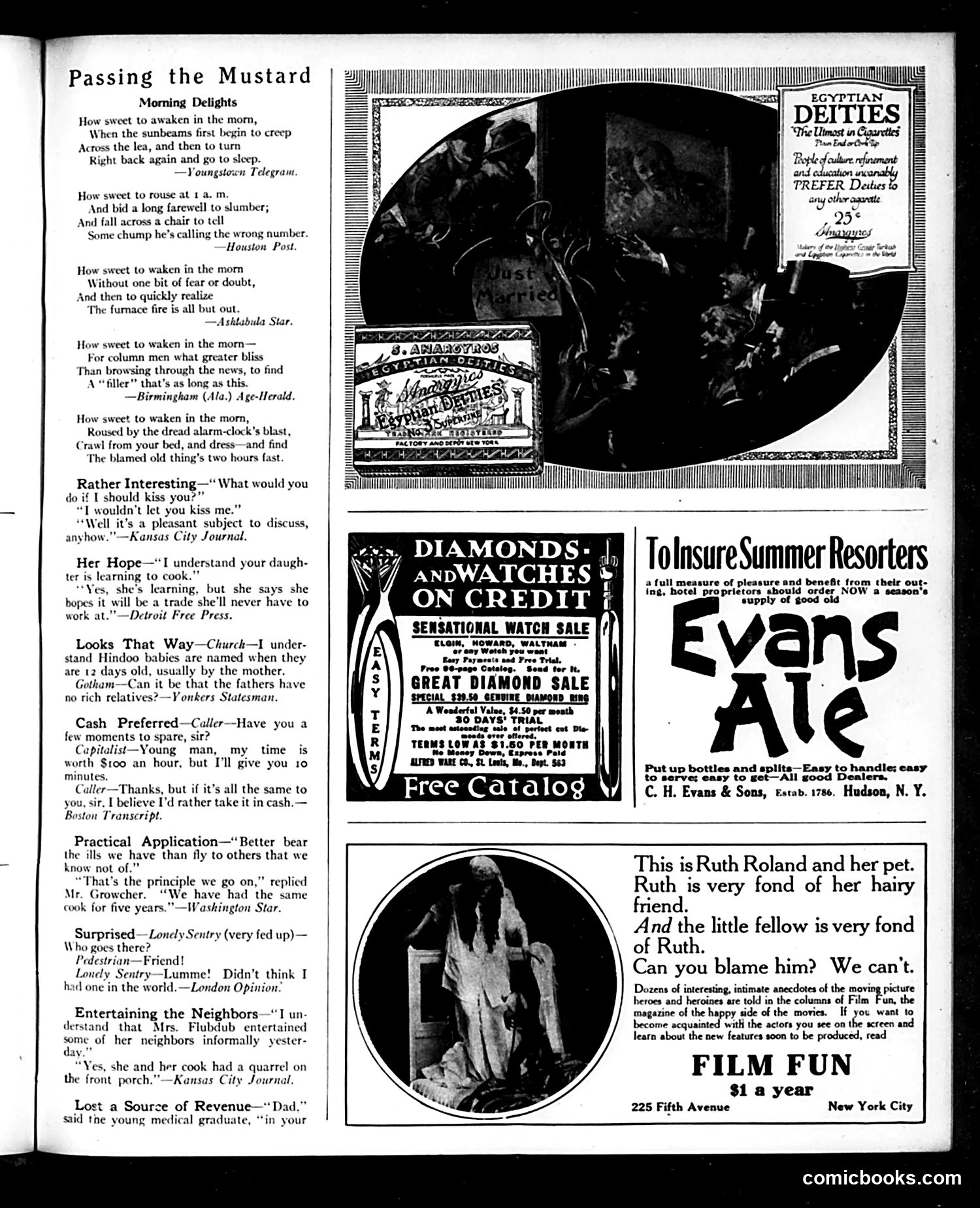
This page is primarily a **humor compilation** rather than political satire. The bulk consists of short, captioned jokes titled "Morning Delights" — brief quips about everyday annoyances (wrong-number calls at 1 a.m., broken alarm clocks, learning-disabled cooks) credited to various newspapers. The jokes reflect **early 20th-century domestic life**: servants' incompetence, marital dynamics, and middle-class anxieties. The humor is gentle and domestic rather than pointed social criticism. The page is mostly **advertisements** (diamonds on credit, Evans Ale, Film Fun magazine) with one photograph of actress **Ruth Roland** and her dog, used to promote Film Fun magazine. No major political figures or events are referenced. The satire is modest, targeting universal human experiences rather than specific public controversies.
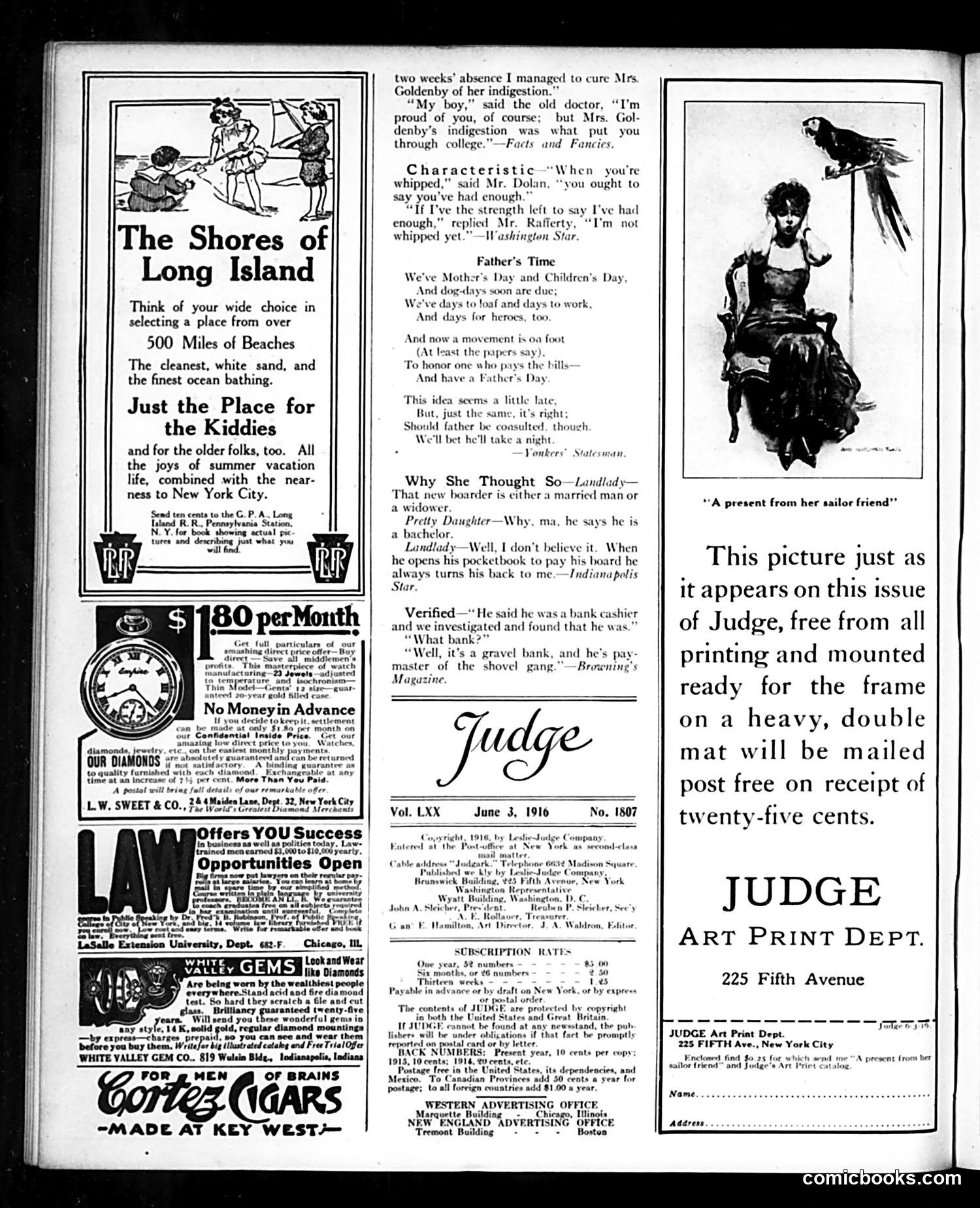
This is primarily a **title/contents page** of Judge magazine rather than a political cartoon page. The page contains: **Main Content:** - Several brief humorous anecdotes about doctors, fathers, and boarders—typical light satirical fare - A feature on "Father's Time," advocating for a Father's Day holiday (then a novel concept) - Advertisements for Long Island beaches, watches, diamonds, and cigars **Notable Elements:** The humor relies on wordplay and social observation rather than political commentary. One joke mocks a woman suspecting a "bachelor" boarder of dishonesty because he hides his wallet—implying bachelors are inherently unreliable. Another satirizes a man claiming to be a bank cashier when he merely works at a gravel operation. **Art Print Advertisement:** The page promotes a romantic illustration ("A present from her sailor friend") available for framing, typical of Judge's commercial sideline. This reflects 1916 popular humor: domestic situations, gender stereotypes, and economic anxieties about trustworthiness and class status.
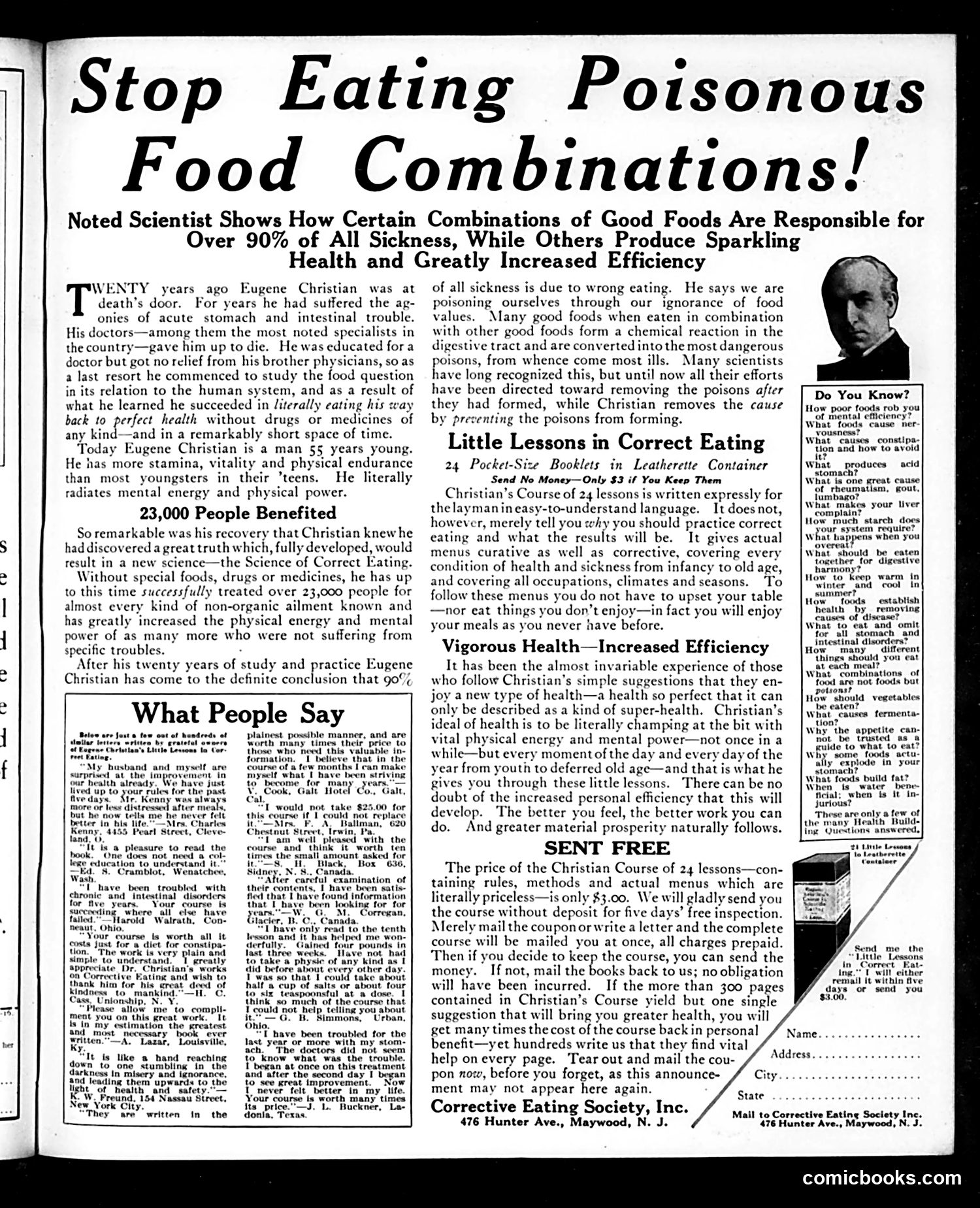
This is primarily **advertising content**, not satire or political commentary. It promotes Eugene Christian's "Science of Correct Eating"—a early 20th-century dietary system claiming that improper food combinations cause 90% of illness. The page features: - **A testimonial format** listing satisfied customers endorsing Christian's lessons - **Appeals to authority**: Christian is presented as a "noted scientist" who recovered from stomach trouble through dietary study - **Pseudoscientific claims**: The assertion that food *combinations* (rather than individual foods) are "poisonous" and responsible for most sickness - **A mail-order course offer**: 24 pocket-sized lessons for $3.00 (substantial money then) **Context for modern readers**: This reflects early 1900s popular health movements that preceded FDA regulation and nutritional science. Such "food combining" theories were widespread but lack scientific basis. The testimonials and dramatic recovery narrative typify health advertising of this era—before modern consumer protection standards existed.
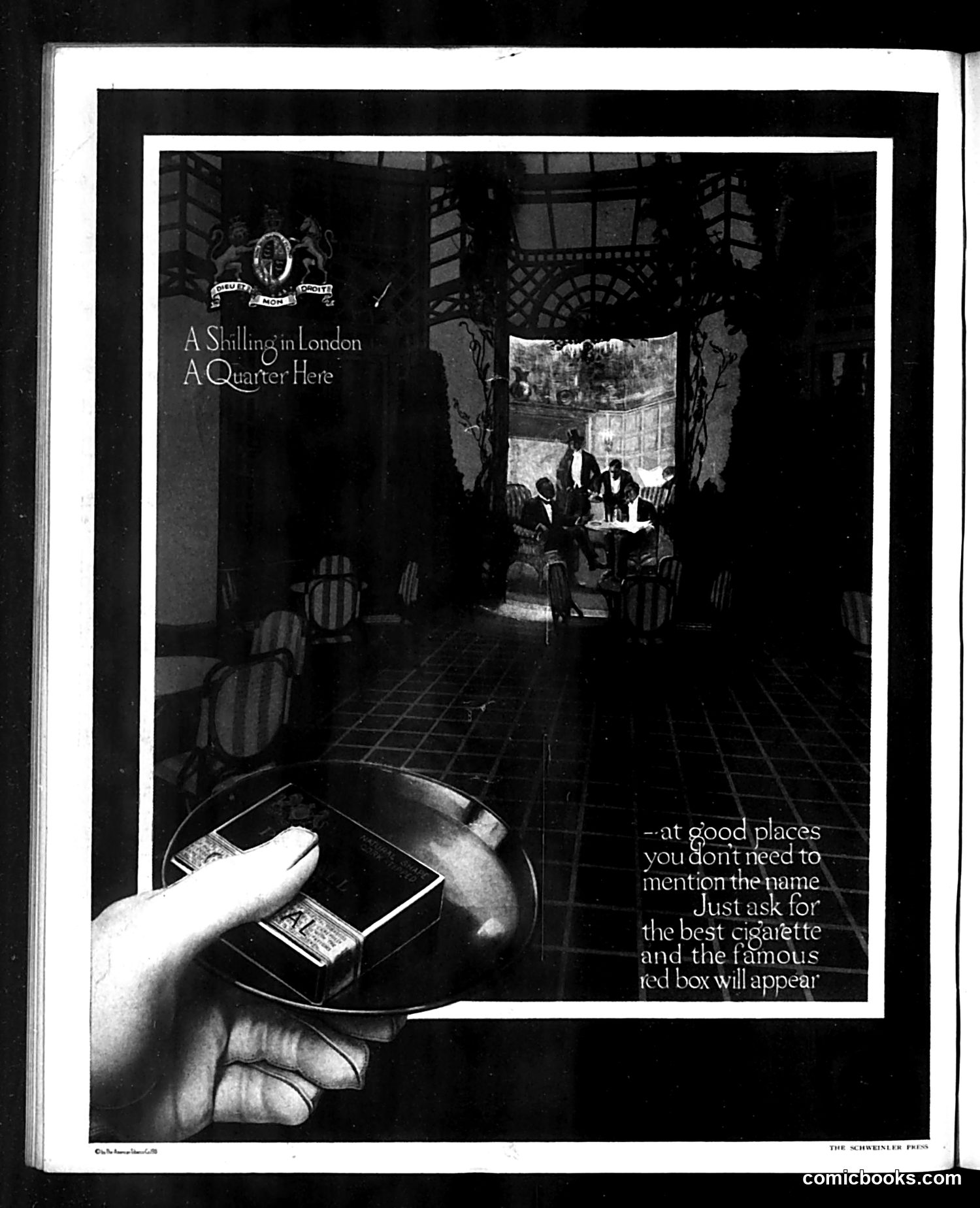
This appears to be a **cigarette advertisement** rather than political satire. The ad promotes an unnamed brand by claiming its red box is so recognizable that customers need only request "the best cigarette" at quality establishments—the famous packaging will be immediately understood by vendors. The image shows a hand holding a cigarette box in the foreground, with an elegant indoor dining scene visible in the background, suggesting upscale venues ("good places") where the product is available. The tagline "A Shilling in London / A Quarter Here" indicates pricing in British and American currency, suggesting this advertisement targeted both markets. This is a straightforward appeal to brand prestige rather than social or political commentary.