
Judge, 1916-06-03 · page 12 of 28
Judge — June 3, 1916 — page 12: what you’re looking at
What you’re looking at
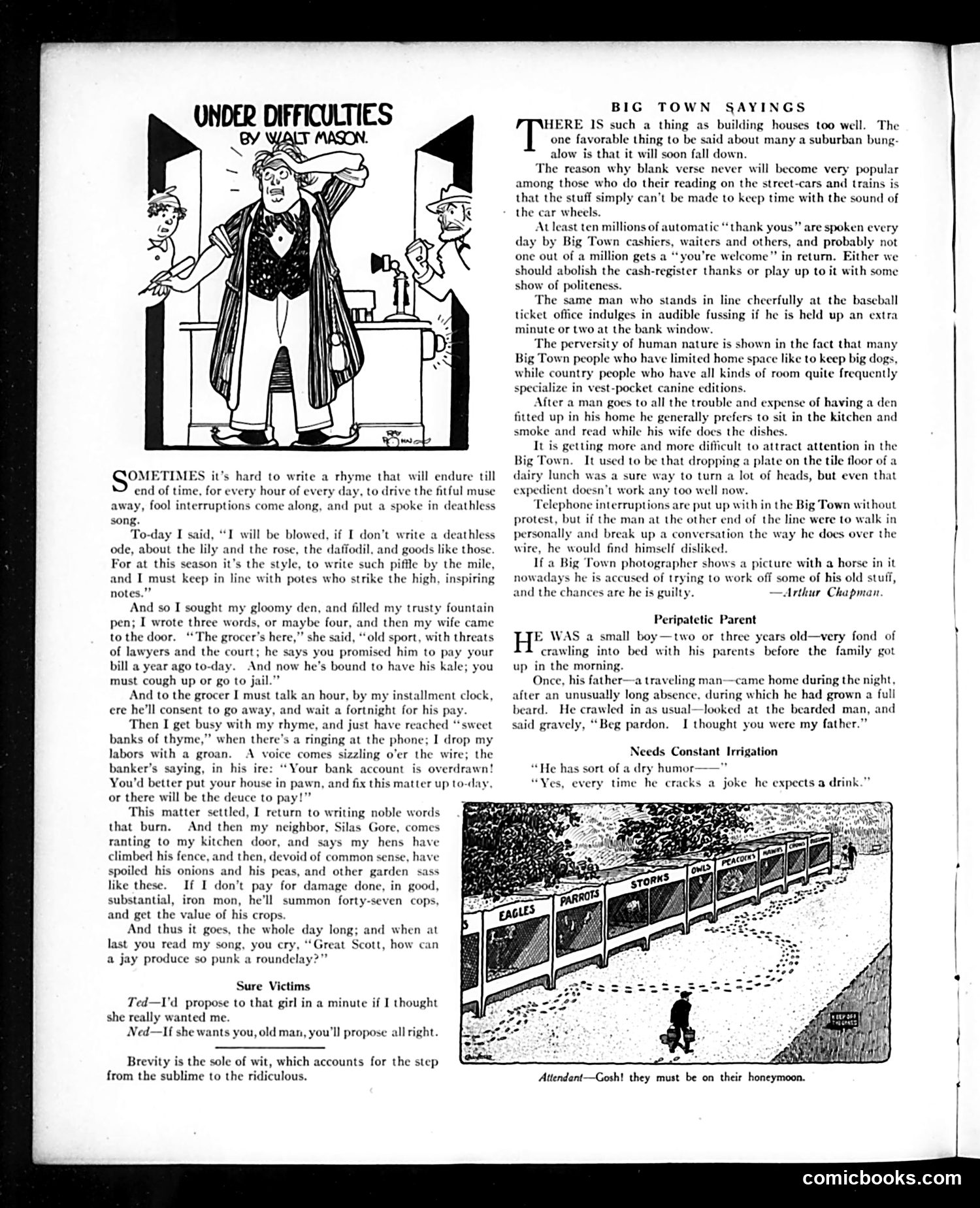
**"Under Difficulties" by Walt Mason** is a humorous poem about a writer's inability to compose because of constant domestic and financial interruptions. The speaker attempts to write "noble words" about flowers but is repeatedly disturbed by his grocer demanding payment, his banker announcing an overdraft, and his neighbor Silas Gore complaining about escaped chickens damaging his garden. By day's end, exhausted and harassed, the writer produces mediocre verse—hence "how can a jay produce so punk a roundelay?" The satire targets the frustrations of middle-class life: bills, creditors, nosy neighbors, and household chaos that prevent intellectual or creative pursuits. It's relatable humor about financial stress and social obligations in early-1900s urban America. The page also contains "Big Town Sayings"—brief witty observations about urban life contrasting city and country behavior, touching on politeness, dog ownership, and attention-getting.
📄 Transcribed text from this page (OCR, searchable)
Machine-transcribed from the original scan — historical spelling and the odd misread are preserved.
UNDER DIFFICULTIES ALT MASON. OMETIMES it’s hard to write a rhyme that will endure till end of time, for every hour of every day, to drive the fitful muse away, fool interruptions come along, and put a spoke in deathless song. To-day I said, “I will be blowed, if I don’t write a deathless ode, about the lily and the rose, the daffodil, and goods like those. For at this season it’s the style, to write such piffle by the mil and I must keep in line with potes who strike the high, inspiring notes.”” And so I sought my gloomy den, and filled my trusty fountain pen; I wrote three words, or maybe four, and then my wife came to the door. ‘The grocer he said, “old sport, with threats of lawyers and the court; he says you promised him to pay your bill a year ago to-day. And now he’s bound to have his kale; you must cough up or go to jail.” And to the grocer I must talk an hour, by my installment clock, ere he'll consent to go away, and wait a fortnight for his pa’ Then I get busy with my rhyme, and just have reached “sweet banks of thyme,” when there’s a ringing at the phone; I drop my labors with a groan. A voice comes sizzling o’er the wire; the banker’s saying, in his ire: “Your bank account is overdrawn! this matter up to-day, You'd better put your house in pawn, and fi ! or there will be the deuce to p: This matter settled, I return to writing noble words that burn. And then my neighbor, Silas Gore, comes ranting to my kitchen door, and says my hens have climbed his fence, and then, devoid of common sense, have spoiled his onions and his peas, and other garden sass like these. If I don’t pay for damage done, in good, substantial, iron mon, he'll summon forty-seven cops, and get the value of his crops. And thus it goes, the whole day long; and when at last you read my song, you cry, “Great Scott, how can a jay produce so punk a roundelay?” Sure Victims Ted—I'd propose to that girl in a minute if I thought she really wanted me. Ned—If she wants you, old man, you'll propose all right. Brevity is the sole of wit, which accounts for the step from the sublime to the ridiculous. BIG TOWN SAYINGS ig 1S such a thing as building houses too well. The one favorable thing to be said about many a suburban bung- alow is that it will soon fall down. The reason why blank verse never will become very popular among those who do their reading on the street-cars and trains is that the stuff simply can’t be made to keep time with the sound of the car wheels. Atleast ten millions of automatic “thank yous” are spoken every by Big Town cashiers, waiters and others, and probably not one out of a million gets a “you're welcome” in return. Either we should abolish the cash-register thanks or play up to it with some show of politeness. The same man who stands in line cheerfully at the baseball ticket office indulges in audible fussing if he is held up an extra minute or two at the bank window. The perversity of human nature is shown in the fact that many Big Town people who have limited home space like to keep big dogs, while country people who h: all kinds of room quite frequently specialize in vest-pocket canine editions. After a man goes to all the trouble and expense of having a den fitted up in his home he generally prefers to sit in the kitchen and smoke and read while his wife does the dishe: It is getting more and more difficult to attract attention in the Big Town. It used to be that dropping a plate on the tile floor of a dairy lunch was a sure way to turn a lot of heads, but even that expedient doesn’t work any too well now. Telephone interruptions are put up with in the Big Town without protest, but if the man at the other end of the line were to walk in personally and break up a conversation the way he does over the wire, he would find himself disliked. If a Big Town photographer shows a picture with a horse in it nowadays he is accused of trying to work off some of his old stuff, and the chances are he is guilty. Arthur Chapman Peripatetic Parent E WAS a small boy—two or three years old—very fond of crawling into bed with his parents before the family got up in the morning. Once, his father—a traveling man—came home during the night, after an unusually long absence, during which he had grown a full beard. He crawled in as usual—looked at the bearded man, and said gravely, “Beg pardon. I thought you were my father.” Needs Constant Irrigation “He has sort of a dry humor—" . every time he cracks a joke he expects a drink.” Attendant—Gosh! they must be on their honeymoon. comicbooks.com