
A complete issue · 28 pages · 1916
Judge — May 13, 1916
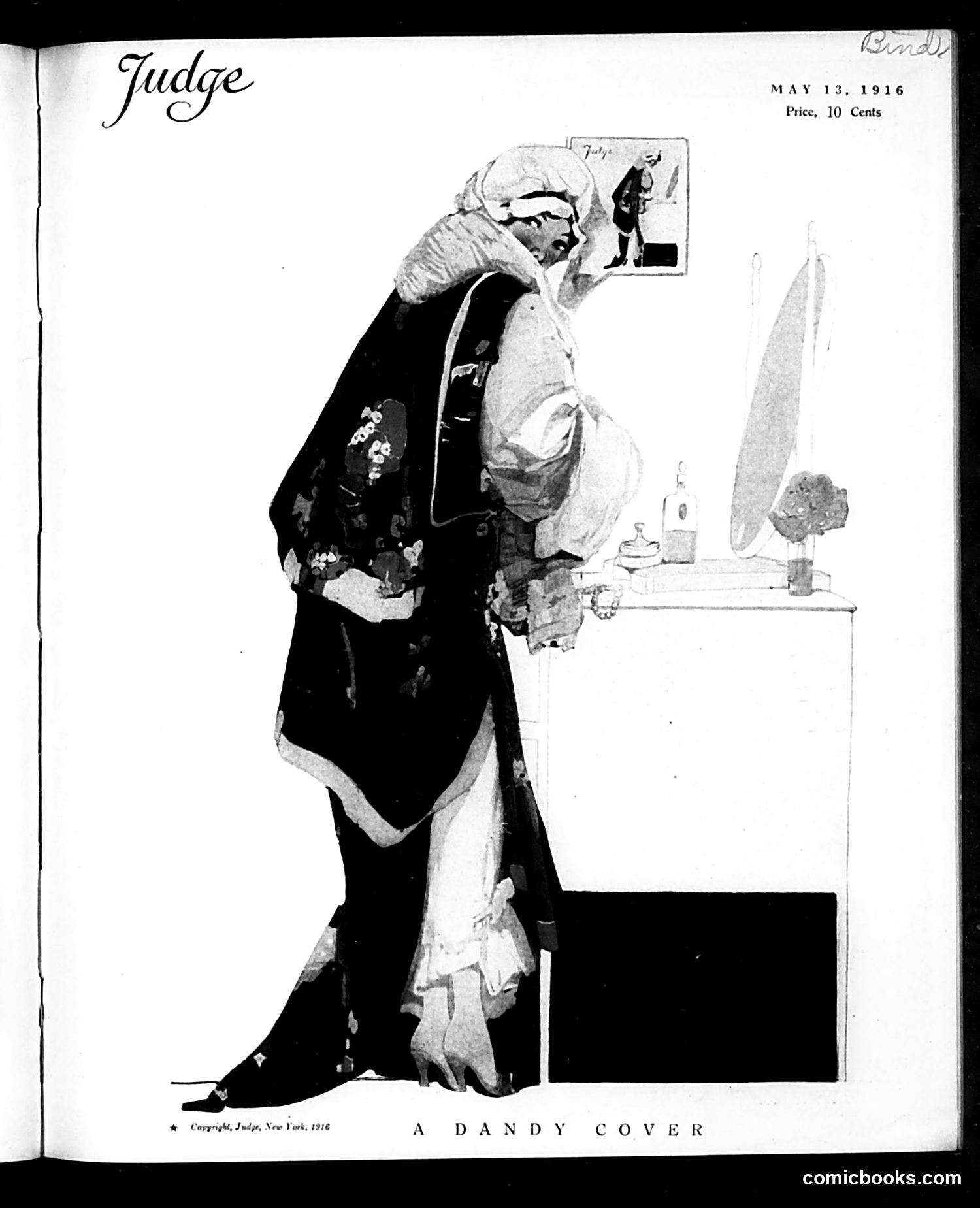
This Judge magazine cover from May 13, 1916 depicts a fashionably dressed woman admiring herself in a mirror. The title "A Dandy Cover" is a pun: "dandy" meaning excellent or stylish, but also referencing the woman's fashionable appearance—her elaborate hat with feathers, decorative coat, and accessories typical of 1910s high fashion. The small inset illustration in the upper right appears to show a contrasting figure, likely emphasizing the satirical point about vanity or class distinctions. The cartoon mocks the preoccupation with fashionable dress and appearance among society women of the era, a common target of Judge's social satire during the Progressive period.
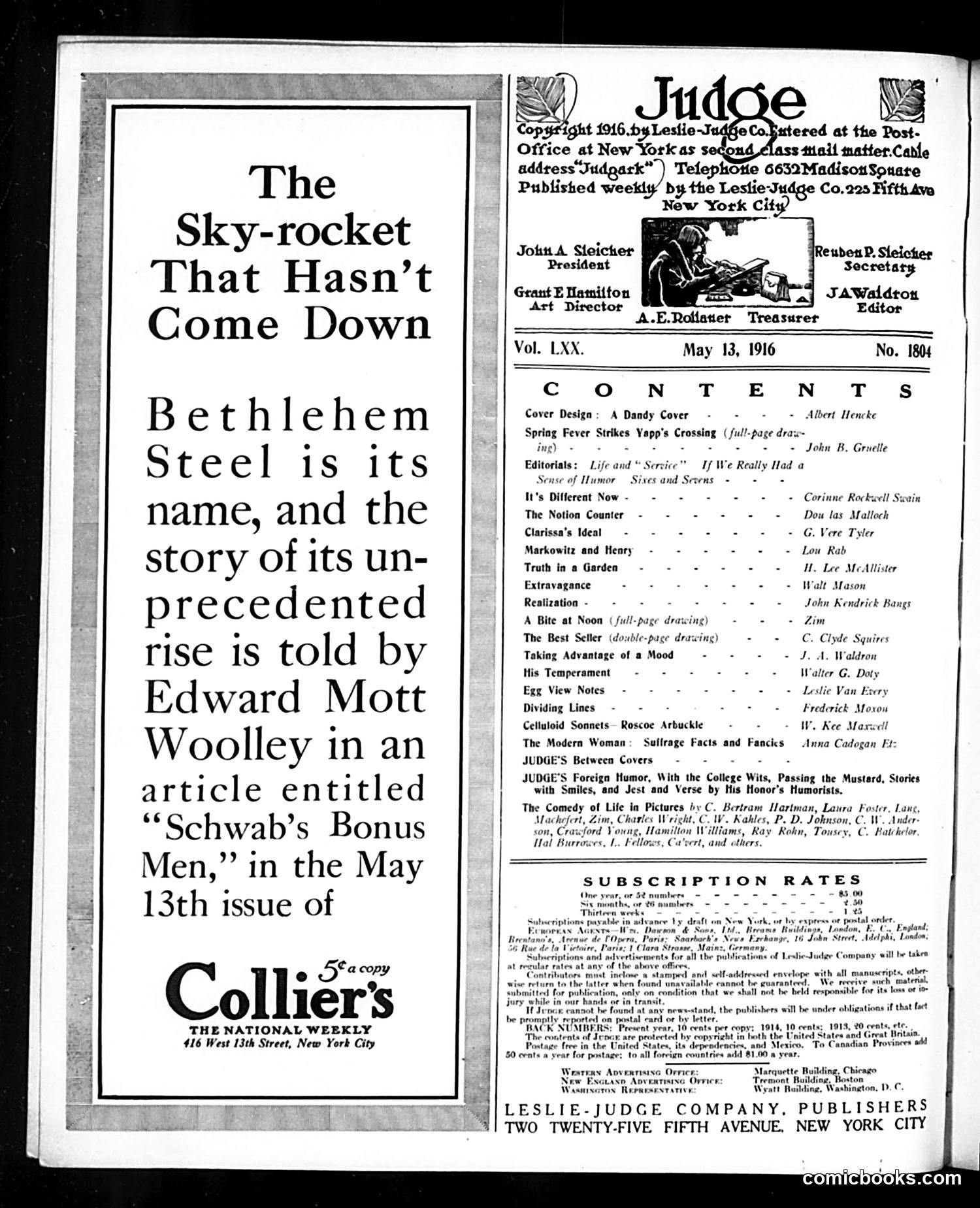
This page is primarily an **advertisement for Collier's magazine**, promoting an article about Bethlehem Steel's rise by Edward Mott Woolley, titled "Schwab's Bonus Men." The headline emphasizes Bethlehem Steel as "The Sky-rocket That Hasn't Come Down." **Historical context**: In 1916, Bethlehem Steel was a major American industrial company, likely headed by Charles M. Schwab. The article appears to examine how the company achieved rapid growth and the role of executive bonuses in its success—relevant during America's pre-WWI industrial expansion and subsequent wartime manufacturing boom. The advertisement itself contains no apparent satire or political commentary; it's a straightforward promotional piece targeting Judge's educated readership interested in business narratives.
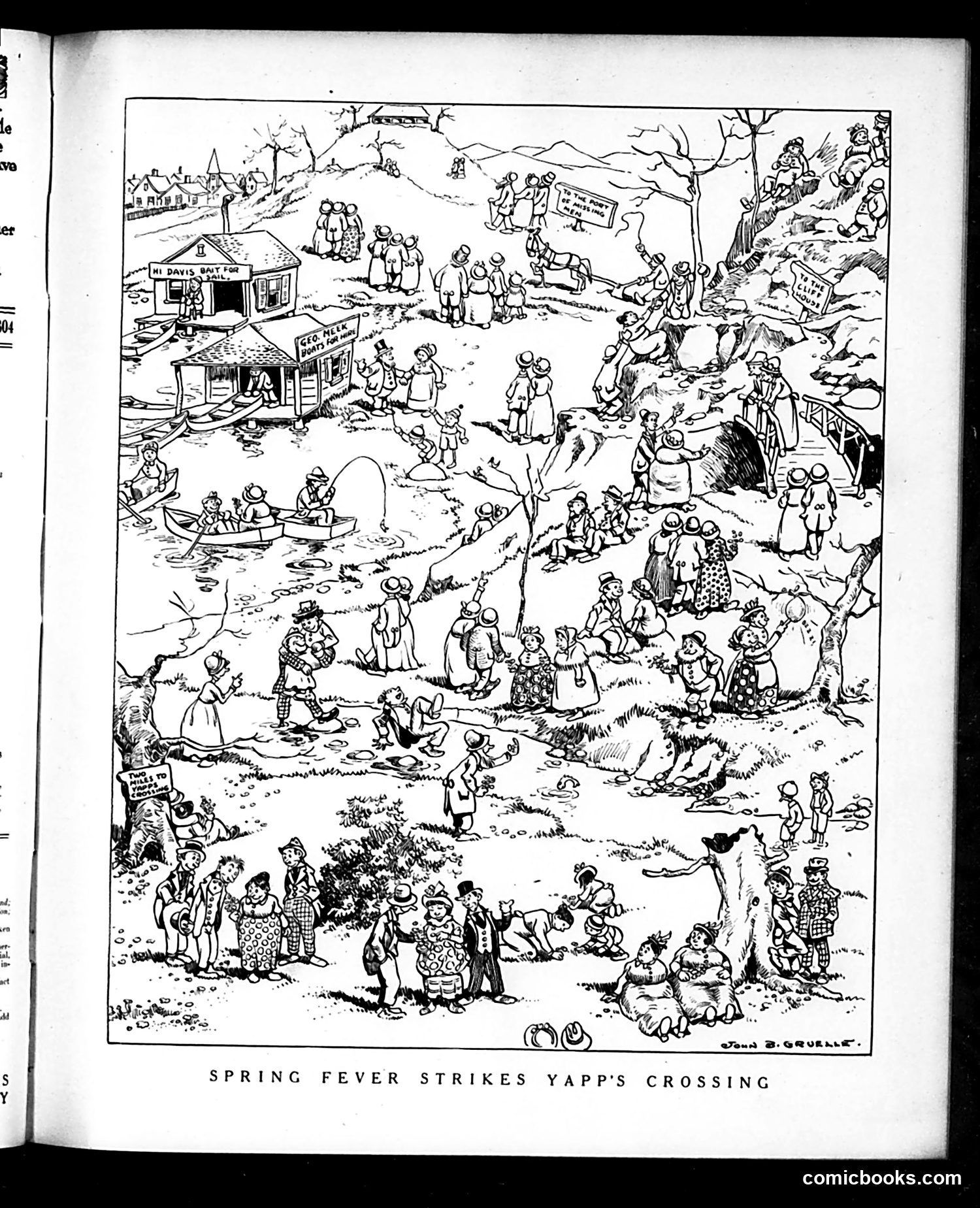
This cartoon depicts a rural settlement overwhelmed by spring fever—a term historically used to describe restlessness, lethargy, or unusual behavior thought to occur seasonally. The crowded scene shows numerous townspeople engaged in idle or frivolous activities: boating, lounging, socializing, and general leisure rather than productive work. The satire mocks how spring weather causes entire communities to abandon responsibility and productivity. The buildings labeled "H. Davis" and other shops suggest commercial neglect. The artist (signed "John S. Gueville") presents spring fever as a contagious affliction spreading through the settlement, leaving work undone and social order disrupted by mass indolence. The cartoon reflects early 20th-century anxieties about seasonal idleness affecting economic productivity and work ethic.
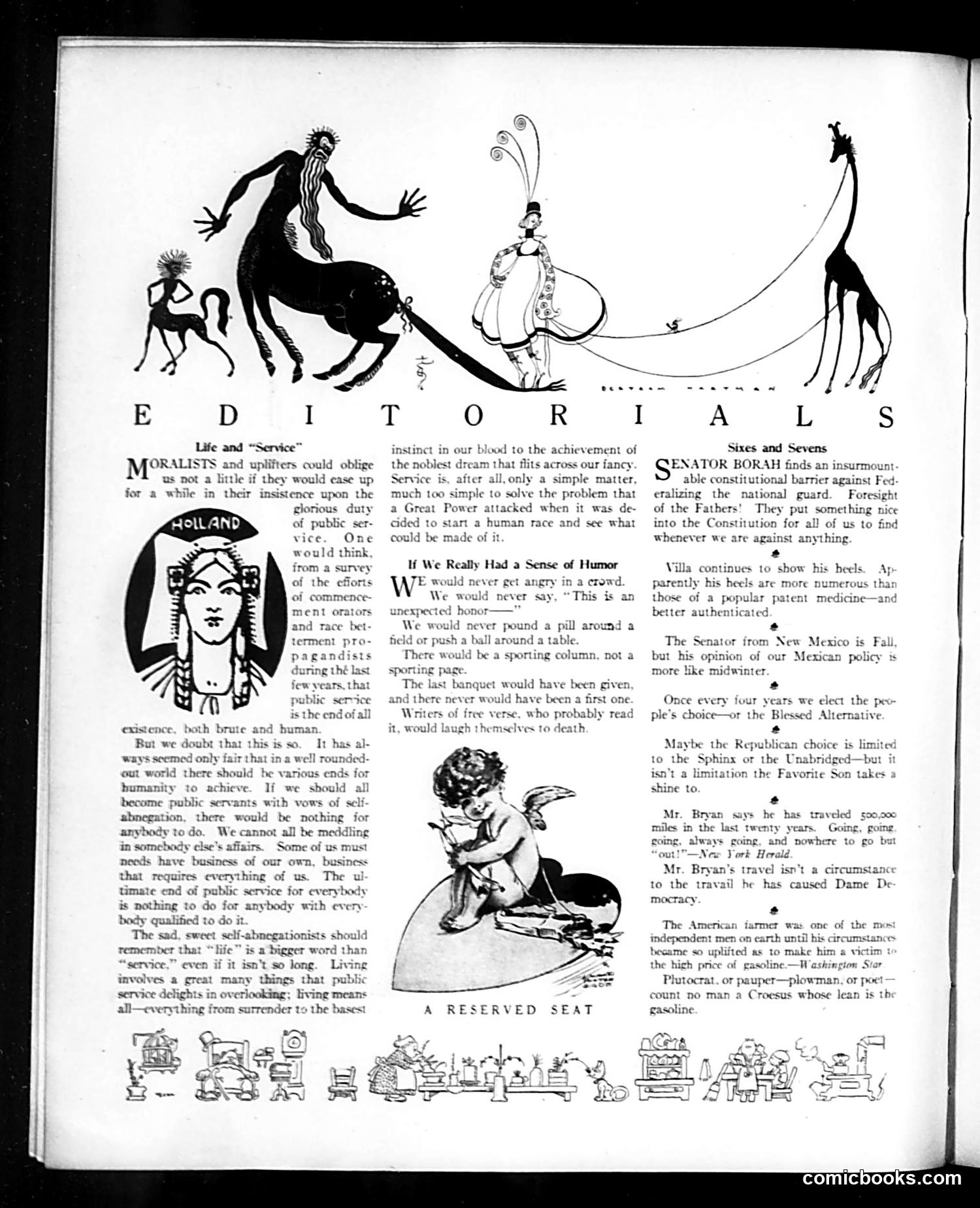
This page satirizes American political and social issues through editorial content and illustrations. **Top Banner ("Editorials"):** Stylized figures represent various societal types—appearing to reference different classes or political factions engaged in conflict or debate. **Left Section:** An article titled "Life and Service" discusses public service obligations, arguing that citizens should embrace civic duty despite its demands. It critiques those who view service as burdensome. **"If We Really Had a Sense of Humor":** Satirizes public discourse, suggesting Americans lack perspective—they'd laugh rather than argue about political disagreements. **Right Section ("Sites and Sevens"):** Commentary on Senator Borah and Mexican policy, plus remarks on Bryan's extensive travels and American farmers' independence, likely referencing early 20th-century political figures. The overall tone is satirical commentary on civic responsibility and contemporary political debates.
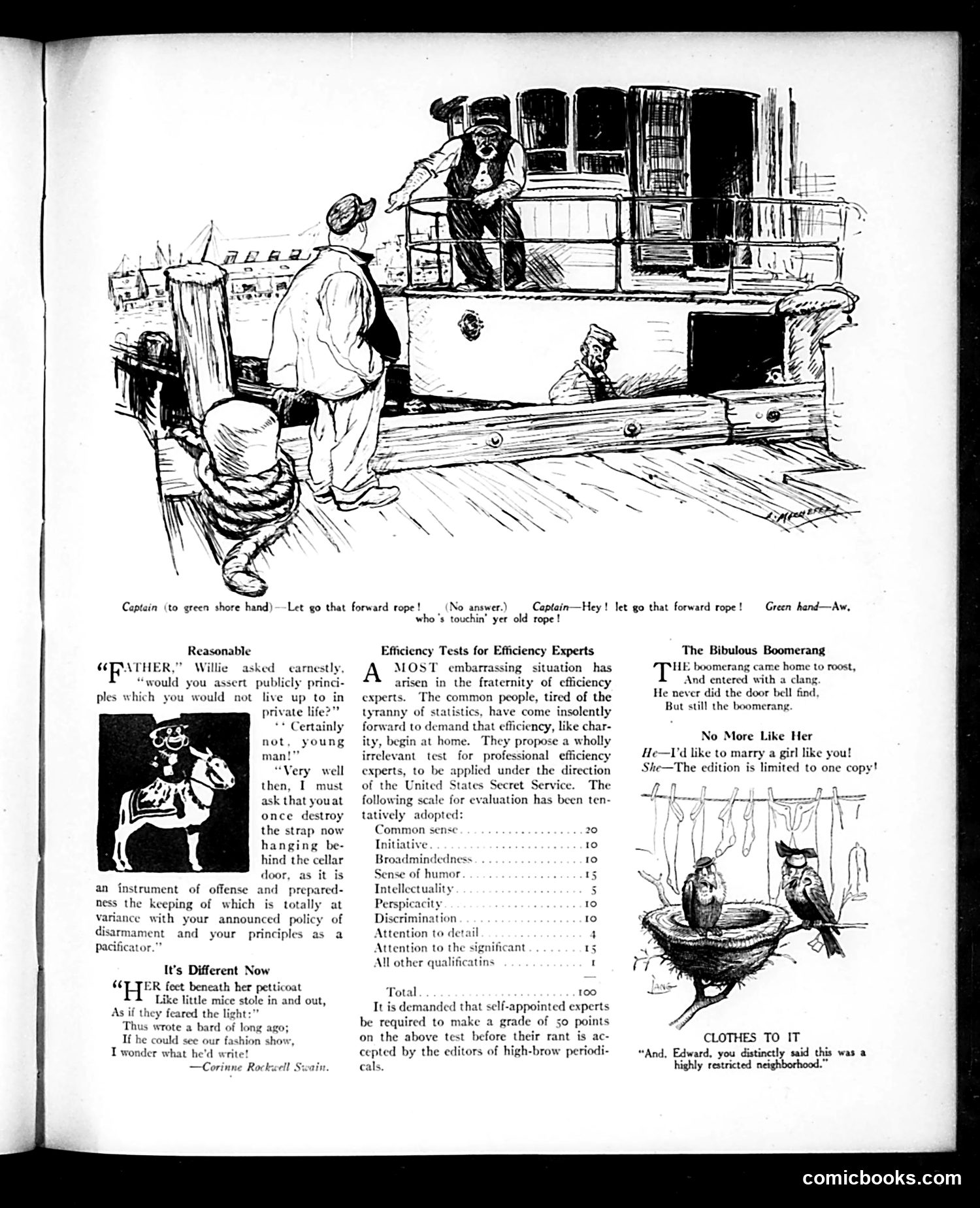
The top cartoon satirizes maritime hierarchy and communication breakdowns. A captain and crew member argue about a "forward rope," with the captain dismissing the sailor's concerns—typical of the era's class-based workplace friction. Below, "Reasonable" mocks efficiency experts who demand others follow principles they don't apply to themselves. The cartoon questions whether such "experts" would accept in their own homes the rigid, dehumanizing standards they impose professionally. The remaining pieces are lighter social commentary: "It's Different Now" jokes about changing fashion; "The Bibulous Boomerang" depicts a man repeatedly returning home drunk; and "No More Like Her" shows marital strain over a daughter's independence. The page reflects early 20th-century anxieties about modernization, workplace authority, and shifting social norms.
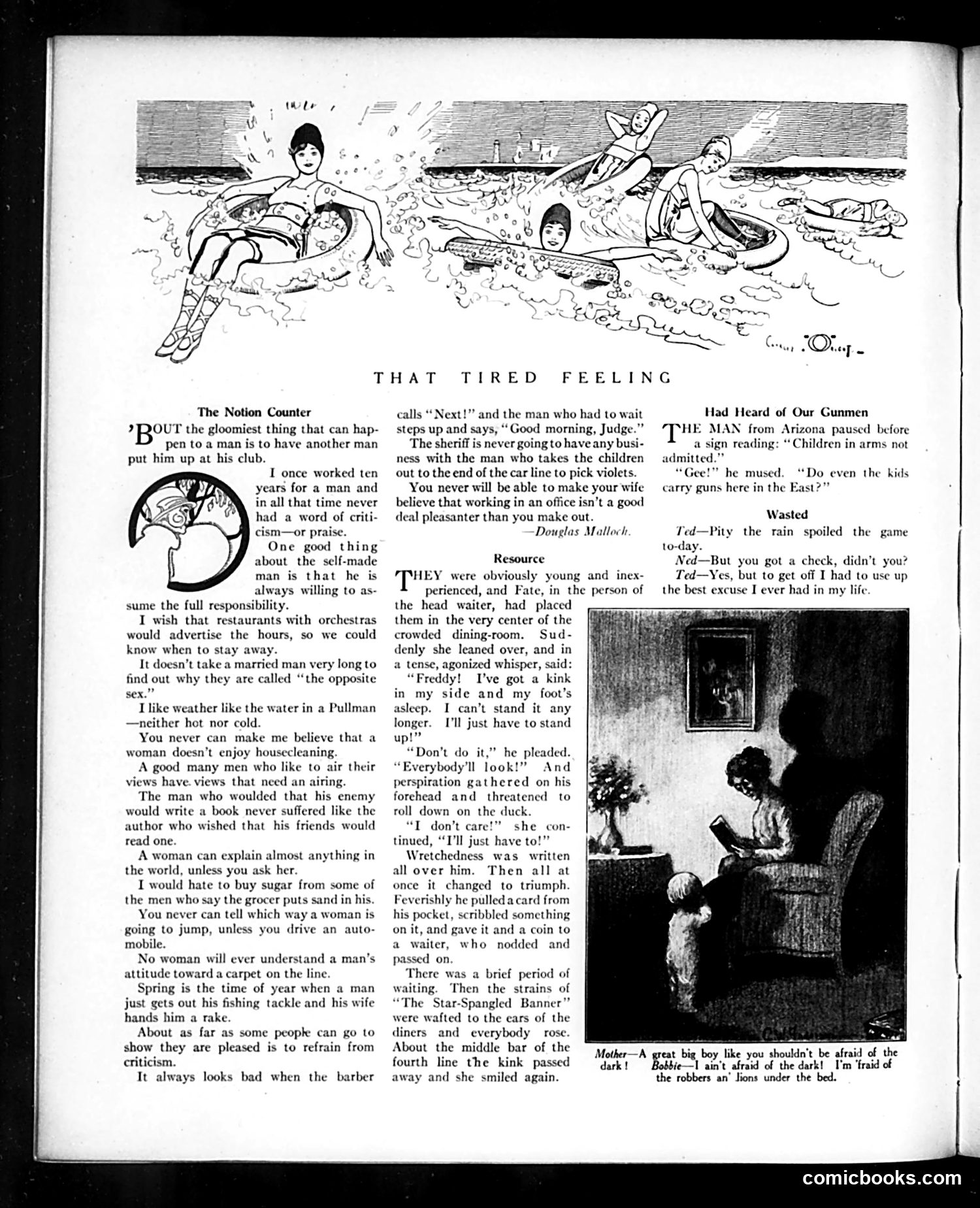
This page from *Judge* magazine contains three distinct humor pieces: **"The Notion Counter"** is a column of witty one-liners about social observations—workplace dynamics, marriage, gender differences, and human nature. These are gentle satirical observations typical of early 20th-century magazine humor, poking fun at universal frustrations (self-made men, restaurants with orchestras, women and housecleaning). **"Resource"** depicts a young couple dining in a crowded restaurant. The woman has leg cramps but fears public embarrassment if she stands. The man cleverly signals a waiter to have the orchestra play "The Star-Spangled Banner," forcing all diners to rise—allowing her to stretch unnoticed. The satire mocks both their self-consciousness and celebrates his resourcefulness. **"Had Heard of Our Gunmen"** is a brief joke about an Arizona man misreading a sign saying "Children in arms not admitted" (meaning babies). He assumes it means children carrying guns—satirizing the Wild West's violent reputation and perhaps stereotypes about Arizona's lawlessness during this era. The illustration at top shows beach scenes unrelated to the text below.
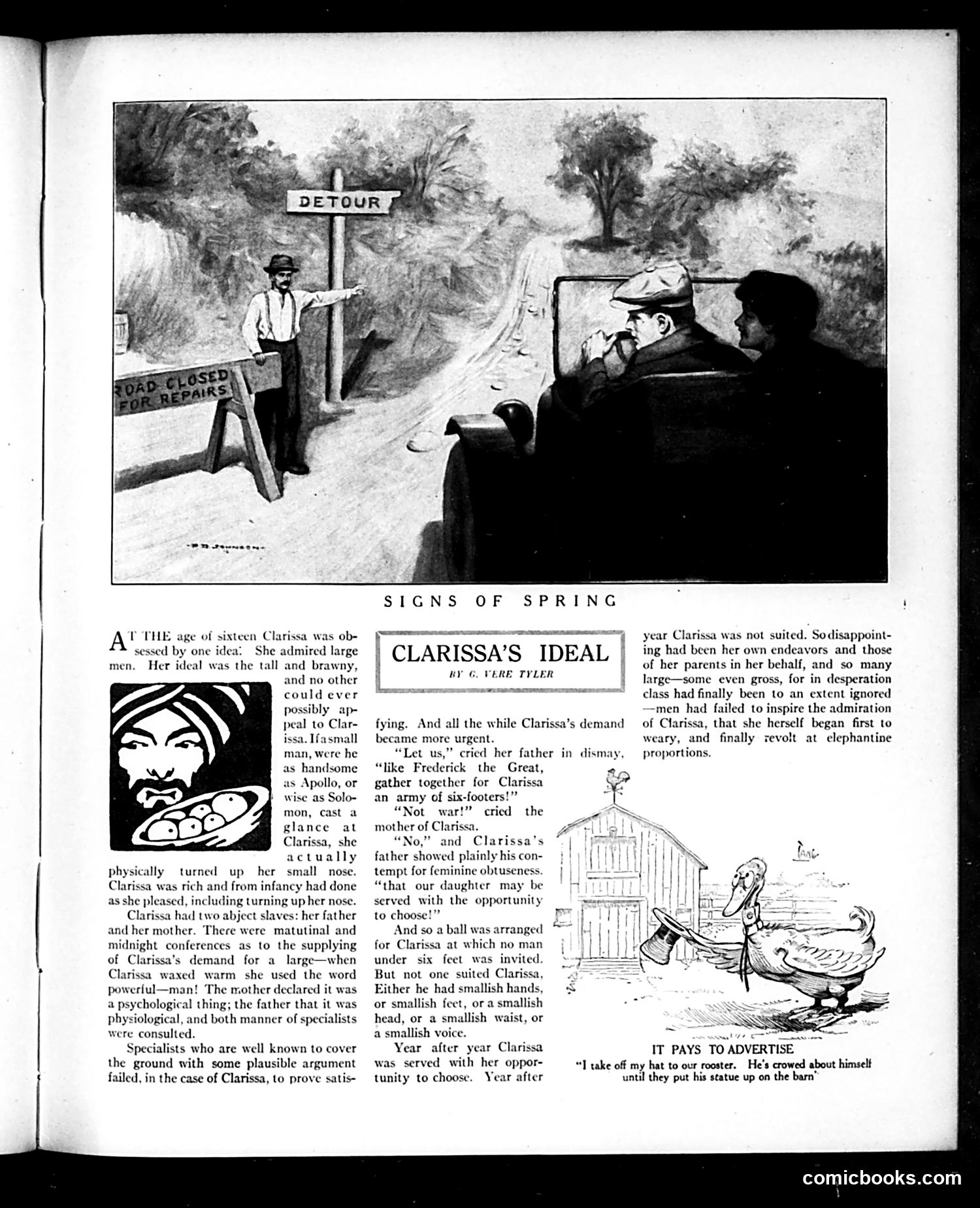
This is a satirical story about Clarissa, a spoiled sixteen-year-old obsessed with finding an exceptionally tall man. Her indulgent parents—described as her "abject slaves"—consult specialists and even attempt to organize an "army of six-footers" to satisfy her demands. The satire mocks wealthy, pampered young women of the era whose unrealistic standards were enabled by doting parents. It ridicules both parental indulgence and the pseudo-scientific "specialists" who claimed to solve such problems with plausible-sounding arguments. The punchline: after years of rejecting every suitor, Clarissa eventually becomes disgusted by the very trait she demanded, rejecting "elephantine proportions." The cartoon illustrates society's satirical view of frivolous upper-class women and the absurdity of their entitled expectations.
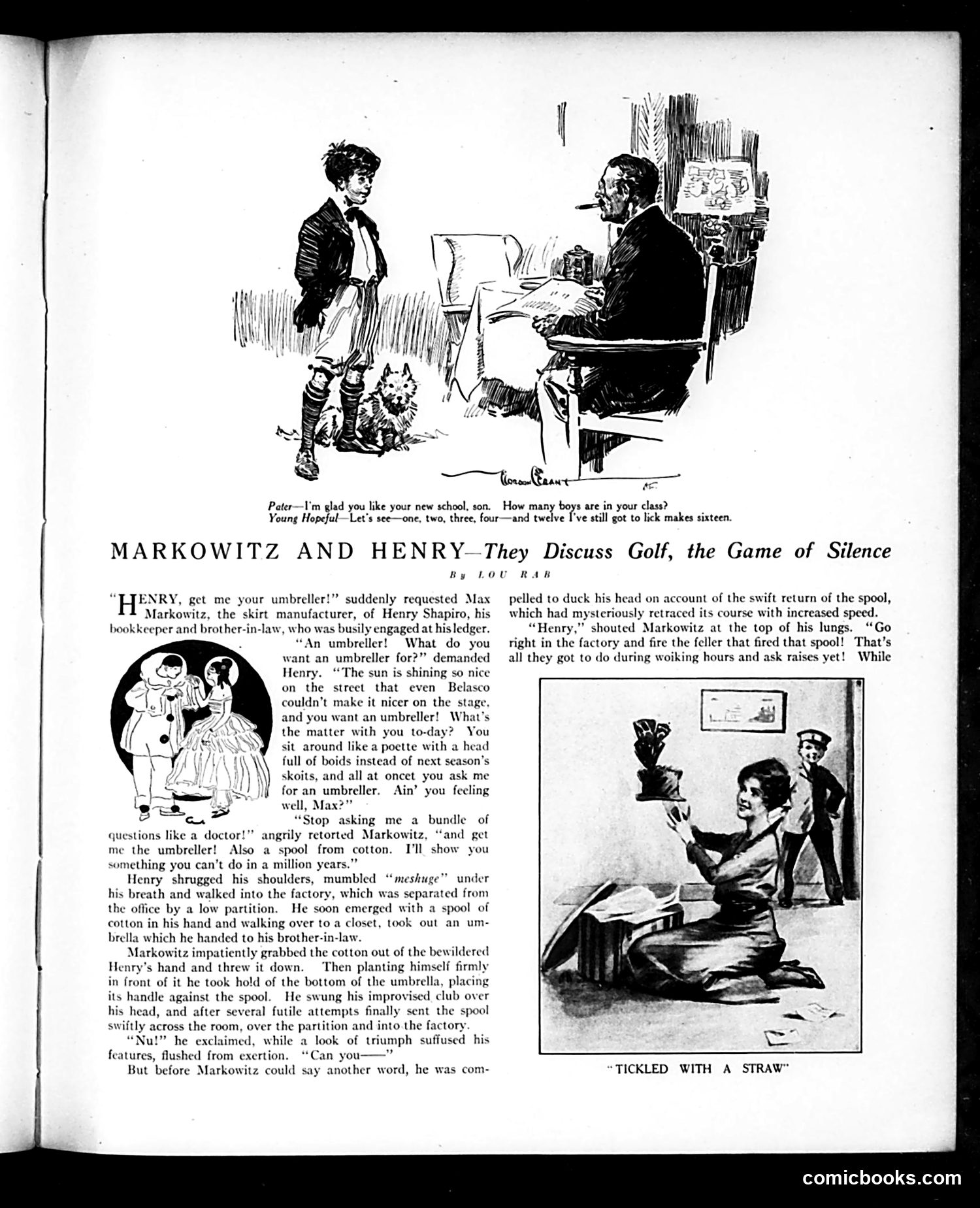
This is a humor piece about two Jewish immigrant businessmen—Max Markowitz (a skirt/clothing manufacturer) and his brother-in-law Henry Shapiro (his bookkeeper). The satire exploits their working-class New York accents and Yiddish expressions ("meshuge"—crazy, "Nu"—an exclamation) for comedic effect. The joke: Markowitz abruptly demands an umbrella and cotton spool, then improvises a golf club to hit the spool across the factory as a makeshift game. When Henry hits it back, Markowitz angrily orders him to "fire the feller that fired that spool"—missing the obvious fact that *he himself* started this game during work hours, then complains workers waste time and demand raises. The humor lies in his obliviousness and working-class irony: the boss complains about worker productivity while playing games at work. The title "The Game of Silence" suggests their competitive wordless exchange. This reflects early 20th-century American stereotypes about Jewish immigrant businessmen.
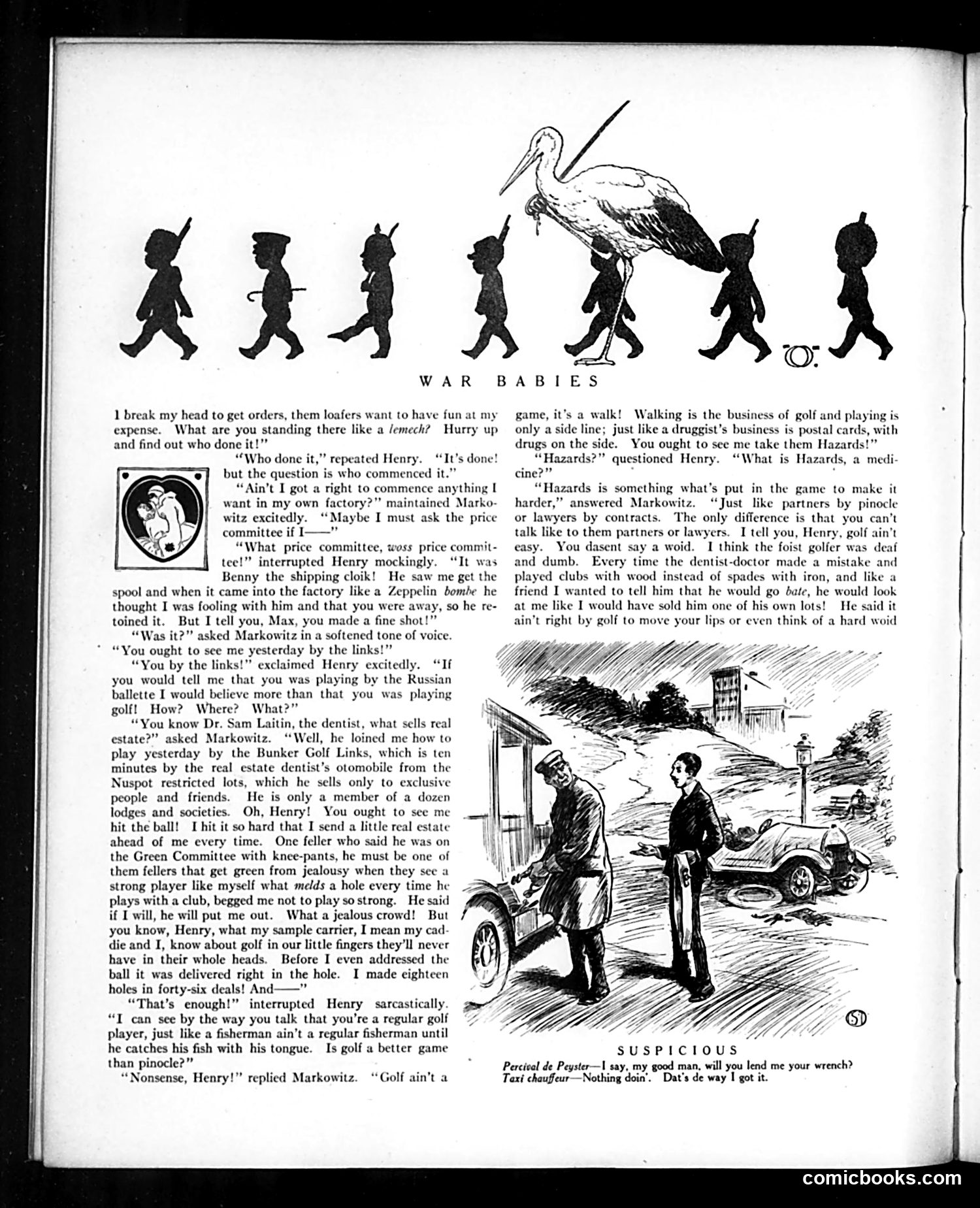
This Judge page features immigrant-inflected humor popular in early 20th-century American satire. The header illustration shows silhouetted children marching militaristically, mocking wartime anxiety. The main story presents **Markowitz**, a Yiddish-inflected factory owner, boasting absurdly about golf to his associate Henry. Markowitz mangles golf terminology ("hazards," "bate") and conflates it with business and gambling (pinocle), while Henry mocks his pretensions through feigned interest. The satire targets nouveau-riche immigrants attempting to adopt upper-class leisure activities (golf) while remaining fundamentally outsiders—his factory background and malapropisms expose the gap between aspiration and reality. The bottom cartoon, "Suspicious," shows class tension: a wealthy man (Percival de Peyster) asks a taxi driver for a tool; the driver refuses, suspecting the gentleman will steal it. This reverses expected class deference, suggesting working-class wariness of the wealthy. Both pieces reflect period anxieties about class mobility, immigrant assimilation, and social friction during wartime.
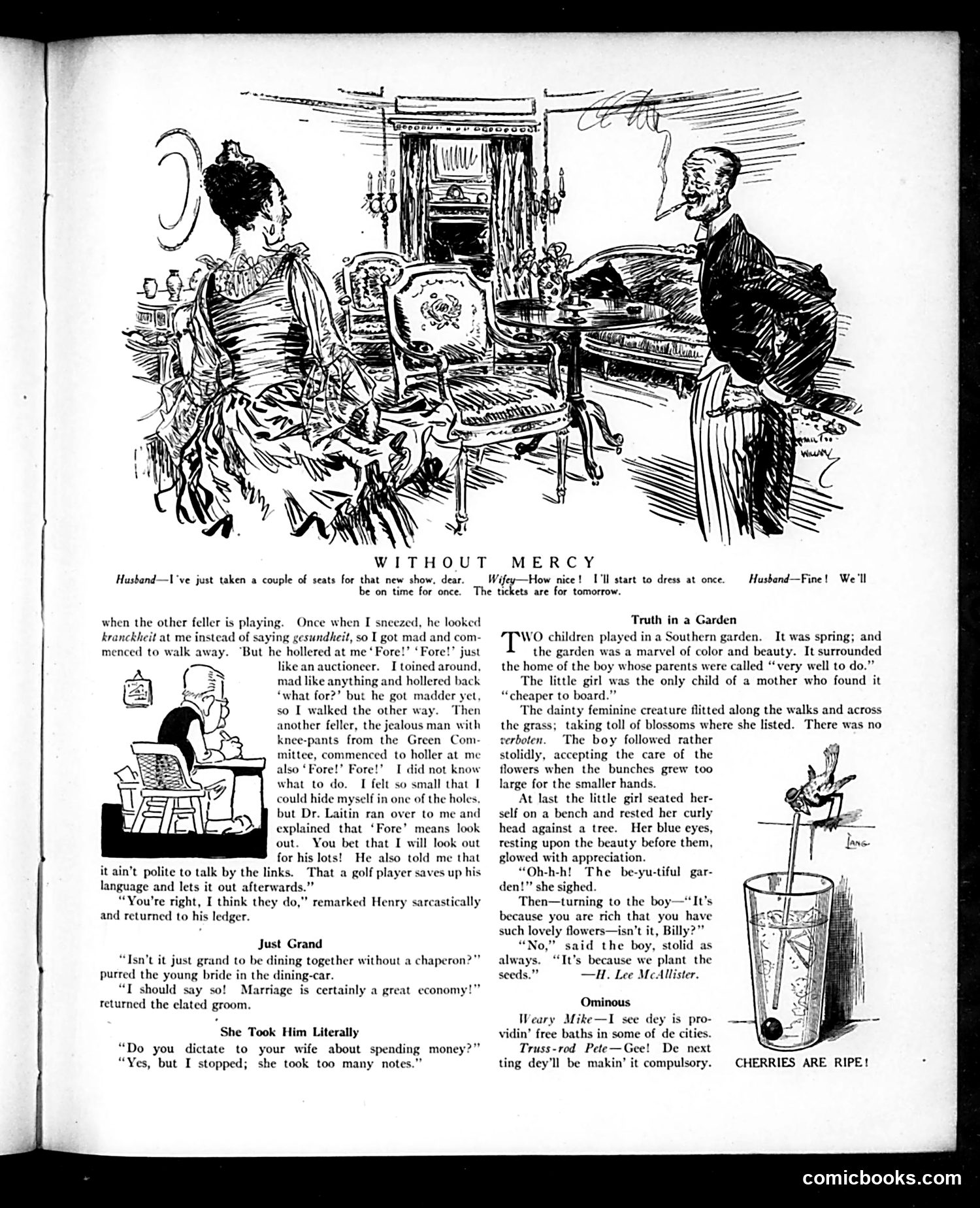
This page contains several short satirical pieces typical of early 20th-century American humor: **"Without Mercy"** mocks newlyweds' financial naïveté—the husband boasts marriage is economical, while the wife casually buys theater tickets for tomorrow, undermining his point. **"She Took Him Literally"** jokes about miscommunication: a husband who stops "dictating" spending to his wife discovers she took *written notes* instead, suggesting she'll use them against him later. **"Truth in a Garden"** presents social commentary: two children from different economic classes (one wealthy, one poor) play together. The poor girl assumes the beautiful garden exists *because* the boy is rich, revealing how economic disparity shapes children's understanding of the world. **"Ominous"** satirizes government overreach—two working-class men worry that if cities provide free public baths, authorities will eventually *mandate* them, reflecting period anxieties about state intrusion into private life. The page reflects early 1900s concerns: marriage dynamics, class differences, and government expansion.
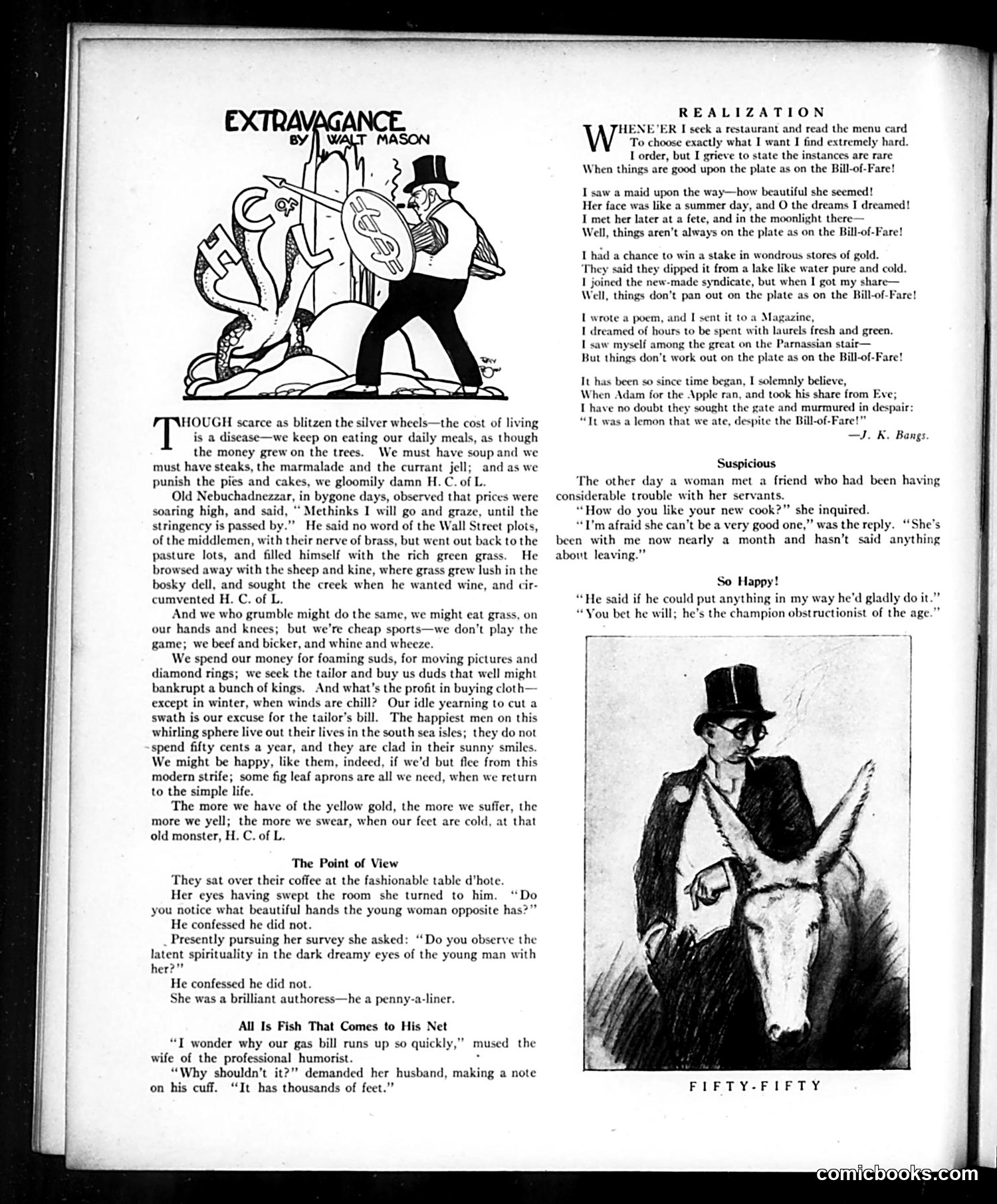
This Judge magazine page satirizes the **cost of living crisis** of the early 20th century (likely 1910s), particularly through the concept "H.C. of L." (High Cost of Living). **The main cartoon** shows a wealthy man being literally squeezed by dollar signs and financial demands—depicting how expenses drain wealth. **"Extravagance" essay** compares modern consumer complaints to the biblical King Nebuchadnezzar, who escaped high prices by grazing like livestock. The satire argues Americans spend wastefully on luxuries (movies, tailored clothes, diamonds) while complaining about expenses, then suggests returning to simple living—a tongue-in-cheek, impractical solution. **The smaller pieces** mock specific situations: a woman using her observational powers for gossip rather than genuine insight, and a humorist making puns about his gas bill to avoid confronting expense. The overall message: people blame economic conditions while their own spending habits are the real culprit. It's period-specific commentary on consumerism and economic anxiety.
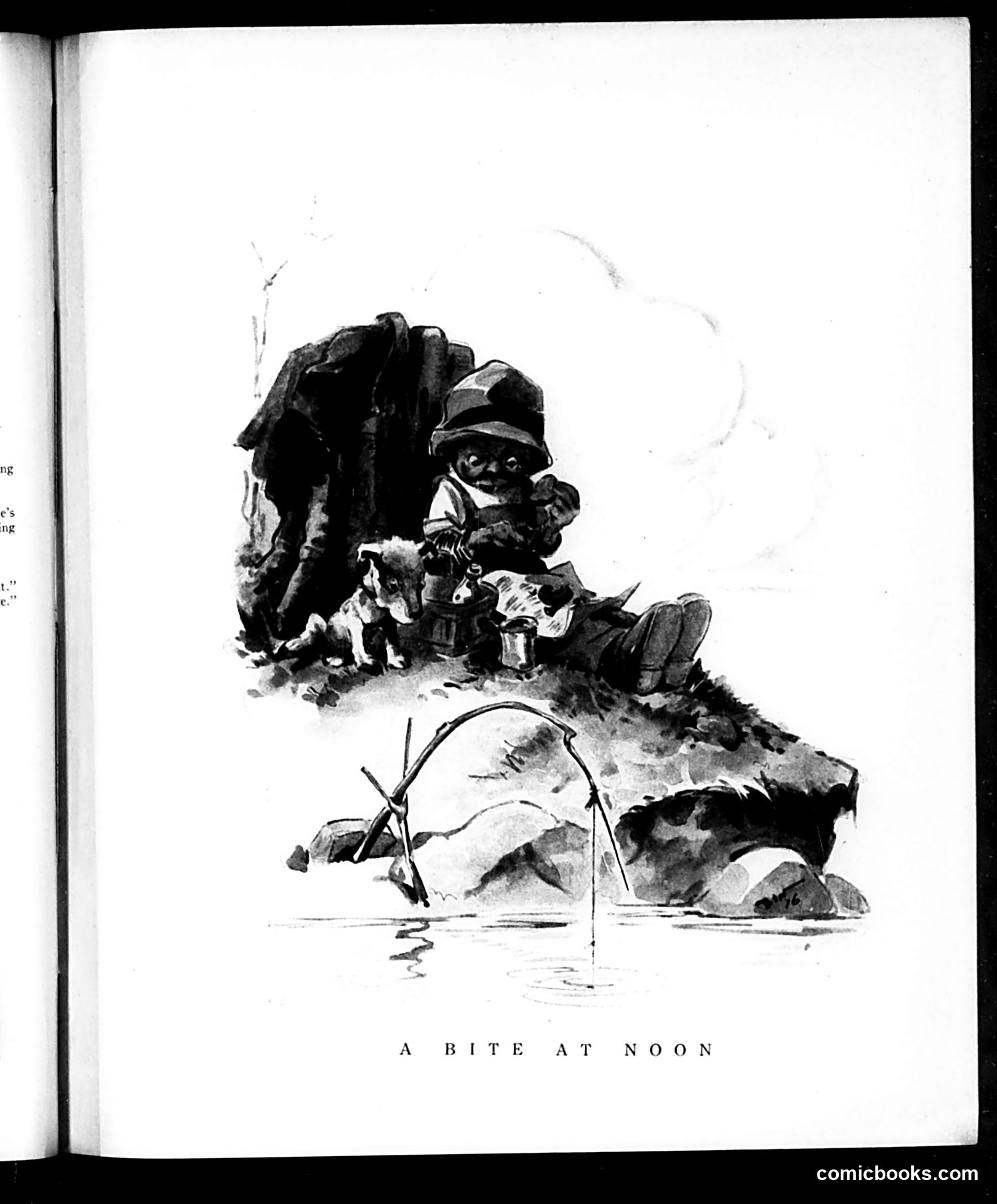
This illustration depicts a figure in military attire and helmet sitting by water with a fishing rod, appearing to catch or prepare food. A small dog or animal sits nearby. The title "A Bite at Noon" suggests a midday meal or break. Without additional context from Judge magazine's publication date or surrounding articles, the specific political reference remains unclear. However, the military dress suggests this may satirize a soldier, officer, or military figure of the period. The juxtaposition of warfare/military readiness with casual fishing—a peaceful, leisurely activity—likely conveys ironic commentary on military life, priorities, or perhaps the contrast between wartime expectations and actual experience. The exact target of satire cannot be determined from the image alone.
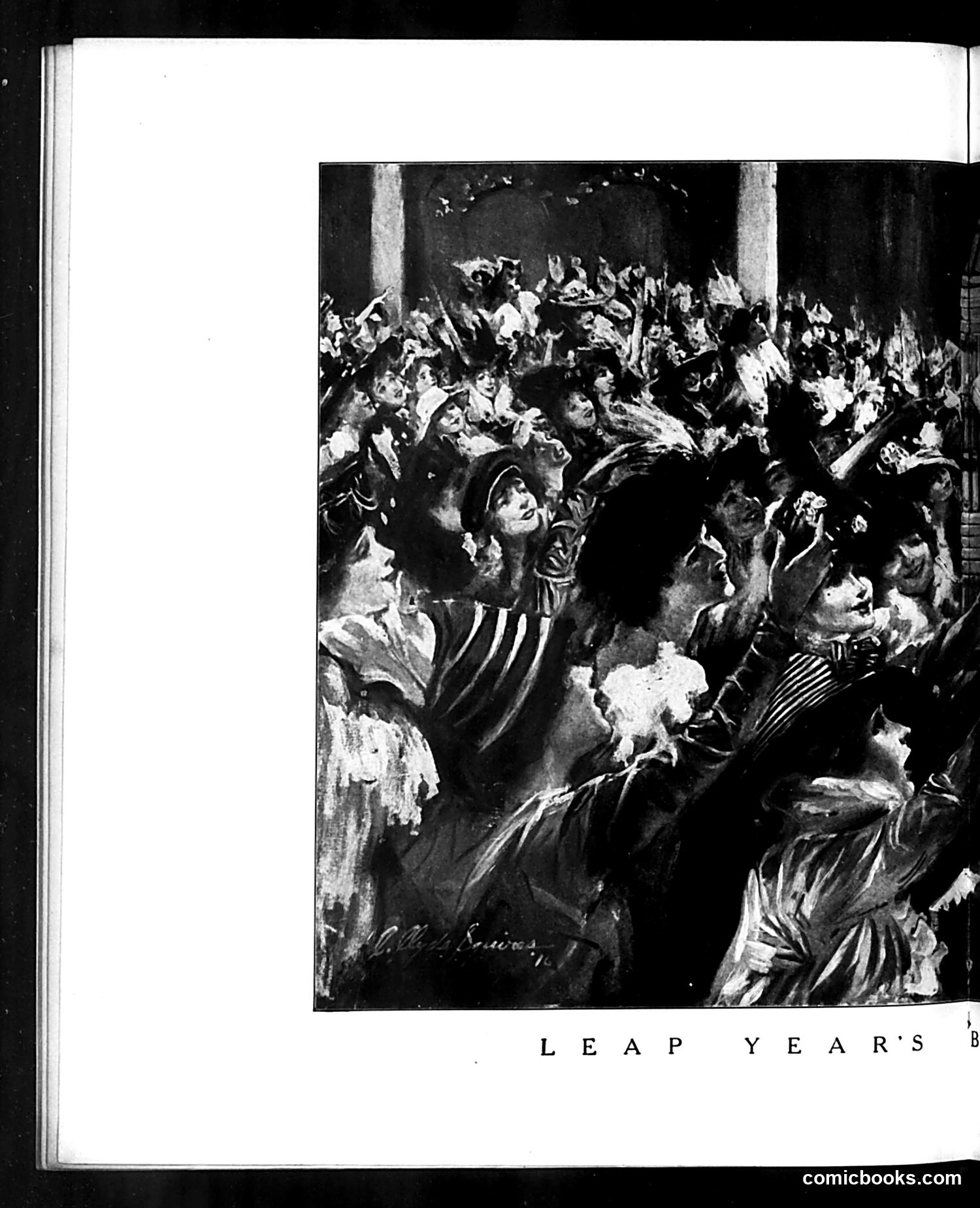
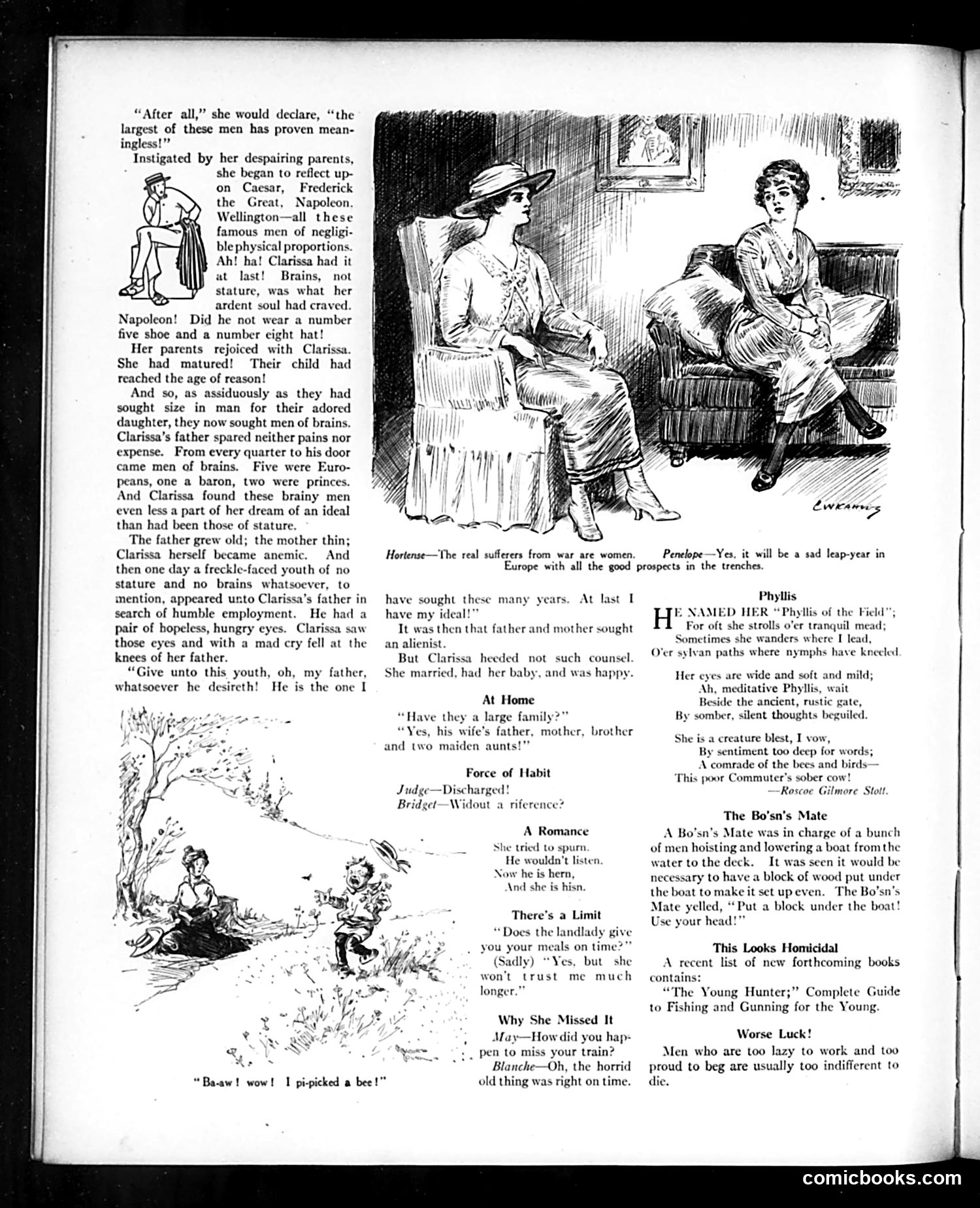
This appears to be a page from *Judge* magazine showing a crowded interior scene with many figures gesturing upward, rendered in dark, dramatic illustration style. The caption reads "LEAP YEAR'S" (text appears cut off). The image likely depicts a satirical scene related to leap year traditions, when—according to folk custom—women were permitted to propose marriage to men. The crowded, chaotic gathering of figures (many appearing to be women based on visible clothing and hats) suggests comic commentary on the reversal of courtship norms that leap year supposedly allowed. Without seeing the complete caption or article text, the exact satirical point remains somewhat unclear, but the visual emphasis on female agency and the resulting social pandemonium was a common *Judge* theme in that era.
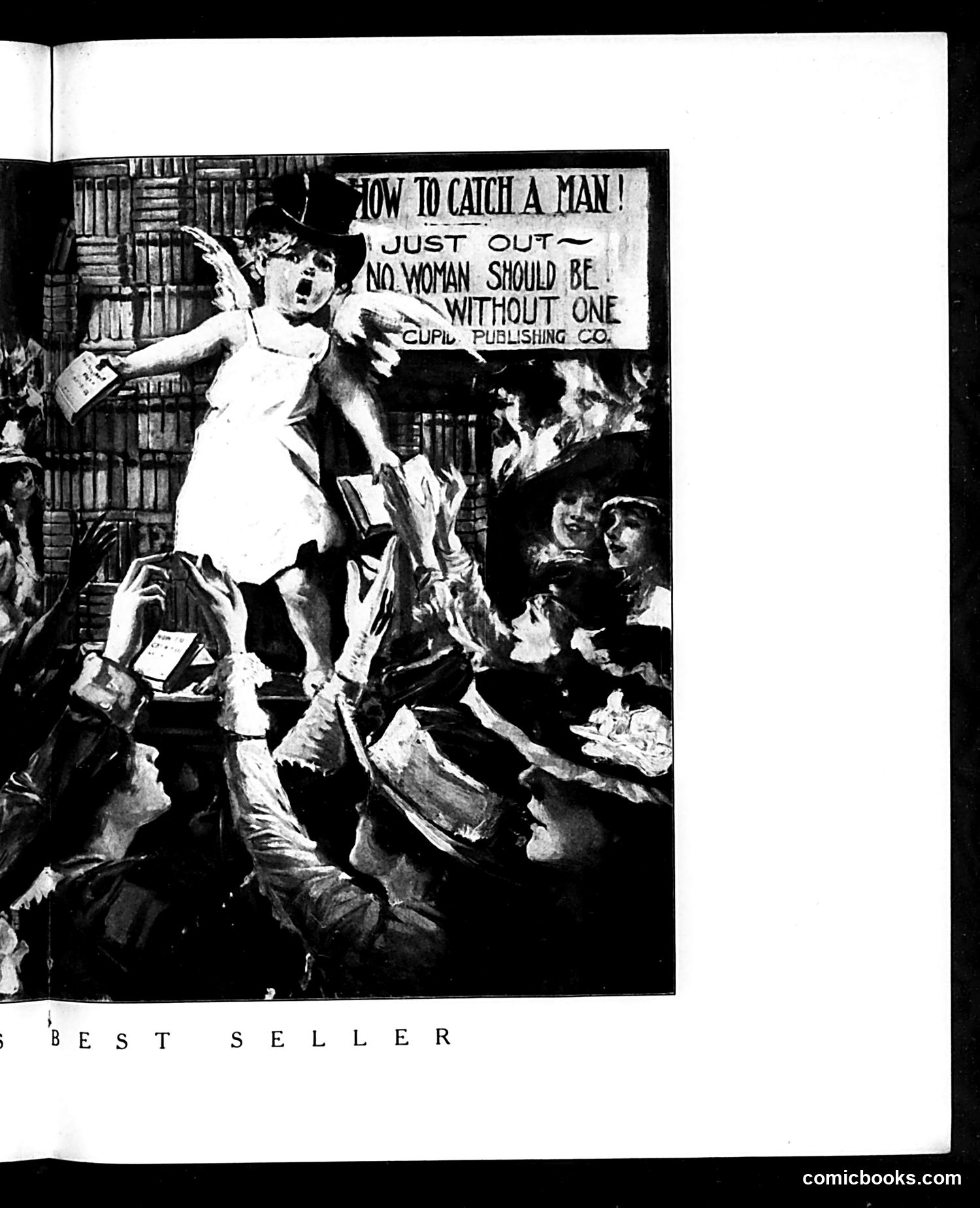
This is a book advertisement for *How to Catch a Man*, published by Cupid Publishing Company. The image shows a woman in white standing prominently above a crowd of men who appear eager or pursuing. The tagline reads: "Just out—No woman should be without one." The satire plays on early 20th-century gender dynamics and dating advice literature. It mocks the notion that women need instruction manuals to attract male attention, presenting the book as essential merchandise. The chaotic scene of men crowding around suggests the premise is absurd—that any woman with such a guide would be irresistibly pursued. The joke reflects Judge magazine's satirical commentary on contemporary courtship customs and commercialized self-help culture.
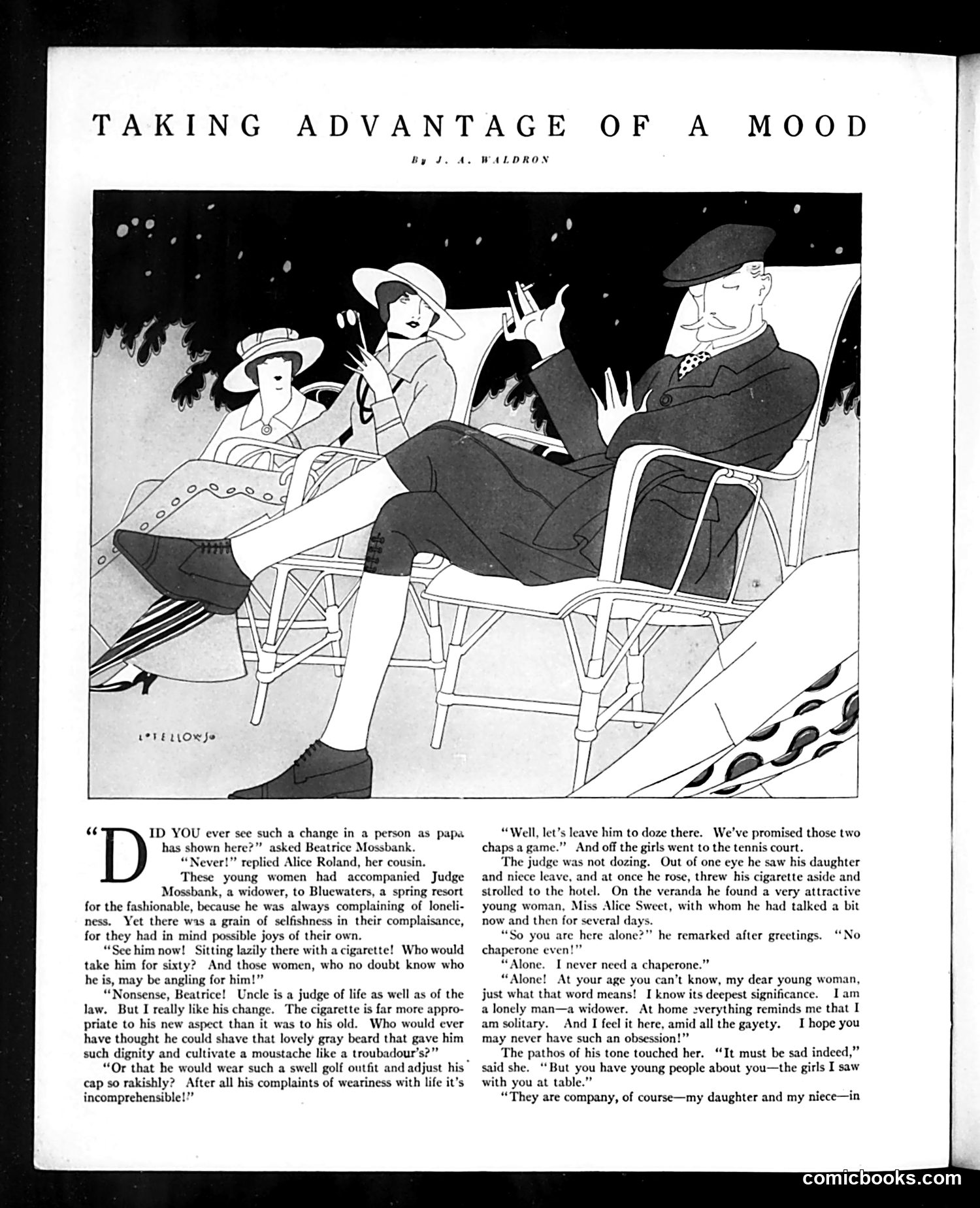
This humorous short story illustrates early 20th-century courtship conventions and gender dynamics. Judge Mossbank, a wealthy widower of sixty, arrives at a fashionable spring resort with his daughter and niece. They ostensibly accompany him out of concern for his loneliness, though the text hints they seek romantic opportunities themselves. The satire centers on Mossbank's sudden transformation: he abandons his dignified gray beard and conservative appearance for a rakish golf outfit, cigarettes, and a youthful demeanor. His niece notes this dramatic change approvingly. However, the twist reveals his real motivation—he abandons his depressed "lonely widower" act once the young women leave, pursuing a solitary young woman on the veranda while manipulating her sympathy with tales of his grief. The joke exposes how the judge has cynically weaponized his widower status to court younger women, "taking advantage" of his melancholic mood as a seduction strategy—ironic given his daughters' innocent belief they're helping a genuinely suffering father.
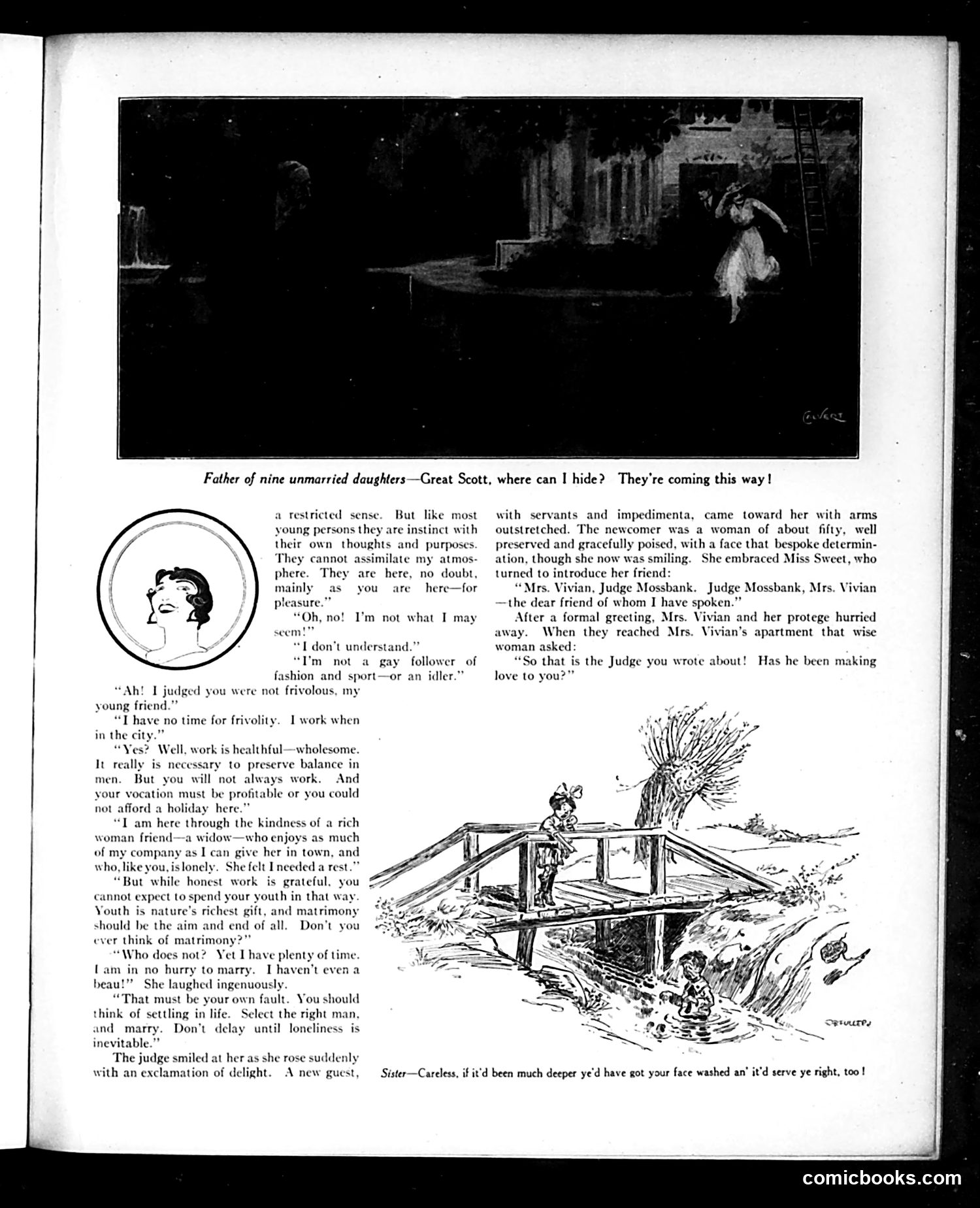
This page satirizes the gap between a moralistic judge's advice and his own circumstances. The judge pontificates to a young working woman about matrimony being "the aim and end" of youth and warns against delay, lecturing her on settling down and selecting "the right man." The satire's punch comes in the top cartoon: the same judge is shown frantically hiding from incoming visitors—revealed to be the arrival of Mrs. Vivian and her nine unmarried daughters. The caption reads "Father of nine unmarried daughters—Great Scott, where can I hide?" The joke targets hypocrisy: the judge preaches marriage as life's solution while being a father of nine unmarried daughters himself—suggesting his own matrimonial advice has catastrophically failed. His sermonizing about women's duty to marry rings hollow given his evident inability to marry off his own children. The bottom illustration about "Sister" appears unrelated domestic humor.
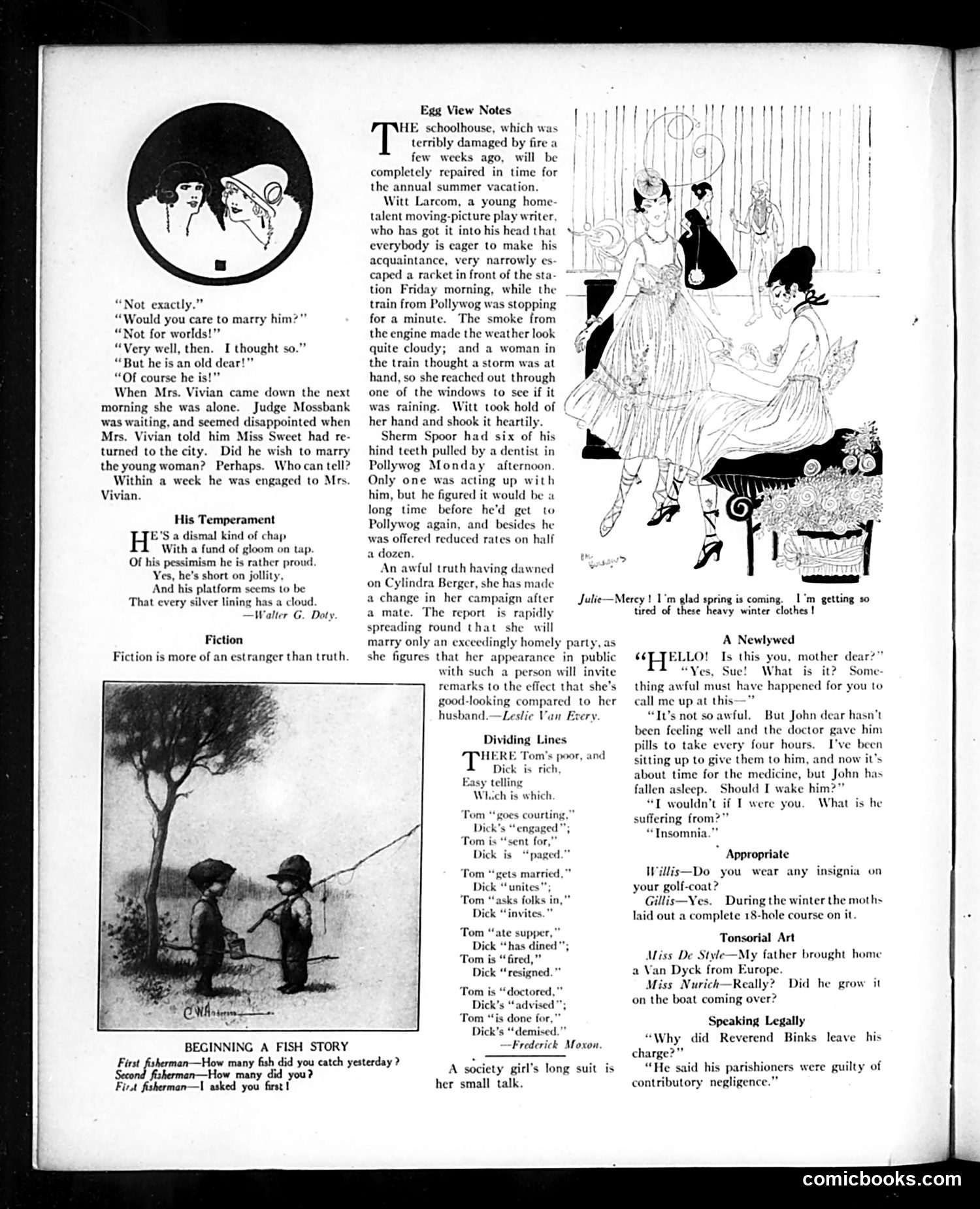
This page from the satirical magazine *Judge* contains several humor pieces typical of early 20th-century American comedy: **Main Content:** "Egg View Notes" satirizes small-town life and social pretension. Witt Larcom, an aspiring screenwriter with delusions of importance, embarrasses himself by shaking a stranger's hand during a train stop. Sherm Spoor extracts six teeth at once simply because he negotiated a bulk discount—satirizing both rural thriftiness and questionable judgment. The piece mocks provincial ambition and absurd logic. **Other Sections:** "Dividing Lines" contrasts working-class Tom's plain speech ("goes courting," "eats supper") with wealthy Dick's refined vocabulary ("engaged," "dines")—a class commentary. Short jokes about newlyweds, golf, and clergy provide typical period humor. The cartoon "Beginning a Fish Story" satirizes fishermen's tall tales. Overall, the page reflects early 1900s urban satire aimed at mocking rural pretension, class differences, and small-town absurdities.
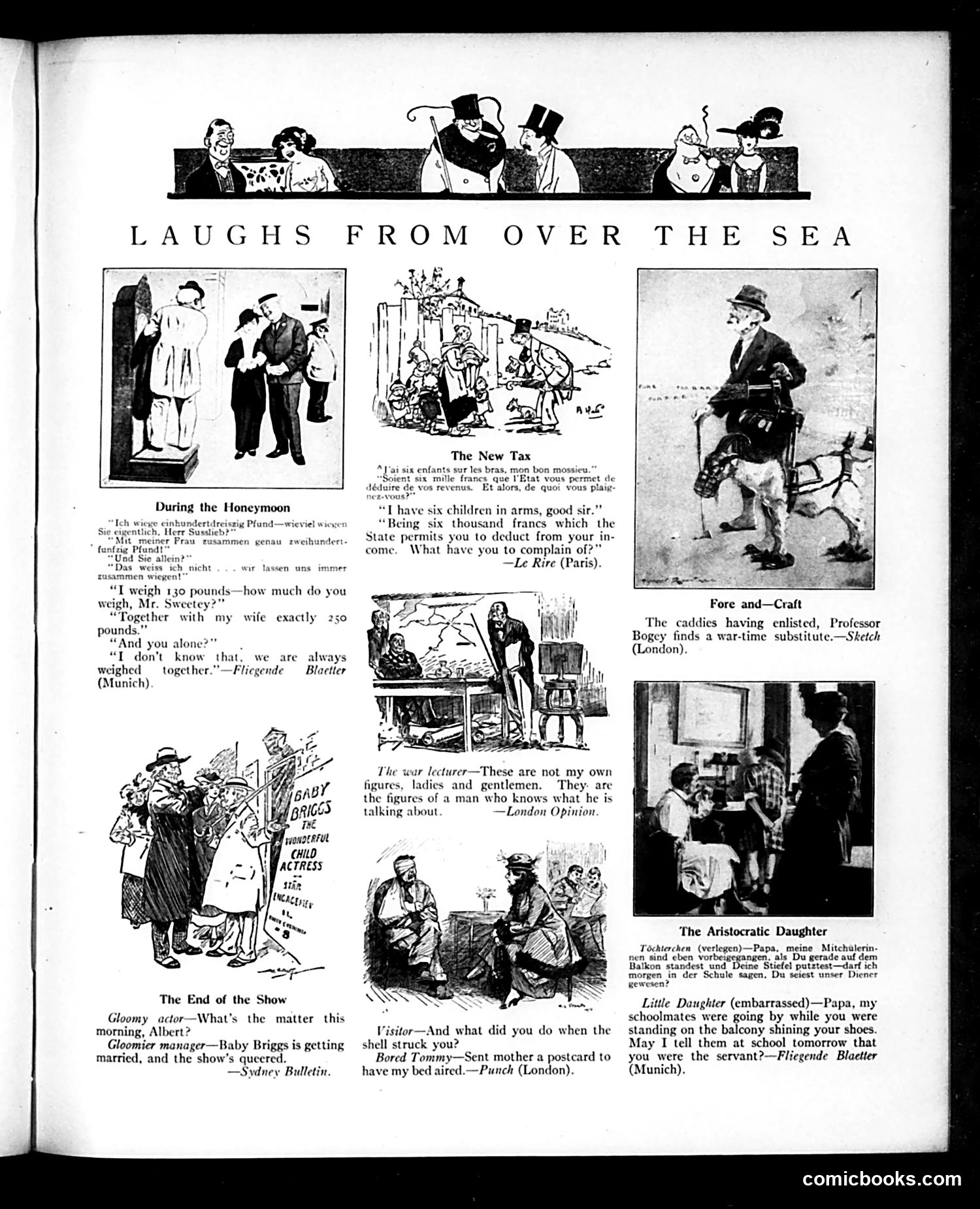
This page collects humor reprinted from European satirical magazines, offering American readers a window into wartime anxieties abroad. Most strips mock WWI-era concerns: **"The New Tax"** satirizes French child-support deductions—a man with six children complains despite tax relief, questioning what more he could want. **"The War Lecturer"** skewers someone citing statistics without original expertise, a jab at wartime propaganda. **"Bored Tommy"** depicts British soldier priorities: after a shell explosion, he's concerned only that his mother send word his bed got aired—absurdist humor deflating martial heroism. **"The Aristocratic Daughter"** (German) shows class anxiety: a girl embarrassed her father was seen doing servant's work (polishing boots on a balcony), fearing social shame at school. The honeymoon and "End of the Show" items are lighter, non-war humor. The page exemplifies how Judge presented foreign satire to American audiences, mixing entertainment with commentary on international wartime conditions and social rigidity.
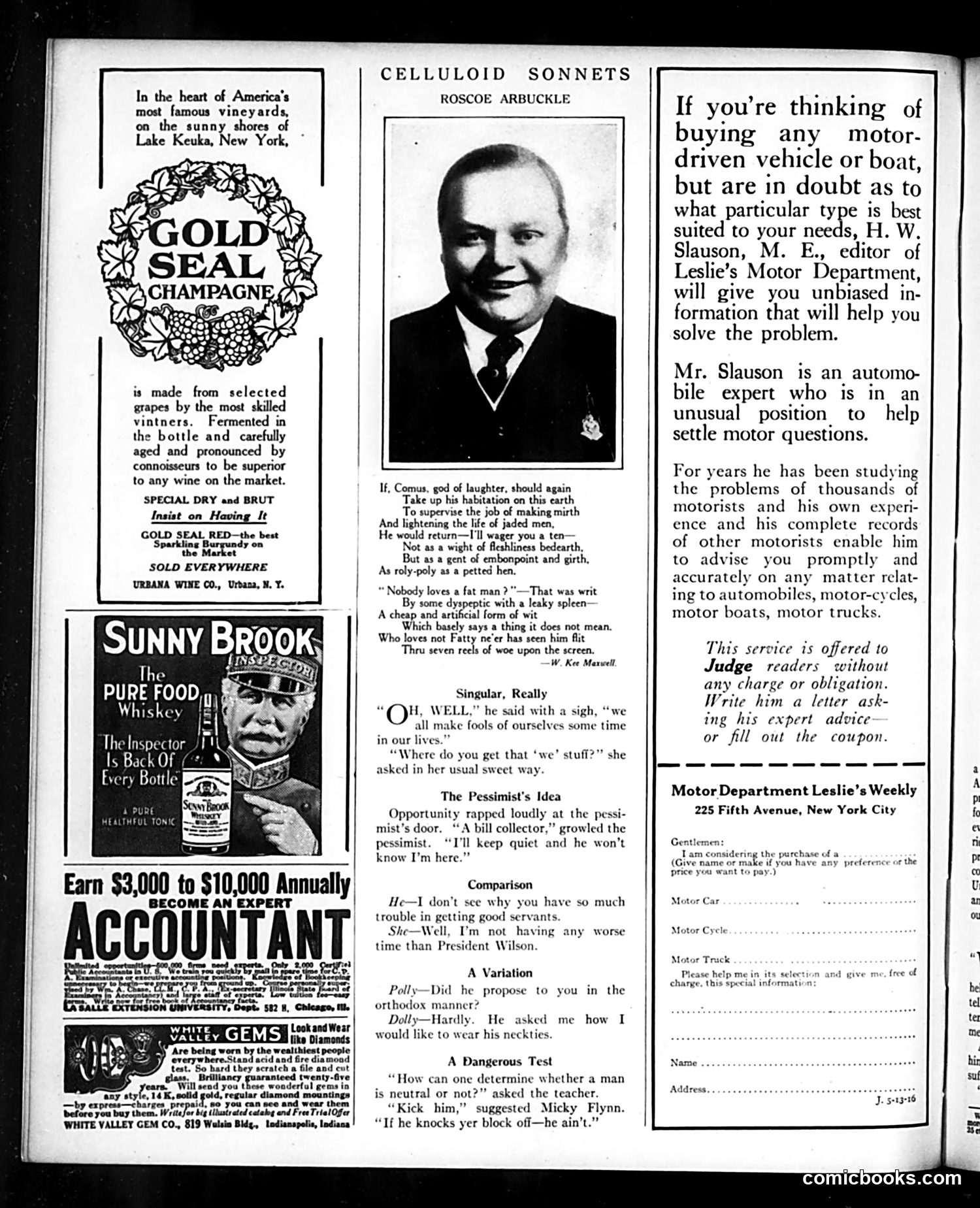
This page is primarily **advertising and advice columns** rather than political satire. The main content includes: **"Celluloid Sonnets"** — a poetic tribute to **Roscoe Arbuckle**, a famous silent-film comedian known for his rotund appearance. The poem playfully defends fat men as sources of laughter, suggesting that Arbuckle embodies Comus (god of merriment). This reflects Arbuckle's popularity in 1910s-20s cinema. **Miscellaneous humor snippets** — brief jokes about relationships, pessimism, and courtship, typical of Judge's satirical content. **Service advertisement** — H.W. Slauson offers free automotive advice through Leslie's Motor Department, addressing the rapidly growing automobile industry's consumer confusion. **Commercial ads** — Gold Seal Champagne, Sunny Brook Whiskey, accountancy courses, and costume jewelry fill the margins, reflecting 1920s consumer culture and Prohibition-era wine advertising. The page captures an era of early mass automobiles, silent film celebrity, and accessible consumer goods.
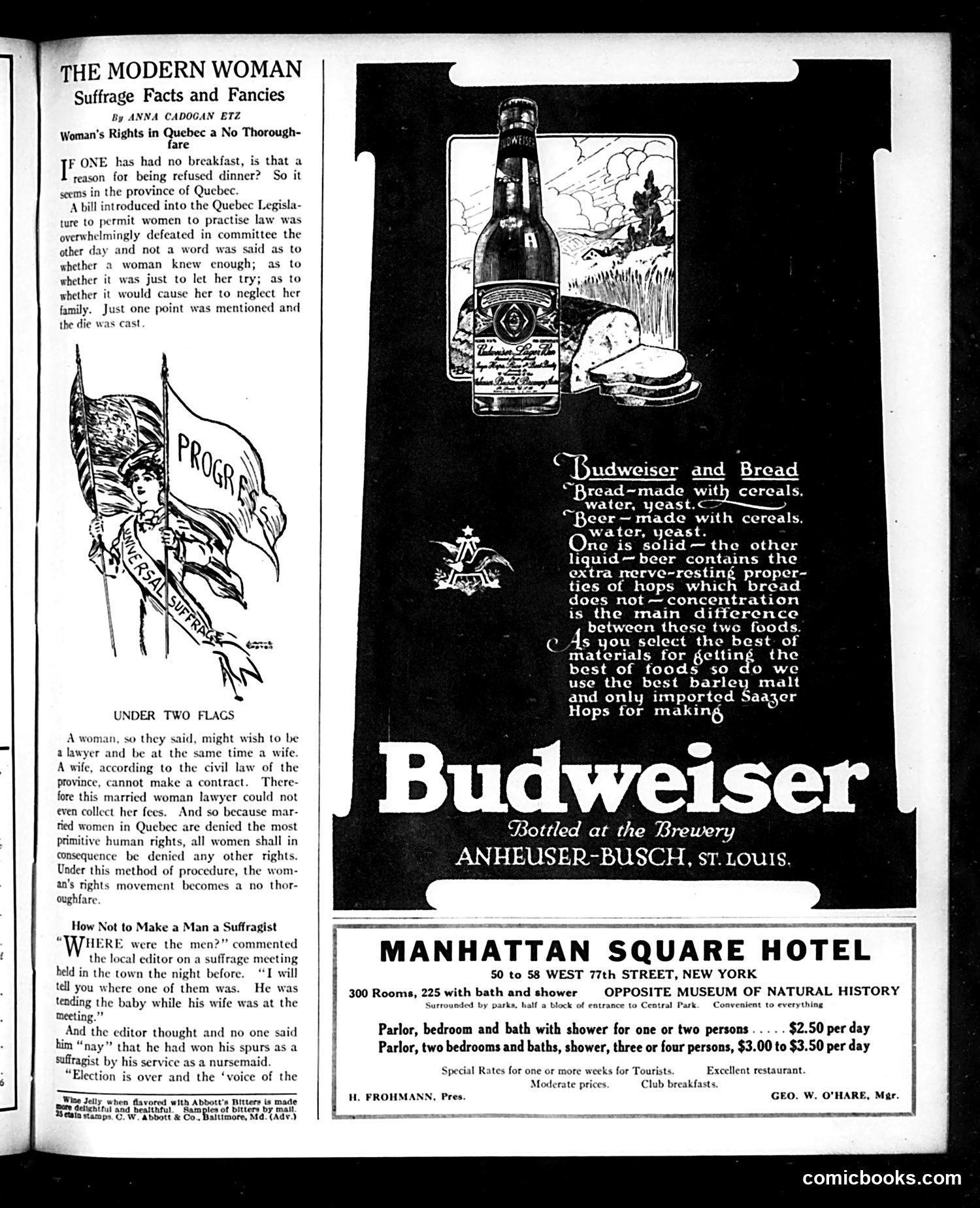
This Judge magazine page satirizes opposition to women's suffrage and professional rights through two articles by Anna Cadogan Etz. **"Woman's Rights in Quebec a No Thoroughfare"** critiques Quebec's defeat of a bill allowing women to practice law. The article exposes the logical contradiction: married women cannot legally make contracts under provincial law, so lawmakers rejected female lawyers—not on merit, but because married women couldn't collect their own fees. The satire highlights how one legal disability becomes justification for denying women all professional rights. **"How Not to Make a Man a Suffragist"** mocks a newspaper editor who sarcastically praised a man as a "suffragist" merely for babysitting while his wife attended a suffrage meeting. The satire suggests the editor inadvertently exposes male absurdity: he considers basic childcare by a husband as noteworthy male sacrifice, implying men deserve credit for minimal domestic participation—while women juggle activism and family responsibility. Both pieces use irony to expose anti-suffrage arguments as circular, discriminatory, and rooted in convenience rather than principle.
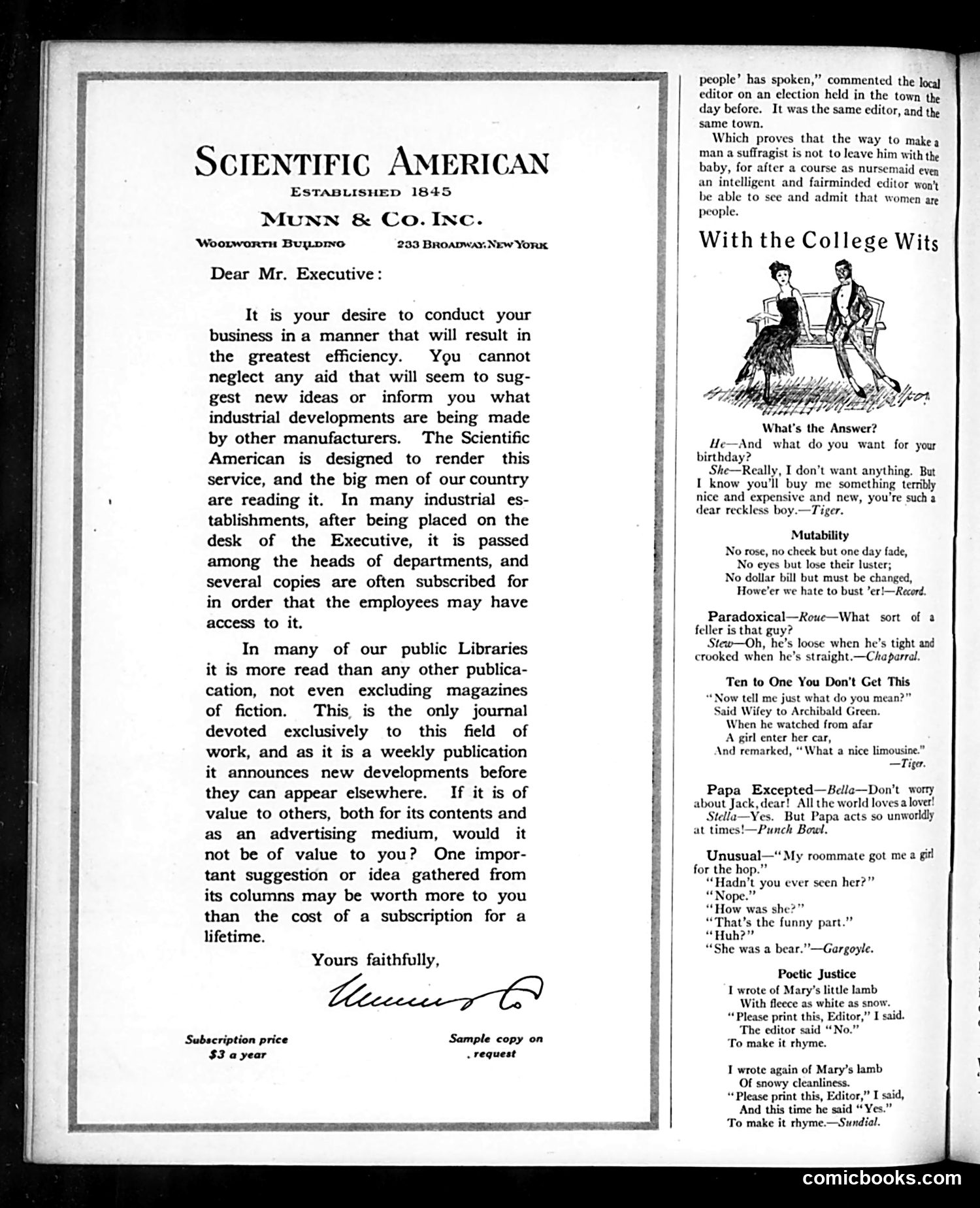
This page is primarily **advertising and filler content**, not political satire. The left side features a **Scientific American subscription pitch** dressed as a letter to business executives, arguing the journal's value for industrial innovation and efficiency. The right side contains "**With the College Wits**"—a humor column of brief jokes and quips, mostly about dating, marriage, and campus life. These are generic gags typical of 1920s college humor magazines. **The one substantive satirical element** appears at the very top: a brief commentary mocking a local newspaper editor who claimed "the people have spoken" after an election, despite being the same editor in the same town the previous day. The joke suggests the editor's editorial stance on women's suffrage changed after experiencing childcare responsibilities—implying even intelligent men resist acknowledging women as "people" until forced into domestic labor. The rest is lightweight social humor with no clear political content—jokes about dating etiquette, gift-giving, and rejected poetry submissions.
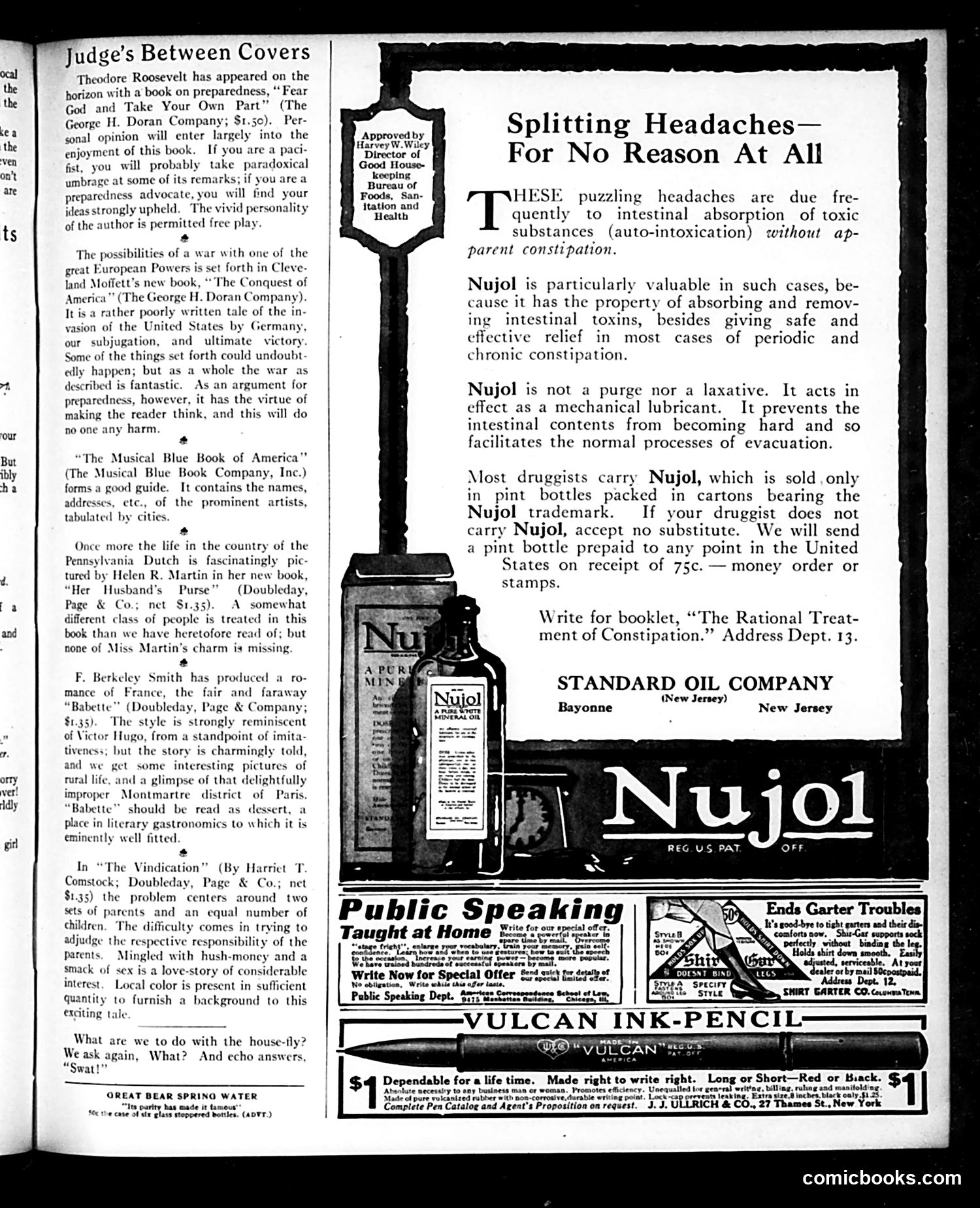
This page is primarily **advertising** rather than editorial content or political satire. The dominant feature is a large advertisement for **Nujol**, a mineral oil-based intestinal lubricant made by Standard Oil Company (New Jersey). The ad claims Nujol treats headaches caused by intestinal toxin absorption without apparent constipation. It carries an approval stamp from Harvey W. Wiley, Director of Good Housekeeping's "Bureau of Foods, Sanitation and Health"—a credential that would have carried weight with 1910s readers. The left column contains **book reviews** of contemporary works, including Theodore Roosevelt's preparedness manual and a fictional German invasion narrative. Below the Nujol ad are smaller advertisements for other products: a "Public Speaking Taught at Home" correspondence course and **Vulcan Ink-Pencil**. No political cartoons or satirical content appear visible on this page. It represents standard early-20th-century magazine advertising practices blending product promotion with authority endorsements.
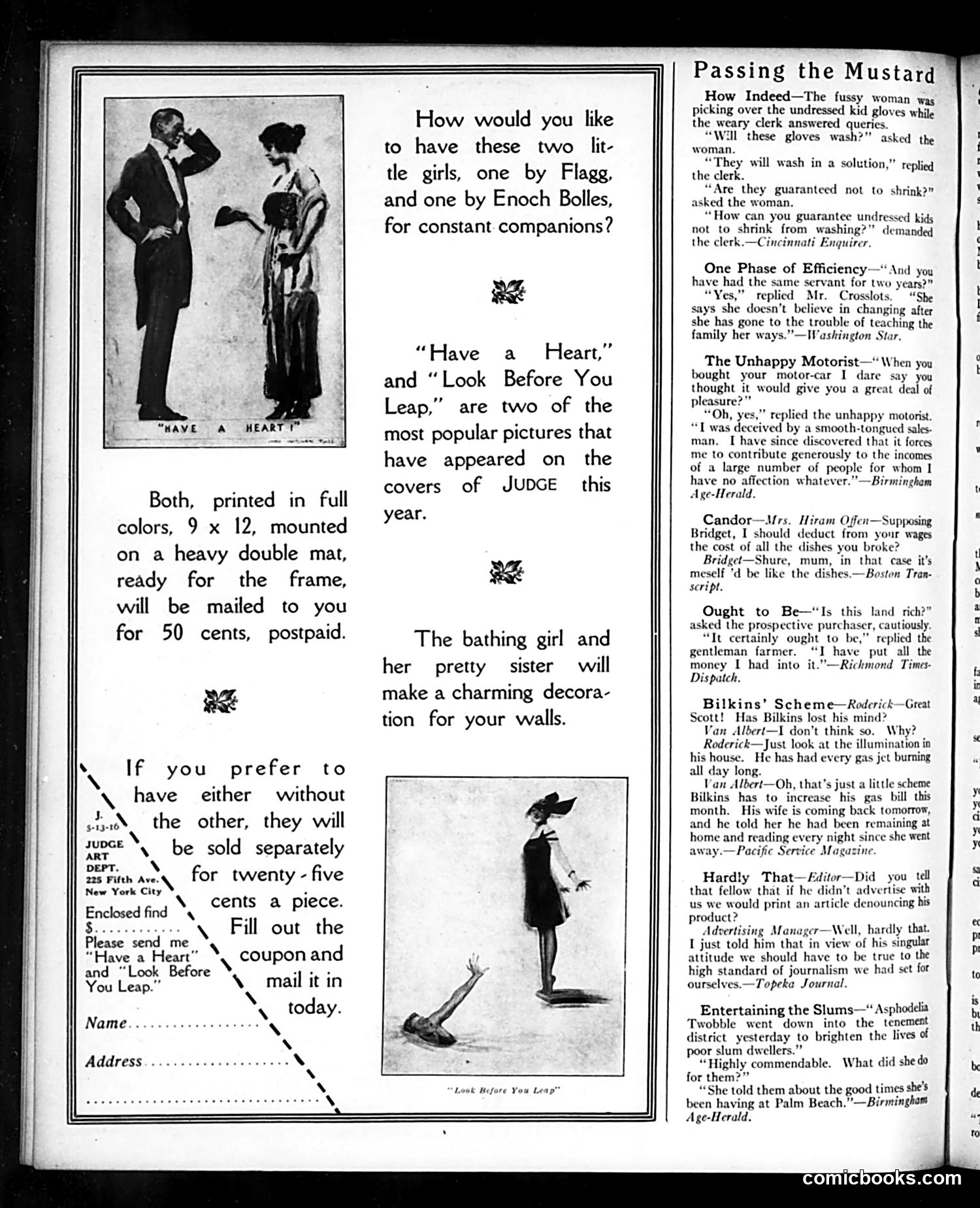
This page primarily features **advertising for two decorative prints** rather than political cartoons. The advertised images—"Have a Heart" and "Look Before You Leap"—are described as popular Judge cover illustrations by artists Flagg and Enoch Bolles, available as framed prints for 50 cents. The page's right column contains **humor anecdotes** typical of Judge's satirical style, mocking various social situations: a fussy woman interrogating a clerk about kid gloves, servants' efficiency, a disappointed car owner, working-class domestic disputes, and wealthy women performing charity. These brief jokes reflect early 20th-century class consciousness and domestic absurdities rather than specific political events. The cartoons themselves (showing a well-dressed couple and a bathing girl) appear designed as *aspirational wall decorations* rather than hard-hitting satire. The overall page represents Judge's commercial side: selling genteel humor and decorative goods to middle-class readers.
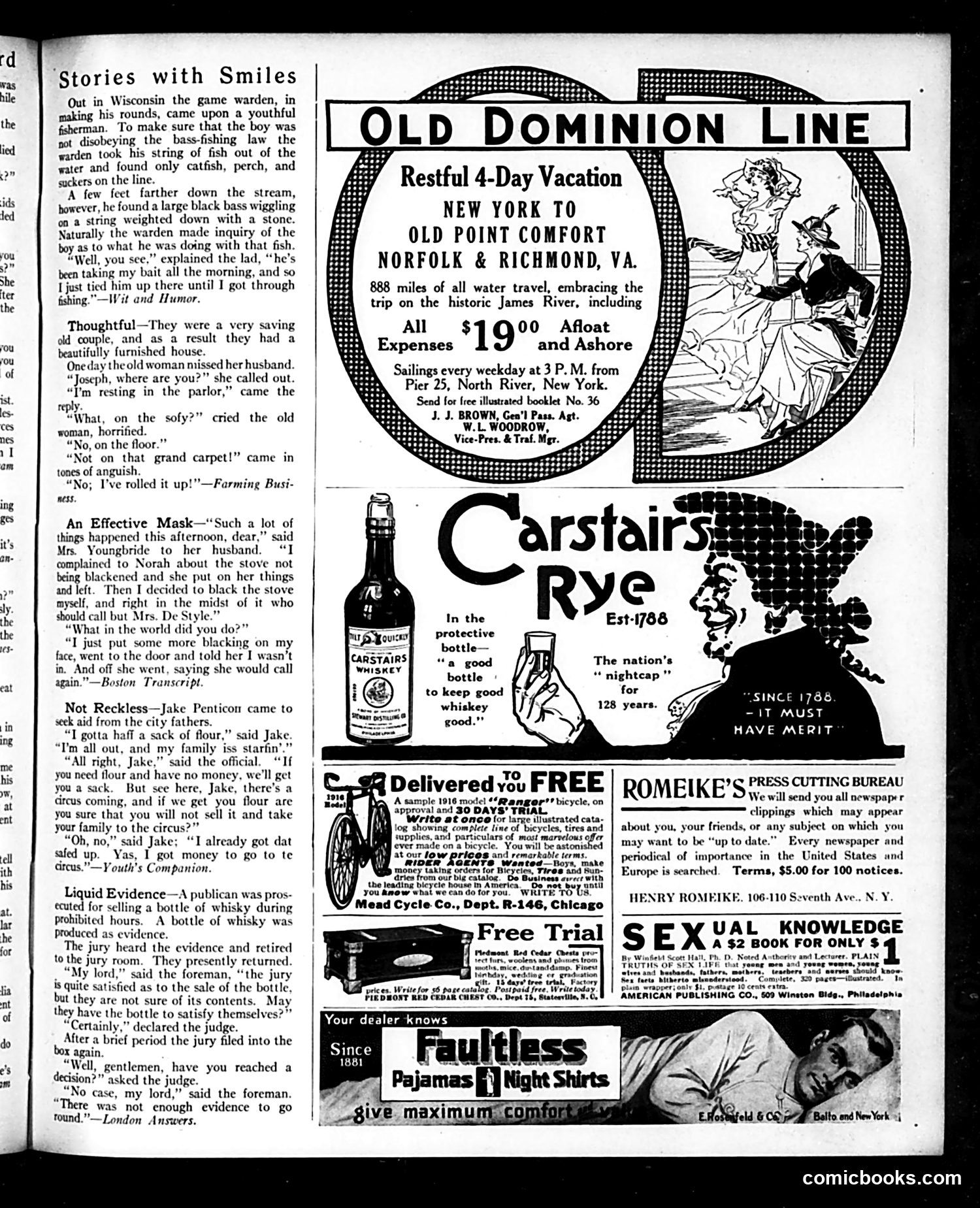
This page from *Judge* magazine consists primarily of **short humorous stories** and **advertisements** rather than political cartoons. The "Stories with Smiles" section contains four brief anecdotes: a boy explaining why he weighted down a bass (he's keeping the fish from stealing his bait), a frugal couple rolling up their carpet to sit on the floor, a woman pretending to be covered in soot to avoid a social call, and a poor man promising not to sell relief flour to attend the circus. The humor relies on **everyday absurdity and working-class characters**—fishermen, servants, city relief applicants. There is **no apparent political satire**; instead, the jokes target human nature: penny-pinching, social climbing avoidance, and poverty. The page is dominated by **period advertisements**: steamship vacations, whiskey (*Carstairs Rye*, established 1788), bicycles, pajamas, and other goods. The *Carstairs* ad notably features the brand's longevity as a selling point during Prohibition—ironic marketing for a liquor product. No identifiable political figures or events appear on this page.
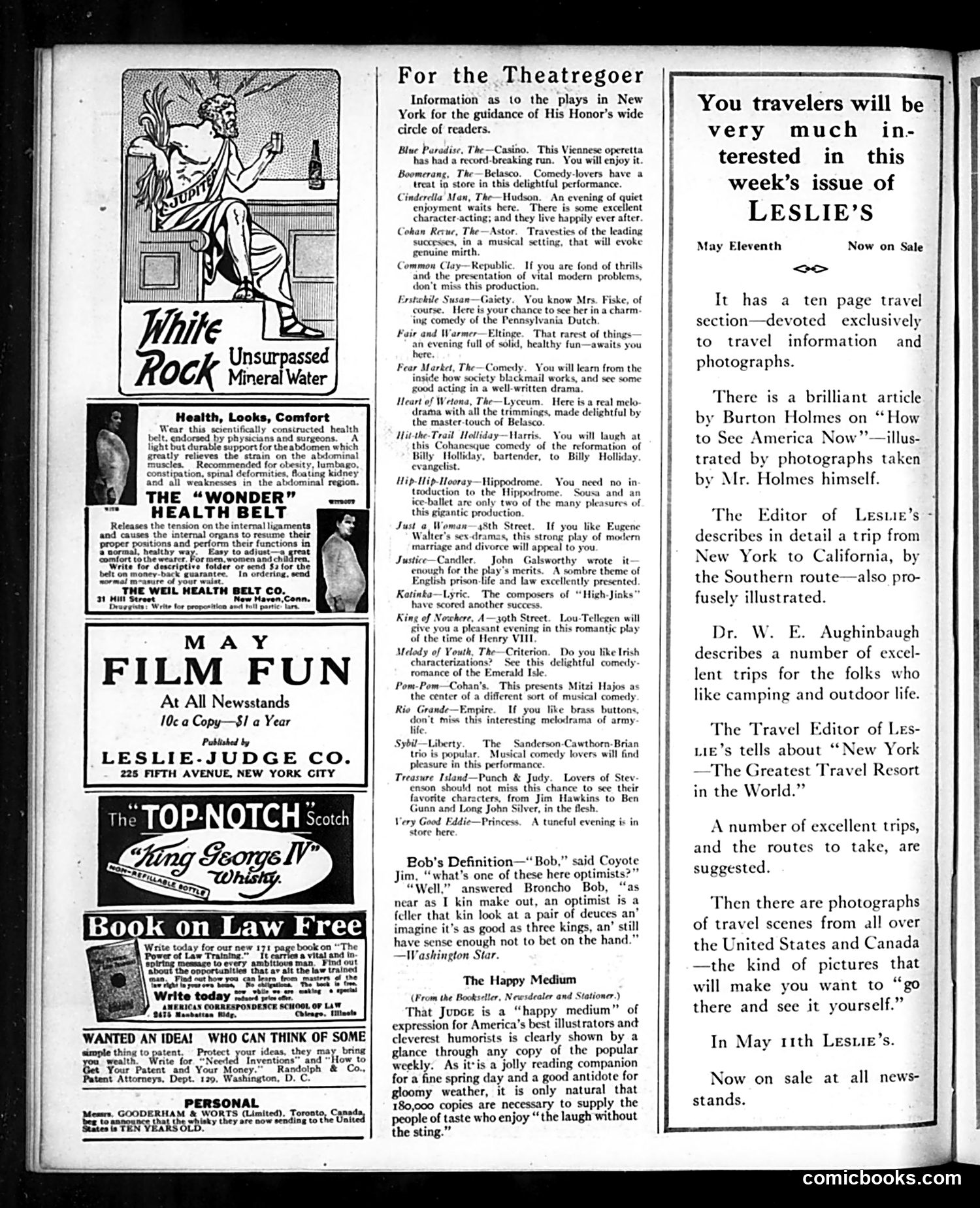
This page is primarily **advertising and theater listings**, not political satire. The left side features commercial ads (health belts, patent services, a whisky advertisement) typical of early 20th-century magazines seeking revenue. The right side contains a "For the Theatregoer" column listing New York stage productions with brief reviews—plays like "Blue Paradise," "The Boomerang," and "Hip-Hip-Hooray" at venues like the Casino and Hippodrome. These appear to be genuine theatrical notices, not satirical commentary. The page also promotes Leslie's magazine's May 11th issue, highlighting travel photography and articles by Burton Holmes on American tourism. **There is no political cartoon or satirical content visible on this page.** It represents Judge functioning as an entertainment and lifestyle publication rather than as political satire—common for American magazines of this era.
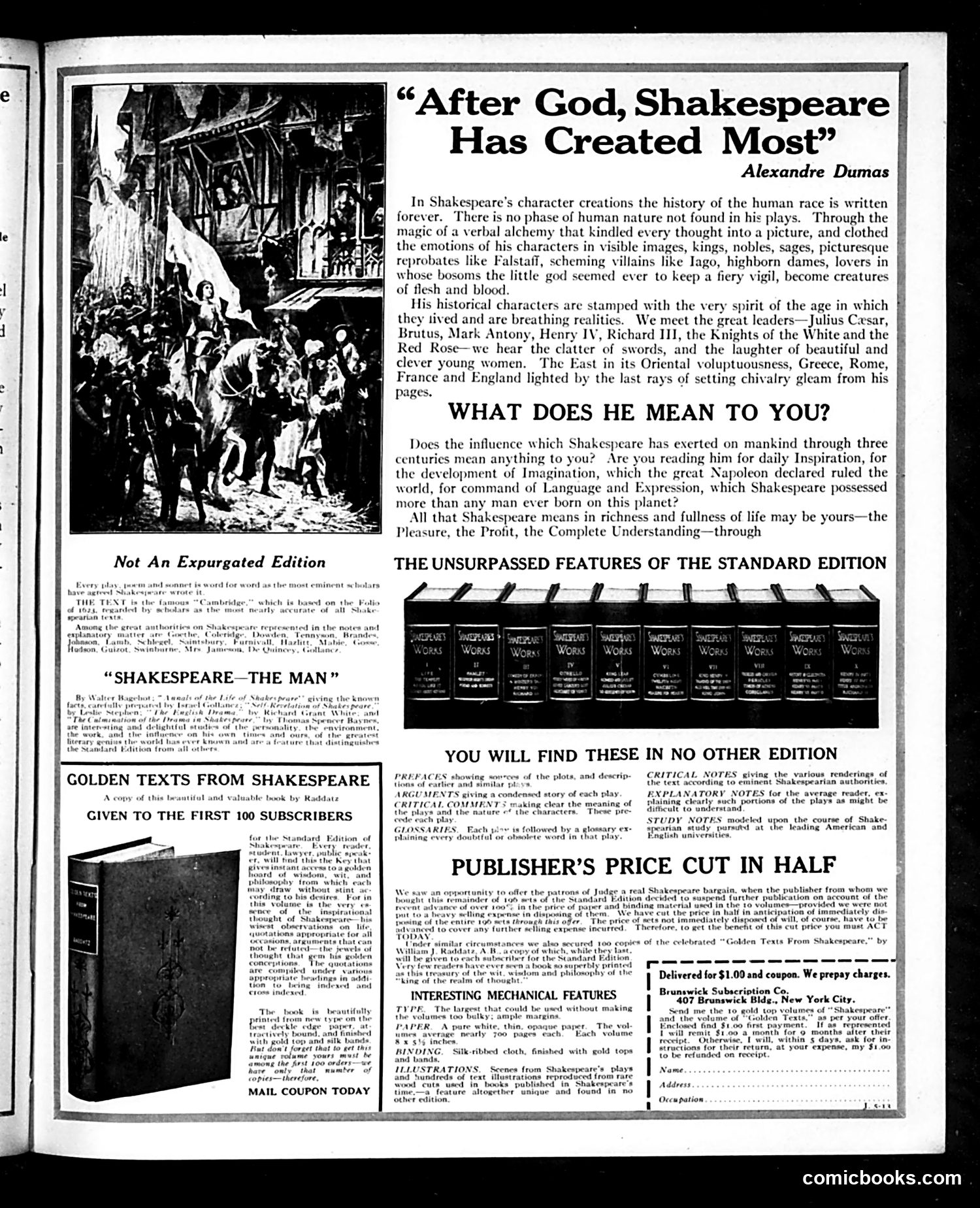
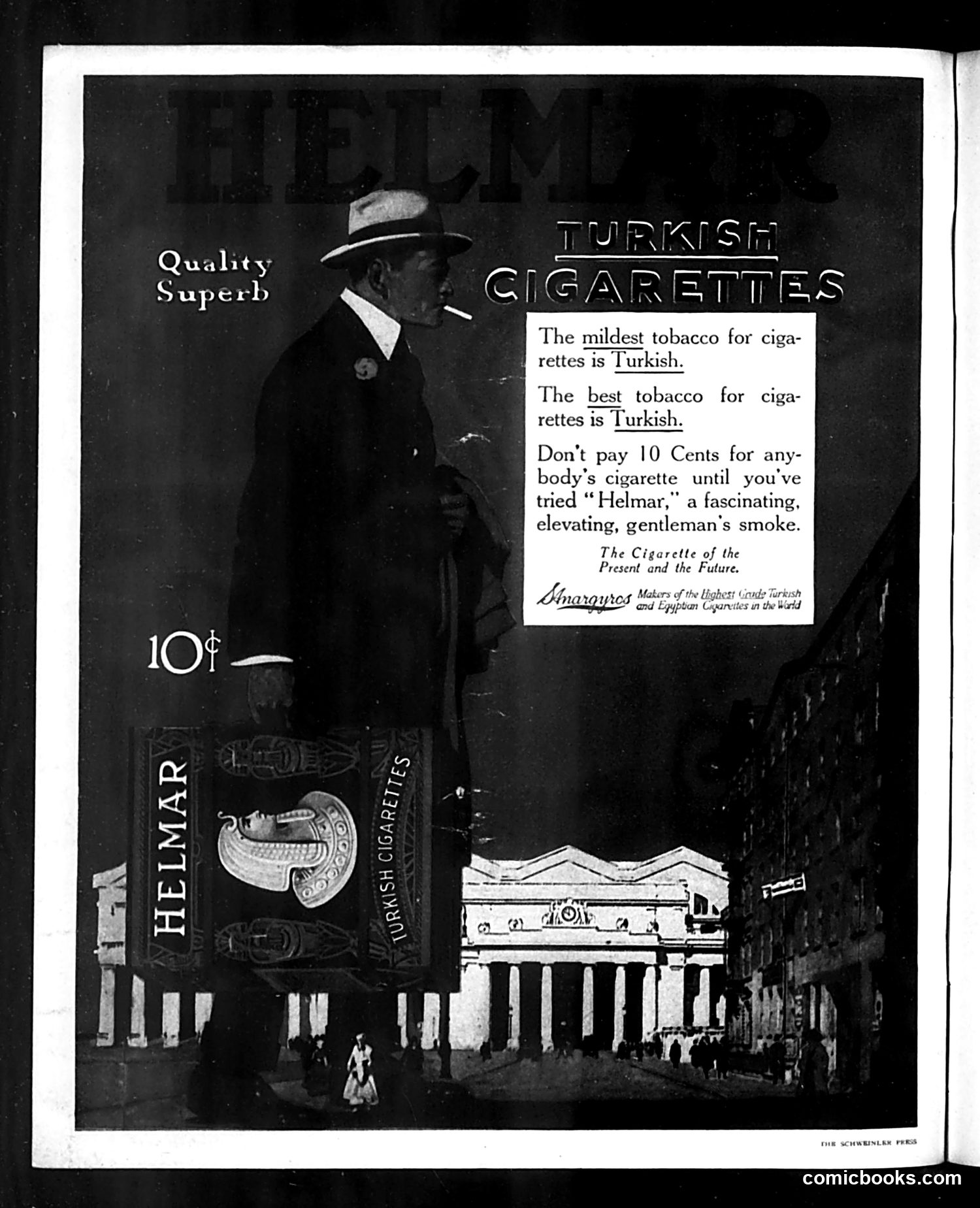
This is primarily a **cigarette advertisement** for Helmar Turkish cigarettes, not political satire. The page features a well-dressed gentleman in formal attire smoking, positioned against an urban architectural backdrop. The ad emphasizes Turkish tobacco as superior—"mildest" and "best"—positioning Helmar as a refined, gentlemanly product at 10 cents. The tagline "The Cigarette of the Present and the Future" reflects early-20th-century marketing optimism. The imagery associates the product with sophistication and urbanity. This represents vintage tobacco advertising before health concerns changed cigarette marketing, when such products were openly promoted as quality consumer goods in mainstream magazines like Judge.