
Judge, 1916-05-13 · page 16 of 28
Judge — May 13, 1916 — page 16: what you’re looking at
What you’re looking at
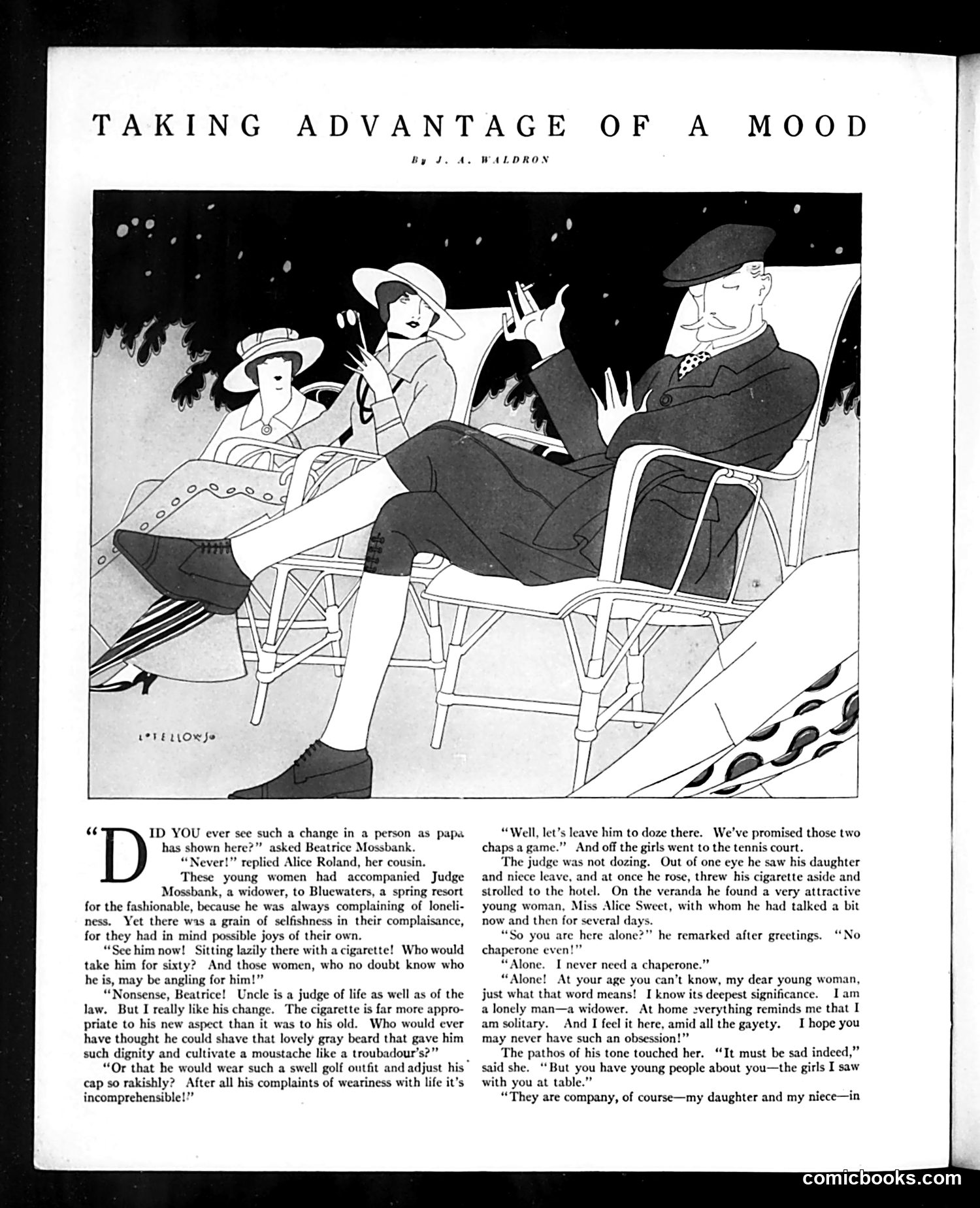
This humorous short story illustrates early 20th-century courtship conventions and gender dynamics. Judge Mossbank, a wealthy widower of sixty, arrives at a fashionable spring resort with his daughter and niece. They ostensibly accompany him out of concern for his loneliness, though the text hints they seek romantic opportunities themselves. The satire centers on Mossbank's sudden transformation: he abandons his dignified gray beard and conservative appearance for a rakish golf outfit, cigarettes, and a youthful demeanor. His niece notes this dramatic change approvingly. However, the twist reveals his real motivation—he abandons his depressed "lonely widower" act once the young women leave, pursuing a solitary young woman on the veranda while manipulating her sympathy with tales of his grief. The joke exposes how the judge has cynically weaponized his widower status to court younger women, "taking advantage" of his melancholic mood as a seduction strategy—ironic given his daughters' innocent belief they're helping a genuinely suffering father.
📄 Transcribed text from this page (OCR, searchable)
Machine-transcribed from the original scan — historical spelling and the odd misread are preserved.
TAKING ADVANTAGE OF A MOOD By Jo AL LeTELLOwSe WALDRON ID YOU ever has shown he ¢ such a change in a person as papa ?” asked Beatrice Mossbank. replied Alice Roland, her cousin. These young women had accompanied Judge Mossbank, a widower, to Bluewaters, a spring resort for the fashionable, because he was always complaining of loneli- ness. Yet there was a grain of selfishness in their complaisance, for they had in mind possible joys of their own. “See him now! Sitting lazily there with a cigarette!. Who would take him for sixty? And those women, who no doubt know who he is, may be angling for him!” “Nonsense, Beatrice! Uncle is a judge of life as well as of the law. But I really like his change. The cigarette is far more appro- priate to his new aspect than it was to his old. Who would ever have thought he could shave that lovely gray beard that gave him such dignity and cultivate a moustache like a troubadour’s?” “Or that he would wear such a swell golf outfit and adjust his” After all his complaints of weariness with life it’s ” cap so rakishly? incomprehensible! “Well, let’s leave him to doze there. We've promised those two chaps a game.” And off the girls went to the tennis court. The judge was not dozing. Out of one eye he saw his daughter and niece leave, and at once he rose, threw his cigarette aside and strolled to the hotel. On the veranda he found a very attracti young woman, Miss Alic ct, with whom he had talked a bit now and then for several da: “So you are here alone? chaperone even!” “Alone. I never need a chaperone.” “Alone! At your age you can’t know, my dear young woman, just what that word means! I know its deepest significance. Iam a lonely man—a widower. At home everything reminds me that I am solitary. And I feel it here, amid all the gayety. I hope you may never have such an obsession!”” The pathos of his tone touched her. ‘It must be sad indeed,” said she. “But you have young people about you—the girls I saw with you at table.” “They are company, of course—my daughter and my niece—in he remarked after grectings. “No comicbooks.com