
Judge, 1916-05-13 · page 12 of 28
Judge — May 13, 1916 — page 12: what you’re looking at
What you’re looking at
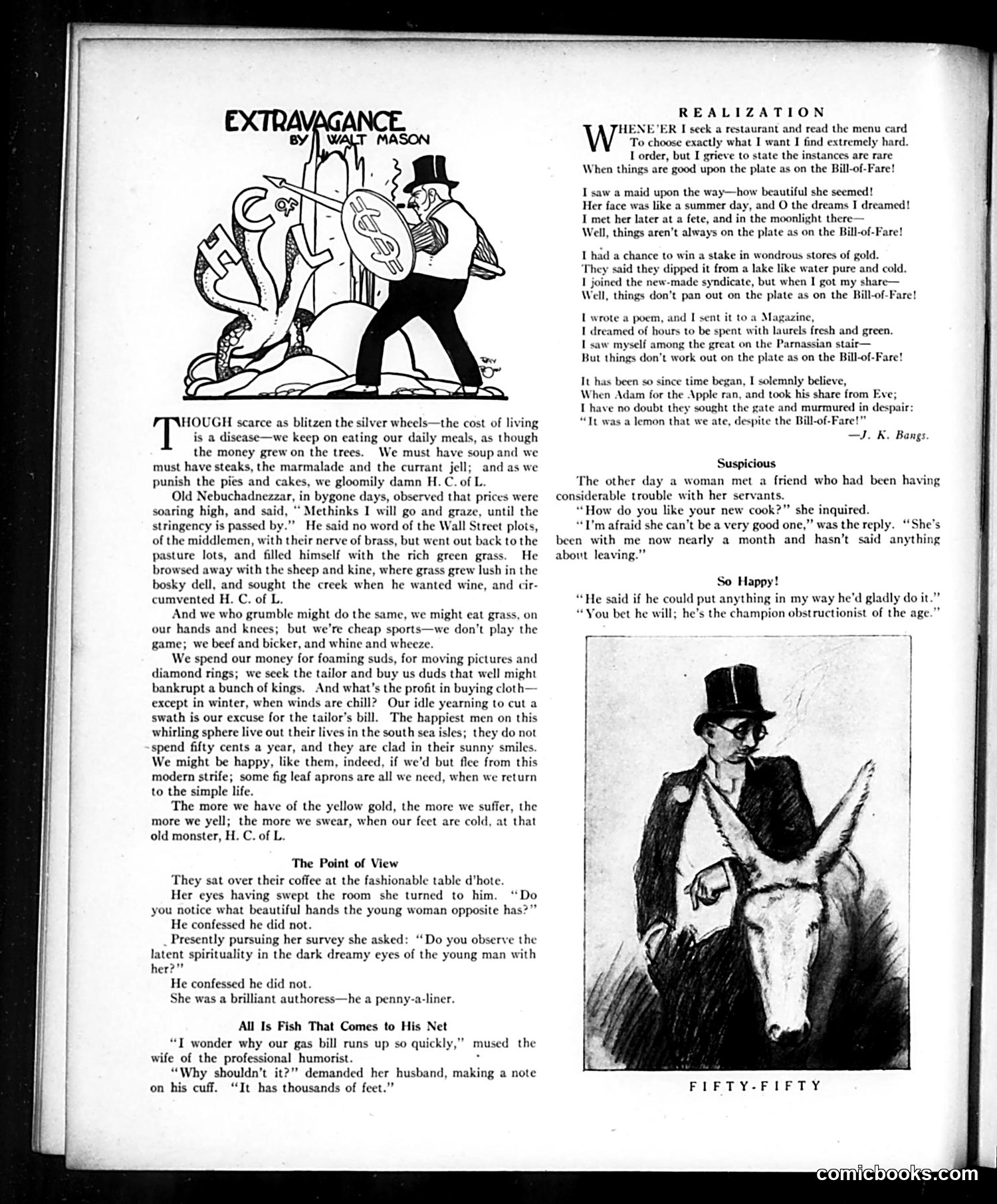
This Judge magazine page satirizes the **cost of living crisis** of the early 20th century (likely 1910s), particularly through the concept "H.C. of L." (High Cost of Living). **The main cartoon** shows a wealthy man being literally squeezed by dollar signs and financial demands—depicting how expenses drain wealth. **"Extravagance" essay** compares modern consumer complaints to the biblical King Nebuchadnezzar, who escaped high prices by grazing like livestock. The satire argues Americans spend wastefully on luxuries (movies, tailored clothes, diamonds) while complaining about expenses, then suggests returning to simple living—a tongue-in-cheek, impractical solution. **The smaller pieces** mock specific situations: a woman using her observational powers for gossip rather than genuine insight, and a humorist making puns about his gas bill to avoid confronting expense. The overall message: people blame economic conditions while their own spending habits are the real culprit. It's period-specific commentary on consumerism and economic anxiety.
📄 Transcribed text from this page (OCR, searchable)
Machine-transcribed from the original scan — historical spelling and the odd misread are preserved.
HOUGH scarce as blitzen the silver wheels—the cost of living is a disease—we keep on eating our daily meals, as though the money grew on the trees. We must have soup and we must have steaks, the marmalade and the currant jell; and as we punish the pies and cakes, we gloomily damn H.C. of L. Old Nebuchadnezzar, in bygone days, observed that prices were soaring high, and said, “* Methinks I will go and graze, until the stringency is passed by.” He said no word of the Wall Street plots, of the middlemen, with their nerve of brass, but went out back to the pasture lots, and filled himself with the rich green grass. He browsed away with the sheep and kine, where grass grew lush in the bosky dell, and sought the creek when he wanted wine, and cir- cumvented H. C. of L. And we who grumble might do the same, we might eat grass, on our hands and knees; but we’re cheap sports—we don’t play the game; we beef and bicker, and whine and wheeze. We spend our money for foaming suds, for moving pictures and diamond rings; we seek the tailor and buy us duds that well might bankrupt a bunch of kings. And what’s the profit in buying cloth— except in winter, when ds are chill? Our idle yearning to cut a swath is our excuse for the tailor’s bill. The happiest men on this whirling sphere live out their lives in the south s ; they do not spend fifty cents a year, and they are clad in their sunny smiles. We might be happy, like them, indeed, if we'd but flee from this modern strife; some fig leaf aprons are all we need, when we return to the simple life. The more we have of the yellow gold, the more we suffer, the more we yell; the more we swear, when our feet are cold, at that old monster, H. C. of L. The Point of View They sat over their coffee at the fashionable table d’hote. Her eyes having swept the room she turned to him. “Do you notice what beautiful hands the young woman opposite has?” He confessed he did not. Presently pursuing her survey she asked: ‘‘Do you observe the latent spirituality in the dark dreamy eyes of the young man with her?” He confessed he did not. She was a brilliant authoress—he a penny-a-liner. All Is Fish That Comes to His Net “I wonder why our gas bill runs up so quickly,” wife of the professional humorist. “Why shouldn’t it?” demanded her husband, making a note on his cuff. “It has thousands of feet.” mused the REALIZATION ‘E’ER I seek a restaurant and read the menu card To choose exactly what I want I find extremely hard. I order, but I grieve to state the instances are rare When things are good upon the plate as on the Bill-of-Fare! I saw a maid upon the way—how beautiful she seemed! Her face was like a summer day, and O the dreams I dreamed! I met her later at a fete, and in the moonlight there— Well, things aren’t always on the plate as on the Bill-of-Fare! I had a chance to win a stake in wondrous stores of gold. They said they dipped it from a lake like water pure and cold. I joined the new-made syndicate, but when I got my share— Well, things don’t pan out on the plate as on the Bill-of L wrote a poem, and I sent it to a Magazine, I dreamed of hours to be spent with laurels fresh and green. I saw myself among the great on the Parnassian stair— But things don’t work out on the plate as on the Bill-of-Fare! It has been so since time began, I solemnly believe, When Adam for the Apple ran, and took his share from Eve; T have no doubt they sought the gate and murmured in despair: “Tt was a lemon that we ate, despite the Bill-of-Fare!” J. K. Bangs Suspicious The other day a woman met a friend who had been having considerable trouble with her servants. “How do you like your new cook?” she inquired. “I'm afraid she can’t be a very good one,” was the reply. “She's been with me now nearly a month and hasn’t said anything about leaving.” So Happ: ‘ould put anything in my way he'd gladly do it.” ; he’s the champion obstructionist of the age.”” “He said if he “You bet he w FIFTY-FIFTY