
A complete issue · 28 pages · 1916
Judge — April 29, 1916
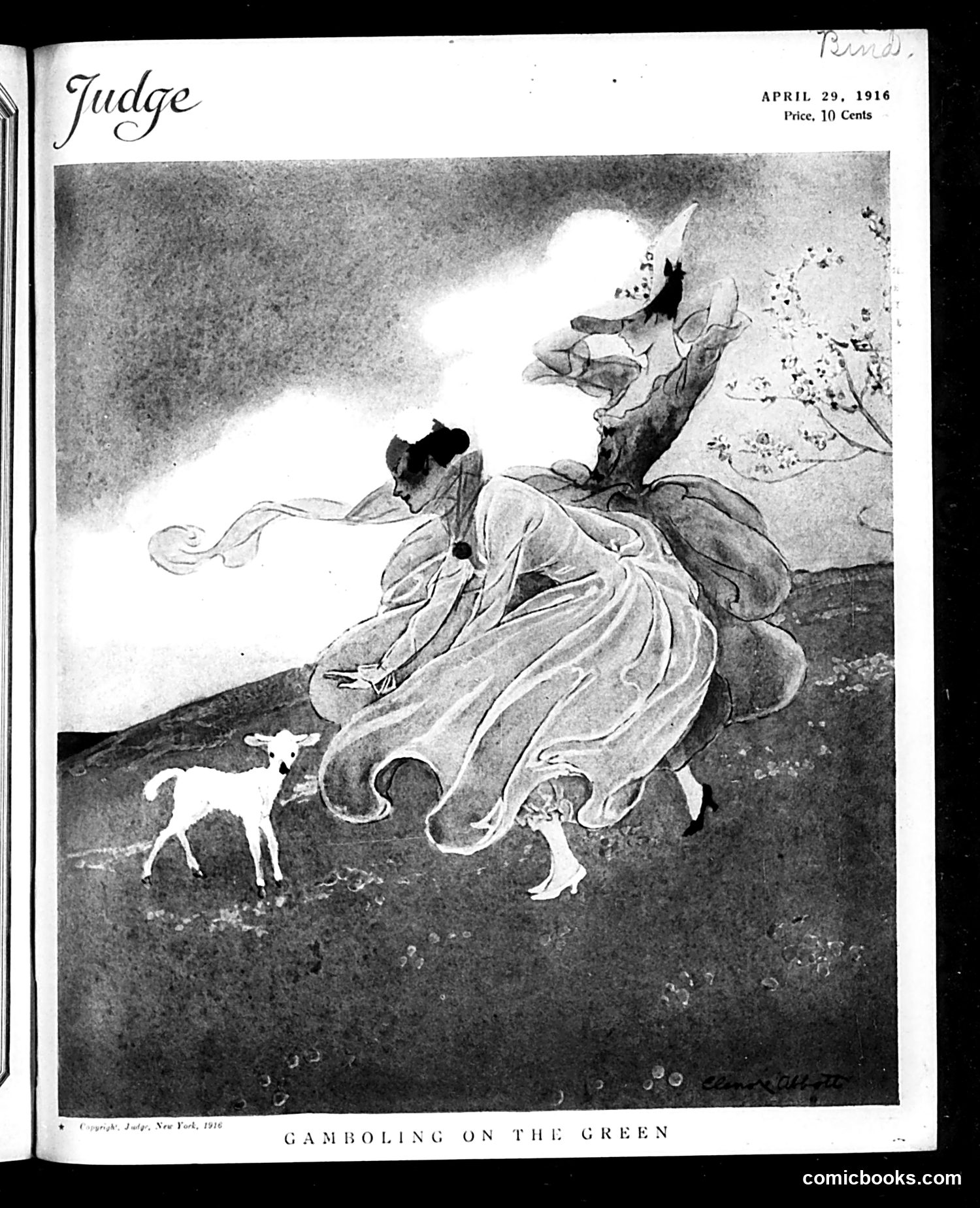
This 1916 Judge magazine cartoon depicts a woman in flowing robes dancing or frolicking outdoors with two small goats. The title "Gamboling on the Green" is a playful pun—"gambol" means to frolic, while "gamboling" sounds like "gambling." The satire likely targets women's leisure activities or fashions of the era, possibly mocking either: - The affectation of wealthy women's pastimes - The increasingly liberated behavior of modern women (the 1910s saw growing women's independence) - Fashion excess (the elaborate, billowing costume) The goats may represent foolishness or frivolity. Without additional context from surrounding Judge content, the exact social target remains somewhat unclear, though the tone is lighthearted rather than scathing.
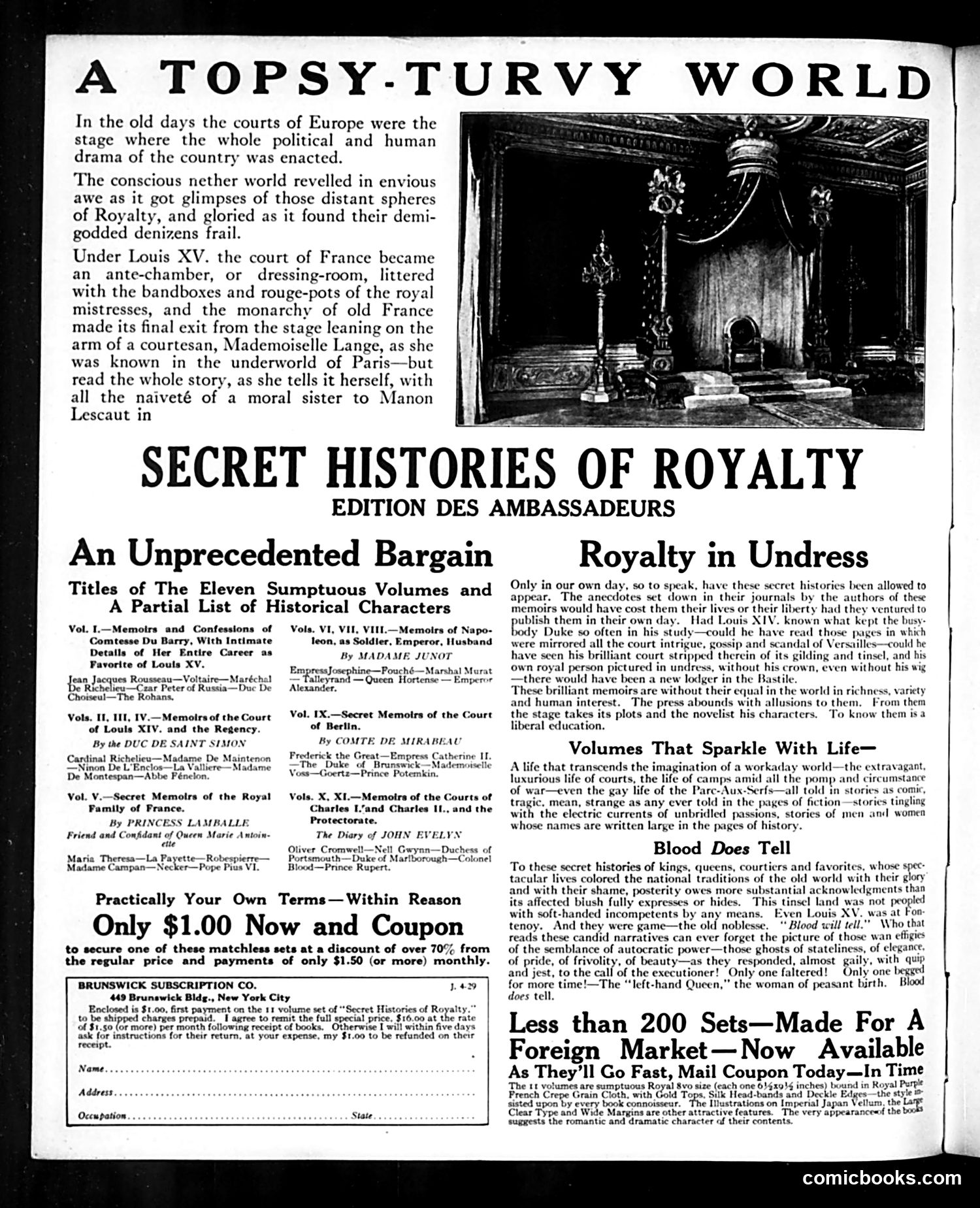
This page is **primarily advertising**, not satire or political commentary. It advertises a book series titled "Secret Histories of Royalty: Edition Des Ambassadeurs," promoted as revealing scandalous court anecdotes involving French royalty (particularly Louis XV and his mistresses). The headline "A Topsy-Turvy World" frames these royal exposés as entertaining glimpses into privileged spheres. The accompanying ornate interior photograph suggests luxury and intrigue. The advertisement emphasizes exclusivity ("Less than 200 Sets—Made For A Foreign Market") and uses sensational language about illicit affairs, scandal, and "blood does tell" — appealing to readers' voyeuristic interest in royal indiscretions. The $1.00 subscription offer targets mass-market audiences eager for scandalous "true stories" about European aristocracy. This reflects Judge's typical blend of entertainment and consumer marketing.
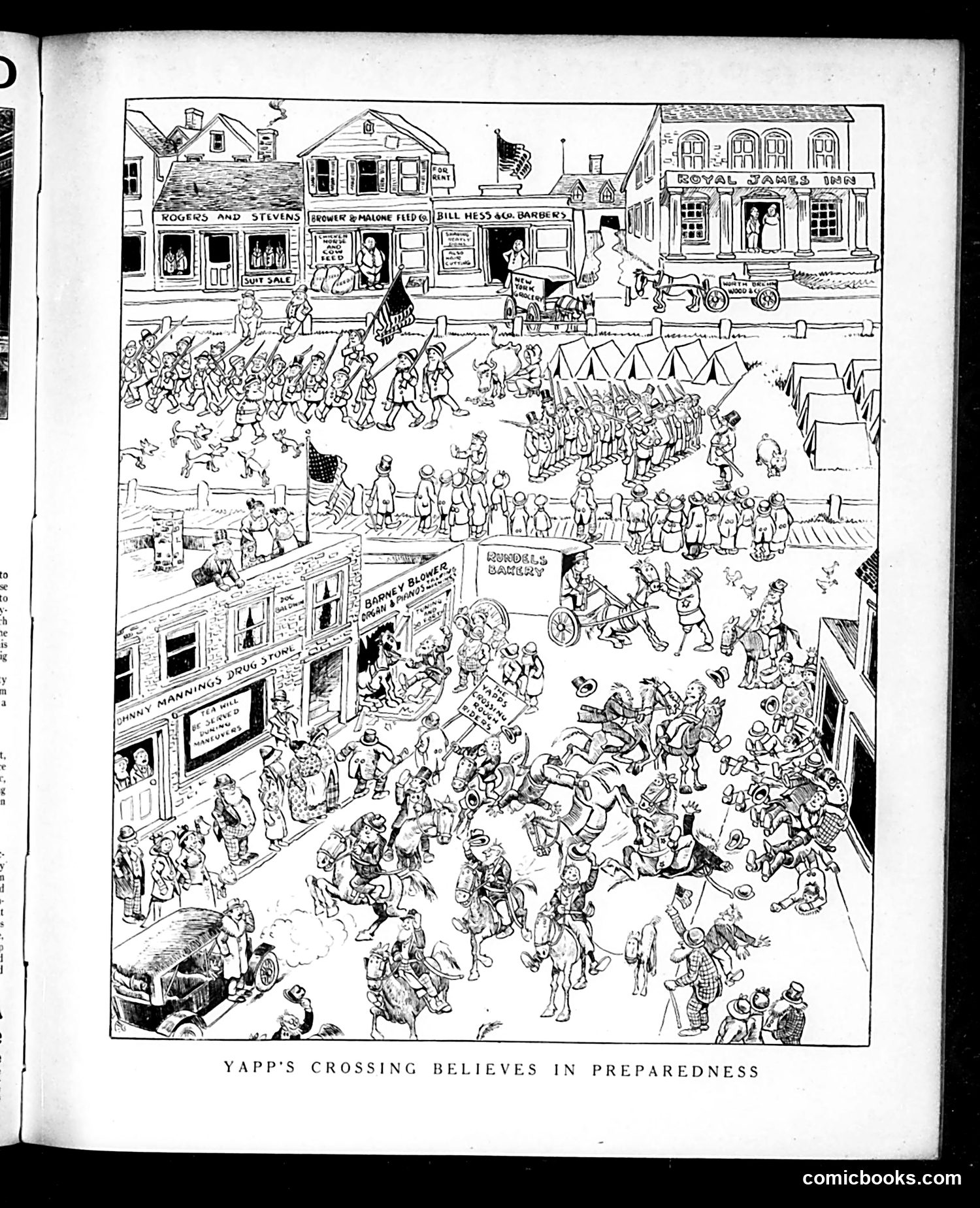
This satirical cartoon depicts a crowded beach or seaside town scene labeled "Yapp's Crossing," showing what appears to be a civil defense or disaster preparedness drill. The image illustrates numerous civilians, soldiers in formation, tents, and various emergency activities occurring simultaneously in an organized fashion. The caption's phrase "believes in preparedness" suggests this is mocking either overzealous emergency planning or a specific town's public safety measures—likely from the World War I era when such drills were common. The cartoon satirizes the chaos and confusion that results from attempting coordinated large-scale evacuation or defense procedures, despite official claims of orderliness. Various shopfronts and civic buildings line the scene, emphasizing this is a civilian population responding to governmental directives.
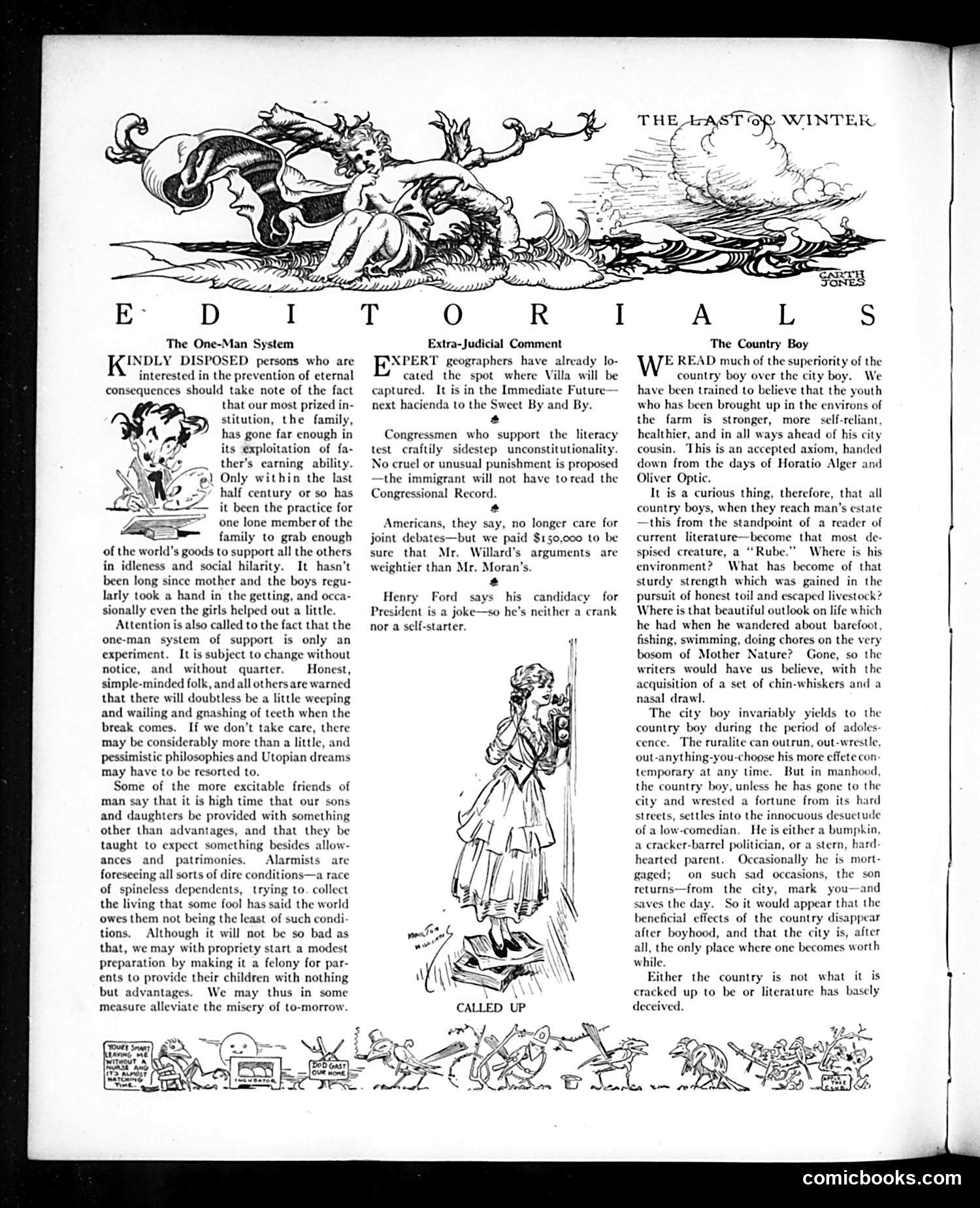
This editorial page critiques the "one-man system" of government, likely referencing executive power concentration during the early 20th century. The left column attacks what it calls indefinite detention and punishment without constitutional protection, warning against allowing "the immigrant" to avoid reading Congressional Record—suggesting anxieties about both immigration and democratic participation. The center section mentions Henry Ford's presidential candidacy as a joke, implying he's unsuitable for politics. "The Country Boy" (right) romanticizes rural youth as morally superior to urban life, a common era stereotype. The illustrated "Called Up" section below depicts military conscription, suggesting this page addresses wartime concerns about social systems and citizen obligations.
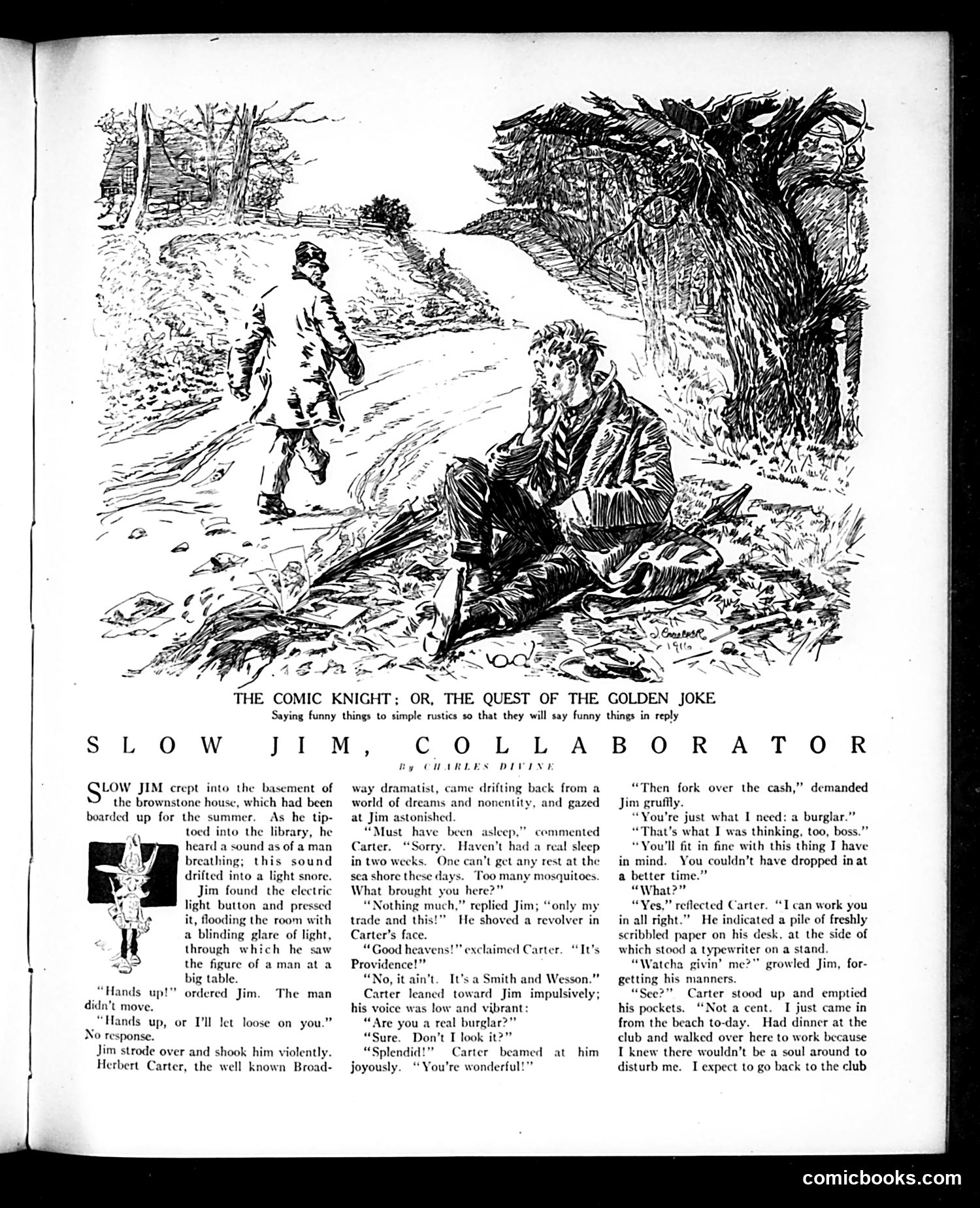
This page presents a serialized humorous story illustrated by Charles Divine. The narrative depicts "Slow Jim," a basement-dwelling vagrant who breaks into a Broadway theater at night. When confronted by Herbert Carter, a well-known Broadway figure, Jim claims to be a burglar. Carter, finding this amusing, appears to hire Jim as some sort of collaborator or assistant, offering him work and payment. The satire seems to mock both theatrical life and the desperation of urban poverty—Jim's fabricated criminal identity becomes his path to employment. The "golden joke" likely refers to this ironic reversal where pretending to be a criminal lands you a job. The story trades on early 20th-century humor about theater culture and hustling.
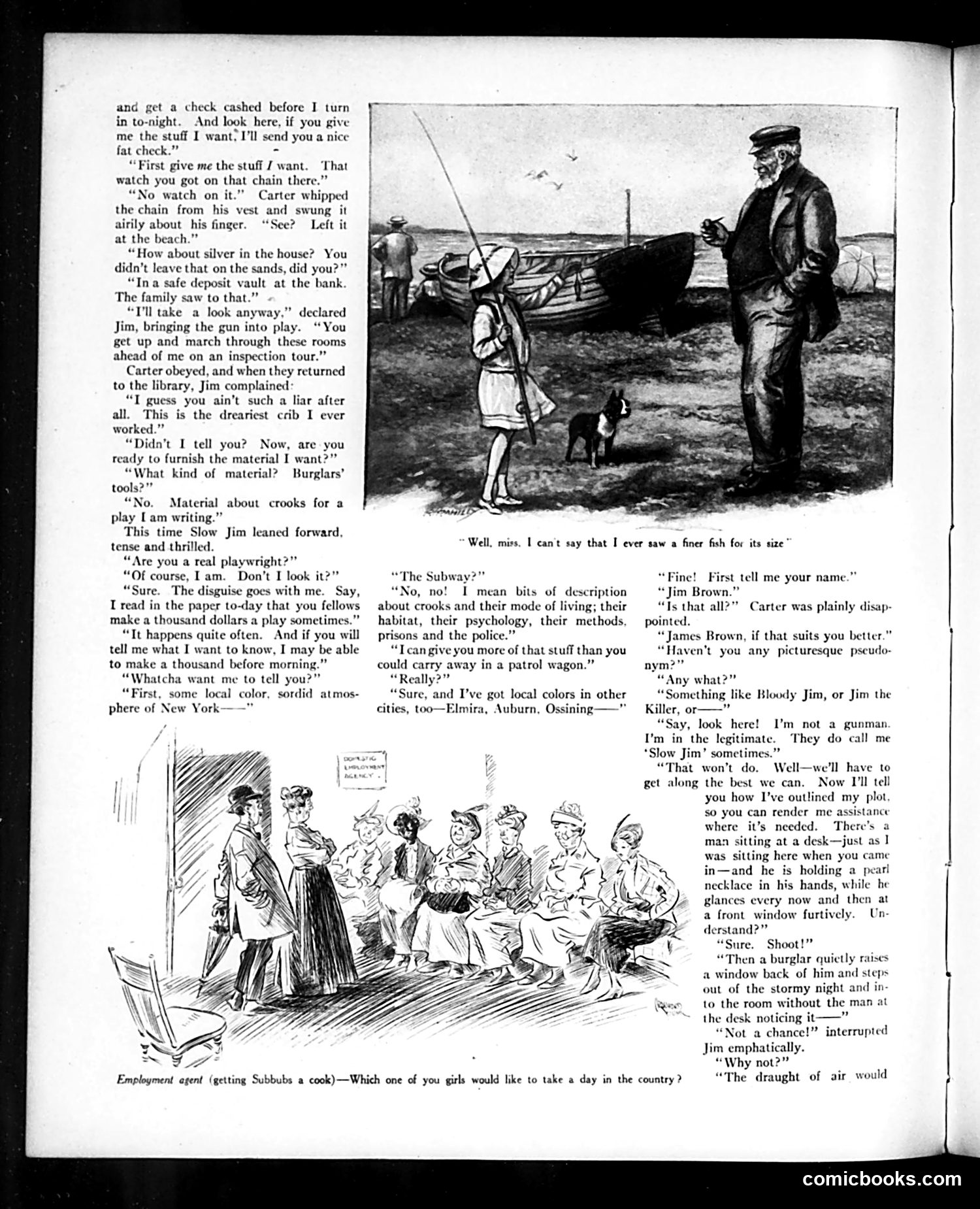
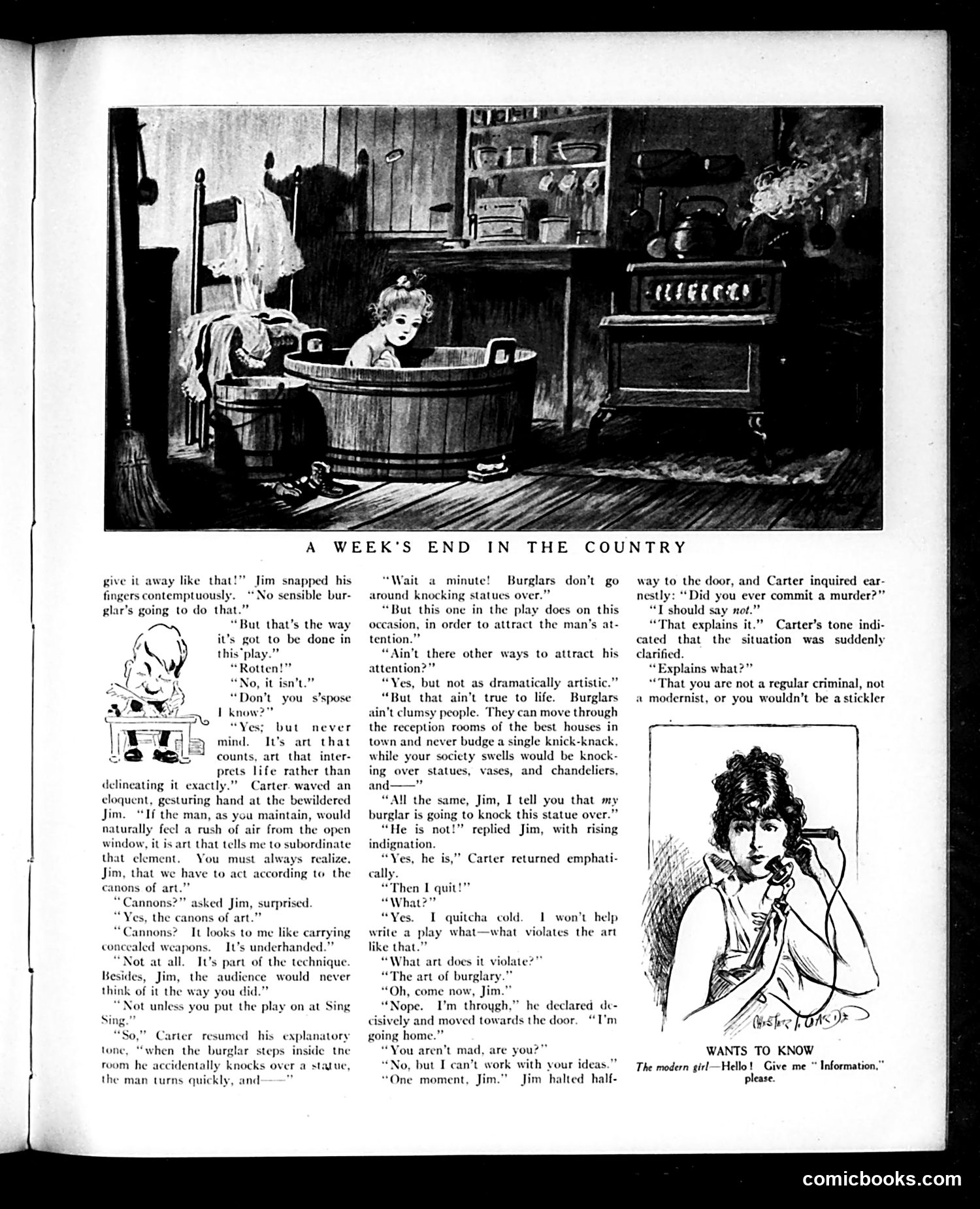
This page satirizes the tension between theatrical realism and artistic convention—a debate prominent in early 20th-century drama. Two characters, Carter (apparently a playwright) and Jim (likely a collaborator or actor), argue over whether a burglar character should accidentally knock over a statue. Carter defends the scene on grounds of "art" and "dramatic effect," invoking "canons of art" that supersede realistic behavior. Jim protests that real burglars are skilled and wouldn't be clumsy—the statue-knocking violates life as it actually occurs. The satire mocks Carter's pretentious artistic justifications, particularly the malapropism "canons" (which Jim mistakes for "cannons," weapons), suggesting Carter's pompous jargon masks hollow reasoning. The joke culminates when Carter asks if Jim ever committed murder—implying that theatrical realism isn't the real concern; the scene simply works dramatically. The cartoon critiques early modernist theater's rejection of naturalism in favor of stylized convention, poking fun at artists who subordinate truth to aesthetic effect.
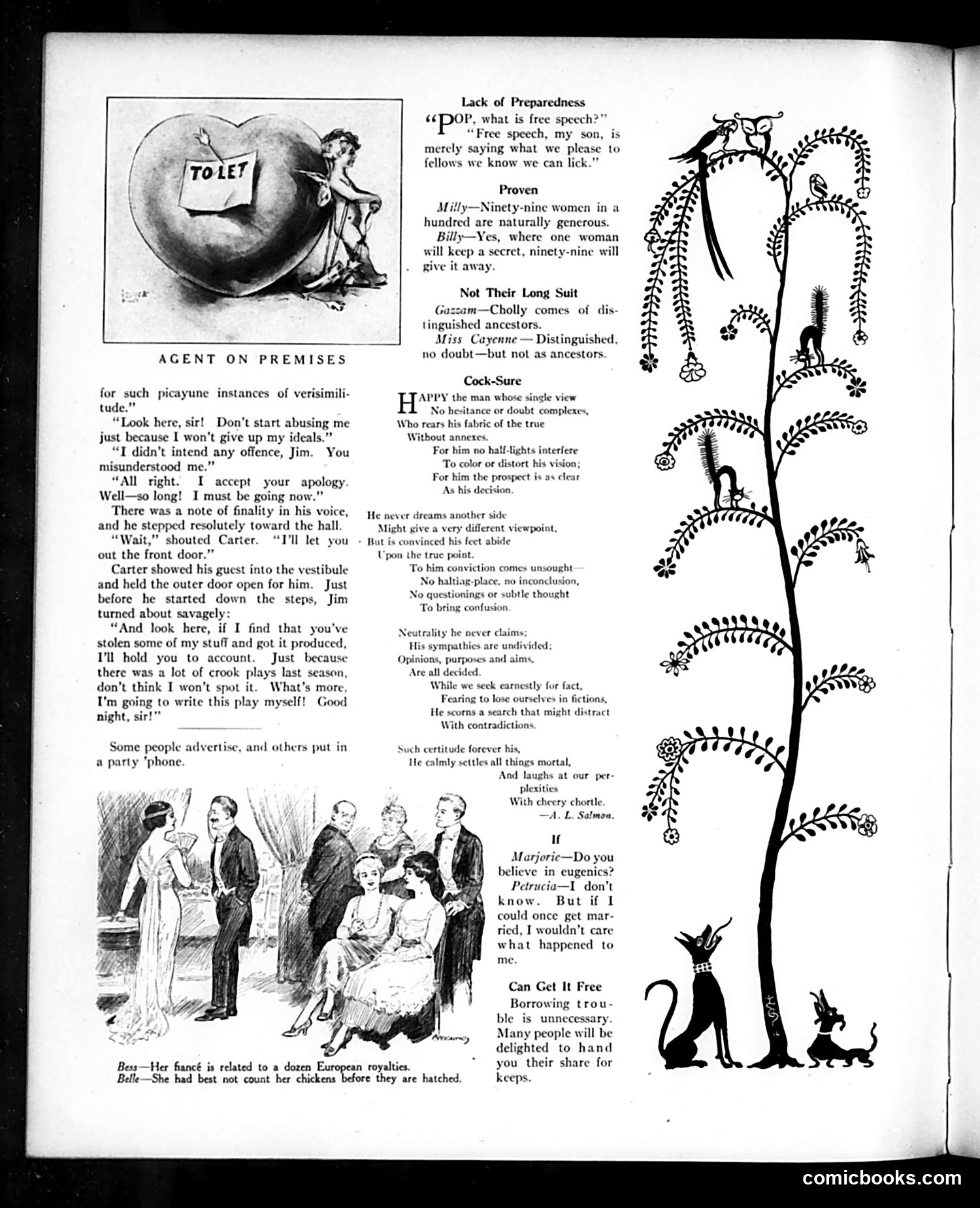
This page contains multiple satirical pieces reflecting early-20th-century American social commentary: **"Agent on Premises"** (top left): A landlord's "To Let" sign sprouts from a large heart, with a small figure clinging to it. This satirizes the housing market and landlords' indifference to tenants' emotional attachment to homes. **Main narrative cartoon**: Jim, a playwright, accuses Carter of stealing his work. The satire targets theatrical ethics—Jim ironically threatens to write his own play while acting offended, suggesting lack of actual talent or originality. Carter's exaggerated politeness undercuts Jim's self-righteous outrage. **"Cock-Sure" poem** (right): A lengthy verse mocking rigid, unwavering certainty. It critiques those who never question their convictions, contrasting them with thoughtful people who seek nuance. **Sidebar jokes**: Brief quips about women's gossip, ancestry-obsessed wealthy people, eugenics, and borrowing troubles—all reflecting period social anxieties and class-conscious humor typical of Judge's audience. The overall theme: satire of human folly, pretension, and unexamined certainty.
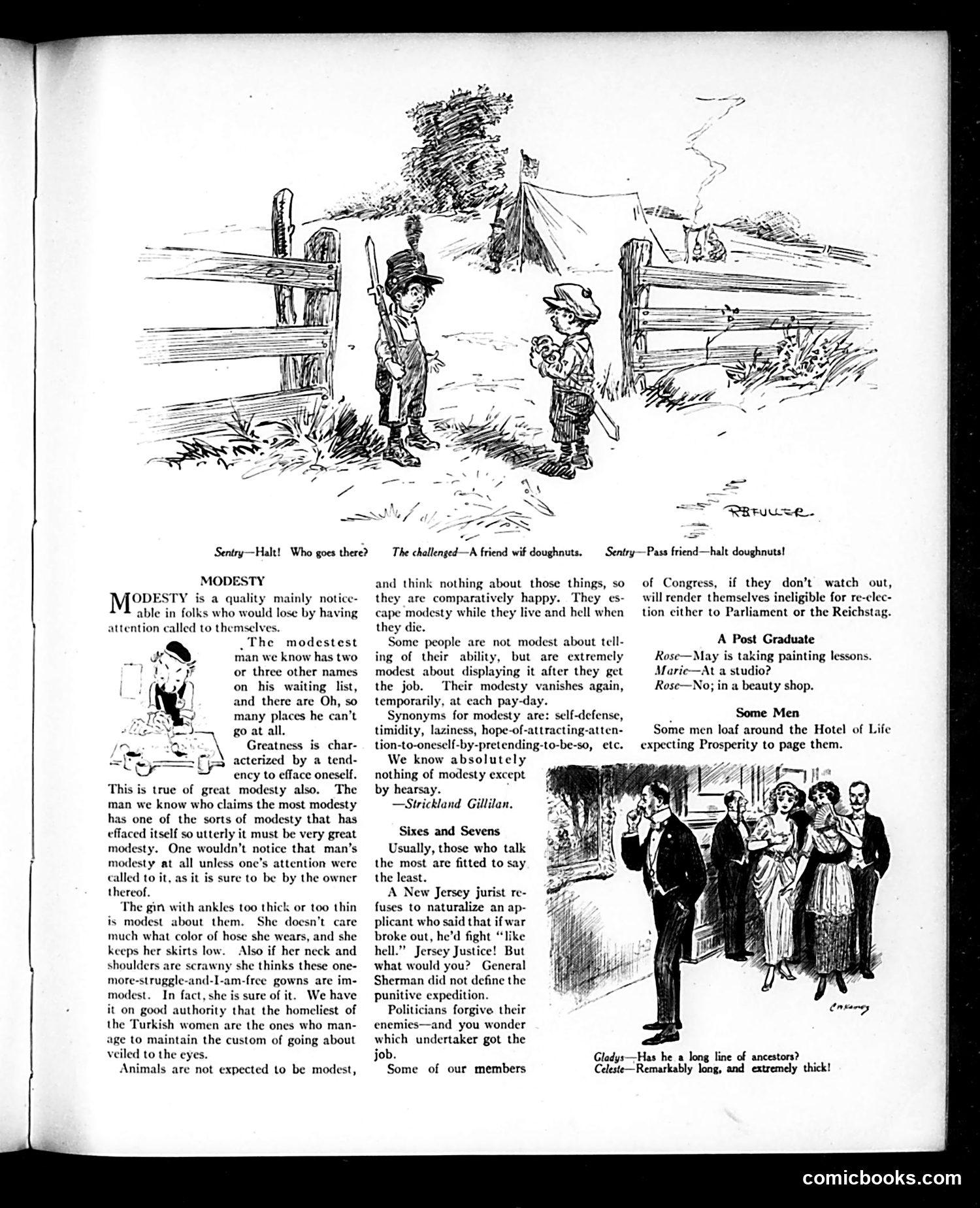
This page satirizes **modesty** through interconnected commentary and cartoons. The main essay mock-defines modesty as a paradoxical virtue: people who possess "real" modesty are invisible, while those who *claim* modesty loudly reveal their lack thereof. The author notes modesty often masks laziness, timidity, or strategic self-effacement. The piece suggests modest people avoid drawing attention—yet some, like those with unflattering physical features, use modesty as cover. **The cartoons:** - **Top**: Two young soldiers exchange doughnuts at a military camp, playing on the sentry's challenge. The joke likely satirizes wartime food sharing or military routine. - **Bottom**: A social gathering where "Gladys" praises someone's long ancestry; "Celeste" replies it's "extremely thick"—an insult implying low-quality or disreputable lineage, mocking aristocratic pretension. The scattered jokes ("A Post Graduate," "Some Men") maintain the theme of false modesty and social hypocrisy. This reflects Judge's typical early-20th-century focus on exposing American social pretension.
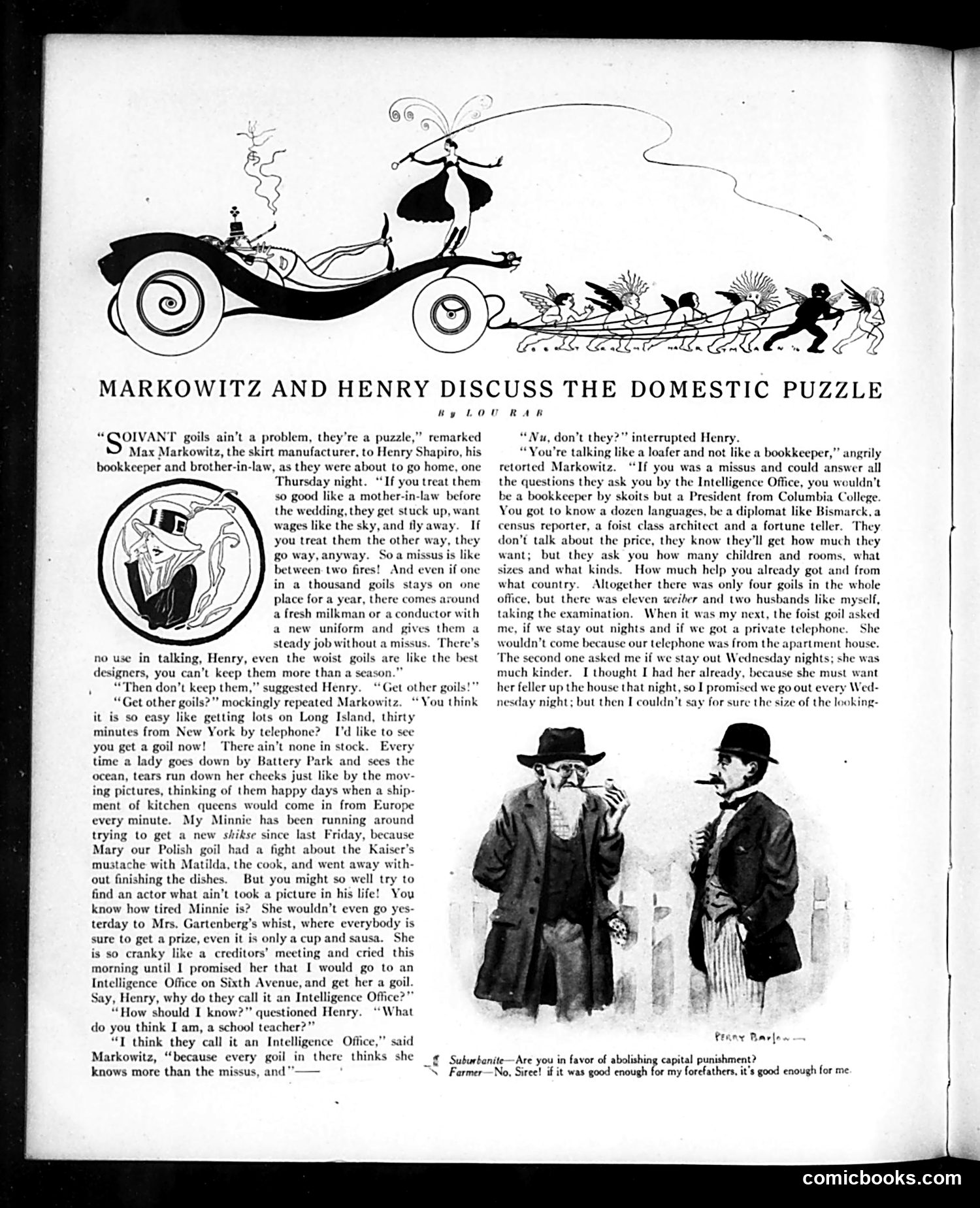
This page satirizes the servant-girl shortage affecting American households in the early 20th century. Max Markowitz, a skirt manufacturer, and Henry Shapiro, his bookkeeper, discuss the difficulties of hiring and retaining domestic workers ("goils"). The satire targets both employers' exploitation of servants and servants' rising independence. Markowitz complains that workers are unreliable, demanding, and easily lured away by suitors offering steady employment. He mocks the "Intelligence Office" (employment agency) as staffed by women who overestimate their qualifications and ask intrusive personal questions of prospective employers. The dialogue uses Jewish-inflected English dialect, typical of Judge's ethnic humor. The cartoon at top shows Markowitz in a fantastical vehicle pulled by tiny servants, visualizing his frustration. The bottom photograph shows two men in period dress; the caption addresses capital punishment—unrelated to the main story.
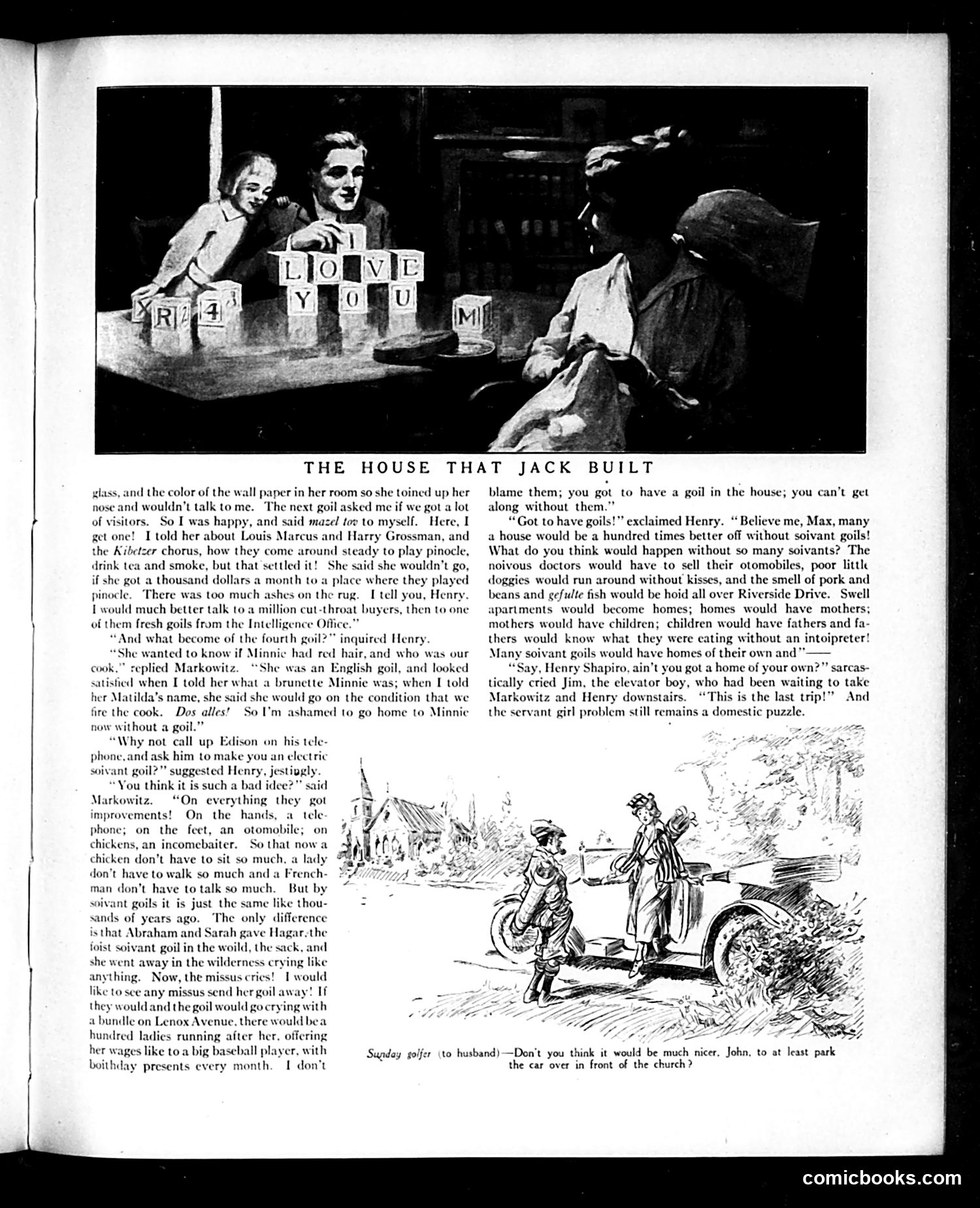
This page satirizes the early 20th-century American "servant girl problem"—the widespread difficulty wealthy households faced hiring and retaining domestic servants. The dialogue between Markowitz and Henry depicts Jewish immigrant perspectives on this issue. Markowitz complains that prospective servant girls ("goils") reject employment due to various household conditions: too much ash on rugs, visitors playing pinochle, or the presence of certain family members. He notes that firing cooks or replacing servants remains practically impossible. Henry counters with sarcasm, arguing that servants themselves cause problems—preventing household simplicity, necessitating automobiles and telephones to manage them. He romanticizes homes without servants as having mothers, children, and fathers who actually know each other. The elevator boy Jim's final sarcastic interjection—asking if Henry has his own home—undercuts both men's complaints, suggesting their argument is academic. The cartoon mocks immigrant attitudes toward labor, domestic hierarchy, and the era's class anxieties about servant availability and household management.
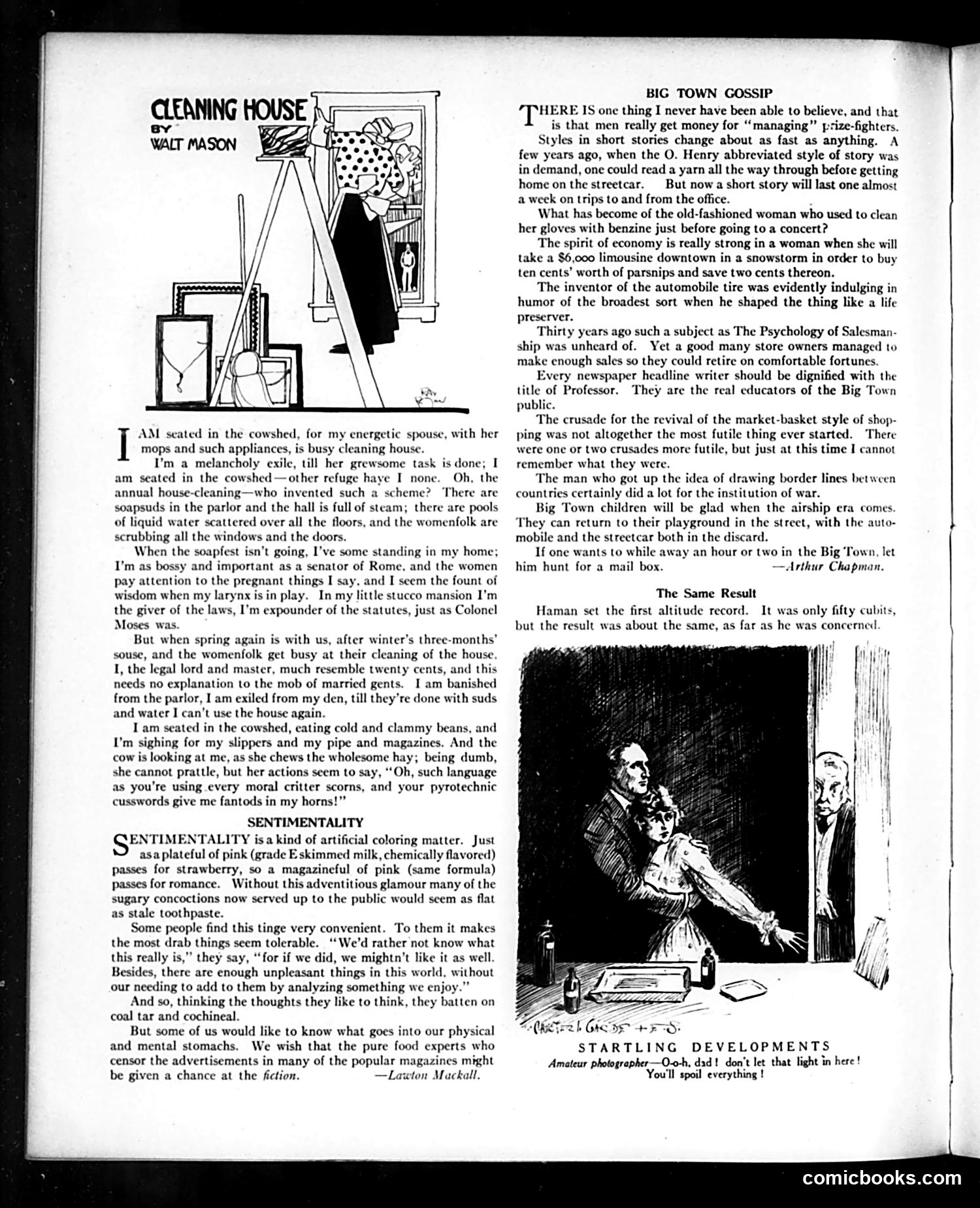
This page contains three distinct pieces of social satire typical of early 20th-century American humor: **"Cleaning House"** (Walt Mason): A humorous poem about spring housecleaning, where the male narrator is displaced from his home and relegated to the cowshed while his wife conducts the annual deep clean. The satire mocks the power reversal: husbands who normally dominate household decisions become powerless during this domestic ritual, exiled and eating "cold and clammy beans." **"Sentimentality"** (Lawton Mackall): Criticizes artificial "sentimentality" in popular magazine fiction—how editors add romantic flourishes to make mundane stories palatable, using the analogy of pink food coloring masking cheap ingredients. The author argues readers should want truth over pleasant illusions. **"Big Town Gossip"**: Brief social observations satirizing modern urban life—the absurdity of prize-fight "managers," changing literary fashions, and wealthy women's illogical economy (taking expensive limousines to save pennies). These pieces reflect common Judge themes: domestic gender dynamics, media criticism, and urban social change.
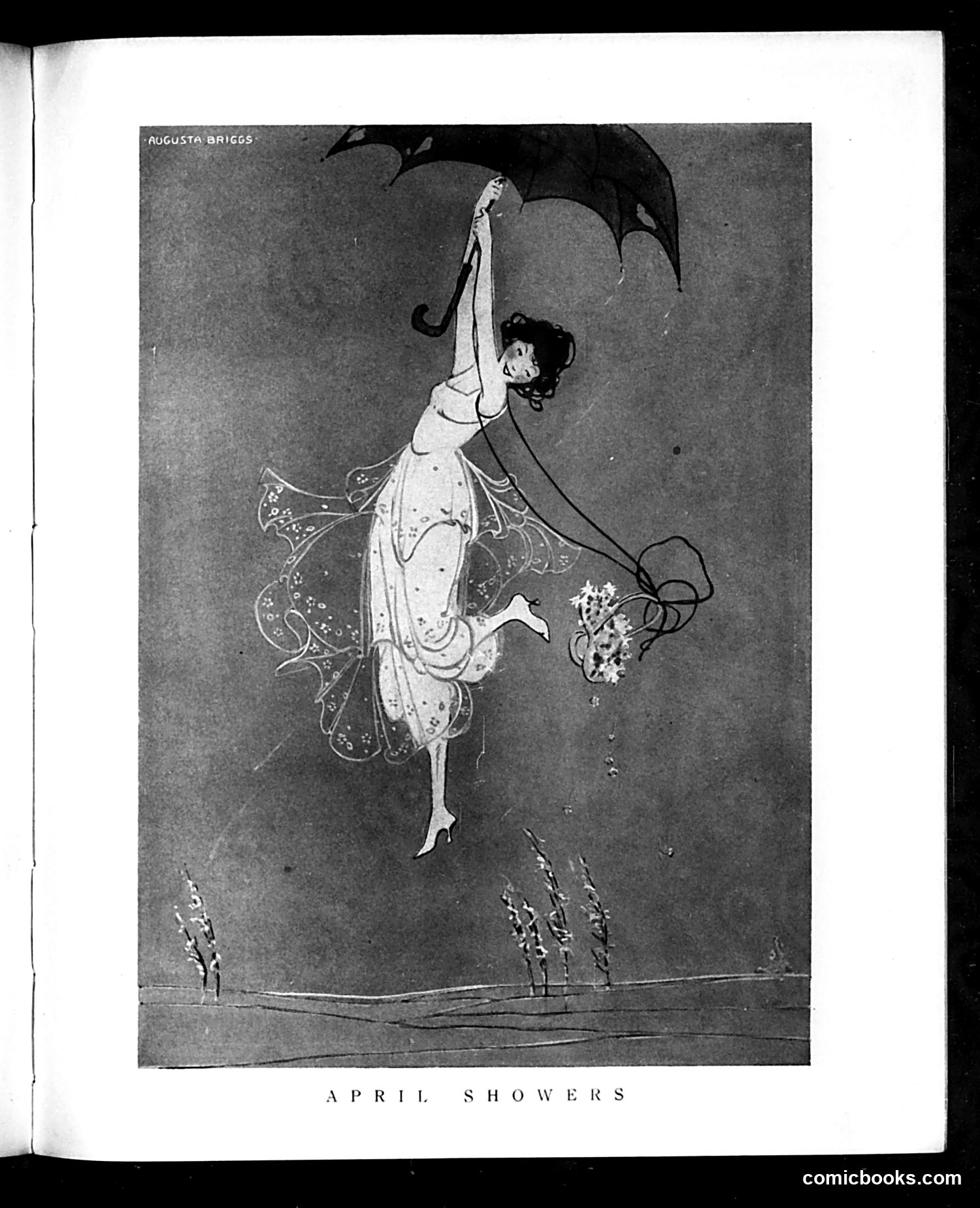
This is an illustration titled "April Showers" by Augusta Briggs, depicting a fashionable woman in an elegant dress holding a parasol while standing in rain. The artwork exemplifies early 20th-century fashion illustration style, showing decorative detail in the woman's gown with ornamental patterns and flowing fabric. The illustration appears to be a seasonal fashion or lifestyle piece rather than political satire. It celebrates spring weather and contemporary women's fashion, with the parasol serving both practical and aesthetic purposes. The graceful, elongated figure and decorative background are characteristic of Judge magazine's artistic contributions. Without additional context or OCR text clarity, the specific satirical message—if any exists beyond celebrating spring fashions—remains unclear.
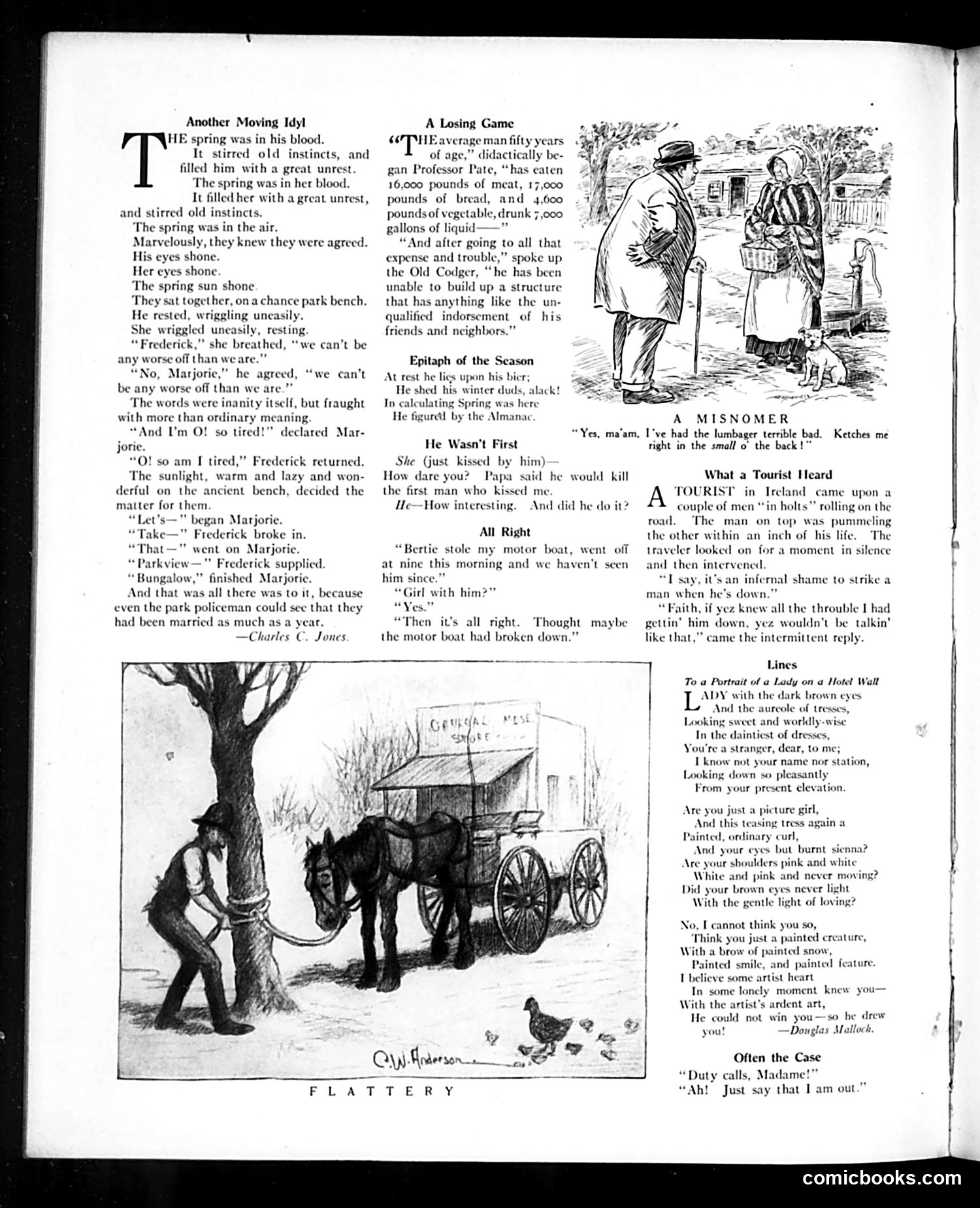
This page contains satirical humor typical of early-20th-century American magazines, with multiple brief comic pieces: **"Another Moving Idyl"** mocks romantic spring fever. A couple named Frederick and Marjorie, sitting on a park bench, speak in bland clichés about being tired and unhappy, then impulsively decide to elope to "Parkview Bungalow"—suggesting hasty, poorly-thought-out decisions made under spring's emotional influence. **"A Losing Game"** satirizes statistical analysis, presenting Professor Pate's calculations that despite consuming massive quantities of food and drink over fifty years, he's gained no meaningful endorsement from friends or neighbors—absurdist humor about life's futility. The cartoons and brief jokes throughout mock common social situations: romantic mishaps, tourist misunderstandings of Irish violence, and pretexts for avoiding social obligations ("Just say that I am out"). The illustrated **"Flattery"** cartoon (by Cj. Anderson) depicts a horse-cart scene, likely commenting on flattery or deception in social interactions. Overall, the page uses gentle satire to mock romantic naiveté, statistical reasoning, and social conventions of the era.
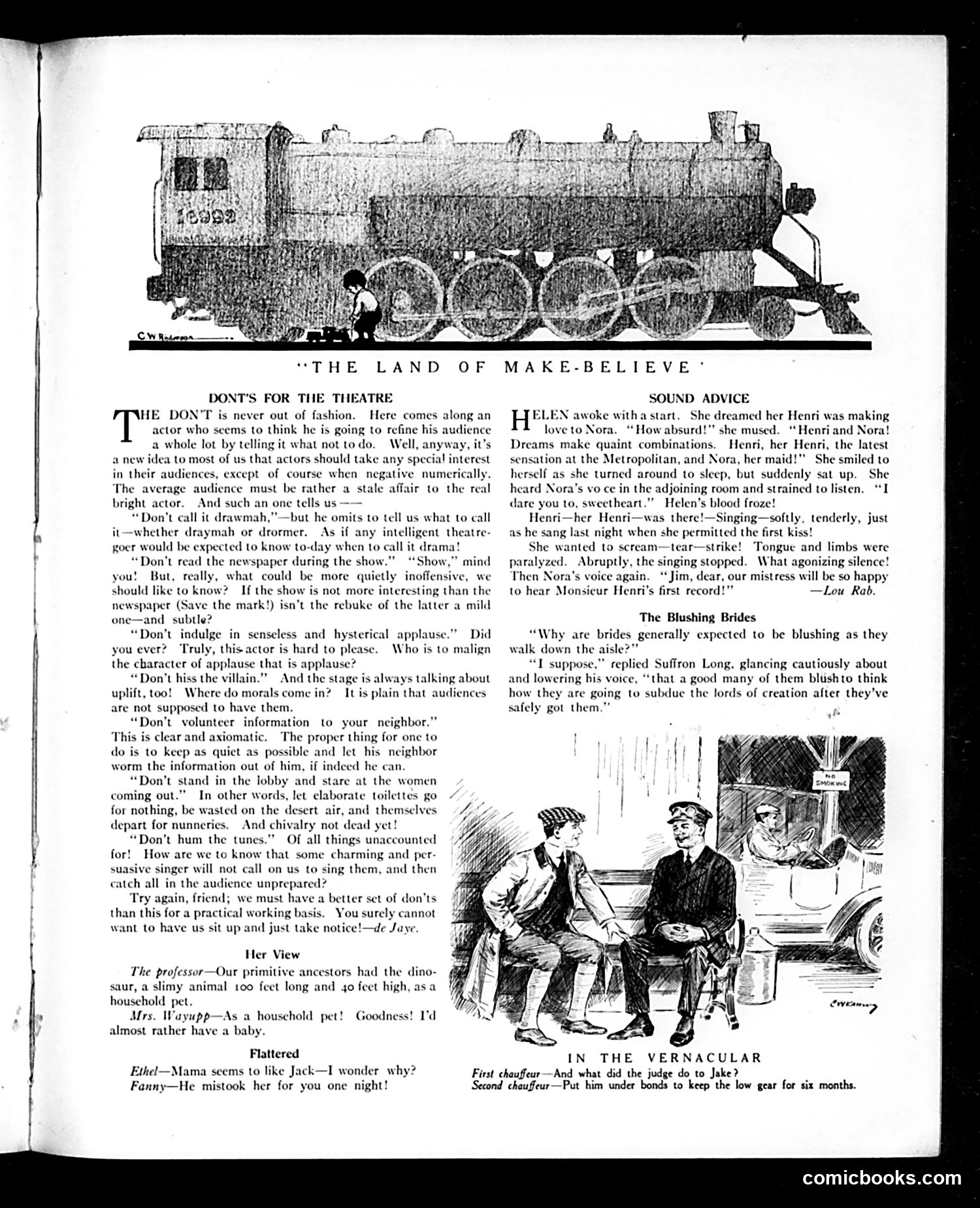
This is a theatrical satire page mocking an unnamed actor who presumes to lecture audiences on proper theater etiquette. The satire ridicules his pompous "don'ts": don't call it "drawmah," don't read newspapers, don't applaud hysterically, don't hiss villains, don't talk to neighbors, don't stare at women leaving. The humor lies in showing these rules as absurdly impractical and insulting to audiences. The writer mocks the actor's moral posturing—suggesting that if his show isn't more interesting than the newspaper, the real problem is his performance, not audience behavior. The satirist defends audience agency and enjoyment against theatrical pretension. Additional brief humor pieces include jokes about ancestors keeping dinosaurs as pets, a girlfriend mistaken for her mother, and blushing brides strategizing marital control—all typical period comedy fare.
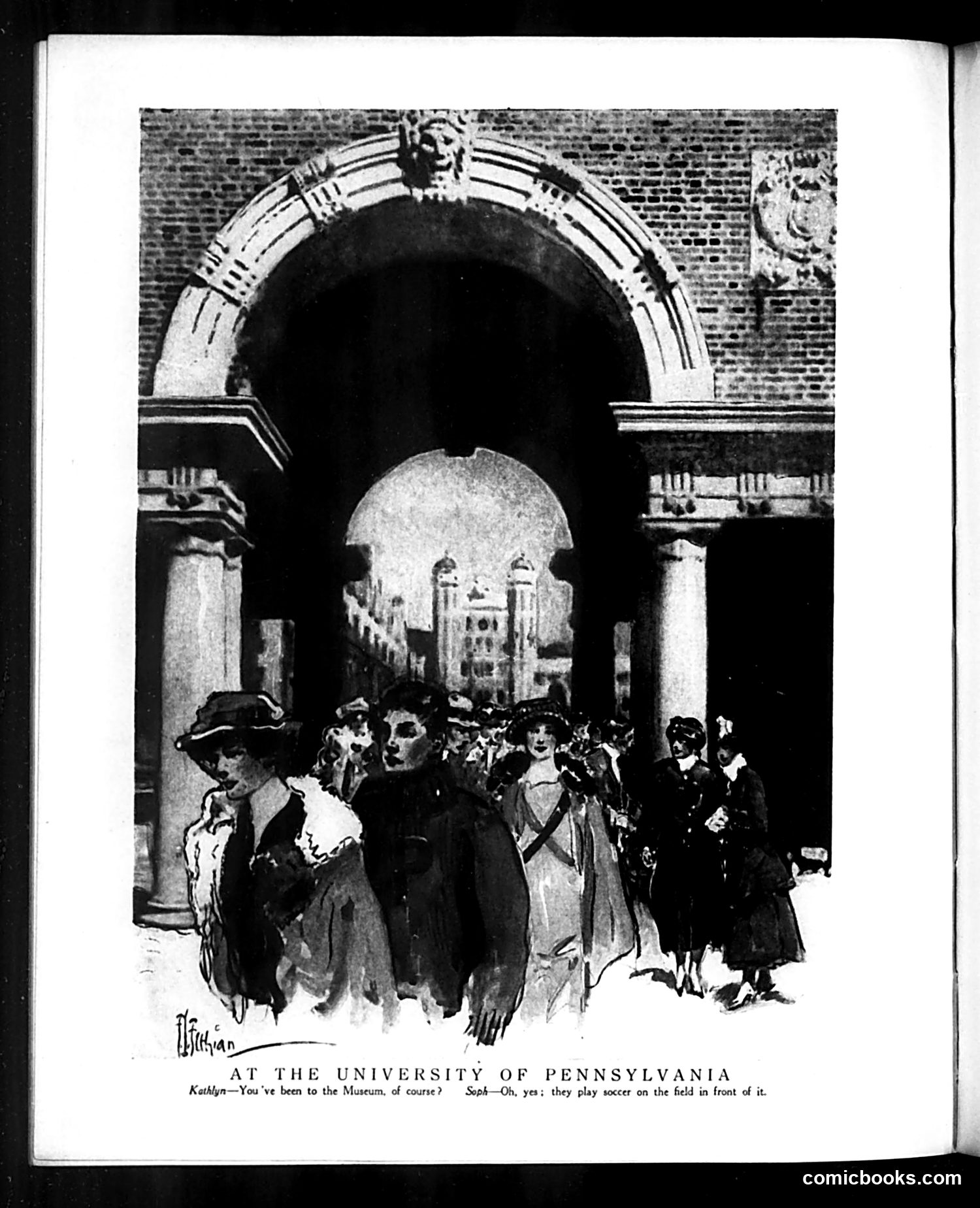
This Judge cartoon satirizes University of Pennsylvania culture. Two women (Kathryn and Sybil, based on dialogue) stand beneath the university's grand archway. When asked if she's visited the museum, Sybil responds that students actually "play soccer on the field in front of it"—suggesting the museum, a supposedly important cultural institution, is overshadowed by athletic activities. The satire targets the priorities of wealthy college women of the era: sports and social activities matter more than intellectual or cultural pursuits. The elegant setting and formal dress of the figures contrasts with their indifference to serious academic pursuits, highlighting the perceived superficiality of university life among the upper classes.
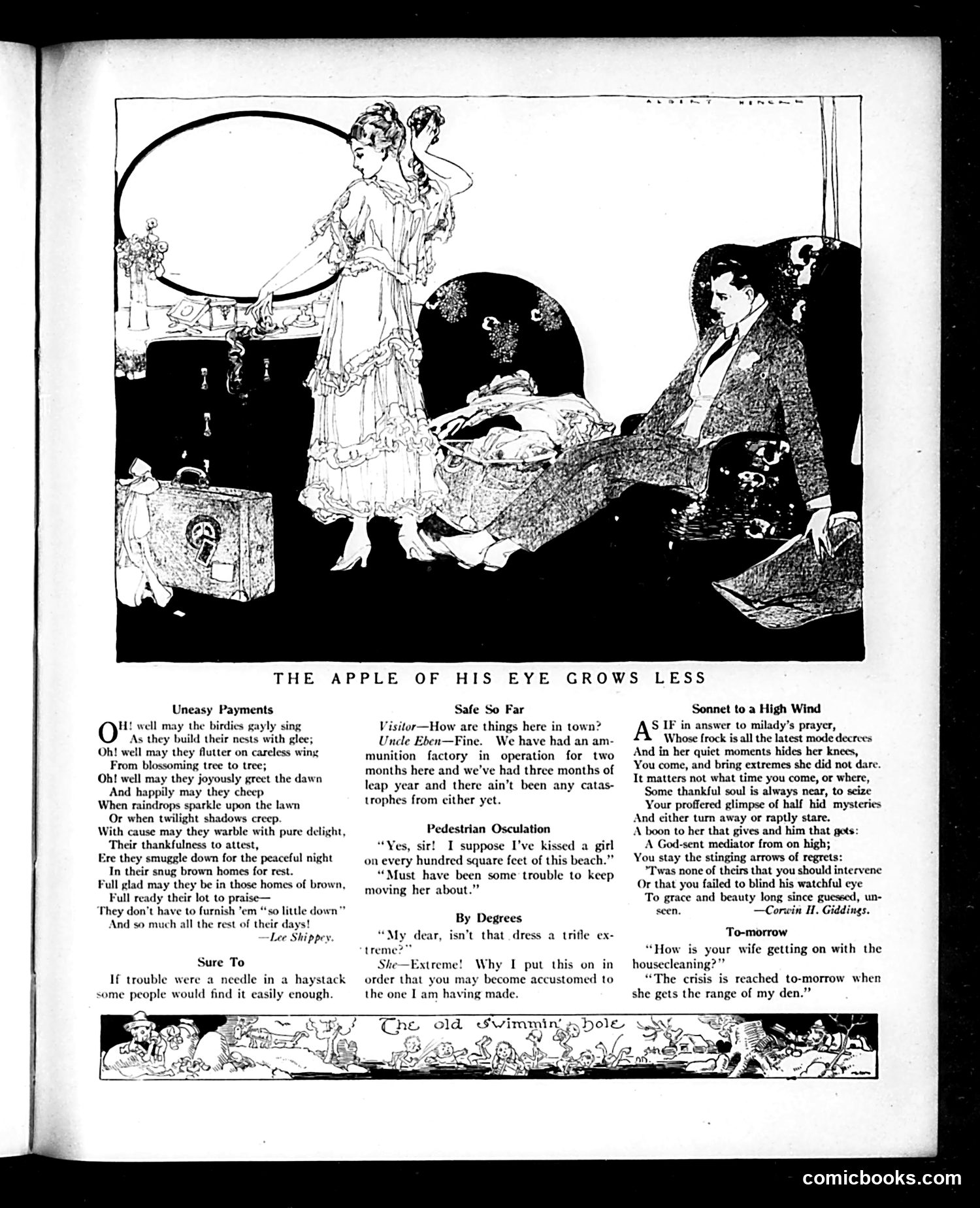
This page contains multiple humorous short pieces satirizing early 20th-century social concerns: **Main cartoon**: Shows a couple where the woman displays an increasingly revealing or fashionable dress. The satirical poems and jokes mock: 1. **"Uneasy Payments"** - critiques installment buying ("so little down / And so much all the rest"), a new consumer practice causing financial anxiety 2. **"Safe So Far"** - jokes about an ammunition factory operating without catastrophe during "leap year" (when women traditionally pursue men), suggesting wartime and gender-role anxieties 3. **"By Degrees"** - mocks wives gradually introducing husbands to increasingly extreme fashions to normalize them 4. **The wind sonnet** - satirizes how gusty weather revealing women's clothing creates excitement for observers while women navigate social embarrassment The page reflects 1910s-era anxieties: consumer debt, women's changing fashion (shorter skirts), wartime manufacturing, and shifting gender dynamics. The humor targets both modern consumer culture and evolving social propriety.
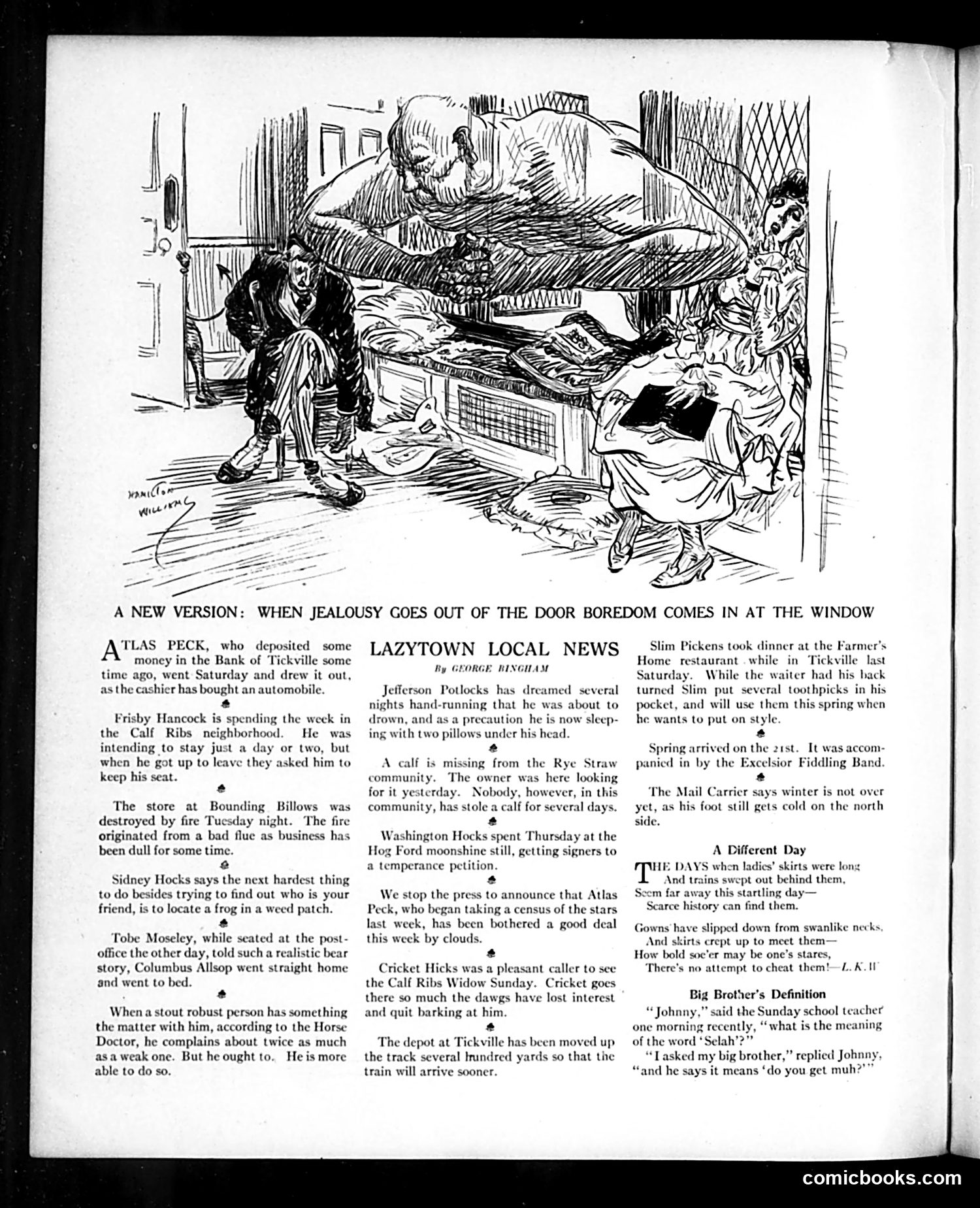
This page from *Judge* magazine contains two distinct elements: **The Cartoon** (top): Illustrates the caption's play on the proverb "when jealousy goes out of the door, love comes in at the window." It depicts a domestic scene where a man sits dejected while his wife entertains another man. The satire suggests that boredom in marriage leads to infidelity—a commentary on marital discord typical of early 20th-century social humor. **"Lazytown Local News"** (below): A humor column featuring small-town gossip and absurdist jokes about fictional characters (Atlas Peck, Jefferson Potlocks, etc.). The jokes are deliberately nonsensical—a man sleeping with two pillows to prevent drowning, a store burning because business was slow. This represents *Judge*'s style of rural Americana satire, mocking small-town life as backward and ridiculous. **"A Different Day"** and **"Big Brother's Definition"** are separate satirical pieces about changing fashion (shorter skirts) and language misunderstandings. The page is primarily satirical humor rather than political commentary.
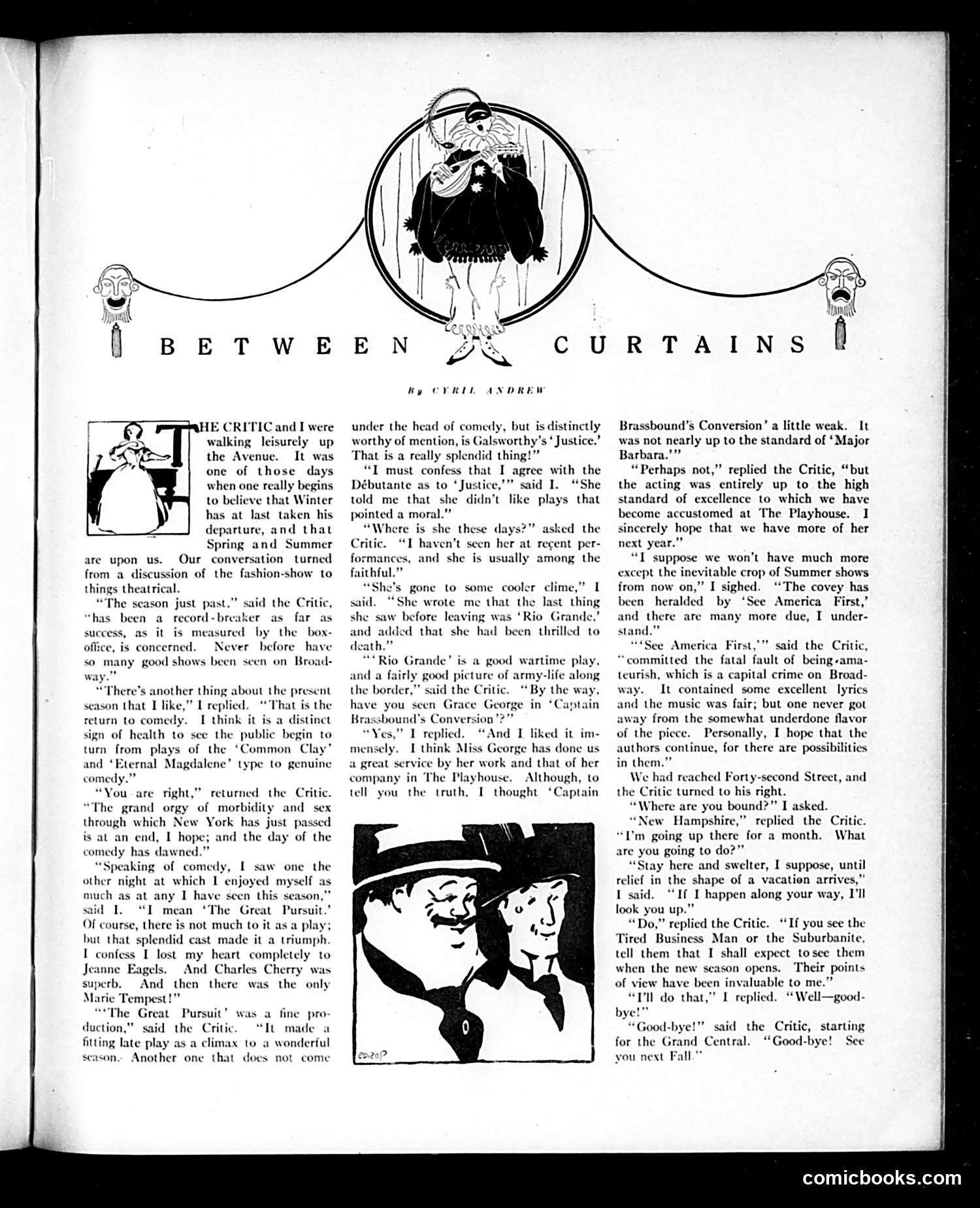
This page presents a dialogue between a theater critic and a companion discussing the Broadway season. They praise the return to comedy after an era of darker plays like "Common Clay" and "Eternal Magdalene." The critic mentions specific productions: "The Great Pursuit" (with actors Jeanne Eagels and Charles Cherry), Galsworthy's "Justice," "Rio Grande," Grace George in "Captain Brassbound's Conversion," and dismisses the amateur production "See America First" as having fatal flaws despite decent music. The two caricatured figures in the illustration appear to be the conversationalists themselves—likely representing a typical Broadway theater-goer and critic of the era (early 1910s based on theatrical references). The piece is essentially theatrical gossip and opinion—the satire lies in the earnest, self-important tone of Broadway insiders discussing the season's merits and failures.
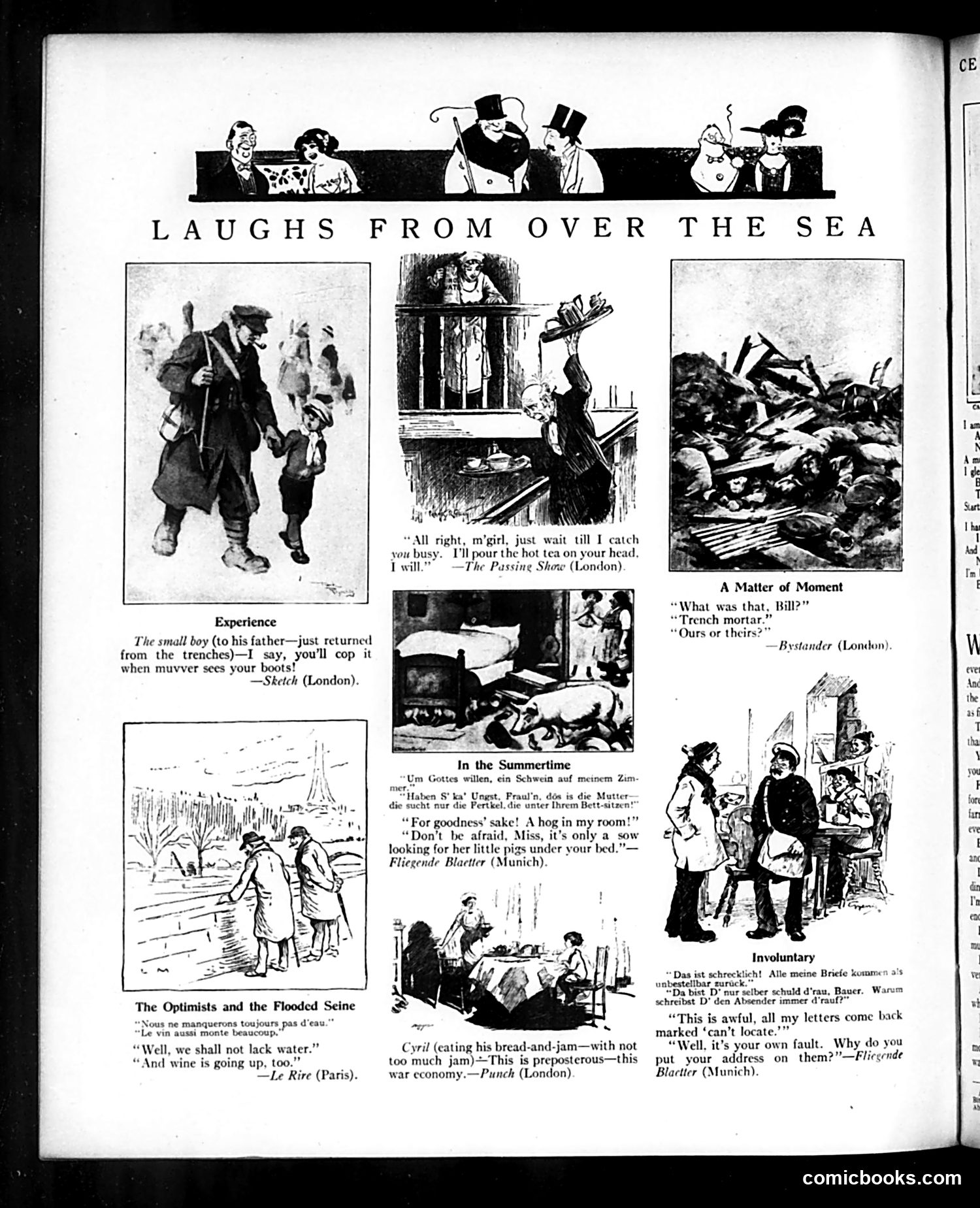
This page collects satirical cartoons from European publications during World War I, arranged to amuse American readers with foreign humor about the war. The cartoons mock wartime absurdities: a child warns his father about muddy trench boots; Parisians sarcastically note the Seine's flooding means no water shortage while wine prices soar; a woman threatens hot tea over romantic jealousy; Germans joke about a pig seeking piglets under a bed; a boy complains rationing is "preposterous"; soldiers confuse which side fired a trench mortar; a farmer's undeliverable mail returns because he forgot to write his address on letters. The recurring theme is ordinary people coping with war's chaos and rationing through dark humor. By reprinting these international cartoons, Judge positions itself as cosmopolitan, sharing sophisticated European wit with American audiences—many of whom weren't yet in the war (which ended 1918). The satire suggests wartime foolishness transcends borders.
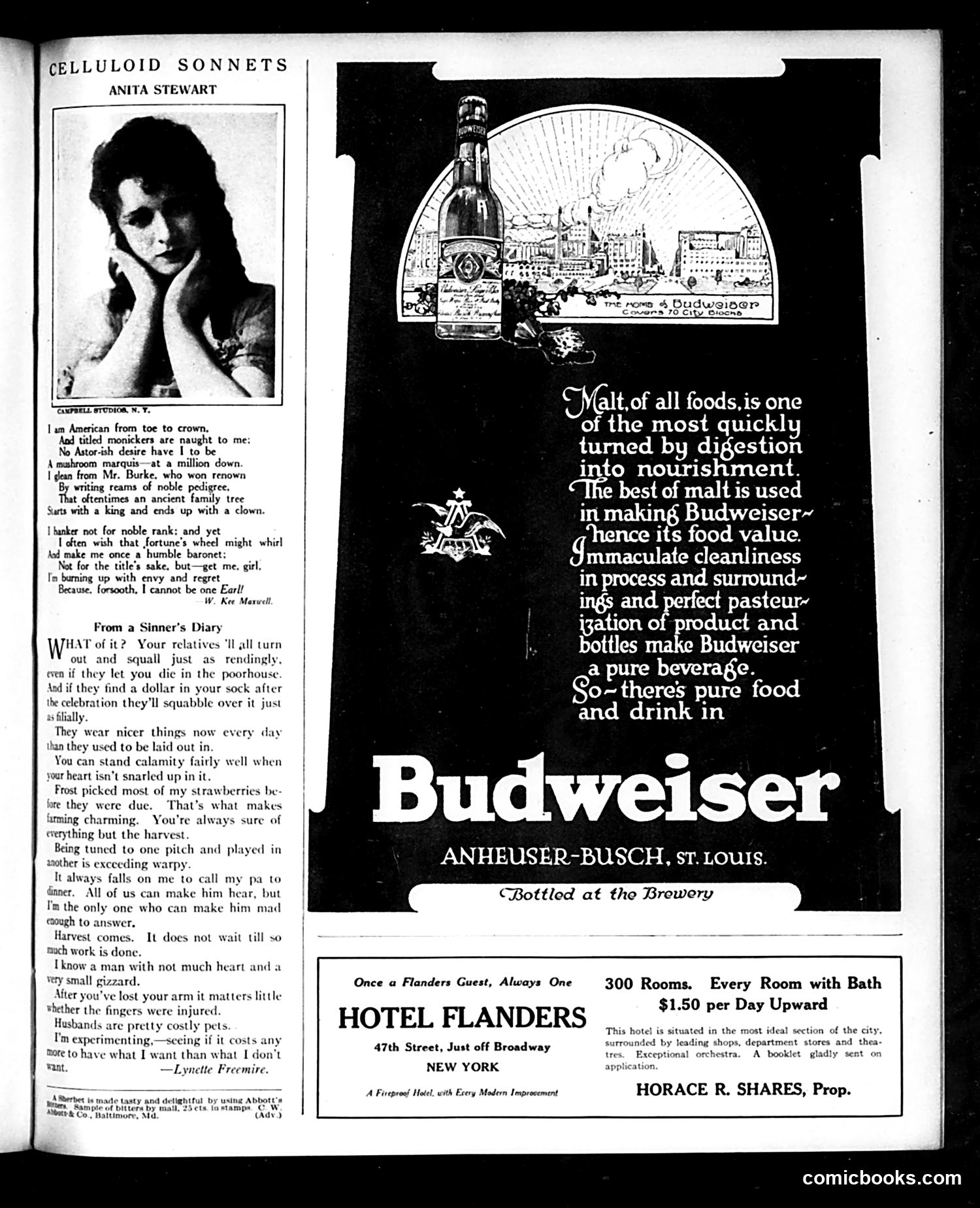
This page from *Judge* magazine features entertainment-focused content. The main item is a portrait and poem about **Anita Stewart**, a silent film actress (the "Celluloid" reference denotes cinema). The sonnet humorously expresses Stewart's American egalitarianism—she claims indifference to titles and aristocratic rank, yet contradictorily admits envying the status of an "Earl," capturing the tension between democratic ideals and status-seeking. Below is "From a Sinner's Diary," a cynical advice column satirizing human nature: relatives quarrel over inheritances, people worry about trivial matters while ignoring genuine problems, and life's hardships often go unheeded. The page is primarily **advertising space**: a large Budweiser beer ad emphasizing digestibility and purity, and a Hotel Flanders advertisement promoting budget accommodation in New York. These ads reflect early 20th-century consumer marketing targeting middle-class readers.
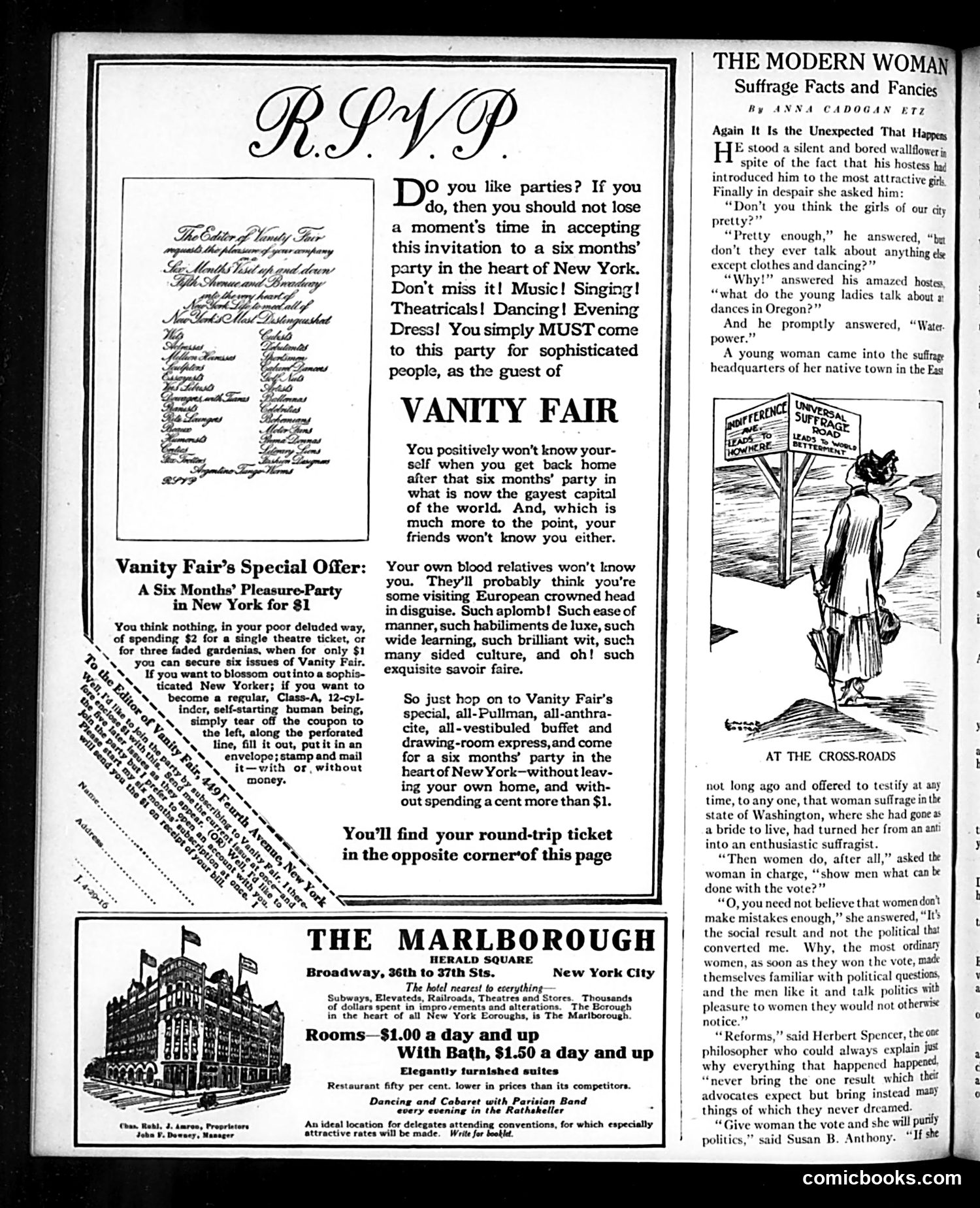
This page is primarily **advertising** with a satirical article on women's suffrage. The main content is a Vanity Fair subscription ad mocking wealthy New Yorkers' pretensions. It sarcastically promises that reading six months of Vanity Fair will transform readers into "sophisticated people" with such exquisite manners that even their own relatives won't recognize them—suggesting the magazine caters to social climbers desperate to appear cultured. On the right, "The Modern Woman: Suffrage Facts and Fancies" presents anecdotes about women's suffrage. One joke depicts a socialite confused why young women discuss clothes and dancing rather than substantive topics like water power (Oregon's actual political concern). Another describes a woman converted to suffrage activism after moving to Washington state. The satire cuts both ways: mocking both shallow sophisticates and outdated assumptions about women's intellectual capacity. The suffrage content appears sympathetic to women's political engagement, contrasting with the vapid consumerism Vanity Fair represents.
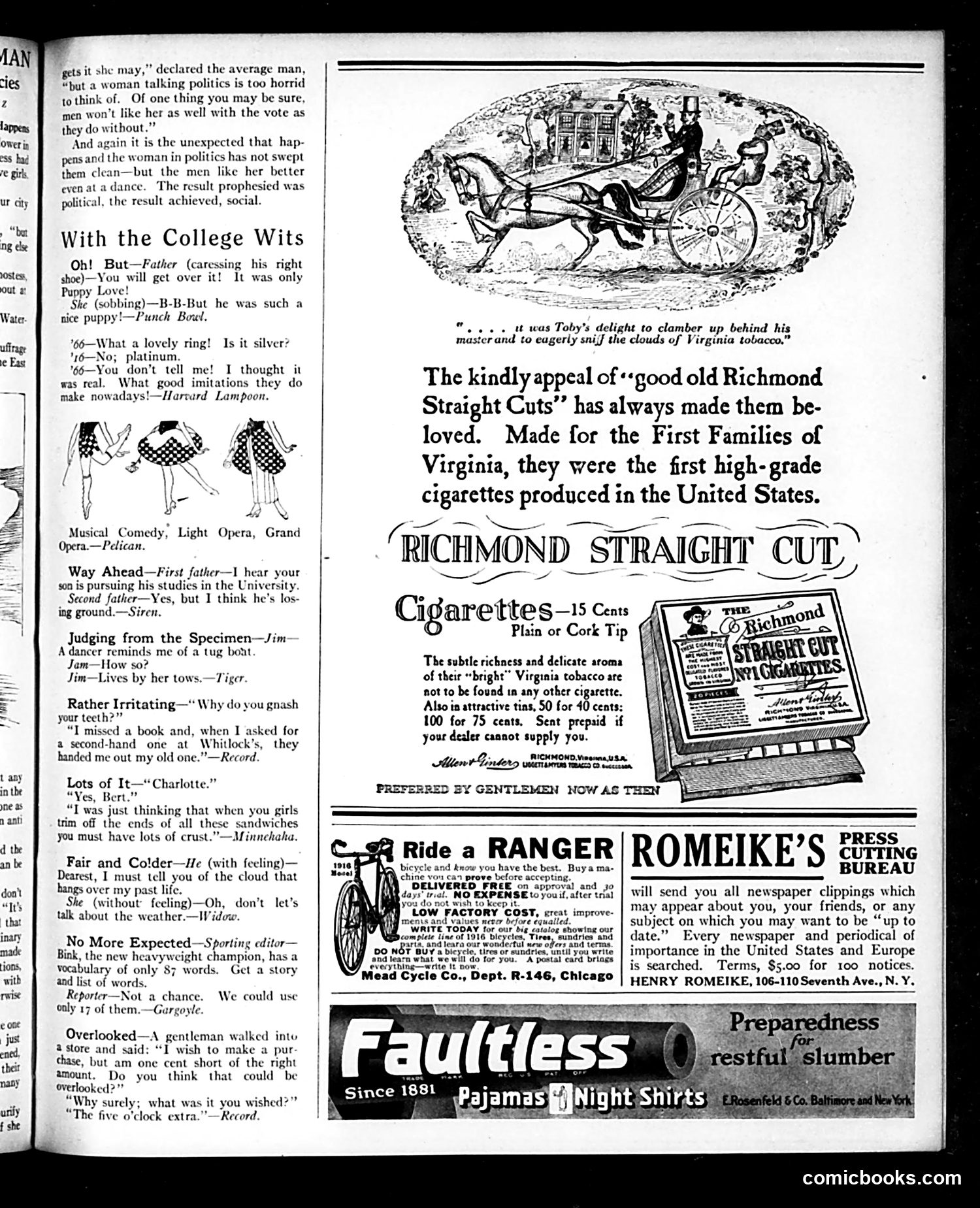
This page is primarily **advertising** with some satirical humor sections. The main content includes: **"With the College Wits"** — A humor column featuring short jokes from various college publications (Harvard Lampoon, Punch Bowl, etc.), mostly playing on puns and romantic misunderstandings typical of early 20th-century collegiate humor. **Major Advertisements:** - **Richmond Straight Cut Cigarettes** — features an illustration of a dog happily riding behind a man on a cart, sniffing tobacco smoke. The ad emphasizes these were "the first high-grade cigarettes produced in the United States," made for Virginia's "First Families." - **Ranger bicycle** — promoting mail-order purchase - **Romeike's Press Cutting Bureau** — a clipping service that monitored newspapers nationally - **Faultless Pajamas and Night Shirts** — for "restful slumber" The cigarette advertisement is notable for its nostalgic appeal and the charming dog imagery—marketing strategies that would later face criticism. The overall page reflects advertising and humor conventions of the era.
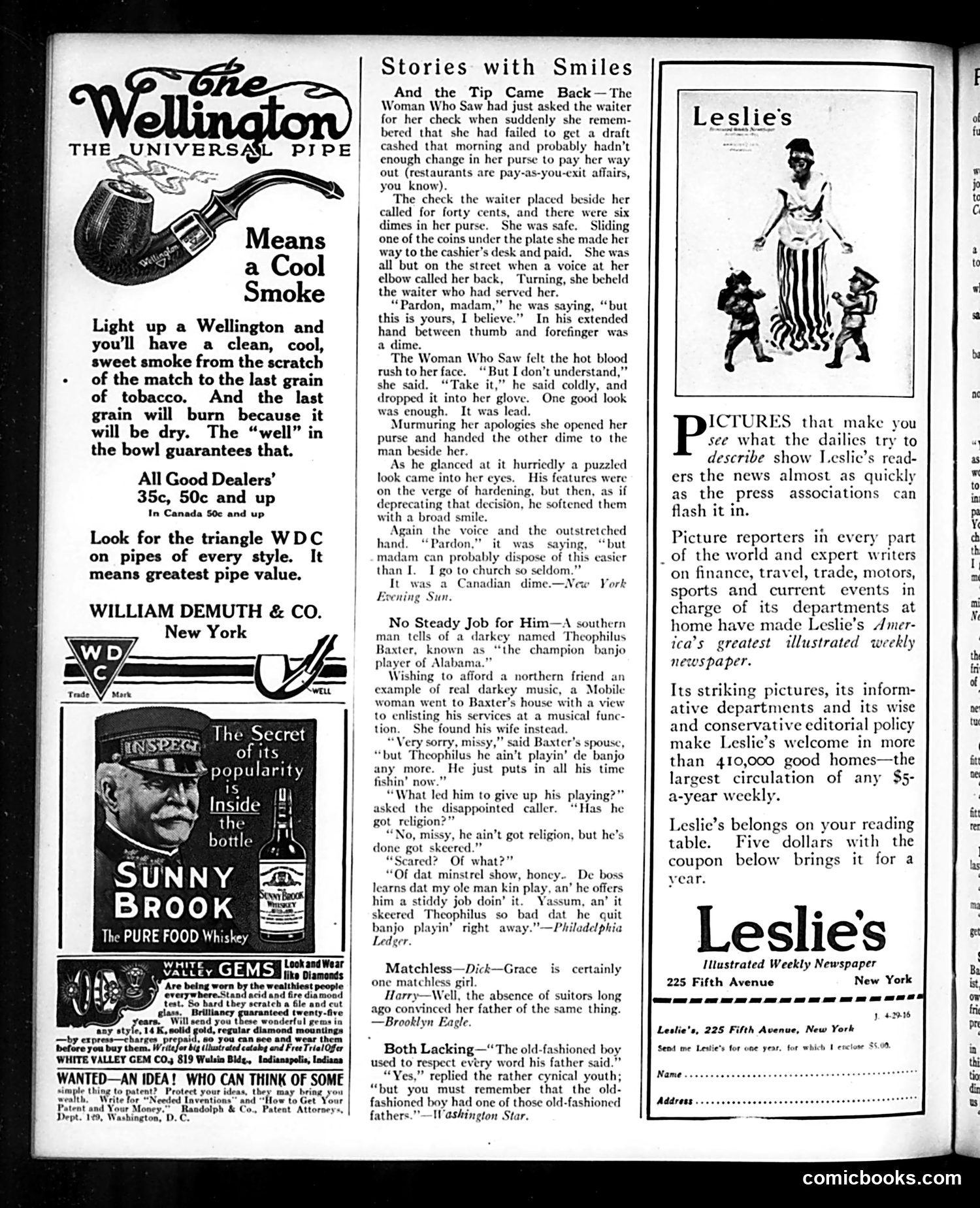
This page is primarily **advertising and light humor** rather than political satire. The main content includes: **Advertisements:** Wellington pipes, Sunny Brook whiskey, and White Valley gems dominate the layout. **"Stories with Smiles" section:** Three brief humorous anecdotes: 1. A woman embarrassed when a waiter returns a dime she undertipped with—a Canadian dime, implying it's worthless American currency. 2. A minstrel show joke: A Southern Black man named Theophilus Baxter quits his banjo playing after learning a minstrel show wants to hire him, fearing he'll be exploited. 3. Two short quips about romance and generational differences. **Leslie's Weekly advertisement:** Promotes their illustrated newspaper as superior for news delivery. The humor reflects early 20th-century attitudes, including casual racial stereotypes in dialect humor and period anxieties about currency. The page targets advertisers' interests rather than delivering political commentary.
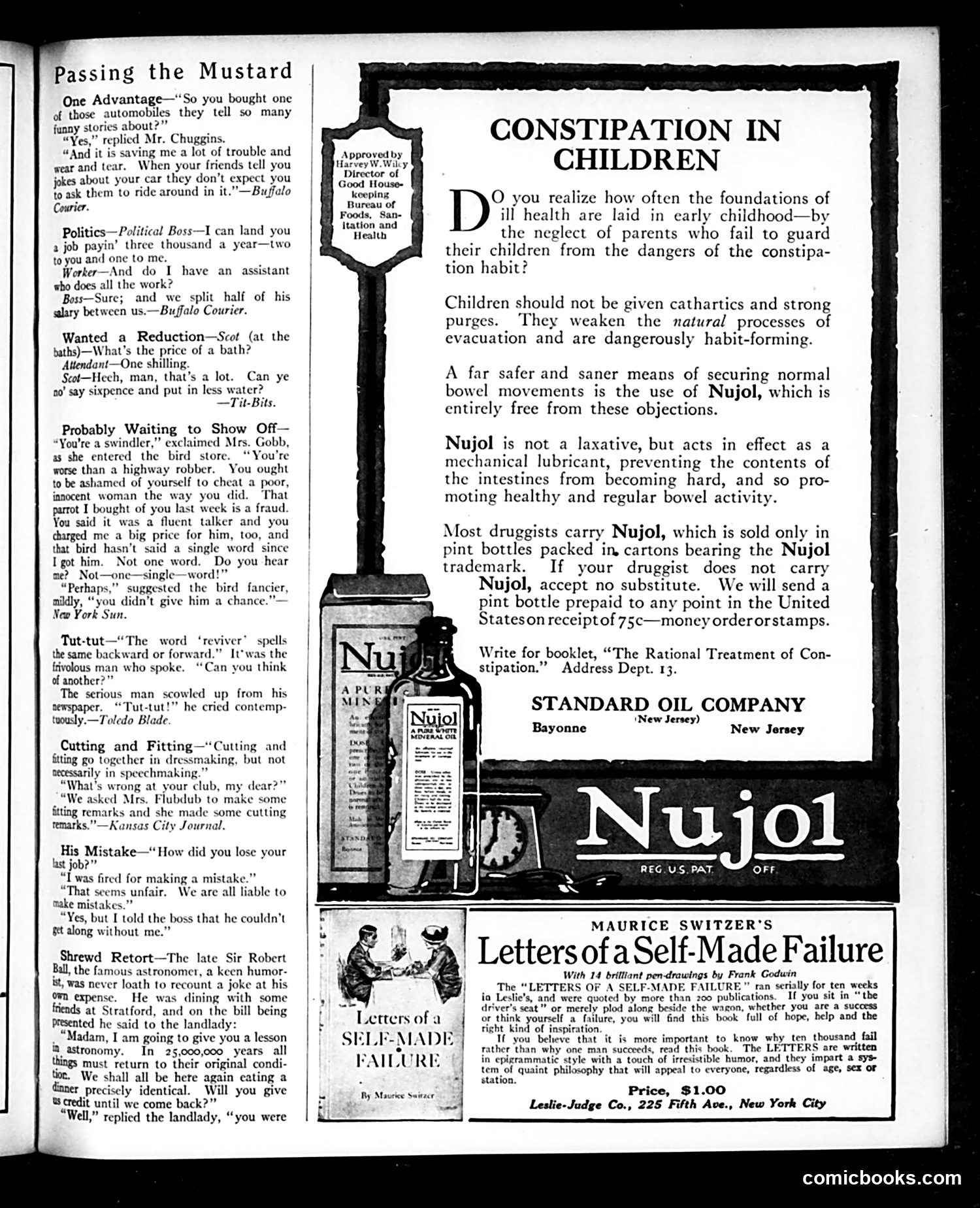
This page contains humor columns ("Passing the Mustard") and advertisements rather than political cartoons. The humor pieces are light satirical vignettes about everyday situations: a man avoiding car-related jokes by owning an automobile; political corruption (a boss skimming wages); a Scottish man haggling over bath costs; a woman berating a bird seller while complaining the parrot won't talk; wordplay about palindromes; confusion between "cutting remarks" and dress "fitting"; and a fired worker who bragged to his boss. The main advertisements feature **Nujol**, a mineral oil product marketed as a non-laxative bowel lubricant for children's constipation, approved by Harvey W. Wiley (the famous Progressive-era food safety official). Below that is an ad for Maurice Switzer's "Letters of a Self-Made Failure," a self-help book sold through Leslie-Judge Company. The satire is gentle—workplace absurdities, marital frustrations, and consumer complaints—typical of Judge's early 20th-century humor aimed at middle-class readers.
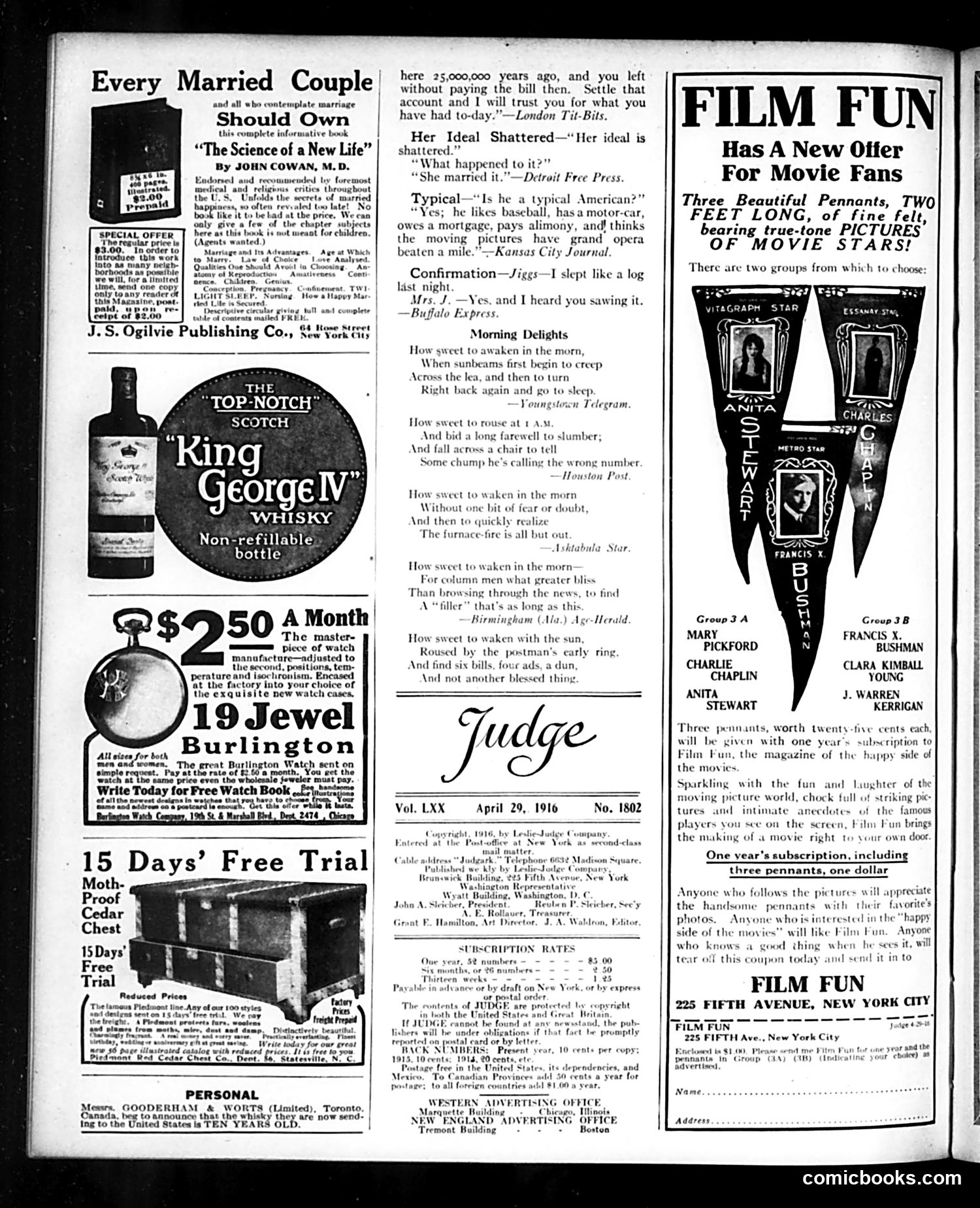
This page is primarily **advertising and light humor** rather than political satire. The main content consists of: **Humor Pieces**: Brief, one-liner jokes about marriage, morning routines, and domestic life—typical of early 20th-century magazine humor. References include a motorcar-owning American stereotype and alimony (suggesting marital discord was common enough to joke about). **Advertisements**: The page heavily features product ads—whisky, watches, bedroom furniture—pitched to married couples and middle-class readers. **Movie Tie-In**: "Film Fun" magazine advertises movie-star pennants featuring silent film celebrities (Mary Pickford, Charlie Chaplin, Francis X. Bushman), reflecting the era's growing movie industry obsession. **Notable Context**: The "Science of a New Life" book advertisement addresses reproductive/marital education, suggesting early-20th-century prudishness around such topics. The marriage-focused humor reflects traditional gender dynamics of the era. The page reflects *Judge*'s shift toward consumer advertising and entertainment culture by 1916, rather than hard political commentary.
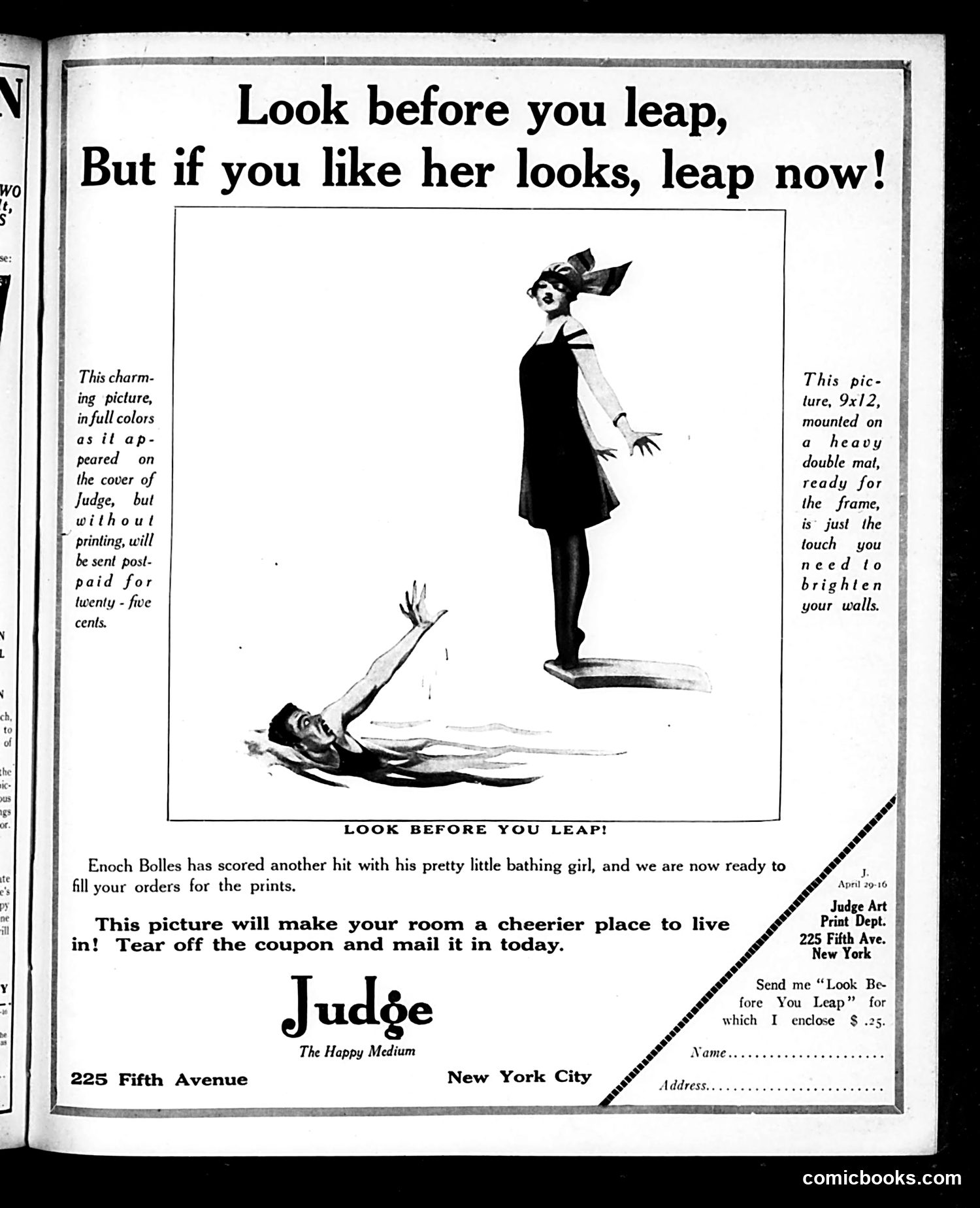
This is primarily an **advertisement** for Judge magazine's art print department, not political satire. The page promotes an illustration by Enoch Bolles, a prominent commercial artist known for depicting attractive women. **The Image:** Shows a stylized young woman in 1920s fashion (headband, dropped-waist dress, stockings) standing above a man who has fallen or is diving/leaping below her. The visual pun plays on the phrase "look before you leap." **The Satire/Joke:** The advertisement uses flirtatious humor typical of 1920s "sexy" advertising—the tagline suggests a man should "leap" (take action) if he finds the woman attractive, despite the cautionary opening. The implicit joke: romantic/sexual impulse overrides prudent consideration. **Historical Context:** This reflects Jazz Age attitudes toward courtship and the "modern girl" of the 1920s, presented here as visually appealing subject matter for home decoration. Bolles was a commercially successful illustrator whose work appealed to this market. The ad cost 25 cents and could be mailed after tearing out the coupon.
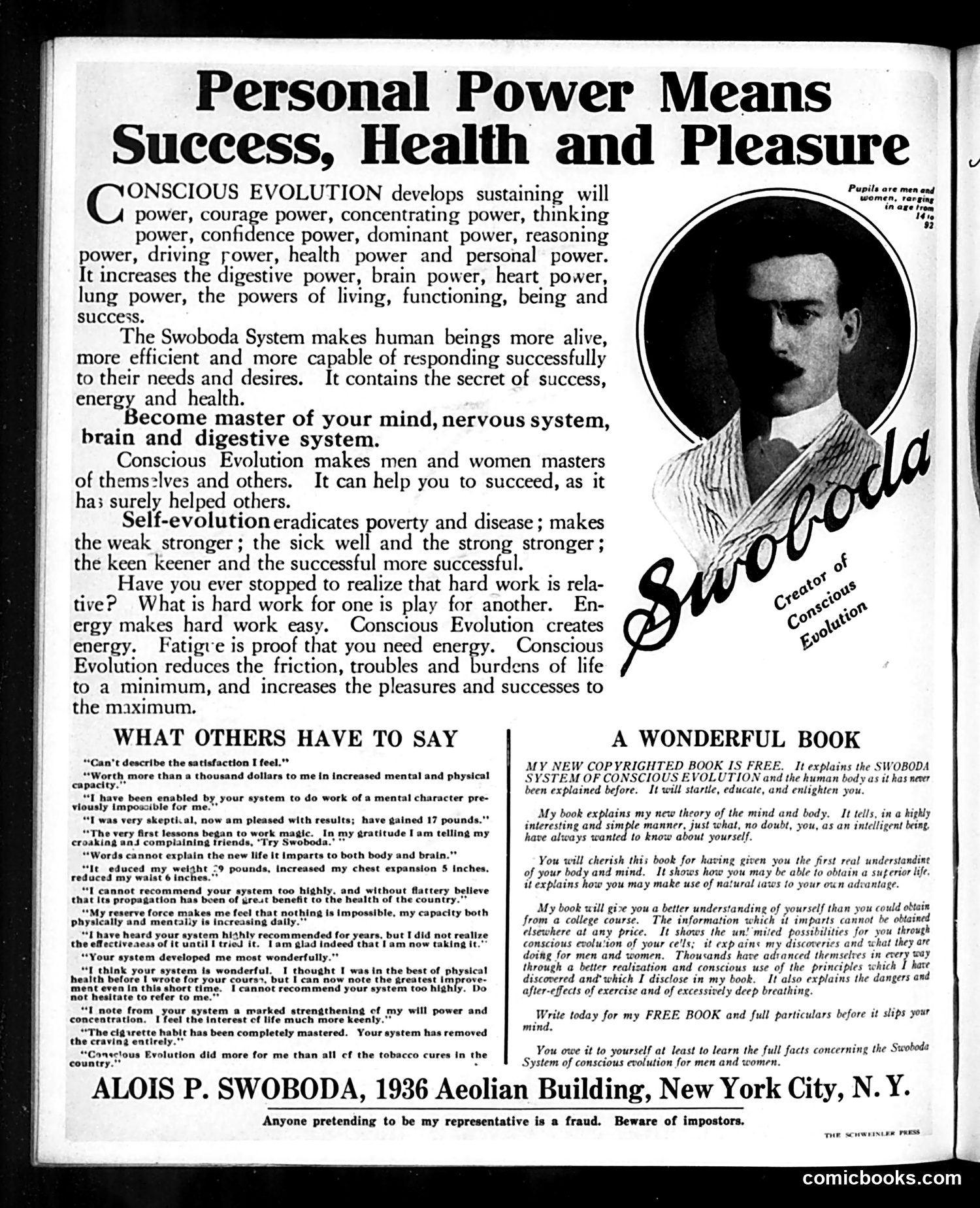
This is primarily **advertising content**, not a satirical cartoon. It promotes the "Swoboda System" — Alois P. Swoboda's self-help/pseudoscientific program claiming to develop "conscious evolution" and personal power. The page uses testimonials (marked with asterisks, likely fabricated) claiming the system cures fatigue, builds muscle, increases mental capacity, and breaks habits like smoking. The photograph shows Swoboda himself. **Historical context**: This represents early 20th-century **self-improvement quackery** — before modern FDA regulations. Such advertisements promised miraculous physical and mental transformation through undefined "systems." The vague language ("develop will power," "master your mind") and unverifiable claims are typical of the era's snake-oil marketing. **For Judge readers**: This would likely appear alongside actual satire mocking such charlatans. The grandiose claims ("eradicates poverty and disease") were already ripe for ridicule by informed audiences, though many people still fell for such schemes.