
Judge, 1916-04-29 · page 4 of 28
Judge — April 29, 1916 — page 4: what you’re looking at
What you’re looking at
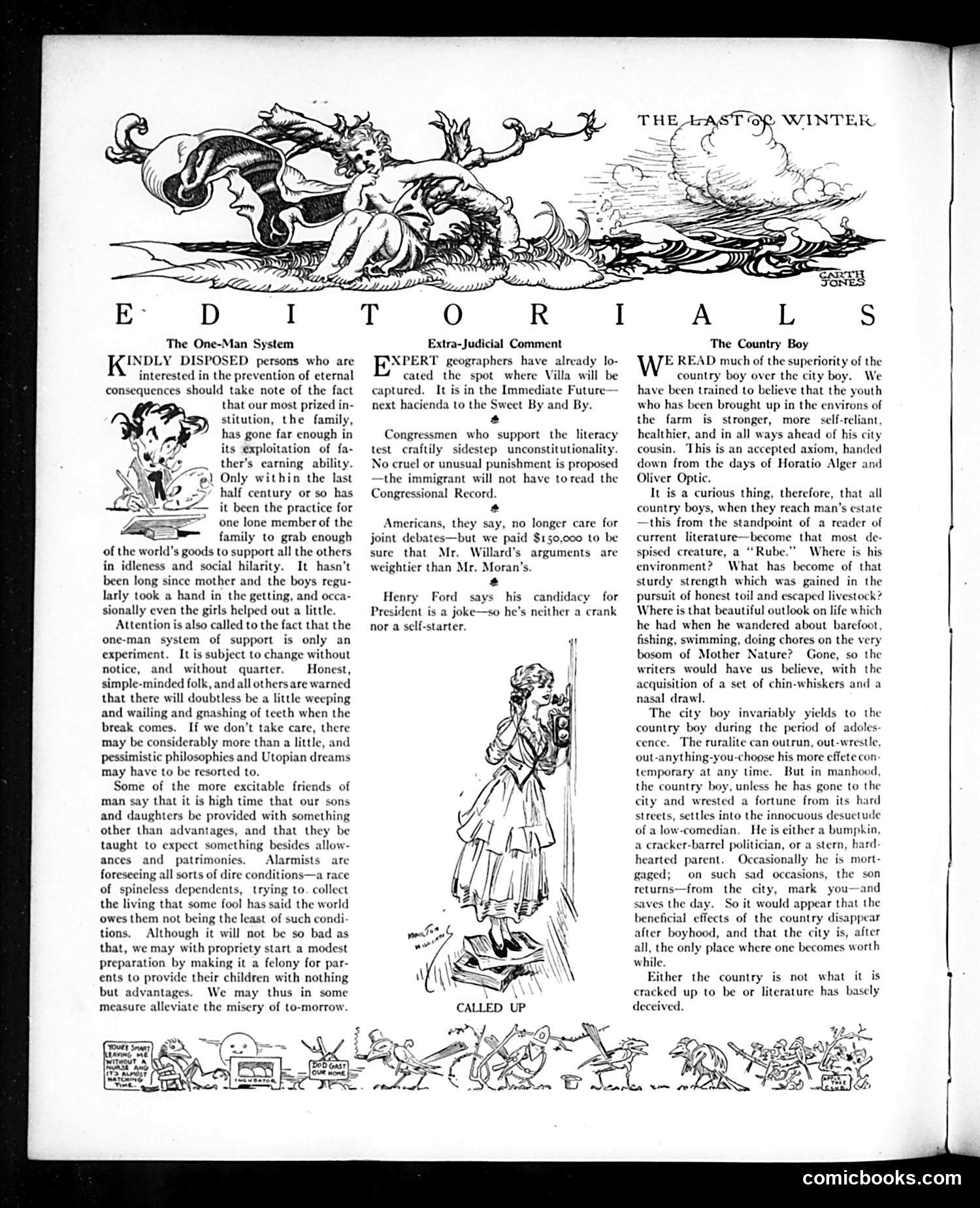
This editorial page critiques the "one-man system" of government, likely referencing executive power concentration during the early 20th century. The left column attacks what it calls indefinite detention and punishment without constitutional protection, warning against allowing "the immigrant" to avoid reading Congressional Record—suggesting anxieties about both immigration and democratic participation. The center section mentions Henry Ford's presidential candidacy as a joke, implying he's unsuitable for politics. "The Country Boy" (right) romanticizes rural youth as morally superior to urban life, a common era stereotype. The illustrated "Called Up" section below depicts military conscription, suggesting this page addresses wartime concerns about social systems and citizen obligations.
📄 Transcribed text from this page (OCR, searchable)
Machine-transcribed from the original scan — historical spelling and the odd misread are preserved.
es; The One-Man System INDLY DISPOSED persons who are interested in the prevention of eternal consequences should take note of the fact that our most prized in- stitution, the family, has gone far enough in its exploitation of fa- ther’s earning ability. Only within the last half century or so has it been the practice for one lone member of the family to grab enough of the world’s goods to support all the others in idleness and social hilarity. It hasn't been long since mother and the boys regu- larly took a hand in the getting, and occa- sionally even the girls helped out a little. Attention is also called to the fact that the one-man system of support is only an experiment. It is subject to change without notice, and without quarter. Honest, simple-minded folk, and all others are warned that there will doubtless be a little weeping and wailing and gnashing of teeth when the break comes. If we don’t take care, there may be considerably more than a little, and pessimistic philosophies and Utopian dreams may have to be resorted to. Some of the more excitable friends of man say that it is high time that our sons and daughters be provided with something other than advantages, and that they be taught to expect something besides allow- ances and _patrimoni Alarmists foresecing all sorts of dire conditions—a race of spine dependents, trying to. collect the living that some fool has said the world owes them not being the least of such condi- tions. Although it will not be so bad as that, we may with propriety start a modest preparation by making it a felony for par- ents to provide their children with nothing but advantages. We may thus in some measure alleviate the misery of to-morrow. O Extra-Judicial Comment XPERT geographers have already lo- cated the spot where Villa will be captured. It is in the Immediate Future— next hacienda to the Sweet By and By. 2 Congressmen who support the literacy test craftily sidestep unconstitutionality. No cruel or unusual punishment is proposed —the immigrant will not have to read the Congressional Record. s Americans, they say, no longer care for joint debates—but we paid $150,000 to be sure that Mr. Willard’s arguments are weightier than Mr. Moran's. 2 Henry Ford says his candidacy for President is a joke—so he's neither a crank nor a self-starter. R I THE ae WINTER A L S The Country Boy WwW E READ much of the superiority of the country boy over the city boy. We have been trained to believe that the youth who has been brought up in the environs of the farm is stronger, more self-reliant, healthier, and in all ways ahead of his city cousin. This is an accepted axiom, handed down from the days of Horatio Alger and Oliver Optic. It is a curious thing, therefore, that all country boys, when they reach man’s estate —this from the standpoint of a reader of current literature—become that most de- spised creature, a ‘Rube.’ Where is his environment? What has become of that sturdy strength which was gained in the pursuit of honest toil and escaped livestock? Where is that beautiful outlook on life which he had when he wandered about barefoot, fishing, swimming, doing chores on the very bosom of Mother Nature? Gone, so the writers would have us bel i acquisition of a set of chin-whiskers and a nasal drawl. The city boy invariably yields to the country boy during the period of adoles: cence. The ruralite can outrun, out-wrestle, out-anything-you-chopse his more effete con temporary at any time. But in manhood, the country boy, unless he has gone to the city and wrested a fortune from its hard streets, settles into the innocuous desuetude of a low-comedian. He is either a bumpkin, a cracker-barrel politician, or a stern, hard hearted parent. Occasionally he is mort- gaged; on such sad occasions, the son returns—from the city, mark you—and saves the day. So it would appear that the beneficial effects of the country disappear after boyhood, and that the city after all, the only place where one becomes worth while. Either the country is not what it is cracked up to be or literature has basely deceived. te — 4 ae comicbooks.com