
Judge, 1916-04-29 · page 19 of 28
Judge — April 29, 1916 — page 19: what you’re looking at
What you’re looking at
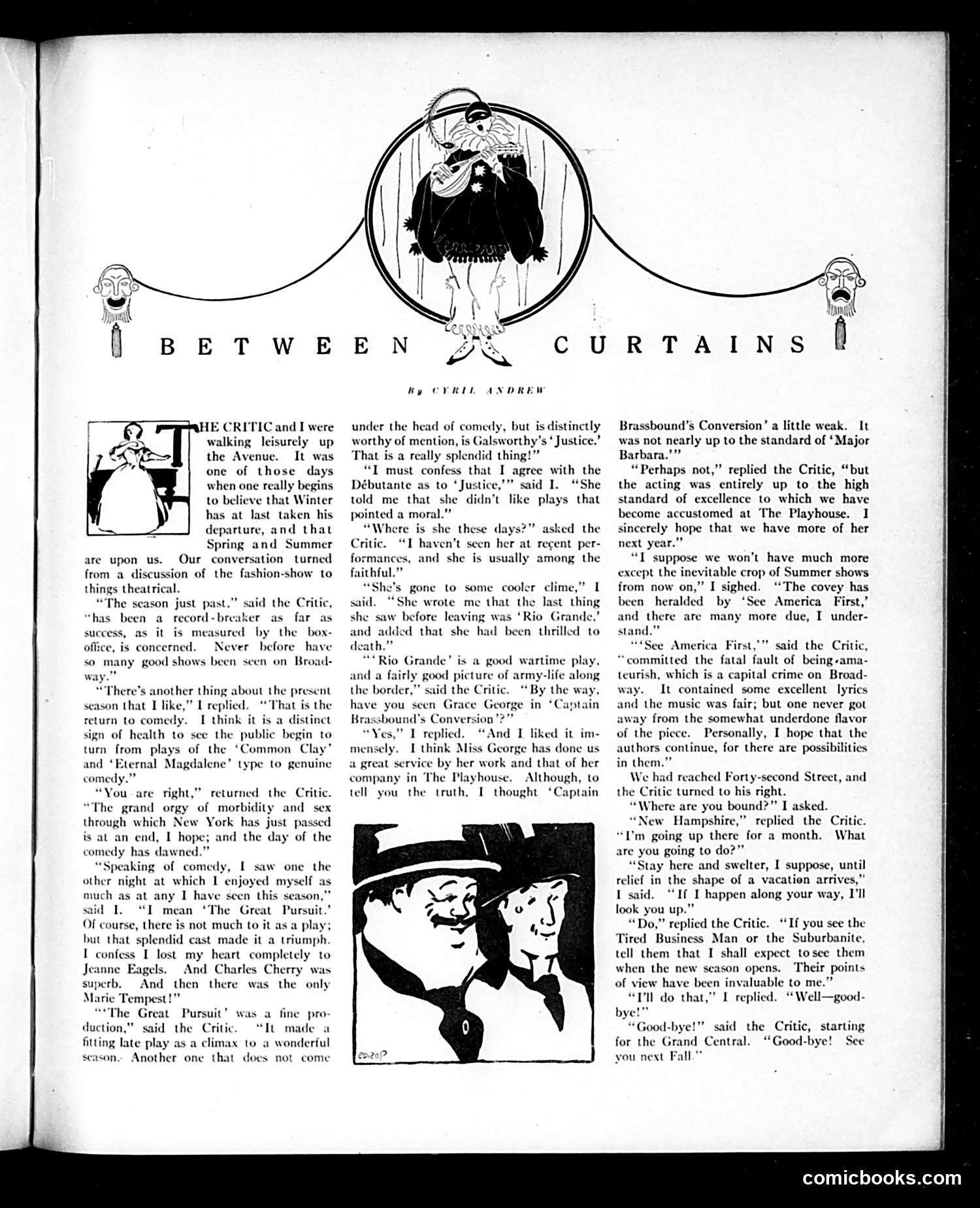
This page presents a dialogue between a theater critic and a companion discussing the Broadway season. They praise the return to comedy after an era of darker plays like "Common Clay" and "Eternal Magdalene." The critic mentions specific productions: "The Great Pursuit" (with actors Jeanne Eagels and Charles Cherry), Galsworthy's "Justice," "Rio Grande," Grace George in "Captain Brassbound's Conversion," and dismisses the amateur production "See America First" as having fatal flaws despite decent music. The two caricatured figures in the illustration appear to be the conversationalists themselves—likely representing a typical Broadway theater-goer and critic of the era (early 1910s based on theatrical references). The piece is essentially theatrical gossip and opinion—the satire lies in the earnest, self-important tone of Broadway insiders discussing the season's merits and failures.
📄 Transcribed text from this page (OCR, searchable)
Machine-transcribed from the original scan — historical spelling and the odd misread are preserved.
HE CRITIC and I were walking leisurely up the Avenue. It was one of thos Ss when one really begi to believe that Winter has at last taken his departure, and that Spring and Summer are upon us. Our conversation turned from a discussion of the fashion-show to things theatrical. “The season just past,” said the Critic, ‘has been a record-breaker as far as success, it is measured by the box- ice, is concerned. Never before have so many good shows been seen on Broad way. “There's another thing about the present season that I like,” L replied. ‘That is the return to comedy. I think it is a distinct sign of health to see the public begin to turn from plays of the ‘Common Clay’ and ‘Eternal Magdalene’ type to genuine comedy.” “You are right,” returned the Cri “The grand orgy of morbidity and sex through which New York has just passed is at an end, I hope; and the day of the comedy has dawned.” peaking of comedy, I saw one the other night at which I enjoyed myself much as at any I have seen this season said 1. “IT mean ‘The Great Pursuii Of course, there is not much to it as a play; but that splendid cast made it a triumph I confess I lost my heart completely to Jeanne Eagels. And Charles Cherry was superb. And then there was the only Marie Tempest!” he Great Pursuit’ was a fine pro: duction,” said the Critic. “It made a fitting late play as a climax to a wonderful season. Another one that does not come CURTAINS By CYRIL ANDREW under the head of comedy, but is distinctly worthy of mention, is Galsworthy’s ‘ Justice.” That is a really splendid thing! “T must confess that I agree with the Débutante as to ‘Justi said I. “She told me that she plays that pointed a moral.” Where is she these 3?” asked the Critic. “I haven't seen her at recent per- and she is usually among the gone to some cooler clime,” I She wrote me that the last thing she saw before leaving was ‘Rio Grande,’ and added that she had been thrilled to death. “*Rio Grande’ is a good wartime play, and a fairly good picture of army-life along the border,” said the Critic. “By the way, have you seen Grace George in ‘Captain Brassbound’s Conv on’? “Yes,”" I replied. “And I liked it im- mensely. I think Miss George has done us a great service by her work and that of her company in The Playhouse. Although, to tell you the truth, I thought ‘Captain Brassbound’s Conversion’ a little weak. It was not nearly up to the standard of ‘Major Barbara.’” “Perhaps not,” replied the Critic, “but the acting was entirely up to the high standard of excellence to which we have become accustomed at The Playhouse. I sincerely hope that we have more of her next year.” “I suppose we won't have much more except the inevitable crop of Summer shows from now on,” I sighed. ‘‘The covey has been heralded by ‘See America First,’ and there are many more due, I under- stand.” “See Ameri said the Critic, “committed the fatal fault of being-ama- teurish, which is a capital crime on Broad- way. It contained some excellent lyrics and the music was fair; but one never got away from the somewhat underdone flavor of the piece. Personally, I hope that the authors continue, for there are possibilities in them.” We had reached Forty-second Street, and the Critic turned to his right. “Where are you bound?” I asked. “New Hampshire,” replied the Critic. “I'm going up there for a month. What are you going to do?” M y here and swelter, I suppose, until relief in the shape of a vacation arrives,” I said. “If I happen along your way, I'll look you up.” “Do,” replied the Critic. “If you see the Tired Business Man or the Suburbanite, tell them that I shall expect to see them when the new season opens. Their points of view have been invaluable to me.” “T'll do that,” I replied. “Well—good- by said the Critic, starting for the Grand Central. “Good-bye! See you next Fall.” comicbooks.com