
Judge, 1916-04-29 · page 14 of 28
Judge — April 29, 1916 — page 14: what you’re looking at
What you’re looking at
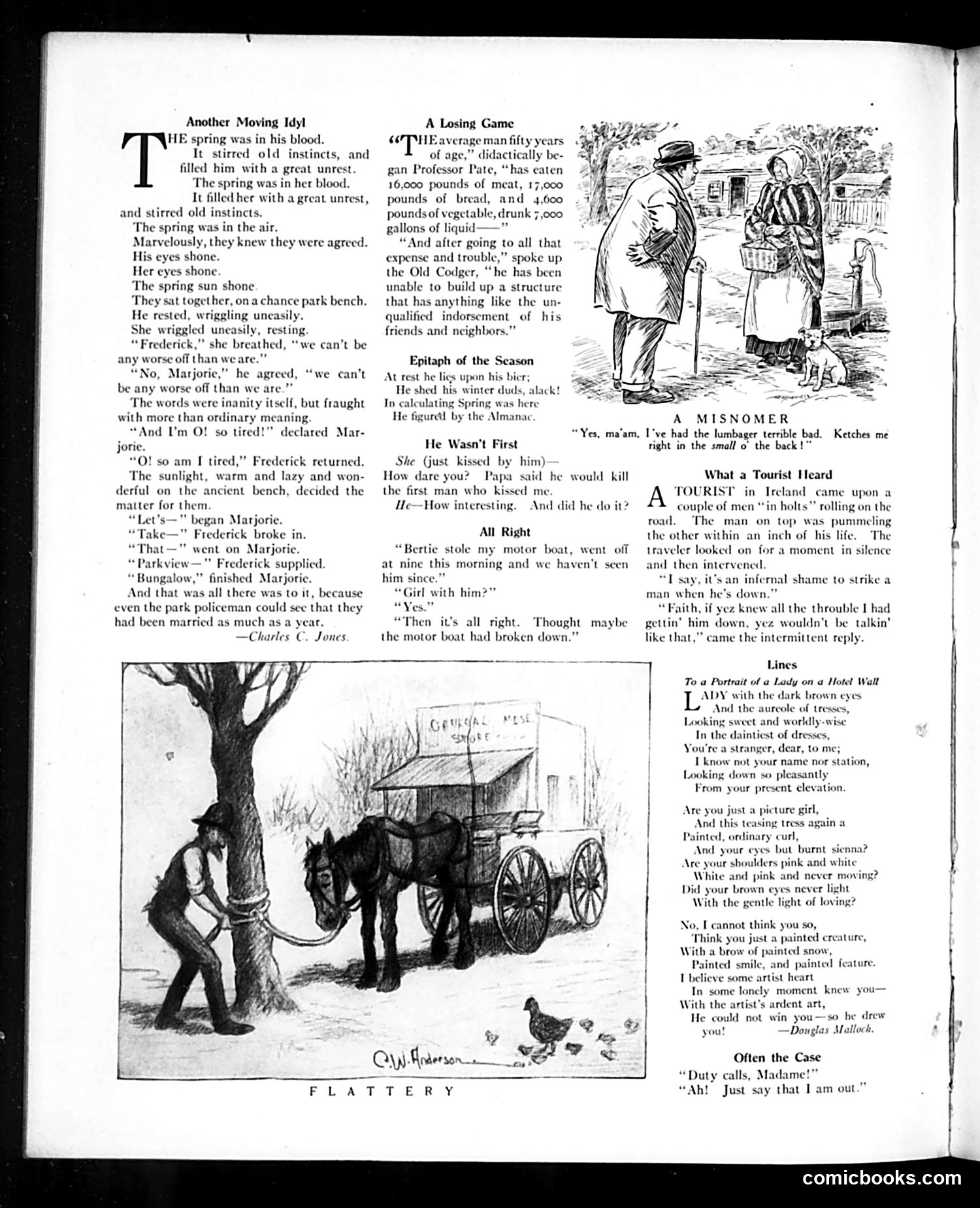
This page contains satirical humor typical of early-20th-century American magazines, with multiple brief comic pieces: **"Another Moving Idyl"** mocks romantic spring fever. A couple named Frederick and Marjorie, sitting on a park bench, speak in bland clichés about being tired and unhappy, then impulsively decide to elope to "Parkview Bungalow"—suggesting hasty, poorly-thought-out decisions made under spring's emotional influence. **"A Losing Game"** satirizes statistical analysis, presenting Professor Pate's calculations that despite consuming massive quantities of food and drink over fifty years, he's gained no meaningful endorsement from friends or neighbors—absurdist humor about life's futility. The cartoons and brief jokes throughout mock common social situations: romantic mishaps, tourist misunderstandings of Irish violence, and pretexts for avoiding social obligations ("Just say that I am out"). The illustrated **"Flattery"** cartoon (by Cj. Anderson) depicts a horse-cart scene, likely commenting on flattery or deception in social interactions. Overall, the page uses gentle satire to mock romantic naiveté, statistical reasoning, and social conventions of the era.
📄 Transcribed text from this page (OCR, searchable)
Machine-transcribed from the original scan — historical spelling and the odd misread are preserved.
Another Moving Idyl HE spring was in his blood. It stirred old instincts, and filled him with a great unrest. The spring was in her blood. It filled hee with a great unrest, and stirred old instincts. The spring was in the air. Marvelously, they knew they were agreed. His eyes shone. Her eyes shone The spring sun shone They sat together, on a chance park bench. He rested, wriggling uneasily. She wriggled uneasily, resting. “Frederick,” she breathed, “we can’t be any worse off than we are.” “No, Marjorie,” he agreed, “we can’t be any worse off than we are.”" The words were inanity itself, but fraught with more than ordinary meaning. “And I’m O! so tired!” declared Mar- jorie. “O! so am [ tired,” Frederick returned. The sunlight, warm and lazy and won- derful on the ancient bench, decided the matter for them Let’s—" began Marjorie. Take—" Frederick broke in. “That—" went on Marjorie. “Parkview —" Frederick supplied. “Bungalow,” finished Marjorie. And that was all there was to it, because even the park policeman could see that they year, les C. Jones A Losing Game 6OTPHE avera pan fifty gan Professor Pate, “has eaten 16,000 pounds of meat, 17, pounds of bread, and 4,600 pounds of vegetable, drunk 7,000 gallons of liquid- “And after going to all that expense and trouble,” spoke up the Old Codger, “he has been unable to build up a structure that has anything like the un- qualified indorsement of his friends and neighbors.”” Epitaph of the Season At rest he lies upon his bier; He shed his winter duds, alack! In calculating Spring was here He figured. by the Almanac “Yes, ma’am, I've had the lumbager terrible bad. Ketches me He Wasn't First She (just kissed by him) How dare you? Papa said he would kill the first man who kissed me. He—How interesting. And did he do it? All Right “Bertie stole my motor boat, went off at nine this morning and we haven't seen him since.” Girl with him?” “Then it’s all right. Thought maybe the motor boat had broken down.” fy Qj). Aoderson + Se FLATTER Y A MISNOMER right in the small o° the back!” What a Tourist Heard TOURIST in Ireland came upon a couple of men “in holts” rolling on the road. The man on top was pummeling the other within an inch of his life. The traveler looked on for a moment in silence and then intervene “Tsay, it’s an infernal shame to strike a man when he’s down.” th, if yez knew all the throuble I had gettin’ him down, yez wouldn't be talkin’ like that,” came the intermittent reply. Lines To a Portrait of a Lady on a Hotet Walt L** with the dark brown eyes And the aurcole of tresses, Looking sweet and worldly-wise In the daintiest of dresses, You're a stranger, dear, to me; I know not your name nor station, Looking down so pleasantly | From your present elevation, you just a picture girl, nd this teasing tress again a inted, ordinary curl, And your eyes but burnt sienna? Are your shoulders pink and white White and pink and never movi Did your brown eyes never light With the gentle light of loving? Ar No, I cannot think you so, Think you just a painted crea With a brow of painted snow, Painted smile, and painted feature. I believe some artist heart | In some lonely moment knew you— With the artist's ardent art, He could not win you—so he drew you! —Douglas Malloch. Often the Case “Duty calls, Madame . “Ah! Just say that I am out comicbooks.com